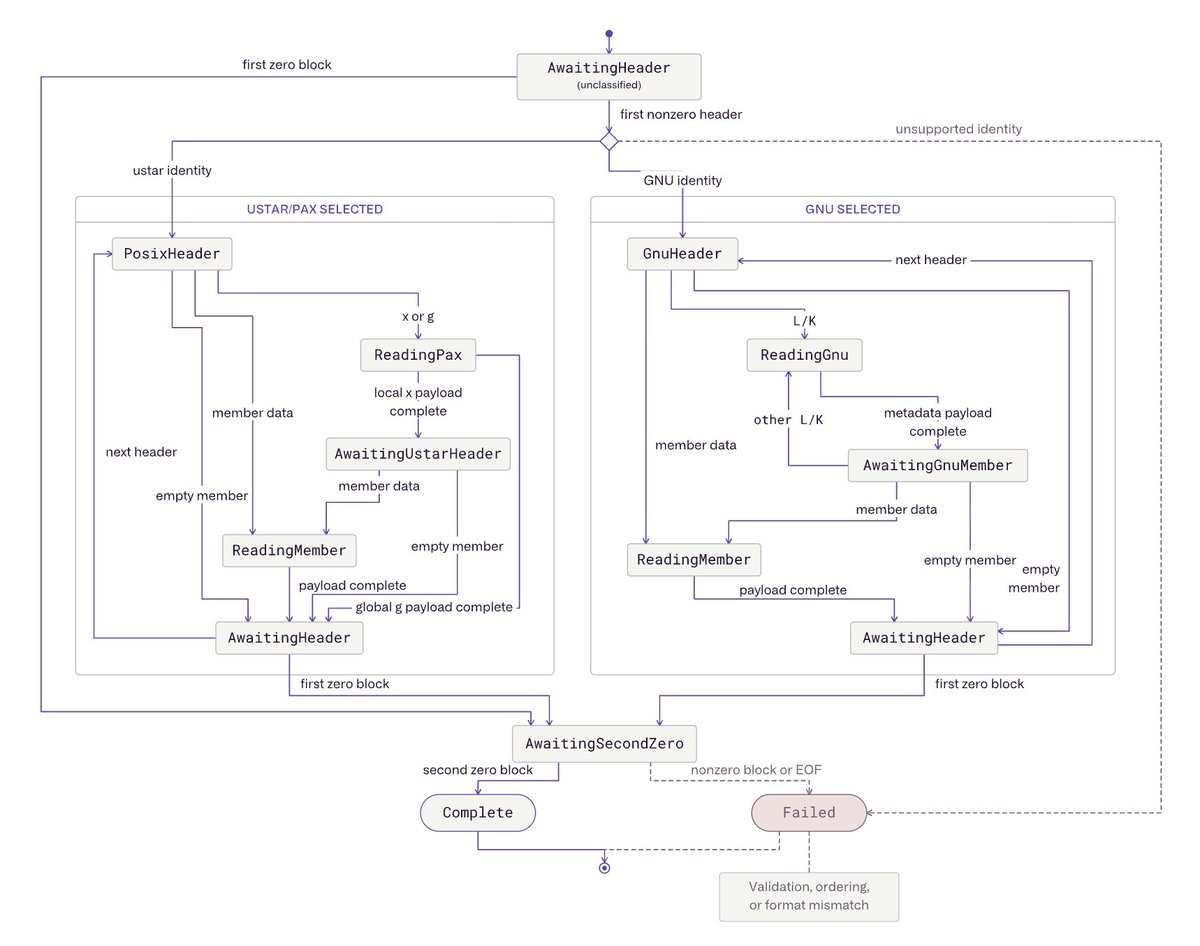
We built tar-codec: a fast and secure tar parser for the Rust ecosystem.
It's roughly twice as fast as our previous tar implementation, but with much lower exposure to parser differentials and other security risks.
Here's the state machine btw.
RT @TaKOBKi: My latest rustc PR introduces adaptive sparse encoding for metadata tables. Rustc-perf results show a 20.18% average reduction in crate metadata size.
RT @steipete: I spent some time on the weekend to test bun's AOT compiler and results are nothing short of amazing. Performance up 2-3x, memory use less than half.
Condividi
Copiato
Jarred Sumner@jarredsumner
Bun AOT also introduces `--trim` which deletes unused parts of Bun from the compiled binary
On macOS, a binary that uses Bun.serve’s HTTP server goes from 89 MB to 25 MB
Bun AOT also introduces `--trim` which deletes unused parts of Bun from the compiled binary
On macOS, a binary that uses Bun.serve’s HTTP server goes from 89 MB to 25 MB
RT @polynoamial: Only 2.5 years ago, AI labs would highlight their frontier LLM performance on grade school math benchmarks (GSM8K). I can't wait to see where we'll be in another 2.5 years.
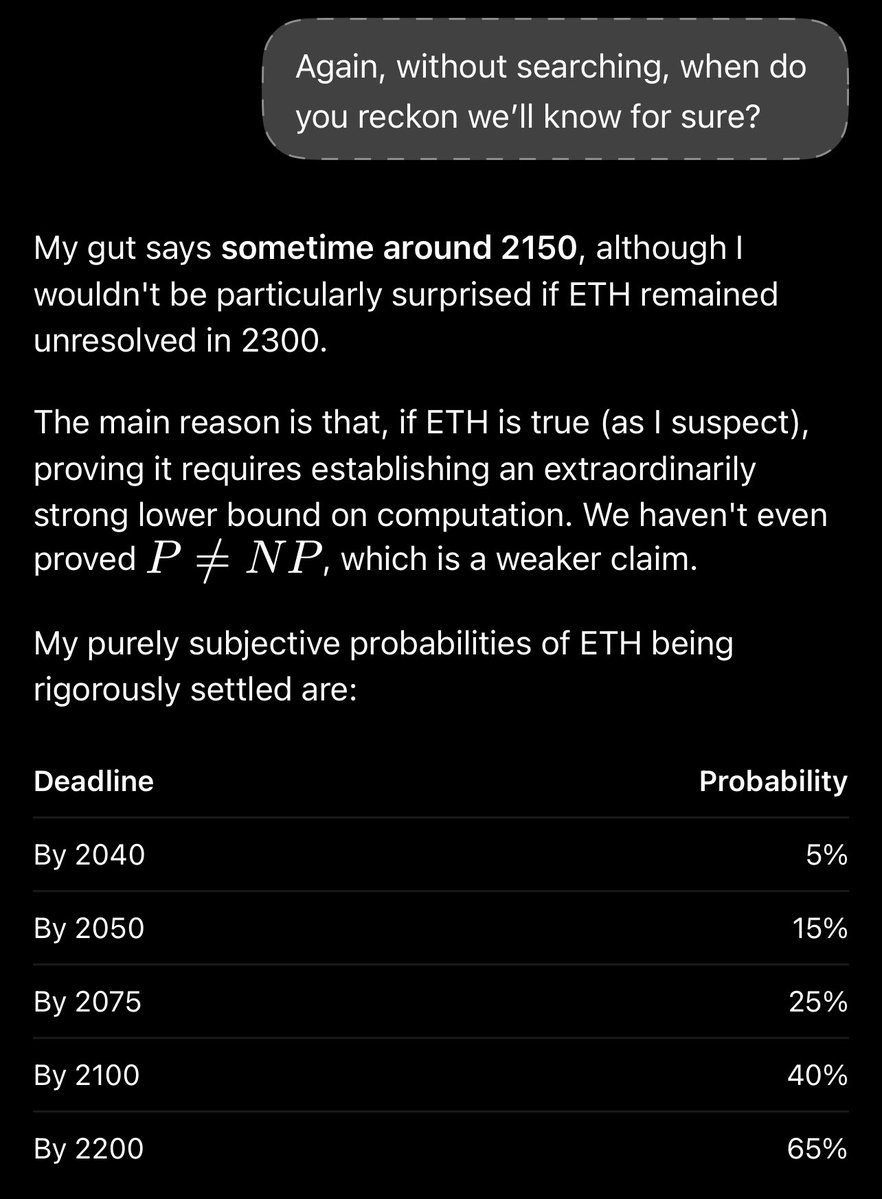
RT @wtgowers: For those who don’t know, ETH is the hypothesis that 3SAT needs exponential time. Very surprising and consequential that it is false.
Condividi
Copiato
Ryan Williams @rrwilliams.bsky.social@rrwilliams
An internal model at OpenAI has produced a claimed refutation of ETH! Russell Impagliazzo, Mohan Paturi, and I have been asked to help organize an open and independent examination of this claim. 1/4
An internal model at OpenAI has produced a claimed refutation of ETH! Russell Impagliazzo, Mohan Paturi, and I have been asked to help organize an open and independent examination of this claim. 1/4
RT @danintheory: We are announcing three new discoveries in mathematics, computer science, and physics about harmonic analysis, complexity theory, and quantum field theory.
RT @mweinbach: GPT 6.1 Terra is out! I had early access, it's a really model for writing and basic use, as well as computer use. It's quick and overall a great value for what it is. It also works extremely well as a subagent.
RT @OpenAI: GPT-6.1 Terra: delivering fast and capable computer use at a lower price.
GPT-6.1 Terra understands what’s on screen, takes action across apps, writes naturally, and is a more capable model for your whole workday with the efficiency to take on more of it.
RT @gdb: “On a technical level, the paper is unbelievable, maybe beyond what a human could have come up with but not beyond human understanding”
Condividi
Copiato
Scott Armstrong@scottnarmstrong
Since I'm now blocked by bluey from replying to this thread, I answer here by quote tweet
the openAI construction has more to do with convex integration than anything else.
In convex integration, the oscillations are typically built by hand and the iteration procedure creates wild weak solutions. The non-uniqueness construction of Albritton–Brué–Colombo used an unstable vortex to split solutions apart. The Córdoba–Martínez-Zoroa singularities amplify vorticity across scales by strain. In the openAI paper, a fluid instability is clever made so that the flow itself generates the oscillations: they grow by drawing energy from the background shear. The Reynolds stress then becomes the force that creates the collapsing smooth vortex. Using a physical instability to create the stress in this way has no precedent, and it is what produces a smooth force rather than a merely rough one.
Some on these ideas are in the literature (e.g. Leibovich-Stewartson 1983) but the way they are combined is definitely insane and definitely nowhere in the literature previously.
I also don't know of anyone suggesting that convex integration would play a role in the creation of a blow-up solution like this.
On a technical level, the paper is unbelievable, maybe beyond what a human could have come up with but not beyond human understanding: there are several different groups of pde experts working on understanding it who say that they more or less understand now. I expect digestions soon
td;lr: anyone saying that this OAI result is unsurprising is bullshitting
sorry!
I think this is like indisputably true for rewrites now.
For new things, I think you still have to choose between something like: (1) a bottleneck on human judgment, or (2) give up control, stop caring about any of the details (may not even realize this is happening).
Condividi
Copiato
Jarred Sumner@jarredsumner
a growing part of how I feel about bun is
this whole category of software - linters, formatters, package managers, type checkers, test runners, bundlers
this used to be hard software to build and now it can be prompted into existence in a day or two
a growing part of how I feel about bun is
this whole category of software - linters, formatters, package managers, type checkers, test runners, bundlers
this used to be hard software to build and now it can be prompted into existence in a day or two