A feature can look important inside a forest but add almost nothing to its predictions.
🌳That's why we compare how trees split with what happens when we shuffle the data.
#MachineLearning#ExplainableAI#RandomForest
Traditional ML ≠ automatically explainable. Ask about the whole model or one prediction. An explanation alone does not prove causation.
Illustrative diagrams.
AI narration: Josh via ElevenLabs.
#ExplainableAI
Trust in AI cannot be earned solely through visibility but requires systems designed to be understood by humans, not just engineers, so that accountability and confidence emerge naturally from comprehension, not obligation.
Microblog @antgrasso#AI#ExplainableAI#DigitalTrust
Trust in AI systems is vital to ensuring widespread adoption in the workplace, as transparency builds confidence and enables more efficient decision-making processes, improving productivity and employee satisfaction.
Microblog @antgrasso#ai#xai#ExplainableAI#workplace
Giving users clear insight into how AI systems think is a smart business strategy that builds loyalty, reduces friction, and keeps people from feeling like they’re at the mercy of a mysterious black box.
Microblog by @antgrasso#AI#ExplainableAI#XAI#DigitalTransformation
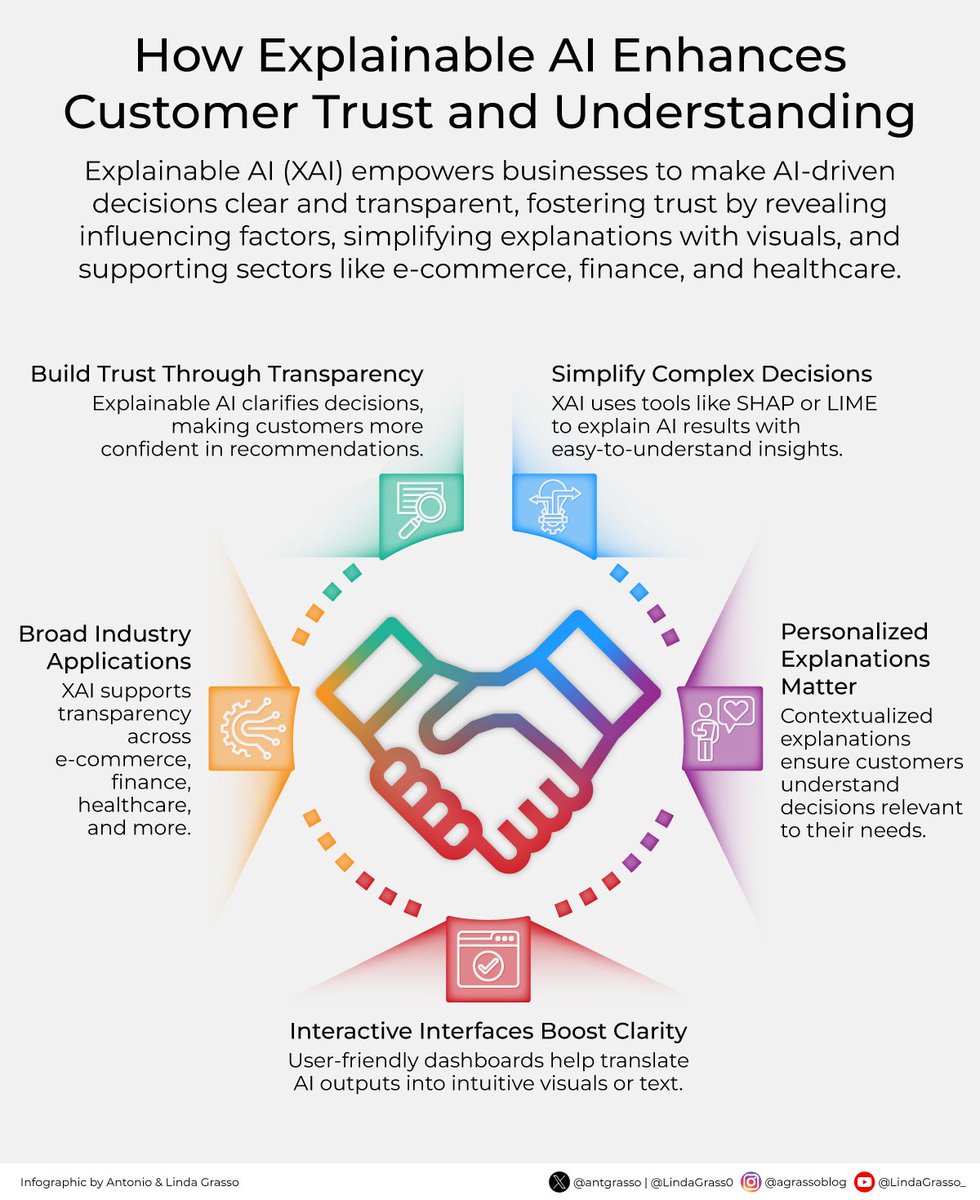
Explainable AI (XAI) enhances the transparency of AI decision-making, which is vital for customer trust—especially in sectors like finance or healthcare, where stakes are high.
Tools like SHAP (SHapley Additive exPlanations) and LIME (Local Interpretable Model-Agnostic Explanations) break down complex algorithms into interpretable outputs, helping users understand not just the “what” but the “why” behind decisions.
Interactive dashboards translate this data into visual forms that are easier to digest, while personalized explanations align AI insights with individual user needs, reducing confusion and resistance.
This approach supports more responsible deployment of AI and encourages wider adoption across industries.
#ArtificialIntelligence#EthicalAI
Want to make your NN more explainable?
We present Gradient Rollback (GR) which tracks how training examples influence the model & use this to explain predictions. We apply GR to knowledge base completion. #ExplainableAI#KnowledgeGraph#ML
Overview below:
Excited to share that my day-long workshop (a short course) on #ExplainableAI is now publicly available as a five-part youtube video lecture series.
Link to video lectures:
Link to slides:
#AI#ML@trustworthy_ml@XAI_Research
Our survey #ExplainableAI#XAI in #deeplearning-based medical image analysis is now in Medical Image Analysis
We surveyed and categorized >200 papers, and described pros & cons so users can choose which technique fits their problem most.
Enjoy the read!
Great to be part of an interesting panel discussion with Karen Myers and Trevor Darrell on opening the BlackBox with #ExplainableAI and talk about some of the work we're doing at @fiddlerlabs.
Paper I’m reading today — November 1, 2026
Can conversational explanations make healthcare AI easier to understand—or do they mainly change how we interact with the same underlying XAI methods?
In this arXiv paper, Eduard Barbu, Rodion Krjutškov, and Anneli Uusküla compare an Explainability Assistant—an LLM function-calling conversational system—with a traditional XAI dashboard. Their within-subjects study used the same Decision Tree classifier and post-hoc explanation methods in both interfaces: SHAP feature attribution, DiCE counterfactuals, and what-if analysis, applied to a heart disease classification model trained on the Cleveland Heart Disease dataset. Five participants with healthcare backgrounds completed tasks using both systems, with follow-up interviews involving three participants. The findings point to complementary strengths rather than a clear overall winner: the assistant offered easier entry and patient-specific explanations, while the dashboard enabled simultaneous inspection of global and local information.
The model combines:
• A Decision Tree heart disease classifier
• SHAP feature attribution
• DiCE counterfactual explanations
• What-if analysis
• Two interaction modalities: conversational assistant + traditional dashboard
What I find most interesting... is the effort to hold the model and explanation methods constant while comparing interfaces. That makes the central question more precise: how much does interaction design contribute to perceived and practical explainability? The small study also makes the conclusion appropriately cautious. All three interview participants recommended combining conversational and dashboard elements within a single clinical workflow, but that direction still needs broader evaluation.
For AI × Medicine, this suggests a useful design principle to explore: conversational systems may help users enter an explanation, while dashboards may support structured comparison and overview. The most effective clinical tools could ultimately need both—but their safety, usability, and value should be tested with larger and more diverse user groups.
Paper: “Evaluating Conversational Explainability in Healthcare: Comparing the Explainability Assistant and a Traditional XAI Dashboard” — Eduard Barbu, Rodion Krjutškov, and Anneli Uusküla, arXiv:2610.39634v1,
Not medical advice.
Figures from Eduard Barbu et al.: Figure page 4. Original images/PDF page screenshots.
@DijkstraLiu A good explanation should do more than translate a model score into conversational language. It should help clinicians understand the evidence, uncertainty, and limits well enough to decide what to review next. #HealthcareAI#ExplainableAI
👁️🗨️ YieldMind ≠ black box
We believe AI should explain itself.
Our explainable AI module gives human-readable breakdowns of each move.
#ExplainableAI#NoBlindTrust#YieldMind
Can AI learn better by explaining itself? 🧠🤖 Our paper 'Learning by Self-Explaining,' published in TMLR, explores how AI models improve generalization and avoid shortcuts by evaluating their explanations. Dive in for more: #AI#ML#ExplainableAI#TMLR
At #AlephAlpha we are developing Large Language Models (LLMs) that can be trusted in real-world applications. Our most recent work is AtMan, an #ExplainableAI method providing explanations of generative transformer models at almost no extra cost. A Thread 1/9
#writtenbyalephalpha
With the last week's launch of Google Cloud’s Explainable AI, the conversation around #ExplainableAI has accelerated.
But it begs the questions - Should Google be explaining their own AI algorithms? Who should be doing the explaining? /thread