Posty z #pythonic

#pythonic

Publiczne posty w X, które używają #pythonic.

  1. Psyho✓@FakePsyho
    meh, the more you dig into each experiment, the less magical it gets; it feels like a loose collection of cherry-picked demonstrations with a grand narrative built around them Exp 1-2 are tiny (~20K params) with unusually easy to interpret architecture; Exp 1 is an MLP, where nearly all params are used in the first layer, so you can easily tell what kind of objects the network is trying identify Exp 5 is about designing a game strategy (we already know that Astra is extremely good at this) and then converting it to a tiny (~20K params) MLP; entirely doable by a human, but of course would require a lot of effort Exp 3 & 8 are closer to automated mechinterp using python and established techniques, rather than direct weight interpretation (at least according to chat) to be clear, those are genuinely cool results, but I think people are reading too much into them I don't think any of this should meaningfully change anyone's intuition about what models are capable of
    Rikiya Takehi @rikiyatakehi
    We asked GPT-6 Astra to edit Qwen3.5-0.8B weights to improve math. It directly changed only 0.016% of weights, fixing 0.8B's reasoning loops & improving math up to 6x and even instruction following 3x, without gradients or training. We call this Weight-Space Programming: frontier LLMs can now natively read/write neural network weights! 🧵 Blog:
    50741.1K58.9K
  2. Rikiya Takehi@rikiyatakehi
    We asked GPT-6 Astra to edit Qwen3.5-0.8B weights to improve math. It directly changed only 0.016% of weights, fixing 0.8B's reasoning loops & improving math up to 6x and even instruction following 3x, without gradients or training. We call this Weight-Space Programming: frontier LLMs can now natively read/write neural network weights! 🧵 Blog:
    Pobierz
    2.4K7.3K55.9K9.7M
  3. Chetaslua✓@chetaslua
    🚨 Sonnet 5.5 Extra looks like routing to next claude model asked "do you where karpathy went in 2026 do not use web" > joined anthropic , may 2026 , pretraining team same chat , "pelican riding bike as realistic as you can only with codes" > 26,599 svg elements , 6.5k feather strokes > 0 images / 0 data uris / 0 scripts > 1,860 lines of python , rebuilds byte for byte no cheating its pure code 🤯
    Pobierz
    62371.7K
  4. Python Coding✓@clcoding
    Python Bootcamp 2026: From Zero to Python Developer! Want to become a Python developer but don't know where to start? This bootcamp is your opportunity to build strong Python skills from the ground up. Learn Python step by step Practice with hands-on coding Strengthen your programming fundamentals Build the skills needed for real-world development Whether you're a beginner or looking to strengthen your Python knowledge, start your learning journey today! Explore the bootcamp:
    Pobierz
    76434816.8K
  5. Python Coding✓@clcoding
    Python 3.15 introduces a cleaner way to flatten nested lists! Remember this traditional approach? [w for day in daily_weather for w in day] With Python 3.15, you can write: [*day for day in daily_weather] Both produce the same flattened list! 🔥 Why is this interesting? Cleaner and more readable syntax. Uses iterable unpacking with *. Reduces the complexity of flattening nested lists. Note: This is a Python 3.15 feature and won't work in Python 3.14 or earlier. Small syntax improvements can make Python code even more expressive! What do you think about this new syntax? Blog:
    Pobierz
    113916.7K
  6. freeCodeCamp.org✓@freeCodeCamp
    Calculus is a powerful tool for understanding change, motion, and growth - and it's good to know as a dev. In this College Calculus course, Ed teaches you the key concepts through the lens of Python. You'll learn about limits, derivative rules, slope interpretation, various theorems, and how to apply symbolic math libraries like SymPy for graphing & computation.
    Pobierz
    67969528.3K
  7. Neo Kim✓@systemdesignone
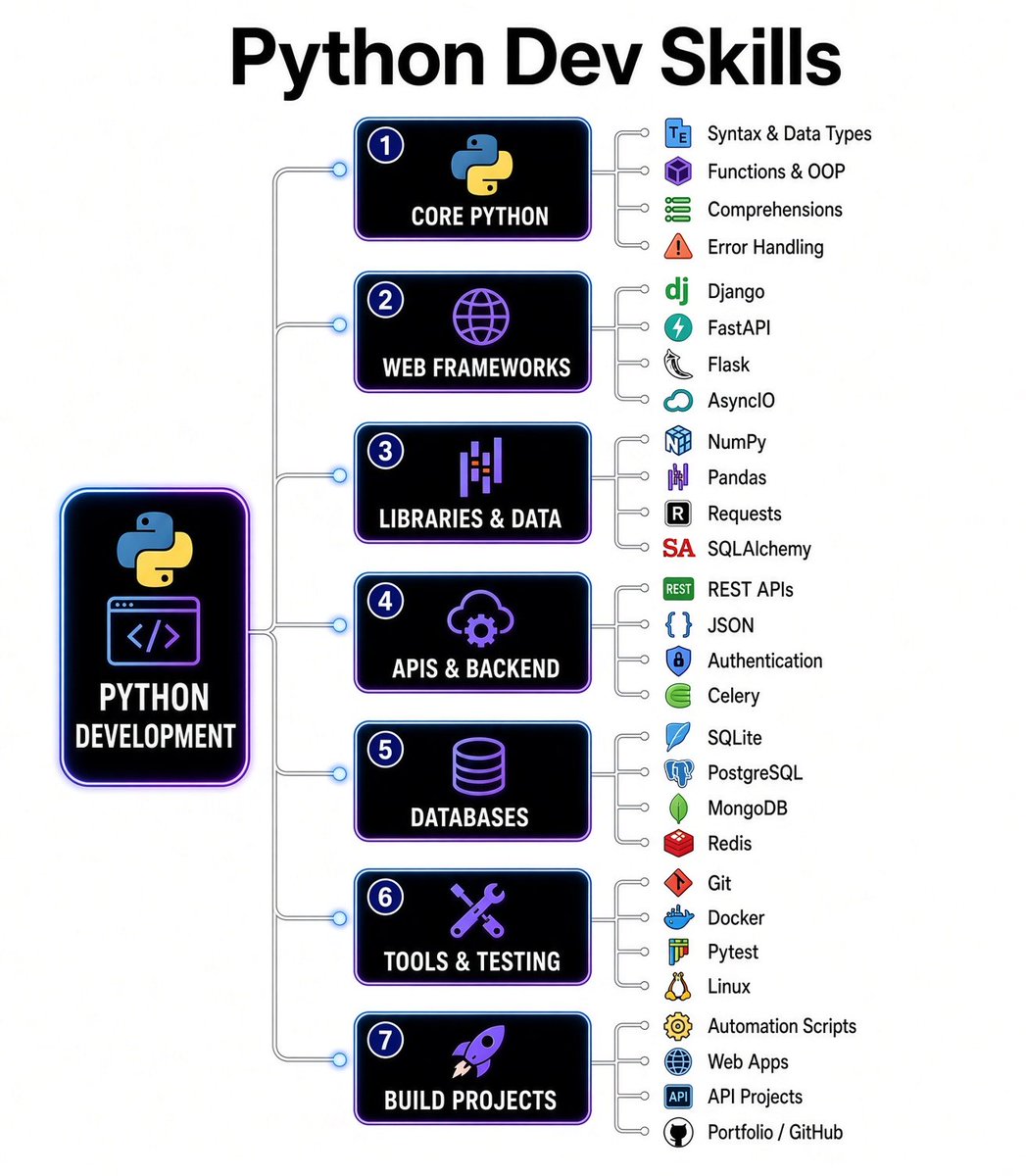
    The best tech stack for web development (in 2026): 1. Programming Languages: > Python > JavaScript > Go > Java > Rust 2. Frameworks: > FastAPI > NodeJS > Spring Boot > Django >ASP NET 3. Databases: > PostgreSQL > MySQL > MongoDB > Redis > DynamoDB 4. Cloud & Deployment: > AWS > Docker > Kubernetes > GCP > Azure 5. CI/CD & Version Control: > GitHub > GitHub Actions > GitLab > Jenkins > CircleCI Remember, you don’t need the whole stack. Pick one tool from each layer & build. Anything else you'd add? === 1. RT to help others start with web development. 2. If you want to get good at backend engineering, @systemdesignone will help you get there.
    Pobierz
    203620911.5K
  8. Python Coding✓@clcoding
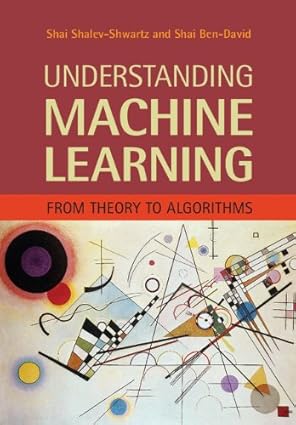
    Understanding Machine Learning: From Theory to Algorithms — FREE PDF Want to understand Machine Learning beyond just writing code? This 449-page book takes you through the mathematical foundations, core concepts, and algorithms behind Machine Learning. What makes it worth reading? Understand the theory behind ML algorithms. Build strong mathematical foundations. Explore important Machine Learning concepts. Learn how algorithms work, not just how to use them. 449 Pages | Free PDF Read & Download:
    Pobierz
    23623015.4K
  9. Tech Fusionist | Kushal Gangil✓@techyoutbe
    Cybersecurity in 6 Weeks: Zero to Practical Skills 🔐 Week 1: Networking & Linux Fundamentals Day 1: TCP/IP, OSI Model Day 2: DNS, HTTP/HTTPS, SSH Day 3: IP Addressing, Subnets, Ports Day 4: Linux Commands & Permissions Day 5: Firewalls, VPNs & Protocols Day 6: Wireshark & Packet Analysis Day 7: Hands-on Networking Lab Week 2: Cybersecurity Fundamentals Day 8: CIA Triad & Security Principles Day 9: Common Cyberattacks & Threats Day 10: Encryption, Hashing & PKI Day 11: Authentication, MFA & IAM Day 12: Vulnerabilities, CVEs & CVSS Day 13: OWASP Top 10 Day 14: Security Assessment Lab Week 3: Ethical Hacking & Penetration Testing Day 15: Ethical Hacking Methodology Day 16: Nmap & Network Scanning Day 17: Vulnerability Assessment Day 18: Burp Suite & Web Security Day 19: SQL Injection & XSS Basics Day 20: Metasploit Fundamentals Day 21: Practice on Legal CTF Labs Week 4: SOC & Defensive Security Day 22: SOC Operations & Blue Team Day 23: SIEM & Log Analysis Day 24: Splunk / Wazuh Basics Day 25: IDS, IPS & EDR Day 26: MITRE ATT&CK Framework Day 27: Threat Hunting & Detection Day 28: Build a Mini SOC Lab Week 5: Cloud Security & DevSecOps Day 29: AWS / Azure Security Basics Day 30: Cloud IAM & Least Privilege Day 31: Cloud Logging & Monitoring Day 32: Container & Kubernetes Security Day 33: SAST, DAST & Dependency Scanning Day 34: Secrets Management & Zero Trust Day 35: Secure a Cloud Application Week 6: Incident Response & Real Projects Day 36: Incident Response Lifecycle Day 37: Digital Forensics Fundamentals Day 38: Malware Analysis Basics Day 39: Security Automation with Python Day 40: AI Security & Prompt Injection Day 41: Cybersecurity Interview Scenarios Day 42: Final Project + GitHub Portfolio 42 Days. 6 Weeks. 6 Practical Labs. Don't just memorize security tools. Learn how attacks work, how to detect them, and how to defend real systems. Save this roadmap and start building your cybersecurity skills. 🔖
    Tech Fusionist | Kushal Gangil @techyoutbe
    Learning Cybersecurity in 2024: → Networking → Linux → Firewalls → VPNs → SIEM → Vulnerability Scanning → Penetration Testing → OWASP Top 10 → Incident Response → Ethical Hacking Learning Cybersecurity in 2026:
    181861.3K59.2K
  10. Tech Fusionist | Kushal Gangil✓@techyoutbe
    Learning Cybersecurity in 2024: → Networking → Linux → Firewalls → VPNs → SIEM → Vulnerability Scanning → Penetration Testing → OWASP Top 10 → Incident Response → Ethical Hacking Learning Cybersecurity in 2026:
    21817657.1K
  11. Python Coding✓@clcoding
    Manage Files and Folders Using Python! Did you know Python can count all the files and directories inside a folder automatically? With just a few lines of code using Python's built-in os module, you can: ✅ Count total files ✅ Count subdirectories ✅ Traverse folders recursively using os.walk() ✅ Calculate the total number of items Key Python concept: os.walk() It's especially useful for: File system automation Managing large directories Organizing downloads Building automation scripts No external libraries required. Just Python! Save this code for your next Python project.
    Pobierz
    2151228.9K
  12. Santiago✓@svpino
    Nothing will ever be the same for developers. It's just incredible that you can build a complete application and deploy it in under 5 minutes. @vercel added Python support, and I'm in heaven!
    Pobierz
    381826626.2K
  13. Matt Dancho (Business Science)✓@mdancho84
    This guy built an entire AI data science team in Python. Then open-sourced (100% free). It automates data science workflows with AI, including data loading, cleaning, exploratory analysis, and feature engineering. And it tracks each step in a 100% reproducible pipeline. 00:00 Project Overview 01:32 Diving into the AI Data Science Workflow and Data Loading 02:10 Data Wrangling and Cleaning 03:33 Data Visualization Insights & Plotting 04:08 Feature Engineering 05:00 Live 1-Hour Workshop 05:44 AI Data Science Team Python Library 🔗 AI Data Science Team On GitHub (Give it a Star) 🚨 Want to learn how to build + ship AI and Data Science projects (that businesses actually want in 2026)? On November 11th, I am hosting a free workshop to help you get started with AI + DS projects in Python. Register here (500 seats):
    Pobierz
    4201265.9K
  14. Python Coding✓@clcoding
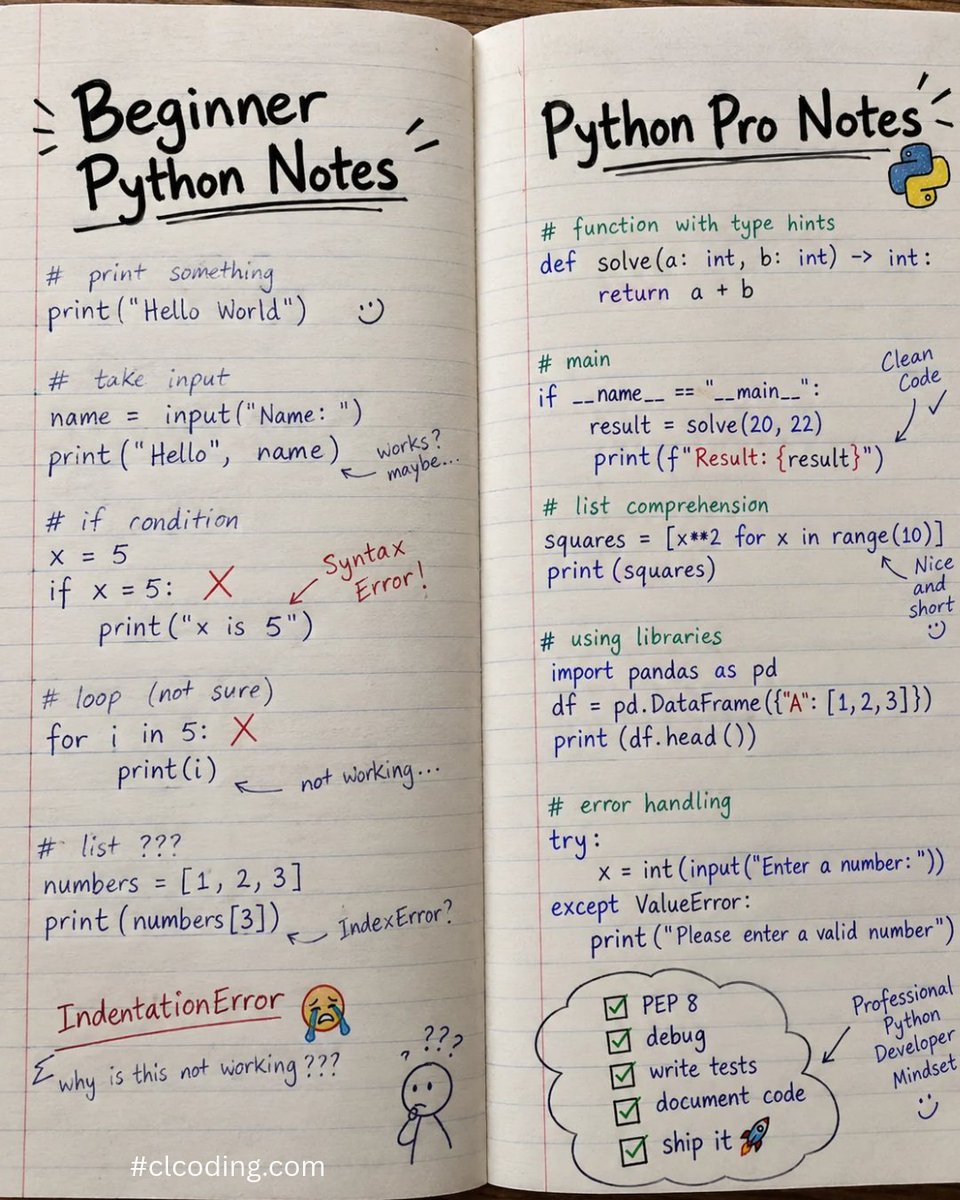
    Beginner Python vs. Python Pro: The Difference Is in the Details! Beginners write code that works. Professionals write code that is clean, readable, reliable, and easy to maintain. Here’s what changes as you grow as a Python developer: ✅ Understand syntax errors and indentation ✅ Use type hints and meaningful function names ✅ Write clean, reusable code ✅ Handle errors properly ✅ Follow PEP 8 guidelines ✅ Debug your code and write tests ✅ Use libraries like Pandas effectively The goal isn't just to make your code run. It's to make it better. Unlock your full potential in Python with 100 practical, real-world projects designed to take you from complete beginner to confident developer. This book is hands-on, structured, and explanation-focused — perfect for students, self-learners, and working professionals who want to learn by building, not just reading. Books:
    Pobierz
    63426017.5K
  15. Python Programming✓@PythonPr
    Python Quiz: 90% beginners get confused! 😈 Can you find the correct output without running the code? 💻
    Pobierz
    3111898.8K
  16. freeCodeCamp.org✓@freeCodeCamp
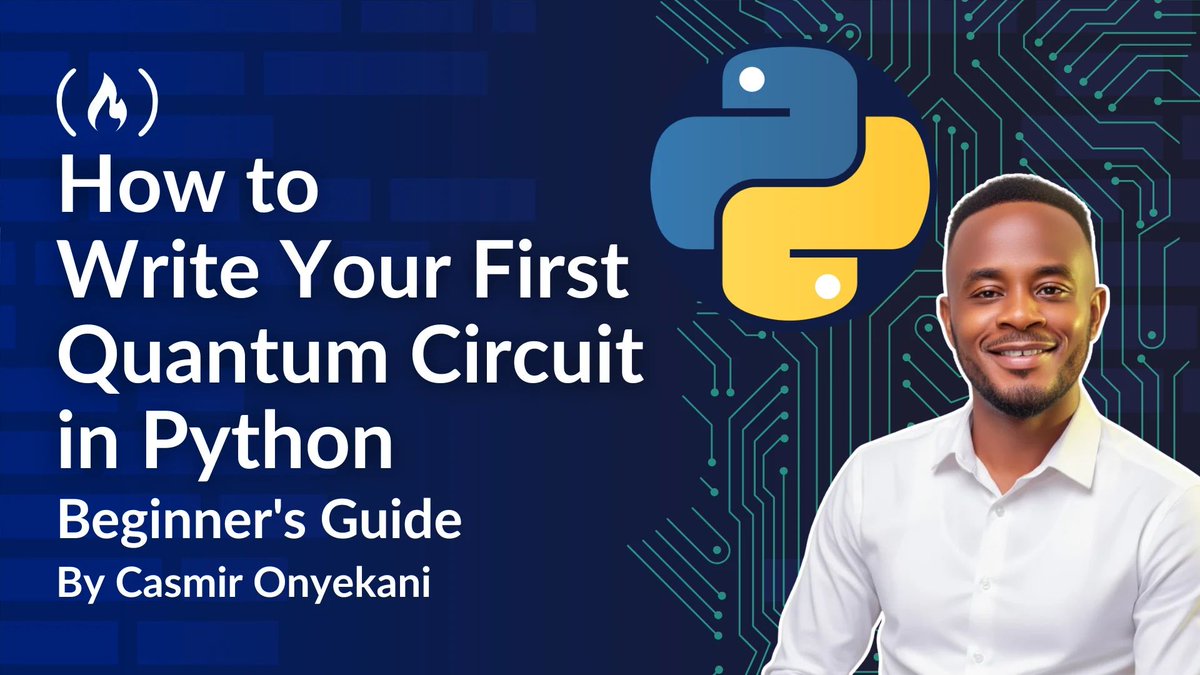
    Quantum computing might sound like something people in long white coats do in secret labs somewhere. But in this beginner-friendly guide, @casweb_dev teaches you how to build a quantum circuit in Python with Qiskit. You'll learn about qubits, quantum gates, superposition, entanglement, Bell States, simulators, and more.
    Pobierz
    04230018.6K
  17. Python Programming✓@PythonPr
    Do you agree that Python is the best language currently available?
    Pobierz
    161413513.8K
  18. Python Coding✓@clcoding
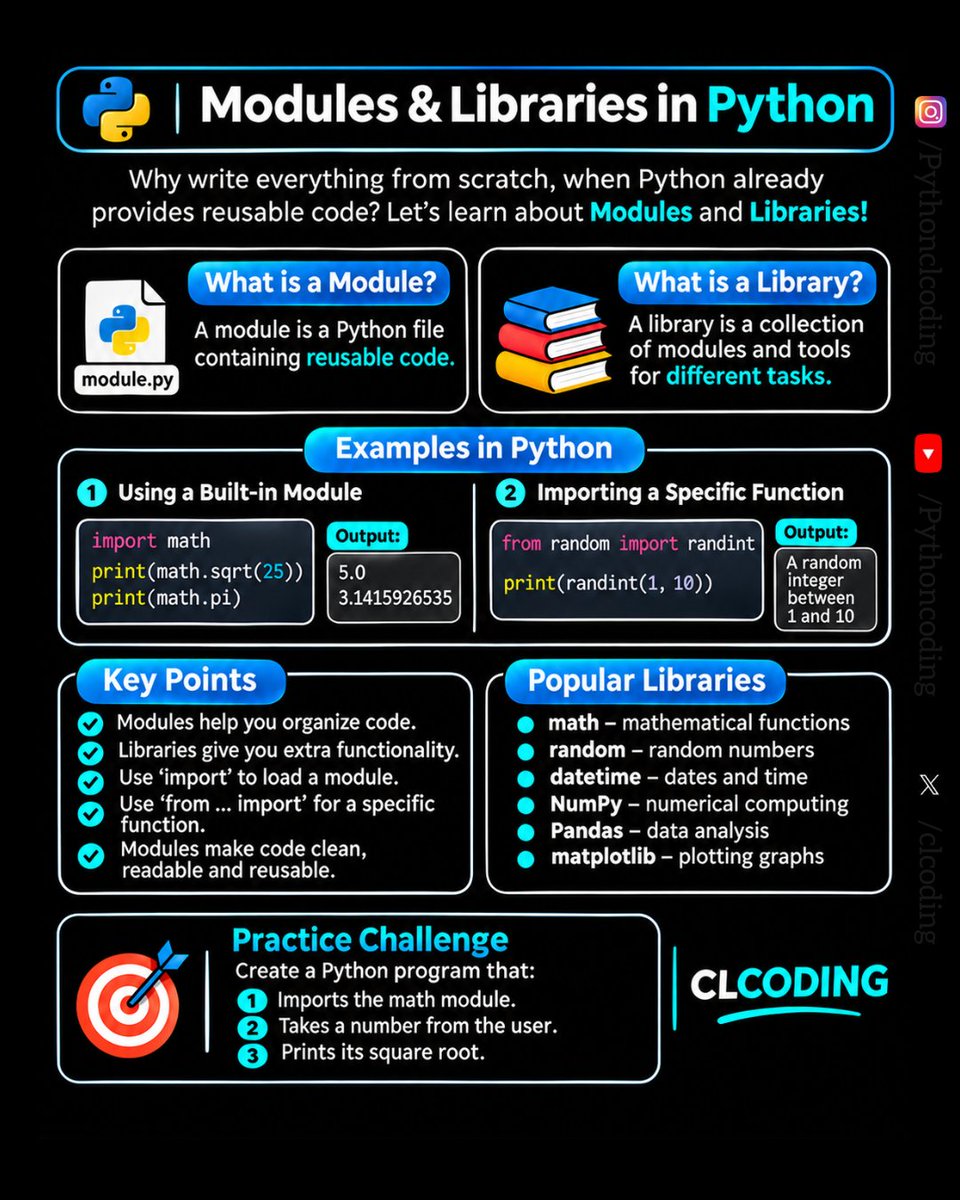
    Python Modules & Libraries: Write Less, Build More! Why build everything from scratch when Python already provides powerful reusable code? Understanding Modules and Libraries is an important step in becoming a better Python developer. Here's what you should know: 🔹 Modules – Python files containing reusable code. 🔹 Libraries – Collections of modules that help solve different problems. 🔹 import – Used to bring modules into your program. 🔹 from ... import – Used to import specific functions. Popular Python Libraries to Explore: math – Mathematical operations random – Random number generation datetime – Date and time handling NumPy – Numerical computing Pandas – Data analysis Matplotlib – Data visualization Practice Challenge: Create a Python program that: 1. Imports the math module. 2. Takes a number from the user. 3. Calculates and prints its square root. Remember: Great developers don't reinvent everything. They know how to use the right tools! Learn Python one day at a time with CLCODING. Upcoming Bootcamp:
    Pobierz
    0219010.1K
  19. Arip✓@machinestein
    We just achieved a 23x speedup on Qwenputer, a Qwen3.5-4B model with a RISC-V computer compiled directly into its weights. Running on a 16 GB Mac via our app Locals, throughput versus MLX is up 3.8x to 155 tokens/s, answering 59 of 60 exact arithmetic questions (vs. 5 for base Qwen3.5-4B). Our new Qwenputer version goes further: the model’s internal computer executes work normally offloaded to the CPU, from JSON and regex to lightweight Python, answering 80/80 tool questions in 59s versus 197s externally. Run both locally today in Locals for Mac.
    Pobierz
    195058324.6K
  20. Python Coding✓@clcoding
    10 Advanced Python Interview Questions Every Developer Should Know Think you know Python well? It's time to test your knowledge! These 10 questions cover some challenging topics: Custom Memory Allocation Cython Optimization Multithreading & the GIL Metaclasses & OOP Celery & RabbitMQ Advanced Decorators Real-Time Streaming with WebSockets Python vs NumPy Performance REST API Security with OAuth 2.0 Microservices Architecture These questions go beyond basic syntax and test your understanding of Python internals, performance, scalability, and system design. How many can you answer confidently without searching online? Save this list for your next interview preparation! Follow @CLCODING for more Python tips, coding challenges, and interview questions.
    Pobierz
    417829.2K
  21. Pokaż więcej postów