DigitalOcean✓

@digitalocean

The AI-Native Cloud. ☁️ Status: @DOstatus Support: https://t.co/5gkvyionbi

274 Urmărește227K Urmăritori82.7K Postări
  1. DigitalOcean✓@digitalocean
    Catch it at the first user, not the four-hundredth. A new user’s bank link fails, the agent says “try again later,” and nothing shows up in the logs. Watch a team find the bug and fix it before anyone else hits it, with Agent Learning Services and Agent Data Services, launching today.
    Descarcă
    129884141.9M
  2. DigitalOcean✓@digitalocean
    DigitalOcean is on @Grok @bot. Sign in once, then ask in plain English to deploy to App Platform, launch Droplets, manage databases and DNS, or check what you’re spending. It shows a cost estimate before anything billable runs.
    Descarcă
    Paddy Srinivasan @paddix
    You can now manage your @digitalocean infrastructure straight from @bot 11 skills for DigitalOcean, including product guidance, App Platform deploys and logs, managed databases, and cost estimates before you take billable actions Get started: Install the DigitalOcean app in Grokbot, then ask it to deploy an app, check your balance, or provision something!
    231157.1K
  3. DigitalOcean✓@digitalocean
    A system prompt is a request. A missing route is a guarantee. @neimuc27 ran an overnight support agent on 99 tickets: it could read, claim and draft, but had no way to send. All 35 sensitive tickets waited for a person. Full build:
    Jeff Fan @neimuc27
    A customer asks for a $6,868 refund at 2 a.m. Your AI support agent reads it first. What stops it from replying "refunded"? Most teams: a line in the system prompt. We removed the send route instead. 99 tickets. 35 sensitive. All 35 stopped for a person. 0 replies sent.
    00557.4K
  4. Jeff Fan✓@neimuc27
    A customer asks for a $6,868 refund at 2 a.m. Your AI support agent reads it first. What stops it from replying "refunded"? Most teams: a line in the system prompt. We removed the send route instead. 99 tickets. 35 sensitive. All 35 stopped for a person. 0 replies sent.
    Descarcă
    30461.5K
  5. DigitalOcean✓@digitalocean
    A restored agent microVM starts running before its memory is loaded. Pages come from storage only when the guest touches them. On the warm-template path, request to serving traffic takes under 200 ms at p50 in our internal testing.
    Descarcă
    00253.4K
  6. DigitalOcean✓@digitalocean
    DigitalOcean
    RT @paddix: You can now manage your @digitalocean infrastructure straight from @bot 11 skills for DigitalOcean, including product guidance, App Platform deploys and logs, managed databases, and cost estimates before you take billable actions Get started: Install the DigitalOcean app in Grokbot, then ask it to deploy an app, check your balance, or provision something!
    080428
  7. DigitalOcean✓@digitalocean
    "Paste the API token into the prompt and hope” is not a security model. We let an agent run a real production migration across two clouds. It never held a credential, ran under an @NVIDIA OpenShell policy profile that locked writes to /workspace, and could only reach allowlisted hosts. All of it declared in config before the session started.
    Descarcă
    10654.9K
  8. DigitalOcean✓@digitalocean
    A model’s suggestion to call a tool is a request, not authority. Action Gateway keeps credentials out of model context and checks every tool call against policy: allow, deny, or ask a human. It aligns with @nvidia’s Open Agent Safety Platform.
    Descarcă
    31954.7K
  9. DigitalOcean✓@digitalocean
    Inference cost at scale is a routing problem before it’s a GPU problem. llm-d 1.0 went production-ready this month. It spreads token volume across the fleet to raise the cache-hit ratio. We run a forked version behind Serverless Inference and Managed Agents.
    51102.5K
  10. DigitalOcean✓@digitalocean
    .@MiniMax_AI reports 73.67% on DeepSWE and 72.5% on AutomationBench-AA, which it calls the best result among open models. M3.1 Flash is now on DigitalOcean Serverless Inference and Dedicated Inference. $0.15 input, $0.60 output per 1M tokens.
    Descarcă
    3226287K
  11. DigitalOcean✓@digitalocean
    Over 90% of input tokens agents send us are tokens the model has already seen. Prompt Caching is now available on DigitalOcean Serverless Inference: cached input at up to 90% off, time to first token up to 80% faster, no code changes. Cache affinity keeps hit rates on flagship models at 85–95%+.
    Descarcă
    3315565K
  12. DigitalOcean✓@digitalocean
    DigitalOcean
    RT @paddix: This week’s PHP2Shell disclosures and the AI-assisted attacks involving ConnectWise show how quickly the security equation is changing. In some cases, attackers reached privileged cloud access in under three hours. As we give agents the ability to execute code, call APIs and use credentials, we need enforceable boundaries around every action. Which systems can they access? Where can they send data? What happens when they exceed their permissions? My view: those controls belong in the infrastructure, outside the agent’s own reasoning loop. That’s why I’m excited that @digitalocean is supporting @nvidia's OpenShell Reference Architecture. It brings together Vera Rubin for inference, Vera CPUs and OpenShell for agent execution, and BlueField-4 DPUs running NVIDIA Sentry for independent monitoring and policy enforcement in silicon. An agent’s effective permissions matter as much as its model’s capabilities. Building an AI-native cloud means taking responsibility for both. Read NVIDIA’s announcement
    020447
  13. DigitalOcean✓@digitalocean
    DigitalOcean
    RT @paddix: @JayaGup10 and @ashugarg make an important argument here: agents create an expanding execution workload around inference. My view: this changes the architecture of the cloud itself. An agent’s task can outlive its process, its model connection, and the person who started it. The infrastructure has to preserve progress, authority, and context across all three. Durable execution goes deeper than keeping a sandbox alive. An agent needs to pause, checkpoint, fork, and resume. But restoring a microVM doesn’t establish whether an external transaction committed. If a tool times out after submitting a payment, blindly replaying the step can duplicate the payment. You need recorded step outcomes, idempotency where supported, and reconciliation when the result is uncertain. Recovery semantics become part of the agent architecture. Model routing and execution placement are coupled. The cheapest model endpoint can become expensive if switching to it requires resending a long history, rebuilding a warm KV cache, or moving context across regions. A router should consider model capability, queue time, cache state, data location, and the probability of completing the task. A locally cheaper decision can make the whole trajectory more expensive. That’s why inference, runtime, and data placement need to be designed together. A sandbox isolates code. Every tool invocation also needs to establish whose authority the agent is exercising, which action is permitted, and whether approval is required. Broker credentials at invocation, enforce policy outside the model, and connect the action to the session’s audit trail. Forking an agent should never silently expand its permissions. Production traces should feed a tested improvement loop. Connect model calls, tool responses, state changes, human corrections, and outcomes in one trace. Turn recurring failures into evaluation cases. Replay candidate fixes in simulations before changing production behavior. That gives execution history a second purpose: evidence for improving the next run. The economic objective follows directly: minimize total cost per successful task, including inference, active compute, persistent state, failed attempts, and recovery. More capable models can support longer tasks and more parallel work. Falling token prices can therefore expand demand for the infrastructure surrounding each call. At @DigitalOcean, we’re building around that entire loop: think, act, remember, improve. Open harnesses and models, governed execution, durable state, and customers retaining control of their accumulated intelligence. The agent’s full lifecycle is becoming the unit of AI Native cloud's architecture.
    Jaya Gupta @JayaGup10
    080394
  14. DigitalOcean✓@digitalocean
    DigitalOcean is aware of the PHP vulnerabilities (CVE-2026-109618 and CVE-2026-109619) and our teams are actively addressing. We’ll share more through direct customer communications and a blog post shortly.
    112418211.7K
  15. Jaya Gupta✓@JayaGup10
    427557081.5K
  16. DigitalOcean✓@digitalocean
    Postări @digitalocean
    Our detailed blog is now live. If you run PHP, you may need to take action. Steps here:
    0041.3K
  17. DigitalOcean✓@digitalocean
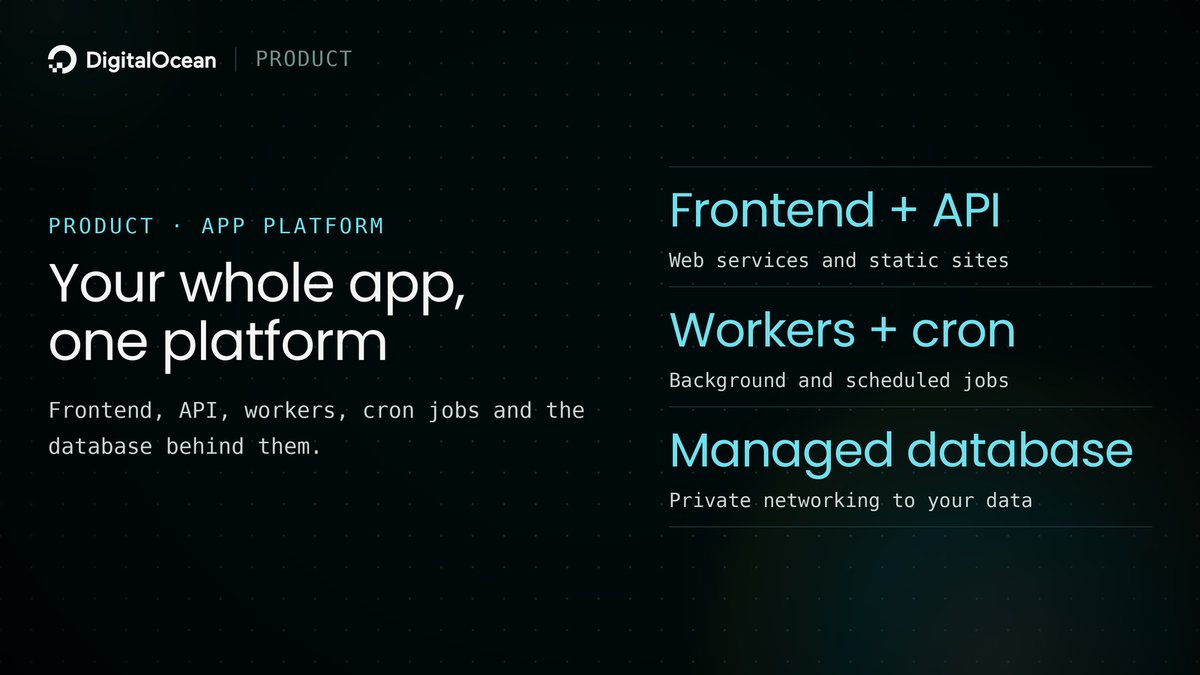
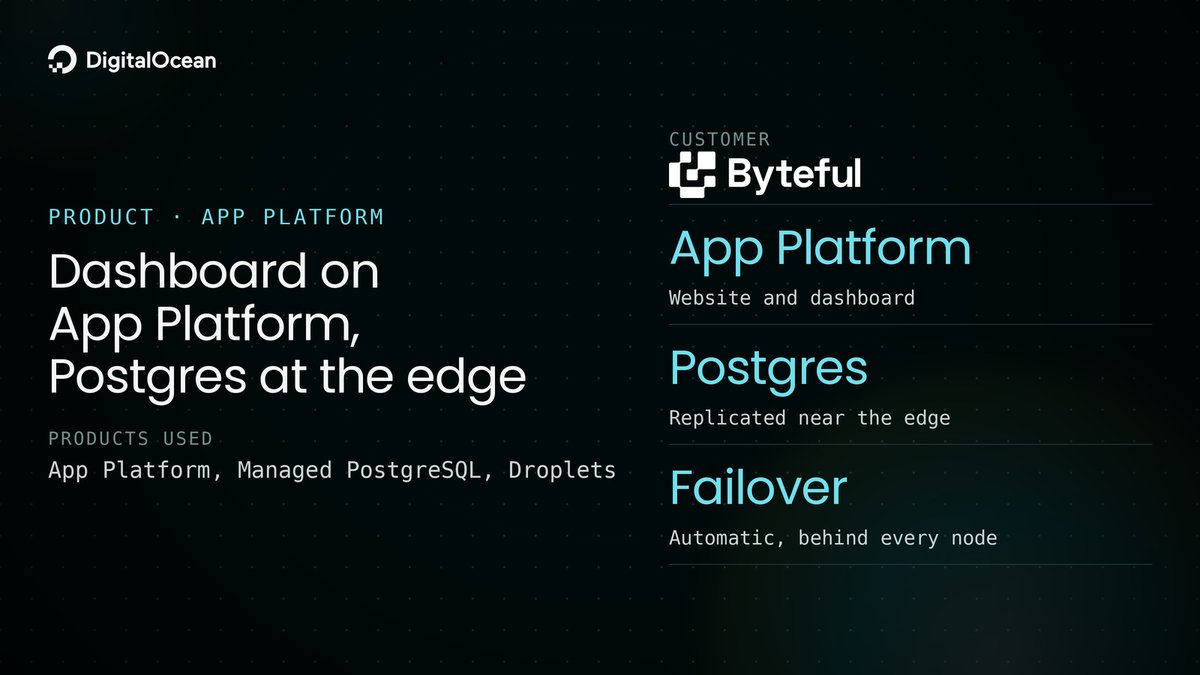
    App Platform runs your whole app: frontend, API, workers, scheduled jobs, and the database behind them, with AI a function call away. One bill, private networking between services and data. Successful teams building on it: 🧵
    Descarcă
    2312217K
  18. DigitalOcean✓@digitalocean
    .@reflection_ai reports Beam matches leading open models on quality with about 3x fewer reasoning tokens. It's a 501B sparse MoE with only 23B active per token, and Reflection's first open-weight model. Now on DigitalOcean Serverless Inference and Dedicated Inference. $0.40 input, $1.20 output per 1M tokens.
    Descarcă
    4213186K
  19. DigitalOcean✓@digitalocean
    Postări @digitalocean
    @PicapLatam @ProbablyDatabot ConfirmOk uses App Platform workers to place daily check-in calls to seniors and send alerts when someone doesn’t respond. Code deploys from GitHub, and Insights shows CPU, memory and request volume.
    Descarcă
    100680
  20. DigitalOcean✓@digitalocean
    DigitalOcean
    RT @paddix: An agent’s unit of work is an entire execution loop: Model call → tool invocation → code execution → state update → a different model call → evaluation. One user request can repeat that loop dozens of times. Inference latency, context reuse, runtime startup, credential handling and state persistence all affect the cost and reliability of completing the task. That changes what the cloud needs to optimize. A fast model endpoint helps. So does a fast sandbox. But every handoff between services can introduce another network hop, authentication boundary, failure mode or gap in the trace. Those costs compound across the loop. At @DigitalOcean, we’re building these primitives to work together: • Inference routing with visibility into the serving layer and opportunities for KV-cache reuse. • Isolated microVMs that pause while an agent waits and resume when execution is needed, with active CPU billing. • Governed tool access through MCP, with credentials brokered at invocation so secrets stay outside the agent’s context. • Persistent agent data, execution traces and evaluations that help teams identify failures and test improvements. The optimization target is cost, latency and reliability per successfully completed task. And there’s a longer-term opportunity: using the history of those tasks to improve the application’s prompts, tools, memory and workflows. Bring your model and harness. Build intelligence that becomes more valuable with use. @jenukal goes deeper on the architecture 👇
    Vinay Kumar @jenukal
    A hypothesis: agents don't need a sandbox. They need a platform that thinks, acts, remembers, and improves as one system. There's a debate running this week about sandboxes. One camp says sandboxes are dead and the future is a private cloud for every agent. Another says a sandbox is a compute primitive, like Postgres or Redis, and primitives don't win markets, platforms do. A third says sandboxes are a winner-takes-most market. I think all three are arguing about one layer of the problem. My hypothesis is that agents are the first workload that exercises every layer of a platform inside a single loop. They think, they act on real systems, they remember, and they improve. A web server touched compute and maybe a database. An agent touches inference, execution, tools, storage, retrieval, telemetry, and evaluation, in one task, often in less than a minute. So what an agent needs isn't a better sandbox. It's a platform where those four things run as one system. If that's right, the unit of competition isn't the sandbox and it isn't the model. It's the integrated cloud for agents. Whoever builds one that's compelling across agents, data, and model access at the same time wins. Let’s start with how an agent actually runs. One “prompt” fans out into a dozen model calls, a web search, a database query, a code execution, a tool call with a credential, a checkpoint, and a trace. Today a typical team buys those from five or six vendors and glues them together. Six vendors means fifteen seams. Every seam is an integration someone maintains, a credential someone stores, a network hop that adds latency, an egress fee, and a place where the trace dies. Point solutions are excellent but partial: most sandbox companies don't run inference, and model companies don't manage agent memory or observability. The loop is what breaks on a stitched stack. Models have to be routable, and routing only works when inference sits next to the agent. Every few weeks a new model tops a chart. Open-weight models went from <20% of token volume on our Inference Engine in April to >85% by August. My read: the model is the most swappable layer in the stack, so you want a router in front of it, not a hard-coded choice. We built an Inference Router for that. On Kimi K3 we see an aggregate cache-hit rate above 90% across our own workloads. The router has to know what the inference layer has cached, and the cache has to sit next to the sandbox that's going to need it. That's a function call on one platform. The agent and harness layer is where the business logic lives, so the runtime has to be built for it. I believe the harness, its prompts, its tool permissions, its memory, and its evals will hold more of a company's business logic than the model ever will. The model is rented. The agent is yours. So we built Managed Agents from the ground up as purpose-built primitives, not VMs with an agent sticker on them. Every session gets its own Firecracker microVM, resumes from pause in a few hundred milliseconds, and is billed for active CPU at $0.044 per vCPU-hour, so the wait costs zero. Action Gateway gives agents governed access to 20K+ tools across 600+ providers through one MCP endpoint, matched intent to tool with 99%+ accuracy in our testing, and brokers credentials at call time. The agent never sees the key. You can only make that promise when the runtime, the gateway, and the secret store are the same system. Data and recursive loops are what make an application more intelligent over time. This is the part I believe in most and the part with the least proof so far, because the products are weeks old. The hypothesis: two teams start with the same model and the same harness, and within a quarter they diverge, and the one with the loop wins. On DigitalOcean the loop runs on two services. Agent Data Services is one governed catalog where video, documents, logs, and agent sessions land agent-ready and searchable by meaning. Agent Learning Services closes the loop: Insights records every step, Signals flags the sessions where the agent stalled, looped, or lost the user, and Evaluations and Simulations test the fix before a customer sees it. In an internal demo, an optimized support agent went from failing to passing it with 90% fewer input tokens. Intelligence stops being something you rent via models and becomes something your application accumulates, tuned to the exact problem it's solving. And the whole thing has to go down to the floor. DigitalOcean builds the routing model and the microVM runtime operates the GPUs they run on, across 20 data centers with NVIDIA HGX B300 and AMD MI350X fleets. Much of the agent infrastructure market rents GPUs from someone who rents a data center from someone else, with margins stacked on margins. My view is that active CPU billing, a warm KV cache next to the sandbox, and a router that can see the inference layer are only possible when you control the data center, the hardware, and the software as one stack. The obvious objection is that "integrated" is a polite word for lock-in. I'd argue the opposite, and I think it's the real test of whether a platform is integrated or just bundled. Integration should be about removing seams, not closing doors. Bring Claude Code, Codex CLI, OpenCode, Hermes, LangGraph, or your own OCI image. Hit one endpoint compatible with OpenAI, Anthropic, and 60+ Open models. Bring your own key for a frontier model, or run open weights we host. Our routing model and the proxy under it are open source. The point is that the seams are gone, not that the exits are. One early signal that the hypothesis might be right: roughly 70% of our large AI customers have attached a one or more platform primitives. Agents come in through inference or a sandbox and pull the rest of the cloud behind them. That's what I'd expect if agents really do need every layer at once. So, back to the debate. The platform that wins won't be the one with the best sandbox, and I don't think it'll be the one with the best model. My bet is on the platform where an agent thinks, acts, remembers, and improves as one system. DM me if you are interested in trying our Agent primitives. #digitalocean #agents #Agenticloop #learning #Context #sandbox #Runtime #DOCN

    050419
  21. DigitalOcean✓@digitalocean
    DigitalOcean
    RT @ld_do_: Hey all, quick update: we tested a new UI with a small group of you, including a collapsible nav bar, and the feedback was loud. Message received. We’re rolling it back. If you saw it and have opinions on how DO should look and feel, DM me. Happy to send account credit or swag for your time. 🫶 Thanks for keeping us honest.
    020442
  22. Vinay Kumar✓@jenukal
    A hypothesis: agents don't need a sandbox. They need a platform that thinks, acts, remembers, and improves as one system. There's a debate running this week about sandboxes. One camp says sandboxes are dead and the future is a private cloud for every agent. Another says a sandbox is a compute primitive, like Postgres or Redis, and primitives don't win markets, platforms do. A third says sandboxes are a winner-takes-most market. I think all three are arguing about one layer of the problem. My hypothesis is that agents are the first workload that exercises every layer of a platform inside a single loop. They think, they act on real systems, they remember, and they improve. A web server touched compute and maybe a database. An agent touches inference, execution, tools, storage, retrieval, telemetry, and evaluation, in one task, often in less than a minute. So what an agent needs isn't a better sandbox. It's a platform where those four things run as one system. If that's right, the unit of competition isn't the sandbox and it isn't the model. It's the integrated cloud for agents. Whoever builds one that's compelling across agents, data, and model access at the same time wins. Let’s start with how an agent actually runs. One “prompt” fans out into a dozen model calls, a web search, a database query, a code execution, a tool call with a credential, a checkpoint, and a trace. Today a typical team buys those from five or six vendors and glues them together. Six vendors means fifteen seams. Every seam is an integration someone maintains, a credential someone stores, a network hop that adds latency, an egress fee, and a place where the trace dies. Point solutions are excellent but partial: most sandbox companies don't run inference, and model companies don't manage agent memory or observability. The loop is what breaks on a stitched stack. Models have to be routable, and routing only works when inference sits next to the agent. Every few weeks a new model tops a chart. Open-weight models went from <20% of token volume on our Inference Engine in April to >85% by August. My read: the model is the most swappable layer in the stack, so you want a router in front of it, not a hard-coded choice. We built an Inference Router for that. On Kimi K3 we see an aggregate cache-hit rate above 90% across our own workloads. The router has to know what the inference layer has cached, and the cache has to sit next to the sandbox that's going to need it. That's a function call on one platform. The agent and harness layer is where the business logic lives, so the runtime has to be built for it. I believe the harness, its prompts, its tool permissions, its memory, and its evals will hold more of a company's business logic than the model ever will. The model is rented. The agent is yours. So we built Managed Agents from the ground up as purpose-built primitives, not VMs with an agent sticker on them. Every session gets its own Firecracker microVM, resumes from pause in a few hundred milliseconds, and is billed for active CPU at $0.044 per vCPU-hour, so the wait costs zero. Action Gateway gives agents governed access to 20K+ tools across 600+ providers through one MCP endpoint, matched intent to tool with 99%+ accuracy in our testing, and brokers credentials at call time. The agent never sees the key. You can only make that promise when the runtime, the gateway, and the secret store are the same system. Data and recursive loops are what make an application more intelligent over time. This is the part I believe in most and the part with the least proof so far, because the products are weeks old. The hypothesis: two teams start with the same model and the same harness, and within a quarter they diverge, and the one with the loop wins. On DigitalOcean the loop runs on two services. Agent Data Services is one governed catalog where video, documents, logs, and agent sessions land agent-ready and searchable by meaning. Agent Learning Services closes the loop: Insights records every step, Signals flags the sessions where the agent stalled, looped, or lost the user, and Evaluations and Simulations test the fix before a customer sees it. In an internal demo, an optimized support agent went from failing to passing it with 90% fewer input tokens. Intelligence stops being something you rent via models and becomes something your application accumulates, tuned to the exact problem it's solving. And the whole thing has to go down to the floor. DigitalOcean builds the routing model and the microVM runtime operates the GPUs they run on, across 20 data centers with NVIDIA HGX B300 and AMD MI350X fleets. Much of the agent infrastructure market rents GPUs from someone who rents a data center from someone else, with margins stacked on margins. My view is that active CPU billing, a warm KV cache next to the sandbox, and a router that can see the inference layer are only possible when you control the data center, the hardware, and the software as one stack. The obvious objection is that "integrated" is a polite word for lock-in. I'd argue the opposite, and I think it's the real test of whether a platform is integrated or just bundled. Integration should be about removing seams, not closing doors. Bring Claude Code, Codex CLI, OpenCode, Hermes, LangGraph, or your own OCI image. Hit one endpoint compatible with OpenAI, Anthropic, and 60+ Open models. Bring your own key for a frontier model, or run open weights we host. Our routing model and the proxy under it are open source. The point is that the seams are gone, not that the exits are. One early signal that the hypothesis might be right: roughly 70% of our large AI customers have attached a one or more platform primitives. Agents come in through inference or a sandbox and pull the rest of the cloud behind them. That's what I'd expect if agents really do need every layer at once. So, back to the debate. The platform that wins won't be the one with the best sandbox, and I don't think it'll be the one with the best model. My bet is on the platform where an agent thinks, acts, remembers, and improves as one system. DM me if you are interested in trying our Agent primitives. #digitalocean #agents #Agenticloop #learning #Context #sandbox #Runtime #DOCN
    241110911.9K
  23. DigitalOcean✓@digitalocean
    .@deepseek_ai reports V4.1 Flash 1017 scores 77.0 on DeepSWE v1.1, up from 74.2 on V4.1 Flash, with shorter outputs and faster task completion. Now on DigitalOcean Serverless Inference and Dedicated Inference. Already on V4.1 Flash? Switch to deepseek-v4.1-flash-1017 and keep the same endpoint and Model Access Keys.
    Descarcă
    1017285K
  24. DigitalOcean✓@digitalocean
    Retry with backoff is the standard advice for flaky APIs. Against inference providers, it more than tripled backend load in fault tests, averaging 3.54x normal. A retry budget plus a circuit breaker held it to 1.02x.
    0163.1K
  25. DigitalOcean✓@digitalocean
    Stop building ETL pipelines for your agents. Point Agent Data Services at a Spaces or S3 bucket and new data is transcribed, chunked, redacted and embedded as it arrives, landing in one governed catalog your agents can query with SQL, semantic search and filters in a single call. Now in private preview. Request access:
    Descarcă
    0262.2K
  26. DigitalOcean✓@digitalocean
    DigitalOcean
    RT @angelahoover_: It’s cool to see the difference building on @digitalocean is making, in both speed and cost, as we scale up our index. Plus their team is just the kindest! Thanks for sharing our experience 💙
    DigitalOcean @digitalocean
    .@andi_search is two people running a 28-billion-page search index for humans and AI agents. It runs on DigitalOcean Droplets and Spaces Object Storage. Agent-led signups are up 10% a day, and their infrastructure spend dropped ~90% when they migrated to DigitalOcean.
    040431
  27. DigitalOcean✓@digitalocean
    Our blog on today’s PHP vulnerabilities is live. If you’re a customer running PHP, you may need to take action yourself. Our teams are working across our platform, and the steps are here:
    53173.9K
  28. DigitalOcean✓@digitalocean
    .@andi_search is two people running a 28-billion-page search index for humans and AI agents. It runs on DigitalOcean Droplets and Spaces Object Storage. Agent-led signups are up 10% a day, and their infrastructure spend dropped ~90% when they migrated to DigitalOcean.
    Descarcă
    44255.3K
  29. DigitalOcean✓@digitalocean
    When an agent gives someone a bad experience, they rarely complain. They just stop asking, and nothing in your dashboard changes. Developer advocate @amit shows how to catch it: Signals surfaces the conversation nobody reported, Simulations turns it into a test, and you prove the fix worked instead of guessing. 0% to 100%. Signals and Simulations. Now in public preview.
    Descarcă
    10113.4K
  30. Afișează mai multe postări