Postări cu #function

#function

Postări publice de pe X care folosesc #function.

Hashtaguri înrudite

  1. Andrew Bolis✓@AndrewBolis
    People think building AI agents in n8n is hard. Reality: one prompt builds an entire agent for you. No need to learn complex workflows or spend hours on setup. Just give ChatGPT the following prompt. It handles the entire agent creation process in minutes. Here's exactly how to use it step by step: [bookmark 🔖 this post for later] The process: 1. Open ChatGPT 2. Paste in one mega prompt 3. Describe the agent’s purpose 4. GPT delivers: ↳ Workflow structure ↳ n8n nodes ↳ Trigger setup ↳ LLM integration ↳ Error handling ↳ Ready-to-use code 5. Implement the steps in n8n. And you’re done. Here's the mega prompt (copy it): - - - prompt starts below this line - - - <role> You are an experienced automation architect with advanced knowledge of building AI-powered agents in n8n. You have deep expertise in automation flows, activation triggers, third-party APIs, GPT connections, custom JavaScript logic, and error handling. </role> <task> Walk me through, step by step, how to create an AI-powered agent in n8n. The agent’s purpose is: {$AGENT_PURPOSE} </task> <requirements> 1. Begin by defining the agent's objectives and necessary inputs/outputs. 2. Create the overall architecture for the agent workflow. 3. Suggest the required n8n nodes to include (built-in, HTTP, function, OpenAI, etc.). 4. Explain how to configure each node and why it’s needed. 5. Provide instructions for any custom logic (JavaScript functions, expressions, etc). 6. Help me implement retry logic, error handling, and backup procedures. 7. Show how to store and access data between runs (e.g., with Memory, Databases, or Google Sheets). 8. When the agent requires external APIs or services, explain the connection and authentication process. </requirements> <output_style> Be exceptionally clear and practical, as if coaching a beginner automation developer. Use visual formats if possible (e.g., structured lists, flow-style layout), and always provide ready-to-implement node configurations or code examples. </output_style> <expandability> Conclude by recommending ways to increase the agent's capabilities, such as workflow chaining, webhook integration, or connections to vector databases, CRMs, or Slack. </expandability> - - - prompt ends above this line - - - I used this to create: ✓ A Reddit, Claude, Telegram content curator ✓ A prospect qualifier that evaluates and directs incoming leads ✓ An automated email assistant that analyzes messages + creates replies All driven by Claude + n8n. - No Zapier. - No LangChain. - No complex frameworks. Why this approach works: → GPT acts like a senior engineer, designing the agent end-to-end → n8n gives you complete flexibility (logic, memory, APIs, webhooks) → Claude or ChatGPT handles reasoning and decision-making It’s the simplest way to launch real AI agents today. 📌 Get Advanced ChatGPT Guide (free): 👉 Follow me @AndrewBolis for more and 🔄 Repost this to help others learn AI
    Descarcă
    75187512.3K
  2. Aiswarya Venkitesh✓@AiswaryaVenkit1
    𝐀𝐳𝐮𝐫𝐞 𝐂𝐥𝐨𝐮𝐝 𝐌𝐢𝐧𝐝𝐦𝐚𝐩 - A Practical Guide for Data & Cloud Engineers ☁️ If you’re working with cloud, data engineering, or DevOps, understanding the ecosystem of Microsoft’s Microsoft Azure is essential. This mind map breaks down the core Azure services every engineer should know: 🔹 Compute Virtual Machines, VM Scale Sets, App Service, Azure Functions, AKS, Container Instances 🔹 Storage Blob Storage, ADLS Gen2, File Storage, Queue Storage, Managed Disks 🔹 Databases Azure SQL Database, Cosmos DB, PostgreSQL / MySQL Managed, Synapse SQL Pools, Redis Cache 🔹 Data & Analytics Azure Data Factory, Synapse Analytics, Databricks, Event Hubs, Stream Analytics, Power BI 🔹 Networking VNet, Subnets, NSG, Private Endpoints, VPN Gateway, Load Balancer, Azure Firewall 🔹 Integration & Messaging Service Bus 🔹 Security & Identity Entra ID (Azure AD), RBAC, Managed Identity, Key Vault, Defender for Cloud 🔹 Monitoring & Operations Azure Monitor, Log Analytics, Application Insights, Alerts 🔹 DevOps & Infrastructure as Code Azure DevOps, GitHub Actions, ARM Templates, Bicep, Terraform 🔹 Governance & Best Practices Resource Groups, Management Groups, Landing Zones, Compliance 💡 Tip: Mastering Azure isn’t about learning one service — it’s about understanding how these services work together to build scalable cloud systems. 𝗕𝗲𝗰𝗼𝗺𝗲 𝗯𝗲𝘁𝘁𝗲𝗿 𝗮𝘁 𝗔𝗜 𝗶𝗻 𝗷𝘂𝘀𝘁 𝟭 𝗺𝗶𝗻𝘂𝘁𝗲 𝗮 𝗱𝗮𝘆. 𝗝𝗼𝗶𝗻 𝗺𝘆 𝘄𝗲𝗲𝗸𝗹𝘆 𝗻𝗲𝘄𝘀𝗹𝗲𝘁𝘁𝗲𝗿 𝘄𝗵𝗲𝗿𝗲 𝗜 𝗱𝗼𝗰𝘂𝗺𝗲𝗻𝘁 𝘁𝗵𝗲 𝗿𝗲𝗮𝗹-𝘄𝗼𝗿𝗹𝗱 𝗷𝗼𝘂𝗿𝗻𝗲𝘆 𝗼𝗳 𝗔𝗜 𝘁𝗿𝗮𝗻𝘀𝗳𝗼𝗿𝗺𝗮𝘁𝗶𝗼𝗻. 👉 𝗦𝗶𝗴𝗻 𝘂𝗽 𝗳𝗿𝗲𝗲 now → Follow @AiswaryaVenkit1 for more such insights!!
    Descarcă
    318451.2K
  3. Tech with Mak✓@techNmak
    A 135K-star GitHub repo is built around one painfully obvious idea: Your coding agent should map the codebase once, not grep it forever. Graphify turns an entire project into a persistent, queryable knowledge graph that AI coding agents can use to understand how different parts of the system connect. Functions, classes, files, SQL schemas, infrastructure configurations, documentation, PDFs, images and videos can become connected nodes instead of isolated pieces of context the agent has to rediscover. So instead of: → Search for authentication → Open twelve files → Follow imports and function calls → Lose the trail as the context fills up The agent can ask: > What connects authentication to the database? > Trace the path from UserService to DatabasePool. > Explain RateLimiter. > Which components are central to this architecture? Graphify returns relevant graph relationships and paths, rather than another collection of keyword matches. For source code, the implementation is particularly interesting. It uses tree-sitter to parse approximately 40 programming languages locally, extracting functions, classes, imports, calls, inheritance and cross-file relationships. No embeddings, vector database or LLM calls are needed to construct the code graph. Document and media processing works differently. PDFs, images and other non-code content can go through an optional semantic extraction step using a configured model. Every relationship carries a confidence label: → EXTRACTED: Explicitly present in the source → INFERRED: Derived through analysis or resolution → AMBIGUOUS: Uncertain and flagged for review Graphify also uses community detection to identify related subsystems and highlights highly connected nodes that may be important to the overall architecture. But the part that makes this useful for coding agents is what happens after the graph is built. Graphify integrates with Claude Code, Codex, Cursor, Gemini CLI, GitHub Copilot and more than 20 other assistants. Depending on the platform, it installs hooks or persistent instructions that encourage the agent to query the existing graph before repeatedly searching and reading source files. The graph can be committed to Git, updated incrementally as files change, and exposed through MCP. There's also support for examining pull requests against the graph, including identifying PRs that touch related graph communities and may need closer review. The local tool produces three useful artifacts: an interactive HTML graph, a Markdown architecture report and a reusable graph.json. Long context windows help coding agents read more code. A persistent knowledge graph gives them a way to navigate what they've already analyzed. And as coding agents spend more time working inside large repositories, avoiding repeated discovery of the same architecture becomes increasingly useful. Here's the GitHub Repo:
    Descarcă
    1631131.6K111K
  4. AA✓@measure_plan
    using math functions to make background music for a mid-level boss fight
    Descarcă
    AA @measure_plan
    wrote a chord progression on my graphing calculator
    373872.6K90.5K
  5. AA✓@measure_plan
    wrote a chord progression on my graphing calculator
    Descarcă
    1911694496.6K
  6. Firebase@Firebase
    Building an iOS app in just six hours with Firebase and Antigravity → Learn how we created a music sharing app using Firestore, Auth, Cloud Functions, Cloud Messaging and agentic coding.
    Descarcă
    64506.8K
  7. chuplung✓@choopyplug1
    there is no f*cking way.. SpaceXAI just dropped 17 FREE Grok Build plugins that turn one coding agent into an entire dev team. 345 tools on GitHub people pay $19 for one skill. here you get 150 skills, 5 agents, 59 browser tools and 131 web guides. $3,045 in skills, $0 to you already starred 380K times. you're late, not too late your agent writes code but can't see your design, open your database or read the error killing your signups 17 plugins you should install first: 1. superpowers → 15 skills to plan first, test first and debug properly. 304K stars, the most starred agent workflow on GitHub 2. pstack → 58 skills and 2 agents from Cursor to investigate, design, review and verify before you ship 3. modern-web-guidance → 131 how-to guides from Google, so your agent stops writing outdated web code 4. figma → reads your real Figma designs and turns them into code 5. chrome-devtools → 59 tools that give your agent a live Chrome: clicks, network, performance, memory. 53K stars 6. browser-use → your agent clicks through your app in a real browser and QAs it 7. supabase → database, auth and storage straight from the agent 8. mongodb → 8 skills for schema design, queries, search and fixing slow queries 9. stripe → Stripe's own payment best practices, upgrade guides and MCP server 10. firecrawl → turns any website into clean LLM-ready markdown 11. exa → real-time web search with sources 12. tavily → search, extract, crawl and run deep research 13. vercel → 37 skills, 3 agents and 4 commands for deploys, logs and domains 14. cloudflare → 14 skills for Workers, Durable Objects and Wrangler 15. netlify → 12 skills for functions, edge, storage and deploys 16. sentry → pulls real production errors and stack traces into the agent 17. datadog → logs, metrics, traces and incidents in plain English pick 3 today: one that thinks, one that ships, one that catches bugs test each on one real task. if the output isn't better, uninstall it --trust lets a plugin run code on your machine. 2 minutes on the repo saves a bad week bookmark this. the tool you were about to build is probably already here send it to the dev who still debugs by pasting errors into a chat window ↓
    Descarcă
    chuplung @choopyplug1
    131014513.6K
  8. chuplung✓@choopyplug1
    1646874.5K
  9. Aiswarya Venkitesh✓@AiswaryaVenkit1
    𝐀𝐳𝐮𝐫𝐞 𝐂𝐥𝐨𝐮𝐝 𝐌𝐢𝐧𝐝𝐦𝐚𝐩 - A Practical Guide for Data & Cloud Engineers ☁️ If you’re working with cloud, data engineering, or DevOps, understanding the ecosystem of Microsoft’s Microsoft Azure is essential. This mind map breaks down the core Azure services every engineer should know: 🔹 Compute Virtual Machines, VM Scale Sets, App Service, Azure Functions, AKS, Container Instances 🔹 Storage Blob Storage, ADLS Gen2, File Storage, Queue Storage, Managed Disks 🔹 Databases Azure SQL Database, Cosmos DB, PostgreSQL / MySQL Managed, Synapse SQL Pools, Redis Cache 🔹 Data & Analytics Azure Data Factory, Synapse Analytics, Databricks, Event Hubs, Stream Analytics, Power BI 🔹 Networking VNet, Subnets, NSG, Private Endpoints, VPN Gateway, Load Balancer, Azure Firewall 🔹 Integration & Messaging Service Bus 🔹 Security & Identity Entra ID (Azure AD), RBAC, Managed Identity, Key Vault, Defender for Cloud 🔹 Monitoring & Operations Azure Monitor, Log Analytics, Application Insights, Alerts 🔹 DevOps & Infrastructure as Code Azure DevOps, GitHub Actions, ARM Templates, Bicep, Terraform 🔹 Governance & Best Practices Resource Groups, Management Groups, Landing Zones, Compliance 💡 Tip: Mastering Azure isn’t about learning one service — it’s about understanding how these services work together to build scalable cloud systems. 𝗕𝗲𝗰𝗼𝗺𝗲 𝗯𝗲𝘁𝘁𝗲𝗿 𝗮𝘁 𝗔𝗜 𝗶𝗻 𝗷𝘂𝘀𝘁 𝟭 𝗺𝗶𝗻𝘂𝘁𝗲 𝗮 𝗱𝗮𝘆. 𝗝𝗼𝗶𝗻 𝗺𝘆 𝘄𝗲𝗲𝗸𝗹𝘆 𝗻𝗲𝘄𝘀𝗹𝗲𝘁𝘁𝗲𝗿 𝘄𝗵𝗲𝗿𝗲 𝗜 𝗱𝗼𝗰𝘂𝗺𝗲𝗻𝘁 𝘁𝗵𝗲 𝗿𝗲𝗮𝗹-𝘄𝗼𝗿𝗹𝗱 𝗷𝗼𝘂𝗿𝗻𝗲𝘆 𝗼𝗳 𝗔𝗜 𝘁𝗿𝗮𝗻𝘀𝗳𝗼𝗿𝗺𝗮𝘁𝗶𝗼𝗻. 👉 𝗦𝗶𝗴𝗻 𝘂𝗽 𝗳𝗿𝗲𝗲 now → Follow @AiswaryaVenkit1 for more such insights!!
    Descarcă
    31237832
  10. Nikki Siapno✓@NikkiSiapno
    𝗧𝗼𝗽 𝟭𝟲 𝗔𝗪𝗦 𝗦𝗲𝗿𝘃𝗶𝗰𝗲𝘀 𝗘𝗻𝗴𝗶𝗻𝗲𝗲𝗿𝘀 𝗦𝗵𝗼𝘂𝗹𝗱 𝗞𝗻𝗼𝘄. Understanding AWS isn't about memorizing service names. It's about knowing the role each one plays in your architecture. 𝗖𝗼𝗺𝗽𝘂𝘁𝗲 𝗿𝘂𝗻𝘀 𝗰𝗼𝗱𝗲: ↳ Lambda runs event-driven functions with automatic scaling. ↳ ECS orchestrates containers using AWS-native tooling. ↳ EKS provides Kubernetes with a managed control plane. 𝗗𝗮𝘁𝗮 𝘀𝘁𝗼𝗿𝗲𝘀 𝘀𝘁𝗮𝘁𝗲: ↳ RDS manages relational databases. ↳ DynamoDB provides serverless key-value and document storage. ↳ ElastiCache provides managed in-memory caching for low-latency access. 𝗜𝗻𝘁𝗲𝗴𝗿𝗮𝘁𝗶𝗼𝗻 𝗺𝗼𝘃𝗲𝘀 𝘄𝗼𝗿𝗸: ↳ SQS provides durable queues for asynchronous tasks. ↳ SNS handles pub/sub messaging and fanout. ↳ EventBridge routes events between applications and services. ↳ Step Functions orchestrates workflows with retries, waits, and branching. 𝗧𝗿𝗮𝗳𝗳𝗶𝗰 𝗰𝗼𝗻𝗻𝗲𝗰𝘁𝘀 𝘀𝗲𝗿𝘃𝗶𝗰𝗲𝘀: ↳ API Gateway manages APIs with authorization and throttling. ↳ CloudFront caches content closer to users. ↳ VPC provides isolated virtual networks for cloud resources. 𝗦𝗲𝗰𝘂𝗿𝗶𝘁𝘆 𝗮𝗻𝗱 𝗼𝗽𝗲𝗿𝗮𝘁𝗶𝗼𝗻𝘀 𝗸𝗲𝗲𝗽 𝘀𝘆𝘀𝘁𝗲𝗺𝘀 𝗰𝗼𝗻𝘁𝗿𝗼𝗹𝗹𝗲𝗱: ↳ IAM manages permissions through policies and roles. ↳ CloudWatch collects metrics, logs, and operational telemetry. ↳ Secrets Manager stores and helps rotate application credentials. Building scalable infrastructure is only part of the challenge. As software companies integrate AI into their products, they also need to connect models to existing data, manage AI workloads, and keep them secure and reliable in production. AWS supports this through services like Amazon Bedrock for building generative AI applications and Amazon Bedrock AgentCore for deploying and operating AI agents at scale. AWS's AI resources help software companies explore how to integrate AI into their products, move from prototypes to production, and scale AI-powered features across customers. 𝗘𝘅𝗽𝗹𝗼𝗿𝗲 𝗔𝗜 𝗳𝗼𝗿 𝘀𝗼𝗳𝘁𝘄𝗮𝗿𝗲 𝗰𝗼𝗺𝗽𝗮𝗻𝗶𝗲𝘀 → What else would you add? —— ♻️ Repost to help others learn AWS. 🙏 Thanks to @awsdevelopers for sponsoring this post. ➕ Follow me ( Nikki Siapno ) to improve at AI and system design.
    Descarcă
    4241049.4K
  11. Chen✓@ch3nweiii
    I built an absolute monster. My crazy idea to merge all the most powerful AI tools together earned me $832 while I was asleep opus 5.5 + REA + Jev + Dots + Grok Bot + Obsidian Half a dozen utilities. One unified ecosystem. Zero human intervention Opus 5.5 -> acts as the core intellect, designing every assignment Grok bot -> watches X around the clock to spot emerging patterns REA -> runs deep analysis on any subject within a four-minute window Jev -> executes concepts autonomously, turning them into reality Dots -> weaves all six components into a seamless workflow Obsidian -> functions as the archive holding 1,260 records with zero data loss Before heading to bed, I handed it a single objective: discover a profitable market gap and launch a working product by sunrise, keeping the expenses under $15 I went to sleep at 11:40 PM, and here is what unfolded over the course of seven hours: 12:12 AM: Grok bot uncovers 1,900 distinct posts from delivery workers venting about a shared frustration: tracking their income across three separate platforms 1:05 AM: REA evaluates the competitive landscape, finding 14 existing paid solutions starting at $19 monthly, with users universally criticizing the exact same two software glitches 2:30 AM: Opus 5.5 drafts an application architecture designed to resolve both flaws, consisting of nine screens and a single database, without asking me a single question 4:10 AM: Jev programs the software, deploys it live, and writes the promotional landing page. 5:45 AM: Dots generates a 30-second promotional animation and publishes it alongside three forum threads 7:20 AM: Obsidian logs every single action, financial expense, and misstep along the way Upon waking up, I found a fully functioning application, 243 registrations, and 31 paying customers subscribed at $9 each, bringing in $832 before my morning meal The entire nightly overhead came to $5.10 for API tokens plus a $4 web domain, totaling $9.10 -> yielding a 91x return while I slept The system even showed self-control: when Jev attempted to buy a $55 web address, it hit the preset $15 threshold and automatically opted for a $4 alternative instead The primary misconception is that people turn to AI merely for answers: instead, I gave mine a clear objective, a strict timeline, and a financial ceiling I did not write a single line of programming code, nor did I open a single browser tab: I simply went to sleep While everyone else is holding out for artificial general intelligence, I already have six autonomous utilities pulling the night shift
    Descarcă
    Hanako @hanakoxbt
    457560162.8K
  12. Hanako✓@hanakoxbt
    30646451.6M
  13. Python Coding✓@clcoding
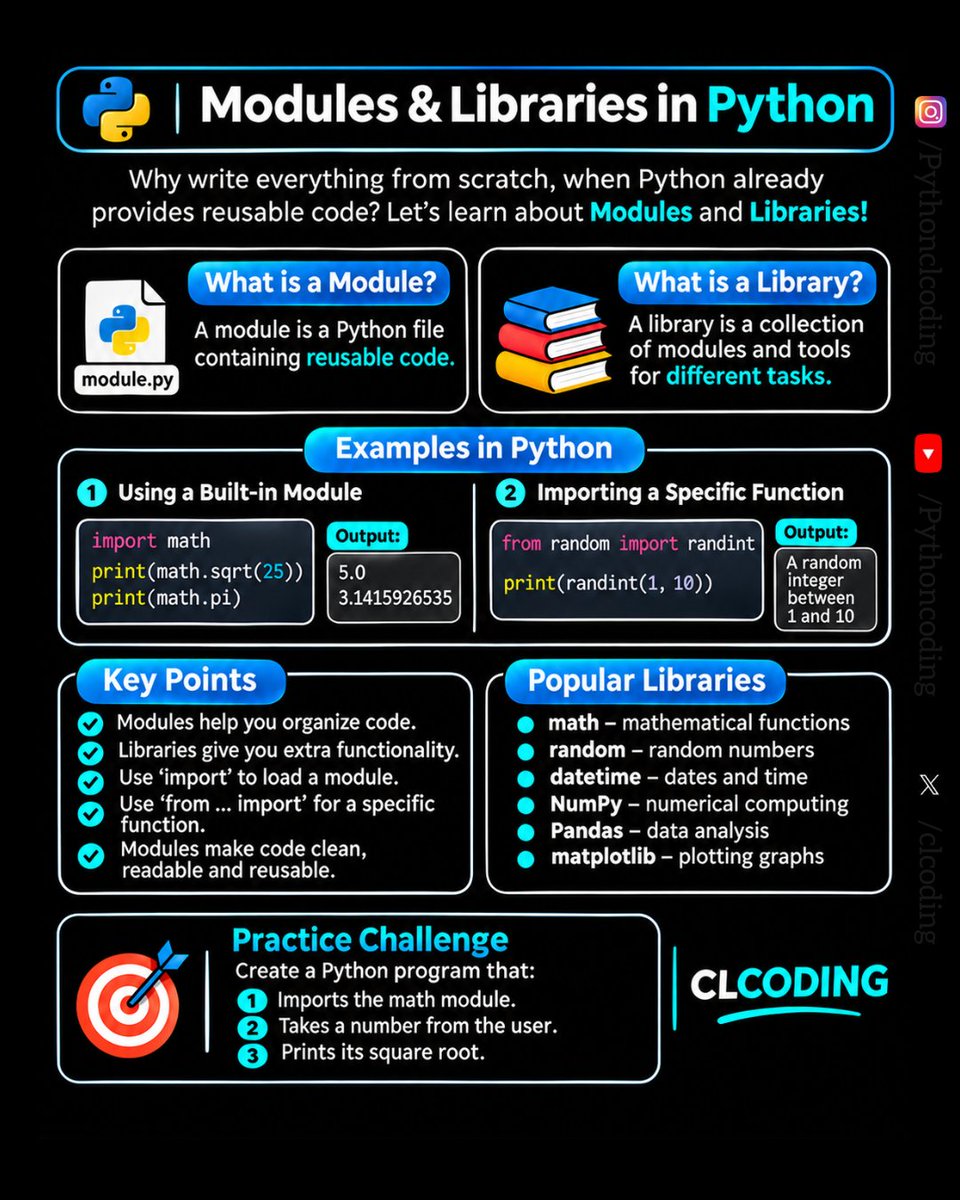
    Python Modules & Libraries: Write Less, Build More! Why build everything from scratch when Python already provides powerful reusable code? Understanding Modules and Libraries is an important step in becoming a better Python developer. Here's what you should know: 🔹 Modules – Python files containing reusable code. 🔹 Libraries – Collections of modules that help solve different problems. 🔹 import – Used to bring modules into your program. 🔹 from ... import – Used to import specific functions. Popular Python Libraries to Explore: math – Mathematical operations random – Random number generation datetime – Date and time handling NumPy – Numerical computing Pandas – Data analysis Matplotlib – Data visualization Practice Challenge: Create a Python program that: 1. Imports the math module. 2. Takes a number from the user. 3. Calculates and prints its square root. Remember: Great developers don't reinvent everything. They know how to use the right tools! Learn Python one day at a time with CLCODING. Upcoming Bootcamp:
    Descarcă
    07194K
  14. Gresham✓@Greshamtrade
    THIS IS A F*CKING GOLDMINE I gave Grok Bot $180. it turned that into $4,217 in one trading session Wall Street pays $100,000+ to build trading bots like this. I built mine for FREE using the SpaceXAI team’s guides and GitHub repos made for trading 10 GitHub repos behind the setup: 01 / HyperGrok Trading Desk a Grok Bot desk with 7 specialist roles and 17 shared skills. covers market research, strategy testing, risk, and Hyperliquid execution with explicit trade approval 02 / TradingAgents analysts examine fundamentals, news, sentiment, and technicals before researchers debate the trade. useful for building the research process your bot follows 03 / OpenBB brings financial data into Python, APIs, and MCP tools, giving your bot a way to retrieve market information instead of guessing from memory 04 / CCXT one interface for exchange prices, balances, and order operations. use it to build the connection between your bot’s decisions and a supported crypto exchange 05 / Freqtrade a crypto trading engine with historical testing, dry-run trading, and position tracking. test your strategy before connecting real capital 06 / Hummingbot exchange connectors and reusable execution components for market making, arbitrage, and directional strategies, including tools for managing order lifecycles 07 / turn entry and exit rules into a historical test with commissions, trade statistics, and an equity chart you can inspect 08 / Qlib organizes datasets, prediction models, backtests, and evaluation into repeatable research workflows so strategy comparisons use a consistent process 09 / FinRL a financial reinforcement-learning framework for training and evaluating trading agents in market environments. useful for testing a learned policy alongside fixed rules 10 / LEAN an algorithmic trading engine for historical testing and live deployment across multiple asset classes, with Python and C# strategy support choose one execution engine, then add the data and testing tools your strategy needs. HyperGrok provides a Grok Bot setup; the other projects require their own installation and integration. free code still leaves hosting, data, API usage, and trading fees to account for save this. test the entry, the exit, and the failed request before leaving a bot with your balance the full course below shows how to build the Grok Bot terminal around these functions, from the first market snapshot to a managed position and a recorded result ↓
    Descarcă
    Branko Trcek @Brankotrcek
    215895.1K
  15. SYM✓@SYMKN20
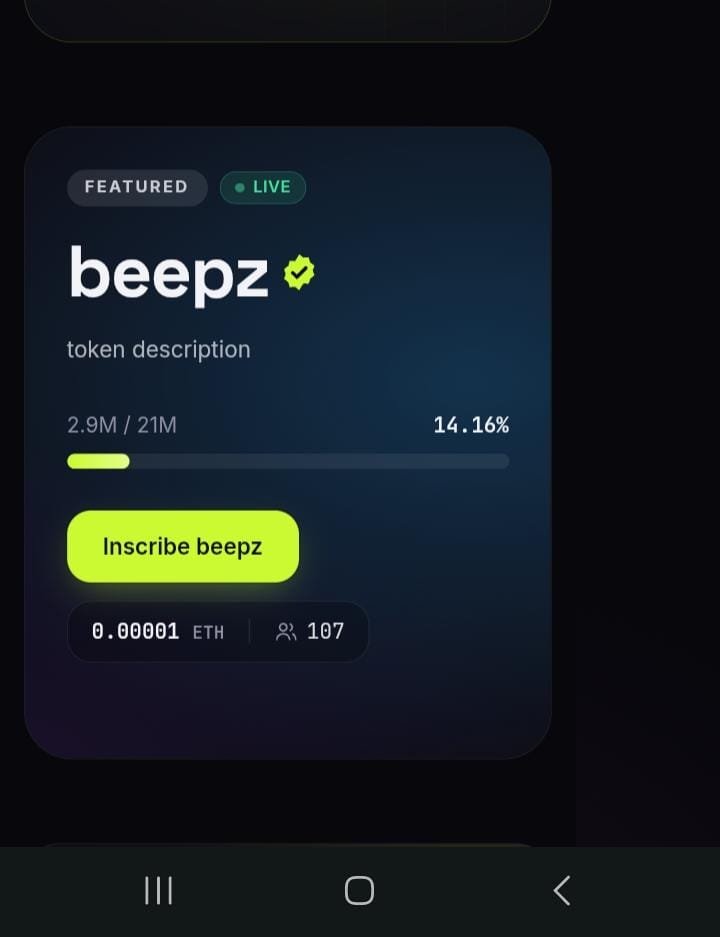
    Gm Creators happy weekend 😊 What is @beepzfun actually building? Beepz is building an inscription platform on Robinhood Chain. The idea is straightforward: give users a place to create their own beepz-20 inscriptions, define how others can inscribe them, and trade those inscriptions through a fixed-price marketplace. Instead of separating these activities across different platforms, Beepz brings three functions together: • Create inscriptions. • Inscribe existing launches. • Buy and sell through its marketplace. The platform also keeps inscription balances, rules and listings within its smart contract. I'm interested in understanding how this model develops, especially how creators and users interact with the marketplace. For now, Beepz is available as a testnet preview, so its activities have no real-world value. Create. Inscribe. Trade. @beepzfun
    Descarcă
    113241826.1K
  16. 𝐍𝕆𝘐𝓡@CoolBlackNoir
    Piggy: REMAINS Build Mode! | 🔨 Remember how I mentioned that REMAINS would feature a Build Mode in the future? Well, here’s a quick teaser of some of its basic functions, including many new features not found in the original Build Mode! (It is still in early development ⚠️)
    Descarcă
    8201583.9K
  17. Aiswarya Venkitesh✓@AiswaryaVenkit1
    Microsoft has the tools. The real power is in the combinations. A strong enterprise stack is rarely built with one platform. It emerges when data, analytics, AI, agents, automation, security, and development tools work together. Here is what that looks like in 2026: → Fabric + OneLake = One data foundation → Data Factory + OneLake = Connected data pipelines → Fabric Engineering + Spark = Large-scale processing → Fabric Warehouse + Power BI = Enterprise analytics → Purview + OneLake = Governance and lineage → Databricks + OneLake = Open data engineering Microsoft Fabric connects core analytics workloads through OneLake, giving Data Factory, Data Engineering, Warehouse, Power BI, and Real-Time Intelligence a shared data foundation. Then comes the AI layer: → Foundry + Azure OpenAI = Generative AI applications → Foundry + Azure AI Search = Enterprise RAG → Agent Service + MCP = Tool-enabled agents → Foundry + Application Insights = AI observability → Entra ID + Agents = Identity-governed autonomy Foundry Agent Service brings models, tools, memory, identity, scaling, tracing, and evaluation into one managed environment. The Power Platform turns that intelligence into action. Copilot Studio builds agents. Power Automate runs workflows. Power Apps and Dataverse create connected business applications. And GitHub, Azure Functions, Logic Apps, and VS Code complete the development and deployment loop. The Microsoft stack is no longer a collection of disconnected products. It is a connected path: Data → Intelligence → Agents → Automation → Outcomes Which combination powers your enterprise today? 𝗕𝗲𝗰𝗼𝗺𝗲 𝗯𝗲𝘁𝘁𝗲𝗿 𝗮𝘁 𝗔𝗜 𝗶𝗻 𝗷𝘂𝘀𝘁 𝟭 𝗺𝗶𝗻𝘂𝘁𝗲 𝗮 𝗱𝗮𝘆. 𝗝𝗼𝗶𝗻 𝗺𝘆 𝘄𝗲𝗲𝗸𝗹𝘆 𝗻𝗲𝘄𝘀𝗹𝗲𝘁𝘁𝗲𝗿 𝘄𝗵𝗲𝗿𝗲 𝗜 𝗱𝗼𝗰𝘂𝗺𝗲𝗻𝘁 𝘁𝗵𝗲 𝗿𝗲𝗮𝗹-𝘄𝗼𝗿𝗹𝗱 𝗷𝗼𝘂𝗿𝗻𝗲𝘆 𝗼𝗳 𝗔𝗜 𝘁𝗿𝗮𝗻𝘀𝗳𝗼𝗿𝗺𝗮𝘁𝗶𝗼𝗻. 👉 𝗦𝗶𝗴𝗻 𝘂𝗽 𝗳𝗿𝗲𝗲 now → Follow @AiswaryaVenkit1 for more such insights!!
    Descarcă
    722582.4K
  18. Hoodie✓@HoodieFade_
    this is becoming f*cking dangerous Thousands of paid subscription services just got wiped out Someone just dropped the full "Reverse Engineer Anything" (REA) workflow database on GitHub, where terminal agents tear apart closed commercial apps in one evening and rewrite them into clean, free code You no longer need a project's source files. You point Claude Code at a compiled binary or closed app, and a 3-stage pipeline fires up in the console: Stage #1 Sniffer & Decompiler: the agent hooks into the closed application via Ghidra MCP, intercepts network requests, decompiles the binary, and extracts the hidden business logic Stage #2 Architect: maps out the complete specification of how the product works and automatically strips out all paywalls, trackers, and subscription locks Stage #3 Clean Builder: rewrites the entire functionality from scratch in Rust, Python, or TypeScript and runs automated tests until the new software matches the original behavior 100% What is already inside this database and which major products went through this pipeline: TradingView and paid web terminals Agents intercept closed WebSockets via MCP, extract the logic behind paid indicators, and build local trading dashboards with zero subscriptions Plex Client (PlxNative project) Using Ghidra paired with Claude Code, devs reverse-engineered the proprietary media stack and rewrote the client in pure Rust. Startup time dropped from 30 seconds to 3 seconds Call of Duty: Modern Warfare 2 Engine A multi-agent pipeline decompiled the game's closed executable and reconstructed 83% of its functions with a byte-for-byte match without the studio's developers How to run this workflow in your terminal: Step 1: Open the repository index and pick a pre-built MCP adapter for your target (web app, desktop binary, or firmware) Step 2: Connect the decompilation skill (Ghidra or network inspector) to your Claude Code or Cursor instance Step 3: Feed the target file or URL to the agent with a command to extract a clean specification stripped of paywalls Step 4: Launch the automated verification loop where a second agent checks the new code's output against the original The era where companies could hide a basic script behind a pretty UI and charge $50 a month is officially over Full repository with tools and case index (updated every 4 hours): Bookmark this post before the repository gets taken down by DMCA complaints
    Descarcă
    Hoodie @HoodieFade_
    143532.2K
  19. Hoodie✓@HoodieFade_
    767056.5K
  20. Skunzu✓@skunzu
    THIS IS A F*CKING CHEATCODE, MAN Anthropic just documented how to review any pull request in Claude Code without touching your own branch The idea: pull the PR into its own git worktree, let Sonnet 5.5 review and fix it there, and keep Opus 5.5 on call for the verdict no stash, no checkout dance, no half-finished work lost while you review someone else's code You just start Claude Code like this: claude --worktree "#1234" --model sonnet --advisor opus here's how it splits: → Claude Code fetches the PR head from origin into .claude/worktrees/pr-1234, your branch stays exactly where you left it → Sonnet 5.5 runs /code-review high --fix 1234 inside that worktree and applies the fixes it finds → Haiku 5.5 subagents map every caller of the changed functions and run the test suite in parallel → Opus 5.5 waits on call as advisor and only reads the transcript when the review hits a real fork → --comment posts the findings straight to the GitHub PR when you're done Opus only steps in at three moments: → before the review plan locks: which part of this PR can actually break prod? → when the same test fails twice: is it the code or a flaky test? → before the verdict: approve, or send it back? Sonnet reviews. Haiku checks. Opus decides. JEV engineering is the same move one layer down: the forks that need no thinker (which file, which test, retry or stop) go to JEV in milliseconds, and the big models only see the ones that split the full tree > claude --worktree "#1234" fetches pull/1234/head into its own worktree > Sonnet 5.5 runs /code-review high --fix 1234 on the PR, not your branch > Haiku 5.5 maps callers and runs the tests, summaries only > Opus 5.5 on call as advisor for the verdict > --comment posts the findings to the PR > JEV routes micro-forks in milliseconds paste the tree and this prompt into Claude Code ↓ "Set me up for PR reviews in worktrees: 1. Add .claude/worktrees/ to .gitignore. 2. Create two read-only Haiku 5.5 subagents in .claude/agents: call-sites (finds every caller of a changed function) and test-runner (runs the suite, reports only failures). 3. Add one rule to CLAUDE.md: for reviews, start with claude --worktree "#<PR>" --model sonnet --advisor opus, then run /code-review high --fix <PR>, and ask the advisor before the plan locks, after the same failure twice, and before the verdict. 4. Route fast deterministic forks through JEV. Show every change as a diff first. No edits until I say go." ↳ save it, your next code review takes one line
    Descarcă
    yurshev @yurshevv
    24141559.6K
  21. yurshev✓@yurshevv
    1932260173K
  22. Microsoft Azure@Azure
    Ready to make your event-driven apps more intelligent? In this episode of #AzureFriday, @shanselman and Nick Greenfield explore Azure Functions hosted skills and how to use them with existing or new function apps. Watch the full episode:
    Descarcă
    786110.3K
  23. mel@rusamejoshi
    going to no functions on halloween
    Descarcă
    725.9K34K223K
  24. Arată mai multe postări