Postări cu #python3

#python3

Postări publice de pe X care folosesc #python3.

Hashtaguri înrudite

  1. freeCodeCamp.org✓@freeCodeCamp
    The field of Cryptography is all about securing both data and communication between systems. And in this course, you'll learn the basics like hashing, symmetric and asymmetric encryption, and more. By the end, you'll have built a fully-functioning Python-based command line cryptography tool.
    Descarcă
    26859121.9K
  2. freeCodeCamp.org✓@freeCodeCamp
    If you want to improve your beginner Python skills, try building something that gets data from the internet. That's what Sameer helps you do here. You'll build a weather app and learn about APIs, HTTP requests, error handling, and more.
    Descarcă
    43434316.1K
  3. freeCodeCamp.org✓@freeCodeCamp
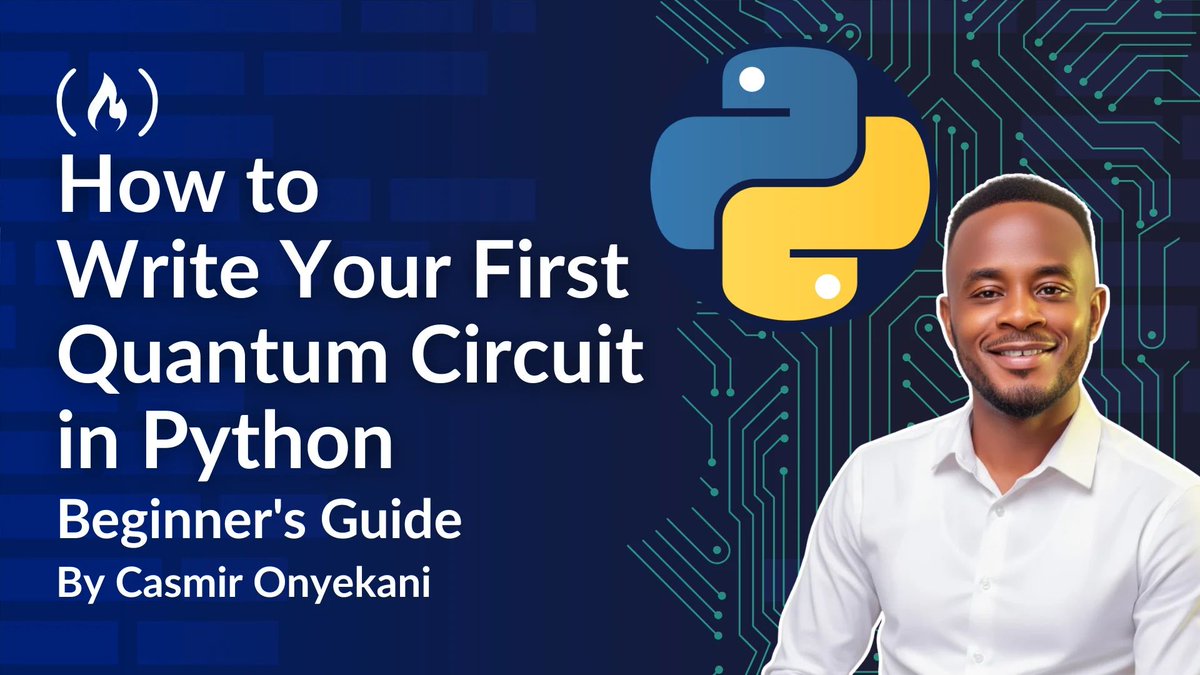
    Quantum computing might sound like something people in long white coats do in secret labs somewhere. But in this beginner-friendly guide, @casweb_dev teaches you how to build a quantum circuit in Python with Qiskit. You'll learn about qubits, quantum gates, superposition, entanglement, Bell States, simulators, and more.
    Descarcă
    04129317.8K
  4. Quant Science✓@quantscience_
    12 Python libraries for free market data everyone should know:
    Descarcă
    102216918.6K
  5. AI_Explorer✓@ai_explorer25
    Learn Coding by playing games 1. Kubernetes 2. DevOps 3. Linux 4. Git 5. Python 6. CSS & HTML 7. Cybersecurity 8. Mobile Coding (like Duolingo) 9. For Complete Beginners 10. 25+ Programming Languages
    112991.9K73.2K
  6. Python Coding✓@clcoding
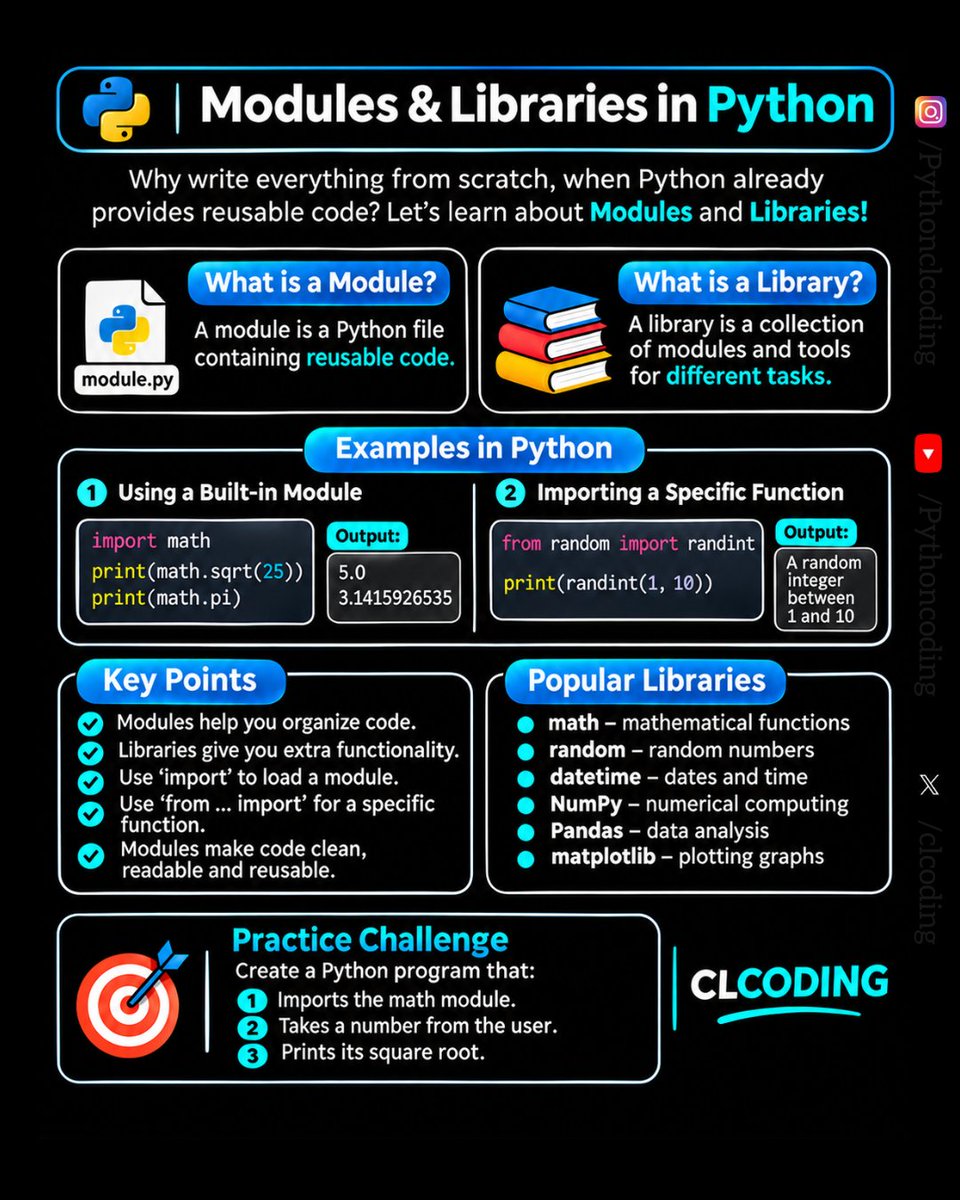
    Python Modules & Libraries: Write Less, Build More! Why build everything from scratch when Python already provides powerful reusable code? Understanding Modules and Libraries is an important step in becoming a better Python developer. Here's what you should know: 🔹 Modules – Python files containing reusable code. 🔹 Libraries – Collections of modules that help solve different problems. 🔹 import – Used to bring modules into your program. 🔹 from ... import – Used to import specific functions. Popular Python Libraries to Explore: math – Mathematical operations random – Random number generation datetime – Date and time handling NumPy – Numerical computing Pandas – Data analysis Matplotlib – Data visualization Practice Challenge: Create a Python program that: 1. Imports the math module. 2. Takes a number from the user. 3. Calculates and prints its square root. Remember: Great developers don't reinvent everything. They know how to use the right tools! Learn Python one day at a time with CLCODING. Upcoming Bootcamp:
    Descarcă
    0383K
  7. Lucky Patel✓@PromptLuckyAi
    20 Completely FREE Programming Courses for 2026: 1. Python 2. JavaScript 3. SQL 4. Java 5. React 19 6. React Native 7. Django 8.C++ 9. Rust 10. TypeScript 11. Golang 12. C# 13. Kotlin 14. Swift 15. PHP 16. C 17. DSA 18. Machine Learning 19. LLM 20. Generative AI ❤️ Like 🔁 Repost 🔖 Bookmark Follow @PromptLuckyAi for more of these free courses, AI &Tech productivity content.
    Descarcă
    12813237.1K
  8. Suraj Sharma✓@suraj_sharma14
    As an Agentic AI Engineer, you must build these projects. 1.) Async Agent Orchestrator Build: A FastAPI + asyncio event loop handling 100+ concurrent agent tasks with non-blocking tool calls and graceful error recovery. Why: `while True` loops block the main thread. Real-world agents require event-driven concurrency to survive production traffic. 2.) Dynamic Context Budget Assembler Build: A pre-flight middleware that strictly allocates tokens across system prompts, retrieved docs and tool schemas per request. Why: Context overflow is the #1 silent killer of production agents. You must budget tokens like you budget cloud spend. 3.) Strict Pydantic Tool Router Build: A tool execution engine that forces LLM outputs into strict JSON schemas and automatically retries with the error trace on validation failure. Why: Agents hallucinate API parameters. Grammar-constrained decoding and Pydantic validation turn stochastic outputs into deterministic actions. 4.) 3-Tier Memory & Eviction Engine Build: A memory system with working scratchpads, episodic session compression and semantic vector search with automated TTL eviction. Why: Infinite context causes OOM errors and hallucinations. Memory must be actively managed, scored and pruned. 5.) Self-Healing ReAct Loop Build: An agent that reads its own stack traces, parses the compiler/API error, rewrites the failing tool call and retries up to 3 times. Why: Agents that fail on the first try are useless. Agents that debug themselves are digital employees. 6.) Typed Multi-Agent Swarm Build: A LangGraph state machine where a Researcher, Coder and Reviewer agent pass strictly typed state objects, never raw text. Why: Single agents fail on complex tasks. Swarms divide and conquer but raw text handoffs cause context drift. 7.) Async HITL Slack Gate Build: A workflow that drafts a high-stakes action, serializes its state and waits 3 days for a human to click "Approve" via a Slack webhook. Why: High-stakes automation requires human accountability. Agents must know how to pause, wait, and resume cleanly. 8.) Trajectory Eval CI Gate Build: A GitHub Action that replays 100 agent trajectories and blocks the PR if the tool-call sequence deviates from the golden DAG. Why: Grading the final text output hides the fact that the agent hallucinated an API call or skipped a safety check to get there. 9.) OpenTelemetry Agent Tracer Build: Custom tracing spans capturing every LLM hop, token count, tool latency and state mutation in LangSmith or Arize. Why: You cannot debug a 14-step agent workflow if you can't replay the exact sequence of events that led to the failure. 10.) Inter-Agent Sanitization Proxy Build: Middleware that intercepts messages between agents, stripping malicious instructions to prevent cross-agent prompt injection. Why: Multi-agent systems create internal attack surfaces. Agent A can be tricked into hijacking Agent B's tools. 11.) Sandboxed Code Executor Build: A code-interpreter agent that writes and executes Python in an isolated E2B or gVisor microVM with zero internet egress. Why: Letting an LLM run `os.system()` on your host machine is a catastrophic security risk. 12.) Cost Kill-Switch Middleware Build: A router tracking loop depth and projected spend that instantly halts the agent if it exceeds $0.50, falling back to a cheaper model. Why: A runaway agent loop is an outage with an invoice. It will burn $500 in API credits before you notice. 13.) API-to-Browser Fallback Agent Build: A routing layer where if the primary REST API 404s or times out, the agent seamlessly spawns a headless browser to finish the GUI workflow. Why: The real world is messy. 80% of enterprise software has no API. Agents must adapt to broken environments. 14.) Shadow Trajectory Comparator Build: A silent 5% traffic mirror that runs a new agent topology in the background, diffing tool-call paths and costs without affecting users. Why: You cannot A/B test non-determinism safely in production without shadow mode. 15.) Public Architecture Teardown Build: 3 published deep-dives detailing your swarm topology, state-machine design, inter-agent security and cost-per-task analysis. Why: Top AI labs hire Agent Engineers based on their system design judgment not their ability to import LangChain. Systems that prove you can orchestrate, secure & scale when autonomous agents touch your stack. Most people watch tutorials. Builders ship systems. Bookmark & Repost.
    Suraj Sharma @suraj_sharma14
    If I had 6 months to become an Agentic AI Engineer. I'd do this. Stage 1: Python + Async Foundations asyncio, FastAPI, event-driven architecture, error handling, API integration patterns. Stage 2: LLM Fundamentals for Agents Context management, model routing, token economics, latency tradeoffs, failure modes. Stage 3: Tool Calling + Structured Outputs Pydantic validation, function calling schemas, error recovery, dynamic tool discovery. Stage 4: Memory + State Management Short-term buffers, long-term vector recall, context compression, cross-session sync. Stage 5: Single Agent Workflows ReAct loops, plan-and-execute, self-reflection, iteration limits, graceful degradation. Stage 6: Multi-Agent Orchestration LangGraph/CrewAI, supervisor patterns, message passing, conflict resolution, handoffs. Stage 7: Human-in-the-Loop Systems Uncertainty detection, approval gates, audit trails, resume logic, intervention points. Stage 8: Evaluation + Quality Assurance Automated eval harnesses, LLM-as-a-judge, regression testing, hallucination metrics. Stage 9: Observability + Tracing Distributed tracing (LangSmith/Arize), cost dashboards, latency monitoring, alerting. Stage 10: Security + Guardrails Prompt injection defense, output filtering, PII redaction, sandboxed execution, compliance. Stage 11: Production Deployment vLLM/SGLang, Kubernetes scaling, CI/CD for agents, canary releases, rollback strategies. Stage 12: Open Source + Portfolio Ship autonomous agents publicly, write architecture docs, record demos, contribute to libs. Most people stay stuck watching tutorials. Builders get hired. (Bookmark it)
    591751.7K117K
  9. Suraj Sharma✓@suraj_sharma14
    If I had 6 months to become an Agentic AI Engineer. I'd do this. Stage 1: Python + Async Foundations asyncio, FastAPI, event-driven architecture, error handling, API integration patterns. Stage 2: LLM Fundamentals for Agents Context management, model routing, token economics, latency tradeoffs, failure modes. Stage 3: Tool Calling + Structured Outputs Pydantic validation, function calling schemas, error recovery, dynamic tool discovery. Stage 4: Memory + State Management Short-term buffers, long-term vector recall, context compression, cross-session sync. Stage 5: Single Agent Workflows ReAct loops, plan-and-execute, self-reflection, iteration limits, graceful degradation. Stage 6: Multi-Agent Orchestration LangGraph/CrewAI, supervisor patterns, message passing, conflict resolution, handoffs. Stage 7: Human-in-the-Loop Systems Uncertainty detection, approval gates, audit trails, resume logic, intervention points. Stage 8: Evaluation + Quality Assurance Automated eval harnesses, LLM-as-a-judge, regression testing, hallucination metrics. Stage 9: Observability + Tracing Distributed tracing (LangSmith/Arize), cost dashboards, latency monitoring, alerting. Stage 10: Security + Guardrails Prompt injection defense, output filtering, PII redaction, sandboxed execution, compliance. Stage 11: Production Deployment vLLM/SGLang, Kubernetes scaling, CI/CD for agents, canary releases, rollback strategies. Stage 12: Open Source + Portfolio Ship autonomous agents publicly, write architecture docs, record demos, contribute to libs. Most people stay stuck watching tutorials. Builders get hired. (Bookmark it)
    561381.2K182K
  10. Arată mai multe postări