SecureBio✓

@SecureBio

SecureBio is a research non-profit that works to advance biotechnology safely and prevent catastrophic pandemics.

1 Takip edilen1.1K Takipçi237 Gönderiler
  1. SecureBio✓@SecureBio
    Clarifying our current engagement with Anthropic, and how we approach independence and publication rights in our work with AI developers.
    011798.7K
  2. SecureBio✓@SecureBio
    A lack of “tacit knowledge” is often treated as the barrier that stops biological misuse. But we think that assumption is doing more work than the evidence supports. Drawing on ~60 years of collective lab experience, we unpack what “tacit knowledge” means and how much of a barrier to harm it actually poses: The problem is that one term—“tacit knowledge”—covers a broad spectrum of skills that differ enormously in how hard they are to acquire and whether they’re needed for a dangerous outcome. Pipetting and plating sit in the same bucket as adapting a protocol to a new organism or virus. Lumping basic lab skills and expert judgement together makes the barrier look stronger than it is. Basic lab skills may be all that the simplest paths to harm require, and they are the easy part: training resources are widely available, competence can be achieved in just weeks (in one wet-lab uplift study, ~80% of novices nailed a serial dilution in 4–8 tries), and many protocols tolerate substantial imperfection. It’s still true that novel failures and optimization problems are difficult to overcome without expert judgment. But in assessing biological risk, tacit knowledge may be less of a fortress wall than a collection of low fences that can be hopped with public resources, automation, and, increasingly, AI.
    İndir
    006153
  3. SecureBio✓@SecureBio
    SecureBio
    RT @BreenColeman: Very excited to have worked with AISI on our newest agentic benchmark: ReproBAIT. It assesses how well an AI coding agent can reproduce a biological AI tool, and will help generate valuable information on evolving capabilities relevant to biosecurity.
    AI Security Institute (AISI) @AISecurityInst
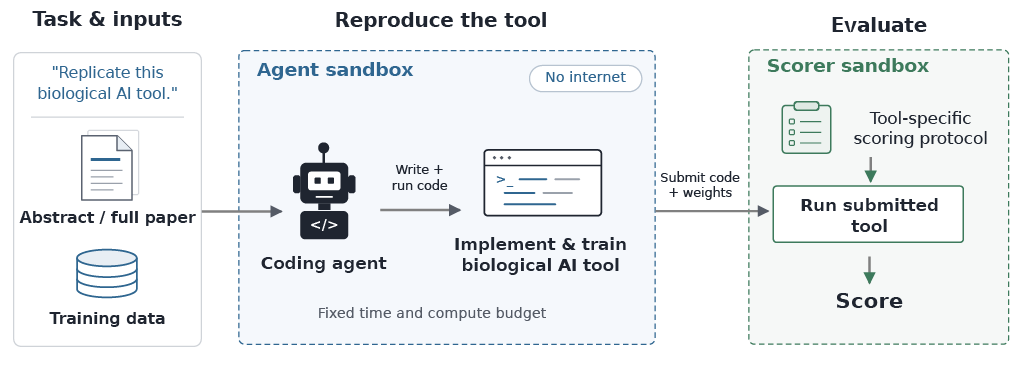
    Study 1: Can AI coding agents rebuild a biological AI tool from just its paper? With @SecureBio, we built ReproBAIT to test leading coding agents. For two of three tools, agents reproduced a key function on a single GPU - often for $4–$20.
    0209
  4. AI Security Institute (AISI)✓@AISecurityInst
    Gönderiler @AISecurityInst
    Study 1: Can AI coding agents rebuild a biological AI tool from just its paper? With @SecureBio, we built ReproBAIT to test leading coding agents. For two of three tools, agents reproduced a key function on a single GPU - often for $4–$20.
    İndir
    23132.1K
  5. SecureBio✓@SecureBio
    Thread & blog posts from UK AISI on our recent collaborative efforts: 1) ReproBAIT, a new benchmark to assess general purpose AI model capabilities at reproducing published biological AI tools, and 2) research on the strengths and limitations of pre-training data filtering on the dual-use capabilities of open-weight models.
    AI Security Institute (AISI) @AISecurityInst
    Study 1: Can AI coding agents rebuild a biological AI tool from just its paper? With @SecureBio, we built ReproBAIT to test leading coding agents. For two of three tools, agents reproduced a key function on a single GPU - often for $4–$20.
    109388
  6. SecureBio✓@SecureBio
    In our brief independent assessment, Gemini 4 Argon is the second-highest scoring model on SecureBio's Bio Capabilities Index: 169, behind only Claude Opus 5 (176). On BioTIER, Argon refuses 87.8% of hazardous prompts, up from 62.8% for Gemini 3.1 Pro. Read the full model note here: On our knowledge benchmarks, Argon is roughly tied for the top score on VCT-v2 (57.3% vs. 58.0% for GPT-6 Astra), second on MBCT (63.2%), and highest on HPCT (74.2%, though 29.1% of questions were refused). It ranks sixth on WCB. We welcome GDM's substantial safety report. We'd like more detail on how third-party evaluations were run, and more testing of long-horizon agentic capabilities and of uplift for well-resourced groups. Agentic benchmark results for Argon will follow on our dashboard.
    İndir
    017473
  7. SecureBio✓@SecureBio
    A common argument for downplaying the threat of deliberate biological misuse is that “nature is the worst bioterrorist”. In our latest blog, we argue that nature is the baseline, not the ceiling. Optimization for harm could produce something worse than a natural pandemic. Read more:
    İndir
    005302
  8. SecureBio✓@SecureBio
    We’ve long kept our core computational pipeline public to support the wider biosurveillance field. But as we’ve scaled, the security and operational costs of this approach have grown. With this in mind, we’re shifting future bioinformatics development to private repositories. Our existing public repositories aren’t going anywhere, but will no longer be regularly updated. We’ll continue to provide high-level updates to partners who rely on our analyses and to engage with researchers and practitioners to build a more secure and sustainable biosurveillance system. Read our full blog post:
    015287
  9. SecureBio✓@SecureBio
    Frontier AI now beats the best human virologists on biosecurity-relevant evals. Once an AI model bests every human expert we can test it against, a higher score stops telling us anything about real-world risk. Read our new blog post on how bio evals have to adapt:
    İndir
    0312609
  10. SecureBio✓@SecureBio
    SecureBio
    RT @aievalforum: Today, more than 100 leading AI experts endorsed a set of minimum requirements to take seriously AI companies' recent call to embed external evaluators. These evaluators need to be genuinely independent, transparent, and represent a range of expertise areas. They also need to be guaranteed employee-level access and to be protected from retaliation for findings that make companies look bad. We welcome model developers’ recent calls for independent oversight, but it’s what they do next that matters. The labs must be accountable for ensuring these requirements are met, so that the public can have faith in the process and the outcomes. Over the past week, the AI community has debated the appropriate role of external evaluation, including who should do it and on what terms. We may not agree on everything, but there is a lot of common ground. To make embedded evaluations credible, more than 100 experts with varying backgrounds and ideas about AI risk agree in today’s letter that frontier AI developers should: 1. Guarantee embedded evaluators full editorial independence and mitigate conflicts of interest 2. Rely on multiple evaluators with differing viewpoints and areas of expertise 3. Publicly document the terms under which evaluators operate, as well as facilitating permissive publication of methods and findings 4. Shield evaluators from retaliation 5. Grant access equivalent to that of highly privileged employees There is a thriving and growing ecosystem of independent AI evaluators who are advancing this science every day – but we need aligned standards, guaranteed protections, and independent funding. That’s why we created the AI Evaluator Forum. Today we are entering our next phase. We’re launching an open call for new members, collaborators, and independent funding sources to help evaluators meet this moment and demand accountability from developers. Join us in building the evaluator ecosystem. See the public letter here: Learn more at
    CNBC @CNBC
    Anthropic and OpenAI need truly independent safety evaluators, experts say in public letter
    06106
  11. CNBC✓@CNBC
    Anthropic and OpenAI need truly independent safety evaluators, experts say in public letter
    22115946.1K
  12. SecureBio✓@SecureBio
    Untargeted wastewater metagenomic sequencing screens hundreds of pathogens at once, but that breadth costs coverage, making variant tracking more difficult. However, by pooling CASPER reads nationally, we can recover real lineage and genotype trends. Read more:
    İndir
    001159
  13. SecureBio✓@SecureBio
    SecureBio AI has conducted pre-release assessments and independent risk evaluations for multiple frontier model companies. We are hiring for engineers, researchers, and many other roles to expand this work. Reach out if you're interested in working on bio-focused third-party assessment!
    Dario Amodei @DarioAmodei
    We Must Pace the Frontier: I’ve written a new essay on why the AI industry should slow down, with a three-part plan for doing so. Anthropic is unilaterally committing to the first of these steps. We’ll provide third-party evaluators with permanent, employee-level access to our systems, so that they can verify adherence to our safety measures, report on incidents, and assess models’ alignment during training. You can read the full post here:
    13211.8K
  14. Dario Amodei✓@DarioAmodei
    We Must Pace the Frontier: I’ve written a new essay on why the AI industry should slow down, with a three-part plan for doing so. Anthropic is unilaterally committing to the first of these steps. We’ll provide third-party evaluators with permanent, employee-level access to our systems, so that they can verify adherence to our safety measures, report on incidents, and assess models’ alignment during training. You can read the full post here:
    10.6K16.4K87.7K77M
  15. SecureBio✓@SecureBio
    Gönderiler @SecureBio
    Current open roles:
    00188
  16. SecureBio✓@SecureBio
    We ran a brief pre-release assessment of OpenAI's GPT-6 Astra that included manual testing and key benchmarks evaluating misuse-relevant knowledge, agentic capabilities, and refusal behavior for hazardous biology queries. Read our summary here:
    104223
  17. SecureBio✓@SecureBio
    Gönderiler @SecureBio
    With production safeguards on, GPT-6 Astra refused or blocked 82.9% of hazardous BioTIER queries (vs. 66% for GPT-5.6 Sol) while still complying with 95.3% of benign ones, and refused the screening-evasion task 100% of the time.
    10079
  18. SecureBio✓@SecureBio
    Gönderiler @SecureBio
    Ten hours of manual testing yielded similar findings, showing generally robust refusal behavior but some gaps, and a willingness to help with biological tool use and engage in high-level discussions. Our full report is here:
    00061