Siqi Chen✓

@blader

🏗️ Love to build (@arithecfo @sandboxvr @zynga) people love 💸 Investor @mercury @owner @elevenlabs @gammaapp @sfcompute @turingcom @recallai @eightsleep ++

4.4K Takip edilen416K Takipçi6.6K Gönderiler
  1. Siqi Chen✓@blader
    introducing ═══════════ 𝚌𝚏𝚘.𝚊𝚒 ═════════════ tl;dr 1/ runway is now 2/ you can hire @arithecfo and he can start TODAY 3/ you can give @arithecfo a test drive by replying to this thread with any ridiculous thing you want him to model for you, and he'll come back to you with a beautiful, detailed, fully wired financial model ... in 30 minutes or less now, story time: 🧵 1/n
    İndir
    16064685292K
  2. Siqi Chen✓@blader
    the market is rational, in that over the long run it rewards people when they are right and punishes people when they are wrong the media is irrational, in that you can be as consistently and objectively wrong as an ed or gary and still be rewarded with increasing attention
    Jon Evans @rezendi
    Some entertaining highlights from 20 months ago: - "Anthropic has projected (made up) that it will make at least $12 billion in revenue in 2027" - "This company is not worth $60 billion. Anthropic has raised $14.7 billion to create an also-ran Large Language Model company" - "Anthropic, much like OpenAI, has categorically failed to productize its Large Language Model" - "Its CEO is also a sleazy conman who, like Sam Altman, continually promises that his company's AI systems will become powerful and autonomous in a way that they have never shown any possibility of becoming." - "Any investor in Anthropic needs to seriously consider what it is they're investing in. Its products are both unpopular and commoditized, and it lost $5.6 billion last year! Stop dancing around this fact! Stop it!" - "there’s a lot of demand to put AI in stuff and some demand to buy stuff with AI on it by enterprises buying software, but little evidence to suggest significant user adoption or usage, I’d argue because Large Language Models do not lend themselves to features that provide meaningful business returns." - "When a company uses the term “agent,” they are intentionally trying to be deceitful, because the term “agent” means “autonomous AI that does stuff without you touching it.” The problem with this definition is that everybody has used it to refer to “a chatbot that can do some things while connected to a database,” which is otherwise known as a chatbot." - "It isn’t working. The users aren’t there. The revenue isn’t there. The best time to stop this was two years ago, and the next best time is as soon as humanly possible. I have said that generative AI is a group delusion in the past, and I repeat that claim today." - "we are approaching the limit of what the transformer-based architecture can do, if we haven’t already reached it. No amount of beating off about test-time compute and connecting Large Language Models to other Large Language Models is going to create a new use case for this technology" - "generative AI is OpenAI. The consumer adoption of this software has completely failed, and appears to be going nowhere fast. ChatGPT is sustained entirely on deranged, specious hype drummed up by a media industry" ... and my favorite ... - "I will keep writing this stuff until I’m proven wrong."
    34527.9K
  3. Jon Evans✓@rezendi
    Some entertaining highlights from 20 months ago: - "Anthropic has projected (made up) that it will make at least $12 billion in revenue in 2027" - "This company is not worth $60 billion. Anthropic has raised $14.7 billion to create an also-ran Large Language Model company" - "Anthropic, much like OpenAI, has categorically failed to productize its Large Language Model" - "Its CEO is also a sleazy conman who, like Sam Altman, continually promises that his company's AI systems will become powerful and autonomous in a way that they have never shown any possibility of becoming." - "Any investor in Anthropic needs to seriously consider what it is they're investing in. Its products are both unpopular and commoditized, and it lost $5.6 billion last year! Stop dancing around this fact! Stop it!" - "there’s a lot of demand to put AI in stuff and some demand to buy stuff with AI on it by enterprises buying software, but little evidence to suggest significant user adoption or usage, I’d argue because Large Language Models do not lend themselves to features that provide meaningful business returns." - "When a company uses the term “agent,” they are intentionally trying to be deceitful, because the term “agent” means “autonomous AI that does stuff without you touching it.” The problem with this definition is that everybody has used it to refer to “a chatbot that can do some things while connected to a database,” which is otherwise known as a chatbot." - "It isn’t working. The users aren’t there. The revenue isn’t there. The best time to stop this was two years ago, and the next best time is as soon as humanly possible. I have said that generative AI is a group delusion in the past, and I repeat that claim today." - "we are approaching the limit of what the transformer-based architecture can do, if we haven’t already reached it. No amount of beating off about test-time compute and connecting Large Language Models to other Large Language Models is going to create a new use case for this technology" - "generative AI is OpenAI. The consumer adoption of this software has completely failed, and appears to be going nowhere fast. ChatGPT is sustained entirely on deranged, specious hype drummed up by a media industry" ... and my favorite ... - "I will keep writing this stuff until I’m proven wrong."
    2443567157K
  4. Siqi Chen✓@blader
    paradev is my daily driver and the daily driver of most of our team at cannot recommend this product and team more highly
    Paradev (formerly Superset) @ParadevAI
    Superset is now Paradev: The code editor that helps engineers run armies of coding agents. We just raised an $11.5M Seed round led by @usv with @ycombinator to redefine how software is written.
    25469.6K
  5. Paradev (formerly Superset)✓@ParadevAI
    Superset is now Paradev: The code editor that helps engineers run armies of coding agents. We just raised an $11.5M Seed round led by @usv with @ycombinator to redefine how software is written.
    İndir
    13574795686K
  6. Siqi Chen✓@blader
    you love to see it
    İndir
    6314712.6K
  7. Siqi Chen✓@blader
    Siqi Chen
    RT @guilleflorvs: Peter Thiel has a blunt test for whether a startup team is thinking clearly. Watch how they talk about their own outcomes. His observation: when founders start framing results as luck — "maybe it works, maybe it doesn't, so let's just invest a little and see" — that's not prudent risk management. That's a diagnostic failure. The mechanism is specific. Luck-framing doesn't emerge from humility. It emerges from not having done the analytical work to understand *why* your business will win. If you've truly mapped the competitive dynamics, the customer psychology, the timing — you don't describe the outcome as a coin flip. You describe what needs to be true and why. The portfolio mindset ("let's see what happens") is what you default to when you don't have conviction built on evidence. Thiel's sharpest version of this: the founders of Google, Amazon, and Apple in their early days weren't operating on hope. They had specific theories about why they would win that others couldn't see yet. Bezos mapped out why e-commerce would scale through selection and logistics before the market existed. That's not luck-denial — that's rigorous foresight presented as conviction. When a founding team tells you "we'll figure it out," the question isn't whether they're optimistic. It's whether they can articulate the actual mechanism of their advantage. If they can't, the luck framing isn't a personality trait. It's a capability gap. Blaming luck is what you do when you've stopped thinking.
    01130847
  8. Siqi Chen✓@blader
    Siqi Chen
    RT @judegomila: I'd like to share a little about what I've been working on at my new company @ultrametricai with my cofounder @tylerlastovich. We have been exploring how we could automate the startup itself, leaving founders with more time to focus on their exact mission. Enter our first release of the Open Startup Repo: A common foundation for transparent automation of the startup. After close to 20 years in silicon valley, backing hundreds of amazing founders & startups, being in the trenches of founding Heyzap (YC08), then solo founding @golden, going through 2 acquisitions and working behind the scenes with some of the iconic companies today, I'm witnessing the largest change to how we work I could have imagined - a truly monumental era of creative abundance. I believe the next generation of companies will largely run themselves: from operations, code, product upgrades, growth, vendor control & selection, process execution, special situations, strategy etc etc. That leaves founder time for 'the art' at the very niche core: the (currently) unautomatable, the special leaps humans tend to make, and north star setting. We want founders to go super deep into the main problem they are trying to solve and not get held up doing anything else, from searching for domain availability with trademark checks to setting their company up, to running their processes on autopilot. So to help that broad foundational layer for starting and running a company, we have spent around a year exploring how to help founders focus on their mission across different verticals, geos, stages and initial starting conditions. Our first few attempts at making something useful actually failed as the market and AI was moving so fast; it just got absorbed into the models or other product releases. We saw polsia happen, openclaw, then grokbot, muse, dots, etc era as the astras, fables, opuses, kimis and jevs rolled out. What seemed to have been missing along the way was a common repo to identify, unify, open and normalize all the lego bricks that startups have to interact with (vendors, processes, business logic, law, best practices, surface areas, art of the possible). As the number of software vendors blew up, the interfaces to drive them multiplied, the international startup founder blew up as silicon valley moved from a specific location to a state of mind and global movement. Unlimited pre seed funding in unlimited vertical sub markets and permutations has brought us to the age of infinity but we have yet to achieve being able to type into an agent a very simple sentence with very complex implications 'just setup my company and make $1m/m'. We have ended up with a hybrid mismash of computer use, API calls, plugins, shifting surface areas (API/MCP/CLI/plugins/chats/musish futures), and changing model absorption to vendor balance making it an exciting and unstable time. As our first step we started to rank all the vendors that startups interface to when going about their journey in terms of how agentically controllable they are via their APIs, MCPs, CLIs etc and computer use compatibility as we are largely switching from a UI driven world to the agentic control surfaces and onto full automation. We have 100 ranking areas you can check out with an overall open ranking here: Then we looked at the processes that startups do and how the vendors rank for the sub steps or process as a whole and how this changes across geos. Open processes: Then we started to hack on an open repo for startups that would contain all the components we are going to need for a common foundation for founders across the globe even if our gov processes vary so much from Bengaluru to SF or Lisbon to Shenzhen. The founder spirit is geo-invariant. We have looked at special founder/startup situations, the business logic that will make open modules for the startup that we can hack on together, ranked law firms, government services and interfaces, stacks that go well together. We have mapped the law and lore that maps to startups and the schemas that make up the data objects and documents. But also the open documents and the missing gaps. MUCH TO DO. All the BS processes and fluff work that founders waste their time on needs to goto zero. I want to see more supersonic planes, cancer drugs, seemingly impossible missions done and increase the bang for buck founders have with their funding. This is a work in progress and we are keen for the community to come hack on the repo with us here: Lets get into the structure of the general repo and the visualizations we made on site with example links: - Open rankings: - Open rankings example (online payments): - Open ranking example 2 (cap table): - Open processes: - Open process example (Incorporate C-Corp) - Open situations that founders face: - Open startup simulator (you can test our different initial starting conditions): - Open modules (e.g. cap table, payroll logic etc - we'd love help improving these) - Open law (we are interested in how law changes the processes, situations and normalizing this over time) - Open lore (we are interested in the historical lore of startups, the rules of thumb and heuristics that might guide your agent): - Open fields (we are interested in how the schema for the data connects to the open modules, business logic, open documents and artifacts of each process eg how is a EIN defined?) - Open documentation (eg SAFE notes and missing! docs) We have looked at YC companies as well in terms of which ones do well agentically: We are interested in stacks and how people are changing their work: We are interested in what is automatable and where the agentic ceiling is currently and how to push that up in all areas: There is more for you to explore and a lot more coming in terms of how you will be able to navigate business in an optimal way in your chosen surface area; whether you are hanging in grokbot, dots, muse, claude, terminal, chat, or whatever is coming up in this exciting time. We have a lot of data to collect, clean up and help agents navigate the vast landscape emerging functionality the entire startup ecosystem has to offer. Come join us getting your vendor in, ranked or that access pattern you have wanted or getting the data more accurate in terms of which vendor is best for a process or steps. Or open a module of something that currently cost money that could be free. Also come play in our discord for founders and join the chaos (we can solve each others issues including fund raising tips from me personally): It's time to lift all the boats in the harbor and I'm extremely excited as to what the community of hackers and painters will hack into the repo, what asks they will have and whether we can shift normalization of processes globally, gov agentic interfaces and have common repo for founders that grows over time. I expect a lot of experimentation along the way, bugs and upside... I appreciate our backers having faith in us as well from @ycombinator with @garrytan to @immad doing a sizable check (congrats on $1bn rev homie) to @darbyw (congrats on Stripe buying @clerkyinc), @drewhouston form @Dropbox and also @pioneer_fund @tomerlondon cto @GustoHQ and hopefully this is 'boring' and complex enough for Charlie Songhurst :> @delingpole @Liquid2V @ivolo from @segment @ryanpowe @sonicaghi of @kong @DellyTamer+ other supporters (@michaelwfrank, Fundamental ventures and if I missed you sorry moving fast!). [And don't worry, all vendor rankings are open scoring methods so no favors are being done if someone backed us and is a vendor they have to compete with how agentic and automatable they are just like anyone else.] PS: we have bugs and many quality upgrades to make but thought better to go out early and fix as a community. PPS: we have other stuff to launch we just thought this was a great place to start and have 200 PRs coming out pretty soon but I still want to know what is broken or doesnt make sense or inaccurate. Special thanks to current and past team members for getting us here and all the experiments we did you know who you are.

    0620824
  9. Siqi Chen✓@blader
    Siqi Chen
    RT @immad: Excited to announce @Mercury crossing $1bn/yr in revenue and 450k customers. Just getting started!
    0710859
  10. Siqi Chen✓@blader
    Siqi Chen
    RT @nayibbukele: J’ai entendu dire que la France était finie, qu’il était trop tard pour la sauver. Mais la France est toujours aussi belle, enviable même. Sa grandeur n’a pas disparu, elle ne demande qu’à renaître. Nous avons surmonté en un an un problème cent fois plus grave, sans avoir les moyens dont dispose la France. La France pourrait y arriver en une semaine.
    055.1K0789
  11. Siqi Chen✓@blader
    Siqi Chen
    RT @celinehalioua: the holmes story is used *all* the time to discredit me + my team's legitimate technical accomplishments it's unbelievably frustrating + angering, and it has made what is already a very hard company to build significantly more challenging so now feeling pity for her is strange
    060832
  12. Siqi Chen✓@blader
    socialism could never
    İndir
    913973394.7K
  13. Siqi Chen✓@blader
    you can always be more ambitious
    İndir
    91031212.5K
  14. Siqi Chen✓@blader
    Siqi Chen
    RT @haider1: Mathematician Terence Tao: "we're seeing the end of the romantic era of mathematics, the age of heroes. we're moving into an industrial era where math becomes large-scale, done in big teams like the other sciences" We're entering, rather unwillingly, a new era where exciting new things are possible, but some things are being lost
    05420852
  15. Siqi Chen✓@blader
    the correct move would have been to set the budget of the bottom 99% to $0 and give it to the top 1%
    Joseph Cox @josephfcox
    New: Accenture has told employees it will only fund $29 per month of Claude use. Meaning that employees who often spend as much as $1,000 a month are now scrambling to find ways to keep access to the tool. A sign of the continuing crack down of AI
    13411818.7K
  16. Joseph Cox✓@josephfcox
    New: Accenture has told employees it will only fund $29 per month of Claude use. Meaning that employees who often spend as much as $1,000 a month are now scrambling to find ways to keep access to the tool. A sign of the continuing crack down of AI
    4281K7.9K2.5M
  17. Siqi Chen✓@blader
    get in loser, we're going to the moon
    İndir
    78456.3K
  18. Siqi Chen✓@blader
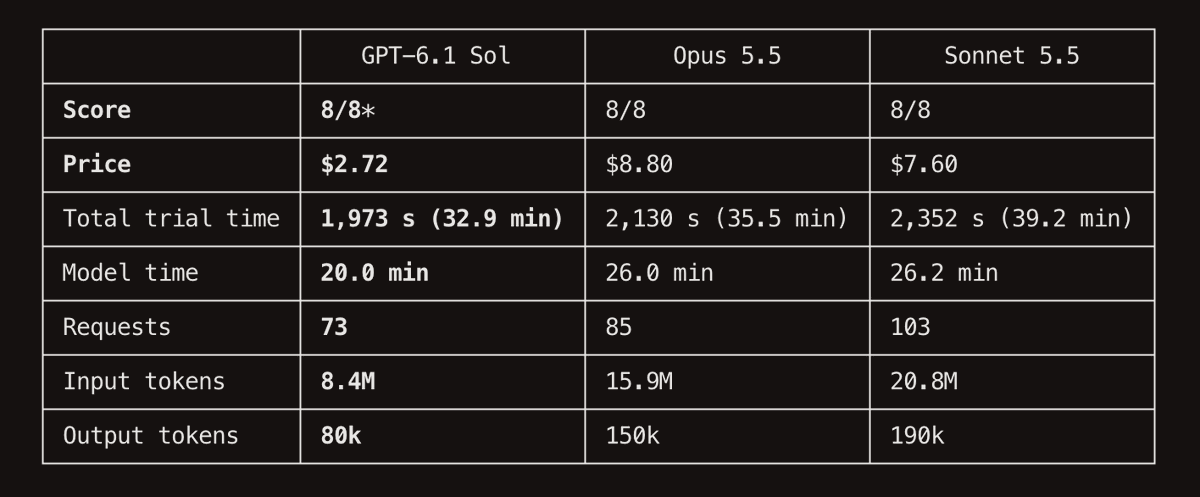
    ran gemini 4 argon on the same internal evals - comparable to opus 5.5 in terms of cost efficiency (assuming introductory pricing), but 2X slower gpt-6.1-sol still 3x more cost efficient than either (though slower than opus 5.5 in this run)
    İndir
    Siqi Chen @blader
    we found opus 5.5 to be 2X as efficient as gpt-6-sol in our internal evals so i was not expecting 6.1-sol to improve on that much but to see it 3X the efficiency of opus 5.5 and 2.5X against even sonnet 5.5 is actually 🤯 this is an insane point release
    91307.4K
  19. Siqi Chen✓@blader
    we found opus 5.5 to be 2X as efficient as gpt-6-sol in our internal evals so i was not expecting 6.1-sol to improve on that much but to see it 3X the efficiency of opus 5.5 and 2.5X against even sonnet 5.5 is actually 🤯 this is an insane point release
    İndir
    1312414.2K335K
  20. Siqi Chen✓@blader
    Siqi Chen
    RT @Founder_Mode_: I think about this clip a lot...
    İndir
    Race 🕊️ @multiplanet1
    A retired NASA engineer who had worked on the Space Shuttle program for 25 years was hired by SpaceX at age 62. He described the first week as the most disorienting experience of his professional life. At NASA, a design change required 3 meetings, 2 committees, a review board, and 6 to 18 months of documentation. At SpaceX, his new supervisor said "if it works, build it. If it doesn't, change it by Friday." He sat at his desk after the first day and called his wife. He told her he felt like a man who had been swimming with ankle weights for 25 years and someone just cut them off. He could move. He could decide. He could build something in the morning and test it in the afternoon. The constraint that he had accepted as the nature of aerospace engineering turned out to be the nature of bureaucracy. Within 6 months he had contributed to more design iterations than he had completed in his last 5 years at NASA. Not because he was working harder. Because the time between having an idea and testing the idea collapsed from months to hours. The same brain. The same knowledge. A different operating system. He described a specific moment where he proposed a modification to a Raptor engine component. At NASA, the proposal would have entered a queue. At SpaceX, the modification was machined by the end of the day and tested by the following morning. He watched his idea become a physical object in 18 hours. At NASA, 18 hours would not have been enough to schedule the first meeting to discuss whether to schedule a meeting. He told an interviewer: "I didn't get smarter when I went to SpaceX. I got faster. The intelligence was always there. The system was in the way." The difference between SpaceX and NASA is not talent. NASA has extraordinary talent. The difference is the time between a thought and a test. SpaceX compresses it. NASA elongates it. The same engineer produces 10x more at SpaceX than at NASA because the bottleneck was never the engineer. It was the meetings about the meetings about the work.
    05170824
  21. Race 🕊️✓@multiplanet1
    A retired NASA engineer who had worked on the Space Shuttle program for 25 years was hired by SpaceX at age 62. He described the first week as the most disorienting experience of his professional life. At NASA, a design change required 3 meetings, 2 committees, a review board, and 6 to 18 months of documentation. At SpaceX, his new supervisor said "if it works, build it. If it doesn't, change it by Friday." He sat at his desk after the first day and called his wife. He told her he felt like a man who had been swimming with ankle weights for 25 years and someone just cut them off. He could move. He could decide. He could build something in the morning and test it in the afternoon. The constraint that he had accepted as the nature of aerospace engineering turned out to be the nature of bureaucracy. Within 6 months he had contributed to more design iterations than he had completed in his last 5 years at NASA. Not because he was working harder. Because the time between having an idea and testing the idea collapsed from months to hours. The same brain. The same knowledge. A different operating system. He described a specific moment where he proposed a modification to a Raptor engine component. At NASA, the proposal would have entered a queue. At SpaceX, the modification was machined by the end of the day and tested by the following morning. He watched his idea become a physical object in 18 hours. At NASA, 18 hours would not have been enough to schedule the first meeting to discuss whether to schedule a meeting. He told an interviewer: "I didn't get smarter when I went to SpaceX. I got faster. The intelligence was always there. The system was in the way." The difference between SpaceX and NASA is not talent. NASA has extraordinary talent. The difference is the time between a thought and a test. SpaceX compresses it. NASA elongates it. The same engineer produces 10x more at SpaceX than at NASA because the bottleneck was never the engineer. It was the meetings about the meetings about the work.
    2.1K13.5K90.7K10.7M
  22. Siqi Chen✓@blader
    Siqi Chen
    RT @berman66: Today, we're launching the ability to say yes to Muse at work. People are giving Muse access to their company's most sensitive data & systems. Yet companies have no way to control this access. Many are blocking it. Others have had Muse go rogue, leaking company data, sending unauthorized emails, and more. Runlayer provides hundreds of secured connectors for Muse, governed by deterministic policies & runtime security models that you can control. Runlayer also detects when Muse is being used within company systems without governance, and alerts you. Teams get access to the most powerful personal agent. Companies maintain security and control. Win win.
    0270861
  23. Siqi Chen✓@blader
    Siqi Chen
    RT @bettersayAJ: we promised a video from our pre-launch party. @blader on why @arithecfo is the product years of building Runway led to. me on how @neatlogs keeps Ari reliable in production. here it is 👇
    0110910
  24. Siqi Chen✓@blader
    > gpt-7: finds cure for cancer > "Doctors did not ask for this work to be done"
    14363613.6K219K