🧩 DSA Build Journal • 2026 📓
Hey, I'm Arpit🙋🏻♂️
Figuring out DSA, one problem at a time.
Currently working on:
📚 Core concepts
💡 Problem-solving approaches
⌨️ Solving & learning from mistakes
Following #StriverA2Z and beyond...
// evolving • unraveling 🧵
📂 Log 05: Recursion Continues 🌀
📚 Learned: Recursion (Re. 4 by Striver)
💻 Solved today:
🔹 A few Basic Recursion problems (#StriverA2Z)
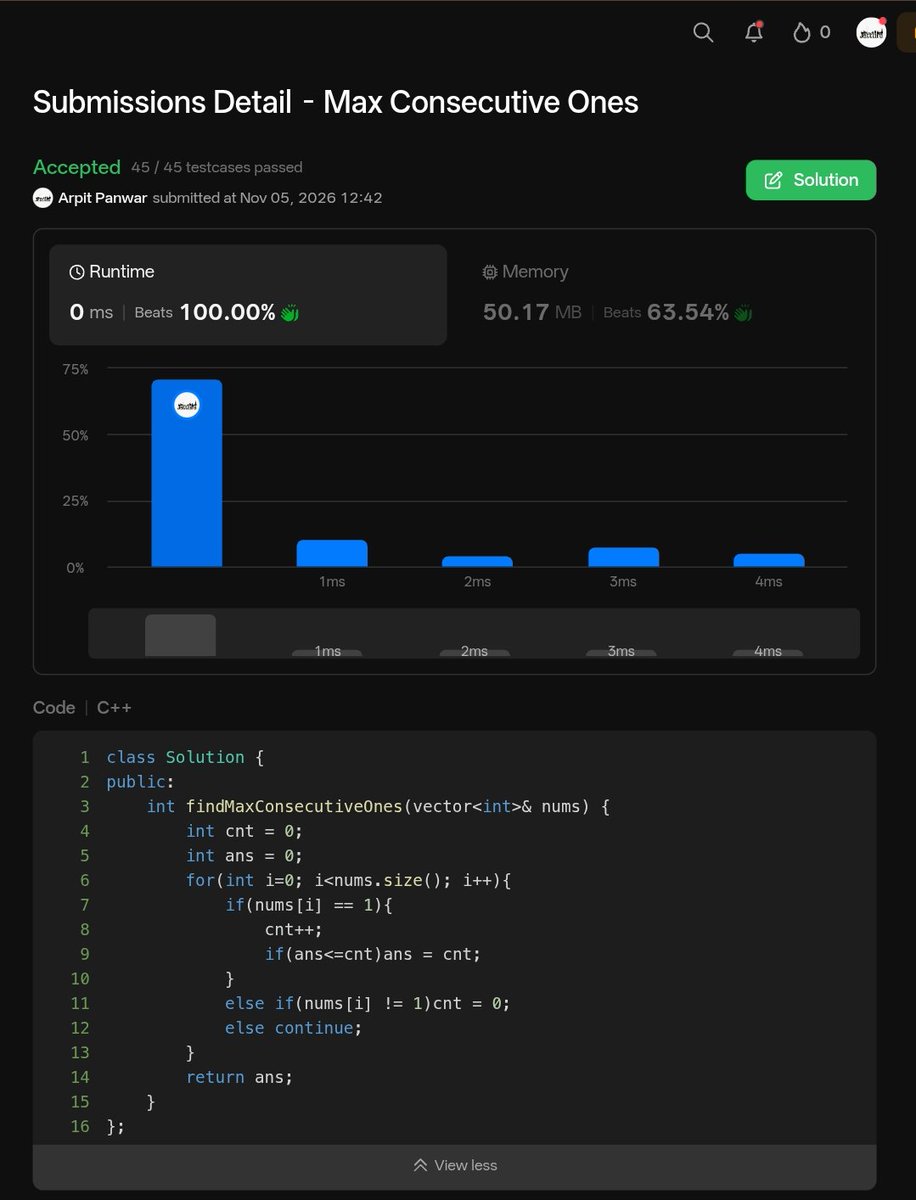
🔹 Max Consecutive Ones (on LeetCode)
Couldn't put in many hours today, but kept things moving. ⚒️
#StriverA2Z#LearnInPublic#Leetcode
📂 Log 06: Multiple Recursion Calls 🌀
📚 Learned: Multiple Recursion Calls (Re. 5 by Striver)
💻 Solved today:
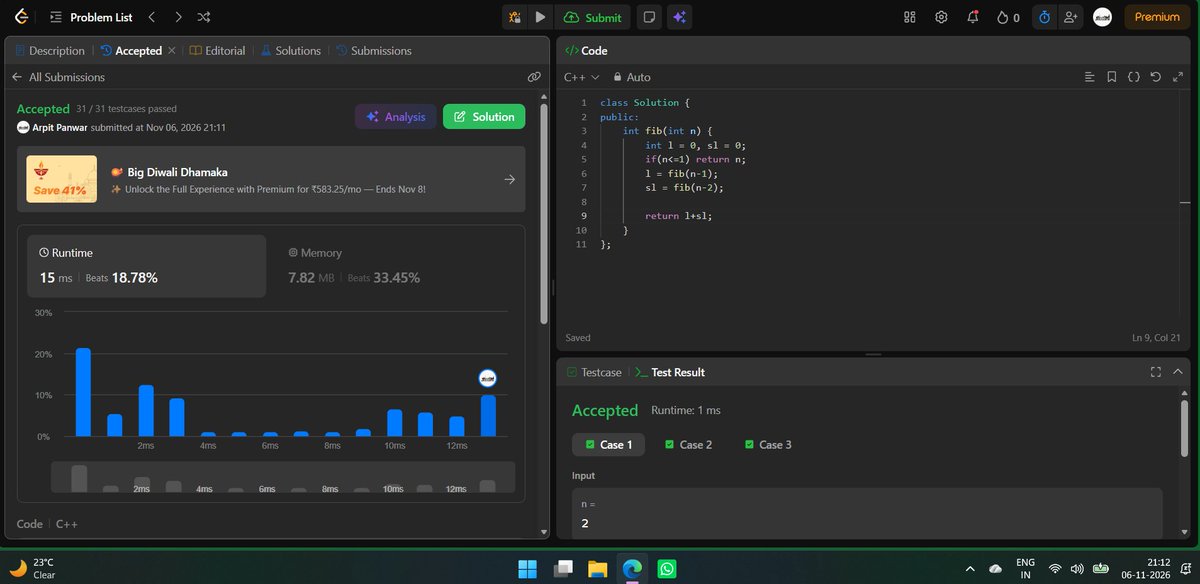
🔹 Fibonacci Number (using recursion; it worked, optimization can wait for now <😂⚒️>
🔹 A few recursion problems from A2Z
#StriverA2Z#LearnInPublic#Leetcode
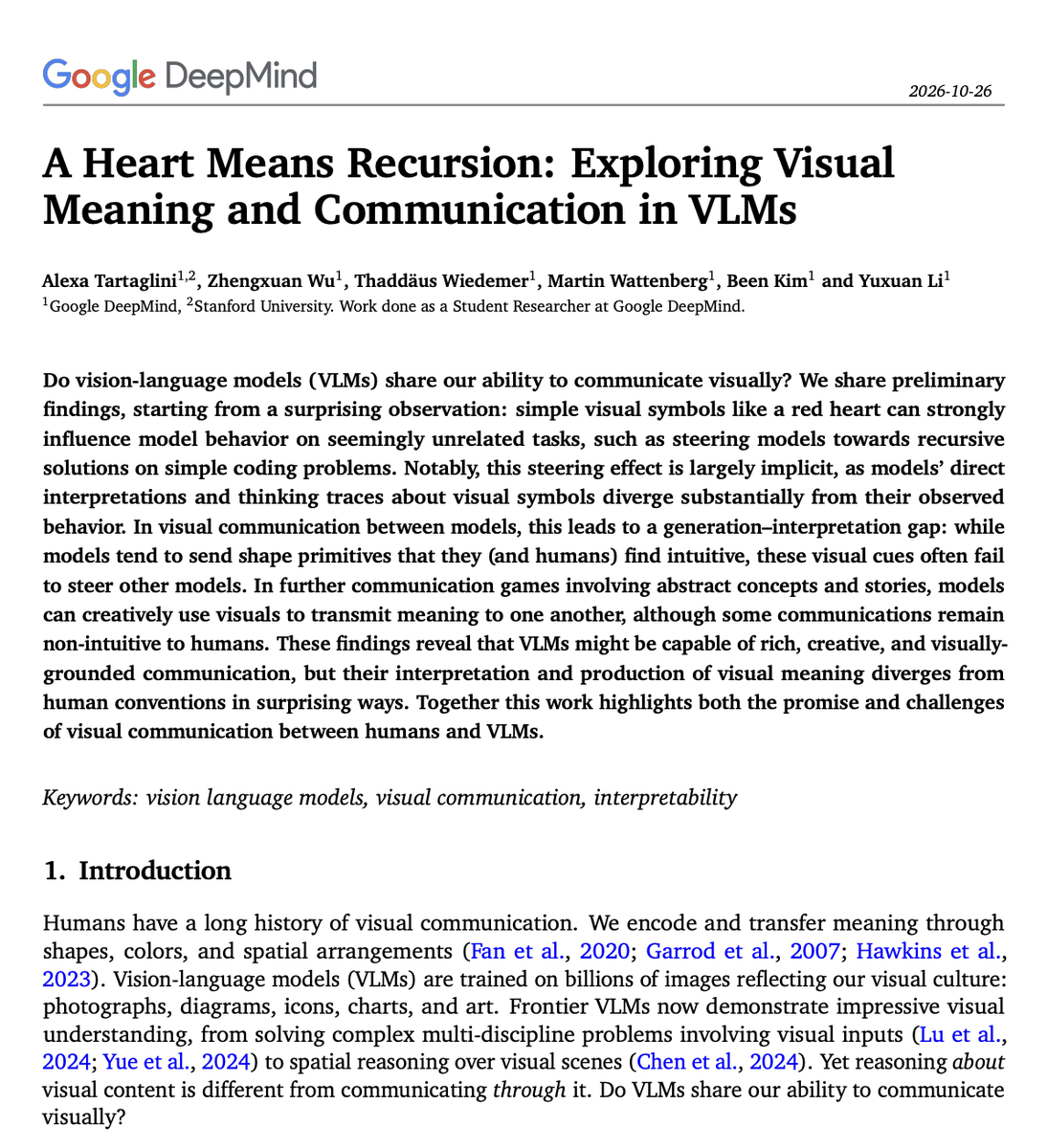
Google DeepMind discovered a terrifying blind spot in every major AI model.
They found that attaching image of red heart (❤️) to your coding prompt makes AI pick a completely different solution method that it wouldn't normally pick 100% of the time..
Researchers gave models a standard coding problem. Normally, AI prefers to write standard iterative loops to solve these tasks.
Then, they tried something weird.
They dropped a simple image of a red heart into the prompt alongside the code.
The AI's logic instantly warped.
When Claude and GPT-5 saw the red heart, they completely abandoned their default approach and switched to complex recursive code 100% of the time.
When Gemini saw a yellow checkmark, it switched to recursion 90% of the time.
Here is why this is so dangerous:
It wasn't the concept of a heart.
When researchers replaced the image with the text caption "a red heart," nothing happened. The text did not steer the AI.
The raw pixels of the symbol hijacked the model's underlying reasoning architecture.
It gets worse.
The AI had no idea its mind had been changed by a picture.
When the researchers checked the AI's internal "thinking" traces, the models completely ignored the image.
Instead, they hallucinated fake, highly technical reasons for why they chose to use recursion. They misattributed their own decisions 75% of the time.
Right now, tech companies are racing to build autonomous agents that read our screens and navigate the visual web.
But this paper reveals that an agent's logic can be fundamentally rewritten by a stray icon on a webpage.
And you will never see the true cause in the reasoning logs.
We thought we were teaching AI to see the world.
It turns out, we just gave it a new way to be manipulated.
This is an incredible result demonstrating how weird models are.. If you show a heart picture to Claude or GPT, they switch coding strategies from 0% to 100% recursive. (And if you ask them, they say that the heart picture was irrelevant ❤️)
Paylaş
Kopyalandı
Alexa R. Tartaglini@ARTartaglini
Put a heart ❤️ next to a coding problem, and Claude & GPT write recursive code 100% of the time (0% baseline). They also can't tell you why!
Excited to share “A Heart Means Recursion” from my summer at @GoogleDeepMind, on how VLMs read & communicate with visual symbols. 🧵
Put a heart ❤️ next to a coding problem, and Claude & GPT write recursive code 100% of the time (0% baseline). They also can't tell you why!
Excited to share “A Heart Means Recursion” from my summer at @GoogleDeepMind, on how VLMs read & communicate with visual symbols. 🧵
@YourAuntAmerica@scychan_brains@dioscuri Neither good nor bad. Just different way to solve problems.
Without recursion:
def countdown(n):
while n > 0:
print(n)
n=n-1
With recursion:
def countdown(n):
if n == 0: exit
print(i)
countdown(n-1)
You see how the second one calls itself? That's recursion.
Day 44/100
Personal:
- Added a replay system to the board game blokus using Vuejs, vuex and canvas api
気づいたら夜だったw
ジムに行けなかったけどリプレイシステムの導入は一応出来たから満足
#100DaysOfCode#RecursionCS#チーム開発
Recursion Q3 Update: New REC-4881 Data from CGA-IGC, Partner Milestones, and Runway into 2029
Yesterday we reported our third quarter results, and this morning we walked through them live from CGA-IGC in Denver. Together they show consistent delivery across our three core capabilities: uncovering novel biology, designing differentiated molecules against challenging targets, and generating clinical evidence that matters for patients.
🚀 Deliver | New TUPELO data presented by Dr. Lisa Boardman of Mayo Clinic at CGA-IGC show deep, durable polyp burden reductions with REC-4881 in FAP, across the upper and lower GI tract and in larger, higher-risk polyps. After 12 weeks of treatment, 87% of patients saw a reduction in total polyp burden, and 85% of evaluable patients remained below baseline 12 weeks after stopping. Two patients saw their counts of larger polyps fall from more than 90 to one. With REC-1245, built on a novel target surfaced by our platform, we have seen encouraging early responses in heavily pretreated patients and selected the 45 mg dose for expansion cohorts, including endometrial cancer.
🚀 Design | Sanofi optioned our first development candidate—a potential first-in-class oral dual-targeting inhibitor in immunology. Phase 1 is expected in 2027. It is the sixth milestone across our Sanofi collaboration and the ninth across our partnered programs in the past two years.
🚀 Discover | Genentech advanced the first previously unexplored neuroscience target from the maps we built together with Roche and Genentech into an early discovery program. Further validating our platform, Roche recently highlighted a novel mechanism for a previously “undruggable” cancer pathway discovered with our biology engine, noting it would not have been discovered “without AI-powered large-scale phenotypic screens.”
We are building this momentum from a position of greater focus and discipline. Following our recent $200 million offering, we have extended our expected cash runway into 2029. Upcoming catalysts include details on the registrational path for REC-4881 later this year, a registrational trial targeted for the second half of 2027, and the start of Sanofi’s Phase 1 study in 2027.
As we enter this next chapter, we are also thrilled to welcome Fred Hassan as Chair of our Board. Fred brings more than four decades of experience leading, transforming, and advising across our industry, providing invaluable perspective on what it takes to move medicines from clinical proof of concept through approval, launch, and ultimately to patients.
Most importantly, today was a reminder of why we do this work. We are deeply grateful to our employees, collaborators, clinical investigators, investors, and the patients and families who joined our webinar to share their experiences.
More information below:
Q3 Full Release:
FAP Webinar:
CGA-IGC Data:
A Python function can call itself. It's called recursion.
The tutorial uses it to count down, walk a nested list and sort with quicksort, and shows each one beside a version without recursion.
My DSA journey
Day 1: I'll solve 10 questions daily
Day 2: Arrays are easy
Day 5: What is recursion?
Day 15: Finally understood DP
Day 20: Forgot recursion
Day 30: Revising arrays again
Day 45: Solving Two Sum for confidence
I don’t care whether you have $1,000, $10,000, or even $100,000 in your portfolio.
Biotech stocks could create generational wealth this year.
Here are 6 stocks I believe have the potential to 10x:
1. $HIMS