BE AWARE OF BRAIN PRIVACY INVASION 👉 RAISE YOUR FREQUENCY🌀
CIA “Voice in the skull”, EMF, Radio wave, Psychotronic apparatus, tracking systems.
🚨 “EVERYONE IN USA IS TARGETED” 🇺🇸
+ over 60 countries says Richard….
now probably the whole world is covered
➡️ Listen to Richard Lighthouse @RLight30 on “tracking systems”, he is a brilliant mechanical engineer Stanford University, formerly worked for NASA, published +100 ebooks.
➡️ He mentions W. Ross Adey evil work on remote brain telemetry CIA mind control + Psychotronic research
👇
Brain telemetry is not new.
In the 1960s–70s, W. Ross Adey at UCLA developed remote brain telemetry systems and studied how weak modulated electromagnetic fields could alter brain rhythms and calcium signaling — work funded in part by military and intelligence interests, including research linked to Project Pandora.
In short
1/ W. Ross Adey (UCLA) pioneered remote brain telemetry and demonstrated that weak, modulated EM fields could influence specific brain rhythms. This was not fringe science — it was military- and intelligence-funded research.
2/ Fast forward: Neuralink is decoding speech from implanted electrodes. Consumer EEG devices collect neural data with minimal protections. DARPA funds high-performance non-invasive interfaces.
3/ The capability to read and, potentially, influence neural activity has moved from classified research to commercial and dual-use systems.
4/ When Lighthouse says the targeting is broader than most realize, the technical trajectory supports the concern. Brain privacy is the last domain being closed.
➡️ currently, there is no law or human rights protecting you from privacy breach and brain control at the moment. This will be in the next frontier of citizens of the world, true mind and spiritual liberation.
➡️ Attempts to create legal protections already exist. Swiss UN Special Rapporteur Nils Melzer’s 2020 report on psychological torture explicitly flagged remote ‘cybertorture’ via technology as a growing risk that can inflict severe mental suffering — the same category of harm claimed by targeted individuals
👇
The report is A/HRC/43/49 by Nils Melzer (Special Rapporteur on Torture), titled Report on psychological torture and ill-treatment (presented to the Human Rights Council in 2020).
Official OHCHR page (with summary and language versions):
UN Digital Library record (direct access to the PDF in multiple languages):
That is the key report on psychological torture that is most often referenced in discussions of remote/technological forms of severe mental suffering.
#CIA#MindControl#TargetedIndividual#BrainTelemetry#PsychotronicResearch#RadioWave#BrainPrivacy#Privacy#Neurotech#UNreportTorture#cybertorture#NilsMelzer@RLight30@NilsMelzer@MARKANTHONYST20
Most “fast local LLM” demos cheat somewhere: different answers under load, cut replies, or a meter that skips prefill.
We wanted the opposite on one RTX 5090 — Qwen3.8-27B that stays identical to plain 4-bit greedy, even with 4 requests in flight, and still feels fast.
Chart: our locked 4 Nov numbers next to published 5090 reads (meters labeled).
Why it matters: if the second person online changes a token the first person already saw, you don’t have a product — you have a demo.
So we pay for batch-invariant kernels. Plain greedy on that stack is only ~38 tok/s. That’s the tax. Speculative decoding is how we buy the speed back without changing the answer.
Welcome All Of The New (#XRP?) Followers..
Allow Me To Introduce Myself..
My Name Is @22_Savage22..
And I Am The Most Accurate #Decoding Account Online..
Welcome.
#TheMatrixology
#โคตรรักEP5 we're all thinking it right? That P'Kit can go rut in h3ll for hurting our baby again and again....
Starring
Thakhi Kawin
Friend Peerakrit
Sundays 22:30 on 3Plus YouTube
#ทาฆิเฟรนด์ #ThakhiFriend#DecodingYou
NOVEMBER - THE TABLE: WHO'S MISSING?
- OFFICIAL NOVEMBER RELEASE
- THE CIPHERRACKET CALENDAR WORKBOOKS
- Every day, decisions are made that affect millions of lives. But who gets a seat? Who controls the conversation? Who benefits? And who suffers the consequences without ever being heard?
- What if the most important piece of the puzzle is the person who was never invited?
- October - The Mask asked: What's behind it?
- November - The Table asks: Who's missing?
- Now connect the two.
- What if the people sitting at the table are wearing masks? What if the missing voices could reveal what those masks conceal?
- NOVEMBER'S CIPHERRACKET CALENDAR WORKBOOK IS NOW AVAILABLE!
- 21 printable pages, 4 separate decoding exercises, and an additional page for 30 decodes.
- Explore missing perspectives, hidden incentives, decisions, contradictions, and the connections others overlook.
- No one tells you what to believe. You investigate, question, and reach your own conclusions.
- Both October and November are available with a $1/month Patreon membership.
- Your thoughts. Your questions. Your decodes. Your eyes only.
- THINK. DECODE. DEFEND.
#November#TheTable#WhosMissing#CipherracketCalendarWorkbooks#WelcometotheCipherracket#Cipherracket#ThinkDecodeDefend#Patreon
If you learn AI Security Engineering, you will never be unemployed again.
I’ll do this.
Stage 1: AI Attack Surfaces & Threat Modeling
- Learn: OWASP Top 10 for LLMs, STRIDE for AI, the "Confused Deputy" problem in agentic workflows & data flow mapping.
- Practice: Draw a complete threat model for an AI agent that reads emails and writes to a CRM, identifying every indirect injection and data exfiltration vector.
- Why: You cannot secure an agentic workflow if you don't understand how an attacker can hijack the agent's legitimate privileges.
Stage 2: Advanced Prompt Injection & Jailbreaking
- Learn: Direct vs. Indirect injection, Crescendo attacks (multi-turn grooming), payload splitting and encoding evasion (Base64, ROT13).
- Practice: Build an automated harness that successfully bypasses a commercial LLM's system prompt using a multi-turn Crescendo strategy.
- Why: Basic "ignore previous instructions" filters are trivial to bypass. Modern attacks groom the model's context over multiple turns.
Stage 3: Agentic Security & MCP Tool Poisoning
- Learn: Model Context Protocol (MCP) security, JSON-RPC sanitization, shadow tool execution and least-privilege scoping for agents.
- Practice: Write an MCP server that strictly validates incoming tool parameters via Pydantic and blocks "confused deputy" attacks where a user prompt tries to access admin tools.
- Why: Agents are only as secure as the tools they call. Tool poisoning is the SQL Injection of the Agentic Era.
Stage 4: RAG Security & Data Poisoning
- Learn: Vector DB access control, citation spoofing, shadow context injection and row-level security for semantic search.
- Practice: Inject a "poisoned" document into a RAG pipeline that forces the LLM to output a specific malicious URL when queried about company policy.
- Why: If an attacker can slip a poisoned document into your knowledge base, they own every answer the AI generates.
Stage 5: PII, Privacy & Cryptographic Guardrails
- Learn: Deterministic masking, UUID swapping, differential privacy and pre-flight/post-flight unmasking proxies.
- Practice: Build a middleware proxy that intercepts user prompts, swaps SSNs and credit cards for UUIDs before the LLM sees them and restores them post-generation.
- Why: Compliance teams will kill any AI product that sends raw customer PII to a third-party frontier API.
Stage 6: Identity, Auth & Delegated Access for Agents
- Learn: OAuth2 for machine identities, scoped JWTs, human-in-the-loop (HITL) approval gates and agent-to-agent (A2A) trust boundaries.
- Practice: Build an auth broker where an AI agent acts on a user's behalf using a heavily scoped, time-limited OAuth token, rather than holding the user's raw password.
- Why: Agents need hands but they should never hold the master keys to the enterprise.
Stage 7: Output Validation & Grammar-Constrained Guardrails
- Learn: CFG (Context-Free Grammar) decoding, NeMo Guardrails, output sanitization and regex-enforced JSON schemas.
- Practice: Implement a guardrail layer that physically prevents the LLM from generating markdown links or executable code blocks in its final output.
- Why: You cannot rely on the system prompt to "please don't output bad things." You must enforce it at the token-decoding level.
Stage 8: Automated Red Teaming & Fuzzing
- Learn: Microsoft PyRIT, Garak, LLM-based fuzzing, adversarial dataset generation and CI/CD security gates.
- Practice: Build a CI pipeline using PyRIT that automatically attacks your agent with 1,000 adversarial payloads on every PR, blocking merges if the jailbreak rate exceeds 1%.
- Why: Manual red teaming doesn't scale. You need automated, continuous adversarial fuzzing integrated directly into your deployment pipeline.
Stage 9: Model Extraction & IP Protection
- Learn: Membership inference attacks, model inversion, API rate-limiting by semantic similarity and output watermarking.
- Practice: Build an API gateway that detects and blocks scraping bots trying to extract your fine-tuned model's weights via thousands of systematic, low-temperature queries.
- Why: Your fine-tuned model's weights are your IP. Competitors will try to distill your model through the public API.
Stage 10: Mechanistic Interpretability & Alignment Safety
- Learn: Activation patching, logit lens, circuit discovery, detecting reward hacking and tools like TransformerLens.
- Practice: Locate the specific attention heads in an open-source model responsible for "deception" or "sycophancy" and patch their activations to neutralize the behavior.
- Why: You cannot fix hidden biases or misalignment if you treat the neural network as a black box.
Stage 11: Compliance, Auditing & Governance
- Learn: EU AI Act requirements, NIST AI RMF, immutable audit trails, SOC2 for AI and bias testing frameworks.
- Practice: Build an immutable, append-only audit log that records the exact prompt, retrieved context, tool calls and final output for every single agent action.
- Why: When an AI agent makes a mistake that causes financial or legal damage, the enterprise must be able to prove exactly why it happened.
Stage 12: Public CVEs, Teardowns & Portfolios
- Learn: Responsible disclosure, writing security advisories, publishing threat models and bug bounty hunting for AI.
- Practice: Find a vulnerability in an open-source AI framework (like LangChain or an MCP server), responsibly disclose it and publish a teardown of the exploit chain.
- Why: AI Security is a brand new field. Publishing novel attack vectors and defenses makes you the undisputed authority in the space.
Bookmark and Repost!
📖 INFINITY | Momo and Nikki's Storybook Translation Challenge
Open the storybook, and the story quietly changes over time. 🍃
Nikki and Momo hid one day's little adventure in strings of secret codes and promised to be each other's "story translator." 📝
Maybe the answer is hidden in their unspoken bond. Join the challenge and find out. ❤
✦ Decoding Guide
① Pages 1 & 2: Read their translations carefully and write the story as you imagine it in the comments!
② Page 3: Let your imagination run wild and write the wondrous tale of this night for them!
💬 Momo: "Hehe, my translation is perfect to the letter. Those three big meals are all mine!"
❄️ Nikki: "✨ I'd love to hear different answers!"
——
➤ Infinity Nikki Version 2.11 Tales Woven in Time is now live worldwide!
➤ Download Now:
➤ Join us on Discord:
#InfinityNikki#TalesWoveninTime
1: what era are we in that the CEO of a company's marital status should/could/would/ affect the company's success and investment?
2: Kit better choose wisely!!
#โคตรรักEP5
#DecodingYou
Decoding 2 phonemes.
The precursor to additive blending (successive blending, continuous phonation) with 3 sounds! Love this scaffold for emerging decoders. Don’t forget to discuss word meanings! #decoding@SoRclassroom#SoR#structuredliteracy#LETRS
An air-gapped computer has no Wi-Fi card, no Bluetooth chip, and no network connection. Yet every word typed on its screen radiates through the surrounding walls as a stream of accidental radio signals.
In a 2024 hardware study at the Universidad de la República in Uruguay, researchers proved that standard HDMI cables continuously broadcast readable desktop displays through building walls (Deep-TEMPEST).
This attack requires no malware and no physical compromise of the operating system. An attacker sets up a directional antenna and an inexpensive Software Defined Radio in an adjacent room to intercept the electromagnetic leakage.
The vulnerability stems from the physical reality of high-speed digital video.
To drive a standard 1080p display at 60 frames per second, a computer pushes pixels over an HDMI cable using Transition Minimized Differential Signaling (TMDS) at a clock rate around 148.5 MHz. While engineers treat digital data as clean ones and zeros, high-speed electrical pulses on copper wires behave as high-frequency radio waves.
Every sharp voltage transition on the video lines radiates electromagnetic harmonics across the VHF and UHF bands, spanning hundreds of megahertz.
Government defense facilities mitigate this risk by following strict military TEMPEST standards (such as NATO SDIP-27), enforcing 360-degree braided copper shielding, RF-isolated conduits, and ferrite chokes. But consumer offices and commercial hardware rely on cheap mass-market HDMI cables wrapped in thin aluminum foil. Tiny gaps in the foil, worn connector seams, or unshielded PCB traces turn the cable into an accidental transmitting antenna.
For decades, digital video was considered relatively safe from radio eavesdropping. Unlike old analog VGA cables, where voltage mapped directly to pixel brightness, HDMI scrambles video bytes into 10-bit symbols using TMDS encoding. Capturing raw HDMI radio emissions with a software-defined radio traditionally produced an unreadable smear of distorted static.
The 2024 breakthrough solved that decoding problem with machine learning.
The researchers treated the smeared radio signals as an inverse imaging problem. By training a deep convolutional neural network on noisy radio captures, the model learned to map the complex RF distortions back into clean letterforms. The system dropped optical character recognition error rates by more than 60 percentage points, allowing eavesdroppers to recover readable text, passwords, and terminal commands through building walls.
Physical air gaps protect computers from internet malware. But unless you physically shield the display cables with certified continuous ground wraps or use specialized low-harmonic fonts, every pixel on your screen remains an open radio broadcast.
After starting Reading Above the Fray by @JuliaBLindsey I made a copy of the Decoding Inventory she outlined. 🫶🏼
I use it to gauge how students are doing with skills we have explicitly covered to help plan next steps!
#decoding#literacy#SoR#edutwitter
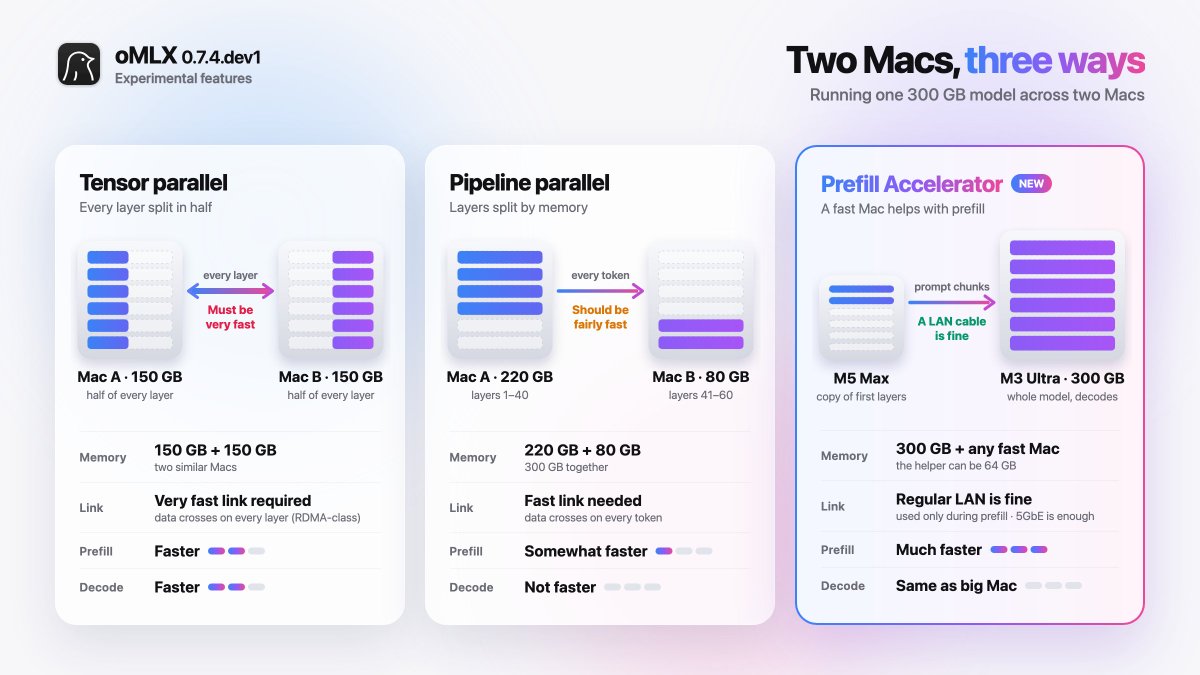
Many people asked which multi-Mac mode to use in oMLX, so I made this image.
Two high-end Macs of the same class (e.g. 2x M5 Ultra)
-> Use TP (Tensor Parallel). Each Mac runs half of every layer, so prefill and decode both get faster. Data goes back and forth on every layer, so you need a very fast link like TB5 with RDMA.
Two smaller Macs that can't hold the model alone
-> Use PP (Pipeline Parallel). The layers are split by memory so the model fits across both. It's mainly for running a model that doesn't fit on one Mac, and decode doesn't get faster.
One big but slower Mac plus one small but fast Mac (e.g. M3 Ultra 512GB + M5 Max)
-> Use Prefill Accelerator. The big Mac holds the whole model and does the decoding. The fast Mac only helps with prefill, so a normal LAN cable (5GbE) is enough. You'll notice it when you send long prompts, like agent loops or a whole repo in context. Decode speed stays the same as the big Mac alone.
INT8 activation prefill, DeepSeek V4.1 CED and other Prefill Accelerator speedups don't work on TP or PP yet. Most users don't have two high-end Macs (me included), so those modes are moving slower, but I'll keep working on distributed inference.