Beiträge mit #decoder

#decoder

Öffentliche Beiträge auf X, die #decoder verwenden.

Verwandte Hashtags

  1. max seddon✓@maxseddon
    Putin is hailing Russia's "liberation" of Mariupol after his forces completely destroyed during a two-month siege. He told defense minister Sergei Shoigu to block off the Azovstal metallurgical plant, where the last Ukrainian troops are holed up, "so that a fly can't get in."
    Herunterladen
    1.8K1.7K5K
  2. Ronaldo Almeida@Ronaldo_uber
    @maxseddon
    @maxseddon There is something wrong with this video. It's like a montage. Reflex on the table, some movements, head, leg and hand holding the table... and shoigu doesn't look forward... just down strange and suspicious... #morse #decoder
    Herunterladen
    71888
  3. Daily Dose of Data Science✓@DailyDoseOfDS_
    The LLM scheduling loop, clearly explained: (bookmark this) Whenever a user sends a prompt to an LLM, the resulting inference request does not go straight from the API endpoint to the GPU. Instead, it first enters the serving engine, where a scheduler decides when and how its tokens will be processed. Here is the complete lifecycle: 1) The request enters the waiting queue Each request arrives with a prompt, sampling settings, and a maximum output length. Prompt lengths vary, and the scheduler cannot know the final generation length in advance. It therefore manages requests one iteration at a time. 2) The scheduler builds the next batch Before every model step, the scheduler checks two main constraints: - How many tokens can be processed in this iteration - How much KV-cache space remains It then applies a scheduling policy, often prioritizing running decode requests before admitting new work. 3) New requests enter prefill During prefill, the model processes the prompt tokens and creates the K and V tensors needed by attention. This stage can process many prompt tokens in parallel. Long prompts may be split into chunks so they do not block active generations for too long. 4) Running requests enter decode Once prefill finishes, the request moves to decode. The model now generates the next token using the KV cache created for all previous tokens. Standard autoregressive decoding usually adds one new token per active request during a model step. 5) The GPU executes the selected work Modern serving engines can place prefill and decode work in the same GPU batch. For example, request A may be processing its prompt while requests B and C generate their next tokens. The batch is therefore not a fixed group that runs until every request finishes. Its composition can change after every model step. 6) The engine updates request state After execution, generated tokens are sampled and appended to their requests. A finished request releases its KV-cache blocks and leaves the batch. An unfinished request keeps its state and becomes eligible for the next scheduling iteration. The scheduler can then use the freed token budget and cache space to admit another waiting request. In the visual below, C finishes after iteration 1, so D enters during iteration 2. By iteration 3, the active batch contains only A and D. This iteration-level replacement is continuous batching. It keeps the GPU working while requests with different prompt and output lengths progress independently. If you want to dive deeper, we wrote a detailed article covering the full LLM inference pipeline, including tokenization, prefill, decode, KV caching, and the latency metrics each stage controls. Read it below.
    Herunterladen
    Avi Chawla @_avichawla
    816765K
  4. Avi Chawla✓@_avichawla
    10103782327K
  5. Brian #VideoWallSolutions#AISolutions#AVSolution@Liu_miaowu9955
    The MA4000 video wall controller, equipped with an IPC decoding card, easily controls the video wall and seamlessly transmits images from hundreds of cameras to the LCD screen. The MA1000 decoder, on the other hand, easily decodes footage from multiple recorders. #decoder #IPC
    Herunterladen
    10169
  6. Aaronia AG✓@Aaronia_AG
    Our LTE Decoder gets Major Decoder & UI Update! Now offering a perfect PBCH & PDSCH measurement, transmitter map, AVG EVM & EVM over time plus lots of other cool features. More at #Aaronia #Decoder #RF #Tech #Sigint
    Herunterladen
    012664.6K
  7. Kalyan KS✓@kalyan_kpl
    Any excellent book to learn LLM Optimization and Serving Why is it important to learn LLM Optimization? Large language models (LLMs) are the reasoning engines of modern AI. Without proper optimization, however, LLMs can be expensive and slow to serve. So, it is necessary for any one (A/ML Engineers, Data Scientist) working on LLMs or LLM applications to be familiar with LLM optimization and serving techniques. Hands-On LLM Serving and Optimization Book This book serves as a comprehensive guide to the complexities of deploying and optimizing LLMs at scale. This book covers Chapter 1 — Introduction to Model Serving and Optimization: Anatomy of a model, the model lifecycle, what model serving is and why we optimize it, serving paradigms (edge, single-model, multi-model), and serving platforms. Chapter 2 — Large Language Model Serving: Inside the transformer, autoregressive generation, decoder-only architecture, attention, the KV cache, prefill and decode, and running LLMs with a serving framework (vLLM). Chapter 3 — Model-Serving System Design: A Deep Dive: Building online single-model and multi-model serving services from scratch, batching and streaming, NVIDIA Triton, and cost- vs. latency-optimized designs. Chapter 4 — Model Serving Best Practices: Serving in an agentic world (agents, RAG, CAG), enterprise serving architecture, building with an open source stack or a cloud vendor, build-or-buy strategy, and performance measurement. Chapter 5 — Challenges When Serving LLMs: Why optimization matters, accelerator chips and GPU specs, model-loading bottlenecks, KV cache sizing, and arithmetic-intensity analysis of prefill and decode. Chapter 6 — Essential LLM Optimization Techniques: Request batching and scheduling (dynamic, continuous, chunked prefill), scalable attention and kernel fusion, model compression (quantization, distillation, pruning), and prefix caching / RadixAttention. Chapter 7 — Advanced LLM Optimization Techniques: Speculative decoding, multi-GPU and multinode inference (data/tensor/pipeline/expert parallelism), prefill–decode disaggregation, and advanced KV caching for long-context serving. Chapter 8 — LLM Serving Frameworks: vLLM internals (architecture, scheduler, layered optimization), TensorRT-LLM, SGLang, llama.cpp, and how to select the right framework. Chapter 9 — LLM Optimization in Practice: A step-by-step optimization plan for Qwen3-14B with vLLM, from hardware inspection and benchmarking to quantization, distributed serving, and common trade-offs. Chapter 10 — Advancements in LLM Serving: Semantic caching, performance profiling, multimodal serving, edge AI, multi-LoRA serving, and model serving in reinforcement learning. Github Repo -
    Herunterladen
    3161453.3K
  8. Decode✓@decodejar
    I still hold the same view, and we have indeed seen that leg down in stocks unfold. Down about 200 points from this post, and now below both 20 week sma and 21 week ema. Like Bitcoin, stocks seem close to a low, in the right region, but perhaps not quite there yet. To finish on positive note, all the accounts that have constantly called the bottom all the way down are a lot more quiet now, and that's usually a good sign 😜
    Decode @decodejar
    I think people are overestimating how quickly the crypto market is going to move up. I don't think it will be easy initially because amongst other things I look at stocks and see another leg down. Nothing drastic, but if it's enough to put Bitcoin back into the 70s, it might take a bit of time to reverse and come back up. My view is still that Bitcoin is most likely in wave 2, and if that holds true, sentiment can get a lot worse. Otherwise we need to see Bitcoin hold 80k.
    641188.9K
  9. Decode✓@decodejar
    I think people are overestimating how quickly the crypto market is going to move up. I don't think it will be easy initially because amongst other things I look at stocks and see another leg down. Nothing drastic, but if it's enough to put Bitcoin back into the 70s, it might take a bit of time to reverse and come back up. My view is still that Bitcoin is most likely in wave 2, and if that holds true, sentiment can get a lot worse. Otherwise we need to see Bitcoin hold 80k.
    9717219.9K
  10. The Hacker✓@theprocracker
    The ultimate open-source Swiss Army knife for decoding data 🧩💻 If you're still using untrusted, ad-filled websites to decode data strings, switch to CyberChef 🌐 It runs entirely inside your browser and can handle everything from simple encoding to complex cryptography. #CyberChef #CryptoTips #OSINT #TechHacks
    Herunterladen
    010742.5K
  11. Dhanian 🗯️✓@e_opore
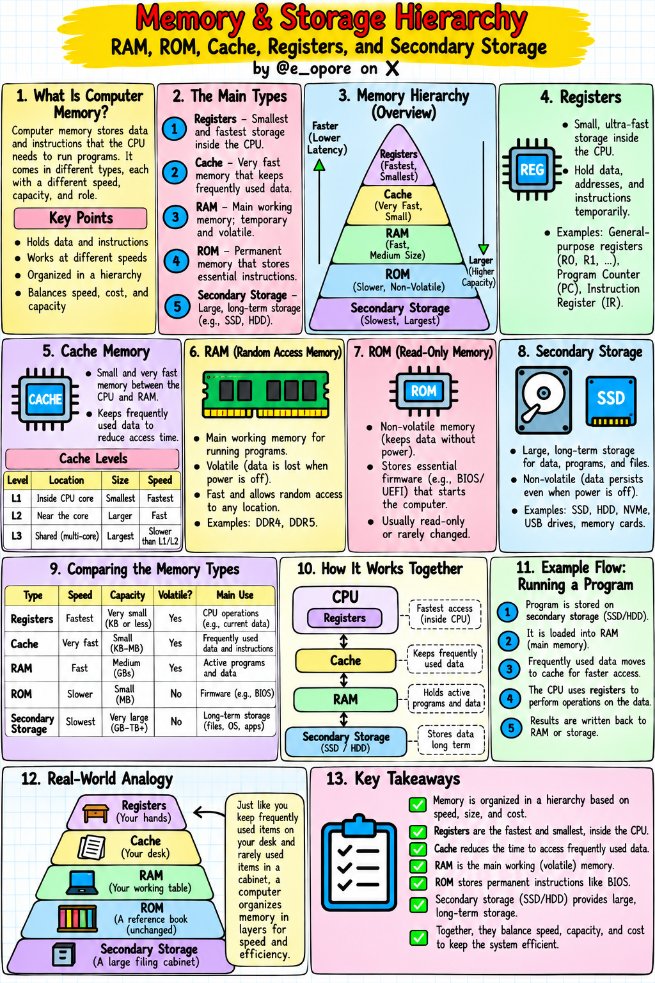
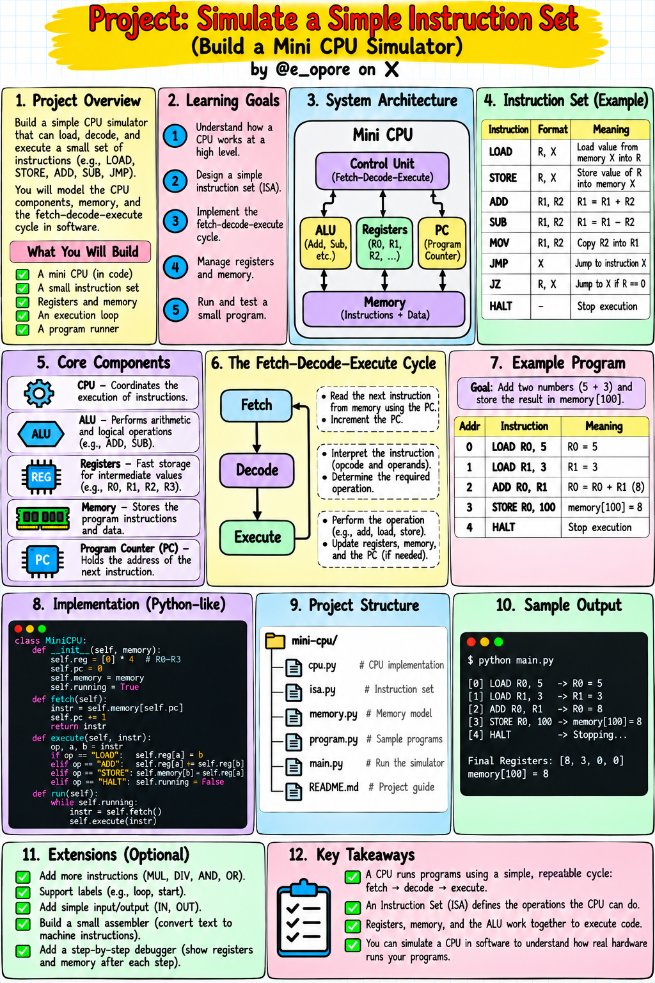
    Day 7/30: Learn Modern Computer Science — Computer Architecture 1. CPU & Processing Units — ALU, Control Unit, Registers, and CPU Operations 2. Memory & Storage Hierarchy — RAM, ROM, Cache, Registers, and Secondary Storage 3. Machine Instructions & Execution Cycle — Instruction Sets, Fetch–Decode–Execute, and How Code Runs on Hardware 4. Project: Simulate a Simple Instruction Set (Build a Mini CPU Simulator) Grab Modern Computer Science Course EBOOK:
    Herunterladen
    Dhanian 🗯️ @e_opore
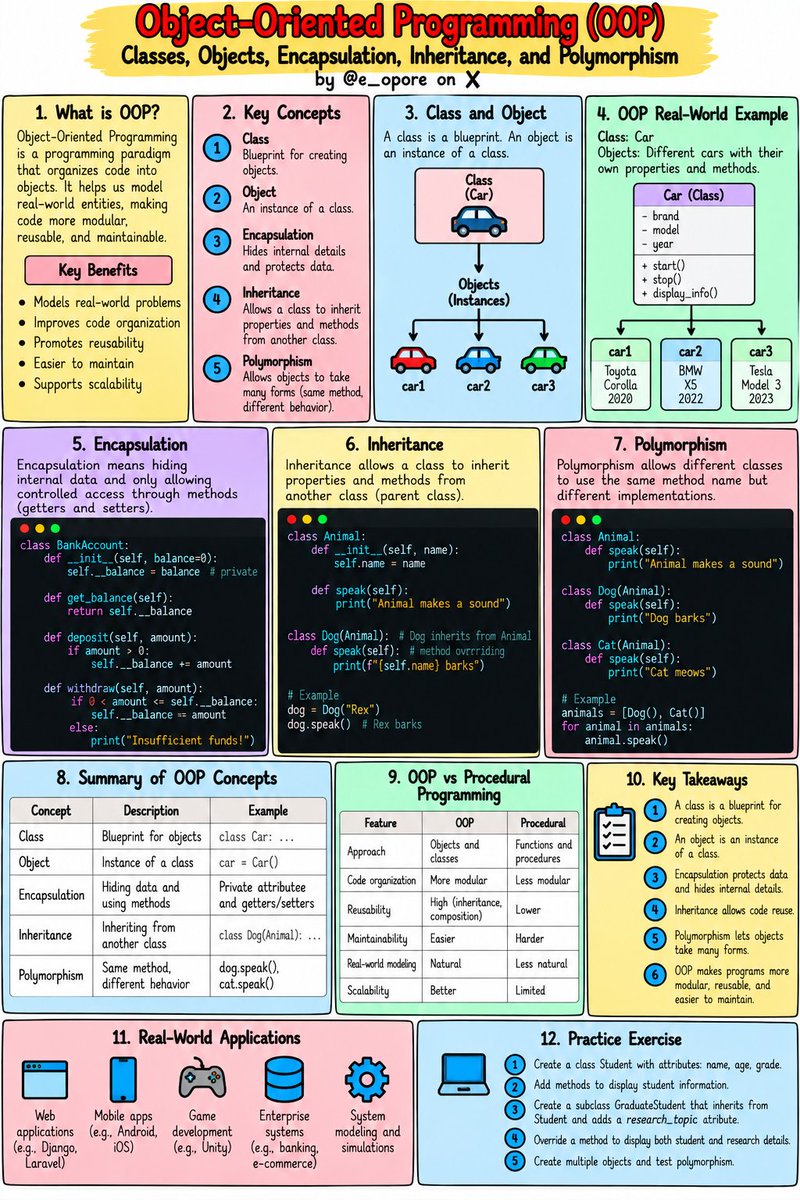
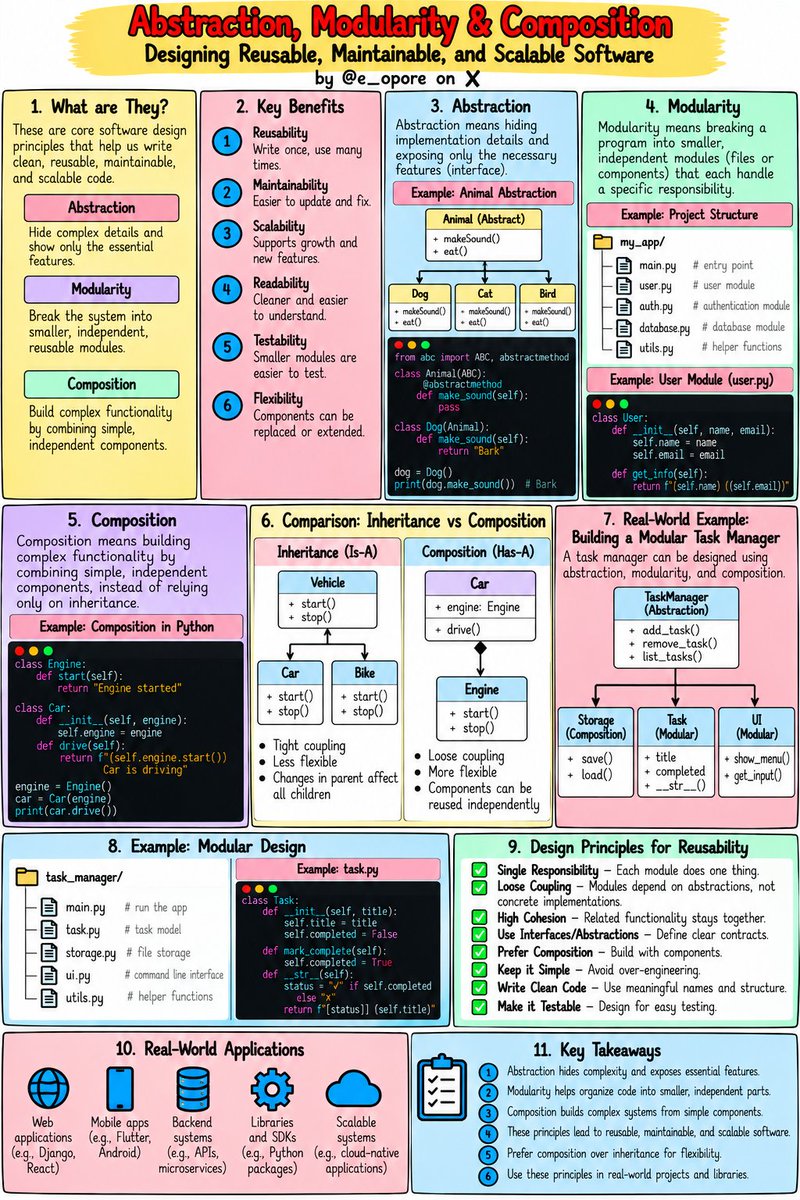
    Day 6/30: Learn Modern Computer Science — Object-Oriented & Functional Programming 1. Object-Oriented Programming (OOP) — Classes, Objects, Encapsulation, Inheritance, and Polymorphism 2. Functional Programming (FP) — Pure Functions, Immutability, Higher-Order Functions, and Declarative Programming 3. Abstraction, Modularity & Composition — Designing Reusable, Maintainable, and Scalable Software 4. Project: Design and Build a Reusable Software Library Grab Modern Computer Science ebook:
    18361.7K
  12. Dhanian 🗯️✓@e_opore
    Day 6/30: Learn Modern Computer Science — Object-Oriented & Functional Programming 1. Object-Oriented Programming (OOP) — Classes, Objects, Encapsulation, Inheritance, and Polymorphism 2. Functional Programming (FP) — Pure Functions, Immutability, Higher-Order Functions, and Declarative Programming 3. Abstraction, Modularity & Composition — Designing Reusable, Maintainable, and Scalable Software 4. Project: Design and Build a Reusable Software Library Grab Modern Computer Science ebook:
    Herunterladen
    811543.1K
  13. Gene Decode✓@Rl_Gene_Decode
    🚨🔥 TEXAS VOTER JUST SAID THE QUIET PART OUT LOUD — AND THE LEFT IS SHAKING 🔥🚨 In Wichita Falls, TX, a hardworking American looked straight into the camera during the final week of the midterms (with over 4 MILLION Texans already voting) and delivered a message that hits like a freight train: “It’s supposed to be FREEDOM. LOW TAXES. You don’t educate my child about what ‘sexual preference’ they want to be. You don’t tell ME how to raise MY child… you get rid of the illegals and you FIGHT for the American Dream.” This isn’t politics. This is a father, a taxpayer, a citizen who is DONE being ignored. No more schools deciding who his kids are. No more open borders while his family pays the price. No more elites lecturing him about the American Dream while they tear it apart. This is the real Texas. This is the real America. And it’s voting. Who else is standing with this man and Ken Paxton? Drop a 🇺🇸 if you’re ready to fight back. The countdown is on. ⏳
    Herunterladen
    371801.3K550K
  14. Shiyi Cao✓@shiyi_c98
    1/n Introducing our NeurIPS’26 work 💙Evolving Agent Teams (EAT) 💛, where a supervisor diagnoses why an agent team stalls and restructures it to escape local optima, for long-running optimization tasks. EAT shows superior performance across domains: 🏆 Open Kernel Challenge, decode layer on H200: 2.449× over SGLang, #4 of 1,180 (as of Nov 1, 2026) ⚡️ NVIDIA kernels: KDA prefill on B200, 3.44× over FlashKDA (previous best: 2.96×) 🔥 AMD kernels: KDA prefill on MI350X, 3.01× over vLLM 💻 MoE serving on Mac: Qwen3.8-Flash-Next (Unsloth UD-IQ4_XS GGUF) on M5 Pro, ~3.3× faster prefill (930 tok/s) and 1.22× faster decode (43.7 tok/s) than Strata at the same memory 🦾 RoboDojo: 62.1 on held-out seeds (the best leaderboard entry as of Oct 26, 2026 is 55.3) - Paper: - Code: 🧵👇
    Herunterladen
    144930339.1K
  15. Mitchell Hashimoto✓@mitchellh
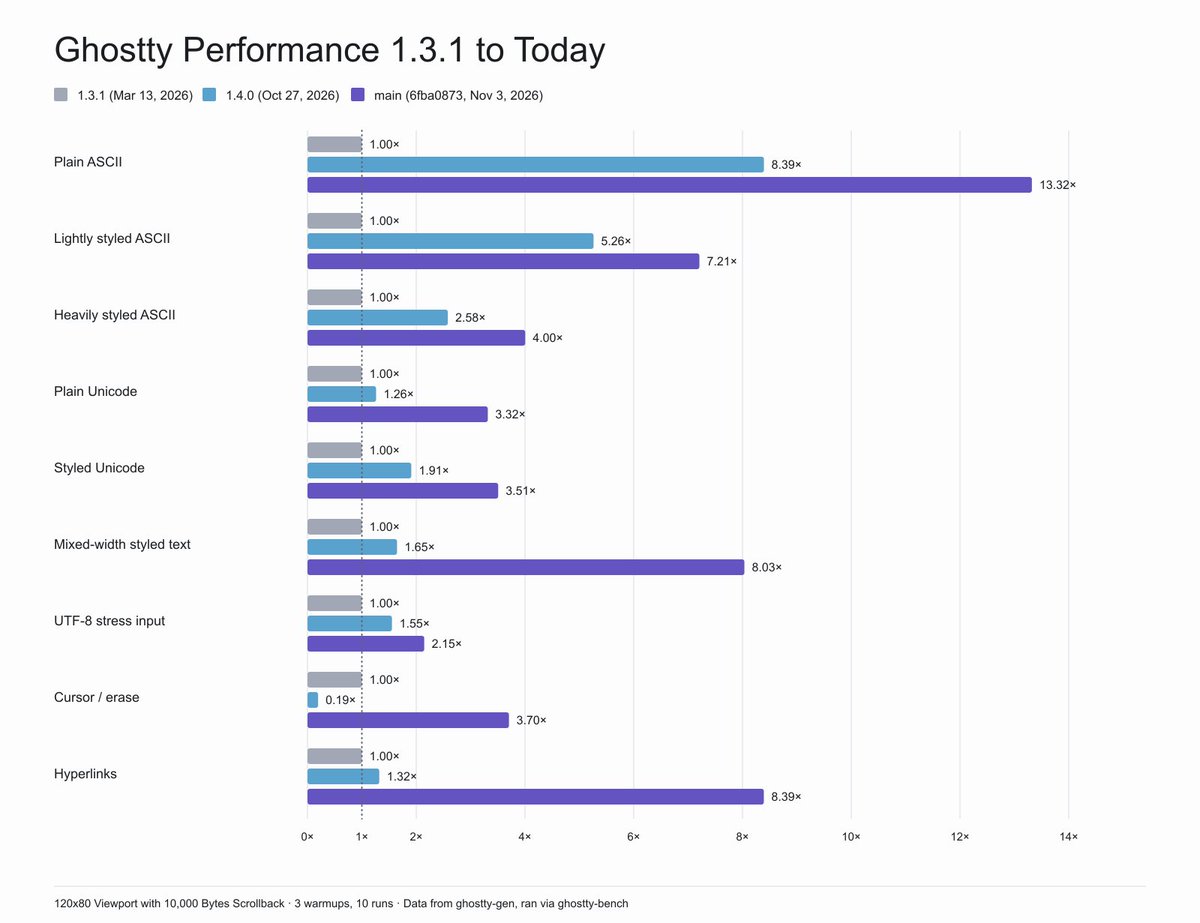
    libghostty has always been fast, but it's also been getting significantly faster. Here are IO throughput measurements comparing Ghostty 1.3.1, 1.4.0, and main as of this morning. We'll be backporting most of these to a 1.4.1 release soon. Here are some highlights of the changes since 1.4: - Ghostty 1.4 had a fast-path for printing runs of plain text. But the fast-path only applied to limited cases. We now support mixed width characters and hyperlinks in the fast path. - Our input path always widened the pty data to codepoints (8-bit to 32-bit) as part of UTF-8 decode, which also incurred a memory copy. We now have a SIMD fast path to detect pure-ASCII and we process the run direct from the read buffer (no copy, narrower data). - New memory pages use most recent two pages actual utilization to pre-size themselves accordingly. This sped up styles, hyperlinks etc. - When a VM page runs out of capacity for a certain type of data (e.g. hyperlinks, styles), we now project the usage so far to guess what you'll need, then shrink available rows to avoid a realloc. Before we'd naively double. This caused a classic "laddering" problem. - We recognized "erase" being a slow path for us, and it's a common sequence, so we use another bit in row headers to track blank (we had space). - Styles are now processed once per SGR. Previously, a sequence like "ESC[1;38;2;r;g;bm" would apply each style as it came in (1, then 38, then 2, etc.). We now apply all attributes at once and write to the cursor atomically. - Styles are now packed into 128-bit values and use aarch64 and x86_64-specific assembly for minimizing instructions to use it. - On x86_64, we found that LLVM was lowering some row resets (hot path) to a 4-byte store followed by an 8-byte load which couldn't be store-forwarded. This caused an almost 10% (!!!) slowdown on scroll operations only on x86_64. The fix was to change our reset to build the full header in a register then do a single memmove per row. Net results are what you see in the graph, but written out main to 1.4: ASCII 1.5x, heavy styling 1.5x, styled Unicode 1.8x, random UTF-8 1.4x, random OSC 8 2.7x, mixed styled text with links 4.8x, cursor/erase 16x, hyperlink-dense text 5.6x.
    Herunterladen
    341769187.5K
  16. Anni🦋✓@Anni_24_
    Only Sharp Eyes Can Solve This! Can you decode this picture puzzle and find the hidden phrase? 👀 Drop your answer in the comments!
    Herunterladen
    7229701.6K
  17. Mehr Beiträge anzeigen