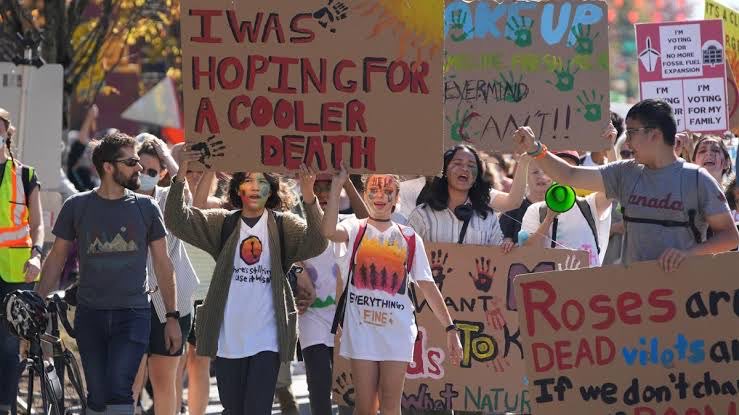
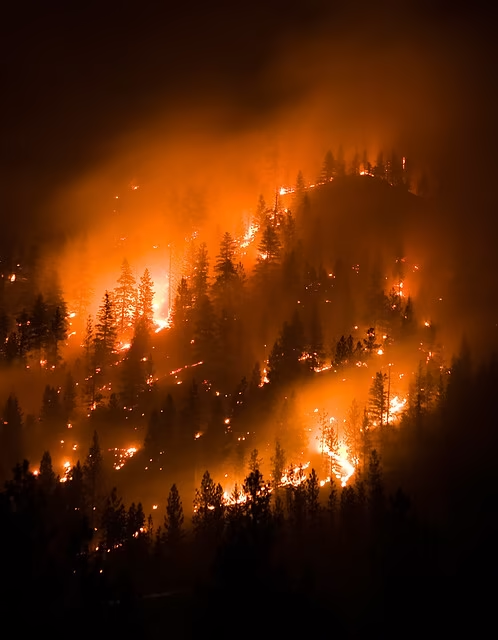
Greenhouse gas levels hit new record highs, locking in more long-term temperature increase.
The intensifying El Niño may lead to a further surge.
New WMO Greenhouse Gas Bulletin provides authoritative scientific information on the state of our climate. 👉
If we don’t stop climate change, climate change will stop us.
~It will stop our farms from producing.
~It will push families from their homes.
~It will threaten our food, water, health and livelihoods.
Climate change is not waiting for us to be ready.
Act now. Adapt now. Protect our future.
Know this, and know peace.
#ClimateAction
🚨: Earth is on track to become uninhabitable, scientists say
A study was published in the journal, One Earth, shows that four major climate systems are all much closer to collapse than previously thought.
Congratulations, Humans!
Can someone please explain how humanity is supposed to adapt to this?
Climate change is making these severe events more severe and more frequent. No time to wait. #ActOnClimate#climate#energy#renewables#spain
The UN has publicly announced that climate change never existed!!
Solar power generation was just about vested interests. All man-made!!
That's the whole story!!!
🐸
Tom Nelson Podcast #440: James Kamis: “El Nino/La Nina system generated by geological forces” is now published.
Geologist James Kamis argues El Niño and La Niña are generated by geological forces near a stationary Pacific Ring of Fire source, not primarily by trade-wind shifts. Citing cone-shaped warming/cooling patterns, helium concentrations as volcanic indicators, burst-like heat “blobs,” sharp temperature boundaries, centuries of recorded events, seafloor volcanoes, hydrothermal vents, trenches, and methane hydrate “ice rocks,” he proposes magma heat melts hydrates to create La Niña cooling and continued heating yields El Niño warming. He compares related phenomena (El Padre/La Madre), points to rapid North Atlantic warming linked to a spreading center, and says volcanic impacts may be underestimated in climate studies. He calls for more seafloor mapping and denser Argo buoy coverage.
00:00 Meet the Geologist
01:14 Geology Behind ENSO
03:09 Why Wind Theory Fails
05:16 Volcanic Evidence
10:18 Ring of Fire Origins
11:05 Ocean Floor Revealed
12:20 Undersea Volcanoes
14:20 Hydrothermal Heat Engine
16:09 Faults and Quakes
17:19 Methane Hydrates Model
20:01 Source Area Deep Dive
21:46 La Niña Mechanics
23:33 Analog Events Worldwide
27:29 Atlantic Heat Spike
29:27 Climate Change Impacts
33:25 Wrap Up and Q&A
American physicist Dr. John F. Clauser, a joint recipient of the 2022 Nobel Prize in Physics:
"I can confidently say there is no real climate crisis, and that climate change does not cause extreme weather events."
Days after Dr. Clauser made the above remarks, the IMF cancelled a talk he had been invited to deliver.
“GOOD RIDDANCE! After 15 years of Dumocrats promising that “Climate Change” is going to destroy the Planet, the United Nations TOP Climate Committee just admitted that its own projections (RCP8.5) were WRONG! WRONG! WRONG!” - President DONALD J. TRUMP 🇺🇸
“Opportunities to accelerate action have never been more abundant.”
@UN Secretary-General @antonioguterres calls for stronger climate pledges & wider use of proven policies as the world is set to breach the Paris Agreement's 1.5°C limit of global warming.
#EmissionsGap
For the first time, we're watching plants breathe in real time.
Plants "breathe" through minuscule openings on their leaves known as stomata—a term derived from the Greek word for "mouths." These tiny pores perform a critical balancing act: they open to allow carbon dioxide (CO₂) to enter for photosynthesis, while simultaneously permitting water vapor to escape into the atmosphere through transpiration. This ongoing compromise influences a plant's growth rate, water requirements, and overall resilience, especially in challenging environments.
Historically, scientists faced significant limitations in studying this dynamic process directly. They could either observe stomatal movements under a microscope (often in artificial or uncontrolled settings) or measure overall leaf gas exchange (which reflects aggregate behavior but obscures microscopic details). A recent breakthrough from the University of Illinois Urbana-Champaign overcomes this divide with an innovative system called Stomata In-Sight.
This integrated tool combines three key technologies in real time:
- A live confocal microscope (specifically laser scanning) that captures high-resolution, three-dimensional images and videos of living stomatal cells and pores without damaging the tissue.
- Precise gas exchange sensors that quantify CO₂ uptake and water loss (stomatal conductance, photosynthesis, and transpiration) from the same leaf section.
- A controlled environmental chamber that maintains specific levels of light, humidity, temperature, and CO₂ to simulate real-world conditions.
By linking microscopic stomatal aperture changes (tracked via machine-learning image analysis for dozens of pores simultaneously) with whole-leaf physiological responses, researchers can now observe how individual stomata behave and contribute to the plant's overall performance under varying scenarios.
The implications are profound, particularly for agriculture. Water scarcity remains the primary constraint on crop yields worldwide. By identifying the genes and mechanisms that govern stomatal efficiency—such as opening/closing speed, density, or aperture size—scientists can develop breeding strategies for crops that conserve water more effectively while maintaining or boosting photosynthesis. This could lead to varieties better equipped to withstand drought, heat, and other effects of climate change, ultimately supporting higher food production with fewer resources.
Stomata In-Sight represents a major advance in plant science, transforming our ability to study—and ultimately engineer—plants that not only endure environmental stress but actively help humanity adapt to a changing climate.
[Crawford, J. D., Mayfield-Jones, D., Fried, G. A., Hernandez, N., & Leakey, A. D. B. (2025). Stomata in-sight: Integrating live confocal microscopy with leaf gas exchange and environmental control. Plant Physiology, 199(4), kiaf600. DOI: 10.1093/plphys/kiaf600]
Young people will live longest with the consequences of AI, climate change and our broken political system. They deserve a voice in shaping their future.
Today I’m in Ann Arbor with Abdul-El Sayed talking to college students about how we fight back.
Losing more ground in the fight against climate change, humanity is heading for a hotter world than experts projected last year — and the United States is a big reason for that, a new United Nations report says.
Read more:
Since the 1960s, carbon dioxide in the atmosphere has increased by more than 30%. The average portion of the planet likely to be covered by heat storms and heat waves has risen more than 12-fold. Explore the first in our series on this climate phenomenon
Amazon is dropping an $11 BILLION AI data center right in Indiana.
This monster will guzzle electricity for 1 MILLION homes and 300 MILLION gallons of water EVERY SINGLE YEAR — just ONE facility.
Drone footage shows the insane scale: endless buildings, massive cooling tanks, power substations stretching forever.
Our grid is already crumbling. Bills will explode. Water shortages incoming. Blackouts while they power their AI overlords. And these same tech giants lecture us REGULAR PEOPLE about “climate change”?
This hits every home near Indiana — Illinois, Ohio, Kentucky, Michigan. They’re not asking. They’re taking. This is NOT okay.