RT @vanstriendaniel: I trained a specialist decision model for curating web-scale data. It's small (380M, fine-tuned from UltraBERT-380M), so it runs relatively cheaply at scale: 1M FineWeb pages took 19 minutes and ~$5 on @huggingface Jobs.
It thinks a quarter of those pages are product pages. 6% passed a simple "educational, not spam" filter, and 1 page in 1,020,000 got "outstanding".
I've shared the model, the training data (with the source, labeller, and licence for every row), and the full recipe.
I hope more people share how they prepare data for training open decision models! We've had some cool open model releases. Time for some more data releases!
RT @mervenoyann: hey, Le Chonk by @MistralAI is now on Hub! 🐱
to celebrate, we ship day-0 support in transformers and llama.cpp, as well as quants 🤗
read our blog for model deep dive, integrations and more!
RT @ScaleAILabs: In collaboration with @HuggingFace, we’ve released the largest open robot dataset, alongside their first open System 1-System 2 model that can reason over step-by-step actions.
FineART is built with 40K+ demonstrations across 151 tasks and 500K subtask labels.
Together, the dataset and model were designed for each other, and both are available on @LeRobotHF where robotics developers work today.
We sat down with @MistralAI's Pierre Stock and Sagar Vaze from Mistral on launch day of Mistral Large 4.
Open weights. Trained in Mistral’s own data centers. Excels at cyber.
Full conversation on cyber, training, evals and sandboxing:
RT @MistralAI: Today, we release the weights of a new and improved Le Chonk, advancing the open frontier for agentic coding and cybersecurity.
💻 Built to build: Le Chonk ranks #1 on @cognition’s FrontierCode among open models, and sets a new benchmark for Pareto efficiency on @artificialanalysis.
🛡 Built to defend: State-of-the-art in cyberdefense, put through the paces by the world's leading cyber vendors, including @CrowdStrike, @cloudflare, @rubrik, @zscaler, and others.
Built for sovereignty: Make it yours. Download the weights on @huggingface , customize it with Mistral Forge, and deploy it wherever you need it.
Read more from our team and customers 👇:
RT @EmmaScharfmann: So much happened in AI for Science on the 🤗 Hub this month!
I summarized what these new models and datasets are about, to make them accessible to anyone curious about AI for Science 🚀
RT @SergioPaniego: how do you post-train an agent?
we laid it out as a 5-step curriculum, from SFT to RL through a real harness, with livestreams, code and docs for each step
RT @NVIDIAAI: Meet NVIDIA Nemotron 3.5 Transcribe 🎙️
An open-weight, promptable 30B MoE model with ~4B active parameters that brings transcription in 40 languages, speaker attribution, translation, contextual prompting and audio understanding into one checkpoint.
Watch it keep track of who said what when everyone’s talking at once.
1/ 🧵
RT @liquidai: Introducing 𝙻𝙵𝙼𝟹: our new generation of Liquid Foundation Models. With a new tri-hybrid architecture and new multimodal encoders, the LFM3 family is the ideal model suite for specialized intelligence.
> 6 model instances, across text, audio, vision, and omni modalities, generative and decision models.
> 𝙻𝙵𝙼𝟹-𝟷.𝟽𝙱: text, 256k context window.
> 𝙻𝙵𝙼𝟹-𝚅𝙻-𝟸𝙱: vision-language model with video-input support for spatial understanding
> 𝙻𝙵𝙼𝟹-𝙰𝚞𝚍𝚒𝚘-𝟸𝙱: tool calls, voice chat, reasoning in 18 languages.
> 𝙻𝙵𝙼𝟹-𝙾𝚖𝚗𝚒-𝟸𝙱: an omni model combines vision, audio, and language.
> 𝚍𝟷-𝟸𝙱 and 𝚍𝟷-𝙾𝚖𝚗𝚒-𝟸𝙱: decision models with typed outputs and calibrated probabilities in a single pass. Omni adds audio input.
> fine-tune on 1 GPU.
> a new tri-hybrid architecture
> architecture optimized for 14 processor classes across GPUs, CPUs, and NPUs.
> 𝙻𝙵𝙼𝟹-𝚅𝙻-𝟸𝙱 is a beast. It performs competitively with Gemma 4 12B (6x larger), and Gemini 3.5 Flash Lite, and GPT-5.6 Luna, with 1.9B parameters.
> 𝙻𝙵𝙼𝟹-𝟷.𝟽𝙱 is #1 on the Pareto frontier of device intelligence 𝚙𝚒𝚙𝚎𝚝𝚝𝚎.𝚕𝚒𝚚𝚞𝚒𝚍.𝚊𝚒
Every modality for specialized intelligence. Pick the one that fits your use case, customize it, and run it on-device.
1/ 🧵
RT @SergioPaniego: last week we closed the Training Agents series IRL at the GitHub offices in SF
4 talks, a panel and audience Q&A. almost 2h on post-training agents with open models
> Learnings from enterprise RL (@t2govind Microsoft)
> Environments and benchmarks in industry (@VBarres86633 Mercor)
> How to train your agents with Miles (@nblintao RadixArk)
> Why we built OpenEnv Arena (@xdotli BenchFlow)
full recording + slides
RT @ben_burtenshaw: You can win $20K in cash prizes by building a demo, training a model, or creating a dataset with Beam by @reflection_ai!
Prizes are split across 3 winners that we'll choose after the challenge ends on Monday, November 2nd.
Plus, we're giving $25 hub credits to the first 400 to take part, just find the link in the page below.
Rules: Build something cool with beam and drop it on the discussion! Anything that might be helpful to the world or a cool demo is allowed:
- You could make a demo that uses the Beam model on Spaces
- You could quantize it for your favorite hardware
- You could generate a synthetic dataset for your favorite problem
- You could build an RL environment with or for Beam
- You could benchmark Beam and share the results.
- You could surprise us!
If you build something with Beam, then share it on the Hub to enter the challenge. We’ll collect all the links, select the best, and reach out to winners.
RT @pollenrobotics: New on MicroDuck Arena: Tug of War 🦆🪢🦆
Two robot ducks, one rope, a pit in the middle. Drag your rival in and you win.
Train yours in simulation, publish it, and it's in the first cup, live Friday, Nov 6 at 9 AM PT.
RT @ben_burtenshaw: We closed out the Training Agents series in person in San Francisco with four talks and a panel on post-training agents with open models in industry.
Enterprise RL (@t2govind Microsoft), environment design (Victor Barres Mercor), scaling agent RL with Miles (@nblintao RadixArk), and OpenEnv Arena (@xdotli BenchFlow).
Full recording, slides and links:
Condividi
Copiato
Ben Burtenshaw@ben_burtenshaw
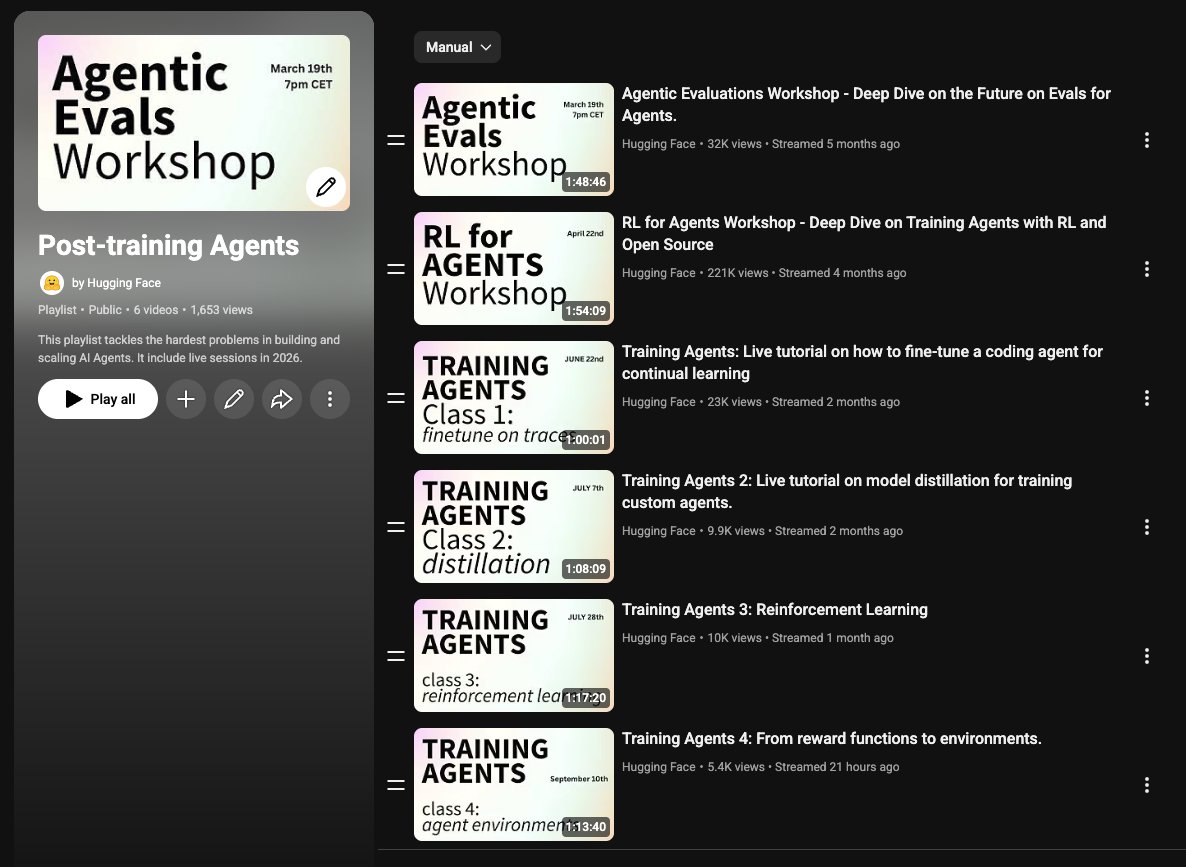
We finished the Training Agents series. Six live sessions over six months, from evaluating agents to training them inside real environments. All of it is on the Hugging Face YouTube channel and all of the code is open.
Here's what we did and who made it happen:
1. Agentic Evaluations WorkshopWhere agent evals actually stand, and why benchmark scores don't match what people see in use. With Avijit Ghosh and Nathan Habib (Hugging Face), Arvind Narayanan (Princeton), Pierre Andrews (Meta), J.J. Allaire (UK AI Security Institute) and Mahesh Sathiamoorthy (Bespoke Labs).
2. RL for Agents Workshop Environments, rollouts, reward design and the inference bottlenecks that appear when you move from RL for LLMs to RL for agents. With Lewis Tunstall (Hugging Face), Will Brown (Prime Intellect), Ofir Press (Princeton) and Alex Zhang (MIT CSAIL).
3. Training Agents 1: SFT on agent traces Public coding-agent traces turned into prompt/completion data, a TRL + LoRA fine-tune on Hugging Face Jobs, metrics in Trackio, and an honest look at what the first eval numbers can and cannot tell you. Joined by Sergio Paniego and Quentin Gallouédec.
4. Training Agents 2: Distillation Off-policy, on-policy and self-distillation for moving capability from a teacher into a smaller coding agent.
5. Training Agents 3: Reinforcement learning GRPO after SFT: group sampling, verifiable reward functions, reading the reward/KL/length curves, and three experiments, one of them with a deliberately gameable reward so we could watch the hacking happen.
6. Training Agents 4: From reward functions to environments The reward stops being a function and becomes a place the agent acts in. We walked the reset()/step() contract from Gym to LLM agents, built an OpenEnv environment and pushed it to the Hub, plugged it into TRL's GRPOTrainer, then trained a real coding agent (OpenCode) through Harbor with AsyncGRPOTrainer on Hugging Face sandboxes.
The series has passed 300k views. Thank you to every speaker, to the TRL team, and to everyone who showed up live with questions.
Playlist:
RT @microagi: As our customers scale to training robot models using millions of hours of our recordings, we needed to build a new kind of data infrastructure.
Terabytes of data delivered in minutes, and the capacity to deliver over a Petabyte per day to each of our customers, to multiple customers at the same time. That’s more than 10 Gigabytes a second, delivered into any cloud, wherever our customers need it.
Using our customer portal, customers select precisely the data they want and it starts arriving in minutes at their destination, including AWS, GCP, Cloudflare, Hugging Face and any cloud provider who can handle the ingest speed.
We’ve written about how we worked with @huggingface and @Cloudflare to build this secure, scalable infrastructure. Link in comments.
RT @linoy_tsaban: Introducing Qwen Image 2.1 Realtime ⚡️
I'm releasing V1 of my *2-step* distilled LoRA, and it runs in *realtime* on ZeroGPU ⚡️⚡️
(live editing part of the video was not sped up!)
> DMD2, rank 32
> 2 steps, with quality competitive with Turbo (8-step) and Base (40-step)
> realtime on ZeroGPU (half of an RTX Pro 6000)
LoRA:
Space:
RT @JensenHuang: I was the opening act for a family of ducks.
Thank you, Berlin. What a GTC.
Europe is building its AI ecosystem and economy, from AI factories to agents to robots.
DSX POD: Vera Rubin modular factories built, cabled and tested in the factory, then delivered ready to produce intelligence.
Agents: models, harnesses, sandboxes, knowledge and tools. NVIDIA Agent Toolkit brings the pieces together so companies control what their agents know, access and do. NVIDIA OpenShell enhances safety.
Physical AI: new customers across AI-RAN, robotaxis and robotics.
Personal AI: after four years building with Microsoft, RTX Spark brings personal agents to the Windows PC.
Thank you to President @EmmanuelMacron, Prime Minister @andyburnham and Chancellor @bundeskanzler for hosting me. Great to celebrate Sferical One with Sweden’s technology leaders. And thank you to President @TokayevKZ for the warm welcome.
And to our partners and NVIDIA teams: thank you for making it happen.
The keynote is here:
Condividi
Copiato
Pollen Robotics@pollenrobotics
Microducks on stage for Jensen Huang’s famous keynote!
We couldn’t be prouder of our little ones. 🥹
RT @NVIDIAAI: Available now: NVIDIA Nemotron 3.5 Bolt E4B 4GB ⚡️
Our newest small open model is built for local assistants, interactive characters and robots that can carry on a conversation and use tools to get things done.
Watch Reachy Mini chat and move, with Bolt handling conversation and NVIDIA Cosmos handling vision. Both models run locally on Jetson Orin Nano 8GB.
Learn more:
OpenResearch now has @TrackioApp built in 📈
Your agent logs its experiments to Trackio, charts open right next to each run, and it reads the curves back to decide what to try next. Open source and local-first.
Running on HF Jobs, Modal, k8s or Slurm? Save a @huggingface Space and every run lands there, private Spaces included.
Check it out:
RT @emmanuel_2m: We just open-sourced 1,300+ 3D models.
All 39 GB are free to download on Hugging Face.
> made with Hitem3D, Meshy, Rodin, Tripo, Claude Opus 5.5 3D and GPT-6 Astra 3D, which all run on Scenario
> includes the input images, prompts and settings that made them
> GLBs up to 8K textures, native Blender files from Opus and Astra, CC BY 4.0
RT @fastinoAI: Our newest decision model is the world's best decision model.
Introducing GLiDE v1.2, the #1 model on the @huggingface Decision Index.
With an overall score of 71.5, GLiDE v1.2 also has one of the lowest calibration errors on the entire Decision Index, meaning its confidence more closely reflects how often its answers are correct.
Beyond improved benchmark performance, it also adds support for multimodal inputs, enabling decision-making using text, JSON, and images.
We are excited to release the model weights on Hugging Face. For hosted inference, you can also run GLiDE v1.2 through the Fastino API at $0.04 / million input tokens.
Use promo code GLIDEIS1 for $10 in API credits.
Model weights:
API:
Blog:
OpenResearch now has @TrackioApp built in 📈
Your agent logs its experiments to Trackio, charts open right next to each run, and it reads the curves back to decide what to try next. Open source and local-first.
Running on HF Jobs, Modal, k8s or Slurm? Save a @huggingface Space and every run lands there, private Spaces included.
Check it out:
RT @RemiFabreRobot: Sorry for the wait, the episode is here!
Live action with real robots instead of animation (episode 4): "Anger"
Enjoy!
As always, the software of Microduck and Reachy Mini is open source:
Even the most regulated industries are going open-source 🤗
Condividi
Copiato
Farsight@farsight_ai
The AI question in financial services has moved from which model to use to where that model is allowed to run.
New post with @TangriKunal and @huggingface on why firms want to run models on their own infrastructure, and how governance gets them approved to run there.
Read it here:
RT @Scenario_gg: We just open-sourced 1,300+ 3D models.
That's 39 GB of 3D files, free to download on Hugging Face.
> Hitem3D, Meshy, Rodin, Tripo, Claude Opus 5.5 3D and GPT-6 Astra 3D, all run on Scenario
> every example ships its input image, prompt and exact settings
> GLB up to 8K textures, native Blender files from Opus and Astra, CC BY 4.0
RT @Lexsi_labs: A big announcement from Lexsi Labs:
Lexsi Labs (@Lexsi_labs) , Cohere Labs (@cohere ) and Hugging Face(@huggingface) are partnering on the Lexsi AI Safety and Alignment Hackathon, one of the biggest hackathon on post-training and AI Safety & Alignment.
Nov 1 to 21, 2026. Online, free, open to builders worldwide.
Teams build real post-training pipelines:
- Models: open-weights Tiny Aya and Aya Expanse from Cohere Labs
- Tooling: six open-source Lexsi Labs toolkits (AlignTune, CuratorKIT, AuditKIT, SafeTune, CircuitKIT, AgentTune)
- Artifacts: models, adapters, logs and datasets hosted on Hugging Face
Three tracks: fine-tuning and data curation, AI red teaming and safety, agentic fine-tuning.
Each submission chains at least two toolkits and reports before-and-after metrics.
$30,000+ in prizes and credits, GPU credits for up to 800 teams, Demo Day for the top 20, and interviews at Lexsi Labs for standout builders.
Kickoff: Bengaluru, Oct 31, with an online option.
Registration starts today at:
Thank you to @huggingface and @cohere for building this with us.
The AI question in financial services has moved from which model to use to where that model is allowed to run.
New post with @TangriKunal and @huggingface on why firms want to run models on their own infrastructure, and how governance gets them approved to run there.
Read it here:
RT @SergioPaniego: Live From SF! We’re teaching these folk how to train their own open weight agents. Sorry, but we won’t live stream. Full recording coming tomorrow!
Condividi
Copiato
Ben Burtenshaw@ben_burtenshaw
Join us tomorrow on the training agents livestream, and here from experts about how they're scaling RL and evals to train frontier agents.
We will look beyond single-turn RL to multi-step, environment-driven training: reward design, rollouts, benchmarks, and the practical gap between training gains and real-world agent behavior.
What to expect Short, 10-minute talks with Q&A, followed by a closing panel on what works in RL for agents, where the bottlenecks are, and what the open-source ecosystem needs next.
Speakers:
- Ben Burtenshaw (HF)
- Govind Kamtamneni (Microsoft)
- Victor Barres (Mercor)
- Zach Wentz (Reflection)
- Tao Lin (RadixArk)
- Xiangyi Li (Benchflow)
Who should attend
ML practitioners, agent builders, and RL researchers.
RT @LoubnaBenAllal1: Introducing Carbon-X: The best open DNA model.
We midtrained a 14B model on DNA and text, and it beats every open language model and matches GPT-6.1 Sol at 1,000x lower cost.
Ask it about a sequence, what a mutation does, or to generate new DNA.
Join us tomorrow on the training agents livestream, and here from experts about how they're scaling RL and evals to train frontier agents.
We will look beyond single-turn RL to multi-step, environment-driven training: reward design, rollouts, benchmarks, and the practical gap between training gains and real-world agent behavior.
What to expect Short, 10-minute talks with Q&A, followed by a closing panel on what works in RL for agents, where the bottlenecks are, and what the open-source ecosystem needs next.
Speakers:
- Ben Burtenshaw (HF)
- Govind Kamtamneni (Microsoft)
- Victor Barres (Mercor)
- Zach Wentz (Reflection)
- Tao Lin (RadixArk)
- Xiangyi Li (Benchflow)
Who should attend
ML practitioners, agent builders, and RL researchers.