
Hugging Face
RT @jeffboudier: Tonight is the night. Today is the day AI Builders unite.
I hear MEGADUCK is coming. Will you?
Open Together, 6pm on 10/16 at The Midway, SF. Free.
0301.6K

@huggingface
The AI community building the future. https://t.co/TpiXQMQ9rZ
SAIR @SAIRfoundationThe math community deserves its own AI system. Introducing Open Math OS: the infrastructure for Math 2.0. Open models and AI agents. 24/7 cloud compute with 100+ tools. The community controls its data. Compute is free for approved teams. Apply now:

Reflection @reflection_aiBeam is now available across platforms, with open weights under the Apache 2.0 license - in collaboration with an ecosystem of 40+ partners. We're releasing: - Weights, tokenizer, and reference implementation - BF16, FP8 and NVFP4 weights and a DFlash2 drafter - The open source harness we built and trained Beam on: Mirror CLI Weights and model card on Hugging Face:
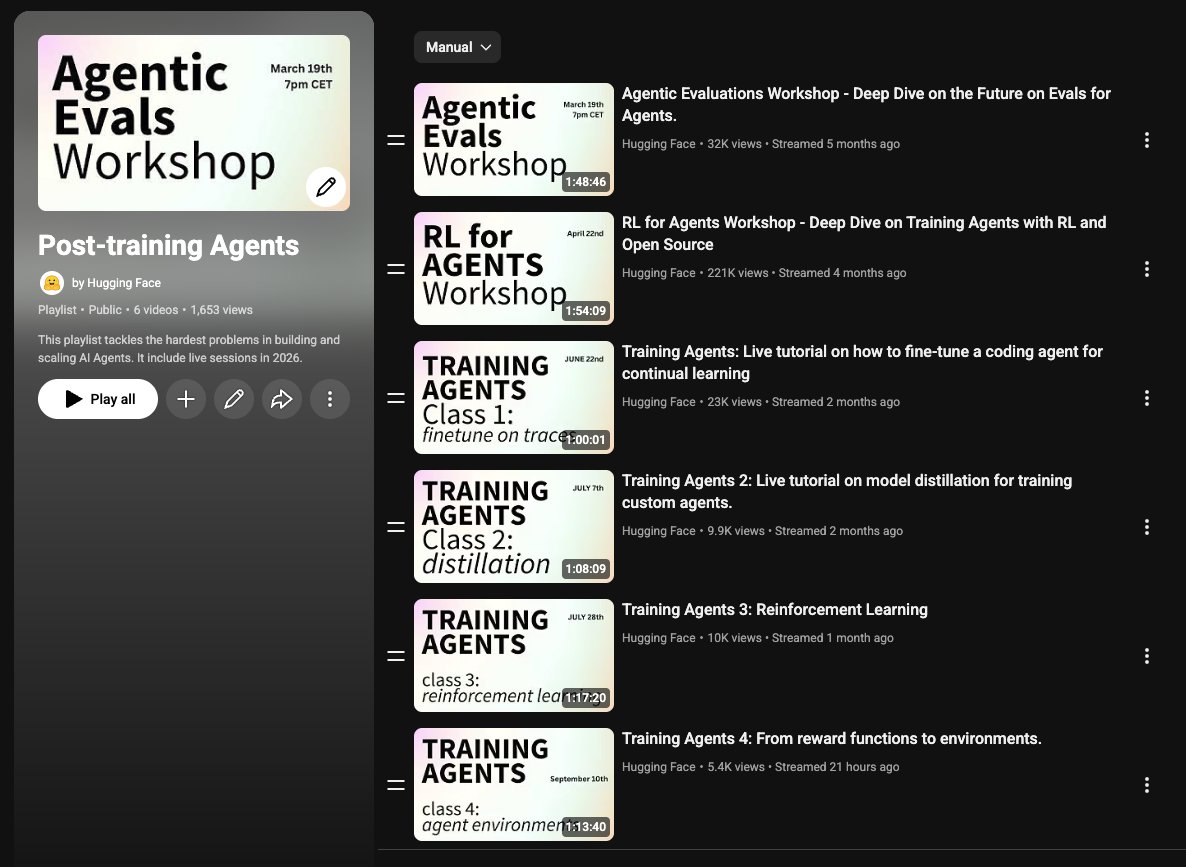
Ben Burtenshaw @ben_burtenshawWe finished the Training Agents series. Six live sessions over six months, from evaluating agents to training them inside real environments. All of it is on the Hugging Face YouTube channel and all of the code is open. Here's what we did and who made it happen: 1. Agentic Evaluations WorkshopWhere agent evals actually stand, and why benchmark scores don't match what people see in use. With Avijit Ghosh and Nathan Habib (Hugging Face), Arvind Narayanan (Princeton), Pierre Andrews (Meta), J.J. Allaire (UK AI Security Institute) and Mahesh Sathiamoorthy (Bespoke Labs). 2. RL for Agents Workshop Environments, rollouts, reward design and the inference bottlenecks that appear when you move from RL for LLMs to RL for agents. With Lewis Tunstall (Hugging Face), Will Brown (Prime Intellect), Ofir Press (Princeton) and Alex Zhang (MIT CSAIL). 3. Training Agents 1: SFT on agent traces Public coding-agent traces turned into prompt/completion data, a TRL + LoRA fine-tune on Hugging Face Jobs, metrics in Trackio, and an honest look at what the first eval numbers can and cannot tell you. Joined by Sergio Paniego and Quentin Gallouédec. 4. Training Agents 2: Distillation Off-policy, on-policy and self-distillation for moving capability from a teacher into a smaller coding agent. 5. Training Agents 3: Reinforcement learning GRPO after SFT: group sampling, verifiable reward functions, reading the reward/KL/length curves, and three experiments, one of them with a deliberately gameable reward so we could watch the hacking happen. 6. Training Agents 4: From reward functions to environments The reward stops being a function and becomes a place the agent acts in. We walked the reset()/step() contract from Gym to LLM agents, built an OpenEnv environment and pushed it to the Hub, plugged it into TRL's GRPOTrainer, then trained a real coding agent (OpenCode) through Harbor with AsyncGRPOTrainer on Hugging Face sandboxes. The series has passed 300k views. Thank you to every speaker, to the TRL team, and to everyone who showed up live with questions. Playlist:

Pollen Robotics @pollenroboticsMicroducks on stage for Jensen Huang’s famous keynote! We couldn’t be prouder of our little ones. 🥹

alphaXiv @askalphaxivOpenResearch now has @TrackioApp built in 📈 Your agent logs its experiments to Trackio, charts open right next to each run, and it reads the curves back to decide what to try next. Open source and local-first. Running on HF Jobs, Modal, k8s or Slurm? Save a @huggingface Space and every run lands there, private Spaces included. Check it out:


Ben Burtenshaw @ben_burtenshawJoin us tomorrow on the training agents livestream, and here from experts about how they're scaling RL and evals to train frontier agents. We will look beyond single-turn RL to multi-step, environment-driven training: reward design, rollouts, benchmarks, and the practical gap between training gains and real-world agent behavior. What to expect Short, 10-minute talks with Q&A, followed by a closing panel on what works in RL for agents, where the bottlenecks are, and what the open-source ecosystem needs next. Speakers: - Ben Burtenshaw (HF) - Govind Kamtamneni (Microsoft) - Victor Barres (Mercor) - Zach Wentz (Reflection) - Tao Lin (RadixArk) - Xiangyi Li (Benchflow) Who should attend ML practitioners, agent builders, and RL researchers.
Farsight @farsight_aiThe AI question in financial services has moved from which model to use to where that model is allowed to run. New post with @TangriKunal and @huggingface on why firms want to run models on their own infrastructure, and how governance gets them approved to run there. Read it here:


