Post con #RustProgramming

#RustProgramming

Post pubblici su X che usano #RustProgramming.

Hashtag correlati

  1. HIM 🎖️🪖@ManlikeAkin_47
    1. Box<T> — store data on the heap Concept: A Box<T> owns a value stored on the heap. Box::new() creates a box that owns its value on the heap. Rust automatically cleans it up when the box goes out of scope.
    Scarica
    HIM 🎖️🪖 @ManlikeAkin_47
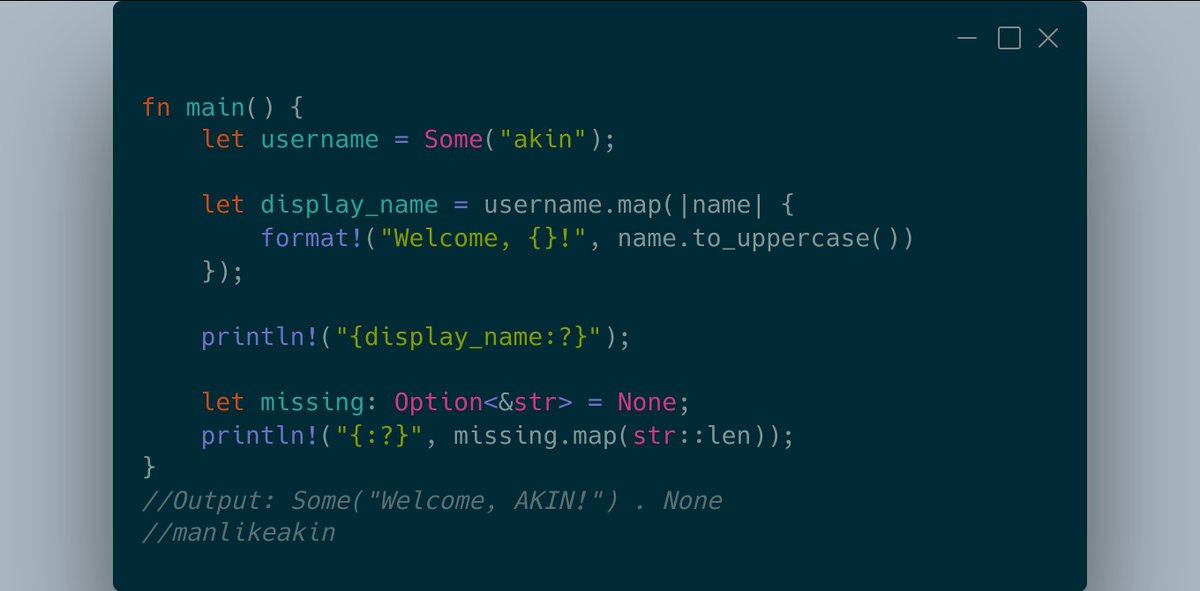
    2. Option::map — transform a value if it exists Concept: Transform the value inside an Option without manually matching every case. map() applies a function to the value inside Some. If the original value is None, the result remains None.
    10126
  2. HIM 🎖️🪖@ManlikeAkin_47
    2. Option::map — transform a value if it exists Concept: Transform the value inside an Option without manually matching every case. map() applies a function to the value inside Some. If the original value is None, the result remains None.
    HIM 🎖️🪖 @ManlikeAkin_47
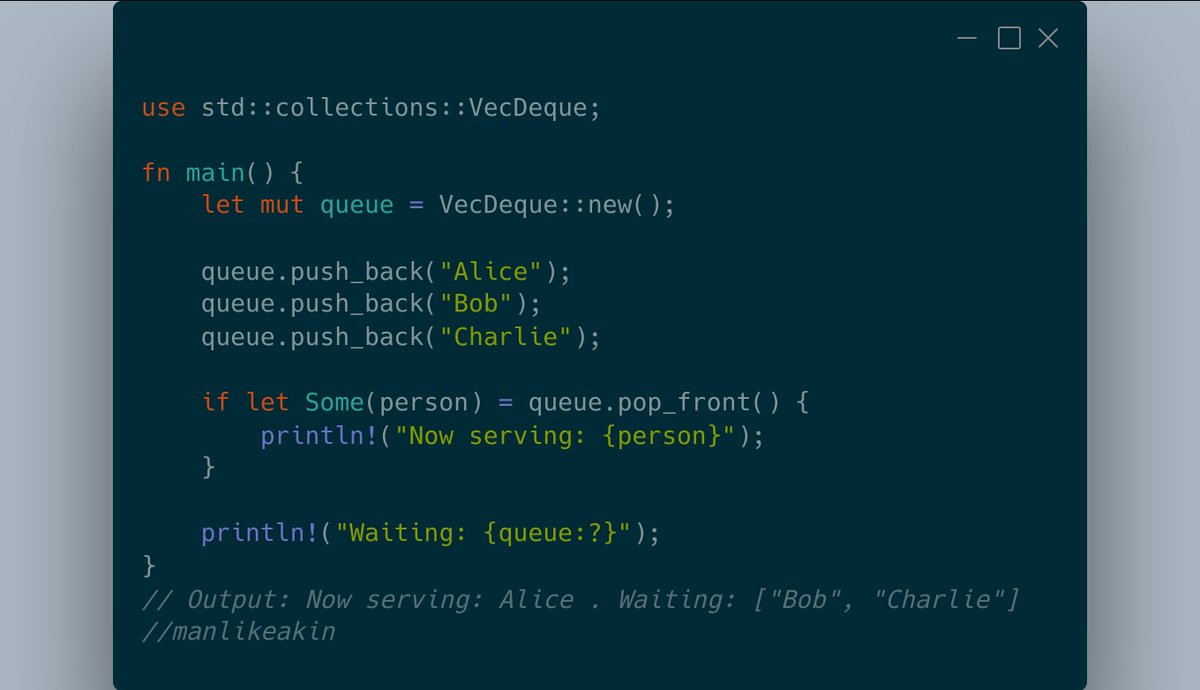
    1. VecDeque — build a queue Concept: A double-ended queue lets you add and remove elements from either end. push_back() adds an item to the end, while pop_front() removes the oldest item. This is useful for queues and task scheduling.
    10121
  3. HIM 🎖️🪖@ManlikeAkin_47
    @ManlikeAkin_47
    Iterating over &scores borrows the map rather than consuming it. Remember that HashMap iteration order is not guaranteed, so the output order may vary.
    1002
  4. HIM 🎖️🪖@ManlikeAkin_47
    1. Arc<T> — share ownership across threads Concept: Atomically reference-counted shared ownership. Arc<T> allows multiple threads to share ownership of the same data safely. Unlike Rc<T>, Arc<T> uses atomic reference counting and is suitable for multithreaded programs.
    Scarica
    HIM 🎖️🪖 @ManlikeAkin_47
    1. Async/Await — write asynchronous functions Concept: Asynchronous programming with Rust. async defines an asynchronous function, while .await waits for its future to produce a result. Rust requires an asynchronous runtime, such as Tokio, to execute this program.
    1008
  5. HIM 🎖️🪖@ManlikeAkin_47
    1. Async/Await — write asynchronous functions Concept: Asynchronous programming with Rust. async defines an asynchronous function, while .await waits for its future to produce a result. Rust requires an asynchronous runtime, such as Tokio, to execute this program.
    Scarica
    HIM 🎖️🪖 @ManlikeAkin_47
    1. find() — search for an element in a collection Concept: Find the first element that satisfies a condition. find() returns the first matching element as an Option. It returns None if no element satisfies the condition.
    10116
  6. HIM 🎖️🪖@ManlikeAkin_47
    @ManlikeAkin_47
    4. filter_map() — filter and transform simultaneously Concept: Filter out unwanted values while transforming the remaining elements. parse() returns a Result. The .ok() converts it into an Option, and filter_map() keeps only successful conversions.
    1002
  7. HIM 🎖️🪖@ManlikeAkin_47
    1. VecDeque — build a queue Concept: A double-ended queue lets you add and remove elements from either end. push_back() adds an item to the end, while pop_front() removes the oldest item. This is useful for queues and task scheduling.
    Scarica
    HIM 🎖️🪖 @ManlikeAkin_47
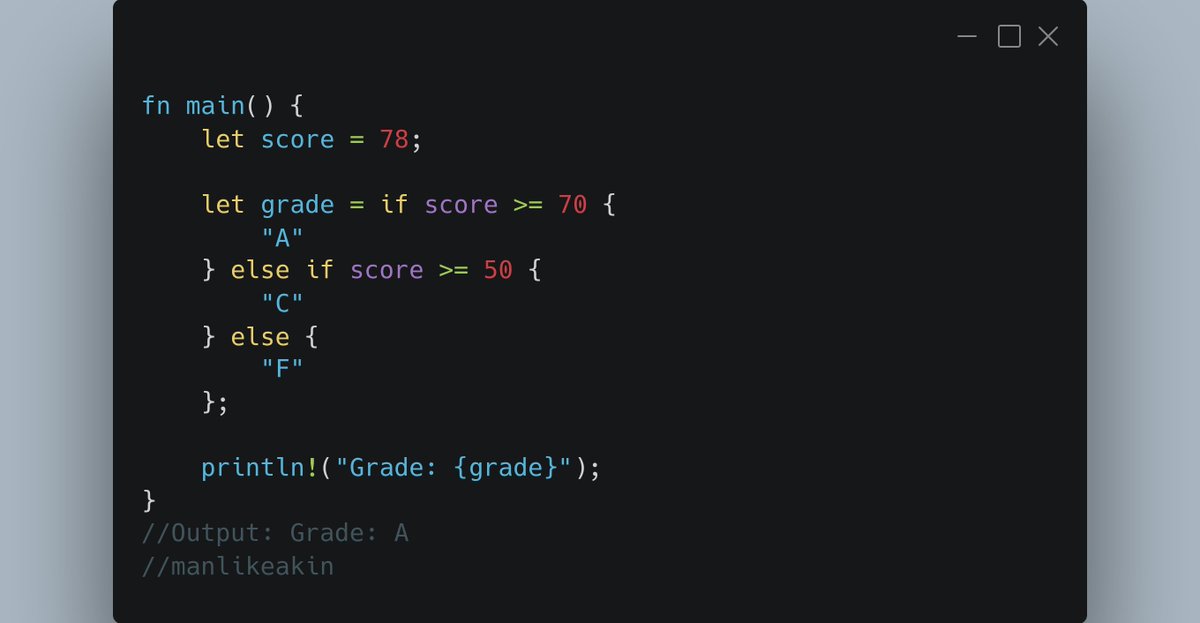
    1. if expressions — conditions return values Concept: In Rust, if can be used to assign a value. Unlike a traditional statement-only approach, Rust's if is an expression that produces a value. Both branches must return compatible types.
    10013
  8. HIM 🎖️🪖@ManlikeAkin_47
    @ManlikeAkin_47
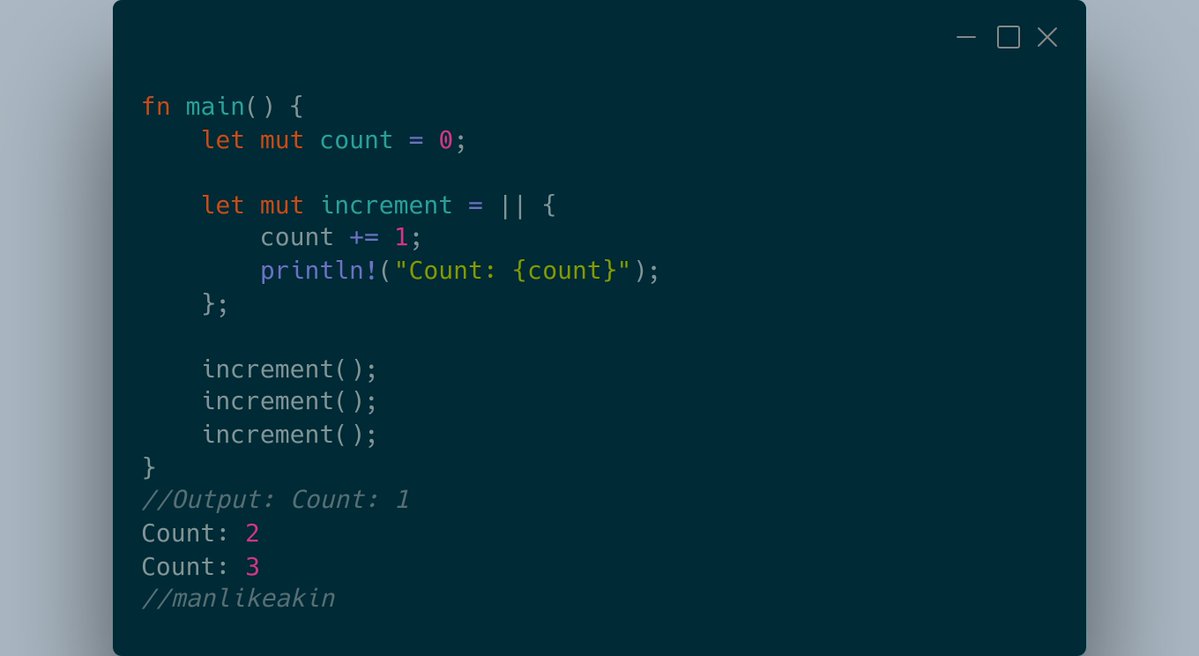
    value. The closure itself must be declared mut because calling it requires mutable access to its captured state.
    100
  9. HIM 🎖️🪖@ManlikeAkin_47
    1. if expressions — conditions return values Concept: In Rust, if can be used to assign a value. Unlike a traditional statement-only approach, Rust's if is an expression that produces a value. Both branches must return compatible types.
    Scarica
    HIM 🎖️🪖 @ManlikeAkin_47
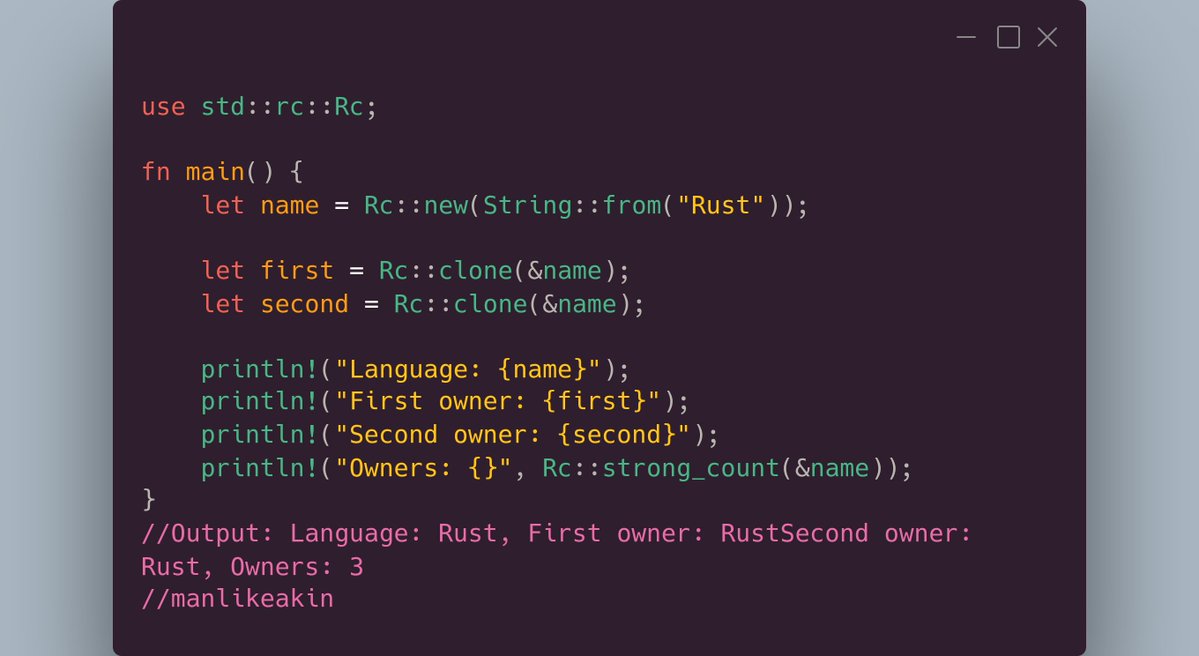
    1. Smart pointers — sharing data with Rc Concept: Rc<T> allows multiple owners of the same data in a single-threaded program. Rc::clone() creates another shared reference-counted owner without cloning the underlying String. Rc is designed for single-threaded use;
    10119
  10. HIM 🎖️🪖@ManlikeAkin_47
    1. Smart pointers — sharing data with Rc Concept: Rc<T> allows multiple owners of the same data in a single-threaded program. Rc::clone() creates another shared reference-counted owner without cloning the underlying String. Rc is designed for single-threaded use;
    Scarica
    10125
  11. HIM 🎖️🪖@ManlikeAkin_47
    @ManlikeAkin_47
    Rust automatically calls drop() when _file goes out of scope. This example demonstrates the mechanism; real file handles generally use standard-library types that already manage cleanup.
    1001
  12. RustDevTraining@RustDevTraining
    Learn modern Rust concepts, explore hands-on projects, and build practical coding knowledge to create reliable applications and advance your tech career. ✅Practical Skills ✅Rust Expertise ✅Expert Guidance ✅Faster Coding #RustProgramming #rustlearning #rusttraining
    Scarica
    0008
  13. HIM 🎖️🪖@ManlikeAkin_47
    1. find() — search for an element in a collection Concept: Find the first element that satisfies a condition. find() returns the first matching element as an Option. It returns None if no element satisfies the condition.
    Scarica
    HIM 🎖️🪖 @ManlikeAkin_47
    1. Default trait — create a default instance Concept: Provide sensible default values for a custom struct. #[derive(Default)] automatically implements the Default trait for this struct because .
    10115
  14. HIM 🎖️🪖@ManlikeAkin_47
    1. Default trait — create a default instance Concept: Provide sensible default values for a custom struct. #[derive(Default)] automatically implements the Default trait for this struct because .
    Scarica
    HIM 🎖️🪖 @ManlikeAkin_47
    1. Box<T> — store data on the heap Concept: A Box<T> owns a value stored on the heap. Box::new() creates a box that owns its value on the heap. Rust automatically cleans it up when the box goes out of scope.
    10118
  15. HIM 🎖️🪖@ManlikeAkin_47
    @ManlikeAkin_47
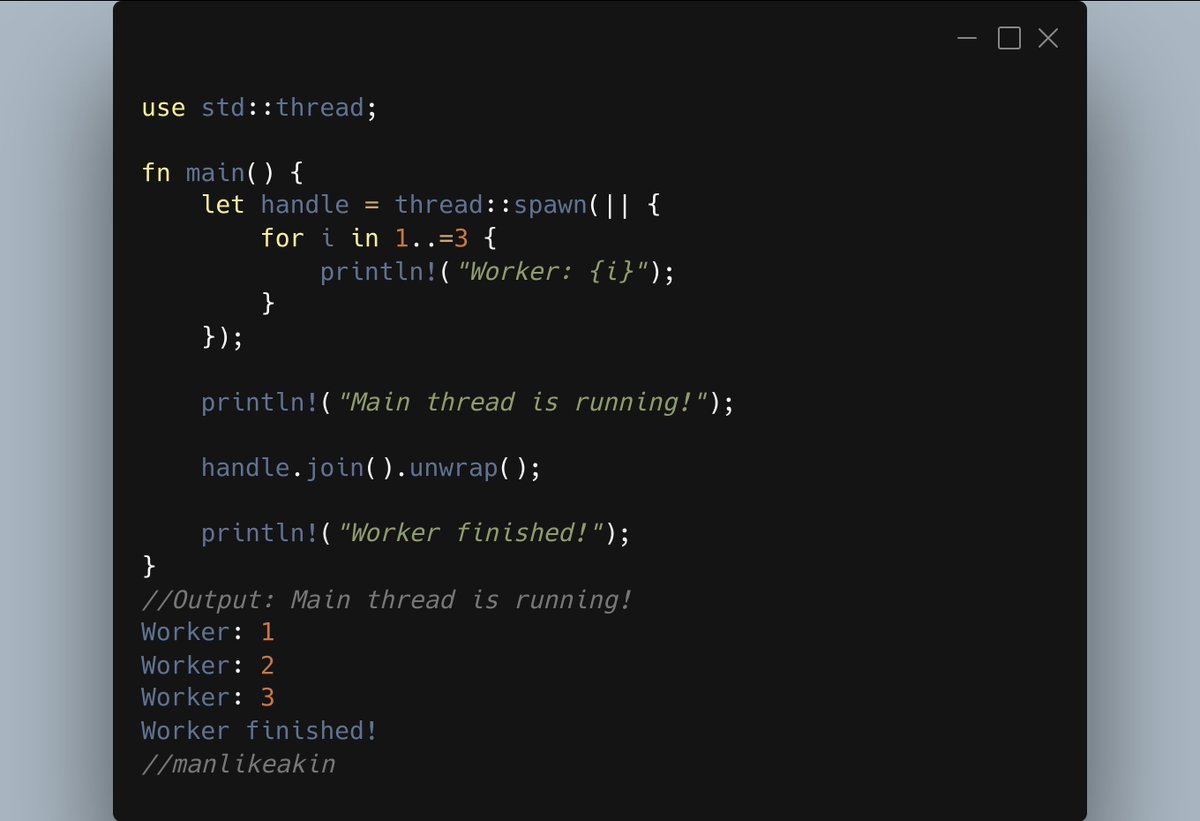
    thread::spawn() starts a new thread. join() waits for that thread to finish before the main thread continues. The exact ordering of the first messages can vary. Rust supports multithreading out of the box. With thread::spawn(), you can execute tasks
    1003
  16. HIM 🎖️🪖@ManlikeAkin_47
    @ManlikeAkin_47
    Unlike println!(), which prints directly to the console, format!() returns a new String that you can store, modify, or pass to another function. Need to build a message dynamically? Rust's format!() combines variables and text into a reusable string.
    1007
  17. Mostra altri post