Post con #Rustprogramming

#Rustprogramming

Post pubblici su X che usano #Rustprogramming.

Hashtag correlati

  1. SPARKKO✓@SPARKKOO
    Started learning Rust recently. At first, I just wanted to understand why everyone calls it “the hardest yet most rewarding language.” Now I get it 😭 — and I kinda love it.#rustprogramming
    Scarica
    10574
  2. Anas@anelgarhy
    Unit tests are a crucial part of any software development process and Rust has first-class support for them 💻 #rustlang #unittest
    2112557
  3. Anas@anelgarhy
    @anelgarhy
    Unit tests in Rust provide a safety net for your code, catching bugs and regressions before they make it to production 💙 #rustlang #unittests #ilikeit
    101109
  4. Anas@anelgarhy
    @anelgarhy
    So, Rust's emphasis on safety and reliability, combined with its first-class support for unit tests, makes it a great choice for developing critical systems 🚀 #RustProgramming #rustlang #Rust
    102108
  5. HIM 🎖️🪖@ManlikeAkin_47
    1. Arc<T> — share ownership across threads Concept: Atomically reference-counted shared ownership. Arc<T> allows multiple threads to share ownership of the same data safely. Unlike Rc<T>, Arc<T> uses atomic reference counting and is suitable for multithreaded programs.
    Scarica
    HIM 🎖️🪖 @ManlikeAkin_47
    1. Async/Await — write asynchronous functions Concept: Asynchronous programming with Rust. async defines an asynchronous function, while .await waits for its future to produce a result. Rust requires an asynchronous runtime, such as Tokio, to execute this program.
    10012
  6. HIM 🎖️🪖@ManlikeAkin_47
    1. Async/Await — write asynchronous functions Concept: Asynchronous programming with Rust. async defines an asynchronous function, while .await waits for its future to produce a result. Rust requires an asynchronous runtime, such as Tokio, to execute this program.
    Scarica
    10120
  7. HIM 🎖️🪖@ManlikeAkin_47
    @ManlikeAkin_47
    4. filter_map() — filter and transform simultaneously Concept: Filter out unwanted values while transforming the remaining elements. parse() returns a Result. The .ok() converts it into an Option, and filter_map() keeps only successful conversions.
    1005
  8. James the Elder 🇳🇬@kaligraph_jay
    Rust: fast, efficient, reliable. Ideal for systems & network programming, and web dev. Low-level control, high-level abstractions. Strong type system, error prevention and management. Popular for performance & safety. #rustlang #rustprogramming #rustacean #ferris
    2914384
  9. HIM 🎖️🪖@ManlikeAkin_47
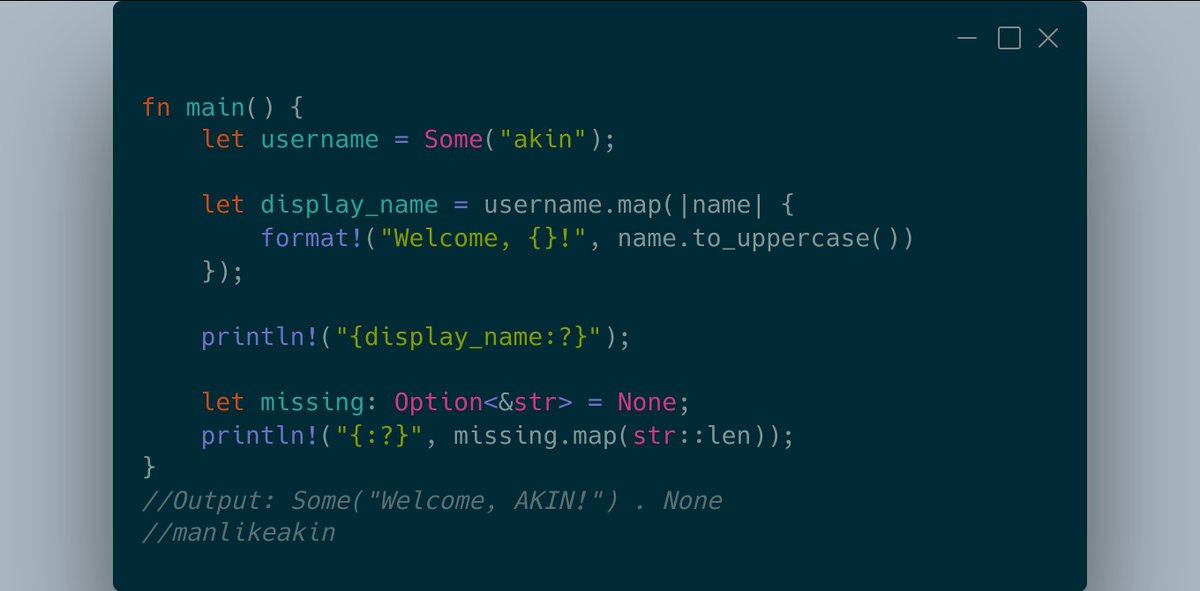
    2. Option::map — transform a value if it exists Concept: Transform the value inside an Option without manually matching every case. map() applies a function to the value inside Some. If the original value is None, the result remains None.
    HIM 🎖️🪖 @ManlikeAkin_47
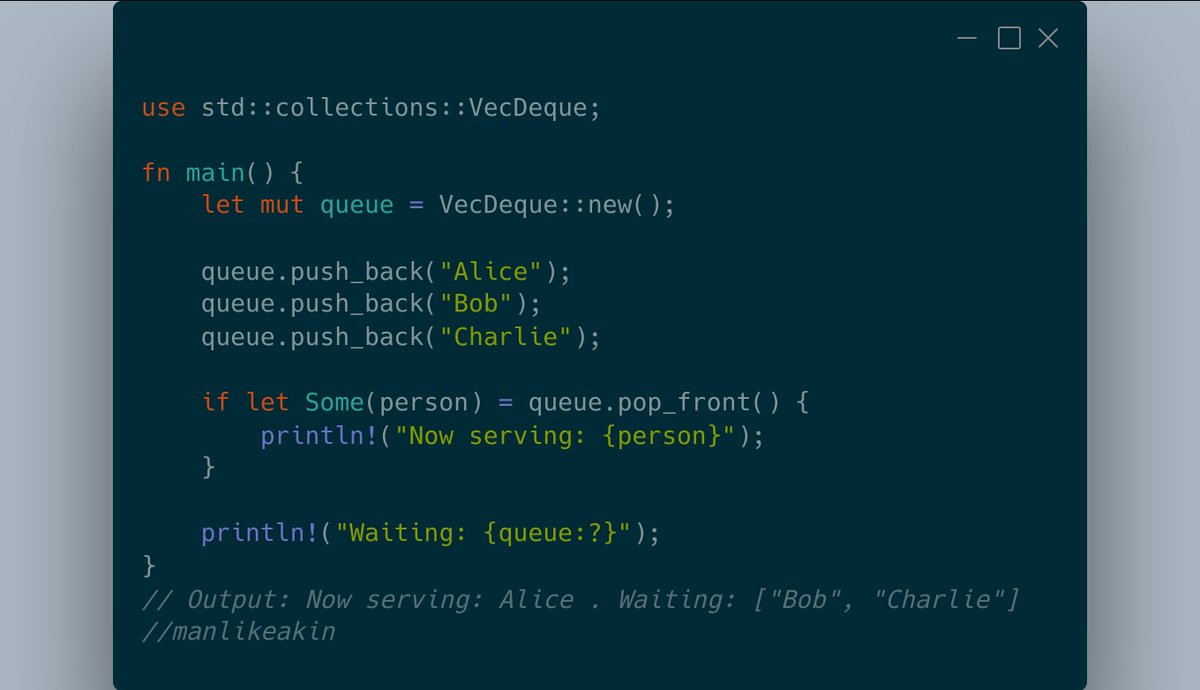
    1. VecDeque — build a queue Concept: A double-ended queue lets you add and remove elements from either end. push_back() adds an item to the end, while pop_front() removes the oldest item. This is useful for queues and task scheduling.
    10121
  10. HIM 🎖️🪖@ManlikeAkin_47
    1. VecDeque — build a queue Concept: A double-ended queue lets you add and remove elements from either end. push_back() adds an item to the end, while pop_front() removes the oldest item. This is useful for queues and task scheduling.
    Scarica
    10013
  11. HIM 🎖️🪖@ManlikeAkin_47
    @ManlikeAkin_47
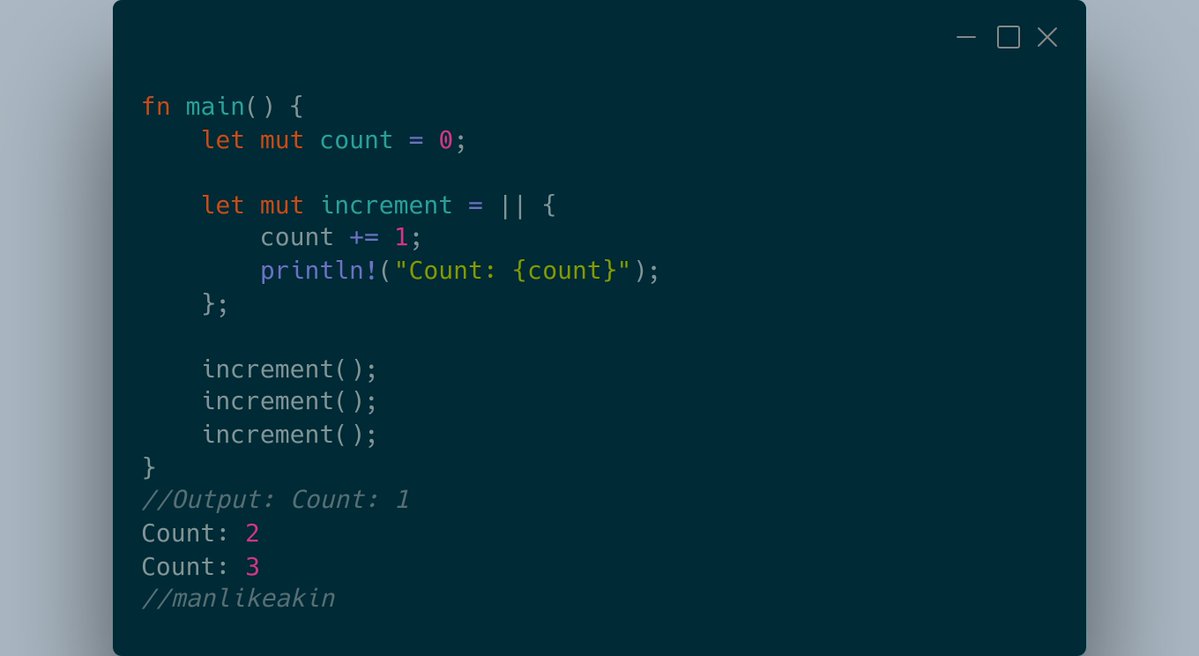
    value. The closure itself must be declared mut because calling it requires mutable access to its captured state.
    100
  12. HIM 🎖️🪖@ManlikeAkin_47
    1. Default trait — create a default instance Concept: Provide sensible default values for a custom struct. #[derive(Default)] automatically implements the Default trait for this struct because .
    Scarica
    HIM 🎖️🪖 @ManlikeAkin_47
    1. Box<T> — store data on the heap Concept: A Box<T> owns a value stored on the heap. Box::new() creates a box that owns its value on the heap. Rust automatically cleans it up when the box goes out of scope.
    10118
  13. HIM 🎖️🪖@ManlikeAkin_47
    1. Box<T> — store data on the heap Concept: A Box<T> owns a value stored on the heap. Box::new() creates a box that owns its value on the heap. Rust automatically cleans it up when the box goes out of scope.
    Scarica
    HIM 🎖️🪖 @ManlikeAkin_47
    2. Option::map — transform a value if it exists Concept: Transform the value inside an Option without manually matching every case. map() applies a function to the value inside Some. If the original value is None, the result remains None.
    10126
  14. HIM 🎖️🪖@ManlikeAkin_47
    @ManlikeAkin_47
    Unlike println!(), which prints directly to the console, format!() returns a new String that you can store, modify, or pass to another function. Need to build a message dynamically? Rust's format!() combines variables and text into a reusable string.
    1007
  15. Mostra altri post