#AsynchronousProgramming: Asynchronous programming is a technique that enables non-blocking execution of code, by allowing other code to run while waiting for slow I/O or network operations. It's often used in web development to improve performance and user experience.
And that's it! Promise.race() allows us to handle multiple Promises concurrently and respond to the first one that settles, be it a resolution or rejection. It's a powerful tool in your asynchronous programming toolbox. 🧰
I hope this thread has shed some light on Promise.race() in JavaScript. Feel free to experiment with it in your projects. Happy coding! 💻🎉
#javascript#Promises#AsynchronousProgramming
NEW ARTICLE ALERT✍ ✍ ✍
As part of @hackmamba bi-weekly writing challenge. I wrote an article that helps you understand Asynchronous JavaScript.
Do check it out , and feedback is appreciated.:
#JavaScript#asynchronousprogramming#writing
Just posted about #Dart isolates! Despite Dart being single-threaded, It can perform multiple tasks concurrently using async programming. Check out the details in my latest blog post: [ #AsynchronousProgramming#flutterdev
Day 9 of #100DaysOfCode! Today, we dived into the world of asynchronous JavaScript, exploring concepts like callbacks, callback hell, promise, and promise chaining. Excited to master these fundamentals! #JavaScript#AsynchronousProgramming
Day 18 of JS30Xplore:
1. What is Asynchronous Programming:
JavaScript is a single-threaded language, meaning it can execute one operation at a time in a sequential manner. However, many operations in web development are inherently asynchronous.
These operations include fetching data from a server, reading/writing to a file, waiting for user input, and more.
If JavaScript were to execute these operations synchronously, it would block the entire program until each operation is completed.
This would result in a poor user experience, as the application would become unresponsive during lengthy tasks.
Asynchronous programming allows JavaScript to execute non-blocking operations, ensuring that the program remains responsive while it waits for these tasks to complete.
Asynchronous code can be written in various ways, but the most common approaches include:
a. Callbacks
b. Promises
c. Async/Await
2. Callbacks:
A callback is a function that is passed as an argument to another function and is executed after the completion of a specific task or operation.
Callbacks are the foundation of asynchronous programming in JavaScript.
In the example, fetchData simulates an asynchronous operation by using setTimeout.
It takes a URL and a callback function as arguments. After a 1-second delay, it calls the processData function and passes the retrieved data to it.
The order of execution in the code is as follows:
- fetchData is called with the URL and the processData callback function.
- The message "Fetching data..." is logged immediately.
- After 1 second, the callback function processData is invoked with the fetched data, and the message
"Processing data: This is the data you requested!" is logged.
Callbacks are essential for handling asynchronous tasks, but they can lead to callback hell or "Pyramid of Doom" when dealing with multiple asynchronous operations.
To address this issue, Promises and Async/Await were introduced in JavaScript to make asynchronous code more readable and maintainable.
In summary, asynchronous programming in JavaScript is a way to handle non-blocking tasks using techniques like callbacks, Promises, and Async/Await.
Callbacks are a fundamental concept where you pass a function to be executed when an operation completes, ensuring that your program remains responsive and efficient.
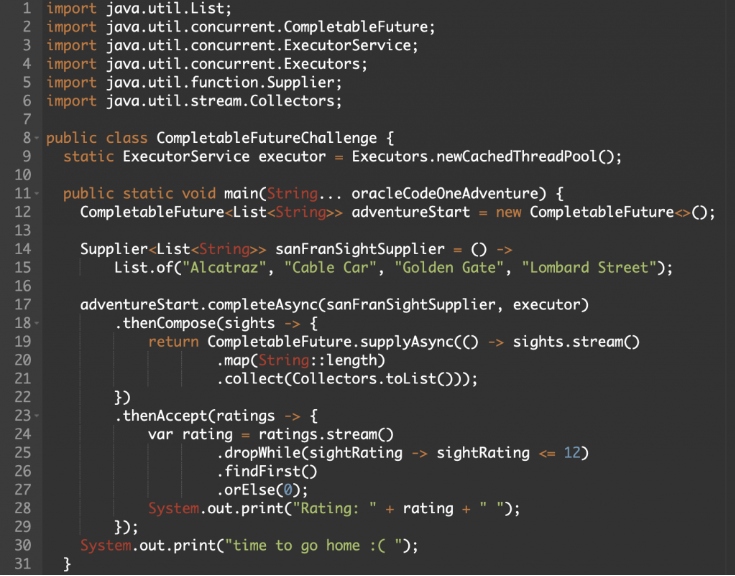
Elevate your performance using the robust CompletableFuture feature for asynchronous methods. Put your skills to the test with the Asynchronous CompletableFuture San Francisco Adventure #JavaChallenge. 💻
🔗
#JavaChallengers#AsynchronousProgramming
🌟Understanding the Event Loop🔄
Have you ever wondered how JavaScript handles multiple things at once?💻
Let's talk about the event loop, a fundamental concept that helps JavaScript manage tasks smoothly.
#JavaScript#EventLoop#AsynchronousProgramming#WebDevelopment