We believe by the end of 2030, every Fortune 500 will be a Self-Driving Company.
That doesn’t mean AI replaces people.
It means people remain in the driver's seat leading judgment, creativity and taste, while agents fuel execution.
This is the Self-Driving Company.
Today we're releasing ViBench 2.0, a benchmark for long-horizon software building. Agents start from an empty project and build a whole product, one feature at a time, without seeing what comes next.
Even the best models (GPT-6.1 Sol, GPT-6 Astra, Opus 5.5) pass every check in only 49-65% of builds.
ViBench 2.0 is now part of @FireworksAI_HQ’s Specialized Intelligence Index, with official results from Fireworks’ runs.
Read more:
We’re working to build the largest collection of private and public practitioner evals.
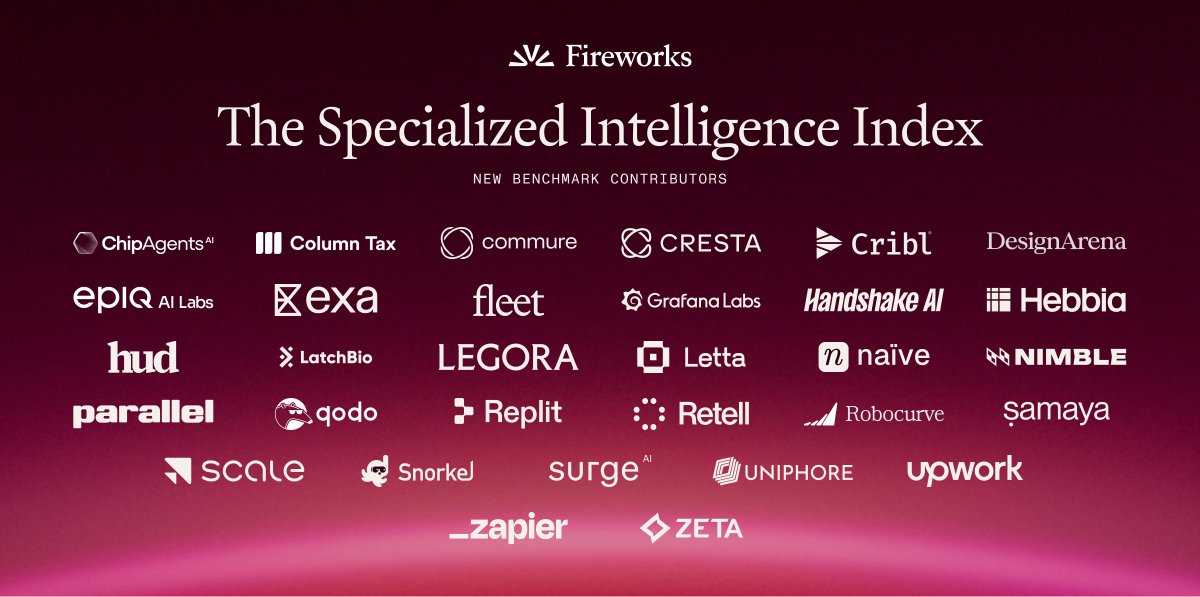
Today, 31 new partners join the Specialized Intelligence Index. Compare open, closed, and specialized models on real work, weigh quality against cost, and see where training could pay off.
Each model family has a house style.
The specs describe what a product does, not how it looks, so models fall back on their own taste:
▪️ GPT models reach for illustrations and big headlines.
▪️ Claude models build plainer screens.
To our eyes, the best-looking builds were no more likely to pass.
Self-driving doesn’t mean sacrificing security.
Our proposed Agent Habitat architecture combines security boundaries, lessons from real failures, and a maturity scale with testable evidence for evaluating agent environments.
Here’s what that looks like ↓
3. A way to separate claims from proof.
A maturity scale with testable evidence for assessing your environment or evaluating vendors.
4. Lessons from real failures.
How agent systems break, which controls address those failures, and where to strengthen defenses first.
Is your coding harness secure?
At Replit, we’ve spent years building security into the infrastructure where agents work.
Last week, that investment paid off: our isolation protections already prevented exploitation of the disclosed kernel vulnerabilities.
We also patched affected tooling and deployed firewall protections centrally, reducing the work customers had to do themselves.
Udostępnij
Skopiowano
Nikesh Arora@nikesharora
It's been an eventful week. Multiple vulnerabilites in Internet facing software, coding repositories, examples of agent behavior that seem concerning and a flurry of security specialists with solutions that can partially solve your problem. There in lies the challenge. Given the state of IT and security infrastructure, no one solution works. Let's break it down:
1/3
1. Vulnerabilites are being found and will continue to be found as models get more capable, the fragmented nature of the effort denies us the opportunity for a comprehensive find and replace option.
2. Even if all vulnerabilities could be found instantly and patches available - we will be reliant on the ability of enterprises to deploy all these changes at speed. It is not clear what the collateral impact of all these patches will/could be to our infrastructure of deployed en masse.
We will need a hybrid patch approach.
3. Virtual patching(VP) is needed in conjunction with direct patching but for a comprehensive (VP) solve you have to be lucky enough to have "modern frontier defenders" (Cyber companies that have vaulted infrastructure that can create patches at speed and push content rapidly to protect their customers) you need them for your network traffic, your traffic to applications on the cloud, your WAF, your end point.
4. There will continue to be patches that will need to be deployed directly but virtual patching will take the heavy load off.
2/3 Medium term solve:
Unfortunately token economics and current cyber architectures will not allow for defender swarms to contend with an offensive attack launched using agents. (Some x pundits who aren't steeped in cyber should take heed). Yes, theoretically we should aspire to have these agentic swarms defend us when we are under attack, unfortunately an attack is a sniper moment, chained vulnerabilities, cloaked attack followed by swift exfiltration. It's a speed program not a brute force problem.
To solve for this, enterprises need to get their SOC architecture right, logs, feeds, cyber products orchestrated via a modern SOAR for swift response. Only then can we deploy agents to detect and remediate. In addition, enterprises need to modernize and dare I say platformize their perimeter stack to ensure consistency.
Unfortunately, enterprises still seem to not see the urgency across the board, decisions are stuck, CIO/CISO's have a lot on their plate. While some honestly have bit seen the scale of such a problem before and it's hard convincing the organization that one needs to open the floodgates on modernizing the IT and security infrastructure. So we will continue to see environments being brought down to patch today it's for PHP, tomorrow it will be for the next one.
3/3 AI deployments are the"wild wild west" - LLM capabilities are expanding faster than we can build products to secure them. Sure an agent will jump across guardrails in a research lab, which is a lesson for all of us to deploy agents securely. But there is a lag between the discovery, the availability of that in a public model and the time needed for the cyber industry to build governance or an antidote. And no, dear frontier lab friends, the world cannot just trust you to build the solve. The infrastructure industry in tech builds and the cyber industry secured and provides assurance to the boards and organizations around security and safety.
AI security is the new attack surface. CEOs (present company included) want AI adoption, getting the pace of adoption wrong could be the last decision we make, at the same time "deploying it wrong" could have the same consequence.
There are billions of dollars being spent on coding, is your coding harness secure? Start there. If agents can jump guardrails, they can hide stuff in code.
Validate business outcomes needed, test your user case and ensure agentic deployments are well guard railed. Deploy a second set of eyes to watch your deployments for drift, compliance and verifiability.
This framework gives security and platform teams a practical starting point: assess each area, require evidence, and address the weakest boundary first.
Read our whitepaper for more:
It's been an eventful week. Multiple vulnerabilites in Internet facing software, coding repositories, examples of agent behavior that seem concerning and a flurry of security specialists with solutions that can partially solve your problem. There in lies the challenge. Given the state of IT and security infrastructure, no one solution works. Let's break it down:
1/3
1. Vulnerabilites are being found and will continue to be found as models get more capable, the fragmented nature of the effort denies us the opportunity for a comprehensive find and replace option.
2. Even if all vulnerabilities could be found instantly and patches available - we will be reliant on the ability of enterprises to deploy all these changes at speed. It is not clear what the collateral impact of all these patches will/could be to our infrastructure of deployed en masse.
We will need a hybrid patch approach.
3. Virtual patching(VP) is needed in conjunction with direct patching but for a comprehensive (VP) solve you have to be lucky enough to have "modern frontier defenders" (Cyber companies that have vaulted infrastructure that can create patches at speed and push content rapidly to protect their customers) you need them for your network traffic, your traffic to applications on the cloud, your WAF, your end point.
4. There will continue to be patches that will need to be deployed directly but virtual patching will take the heavy load off.
2/3 Medium term solve:
Unfortunately token economics and current cyber architectures will not allow for defender swarms to contend with an offensive attack launched using agents. (Some x pundits who aren't steeped in cyber should take heed). Yes, theoretically we should aspire to have these agentic swarms defend us when we are under attack, unfortunately an attack is a sniper moment, chained vulnerabilities, cloaked attack followed by swift exfiltration. It's a speed program not a brute force problem.
To solve for this, enterprises need to get their SOC architecture right, logs, feeds, cyber products orchestrated via a modern SOAR for swift response. Only then can we deploy agents to detect and remediate. In addition, enterprises need to modernize and dare I say platformize their perimeter stack to ensure consistency.
Unfortunately, enterprises still seem to not see the urgency across the board, decisions are stuck, CIO/CISO's have a lot on their plate. While some honestly have bit seen the scale of such a problem before and it's hard convincing the organization that one needs to open the floodgates on modernizing the IT and security infrastructure. So we will continue to see environments being brought down to patch today it's for PHP, tomorrow it will be for the next one.
3/3 AI deployments are the"wild wild west" - LLM capabilities are expanding faster than we can build products to secure them. Sure an agent will jump across guardrails in a research lab, which is a lesson for all of us to deploy agents securely. But there is a lag between the discovery, the availability of that in a public model and the time needed for the cyber industry to build governance or an antidote. And no, dear frontier lab friends, the world cannot just trust you to build the solve. The infrastructure industry in tech builds and the cyber industry secured and provides assurance to the boards and organizations around security and safety.
AI security is the new attack surface. CEOs (present company included) want AI adoption, getting the pace of adoption wrong could be the last decision we make, at the same time "deploying it wrong" could have the same consequence.
There are billions of dollars being spent on coding, is your coding harness secure? Start there. If agents can jump guardrails, they can hide stuff in code.
Validate business outcomes needed, test your user case and ensure agentic deployments are well guard railed. Deploy a second set of eyes to watch your deployments for drift, compliance and verifiability.
Becoming self-driving means giving more people the ability to contribute while keeping security controls and engineering oversight in place.
Replit brings together isolated execution, protected credentials, admin controls, audit logs, and engineering review workflows.
Udostępnij
Skopiowano
Luis Héctor Chávez@lhchavez
For @Replit to become a Self-Driving Company, we have been building a strong policy and network level enforcement that goes beyond traditional guardrails.
Giving agents more responsibilities means policies enforced in all layers of the system to keep humans in control.
This is the foundation we’re bringing to the Self-Driving Company: agents that can do more, with controls that hold as their autonomy grows.
Read more about our philosophy:
For @Replit to become a Self-Driving Company, we have been building a strong policy and network level enforcement that goes beyond traditional guardrails.
Giving agents more responsibilities means policies enforced in all layers of the system to keep humans in control.
Udostępnij
Skopiowano
Replit ⠕@Replit
For years, Replit has built security into the infrastructure where agents work.
Last week is one example: Our existing isolation protections prevented exploitation of the disclosed kernel vulnerabilities.
We also patched affected tooling and deployed firewall protections centrally, reducing remediation work for developers.
Our CTO @lhchavez explains what’s available today and what’s next:
Every transformative workplace technology introduces chaos.
At Replit, we believe becoming a Self-Driving Company means empowering more people to build, experiment, and solve problems with AI agents.
That kind of transformation requires new ways of working, with the right guardrails to turn innovation into something that scales.
Let chaos reign. Then rein in chaos.
Here’s why that matters to @Teamworks. ↓
“Our customers trust Teamworks with sensitive athlete health and performance data, so security and governance are non-negotiable.
We chose Replit to help more people across our business improve our software while maintaining the security controls and engineering oversight we need.” - @reedacted, CTO at Teamworks.
RT @amasad: For centuries, the architecture of the firm has barely changed: hierarchies of people organized into departments and coordinated through bureaucracy.
AI agents are about to upend that.
We’re moving toward the self-driving company where humans exercise judgment and agents execute most of the work.
At Replit, we’re building the foundation for this new kind of company. We’re calling it “the Agent Habitat.”
Marc Andreessen wrote a fantastic piece placing this shift in the history of computing. Every major computing revolution began with chaos before businesses figured out how to harness it.
For years, Replit has built security into the infrastructure where agents work.
Last week is one example: Our existing isolation protections prevented exploitation of the disclosed kernel vulnerabilities.
We also patched affected tooling and deployed firewall protections centrally, reducing remediation work for developers.
Our CTO @lhchavez explains what’s available today and what’s next:
Companies that become self-driving will force an existential choice on their competition: change how you work or watch competitors do what you can't.
Let people drive decisions. And let agents execute on the work, with clear goals and boundaries.
Udostępnij
Skopiowano
Amjad Masad@amasad
Software ate the world, now it's learning to run it.
Security has to scale with agent autonomy.
Replit combines isolated execution, protected credentials, access controls, and review workflows so teams can delegate more while retaining control.
RT @a16z: One of the best tells that a technology will change the world: it makes a chaotic entrance.
In the 1980s, employees lied on procurement forms to get PCs into the office, claiming they were buying oscilloscopes or typewriters, while experts warned of "shadow" data processing departments.
Spreadsheets, the original "workplace agent," filled companies with models only their creator could understand.
Email broke the mailroom's control over who could reach whom.
Each time, the fix was a habitat: guardrails that kept the bottom-up energy alive while reining in the chaos just enough.
Now agents are following the same path. As Replit's Amjad Masad puts it, "Today, most agents live somewhere chaotic. They run in chat windows, personal accounts, and one-off scripts, holding whatever credentials and data someone handed them."
"Code is the ultimate 'aligning artifact' that someone can produce, because it literally is the business logic of the organization."
"Soon, you'll be able to measure a company's alignment by the richness of its agent habitat."
Marc Andreessen on Replit and the dawn of the self-driving company:
@Replit@amasad
In a Self-Driving Company, the people closest to the problem can build the solution.
With Replit, anyone in the business can now contribute safely to the company codebase.
More collaboration. Fewer bottlenecks. Product shipped faster.
RT @amasad: “is Replit built with Replit?”
The answer was historically “kinda.”
But today it’s “absolutely!”
Introducing Cloud Agents: run any codebase and generate pull requests right from Replit.
Same UX you love, but can run any repo!
Udostępnij
Skopiowano
Replit ⠕@Replit
Now anyone can now bring their ideas into the company codebase on Replit.
Replit Cloud Agents can turn natural language into a tested pull request, and engineers still approve the final code before it ships.
Our own design team used Replit to safely ship over 250k lines of code in the last 6 months, reviewed and approved by engineers.
A website, a pitch deck, and launch graphics should tell the same story.
Start in Replit: “Build a website for my coffee brand.”
Then keep going: “Turn this into a pitch deck.” “Now create launch graphics in the same style.”
Build on the brand and visual direction already in the conversation, then refine each output for where it will be used.
Now anyone can now bring their ideas into the company codebase on Replit.
Replit Cloud Agents can turn natural language into a tested pull request, and engineers still approve the final code before it ships.
Our own design team used Replit to safely ship over 250k lines of code in the last 6 months, reviewed and approved by engineers.
We’re breaking down the barriers between the company codebase and people with ideas:
- High-quality pull requests arrive with video evidence
- The company gets smarter with self-improving workspace memory
- Create requests right from Slack, where your teams collaborate
- Shared environments mean you don’t need to get things up and running yourself
Now available for Enterprise and Pro users.
This Week in Replit
1) Stripe Atlas on Replit. Ask Replit to incorporate your business through the Stripe MCP integration, with 20% off when you incorporate through Replit.
→ Try it today. Ask Replit: "Incorporate my business with Stripe Atlas"
2) Chat and asset sharing. Give your teammate the full context rather than just the summary. Share a whole chat or a single asset with selected teammates or your whole workspace. No copy-pasting the whole chat.
→ Hit Share at the top of your chat:
3) Create and update skills. Turn useful workflows from your conversations and projects into reusable workspace skills. Replit suggests new skills or improvements to existing ones, and you approve them before they're saved.
→ Nailed a workflow? Ask Replit: "Turn this into a skill"
4) Meet Replit for Government. National, state, local, tribal, and territorial governments can now turn shared knowledge into useful tools. Because public service deserves better software.
→
5) Security update. Recent vulnerabilities in widely used third-party software created risks across the internet. Replit patched infrastructure, updated language tooling, and blocked exploits to protect your apps. Where you need to republish, you'll get clear instructions.
→
6) Meet Replit Monitoring Agent, your autonomous on-call engineer. It can see, fix, and deploy changes autonomously. Turn on Monitoring alerts and Auto-fix, and add Auto-republish to ship validated fixes on their own.
→
Full replay of today's sh, with Jon Cheney on building a $20M company on Replit, and Andrea Leang and Josh McFarlin on Monitoring Agent:
Recent vulnerabilities in widely used third-party software have created risks for businesses across the internet.
We have patched infrastructure, updated language tooling, and blocked exploits to protect your apps. We’ve applied fixes automatically wherever we can. Where you need to republish, we’re notifying you with clear instructions.
Read more on our blog:
You don’t need a perfect prompt to start working through an idea.
And your first question doesn’t have to contain the whole brief. Add context as you go.
Q&A and follow-ups in Free mode don’t use additional paid credits. Select Free below the prompt box to start exploring.
You now have an on-call engineer right in your pocket.
Meet Monitoring Agent.
Replit Monitoring Agent can see, fix, and deploy changes autonomously for AI-app builders.
Create your own apps, without the headaches of managing fixes.
Learn more:
When a production issue occurs, Monitoring Agent can investigate the alert, identify the cause, make and validate a fix, and deploy that fix to production.
It then reports back with what happened and what changed.
To get started enable monitoring alerts and auto-fix in your publishing settings.
Turn on auto republish to enable Monitoring Agent to deploy validated fixes for you.