Posty z #Pythonic
#Pythonic
Publiczne posty w X, które używają #Pythonic.
Powiązane hashtagi


Python Quiz: What is the Output? x = 10 if x == 10: print("Hello")1732021.6K2.7M
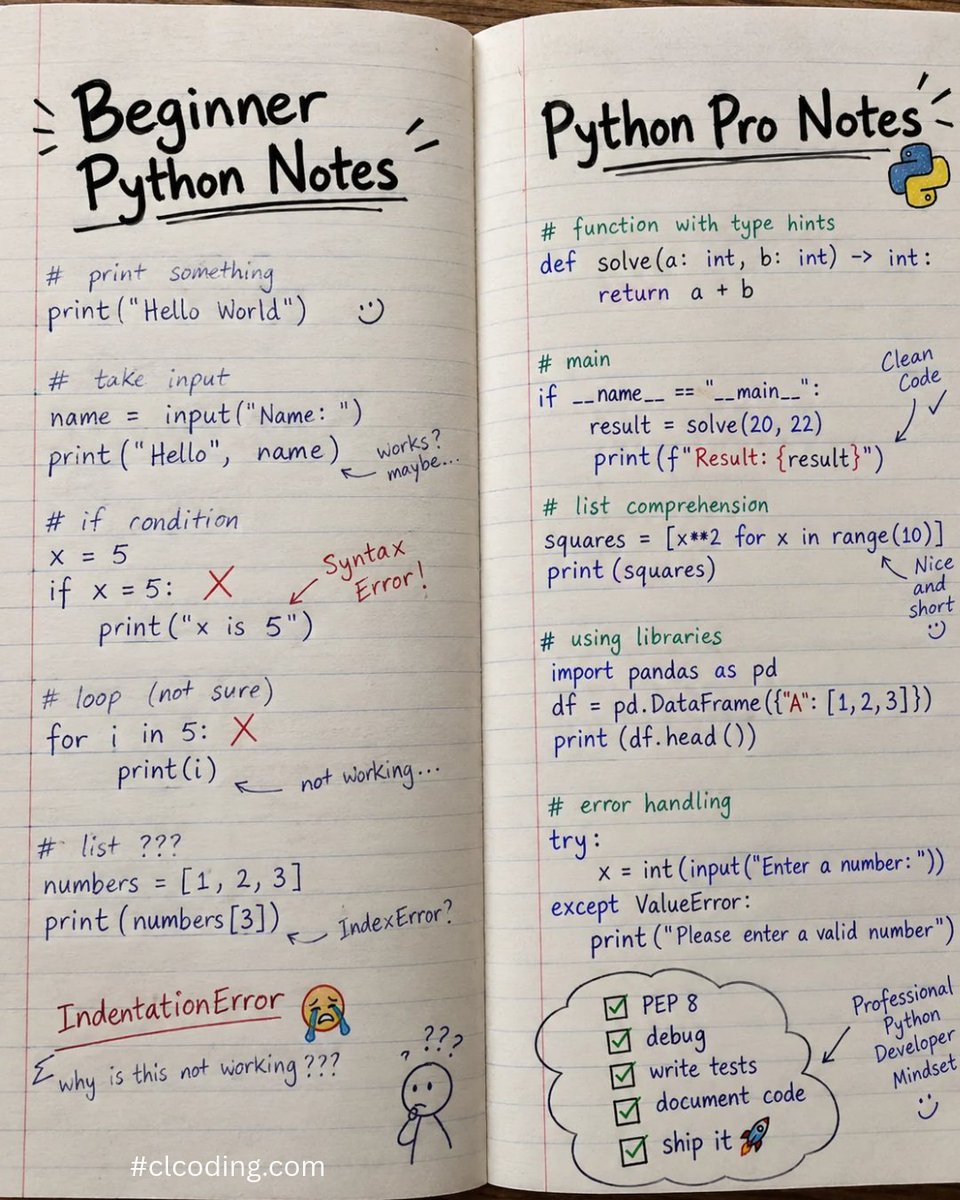
Beginner Python vs. Python Pro: The Difference Is in the Details! Beginners write code that works. Professionals write code that is clean, readable, reliable, and easy to maintain. Here’s what changes as you grow as a Python developer: ✅ Understand syntax errors and indentation ✅ Use type hints and meaningful function names ✅ Write clean, reusable code ✅ Handle errors properly ✅ Follow PEP 8 guidelines ✅ Debug your code and write tests ✅ Use libraries like Pandas effectively The goal isn't just to make your code run. It's to make it better. Unlock your full potential in Python with 100 practical, real-world projects designed to take you from complete beginner to confident developer. This book is hands-on, structured, and explanation-focused — perfect for students, self-learners, and working professionals who want to learn by building, not just reading. Books:43425416.5K
Top 10 Python Built-in Functions Every Beginner Must Know 💥1372797.4K

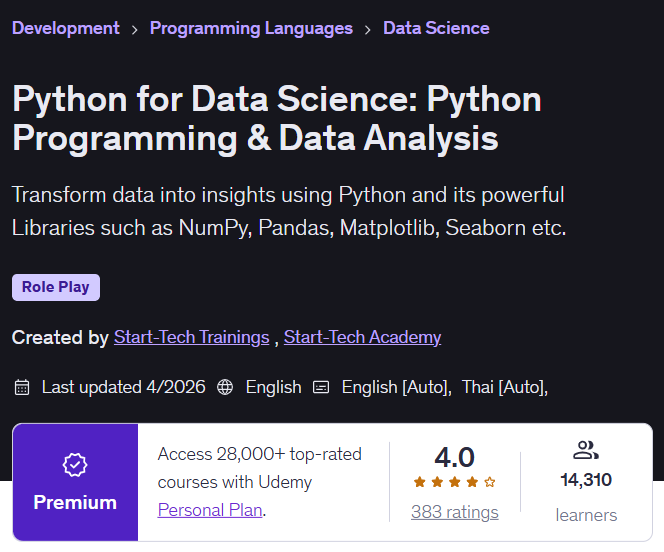
Want to learn Python for Data Science? Turn raw data into meaningful insights with Python! Explore essential libraries used in data analysis and visualization: ✅ NumPy – Numerical computing ✅ Pandas – Data manipulation and analysis ✅ Matplotlib – Data visualization ✅ Seaborn – Statistical data visualization Build practical skills, analyze datasets, and take your first steps toward becoming a Data Scientist. Perfect for Python developers, students, and aspiring data analysts. Detailed Explanation:11310711.1K
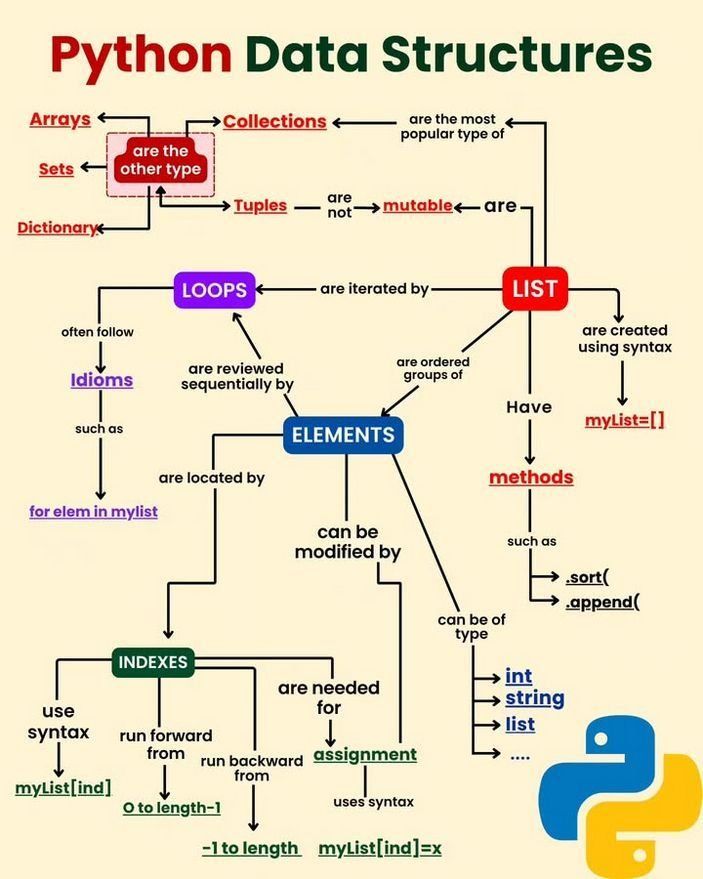
If you’re serious about PYTHON, This is all you need!!3251917K
You may have heard about the Model Context Protocol and wondered how it lets AI tools connect to other tools, APIs, and systems. Well, it's all thanks to MCP servers. In this guide, @manishmshiva explains how MCP servers work and helps you build your own with Python and the FastMCP library.118566430.4K
“Bayesian Modeling and Computation in Python” available at ————— #Mathematics #DataScience #DataScientist218924.5K
Download this 371-page PDF “Guide to NumPy” (from MIT) for deepening your Python programming expertise — get it at1402197.2K
10 Advanced Python Interview Questions Every Developer Should Know Think you know Python well? It's time to test your knowledge! These 10 questions cover some challenging topics: Custom Memory Allocation Cython Optimization Multithreading & the GIL Metaclasses & OOP Celery & RabbitMQ Advanced Decorators Real-Time Streaming with WebSockets Python vs NumPy Performance REST API Security with OAuth 2.0 Microservices Architecture These questions go beyond basic syntax and test your understanding of Python internals, performance, scalability, and system design. How many can you answer confidently without searching online? Save this list for your next interview preparation! Follow @CLCODING for more Python tips, coding challenges, and interview questions.419829K
Python Quiz: What is the Output? A) 0 B) 10 C) True D) False 👉 Comment your answers below!251615223K
holy f*cking sh*t Karpathy put an entire AI degree on github for free while you are still paying $200/month to watch youtube tutorials from a guy with 3000 followers 7 repos. 306,741 stars combined. in the right order they take you from "how a neuron learns" to "agents that run research overnight while you sleep" every repo you skip is a layer of understanding your competition at work already has and you do not. and every month you keep "planning to start" is another month someone on your team gets handed the AI project you should have been running here is the exact order. do not reshuffle it 1. micrograd → how a neural net actually learns. backpropagation in about 100 lines of python. this is where every AI engineer on earth started. if you cannot read this file, every other repo on the list is going to feel like black magic to you 2. nn-zero-to-hero → his full video course. lecture notebooks that walk you from a single neuron to GPT. the thing people pay $2000 for from AI "bootcamps" that teach a fraction of what is in this one free repo 3. minbpe → how text actually turns into tokens. the tokenizer that sits inside every LLM, in clean minimal code. this is the part 95% of self-taught people skip, and it is why their models never work right 4. nanoGPT → your own GPT. the simplest repo in existence to train and fine-tune one. after this file you stop asking "how does ChatGPT work" because you have literally built the smaller version with your own hands 5. llm.c → the same training with nothing hidden. raw C and CUDA, no PyTorch wrapper doing the hard parts for you. this is where you stop being a prompt engineer and start being an actual engineer 6. nanochat → a full chat model end to end. GPT-2 level training that cost ~$43,000 in 2019. in this repo it costs about $48. let that sit for a second. the thing people called a breakthrough is now a weekend project 7. autoresearch → agents that do the research for you. the agent edits your training code, trains for 5 minutes, keeps whatever improved, discards whatever did not, and repeats all night while you sleep. this is where the people reading this list stop being students and start being whatever comes after that the brutal truth most people avoid: train one GPT from scratch and you become the person who gets handed the AI project at work, along with the raise that comes with it. keep "planning to start" and you become the person watching that happen to someone else the classroom half of the same degree, what Stanford actually teaches about AI for real, is belowyurshev @yurshevv241661.4K123K
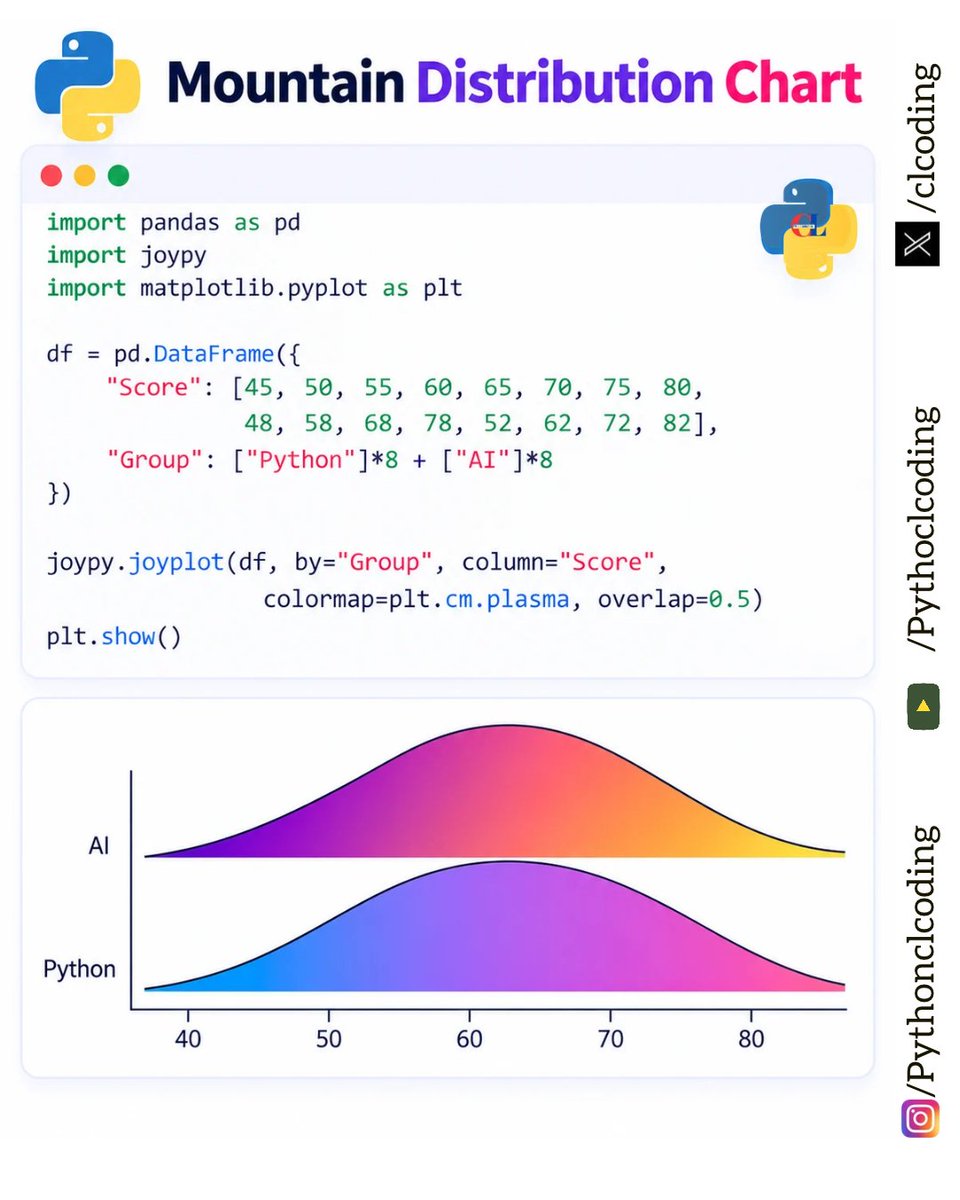
Visualize Data Distributions in Python with JoyPy! Want to compare how different groups are distributed across a range of values? Try a Mountain Distribution Chart using Python! With pandas, joypy, and matplotlib, you can create beautiful overlapping density plots that make data patterns easier to understand. What you'll learn: ✅ Compare distributions across groups ✅ Identify peaks, spread, and patterns ✅ Visualize score distributions with colorful charts ✅ Create professional statistical visualizations with just a few lines of Python Perfect for: Data Science, Exploratory Data Analysis (EDA), Statistics, and Machine Learning projects. ML Papers Explained (Free PDF) Download Book:12212412.2K- Pokaż więcej postów