If you want to improve your beginner Python skills, try building something that gets data from the internet.
That's what Sameer helps you do here.
You'll build a weather app and learn about APIs, HTTP requests, error handling, and more.
The field of Cryptography is all about securing both data and communication between systems.
And in this course, you'll learn the basics like hashing, symmetric and asymmetric encryption, and more.
By the end, you'll have built a fully-functioning Python-based command line cryptography tool.
Algorithms — Free PDF (472 Pages!)
Want to strengthen your problem-solving skills and become a better programmer?
This 472-page Algorithms book is a great resource for anyone interested in understanding how algorithms work and how to solve computational problems efficiently.
What you can learn:
✅ Algorithm design and problem-solving
✅ Time and space complexity
✅ Efficient approaches to computational problems
✅ A stronger foundation for Data Structures & Algorithms (DSA)
✅ Skills useful for coding interviews and competitive programming
Perfect for Python developers, computer science students, software engineers, and aspiring programmers!
Get the free PDF here:
Web research agents don't have to depend on hosted chat tools.
In this tutorial, Darsh shows you how to build a personal AI research agent with Ollama, Qwen, and Python.
Your agent will search the web, fetch pages, summarize results locally, and save a Markdown digest on your machine.
Python Bootcamp 2026: From Zero to Python Developer!
Want to become a Python developer but don't know where to start?
This bootcamp is your opportunity to build strong Python skills from the ground up.
Learn Python step by step
Practice with hands-on coding
Strengthen your programming fundamentals
Build the skills needed for real-world development
Whether you're a beginner or looking to strengthen your Python knowledge, start your learning journey today!
Explore the bootcamp:
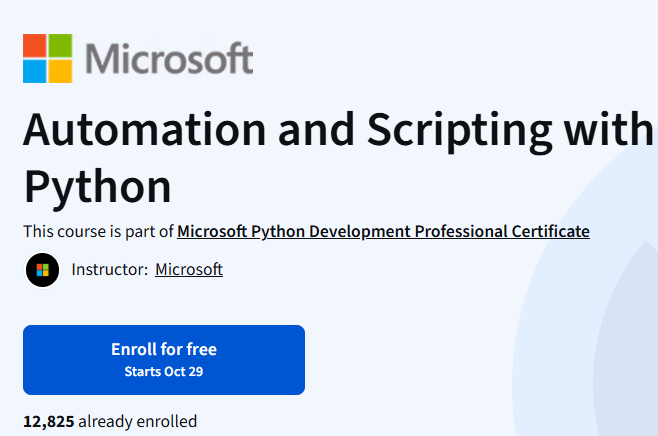
Check out Automation and Scripting with Python by Microsoft!
Learn how Python can help you automate everyday tasks, write useful scripts, and improve your productivity.
✅ Learn from Microsoft
✅ Part of the Microsoft Python Development Professional Certificate
✅ Enroll for FREE!
Start learning and build your Python skills today.
Course details:
holy f*ck, Karpathy put an entire AI degree on GitHub for free
7 repos, 306,741 stars, and in the right order they take you from backprop to agents that run research overnight
each repo is the next layer of the one before
1. micrograd -> how a neural net actually learns
backprop in about 100 lines of Python
↳
2. nn-zero-to-hero -> the video course
his lecture notebooks, from one neuron to GPT
↳
3. minbpe -> how text turns into tokens
the tokenizer every LLM starts with, in clean minimal code
↳
4. nanoGPT -> your own GPT
the simplest repo to train and fine-tune one
↳
5. llm.c -> the same training with nothing hidden
raw C and CUDA, no PyTorch underneath
↳
6. nanochat -> a full chat model end to end
GPT-2 level training cost ~$43,000 in 2019
here it's about $48
↳
7. autoresearch -> agents that do the research
an agent edits the training code, trains for 5 minutes, keeps what improved and repeats all night
↳
train one GPT from scratch and you become the person who gets handed the AI project, along with the raise that comes with it
the classroom half of the same degree, what Stanford actually teaches about AI, is below ↓
10 Advanced Python Interview Questions Every Developer Should Know
Think you know Python well? It's time to test your knowledge!
These 10 questions cover some challenging topics:
Custom Memory Allocation
Cython Optimization
Multithreading & the GIL
Metaclasses & OOP
Celery & RabbitMQ
Advanced Decorators
Real-Time Streaming with WebSockets
Python vs NumPy Performance
REST API Security with OAuth 2.0
Microservices Architecture
These questions go beyond basic syntax and test your understanding of Python internals, performance, scalability, and system design.
How many can you answer confidently without searching online?
Save this list for your next interview preparation!
Follow @CLCODING for more Python tips, coding challenges, and interview questions.
As an Agentic AI Engineer, you must build these projects.
1.) Async Agent Orchestrator
Build: A FastAPI + asyncio event loop handling 100+ concurrent agent tasks with non-blocking tool calls and graceful error recovery.
Why: `while True` loops block the main thread. Real-world agents require event-driven concurrency to survive production traffic.
2.) Dynamic Context Budget Assembler
Build: A pre-flight middleware that strictly allocates tokens across system prompts, retrieved docs and tool schemas per request.
Why: Context overflow is the #1 silent killer of production agents. You must budget tokens like you budget cloud spend.
3.) Strict Pydantic Tool Router
Build: A tool execution engine that forces LLM outputs into strict JSON schemas and automatically retries with the error trace on validation failure.
Why: Agents hallucinate API parameters. Grammar-constrained decoding and Pydantic validation turn stochastic outputs into deterministic actions.
4.) 3-Tier Memory & Eviction Engine
Build: A memory system with working scratchpads, episodic session compression and semantic vector search with automated TTL eviction.
Why: Infinite context causes OOM errors and hallucinations. Memory must be actively managed, scored and pruned.
5.) Self-Healing ReAct Loop
Build: An agent that reads its own stack traces, parses the compiler/API error, rewrites the failing tool call and retries up to 3 times.
Why: Agents that fail on the first try are useless. Agents that debug themselves are digital employees.
6.) Typed Multi-Agent Swarm
Build: A LangGraph state machine where a Researcher, Coder and Reviewer agent pass strictly typed state objects, never raw text.
Why: Single agents fail on complex tasks. Swarms divide and conquer but raw text handoffs cause context drift.
7.) Async HITL Slack Gate
Build: A workflow that drafts a high-stakes action, serializes its state and waits 3 days for a human to click "Approve" via a Slack webhook.
Why: High-stakes automation requires human accountability. Agents must know how to pause, wait, and resume cleanly.
8.) Trajectory Eval CI Gate
Build: A GitHub Action that replays 100 agent trajectories and blocks the PR if the tool-call sequence deviates from the golden DAG.
Why: Grading the final text output hides the fact that the agent hallucinated an API call or skipped a safety check to get there.
9.) OpenTelemetry Agent Tracer
Build: Custom tracing spans capturing every LLM hop, token count, tool latency and state mutation in LangSmith or Arize.
Why: You cannot debug a 14-step agent workflow if you can't replay the exact sequence of events that led to the failure.
10.) Inter-Agent Sanitization Proxy
Build: Middleware that intercepts messages between agents, stripping malicious instructions to prevent cross-agent prompt injection.
Why: Multi-agent systems create internal attack surfaces. Agent A can be tricked into hijacking Agent B's tools.
11.) Sandboxed Code Executor
Build: A code-interpreter agent that writes and executes Python in an isolated E2B or gVisor microVM with zero internet egress.
Why: Letting an LLM run `os.system()` on your host machine is a catastrophic security risk.
12.) Cost Kill-Switch Middleware
Build: A router tracking loop depth and projected spend that instantly halts the agent if it exceeds $0.50, falling back to a cheaper model.
Why: A runaway agent loop is an outage with an invoice. It will burn $500 in API credits before you notice.
13.) API-to-Browser Fallback Agent
Build: A routing layer where if the primary REST API 404s or times out, the agent seamlessly spawns a headless browser to finish the GUI workflow.
Why: The real world is messy. 80% of enterprise software has no API. Agents must adapt to broken environments.
14.) Shadow Trajectory Comparator
Build: A silent 5% traffic mirror that runs a new agent topology in the background, diffing tool-call paths and costs without affecting users.
Why: You cannot A/B test non-determinism safely in production without shadow mode.
15.) Public Architecture Teardown
Build: 3 published deep-dives detailing your swarm topology, state-machine design, inter-agent security and cost-per-task analysis.
Why: Top AI labs hire Agent Engineers based on their system design judgment not their ability to import LangChain.
Systems that prove you can orchestrate, secure & scale when autonomous agents touch your stack.
Most people watch tutorials. Builders ship systems.
Bookmark & Repost.
Paylaş
Kopyalandı
Suraj Sharma@suraj_sharma14
If I had 6 months to become an Agentic AI Engineer.
I'd do this.
Stage 1: Python + Async Foundations
asyncio, FastAPI, event-driven architecture, error handling, API integration patterns.
Stage 2: LLM Fundamentals for Agents
Context management, model routing, token economics, latency tradeoffs, failure modes.
Stage 3: Tool Calling + Structured Outputs
Pydantic validation, function calling schemas, error recovery, dynamic tool discovery.
Stage 4: Memory + State Management
Short-term buffers, long-term vector recall, context compression, cross-session sync.
Stage 5: Single Agent Workflows
ReAct loops, plan-and-execute, self-reflection, iteration limits, graceful degradation.
Stage 6: Multi-Agent Orchestration
LangGraph/CrewAI, supervisor patterns, message passing, conflict resolution, handoffs.
Stage 7: Human-in-the-Loop Systems
Uncertainty detection, approval gates, audit trails, resume logic, intervention points.
Stage 8: Evaluation + Quality Assurance
Automated eval harnesses, LLM-as-a-judge, regression testing, hallucination metrics.
Stage 9: Observability + Tracing
Distributed tracing (LangSmith/Arize), cost dashboards, latency monitoring, alerting.
Stage 10: Security + Guardrails
Prompt injection defense, output filtering, PII redaction, sandboxed execution, compliance.
Stage 11: Production Deployment
vLLM/SGLang, Kubernetes scaling, CI/CD for agents, canary releases, rollback strategies.
Stage 12: Open Source + Portfolio
Ship autonomous agents publicly, write architecture docs, record demos, contribute to libs.
Most people stay stuck watching tutorials.
Builders get hired.
(Bookmark it)
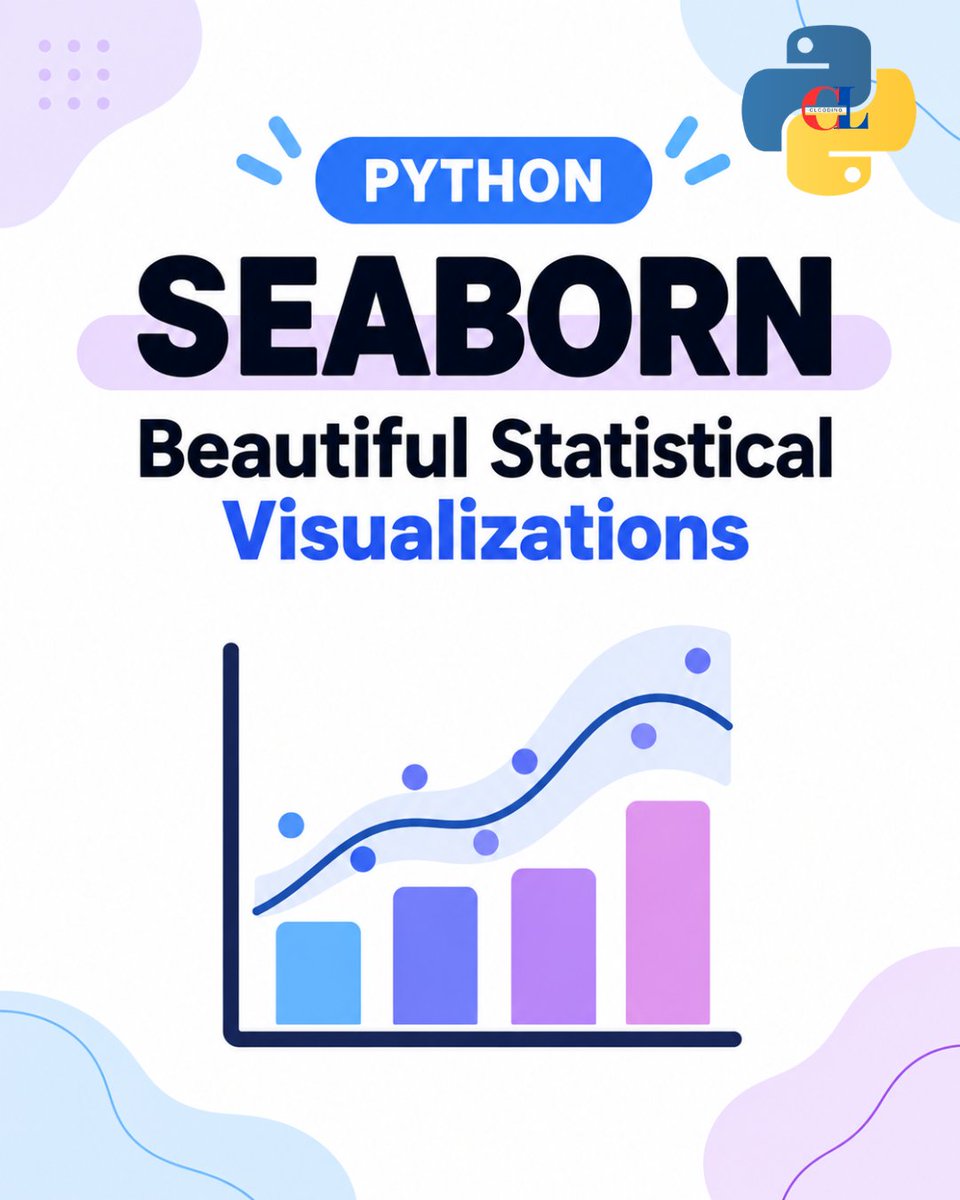
Python Seaborn: Create Beautiful Statistical Visualizations!
Want to turn raw data into beautiful, meaningful visualizations using Python?
Meet Seaborn — a powerful Python library built on top of Matplotlib that makes statistical data visualization easier and more attractive.
A practical thread for Python developers and Data Science beginners.
I’m a senior data analyst.
If you’re learning:
• Statistics
• SQL
• Excel
• Power BI
•Python
• Data Modeling
• Data Visualization
• AI for data analysis
and looking to break into data analytics. This account shares practical insights on Statistics, SQL, Excel, Python, Power BI, Data Modeling, and Data Visualization, Ai for data analysis - helping you skip the headaches and fast-track your career.
LEARN an Engineering Software...
If you're in Mechanical Engineering, learn AutoCAD, SolidWorks, MATLAB and ANSYS.
In Chemical Engineering, learn Aspen HYSYS, Aspen Plus and MATLAB.
In Civil Engineering, learn AutoCAD Civil 3D, Revit, and ETABS.
In Electrical Engineering, learn MATLAB/Simulink, ETAP, AutoCAD Electrical and PLC programming software.
In Petroleum Engineering, learn PETREL, Eclipse, PROSPER and PIPESIM.
In Mechatronics Engineering, learn MATLAB/Simulink, SolidWorks, LabVIEW and TIA Portal.
In Agricultural Engineering, learn AutoCAD, SolidWorks, MATLAB and ArcGIS.
In Computer Engineering, learn Python, MATLAB, Proteus and Multisim.
In Structural Engineering, learn ETABS, SAFE, and Tekla Structures.
In Environmental Engineering, learn ArcGIS, EPANET, SWMM and MATLAB.
Learn at least one engineering software before you graduate.
Paylaş
Kopyalandı
MATLAB@MATLAB
Why did racing cars start bouncing down the straights?
Using MATLAB Agentic Toolkit, this visual helps students explore the physics of porpoising.
Lower ride height creates more downforce. Too low, and airflow can detach, reducing downforce and allowing the car to rise again.
Why did racing cars start bouncing down the straights?
Using MATLAB Agentic Toolkit, this visual helps students explore the physics of porpoising.
Lower ride height creates more downforce. Too low, and airflow can detach, reducing downforce and allowing the car to rise again.