Posty z #TextToSQL

#TextToSQL

Publiczne posty w X, które używają #TextToSQL.

Powiązane hashtagi

  1. DataTalk.bi✓@DataTalkDkR
    AI-to-SQL is not solved. Most demos prove the model can write SQL. Production asks a harder question:can the agent understand which table, join, metric, filter, and business rule actually apply? That is where most failures start. #TextToSQL #SQL
    Pobierz
    01453
  2. Tanzila Shah✓@TanzilaSha9574
    👀 WHAT ARE YOU SHIPPING? Built a SaaS people actually need? Drop your product below 👇 No pitch. No hype. Just show us what you built. 🚀 Let’s discover the next underrated SaaS. 🔥
    28111984
  3. Avnish Kumar@avikeid2007
    @TanzilaSha9574
    @TanzilaSha9574 Built Zeroquery: connect any database, get a working AI app - no hand-built APIs, no admin panel. DAB-powered SQL MCP + dynamic UI + human-in-the-loop writes. Open source, MIT 🧵 #MCP #textToSql #OpenSource
    00414
  4. Agus Kurniawan@agusk2010
    Just published my new Udemy course: Chat with Your Business Data: LLM, RAG, SQL and NoSQL Build an AI data assistant with Text-to-SQL, RAG, Ollama, SQL Server, PostgreSQL, MongoDB, pgvector, FastAPI, and guardrails. #LLM #RAG #TextToSQL #AI
    203185
  5. Avnish Kumar@avikeid2007
    Point at any database → get a working AI app in 60 sec. ⚡ Zeroquery auto-generates a scoped SQL MCP server, then renders your natural language queries as live tables, charts & cards with human-confirmed writes, not autonomous ones. #TextToSQL #mcp #ai
    10546
  6. Suraj Kumar@SurajKu28969743
    Built a self-correcting text-to-SQL agent: LangGraph state machine + Ollama (local LLM) + ChromaDB for schema-aware retrieval, with a read-only SQL validator. A Multi-source orchestration 🧠🗃️🔒 #LangGraph #Ollama #TextToSQL
    204101
  7. GaurData@hellogaurdata
    𝗧𝗲𝘅𝘁-𝘁𝗼-𝗦𝗤𝗟 𝗜𝘀 𝗡𝗼𝘁 𝗮 𝗣𝗿𝗼𝗱𝘂𝗰𝘁𝗶𝗼𝗻 𝗔𝗿𝗰𝗵𝗶𝘁𝗲𝗰𝘁𝘂𝗿𝗲 Generating SQL is easy. Guaranteeing trust, permissions, and stable semantics is the hard part. AI should assist exploration. Not become the runtime layer. #ai #texttosql #llm #dataengineering
    Pobierz
    00233
  8. Dundu John Doe@KgothatsoThooe
    Data Exploration & Database Tools Kanaries/pygwalker → Turn any dataframe into an interactive Tableau-like UI → Best industry: Business intelligence, data analytics, fintech, internal tools, startups #TextToSQL #DataExplorer #OpenSource #DataScience
    202131
  9. Pavel Simó✓@pavelsimo
    Day 2/100 of Inference Engineering > today i read chapter 1 of Inference Engineering. compared to yesterday chapter there is a lot of important stuff on this one, i tried my best to extract the main points. > there is not one fit all for inference, an inference services must be specialized for the demands of their workloads. thus it's important to know: model requirements, app. interface, latency budgets, unit economics and usage patterns. > there are two ways to add ai to your app: shared inference or dedicated deployment. > if you're building ai product and you have no idea of your workload will be, start with pay-per-token API, something like OpenRouter (shared inference). > one of the most important decisions is which model you choose to work with. smaller models tend to be cheaper and faster to run. so before you go all crazy on speculative decoding keep that in mind... check if a smaller model can get the job done. > on evals, the book mentioned the ongoing industry benchmark-maxxing that is going on and how those tests are being gamed to make a model looks good... also on the importance of having application evals tailor to your app. the latter is a must have! > the book defines fine-tuning as taking a foundation model and re-targeting it to different use case. fine-tuning benefits from tasks when the scope is small, for example text2sql. important fine-tuning does not changes the model architecture only the weights. > destillation on the otherhand preserves the behavior of a large model in a smaller, more efficient model, and thus changes the architecture. > learned a bunch of metrics: time to first token (TTFT), perceived and total tokens per second (TPS), iter-token latency (ITL), also the important of consider latency percentiles while measuring those.
    Pobierz
    Pavel Simó @pavelsimo
    Day 1/100 of Inference Engineering > today i read chapter 0 of Inference Engineering. some of the learnings below. > apparently we have time... inference engineering is still in its infancy. huge potential, still a young field. used to be a pretty niche field (around 3 years ago). > the book explained a trend starting around 2024 when open models started to catch up with the frontier. you might remember deepseek v3 and r1 crashing ai stocks :) > since open models are becoming better and better, "many" companies are actively swapping out closed models and fine-tuning open ones for domain specific tasks. > a production "ready" inference stack have both runtime and infrastructure optimizations, also tools for helping developers deal with the complexity and stay productive...
    8121515.5K
  10. Pavel Simó✓@pavelsimo
    Day 1/100 of Inference Engineering > today i read chapter 0 of Inference Engineering. some of the learnings below. > apparently we have time... inference engineering is still in its infancy. huge potential, still a young field. used to be a pretty niche field (around 3 years ago). > the book explained a trend starting around 2024 when open models started to catch up with the frontier. you might remember deepseek v3 and r1 crashing ai stocks :) > since open models are becoming better and better, "many" companies are actively swapping out closed models and fine-tuning open ones for domain specific tasks. > a production "ready" inference stack have both runtime and infrastructure optimizations, also tools for helping developers deal with the complexity and stay productive...
    Pobierz
    142129113.1K
  11. MKTweetsHere@MKNhere
    Your warehouse has 240 tables named things like f_pto_agg and d_wfm_fclty_pop_dfntn_mnl. No table or column comments. No dbt docs, no ERD, no data model anyone kept up to date. Unity Catalog or Snowflake is there, but nobody filled in the descriptions, so there’s nothing for a tool to build a semantic model from. The one engineer who knows how these tables join just gave notice. And your VP wants a text-to-SQL agent. So you’re stuck choosing. Write the semantic layer by hand, table by table, for six months. Or push raw table names into a vector DB and watch retrieval miss. Someone asks about “approved time-off requests,” and the right table is f_pto_agg. Those share zero words, so embeddings have nothing to match on. A new paper from Amazon and USC takes a different route: skip the docs and mine your query logs. Every JOIN your analysts ever wrote is sitting in your query history. Those logs already record which tables go together, on which keys, and how often. I rebuilt the first stage in Python with sqlglot and DuckDB on TPC-DS (24 tables, zero declared keys). From 99 queries, the parser pulled 79 join edges. The top one showed up 64 times, and the catalog had no record of it. What I took away from the paper: → The graph replaces the YAML. Tables become nodes, joins become edges weighted by how often people use them. On Amazon’s warehouse that meant 1,847 edges from about 500K queries. → An LLM writes the missing docs. Feed Claude 3.7 Sonnet sample queries for each table and it returns descriptions, filters, and business terms like “employee” and “time-off” as JSON. → Entities first, embeddings last. Exact term matches get 0.5 weight, substring matches 0.3, embeddings 0.2, then Personalized PageRank finds the bridge tables. On the BEAVER benchmark, 95.7% of its SQL ran without errors, against 60.8% for plain embedding retrieval. Amazon’s data engineers preferred it 70% to 10%. → Read the numbers twice. “Runs without errors” isn’t “correct.” On questions with one right answer, human-written SQL still won 64.9% to 26.3%. The BEAVER test had no query logs at all. And logs carry your team’s old mistakes, deprecated joins included. The video shows the moment it clicks. The full article has the sqlglot code, a stack guide by warehouse size (NetworkX for small, Neo4j when teams share the graph), and my critique. How is your team handling undocumented tables for LLM agents: semantic layer, or query logs? #DataEngineering #TextToSQL #GraphRAG #LLM #DuckDb
    Pobierz
    30178
  12. MKTweetsHere@MKNhere
    @MKNhere
    Full step-by-step article:
    00011
  13. Arian Askari@arian_ask
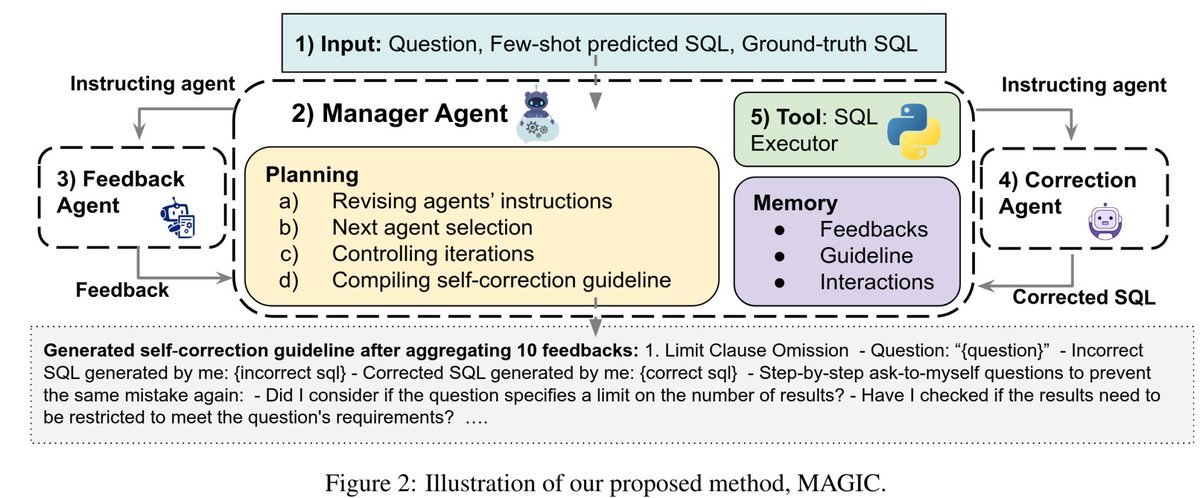
    🎉 Thrilled to share that my internship at Microsoft, titled "MAGIC: Generating Self-Correction Guideline for In-Context Text-to-SQL" has been accepted at the at AAAI 2025 (Main)! together w/ Christian Pölitz and Xinye Tang! #AAAI2025 #AAAI #NLP #Microsoft #SelfCorrection 1/9
    Pobierz
    20131.6K
  14. Fede_Ranaldi@FedeRanaldi
    @arian_ask
    @arian_ask Impressive work! Have you considered tò test your approach on other less known benchmarks? Zero-shot Performances seems to be overestimated for famous benchmarks. See how #DataContamination impact on #TextToSQL at
    10291
  15. Pokaż więcej postów