Hubble✓

@NASAHubble

The official X account for the NASA Hubble Space Telescope, managed and operated by NASA's Goddard Space Flight Center.

44 Urmărește8.9M Urmăritori8.5K Postări
  1. Hubble✓@NASAHubble
    Hubble
    RT @NASAGoddard: Eye see you 👁️ The sonification of the Helix Nebula scans from left to right, where redder colors correspond with lower pitches while bluer colors are associated with higher pitches. It has been called “The Eye of Sauron" for its uncanny and all-seeing appearance.
    023305.1K
  2. Hubble✓@NASAHubble
    Thank you, Swift! ❤️ Though the Neil Gehrels Swift Observatory's mission is at an end, its legacy and extensive collection of data will remain. Swift's discoveries, and the work completed in tandem with Hubble, advanced astrophysics in so many ways. Learn more ⬇️
    NASA Universe @NASAUniverse
    Science operations for our Neil Gehrels Swift Observatory have now ended. With the spacecraft orbiting less than 171 miles (275 kilometers) above Earth, atmospheric drag prevents the satellite’s telescopes from steadily gazing at their cosmic targets. 🧵
    247655338.3K
  3. NASA Universe✓@NASAUniverse
    Science operations for our Neil Gehrels Swift Observatory have now ended. With the spacecraft orbiting less than 171 miles (275 kilometers) above Earth, atmospheric drag prevents the satellite’s telescopes from steadily gazing at their cosmic targets. 🧵
    Descarcă
    136942069.3K
  4. Hubble✓@NASAHubble
    We know our universe is expanding. But telescopes like Hubble measure an expansion rate that’s faster than predicted, based on models of the early universe. Here’s how @NASARoman will join the quest on cracking the case of this “Hubble Tension” ⬇️
    Descarcă
    5717398660.7K
  5. Hubble✓@NASAHubble
    Even galaxies need to vent. Because of a prior gravitational interaction with a neighboring galaxy, M82 undergoes super intense star formation. This image shows its "exhaust system" in action, regulating the galaxy's growth by venting gas outwards. ⬇️
    Descarcă
    493452K60.6K
  6. Hubble✓@NASAHubble
    Postări @NASAHubble
    In this image, @ChandraXray's data (blue) highlight superwinds of million-degree gas blowing out of the galactic disk, while Hubble's optical light (yellow, orange, and white) shows the galaxy shape, and @NASAWebb and Spitzer observations detail infrared dust emission (red):
    1911515.2K
  7. Hubble✓@NASAHubble
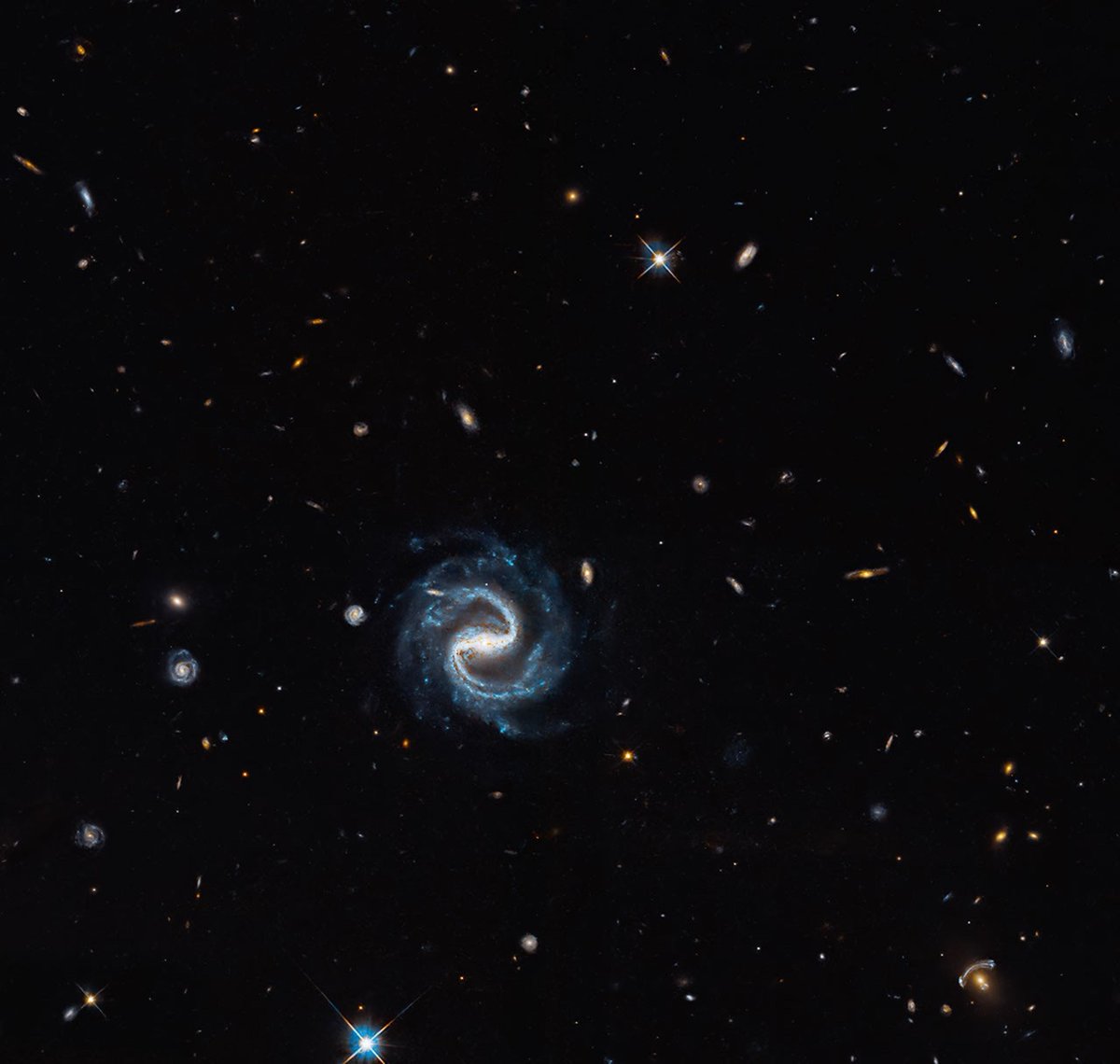
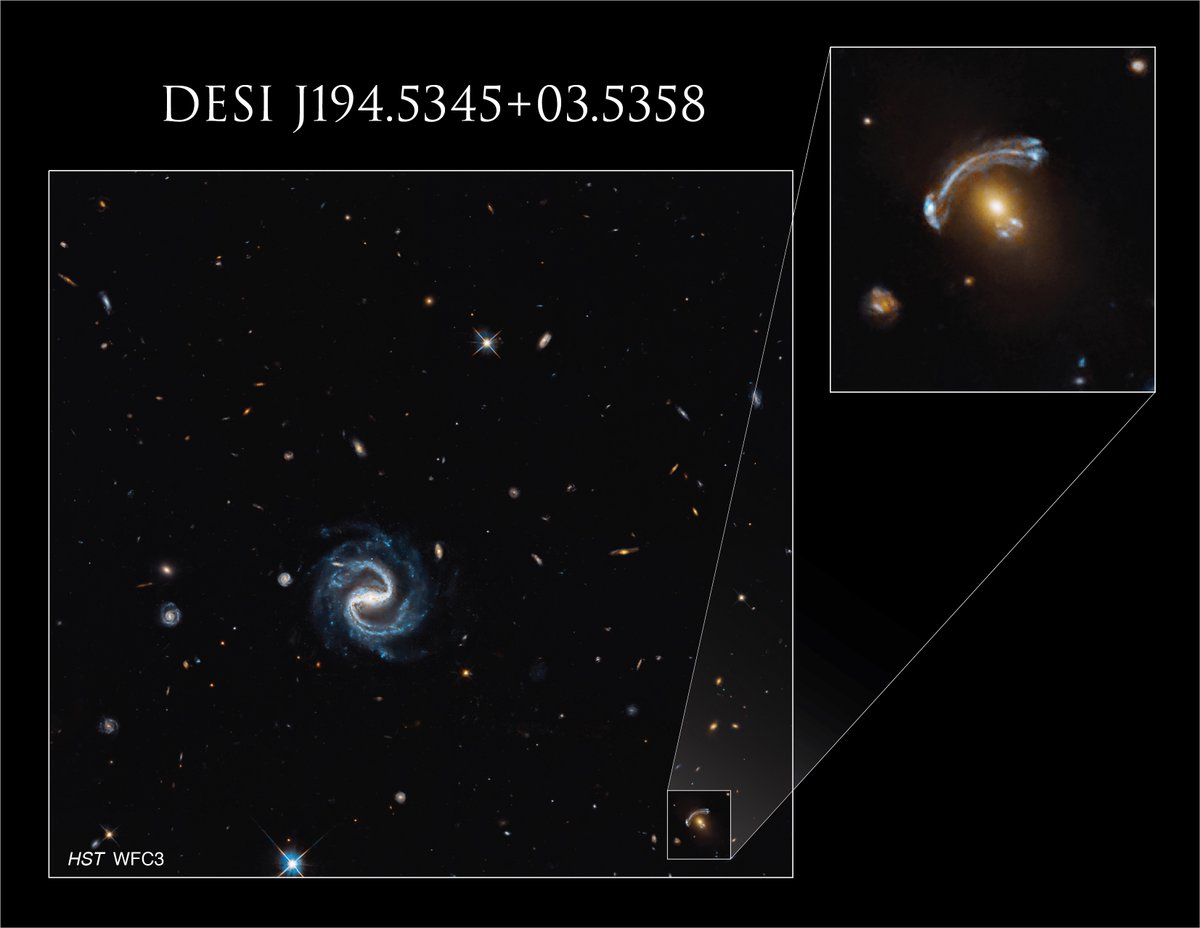
    A gorgeous galaxy marks the spot in this image, but the real treasure is the gravitational lens in the lower-right corner, where a distant background galaxy is being magnified and distorted by the gravity of a closer galaxy:
    Descarcă
    684232.5K78.8K
  8. Hubble✓@NASAHubble
    Postări @NASAHubble
    Hubble observed this lens in preparation for science with the recently launched @NASARoman. While Hubble can only view these gravitational lenses one at a time, Roman’s wide view of the sky will provide a greater sample of these lenses!
    Descarcă
    22213914.7K
  9. Hubble✓@NASAHubble
    Hubble
    RT @NASAAmes: A cosmic butterfly 🦋 In this shimmering view captured by @NASAHubble, the complexities of the Twin Jet Nebula are seen in striking detail, with lobes of material stretching outward while jets of gas stream from a central star system.
    01.3K05.7K
  10. Hubble✓@NASAHubble
    Stellar ingredients 🧑‍🍳 This Hubble view shows a grouping of cosmic dust, made up of a concentration of elements that are responsible for the formation of stars in our galaxy and throughout the universe. Learn more about these "Bok globules":
    Descarcă
    583842.2K56.2K
  11. Hubble✓@NASAHubble
    Hubble
    RT @NASAUniverse: @chandraxray @NASAWebb While Swift usually looks far beyond our solar system, it can study objects closer to home, too. In 2010, Swift and @NASAHubble worked together to catch the remnants of an asteroid smash-up just weeks after the collision.
    01205.2K
  12. Hubble✓@NASAHubble
    Twinkle, twinkle little galaxy… NGC 1827 is a low-mass galaxy that was captured as part of a Hubble observing program that will help scientists test predictions of cosmological models on smaller scales:
    Descarcă
    474112.4K68.6K
  13. Hubble✓@NASAHubble
    Did you catch the @NASARoman launch? 🚀 NASA’s newest space telescope is on the way to its home orbit a million miles away, where it’ll capture wide-field, infrared views of the universe! Roman gets the big picture, while Hubble delivers the details. ⬇️
    Descarcă
    302001.1K54.4K
  14. Hubble✓@NASAHubble
    Postări @NASAHubble
    Hubble can follow up on Roman's much wider views in greater detail, and in different types of light. Each telescope picks up complementary info! You can think of Roman as a wide-angle camera viewing a broad landscape, and Hubble as a zoom lens in ultraviolet and visible light:
    02310514.4K
  15. Hubble✓@NASAHubble
    NGC 1385 glows with regions where stars are forming. @ChandraXray data (magenta) highlights stellar nurseries and X-ray binaries, while Hubble's optical (white and gray) and @NASAWebb's infrared (orange and red) observations showcase the galaxy's dusty spiral structures.
    Descarcă
    402571.5K57.1K
  16. Hubble✓@NASAHubble
    Postări @NASAHubble
    @chandraxray @NASAWebb These multiwavelength observations help scientists learn how nearby galaxies with active star formation build up mass over time.
    42012316K
  17. Hubble✓@NASAHubble
    Hubble
    RT @NASAUniverse: Imagine finding the “bones” of dead stars! 🦴 At the end of a massive star’s life, it can leave behind its core as a neutron star … just a trace of what it once was. Like other fossils, these remains can teach us about the star’s past: #NationalFossilDay
    018705.4K
  18. Hubble✓@NASAHubble
    What's in a wavelength? Different "types" of light unveil different data about our universe. Hubble detects visible light, along with some near-infrared wavelengths that "cut through" clouds of gas and dust, as seen in this view of the Pillars of Creation ⬇️
    Descarcă
    1126683.9K181K
  19. Hubble✓@NASAHubble
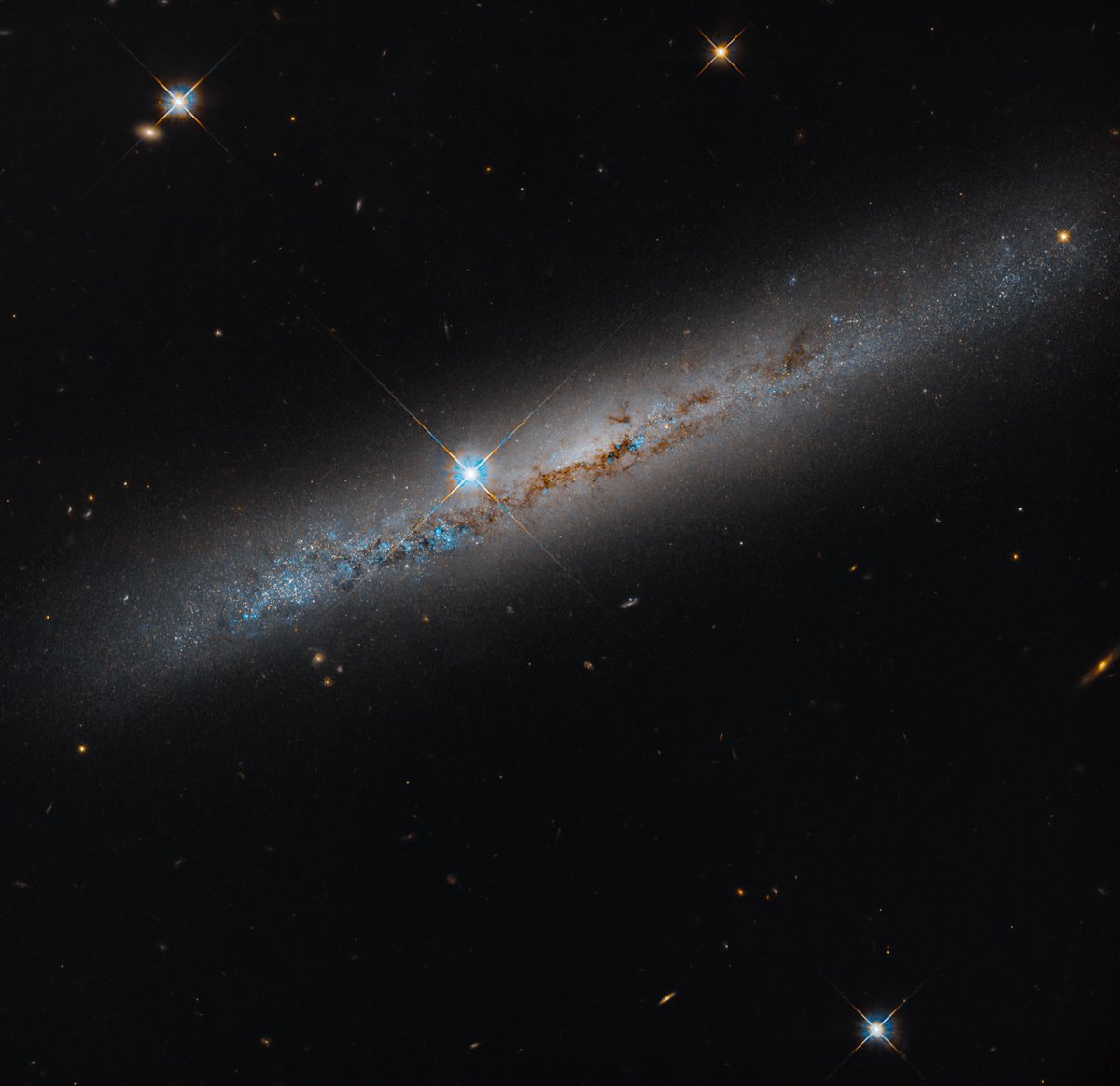
    A pair of galaxies called NGC 6670 overlap in this Hubble image. They appear edge-on, and though they look very close to each other, the two galaxies' nuclei are actually 50,000 light-years apart! NGC 6670 is ~400 million light-years away:
    Descarcă
    773092.1K79.5K
  20. Hubble✓@NASAHubble
    Postări @NASAHubble
    And in just a couple months, it'll be time for a whole new era of astronomy as the @NASARoman telescope's first images are revealed! Here's where Roman joins the scene wavelength-wise:
    Descarcă
    31314213.9K
  21. Hubble✓@NASAHubble
    Hubble
    RT @NASA: While observing the universe, @NASAHubble caught a galaxy cluster smiling for the camera. 😊 The smile lines are arcs caused by an effect known as gravitational lensing, where massive structures warp spacetime with their powerful gravitational forces and act as a cosmic lens.
    03.7K03.4K
  22. Hubble✓@NASAHubble
    Postări @NASAHubble
    Along with the redder part of visible light, Roman captures infrared data, allowing for extraordinary observations that will reveal more about dark matter and dark energy, both mysterious phenomena that make up most of our universe. As we gear up for its first images, we'll share more here on how Roman and Hubble bring different superpowers to astronomy.
    158512.1K
  23. Hubble✓@NASAHubble
    The galaxy pair Arp 143 once collided with each other, triggering the bright star formation in the right galaxy. However, it hasn't escaped the gravitational clutches of the galaxy on the left, which causes the "triangle" shape of the blue ring of stars:
    Descarcă
    753312K83.2K
  24. Hubble✓@NASAHubble
    Postări @NASAHubble
    In this view, @chandraxray data shows X-ray binary systems (like a black hole, neutron star, or white dwarf pulling material from a companion star – seen as purple dots) along the collision shock wave, laid over Hubble’s visible-light image (blue and white).
    488217.8K