NASA Universe✓

@NASAUniverse

Your backstage pass to the universe and how NASA studies it. Exoplanets, black holes, dark energy, and more!

80 Takip edilen1.1M Takipçi12.7K Gönderiler
  1. NASA Universe✓@NASAUniverse
    Science operations for our Neil Gehrels Swift Observatory have now ended. With the spacecraft orbiting less than 171 miles (275 kilometers) above Earth, atmospheric drag prevents the satellite’s telescopes from steadily gazing at their cosmic targets. 🧵
    İndir
    136942069.3K
  2. NASA Universe✓@NASAUniverse
    NASA Universe
    RT @NASAScience_: NASA has confirmed the UVEX (UltraViolet EXplorer) mission for launch by January 2031. 🚀 UVEX will map the universe in ultraviolet light, study the evolution of stars and galaxies, and help capture cosmic events tied to gravitational waves. Read more:
    070649
  3. NASA Universe✓@NASAUniverse
    NASA Universe
    RT @NASAGoddard: Eye see you 👁️ The sonification of the Helix Nebula scans from left to right, where redder colors correspond with lower pitches while bluer colors are associated with higher pitches. It has been called “The Eye of Sauron" for its uncanny and all-seeing appearance.
    02470865
  4. NASA Universe✓@NASAUniverse
    The warm embrace of a star could be the stuff of nightmares. 😱 Small stars like our Sun puff out into red giants at the ends of their lives, engulfing anything orbiting too close, but brown dwarf WD 1202-024 B may have survived just such a hug. #MondayMotivation
    İndir
    138148031.4K
  5. NASA Universe✓@NASAUniverse
    NASA Universe
    RT @chandraxray: Remember that time when you spotted the remains of an exploded star that no one had identified before and Chandra followed up, revealing superheated debris? Together we helped scientists understand one of the youngest remnants in our galaxy, G306.3. We'll miss you, Swift!💜
    NASA Universe @NASAUniverse
    Science operations for our Neil Gehrels Swift Observatory have now ended. With the spacecraft orbiting less than 171 miles (275 kilometers) above Earth, atmospheric drag prevents the satellite’s telescopes from steadily gazing at their cosmic targets. 🧵
    06301.1K
  6. NASA Universe✓@NASAUniverse
    NASA Universe
    RT @NASAHubble: We know our universe is expanding. But telescopes like Hubble measure an expansion rate that’s faster than predicted, based on models of the early universe. Here’s how @NASARoman will join the quest on cracking the case of this “Hubble Tension” ⬇️
    01760923
  7. NASA Universe✓@NASAUniverse
    Gönderiler @NASAUniverse
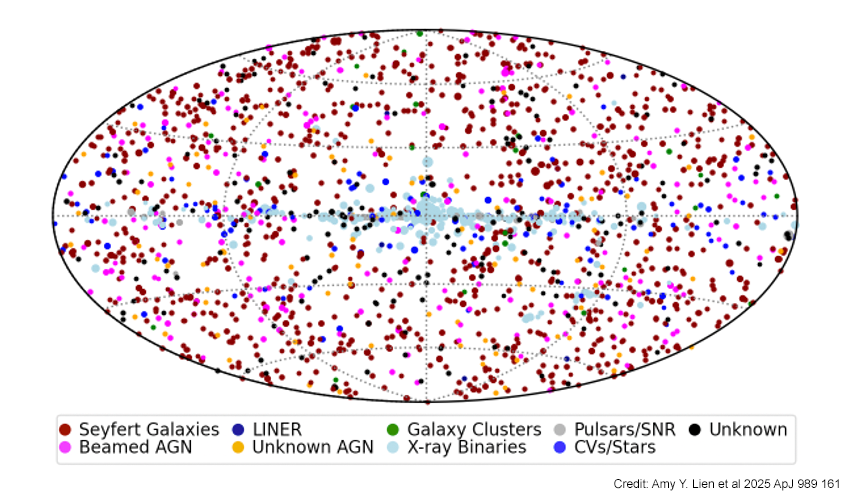
    Since launching on November 20, 2004, Swift observed: More than 2,000 gamma-ray bursts More than 1,400 supernovae Stars being shredded by black holes Asteroids and comets … and so much more!
    İndir
    414924.3K
  8. NASA Universe✓@NASAUniverse
    Gönderiler @NASAUniverse
    Data from Swift’s three telescopes has contributed to about 7,000 published scientific papers. Swift leaves behind a treasure trove of 12 TB of data — equivalent to about 600 HD movies — that astronomers will continue to comb through for years to come.
    İndir
    211863.7K
  9. NASA Universe✓@NASAUniverse
    Doing some pumpkin carving this weekend? Make space on your front porch for some out-of-this-world jack-o’-lanterns! 🎃 Check out these stencils featuring some cosmic cartoon characters, @NASAWebb, @NASARoman, and more. Download them here:
    İndir
    111497K
  10. NASA Universe✓@NASAUniverse
    NASA Universe
    RT @NASAHubble: Even galaxies need to vent. Because of a prior gravitational interaction with a neighboring galaxy, M82 undergoes super intense star formation. This image shows its "exhaust system" in action, regulating the galaxy's growth by venting gas outwards. ⬇️
    03450955
  11. NASA Universe✓@NASAUniverse
    NASA Universe
    RT @NASA: Ahh… blue lagoon 🏖️ This deep-blue sea of gas and dust—called Messier 8 or the Lagoon Nebula—is a hotbed of star formation. The young stars within the nebula emit rays of high-energy light, including X-rays shown in pink by @chandraxray.
    01.6K0832
  12. NASA Universe✓@NASAUniverse
    NASA Universe
    RT @NASARoman: It's the final countdown 🎶 We're one step closer to Roman's first images! The observatory is now fully functional and the team is performing their final checks and calibrations before starting science observations.
    099001.2K
  13. NASA Universe✓@NASAUniverse
    NASA Universe
    RT @NASA_Marshall: You're looking at a cosmic collision zone 🚧 This is II Zw 096, a chaotic, dust-shrouded system of merging galaxies forming stars at a furious rate. Systems like this one show us how powerful galaxy collisions shaped the early universe. More images >>
    020001.2K
  14. NASA Universe✓@NASAUniverse
    NASA Universe
    RT @NASAScience_: The universe has a musical side. 🎶 Meet the Treble Clef, an unusual radio structure stretching more than 2 million light-years across space. Its shape is striking, but the science behind it is even more fascinating. Studying structures like this can reveal how galaxy clusters interact and evolve. In this composite, radio emission appears in red, X-rays in blue, and infrared data in white:
    022701.2K
  15. NASA Universe✓@NASAUniverse
    NASA Universe
    RT @NASAHubble: A gorgeous galaxy marks the spot in this image, but the real treasure is the gravitational lens in the lower-right corner, where a distant background galaxy is being magnified and distorted by the gravity of a closer galaxy:
    04230930
  16. NASA Universe✓@NASAUniverse
    NASA Universe
    RT @NASAWebb: Double, double toil and trouble; Fire burn and cauldron bubble 🧙‍♀️ This turbulent cauldron of star formation, N159, resides about 161,000 light years away in the Large Magellanic Cloud, one of the satellite galaxies orbiting our Milky Way.
    02640901
  17. NASA Universe✓@NASAUniverse
    NASA Universe
    RT @NASA_Marshall: For 22 years, NASA’s Swift observatory has studied the universe's most powerful explosions and teamed up with other telescopes like Chandra and IXPE for breakthrough discoveries. Even as its mission winds down, its science won’t! Explore its legacy:
    015501.3K
  18. NASA Universe✓@NASAUniverse
    LISA is an @ESA-led mission in partnership with @NASA that will detect and measure ripples in space-time called gravitational waves. LISA’s three spacecraft will fly in a triangular formation that follows Earth as it orbits the Sun. What object could fill this triangle?
    73421715.6K
  19. NASA Universe✓@NASAUniverse
    Gönderiler @NASAUniverse
    Each arm of this triangle will be about 1.6 million miles long, big enough that our Sun would snugly fit inside. Gravitational waves from cosmic events will ripple across the triangle, slightly changing the distances between the spacecraft. Meet LISA:
    İndir
    23343K
  20. NASA Universe✓@NASAUniverse
    NASA Universe
    RT @NASAAmes: A cosmic butterfly 🦋 In this shimmering view captured by @NASAHubble, the complexities of the Twin Jet Nebula are seen in striking detail, with lobes of material stretching outward while jets of gas stream from a central star system.
    01.3K01.3K
  21. Daha fazla gönderi