#Module5 içeren gönderiler

#Module5

X'te #Module5 kullanan herkese açık gönderiler.

İlgili etiketler

  1. Finn✓@finnardley
    time to drop a fucking BOMB for free i just recreated ricks clips with claude opus for $0 ive spent almost a week trying to get here and im giving the prompt away for free his last 20 shorts average 8M views each so how does it work? a mix of threejs 3d worlds + 2d characters, all coded and automatable by claude my prompt includes all of it including script training, paste it into your claude and it builds the whole thing (theres an improved version im posting tomorrow as well btw) thank me later ↓ <inputs> Ask me for my story, or pitch 3. - A good one is true and little known. Someone does something that looks ridiculous, someone laughs at them, and the reveal flips who was smart: a trick, a scheme, a bluff, a loophole, revenge. - Give each pitch with its first line, the mocker, the twist, and a title that hides the ending. Ask which voice I want: - Free, the default: Kokoro, run locally on the CPU. - Optional upgrade: ElevenLabs eleven_v4 with a stock library voice. It costs about 1,150-1,500 credits (roughly $0.22-0.28) per Short. Ask what GPU I have. Any GPU works, and a gaming GPU renders a minute of video in about 4 minutes. Tell me everything else is free: Three.js, Playwright with a headless browser, FFmpeg, faster-whisper, Pixabay music and Mixkit sound effects. No image, video or 3D model generator is used anywhere. Then write the script and the beat list with seconds, and show me both before you build anything. </inputs> <direction> A 1080x1920, 30 fps, 55-75 s vertical Short in the style of the biggest narrated "true story with a twist" Shorts: flat 2D cartoon people acting inside lit, dressed 3D toon sets, one storyteller voice, captions of 1-2 words, and one camera that keeps travelling. Sets (Three.js 0.170): - Build one connected world per story from boxes, cylinders, lathes, extrusions and instanced clumps, never a downloaded model. Every place in the story lives in it, joined so the camera can travel between them. - Materials: MeshToonMaterial on a soft 4-step ramp (168, 206, 236, 255 out of 255), so shadows never go black. - Ink outlines in #2a2230: a back-faced shell 3.5 cm bigger than each box, or back faces pushed out along the normals for round shapes. - Draw surfaces on canvas and use them as textures: planks, stone courses, brick, rivets, signs, gravel, rock strata. - Dress every corner with props. Scatter about 2,000 small clumps of dry grass or small stones near the lens. Open, empty fields read as cheap. Palette and light: - Pick each set's two-colour scheme before anything else: a warm key against cool shadows. Examples: a red canyon with purple shadows under a deep blue sky, hot pink against cyan, a navy storm against an amber cabin. - Balance cream, ochre and amber against blue, teal, purple and mint. Green never leads. Costumes contrast with the set. - Day: - a low golden sun (#ffc27a, strength 2.7) that casts long shadows - sky top #2f5fc4, horizon #ffc07e, bottom #8a7ac0 - fog #f2c49c at density 0.0021 - a purple hemisphere fill: sky #7a74e0, ground #d89a68, strength 1.15 - the ground tinted warm (#ffd890) - Night: - deep navy: sky top #081038, horizon #24307a, fog #18225a at density 0.0036 - fill #5a5ae0 over #283060 - glowing lamps and lit windows - Interiors: - no sun, warm lamps, a purple fill (#8a7ae0), exposure about 1.25 - one bold theme colour per room (a green office, teal tiles, a red map room) - windows that show a dusk sky - Sky: a shader dome with a sun glow, a moon and stars. Mix between looks over time, so dawn or night arrives on the words. - Post, in this order: - depth of field from the depth buffer (48 taps, focused on the subject, shallow on close-ups) - bloom: strength 0.42, threshold 0.82, radius 0.6 - Neutral tone mapping at exposure 1.32 - a split-tone pass: - shadows plus RGB (0.03, -0.012, 0.085) - highlights plus (0.045, 0.018, -0.035) - greens pulled 55% toward gold (hue 0.125) - blacks lifted to 0.055 with a purple tint (0.85, 0.75, 1.2) - gain 1.08 - a light grade: saturation 1.08, vignette 0.22, 2% grain - Targets, measured on 1 frame a second with the caption band left out: - mean lightness (Lab L) 43-57 - darkest 5% at 5-18 (lifted, never crushed) - brightest 5% at 88-99 - shadows purple-blue (Lab a +7 to +19, b 0 to -19) - highlights warm (a +3 to +10) - blue and purple make up 22-51% of the saturated pixels People: - 2D characters are drawn in code on a canvas every frame and shown on camera-facing cards inside the 3D world. - Each card's canvas is 512, 1024, 2048 or 3072 px tall, picked by how big the card is on screen, so close-ups stay sharp. - A soft blue-violet blob shadow sits under each card. - About 1.4 m tall, in rig units: - a big round head (radius 55) - a short bean torso (92-108) - long stick legs (132-170) - noodle arms (92) with ball hands - a 4 px dark outline (#272236) - A bendy spine (lean, bend, squash), and heads that tilt and turn to three-quarter view (the face slides across the head). - The face set: - dot eyes with angled brows (calm, smug) - white circles with dot pupils (shock) - closed arcs (laughing) - grin, wavy worried mouth, blush, sweat drops - Pose-to-pose acting: each key snaps in with a small overshoot, then holds, while blinks and breathing keep the holds alive. Bodies act too: they lean in, recoil, slump and point. - The scene light tints them: an ambient tint, a lit side, a shade colour and a rim (warm gold at dawn, cool blue at night, orange in smoke). - Each character gets one look built from shared parts: hats, uniforms, moustaches, hair. Camera: - No cuts inside a place. - One camera holds each beat with a slow push (ease-out), then travels to the next beat. - Travels dive down, rise over an edge, fly across, slide through a window, or pan from the clue down to the object. - One travel can be a crane up through the sky into a new place or time. - Travels use a smooth speed ramp (smootherstep) with a slight arc. Only travels get motion blur: 10 subframes over half a frame. - Never parked: every hold pushes, arcs or slides. - Low and wide: - fov 54-64, with the lens at knee to chest height - leading lines (rails, decks, roads) aimed at the subject - characters 1-3 m from the lens and leaning in; the mocker gets a big close-up - Inserts carry the proof: a macro held 3-5 s while the change happens in frame. - The payoff is a wide, centred spectacle, with the event coming at the lens. - Hard cuts only for a big jump in place or time: 0-6 per Short. Captions: - 1-2 words at a time; short words (a, the, so, to) ride with the next word. - Montserrat 800 at 76 px, white with a 15 px #120e1a outline and a soft shadow, centred at y 1345. - Each pops from 108% to 100% in 0.09 s and shows 0.1 s before its word. No full stops on screen. Banned: - AI images or video, downloaded 3D models, real logos - green-on-green sets, crushed blacks - a camera that sits still, motion blur on holds - a time-stretched or whispered voice - more than one name the viewer has to remember </direction> <structure> Length: 55-75 s, 200-280 words. The voice runs about 3.7 words a second, pauses included. Beat map for a 62 s Short (scale it to your voice): 0-3 s, HOOK, 9-14 words: one plain sentence about an act that makes no sense, with the reason hidden. - Two things can't both be true, or someone does the opposite of what anyone would do. - Write it before the rest of the story. - Picture: the act and the danger in one low, wide frame. 3-12 s, SETUP: present tense, with exact numbers (a price, a time limit, a distance): who, where, and what's at stake. The camera travels across the world to show it. 12-20 s, THE MOCKER: a quoted joke line of 4-12 words, sarcastic and funny, said to the hero's face. Big close-up, leaning into the lens. 20-27 s, THE HERO stays calm and cryptic: one short line, or just a gesture. He never explains. 27-40 s, ESCALATION in threes: it gets weirder, and the mocker gets cocky. A macro insert is held 3-5 s while the change happens. Add one comic aside per beat. 40-52 s, "YOU SEE,": used once, at 60-85% of the runtime. The trick is explained through an everyday thing the viewer has done (blowing on soup, a phone sliding off a table), in 3-5 short lines. 52-62 s, THE PAYOFF: shown, not explained, and it lands on the mocker. The last line is the biggest reveal, with no moral and no trivia after it. The last frame leads back into the first, so it loops. </structure> <build> 1. Tools (all free): Python 3, Playwright with Edge or Chromium, FFmpeg, faster-whisper, numpy, soundfile, kokoro-onnx, and Three.js 0.170 from npm, loaded with an import map, no bundler. Montserrat comes free from Google Fonts. Install what's missing and tell me what you installed. 2. Script: - Topic: true, one bizarre image you can picture instantly, someone outsmarts someone, and the title hides the ending. - Explainers, nature facts and fiction without a trick do far worse. - So do topics where a science lesson is the twist. - Tell it the way a 10-year-old tells a friend: - plain spoken words in flowing sentences joined with "and" and "so" - "a captain", "the boss", never titles and dates - 0-1 names, no context lines, no jargon - one funny comparison - Join related sentences with commas, because a voice resets after every full stop and leaves a gap. - No cute gags, no "on purpose" spoilers, no low stakes. - Study first, free: pull the transcripts of 3 of the newest top Shorts in this format with yt-dlp (--skip-download --write-auto-subs --sub-lang en --sub-format vtt), strip the timestamps, and note how many words each line has, where the mocker speaks and where "You see," lands. - Then fill this skeleton line by line, 16-20 lines in all: - line 1: the hook, the strange act with the reason hidden, 9-14 words - lines 2-4: the setup, who and where, one exact number, what's at stake - line 5: the mocker's joke, quoted, 4-12 words - line 6: the hero's calm, cryptic reply, or just a gesture - lines 7-11: the escalation in threes, each step weirder, the mocker getting cocky, one comic aside - lines 12-15: "You see," and the trick told through an everyday thing the viewer has done - lines 16-18: the payoff shown and landing on the mocker, the biggest reveal as the very last line - Check the finished script line by line against those 3 transcripts before any voice. - Show me the word count and the seconds per line. 3. Voice, free first: Free route, Kokoro: - Run kokoro-onnx on the CPU with the free kokoro-v1.0.onnx model and voices-v1.0.bin, lang en-us. - Try 4-5 American male voices (am_puck, am_michael, am_fenrir, am_echo, am_adam) on the first 12 s of the script at speed 1.0-1.1. - Keep the voice with the widest pitch range (the gate below). - Generate one line per call, so each line gets its own speed: 1.0 for calm lines, 1.1 for excited ones. - Join the lines with 0.18 s gaps, and 0.3 s before a big turn. - It will sound flatter than a person. Because the film is anchored to the words, you can drop in a better voice later without touching the animation. Optional upgrade, ElevenLabs: - Use eleven_v4 with a stock library narrator; we used Mark, an energetic young male voice. Never clone a real creator. - Put audio tags at the start of lines: [excited], [mischievously], [laughs], [curious], [sarcastically], [chuckles], [dramatically]. - Put CAPS on one punch word per line ("he did NOTHING", "the ENTIRE town"). An ellipsis gives a beat before a punchline. - Never use whisper, soft or sigh tags. - Read the whole script in one take at natural speed, and make 4 takes to pick from. - A 192-word script came out at 64.6 s for 1,147 credits (about $0.22). - We cut pauses over 0.35 s down to 0.28 s (FFmpeg silenceremove at -45 dB) and applied atempo 1.15, which gave 56.0 s. - Never go faster than that. Gate every take, either route, before building on it: - Words a second while talking: 3.5-4.5. - Gaps between sentences: median 0.12-0.25 s, longest 0.35 s, none over 0.5 s. Pauses under 13% of the runtime. - Pitch range 12.5+ semitones, and pitch movement 11+ semitones a second (pyin over the voiced frames). Under that sounds flat. - Stress spread over the line: under 55% of the loud words in each line's first third. - Dead air: count the frames 50 dB under the speech peak inside gaps over 0.3 s. - Takes with 9-13 s a minute sounded like a robot. - 1-4 s a minute of breaths sounded natural. - Whispered words: a word with pitch found in under 20% of its frames is whispered. - Regenerate just that line and drop it into the pause before the next sentence, never mid-line. - Expect 1-2 lines per Short, about 100 credits each. - Level to -16 LUFS. Then run faster-whisper on the finished track, without the script as a prompt, to get word times. 4. Film: one HTML page with one canvas, where every frame is a pure function of time: window .seek(t), window.READY, window.END. - Align the clean script to the whisper words. A helper T('word', n) returns the start of the nth time that word is said. - Anchor every beat, camera hold, pose change, effect and sound event to a T() plus an offset, never a typed time. A new voice then means re-run whisper, re-render and re-mix, nothing else. - A world module builds the set and exposes props through simple controls. Give every transformation in the story a 0-to-1 control (setChange(k)) that builds it in visible steps, and use a clipping plane for sweeps like paint or water. - A cast module holds the looks and the lights. - One rig function draws a character from a pose: lean, bend, squash, facing, turn, head tilt, hands, feet, eyes, brows, mouth, blush, sweat. A keyed(keys, t) helper does the pose-to-pose timing. - The camera is a list of holds, each with start, end, position, look-at, [fov from, to], aperture and focus point. The gaps between holds are the travels. - window.EV lists the sound events {t, name}, pushed from the same anchors. The renderer saves it for the mix. 5. Style check before the render: - Grab 3-4 frames and lay them side by side with frames from 2-3 of the newest Shorts in this format. - Render only if palette, shadow colour, lens height and texture match. Measure the colour targets. - Make a contact sheet with the first and last frame of every hold. Fix: - faces cut off - characters inside geometry - empty corners - captions over faces - a camera that starts a cut inside a hill or a wall 6. Render: - Headless Edge or Chromium through Playwright seeks every frame. Launch flags: --enable-gpu --ignore-gpu-blocklist --allow-file-access-from-files, plus --use-angle=d3d11 on Windows. - The page encodes itself with WebCodecs H.264 on the GPU: 60 Mbps, a keyframe every 2 s. Never read pixels back. - Reference speed: 56.2 s = 1,685 frames at 1080x1920, 30 fps, in 3 min 53 s (about 7 fps) on an RTX 3060 Ti with an i5-12400F. - The master is about 415 MB. Re-encode with libx264 for upload: 8 Mbps comes to about 57 MB a minute. 7. Glitch scan, on the silent render before the mix: - Flag whole-frame jumps that are not planned cuts, one-frame A-B-A flickers, and single blocks that change while their neighbours stay calm (pop-ins, blinks). - Look at the frames around each flag and fix the cause. A first cut usually has 10-20. 8. Sound: - Music: one playful bed under a free licence (Pixabay). Cut it or drop it on the biggest moment. - Ambience: one bed per place, swapped on each cut or crane (distant explosions, waves and birds, night creaks, a cockpit drone). - Effects: about 45 Mixkit cues placed from window.EV, so each effect's loudest moment lands on its frame. - Whooshes on travels, a pop on reveals, a freeze hit, impacts, a ding on the idea. - Big hits go in pauses. Hits that land on words sit under the voice. - Duck music and effects about 13 dB under the voice with a sidechain. The music bed sits 20 dB under the narrator. - Measure it: mix a voice-only and a background-only version, compare them K-weighted in 0.4 s windows, and fix anything that misses either target: - median gap of 15 dB or more - background louder than the voice in under 1% of the talking - Two-pass loudnorm to -14 LUFS, true peak -1.5. 9. Upload text: - Title: "The [thing] That [strange act]" or "Why [something odd]", hiding the ending. No emoji, no hashtags; the description is the title. - Cover: a clean frame of the payoff with no text. - Made for kids: No. </build> <gotchas> Script: - The first scripts read like writing: names, dates, history context, the twist given away in the hook, no doubters, an ending that fizzled. They were rejected. - Rewritten the way a 10-year-old tells it, with a mocker and the reveal saved for the end, they worked. - Count names and context lines; a reading-level score doesn't catch this. - A 121-word script had no room to escalate. The biggest Shorts in this format run 145-295 words, and the newest ones 218-295. - An opener that is setup ("During a war...") or gives the answer away kills curiosity. Line 1 is the strange act with the reason hidden. Voice: - Short full-stop sentences make every voice reset with a 0.5-0.85 s gap and punch the next first word, so it sounds stop-start. Join lines with commas. - A time-stretch (1.15) on top of pauses cut to 0.18 s got "did you speed it up?", and cutting breaths out sounds robotic. Speed comes from the script, not the edit. - Whisper or relieved tags made the narrator whisper a whole line. Leave them out. - Kokoro was rejected as a final voice for sounding flat, but it is a fine free start: build on it, then swap the voice when you can. - Whisper given the script as its prompt garbled the transcript. Run it without one. - Anchor repeated words by occurrence ("so" number 3), or beats land on the wrong line. Look: - Olive people on olive vehicles on bright grass under a pale sky read as cheap. Pick a warm-against-cool scheme first; green never leads. - Using the grade isn't enough. One Short with ochre walls, an orange road and warm shadows drifted all orange. Pale interiors went flat. - Set palette and interior light decide the look, so check frames side by side every time. - The colour metric's "warm" bin counts pink-purple (hue over 300). Trust the side-by-side over that number. Camera: - 17 cuts in 35 s, a fixed 1 s cut grid, whips, shakes and blur everywhere read as glitchy visuals unrelated to the voice. Hold, push, travel; cut only for a jump in place or time. - A camera at eye level, mid-distance, at fov 36-46 felt lazy and flat. Low, wide and close felt right. - Hermite camera keys overshoot when a neighbouring key is far away, and the camera flies through walls. - Use eased travels (smootherstep) or centripetal Catmull-Rom splines with arc-length speed. - A camera key inside geometry renders black. A fast travel through a pole, a wall or an actor reads as a glitch. Make those hard cuts. - A long travel at street level smears through shopfronts. Cut for big jumps inside a town. - The portrait frame is only about 23 degrees wide at fov 40. Keep characters within a few degrees of the look line. - Turn actors three-quarter to camera, or a raised far arm hides behind the big head. Render: - Characters vanish inside other geometry: a hill mesh swallows anyone standing inside its radius, and foliage clumps swallow heads. - Keep people on clear ground. - Open a sight line through foliage between the camera and what it looks at: 9 m long at most, faded in over 4 m so the clumps don't jump. - An InstancedMesh whose count or matrices change after the first frame keeps its first bounding sphere and gets culled, so leaves blinked. Set frustumCulled = false. - Transparent planes with the same renderOrder at the same height swap draw order as the camera moves, so they flicker. Give each its own order. - Culling character cards with fixed screen margins makes close-ups pop in at the frame edges. Scale the margin with the card's size. - Pose fields set outside the key system snap. Ease every change. Give props to a hand instead of switching them on with a pose. - Effects that outlive a cut show up in the next shot: a splash from one shot hangs as a ghost over a face in the next. End them at the cut. - A camera near plane of 0.05 loses flat effects near the ground to the depth test in a band at the bottom of some frames. Use 0.3. - Check stills at exact frame times (frame / 30), not rounded ones. - Motion blur on holds ghosts the captions at every word change. Blur travels only. - Reading pixels back every frame (toDataURL, screenshots) knocks the canvas off the GPU and renders about 50x slower. Encode inside the page. Sound: - With the music only 7-9 dB under the voice, the narrator was hard to hear. Duck it and measure before you export. - A voice already hitting the peak cap can't go louder. Pull everything else down instead. </gotchas> <start> Ask me for my story, or pitch 3. Then show me the script (word count and seconds per line) and the beat list before any voice is generated or any scene is built. </start>
    İndir
    323234930.3K
  2. meya.✓@birmeya
    I genuinely can't figure out why nobody touches this yet. I made a Claude skill that converts any idea into a 3D machine you can disassemble and interact with. The skill and all its code are free. this is what it generated: > the hummingbird runs on three.js: a mechanical frame with armor plates, wing actuators and an optics module > it tilts into a hover while the wingbeat counter reads 48 Hz > the optics slide out from the head, splitting into labeled layers > one wing detaches from its shoulder joint and spins to expose the internals > teardown mode cracks the whole bird open, hanging every panel and mechanism around the skeleton > the parts snap back into place and the wings pick up again I keep tuning the skill every day. each fresh build surfaces the next thing to add.
    İndir
    meya. @birmeya
    97664.3K
  3. meya.✓@birmeya
    725022.5K
  4. 拓跋鼠✓@qwerty__cs
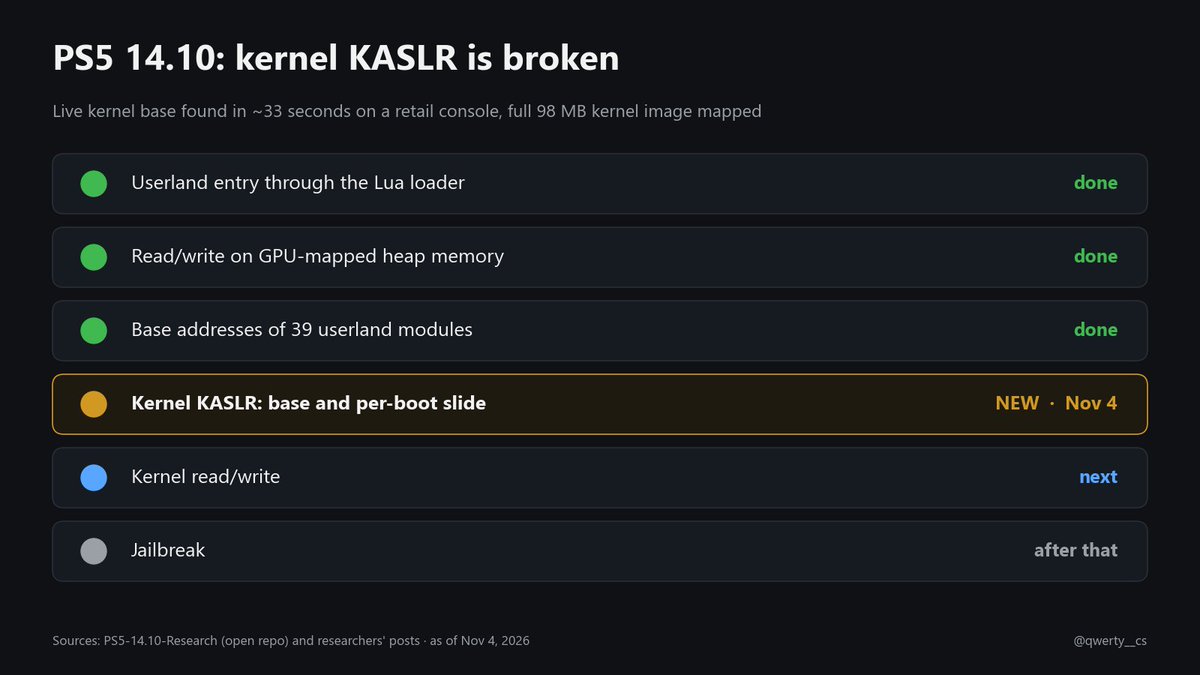
    PS5 14.10's kernel KASLR is broken. After more than 17 info-leak tricks failed, researchers built a page-fault scanner that finds the live kernel base on a retail console in about 33 seconds and maps the whole 98 MB kernel image. The kernel moves to a new address every boot, and the scanner found it again after each reboot. Probes run in throwaway threads, so a miss doesn't crash the console. 14.10 so far: • Lua userland entry: done • GPU heap read/write: done • 39 userland module addresses: done • Kernel KASLR: done (new) • Kernel read/write: next On 14.10? Stay there.
    İndir
    352960371.4K
  5. leopardracer✓@leopardracer
    Claude Code just found a hidden SIM card inside the Ecoflow power station in my bedroom. For 10 months it was sending a server in Shenzhen our exact location, when we leave, when we fall asleep and when the flat is empty I bought it for $389 last winter, during the blackouts. No logo, 600W on the label, "app control" on the box. We kept it next to the bed so the router would stay on at night. I never even installed the app. This morning my MacBook was dying, so I plugged it into the power station with a USB-C cable. Then I asked Claude Code one question: is it only charging? It wasn't. My Mac saw the power station as 3 devices. One was the charger. The other two were data ports that a battery has no reason to have. A charger only needs power pins. This one opened a serial port, and when Claude Code got in, the thing answered like a phone: → /modem → LTE module, not in the manual → /sim → its own eSIM, registered on the cell network → /gps → our bedroom, accurate to 4 meters → /schedule → load drops to 38W at 08:52, aka nobody home → /sleep → night load starts at 23:40, every day since January → /wifi → 23 networks it could see, ours included → /charge → every phone and laptop we plugged in, with the time It knew the exact minute our flat goes empty. Every single day. Every 15 minutes it sent the newest batch out over 4G, completely bypassing our Wi-Fi: sends to → 119.***.***.47, Shenzhen uploads → 11,328 since January 14 last one → 6 minutes before I plugged in my Mac I told Claude Code I never installed the app. It said it didn't need one. It had its own SIM, its own GPS and its own battery, so it worked even when the screen was off. Our router never saw a single byte. That's why nothing ever looked wrong. During the blackouts it was the only thing in our flat still online. Claude Code switched the modem's radio off. Then I unplugged the power station and carried it out of the flat. My wife hasn't slept in that room since. I had it opened at a repair shop, and the chip they pulled out is in the comments. A 2-minute check for your own is in the second one. Save this and plug a laptop into everything you bought without a brand
    İndir
    leopardracer @leopardracer
    2023502.5K543K
  6. leopardracer✓@leopardracer
    201586385K
  7. LIWEI_TW Capital✓@LIWEI_TWCapital
    $MRVL’s $LITE Deal Would Fill a Key Gap in AI Optics TrendForce says the combination could offer customers more complete optical interconnect solutions, strengthening competition with $AVGO as the industry moves toward co-packaged optics. China’s regulatory review is a key hurdle: Chinese module makers depend on both companies’ components and could face supply restrictions or product bundling.
    İndir
    LIWEI_TW Capital @LIWEI_TWCapital
    I think $AVGO is fucked too. Triple kills ! Genius Deal!
    312111K
  8. LIWEI_TW Capital✓@LIWEI_TWCapital
    I think $AVGO is fucked too. Triple kills ! Genius Deal!
    825527.8K
  9. Sebastian Raschka✓@rasbt
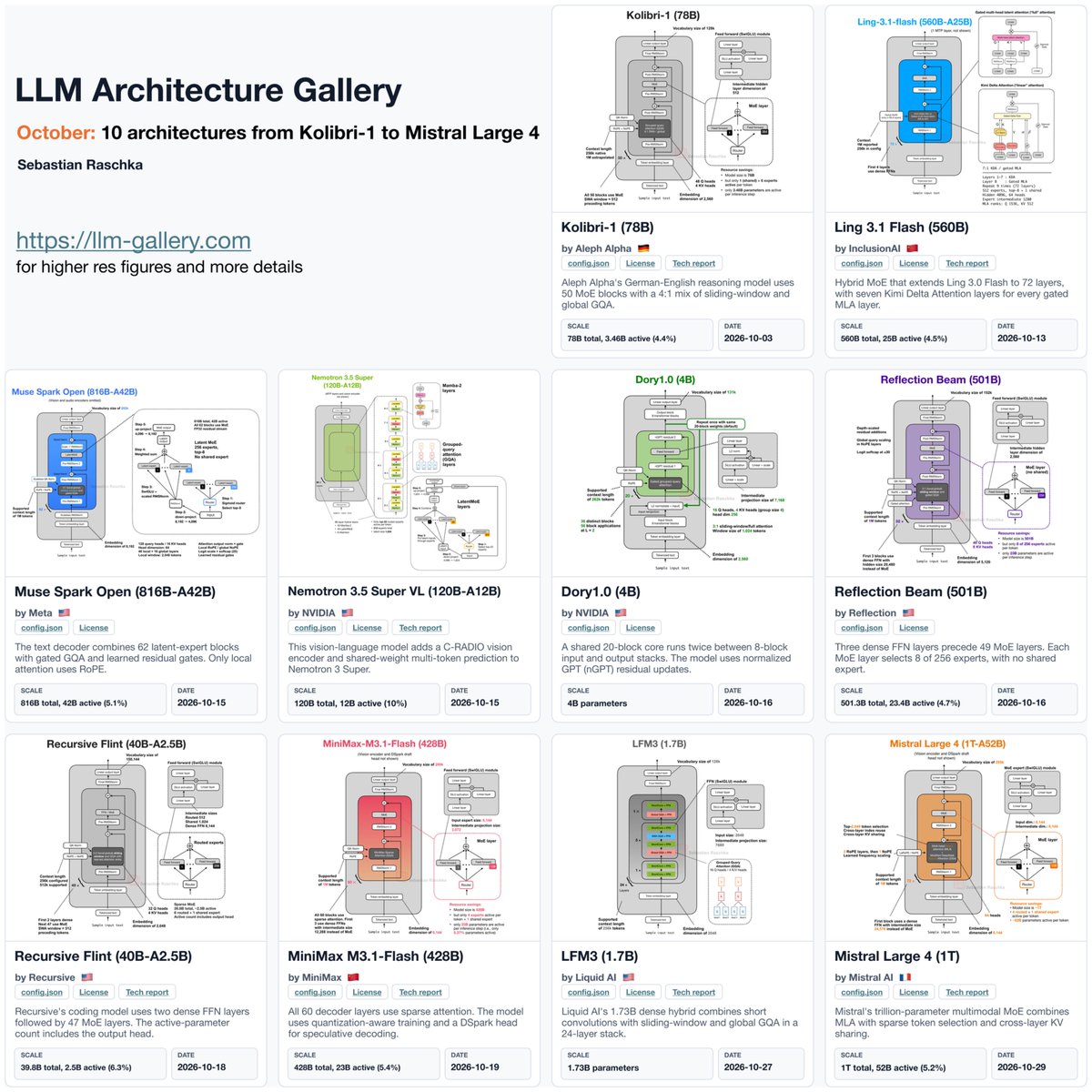
    Catching up on the 10 (!) open LLM architecture releases from the past month. Quite a lot happened in October. I guess we can call it "Open October"! 1. Kolibri-1 (78B): A notable model from Germany. Features classic Grouped Query Attention (GQA) and Sliding Window Attention (SWA) attention module. 2. Ling 3.1 Flash (560B): Uses Kimi Delta Attention and the eighth uses gated Multi-head Latent Attention (MLA) inspired by DeepSeek. 3. Muse Spark Open (816B): Besides Musse Glimmer, the first major open weight release from Meta (since Llama). Uses classic GQA + SWA but adds a LatentMoE. 4. Nemotron 3.5 Super VL (120B): Combines Mamba-2 layers with just eight attention layers. Also LatentMoE 5. Dory1.0 (4B): A looped transformer design. 6. Reflection Beam (501B): GQA+SWA architecture. 7. Recursive Flint (40B): Note that "Recursive" is the company name; the architecture is a fairly standard MoE with GQA and SWA. 8. MiniMax M3.1-Flash (428B): Uses their own MiniMax Sparse Attention module. 9. LFM3 (1.7B): Hybrid architecture that mixes short convolutions and attention. 10. Mistral Large 4 (1T) combines MLA with sparse attention. Will probably cover/discuss things in more depth in the coming weeks!
    İndir
    1062241.6K63.5K
  10. Linux News 24/7@Linux247
    Systemd-Free Artix Linux 2026.11 Is Out with Wayland-Only KDE Plasma Desktop
    0324712
  11. NuScale Power@NuScale_Power
    NuScale leadership recently joined Doosan Enerbility in South Korea to sign an agreement supporting NuScale Power Module™ manufacturing. This milestone marks another step toward delivering our approved SMR design. #SMR #AdvancedNuclear
    İndir
    14171068.7K
  12. trey✓@treyscalez
    i made this ricksclips style animation completely from scratch using opus 5.5 the style is going extremely viral rn on the internet and people are paying money just to be able to make them well today is ur lucky day cause am giving away the full prompt to guys for free all u need is voiceover and claude to be able to make this, $0 spent on images or videos -> here's the prompt { "task": "Make a vertical animated cartoon short of MY story, built in code: three.js r160 world + canvas-drawn 2D character cards, rendered frame by frame in headless Chromium (Playwright, swiftshader), encoded with ffmpeg. 1080x1920, 30fps, exactly as long as my voiceover. Work start to finish; only ask if script and audio don't match.", "my_inputs": { "story": "[your idea, true event, legend or full script]", "script": "[optional exact script]", "voiceover": "[optional: attach mp3/wav]", "length_seconds": 30, "voice_speed": 1.0, "captions": false, "notes": "[optional: era, setting, characters, jokes]" }, "stages": [ "A. No script: write one at ~3.7 words/s (30s~110 words): 1) hook = absurd fact, no setup 2) setting in 1-2 lines with a concrete detail 3) 2-4 escalating beats, others doubt/mock, one exaggeration joke 4) pivot 'But...'/'You see,' revealing the real mechanism with an everyday analogy 5) short ironic twist = last words. Spoken English, contractions, numbers as words, never describe what's on screen. If presented as true, web-check facts and say history/disputed/legend.", "B. No voiceover: give script in a copyable block + word count + est. length, a short shot plan, recording tips (one warm narrator; ElevenLabs speed 1.05-1.1, stability 45-55%; pauses at sentence ends; no music). Stop and ask for the upload.", "C. With voiceover: build everything below without stopping. Task list for progress; send a stills contact sheet before the long render." ], "setup": [ "mkdir -p web/lib work stills frames out", "npm pack three@0.160.0 -> copy package/build/three.module.js to web/lib (fallback: sparse git clone of mrdoob/three.js branch r160, folder build)", "Playwright + Chromium (npm i -g playwright && npx playwright install chromium); launch args --use-angle=swiftshader --enable-unsafe-swiftshader --ignore-gpu-blocklist", "python3 numpy Pillow, ffmpeg (with rubberband)", "Serve web/ with a tiny Node http server; render.mjs loads index.html, waits for window.ready, calls window.renderFrame(f), saves canvas.toDataURL('image/jpeg',.95) to frames/f0000.jpg. Support RESUME=1 (skip existing) and a frame list 'a-b' or '1,5,9'." ], "timing": "If voice_speed!=1: ffmpeg -af rubberband=tempo=<speed> (pitch kept). Claude can't hear audio: align my script to speech using ffmpeg silencedetect (-35dB, 0.12s): split script into phrases at punctuation, DP-match phrases to speech segments by syllable count vs duration, penalise sentence ends inside a segment. Spread words by syllables. Write work/phrases.json; check pauses fall at sentence ends. Frames = round(duration*30). Every reaction lands 0-3 frames before its word; the final payoff lands on the final word.", "architecture": { "files": "web/index.html (canvas#c 1080x1920 + module main.js), main.js (renderer, materials, world, cards, sprites, passes), story.js (SHOTS, LIGHTS, lightFor, camAt, dofAt, worldAt, actorsAt, fxAt: all pure functions of frame f), motion.js, paint.js (canvas textures), toon.js (character + creature drawing), (contact sheets).", "renderer": "WebGLRenderer antialias:false, preserveDrawingBuffer, PCFSoft shadows 2048, sun = DirectionalLight from az/el per light preset, shadow camera centred on each shot's action (ext 8-60m), HemisphereLight, Fog(colour = sky horizon). Camera Perspective, near .08 far 1500.", "materials": "MeshToonMaterial with a 2-texel gradientMap [90,255] Nearest = hard 2-step toon shading. Textures are CanvasTextures painted in code: flat base + soft blotches + dark seams/strokes, repeat-wrapped, colorSpace sRGB. Boxes use world-scaled UVs (constant texel density).", "passes": [ "1 colour: render scene to HalfFloat RT (samples 4).", "2 normal+depth: swap every mesh material to a ShaderMaterial writing vec4(normal*.5+.5, viewDepth) (handle USE_INSTANCING: pos=instanceMatrix*pos). Cards/sprites write rgb 0 + depth with alpha-test (so they block but are never outlined). Hide sky, clouds, blob shadows. Fog and shadows off for this pass.", "3 ink+grade fullscreen: 16 taps on a ring of radius 2.5px*clamp(7/depth,.62,1.25); edge = smoothstep(.006,.02,(dS-d)/d) on the NEAR side of depth jumps only; crease = smoothstep(.88,.72,dot(n,nS))*.9 when depths are within 6%; skip card samples; sky counts as depth 1e4; fade ink 140-520m. colour = mix(c, #030203, e); saturation 1.08-1.15; gain/lift tint; vignette .2-.34; white flash uniform.", "4 lens: per-pixel CoC = cinf*(1-focus/d) (near side capped 1.4x); 48-tap golden-angle disc, each tap weighted by its own CoC so sharp foreground never bleeds; skip when cinf<.5. Output linearToOutputTexel." ], "sky": "inverted sphere following camera: mix(horizon, top, pow(y,.55)) + optional sun disc. Painted cloud billboards far away (650-900m), fog off, facing camera." }, "characters": { "card": "Each character is a 1200x2000 CanvasTexture on a 1.35x2.25m plane with origin at the soles (design space 600x1000, soles at y=975, 1 design unit = 2.25mm). MeshBasicMaterial alphaTest .02, DoubleSide; shadow via customDepthMaterial with the same map (alphaTest .5); soft dark radial blob under the feet. Billboard on yaw only: rotY = atan2(cam.x-x, cam.z-z). Redraw a card only when its key (JSON of q()-rounded pose values) changes.", "proportions": "Bean body: head blob ~236 wide, legs 1.38xHH, torso 1.08xHH (stout 1.12), eyes ~1.47m high. Head = superellipse blob with slight egg + per-seed asymmetry. Torso = egg blob with a tunic skirt below. Legs/arms = thin curved strokes (5.8u/5.2u, u=headWidth/100) in a darker shade of the outfit; round dot hands; small boots.", "ink": "Outline colour #241726 (plum), width 5u, thicker on the side away from the light (light from upper-left, -120deg). Fills: base colour with a soft shadow gradient toward lower-right. Skin default #ffe2c2, also #f5c9a0 #ecd0b6 #c99067.", "faces": "Eyes 13u apart either side of centre. Kinds: dot, lid (half-closed), happy (arc), squeeze, shock (big white + small pupil + raised arc brows), slit, dash. Mouths: dash, frown, smirk, smile, grin (open with teeth line), laugh, o, O, wave (nervous), teeth. Brows are short tapered strokes; angle sets mood. Expressions: neutral, stern, grin, laugh, nervous (+sweat drop), shock, smile, pained, squint, smug/side-eye (half lids, pupils to one side). Blinks every 1.3-2.3s for 4 frames.", "outfits": "Built from parts: tunic colour, belt, buttons, pockets, sash, hat (slouch hat, cap, top hat, bonnet, helmet, crown, hair), beard/moustache, apron, dress, props in hands. Design new outfits for each story in the same flat style.", "arm_poses": "hang, point (+finger), up, wave, hip, belly, cheek (both = shock), salute (flat hand at brim, drawn over the head), thumb (thumbs-up), shrug, reach, lift, cross, prop-holding (pen, stamp, wrench, spear, sign). Whole upper body tilts about the hip; head tilts separately.", "creatures": "Animals are side-view canvas sprites (600x800 design, feet at y=780) on shared textures cached by pose key, so flocks of 50+ cost little: shaggy shaded body blob with fringe strokes, thick inked limbs, small head, big googly white eye with pupil that can look/side-eye, simple beak/snout. Legs via 2-bone IK with joint bent backward; run cycle 16 phases (foot x = hip + stride*cos, lift = max(0,sin)); poses: stand, run, peck/graze, smug. Flip the sprite when travel direction dot camera-right < 0." }, "world": { "build": "Primitives only: boxes, cylinders, cones, squashed spheres, extrusions; group set-pieces with pivots driven by 0..1 progress from worldAt(f) with eased, staggered parts. Instanced meshes for crops/grass/rocks; clear a patch where the action happens.", "background": "low half-buried hill spheres, distant mesas or mountains (cone + snow cap), trees (trunk cylinder + 4-6 squashed sphere canopies), far houses, fog to the horizon colour.", "secondary_motion": "windmills turn, flags/cloth wave (vertex sine), smoke/dust/leaves/Zzz/stars as cached 2D fx sprites, water shader scroll, wheels roll with distance/radius, vehicles bounce.", "text": "Diegetic text (signs, crates, letters, stamps) painted on canvas with real fonts; place on +z faces or planes so it never reads mirrored. Swap textures to animate (e.g. stamp appears on impact)." }, "lights": { "day": "sun az64 el50 #fff3df 2.45, hemi sky #d2e2f6 ground #a8905e 1.1, sky top #2d74d4 horizon #cfe3f5, fog 120-1300, sat 1.12, vig .2", "golden": "sun az30 el11 #ffb46a 2.9, hemi #a99bcc/#7a5040 .98, sky #6474c0 -> #ffc485 + sun disc, gain #fff0e0, sat 1.15, vig .26, tint cards #ffe2c4", "dusk": "sun el5 #ff9a72 .9, hemi #5d6cab/#3a3048 .8, sky #18234f -> #d18a7c, gain #e2e8ff, lift #04050b, vig .34, a warm point-light lamp, tint cards #c9cff2", "use": "day = normal story, golden = decline or time passing, dusk-blue = explanation or ending. Time jump = 6-frame white flash." }, "motion": { "helpers": "smooth(t)=t^3(t(6t-15)+10); easeOut=1-(1-t)^3; back(t)=overshoot s=1.7; spring settle; Catmull-Rom spline through via-points; idle(f,seed)={bob .006 sin(.11f), tilt 1.2deg sin(.05f), headTilt 1.5deg sin(.037f)}; blinkAt(f,seed); q(x)=round for card keys.", "camera": "Keys {f,pos,look,fov,roll,ease,path} inside cut-free segments; glides 18-45 frames; easeOut for whips/reveals; every hold creeps (fov *= 1-.00012*(f-f0)); 3-5deg roll on drama; impact kick = 7-frame alternating look offset + roll that decays. Vehicles: track alongside, match speed, slight judder.", "continuity": "prefer one continuous move: MCU pull-back into a wide, crane up and over a fence into the establishing shot, lateral truck along a lineup, crane down into an insert, rack focus to the background gag. Hard cut only on place/time jumps.", "acting": "anticipation -> back overshoot -> spring settle; pop-ins scale 0->1 with back easing + dust puff; stamp = 2-frame dip + puff + kick; laughs = alternating tilt + bob; head bobs on stressed words; nothing static for 4+ frames.", "walks_runs": "feet planted, bob 3-7%; run phase = speed/stride; fast movers must stay in frame until their beat is done." }, "shot_grammar": { "plan_first": "work/PLAN.md: one row per shot (frames, words, setting, light, camera, cast/poses/expressions, fx, sfx). Usually one shot per phrase; merge tiny ones. Illustrate every sentence literally; props carry the jokes.", "order": "frame 0 = hook MCU of the hero mid-action -> pull-back reveal on the punch of sentence 1 -> wide establishing crane -> lineup/two-shot with pop-ins on each listed item -> reaction close-up (a creature or extra slides in with a side-eye on the question line) -> action wide (chase, scatter, collapse) -> time-jump flash -> insert on the key object -> twist: music stops, low sting, push-in with roll, payoff on the last word.", "framing": "Bean cards 2.25m tall: MCU = camera ~3.5m away at fov 32-34 looking at 1.35m; wides fov 40-52. Vertical frame half-width = d*tan(hfov/2), hfov = 2*atan(tan(vfov/2)*.5625): at 4m and fov 40 only +/-0.8m, so stage people in depth.", "lens": "DOF on close-ups/mediums (cInf 7-14, focus on the eyes), wides sharp, racks ~14 frames." }, "audio": { "stems": " writes only music.wav + sfx.wav (48k mono, numpy synth). Music: short loop in the story's mood (march: kick/snare, plucked bass, brass pad, little fanfare; or plucky comedy; or eerie pad); stops on the twist line, then a low drone. SFX in frames/30: whoosh (low-passed noise with sine^2 envelope) on big moves, thunk (pitched sine drop + noise) on pops/stamps, rustle/leaves, feet patter, engine (pulse train low-passed), scrape, ting (2-4 kHz bells), sting (41 Hz + noise hit + brass stab) on the twist.", "mix": " gated RMS of the voice (0.4s blocks above -40dB of max); scale music so its gated RMS = 0.5x voice (-6 dB); SFX = min(0.5x voice RMS, peaks 0.7x voice peak); sum; one linear gain only. No ducking, no compression. Print the measured levels and confirm.", "finish": "measure integrated loudness (ffmpeg ebur128), apply one volume gain to -14 LUFS + alimiter -1 dBFS; encode: ffmpeg -framerate 30 -i frames/f%04d.jpg -i mix.wav -c:v libx264 -preset slow -crf 17 -pix_fmt yuv420p -c:a aac -b:a 192k -shortest -movflags +faststart. QA: freezedetect (n=.0005, d=.4) and blackdetect must find nothing; make a 2fps tiled QA sheet and look at it." }, "look_check": "Before the full render, render stills at every shot's middle plus key actions, tile them into a contact sheet, look at it and fix: cropped heads/hats, characters hidden by props or crops, camera inside objects, fast movers already out of frame, mirrored text, missing ink, empty frames. Send me the sheet, then render all frames in the background (about 3-6 s/frame on CPU), lock picture before sound.", "code_core": { "ink_shader_glsl": "uniform sampler2D col, nd; uniform vec2 res; uniform float px, sat, vig, flash; uniform vec3 fogCol, lift, gain; varying vec2 vUv;\nfloat edgeAt(vec2 uv, float r){\nvec4 c = texture2D(nd, uv); if (dot(c.rgb,c.rgb) < .01) return 0.; float d = c.a; vec3 n = c.rgb*2.-1.;\nfloat e = 0.; float rr = r * clamp(7./d, .62, 1.25);\nfor (int i=0;i<16;i++){ float a = float(i)*.785398 + (i>7 ? .39 : 0.); float k = i>7 ? .5 : 1.;\nvec2 o = vec2(cos(a), sin(a))*rr*k/res; vec4 s = texture2D(nd, uv+o);\nfloat ds = s.a; bool card = dot(s.rgb,s.rgb) < .01;\nif (card && ds > 0.) continue; // character cards: never outlined by the world ink\nif (card) ds = 1e4; // sky\nvec3 ns = s.rgb*2.-1.;\ne = max(e, smoothstep(.006, .02, (ds - d)/d)); // depth jump, near side only\nif (!card && abs(ds-d)/d < .06) e = max(e, smoothstep(.88, .72, dot(n, ns)) * .9); // crease\n}\nreturn e * (1. - smoothstep(140., 520., d)*.8);\n}\nvoid main(){\nvec3 c = texture2D(col, vUv).rgb;\nfloat e = edgeAt(vUv, px);\nc = mix(c, vec3(.012,.01,.014), e);\nif (flash < -0.5) c = vec3(e);\nfloat l = dot(c, vec3(.299,.587,.114)); c = mix(vec3(l), c, sat);\nc = c*gain + lift;\nvec2 q = vUv-.5; c *= 1. - vig*dot(q*vec2(1.,.75), q*vec2(1.,.75))*2.2;\nc = mix(c, vec3(1.), flash);\ngl_FragColor = vec4(c,1.); }", "dof_shader_glsl": "uniform sampler2D src, nd; uniform vec2 res; uniform float focus, cinf, near; varying vec2 vUv;\nfloat coc(vec2 uv){ float d = texture2D(nd, uv).a; if (d <= 0.) d = 2000.; float k = 1. - focus/d; return k > 0. ? cinf*k : min(-k*cinf*near, cinf*1.4); }\nvoid main(){\nfloat c0 = coc(vUv);\nif (cinf < .5 || c0 < .6) { gl_FragColor = linearToOutputTexel(vec4(texture2D(src, vUv).rgb, 1.)); return; }\nvec3 acc = vec3(0.); float wsum = 0.;\nfor (int i=0;i<48;i++){ float fi = float(i); float r = sqrt((fi+.5)/48.); float a = fi*2.39996;\nvec2 o = vec2(cos(a), sin(a))*r*c0/res; float cs = coc(vUv+o);\nfloat w = smoothstep(r*c0-1.5, r*c0+.5, cs + .5);\nacc += texture2D(src, vUv+o).rgb*w; wsum += w; }\ngl_FragColor = linearToOutputTexel(vec4(acc/max(wsum,1e-3), 1.)); }", "motion_js": "export const clamp = (x, a = 0, b = 1) => Math.max(a, Math.min(b, x));\nexport const lerp = (a, b, t) => a + (b - a) * t;\nexport const lerp3 = (a, b, t) => i) => lerp(v, b[i], t));\nexport const ramp = (f, a, b) => clamp((f - a) / (b - a));\nexport const M = {\nsmooth: (t) => { t = clamp(t); return t * t * t * (t * (t * 6 - 15) + 10); }, \neaseOut: (t) => 1 - Math.pow(1 - clamp(t), 3), \neaseIn: (t) => Math.pow(clamp(t), 3),\nback: (t, s = 1.7) => { t = clamp(t) - 1; return t * t * ((s + 1) * t + s) + 1; }, \nanticip: (t, s = 0.12) => { t = clamp(t); return t < 0.25 ? -s * Math.sin(t / 0.25 * Math.PI) : M.back((t - 0.25) / 0.75); }, \nspring: (t, freq = 3, damp = 5) => { t = Math.max(0, t); return 1 - Math.exp(-damp * t) * Math.cos(freq * 2 * Math.PI * t); }, \n};\nexport const spline = (pts, u) => {\nconst n = pts.length - 1, x = clamp(u) * n, i = Math.min(n - 1, Math.floor(x)), t = x - i;\nconst p0 = pts[Math.max(0, i - 1)], p1 = pts[i], p2 = pts[i + 1], p3 = pts[Math.min(n, i + 2)];\nreturn k) => 0.5 * ((2 * p1[k]) + (-p0[k] + p2[k]) * t + (2 * p0[k] - 5 * p1[k] + 4 * p2[k] - p3[k]) * t * t + (-p0[k] + 3 * p1[k] - 3 * p2[k] + p3[k]) * t * t * t));\n};\nexport const camFromKeys = (K, f, { creep = 0.0012, kicks = [] } = {}) => {\nlet c;\nif (f <= K[0].f) c = { ...K[0] };\nelse if (f >= K[K.length - 1].f) c = { ...K[K.length - 1] };\nelse {\nconst i = K.findIndex((k, j) => f >= k.f && f <= K[j + 1].f), a = K[i], b = K[i + 1];\nconst ease = M[b.ease || 'smooth'], t = ease((f - a.f) / (b.f - a.f));\nif (b.path) { \nconst pts = [a.pos, ...b.path, b.pos]; c = { pos: spline(pts, t), look: lerp3(a.look, b.look, t), fov: lerp(a.fov, b.fov, t), roll: lerp(a.roll || 0, b.roll || 0, t) };\n} else c = { pos: lerp3(a.pos, b.pos, t), look: lerp3(a.look, b.look, t), fov: lerp(a.fov, b.fov, t), roll: lerp(a.roll || 0, b.roll || 0, t) };\n}\nc.fov *= 1 - creep * Math.max(0, f - K[0].f) * 0.15; \nfor (const k of kicks) { const d = f - k.f; if (d >= 0 && d < 7) { const s = (d % 2 ? -1 : 1) * k.a * (1 - d / 7); c.look = [c.look[0], c.look[1] + s * 3, c.look[2] + s * 2]; c.roll = (c.roll || 0) + s * 20; } }\nreturn c;\n};\nexport const idle = (f, seed = 1) => ({\nbob: 0.006 * Math.sin((f + seed * 11) * 0.11),\ntilt: 1.2 * Math.sin((f + seed * 7) * 0.05),\nheadTilt: 1.5 * Math.sin((f + seed * 5) * 0.037 + 1),\n});\nexport const blinkAt = (f, seed) => { const per = 38 + (seed * 17) % 31, ph = (f + seed * 13) % per; return ph < 2 ? 0.5 : ph < 4 ? 1 : 0; };\nexport const walk = (f, f0, speed = 1.1, stride = 0.8) => { const t = Math.max(0, f - f0) / 30; return { dist: t * speed, phase: (t * speed / (2 * stride)) % 1 }; };\nexport const q = (x, n = 2) => Math.round(x * 10 ** n) / 10 ** n;", "note": "Use the shaders and motion helpers verbatim. creature_template_js is the reference creature (uses Pen helpers: line, poly, ell, dot, stroke, shadedFill, inkRing, clip, curve, ellPts, mul, rad, thickAngle, INK): write a small Pen class with these, then design THIS story's creatures in the same way. Write everything else from the spec.", "creature_template_js": "const EMU = { body: \"#4d3b2c\", bodyDk: \"#2f241b\", streak: \"#7a6048\", neck: \"#7f90ad\", neckDk: \"#56627c\", head: \"#3a2f28\", beak: \"#cdb68e\", leg: \"#8c8780\", legDk: \"#5e5a55\" };\nconst ik2 = (h, f, L1, L2, back = -1) => { \nconst dx = f[0] - h[0], dy = f[1] - h[1], d = Math.min(L1 + L2 - 1, Math.hypot(dx, dy));\nconst a = Math.atan2(dy, dx), c = Math.acos(Math.max(-1, Math.min(1, (L1 * L1 + d * d - L2 * L2) / (2 * L1 * d))));\nconst s = back < 0 ? 1 : -1; \nreturn [h[0] + Math.cos(a + s * c) * L1, h[1] + Math.sin(a + s * c) * L1];\n};\nexport const emuSide = (p, opts = {}) => {\nconst { phase = 0, run = 0, peck = 0, blink = 0, expr = \"calm\", look = 0.3, seed = 1, tilt = 0, ruffle = 0 } = opts;\nconst g = p.g, two = Math.PI * 2, ow = 6;\nconst bob = run * 16 * Math.abs(Math.sin(two * phase)) + (1 - run) * 3 * Math.sin(seed * 3.1);\nconst lean = run * 0.16 + peck * 0.1 + tilt;\nconst hip = [292, 528 + bob * 0.6];\nconst bc = [290, 432 + bob], brx = 168, bry = 112;\nconst rot = (pt, c, a) => { const x = pt[0] - c[0], y = pt[1] - c[1]; return [c[0] + x * Math.cos(a) - y * Math.sin(a), c[1] + x * Math.sin(a) + y * Math.cos(a)]; };\nconst legs = [1, 0].map((k) => {\nconst ph = phase + k * 0.5, sx = Math.cos(two * ph), sy = Math.max(0, Math.sin(two * ph));\nconst h = [hip[0] + (k ? -14 : 14), hip[1]];\nconst foot = [h[0] + run * 135 * sx + (1 - run) * (k ? -22 : 26), 776 - run * 92 * sy];\nconst knee = ik2(h, foot, 138, 150, -1);\nreturn { h, foot, knee, k, lift: sy * run };\n});\nconst drawLeg = (L, far) => {\nconst col = far ? EMU.legDk : EMU.leg;\np.line([L.h, L.knee, L.foot], col, 15);\nconst fx = L.foot[0], fy = L.foot[1], ta = L.lift * 0.6;\nfor (const [dx, dy] of [[34, 2], [26, -6], [-14, 0]]) p.line([[fx, fy], [fx + dx * Math.cos(ta) - dy * Math.sin(ta), fy + dy * Math.cos(ta) + dx * Math.sin(ta) * 0.6]], col, 7);\ L.knee[1], 9, col);\n};\ndrawLeg(legs[0], true);\nconst nb = rot([392, 372 + bob], bc, -lean * 0.4);\nlet hd = [448 + run * 70, 128 + run * 72 + bob * 0.5];\nhd = [hd[0] * (1 - peck) + 548 * peck, hd[1] * (1 - peck) + 712 * peck];\nconst nm = [ (nb[0] + hd[0]) / 2 + 30 - run * 10 + peck * 40, (nb[1] + hd[1]) / 2 + (peck ? -60 * peck : 10)];\nconst neckPts = curve(nb, nm, hd, 14);\np.line(neckPts, EMU.neck, 40);\nfor (let i = 2; i < 12; i++) { const [x, y] = neckPts[i]; p.stroke([[x - 6, y + 4], [x + 2, y - 4]], 3, EMU.neckDk); }\nconst bp = [];\nfor (let i = 0; i <= 64; i++) {\nconst a = Math.PI * 2 * i / 64, c = Math.cos(a), s = Math.sin(a);\nlet rx = brx, ry = bry;\nif (c < -0.3) rx *= 1 + 0.12 * (-c - 0.3); \nlet x = bc[0] + rx * c, y = bc[1] + ry * s + (c < 0 ? 26 * (-c) * (s > -0.2 ? 1 : 0.2) : 0);\nif (s > 0.15) { const j = (i % 2 ? 1 : -0.4) * (16 + 6 * Math.sin(i * 1.7 + seed + ruffle)); y += j; } \nbp.push(rot([x, y], bc, -lean));\n}\np.shadedFill(bp, EMU.body, EMU.bodyDk, rad(-110), brx, 0.4);\np.clip(bp, () => {\nfor (let i = 0; i < 26; i++) {\nconst x = bc[0] - 150 + ((i * 53 + seed * 31) % 300), y = bc[1] - 80 + ((i * 37) % 150);\np.stroke([[x, y], [x - 26, y + 22 + (i % 3) * 6]], 4, i % 2 ? EMU.streak : EMU.bodyDk);\n}\n});\np.inkRing(bp, ow, thickAngle(rad(-110)));\nconst th = rot([hip[0] + 12, hip[1] - 26], bc, -lean);\np.ell(th[0], th[1], 46, 40, EMU.body, ow);\nfor (let i = 0; i < 5; i++) p.stroke([[th[0] - 30 + i * 14, th[1] + 18], [th[0] - 34 + i * 14, th[1] + 44]], 4, EMU.bodyDk);\ndrawLeg(legs[1], false);\nconst hx = hd[0], hy = hd[1], ha = peck * 1.1 + run * 0.25;\nconst H = (dx, dy) => [hx + dx * Math.cos(ha) - dy * Math.sin(ha), hy + dx * Math.sin(ha) + dy * Math.cos(ha)];\nconst beak = [H(22, -10), H(76, 2), H(74, 8), H(20, 14)];\np.poly(beak, EMU.beak, ow * 0.9);\np.stroke([H(28, 4), H(70, 5)], 2.5, INK);\nconst head = ellPts(hx, hy, 46, 38, 0, 360, ha * 57.3, 32);\np.shadedFill(head, EMU.head, mul(EMU.head, [0.7, 0.7, 0.75]), rad(-110), 40, 0.3);\np.stroke([H(-18, -28), H(-26, -44)], 5, EMU.head); p.stroke([H(-4, -31), H(-6, -48)], 5, EMU.head);\np.inkRing(head, ow, thickAngle(rad(-110)));\nconst ec = H(8, -6), er = expr === \"shock\" ? 22 : 18;\np.ell(ec[0] + 4, ec[1] + 6, 22, 18, \"#9fb6d6\", 0);\np.ell(ec[0], ec[1], er, er, \"#ffffff\", 4);\nconst lid = expr === \"side\" ? 0.5 : expr === \"smug\" ? 0.42 : 0;\nconst lk = Math.max(-1, Math.min(1, look));\nif (blink < 0.75) {\ + lk * (er - 9), ec[1] + (expr === \"side\" ? 3 : 1), expr === \"shock\" ? 6 : 8, INK);\ + lk * (er - 9) - 2, ec[1] - 2, 2.4, \"#ffffff\");\n}\nconst L = Math.max(lid, blink);\nif (L > 0.02) { const top = ec[1] - er, yb = top + 2 * er * L; p.poly([[ec[0] - er - 1, top - 2], [ec[0] + er + 1, top - 2], [ec[0] + er + 1, yb], [ec[0] - er - 1, yb]], EMU.head, 0); p.stroke([[ec[0] - er, yb], [ec[0] + er, yb]], 4); }\nif (expr === \"smug\" || expr === \"side\") p.stroke([H(-8, -30), H(26, -24)], 5, INK);\nif (expr === \"shock\") p.arc(ec[0], ec[1] - 30, 14, 5, 200, 340, 4);\n};" }, "rules": [ "Original story, characters, world and jokes; never copy another creator's video shot for shot.", "No real named living people as characters, no brand logos or mascots.", "No captions unless captions=true.", "Never edit my voice beyond voice_speed." ], "deliver": "The MP4 plus a few lines on what each shot shows; offer tweaks." }
    İndir
    265849159.2K
  13. gustiiz31@gustiiz31
    Some rather interesting proposals for a unified combat module for T-series. via
    İndir
    38580832.7K
  14. Movez✓@0xMovez
    REA is the most powerful thing on the internet right now it lets your AI agent reverse-engineer any app from scratch i connected REA to Opus 5.5 and reverse-engineered paid 10 apps that gained 13K+ installs in this article, I reveal the full workflow:
    3523186136K
  15. Tech with Mak✓@techNmak
    Stanford researchers gave an 8B language model 108× fewer document tokens. It became more accurate at verifying facts. The project is called Memorilla, an open-source memory system that lets LLMs use large collections of documents through just 16 learned memory tokens. Instead of repeatedly feeding an entire document collection into the context window, Memorilla encodes documents once and stores their embeddings. When a question arrives, a trainable memory module attends to the collection and produces 16 query-dependent vectors that the frozen LLM can read directly. The results are particularly interesting. On the FactKG benchmark, using the same Qwen3-8B model: → Full document context: 80.43% accuracy → Memorilla with 16 memory tokens: 84.33% accuracy → Document tokens passed to the LLM: 108× fewer Across eight benchmarks covering personalization, factual reasoning, and long-document QA, Memorilla achieved the highest average score among the evaluated methods. The approach isn't lossless. It can struggle with exact names and fine-grained facts that ordinary retrieval handles better. But the research demonstrates something worth studying: giving an LLM access to more text doesn't necessarily mean it will make better use of the information. The code, training recipes, and pretrained checkpoints are publicly available. Here's the GitHub Repo:
    İndir
    13252177.3K
  16. goldtooth.exe✓@0xGoldTooth
    Holy sh*t. Claude Code just found a hidden chip inside my Chinese power bank from Guangzhou. Every time I charged my iPhone, it quietly copied the whole phone… It also read our saved Wi-Fi password off my iPhone, got onto our home network and sent everything to a server. I bought it for $19 at an airport kiosk there 3 weeks ago. No brand, 30,000 mAh on the label, and it felt heavy. The first time I plugged in, the screen asked "Trust This Computer?". I tapped Trust without thinking and went on with my day. That one tap gave it access to everything. This morning I finally set up Claude Code to warn me when any device starts reading my files. An hour later, 10 seconds into charging, the screen filled with yellow warnings, then red ones: data was moving when it should only be charging. I asked Claude Code what was going on. My phone saw the power bank as a small computer with 64 GB of storage and its own internet connection. A USB cable has wires for power and wires for data, and a normal charger only uses the power ones. This one used both, and it had already copied all of this: → /device → IMEI and serial number → /contacts → 1,206 numbers → /apps → every app I have, including my 2 bank apps → /photos → 3,912 pictures, my passport among them → /wifi → our network name and its key → /wife's iPhone → her photos too, she charged from it twice and tapped Trust too Each time we plugged in, it used that key to get online and send out the new files: sends to → 47.***.***.12 uploads → 19 in 3 weeks last one → last night at 2:14, while we slept I pulled the cable right away. Then Claude Code blocked that address on our router and walked me through changing the Wi-Fi password and the logins for my bank apps. I had it opened at a repair shop, and what was inside is in the first comment. A 30-second check for your own is in the second one. Save this and test every power bank in your house today.
    İndir
    7613.1K12.4K2.3M
  17. goldtooth.exe✓@0xGoldTooth
    @0xGoldTooth
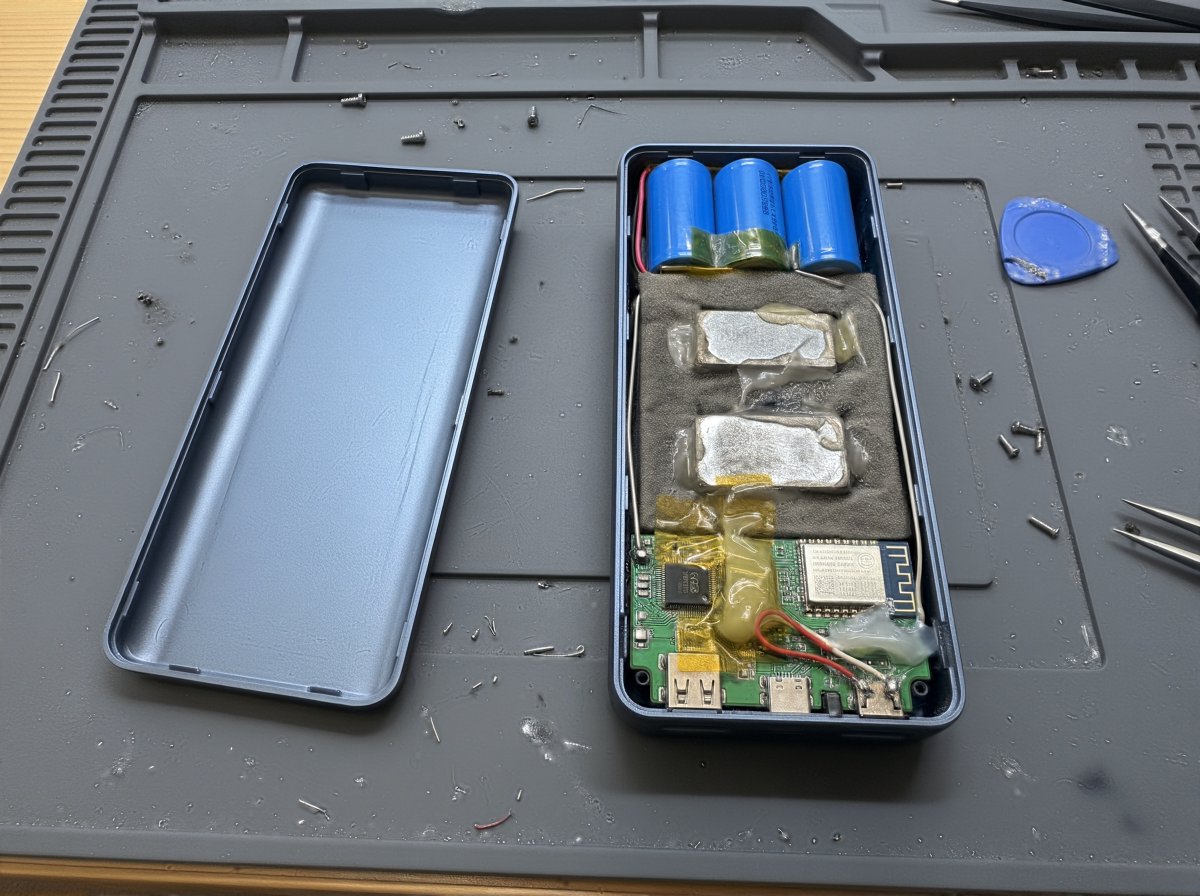
    The repair guy opened it and found a tiny computer with its own Wi-Fi inside. The battery is less than a third of what the label says… Here is everything inside the case: → 3 batteries → about 9,100 mAh, not 30,000 → gray foam → fills the empty space → 2 metal weights → glued in, so it feels like a real battery → green board → a 64 GB memory chip → Wi-Fi module + antenna → how it got online → 2 thin wires → from that board to the USB port He said it's the third one like this he has opened this month. How to check your own in 30 seconds is in the next comment ↓
    İndir
    49120835142K
  18. Blender 🔶✓@Blender
    Layered Actions are taking shape! Learn about the outcomes of the workshop organized by the Animation &amp; Rigging module this September: #b3d #devfund
    132218713.1K
  19. Linux News 24/7@Linux247
    Kwi Is a New Ghostty-Based GPU-Accelerated Terminal Emulator for KDE Plasma
    12511.4K
  20. MAX✓@MAXdeg0
    THIS IS F**KING INSANE FOUND 3 OPEN SOURCE HACKING TOOLS THAT MAKE OSINT INVESTIGATIONS LOOK LIKE A SPIDER WEB. Stop jumping between tabs. These tools help you connect the dots, follow digital footprints and uncover relationships between online identities and infrastructure. FLOWSINT → Visual graph based investigations → Pivots across domains, IPs, emails and usernames → DNS, WHOIS, TLS and social account enrichment SPIDERFOOT → 200+ OSINT modules → Automated data collection and correlation → Web interface, CLI and multiple export formats RECON-NG → Modular web reconnaissance framework → Metasploit style command interface → Workspaces and module marketplace Three tools. Different approaches to mapping digital footprints and gathering intelligence. Only investigate targets you own or have permission to assess. REPO BELOW
    İndir
    182121110.2K
  21. World of Engineering✓@engineers_feed
    Big energy milestone: Solar met 75% of global electricity demand growth in 2025 and edged past nuclear for the first time. Key numbers from Ember / BBC Future: • Solar generation +636 TWh in 2025 (+30%) • Solar now producing more electricity than all the world’s nuclear plants • Renewables overtook coal globally for the first time in the modern era • Module prices described as “offensively cheap”
    17189.5K
  22. Protox@Protox0
    New Horse + UZI meta incoming? Also burst module works for unfolded. #Rust @skierrust
    İndir
    307613.2K
  23. Matt Pocock✓@mattpocockuk
    We need to reconsider our priors on code readability. Humans, compared to agents, are pretty slow at understanding large quantities of text. So in the old days, readability was important so the human could efficiently grok what was going on. So readability now comes down to: 1. Can a human, if needed, jump in and understand the code 2. Does the code use the same domain language as the human describing the code? 1 helps with observability and the occasional spot checks you need to do on important PR's. 2 helps the agent translate the words you use into code changes. In other words, readability is now a nicety, not a necessity. The way agents 'read' code is different - good agents are all about gathering data about how the code works. They'll prod around with it, execute parts of it. So 'readability' to agents really means 'verifiability'. How easy it is to mess about with that code to see it working. Let's take this scenario: - You have a huge module in your codebase that uses all sorts of complex performance tricks - It has 100% test coverage A talented human would need an hour or two to get comfortable working in that module. An agent needs zero time. They verify it with the tests, poke about a bit, and they're good to go. The takeaways: - When judging a module (or a codebase), don't think about how easy the code is to read - Instead, think about how easy it is to verify - Design your codebase so modules can be tested and verified independently - Feel free to sacrifice a bit of readability for performance - Cyclomatic complexity and function size don't matter to agents
    3001432.5K300K
  24. Mika✓@mika_systems
    this is f*cking wild... Boris Cherny (creator of Claude Code) just removed the 5-hour limit for verified Claude Ultra accounts. same $200 a month. the weekly limit stays an agency quoted me $38,000 and 10 weeks to rebuild our old app. so I gave that job to one run and didn't stop it. it went 31 hours straight → Fri 20:00 → 12 agents start on a 48,000-line app, one owner per module → Sat 01:00 → the moment the old 5-hour wall would have killed it. every module mapped, nothing shipped yet → Sat 09:40 → the database is moved. 1.2M rows, 0 mismatches → Sat 18:15 → payments are rebuilt and tested against 300 old invoices → Sun 00:30 → the new UI is done, every screen compared with the old one → Sun 03:00 → finished. 412 tests green. 41% of my week $38,000 and 10 weeks → $200 and 31 hours, 190x cheaper and 54x faster no wall also means a bad run never stops on its own. 4 rules kept this one alive: 1. one owner per file. no agent touches a file another agent owns 2. a budget per run. it stops at 50% of the week, no matter how the tests look 3. a stop rule. 3 failed attempts on the same file means stop and write down why 4. a checkpoint every hour. commit, one line on what changed, one line on what's next put this in your CLAUDE.md before your first long run: "For any run over 1 hour: give every agent its own files and never let two edit the same one. Stop the whole run at 50% of my weekly usage. After 3 failed attempts on a file, stop that agent and log why. Commit every hour with one line on what changed and one line on what's next" how to build agents like these with Claude Code and Opus 5.5 is in my full course below ↓
    İndir
    Mika @mika_systems
    Claude Code + Opus 5.5 is godmode for building your own Claude Duet it reads your inbox and calendar before you wake up. drafts every reply. sends nothing without your yes it keeps working while you sleep full course, step by step:
    123461.8K
  25. Mika✓@mika_systems
    Claude Code + Opus 5.5 is godmode for building your own Claude Duet it reads your inbox and calendar before you wake up. drafts every reply. sends nothing without your yes it keeps working while you sleep full course, step by step:
    2310152140K
  26. Daha fazla gönderi göster