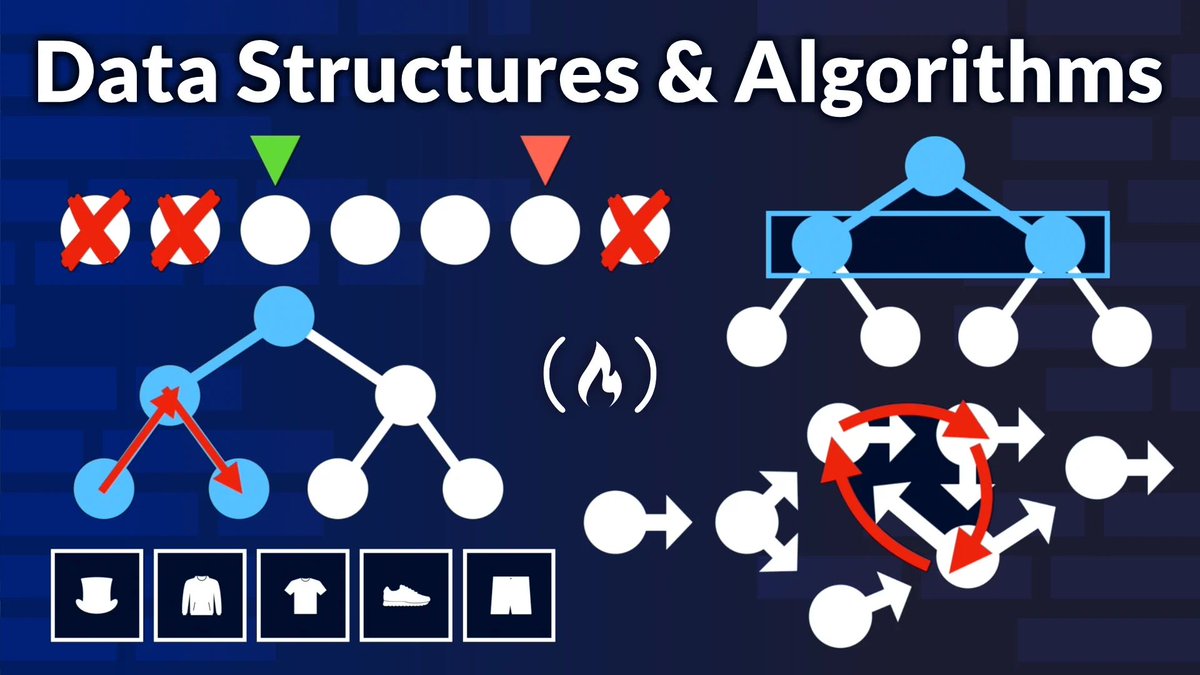
If you're prepping for tech job interviews, you should know how to apply data structures & algorithms to coding challenges.
And this course helps you learn the key DSA you'll need to know with plenty of examples.
It covers arrays, sets, hashmaps, Big O notation, sliding window, binary search, depth-first search, and lots more.
I built a Real-time, Coded Terminal GUI Tool to Track live Network Traffic across Tor, SSH, FTP and Web Protocols on Kali Linux
#Python#KaliLinux#Coding#Infosec#OSINT
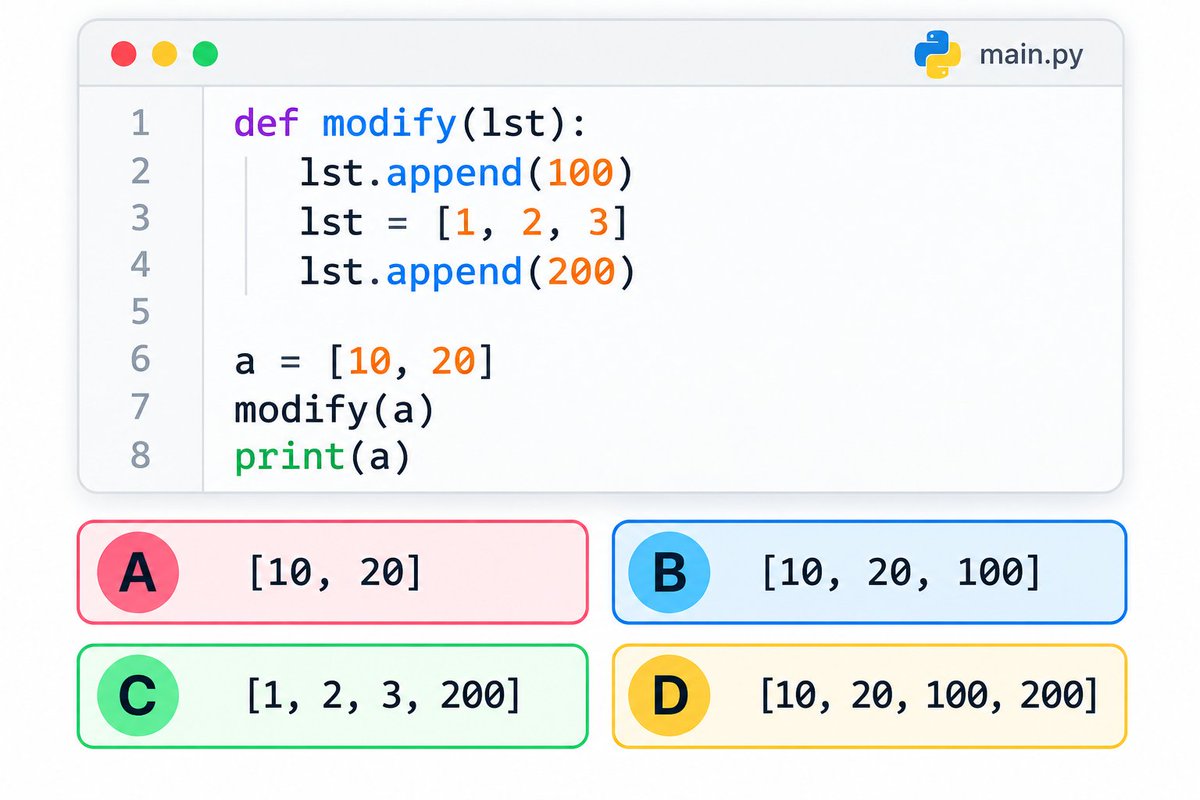
Python challenge: Mutation vs. reassignment
Can you predict the output?
A, B, C, or D? 👀
Think carefully before answering. Drop your choice below! 💻
#Python#Coding#Programming@PythonPr
A lot of people quote tweeted this as 1 year anniversary of vibe coding. Some retrospective -
I've had a Twitter account for 17 years now (omg) and I still can't predict my tweet engagement basically at all. This was a shower of thoughts throwaway tweet that I just fired off without thinking but somehow it minted a fitting name at the right moment for something that a lot of people were feeling at the same time, so here we are: vibe coding is now mentioned on my Wikipedia as a major memetic "contribution" and even its article is longer. lol
The one thing I'd add is that at the time, LLM capability was low enough that you'd mostly use vibe coding for fun throwaway projects, demos and explorations. It was good fun and it almost worked. Today (1 year later), programming via LLM agents is increasingly becoming a default workflow for professionals, except with more oversight and scrutiny. The goal is to claim the leverage from the use of agents but without any compromise on the quality of the software. Many people have tried to come up with a better name for this to differentiate it from vibe coding, personally my current favorite "agentic engineering":
- "agentic" because the new default is that you are not writing the code directly 99% of the time, you are orchestrating agents who do and acting as oversight.
- "engineering" to emphasize that there is an art & science and expertise to it. It's something you can learn and become better at, with its own depth of a different kind.
In 2026, we're likely to see continued improvements on both the model layer and the new agent layer. I feel excited about the product of the two and another year of progress.
Udostępnij
Skopiowano
Andrej Karpathy@karpathy
There's a new kind of coding I call "vibe coding", where you fully give in to the vibes, embrace exponentials, and forget that the code even exists. It's possible because the LLMs (e.g. Cursor Composer w Sonnet) are getting too good. Also I just talk to Composer with SuperWhisper so I barely even touch the keyboard. I ask for the dumbest things like "decrease the padding on the sidebar by half" because I'm too lazy to find it. I "Accept All" always, I don't read the diffs anymore. When I get error messages I just copy paste them in with no comment, usually that fixes it. The code grows beyond my usual comprehension, I'd have to really read through it for a while. Sometimes the LLMs can't fix a bug so I just work around it or ask for random changes until it goes away. It's not too bad for throwaway weekend projects, but still quite amusing. I'm building a project or webapp, but it's not really coding - I just see stuff, say stuff, run stuff, and copy paste stuff, and it mostly works.
There's a new kind of coding I call "vibe coding", where you fully give in to the vibes, embrace exponentials, and forget that the code even exists. It's possible because the LLMs (e.g. Cursor Composer w Sonnet) are getting too good. Also I just talk to Composer with SuperWhisper so I barely even touch the keyboard. I ask for the dumbest things like "decrease the padding on the sidebar by half" because I'm too lazy to find it. I "Accept All" always, I don't read the diffs anymore. When I get error messages I just copy paste them in with no comment, usually that fixes it. The code grows beyond my usual comprehension, I'd have to really read through it for a while. Sometimes the LLMs can't fix a bug so I just work around it or ask for random changes until it goes away. It's not too bad for throwaway weekend projects, but still quite amusing. I'm building a project or webapp, but it's not really coding - I just see stuff, say stuff, run stuff, and copy paste stuff, and it mostly works.
Your AI isn't bad at design. It has just never seen good design.
I've tested 100+ vibe coding resources this year. These are the 40 I actually kept, grouped by what you're stuck on.
Bookmark this 🔖
1. 👑
Why it's different from everything below:
- Every one is a complete prompt, not a snippet you wire up yourself
- 3 steps: copy the prompt, paste it into your AI, launch it live
- 300+ award-winning prompts, all in one place
- Full source code to download and edit
- Works with Claude Code, Cursor or v0
Built for founders and freelancers who want award-level sites without a design team or a week of tweaking. If you only open one link in this post, make it this one.
2. - design systems as markdown your agent can read
3. - ready-made prompts for dashboards and landing pages
4. - curated high-end sites
5. - real UI inspiration mapped to prompts
6. - 2,000+ real product styles with typography
7. - 2,600+ examples of how top design systems solve the same element
8. - curated collection of beautiful websites
9. - the best of web design, recognized and ranked
10. - showcase of the best animation websites
11. - curated landing pages
12. - mobile design patterns
13. - experimental web design projects
14. - navigation patterns
15. - footer layouts
16. - conversion-tested forms, popups and buttons
17. - curated hero sections
18. - the best pricing page examples
19. - community component marketplace that plugs into agents via MCP
20. - still the gold standard
21. - 200+ animated React and Tailwind components
22. - 150+ animated components and effects
23. - advanced interactions
24. - open-source UI elements
25. - animated components built on Motion and GSAP
26. - 2,000+ pre-built section blocks for shadcn/ui
27. - 150+ motion effects with React code and prompts
28. - micro-interactions
29. - glass refraction components
30. - lightweight animation engine
31. - the most popular web 3D library
32. - the standard online shader editor and community
33. - free interactive intro to fragment shaders
34. - full Three.js course with shader chapters
35. - 2,000+ hand-drawn illustrations
36. - 3D icons
37. - command-line AI coding agent
38. - AI-first code editor
39. - Vercel's prompt-to-component tool
40. - AI app builder in the browser
Which one should I add next?
🐍 Python Challenge!
words = [“AI”, “with”, “Python”]
print(”-”.join(words[::2]))
What’s the output? 🤔
A) AI-with-Python
B) AI-Python
C) with-Python
D) Error
👇 Reply before the reveal!
Follow @DyogoCodes for more Python tricks.
#Python#Coding