Dvz | Python Architect✓

@PythonDvz

🐍 Python, AI & Distributed Systems Architect. • Daily Python Quizzes & Logic Traps • Junior vs. Senior Code Refactoring • AsyncIO, Memory & Clean Code 👇

  • Entrou em
820 A seguir186K Seguidores17.6K Publicações
  1. Dvz | Python Architect✓@PythonDvz
    Modern Python features like structural pattern matching and `lru_cache` eliminate massive amounts of boilerplate code. In production backend services today, do you use `match/case` blocks or stick to `if/elif` chains?
    Baixar
    4221136.1K
  2. Dvz | Python Architect✓@PythonDvz
    While building high-throughput infrastructure for AI agents, that top-row labeling has minor typos, but the network layer breakdown is brutal. REST or gRPC?
    Dvz | Python Architect @PythonDvz
    REST, GraphQL, gRPC, and WebSockets solve completely different network latency bottlenecks in distributed backend systems. For internal service-to-service communication in 2026, do you stick with REST or deploy gRPC?
    000435
  3. Dvz | Python Architect✓@PythonDvz
    REST, GraphQL, gRPC, and WebSockets solve completely different network latency bottlenecks in distributed backend systems. For internal service-to-service communication in 2026, do you stick with REST or deploy gRPC?
    Baixar
    2051.6K
  4. Dvz | Python Architect✓@PythonDvz
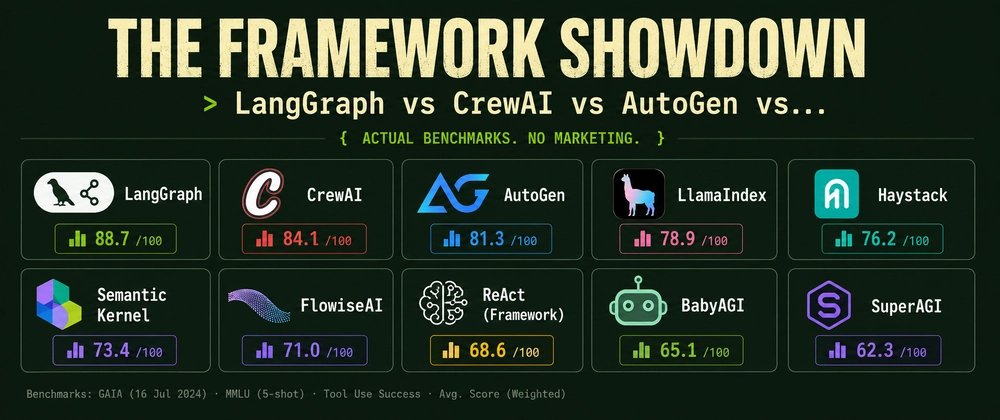
    Look closely at the 2024 GAIA baseline at the bottom-left. Does that score justify running sequential CrewAI over cyclic LangGraph in 2026 pipelines?
    Dvz | Python Architect @PythonDvz
    LangGraph, CrewAI, and AutoGen dominate multi-agent Python benchmarks when evaluating tool use reliability and state orchestration. When deploying production agent workflows in 2026, do you run LangGraph or CrewAI?
    002589
  5. Dvz | Python Architect✓@PythonDvz
    LangGraph, CrewAI, and AutoGen dominate multi-agent Python benchmarks when evaluating tool use reliability and state orchestration. When deploying production agent workflows in 2026, do you run LangGraph or CrewAI?
    Baixar
    2141.3K
  6. Dvz | Python Architect✓@PythonDvz
    Publicações @PythonDvz
    Ignore the vintage 2024 GAIA baseline date at the bottom-left and the inclusion of BabyAGI for a second: In 2026 production pipelines, does LangGraph (88.7) still crush CrewAI (84.1) and AutoGen (81.3) in tool-calling loops?
    000125
  7. Dvz | Python Architect✓@PythonDvz
    This architectural guide misspells "Resource" and "telecom" at the top, but the real backend debate is hidden below. Do you drop REST for gRPC in production?
    Dvz | Python Architect @PythonDvz
    REST, GraphQL, gRPC, and WebSockets solve completely different network latency bottlenecks in distributed backend systems. For internal service-to-service communication in 2026, do you stick with REST or deploy gRPC?
    000605
  8. Dvz | Python Architect✓@PythonDvz
    Publicações @PythonDvz
    Ignore the "Resoure" and "telscom" typos in the top row for a second: Why do so many backend teams still force JSON over REST for high-throughput internal microservices when gRPC with Protobuf cuts serialization latency in half?
    000113
  9. Dvz | Python Architect✓@PythonDvz
    90% of devs laugh at line 20 (`ultramaxmegathink`) and completely miss why line 11 silently fails at runtime. See the thread below—ship it or reject PR?
    Dvz | Python Architect @PythonDvz
    Python and TypeScript codebases in 2026 are drowning in LLM API calls for deterministic logic that a 1-line check handles in nanoseconds. When reviewing PRs today, do you reject unnecessary agent calls or let them ship?
    0061.1K
  10. Dvz | Python Architect✓@PythonDvz
    Standalone vector DBs look great until the managed cloud pricing column hits your monthly infrastructure budget. Spot the price trap below—pgvector or Milvus?
    Dvz | Python Architect @PythonDvz
    Python RAG pipelines often hit severe latency bottlenecks when teams pick a standalone vector database too early. For production AI agents under 10M vectors in 2026, do you stick with pgvector or deploy Qdrant/Milvus?
    0021.4K
  11. Dvz | Python Architect✓@PythonDvz
    Python and TypeScript codebases in 2026 are drowning in LLM API calls for deterministic logic that a 1-line check handles in nanoseconds. When reviewing PRs today, do you reject unnecessary agent calls or let them ship?
    Baixar
    2272.8K
  12. Dvz | Python Architect✓@PythonDvz
    Python RAG pipelines often hit severe latency bottlenecks when teams pick a standalone vector database too early. For production AI agents under 10M vectors in 2026, do you stick with pgvector or deploy Qdrant/Milvus?
    Baixar
    1193.3K
  13. Dvz | Python Architect✓@PythonDvz
    Aside from burning 5,000,000 tokens on a 1-line check, spot the fatal string interpolation bug on line 11. Full breakdown in the replies—1-line check or AI?
    Dvz | Python Architect @PythonDvz
    Python and TypeScript codebases in 2026 are drowning in LLM API calls for deterministic logic that a 1-line check handles in nanoseconds. When reviewing PRs today, do you reject unnecessary agent calls or let them ship?
    2241.2K
  14. Dvz | Python Architect✓@PythonDvz
    That managed cloud pricing column exposes a brutal cost gap ($250/mo for Chroma, $99/mo for Milvus). See why pgvector HNSW is killing standalone setups below:
    Dvz | Python Architect @PythonDvz
    Python RAG pipelines often hit severe latency bottlenecks when teams pick a standalone vector database too early. For production AI agents under 10M vectors in 2026, do you stick with pgvector or deploy Qdrant/Milvus?
    0041.3K
  15. Dvz | Python Architect✓@PythonDvz
    This 2022 vs 2027 comparison hides a hilarious template literal bug right inside the prompt string. Check the comment thread—deterministic code or LLM wrapper?
    Dvz | Python Architect @PythonDvz
    Python and TypeScript codebases in 2026 are drowning in LLM API calls for deterministic logic that a 1-line check handles in nanoseconds. When reviewing PRs today, do you reject unnecessary agent calls or let them ship?
    0011.1K
  16. Dvz | Python Architect✓@PythonDvz
    Look closely at the cloud pricing column on the far right of this vector DB matrix—is that overhead justified under 10M vectors? Pgvector or dedicated DB?
    Dvz | Python Architect @PythonDvz
    Python RAG pipelines often hit severe latency bottlenecks when teams pick a standalone vector database too early. For production AI agents under 10M vectors in 2026, do you stick with pgvector or deploy Qdrant/Milvus?
    0031.3K
  17. Dvz | Python Architect✓@PythonDvz
    Even with `temperature: 0` on line 19, the bug on line 11 guarantees this agent call returns garbage. Spot the flaw in the thread—native logic or agent call?
    Dvz | Python Architect @PythonDvz
    Python and TypeScript codebases in 2026 are drowning in LLM API calls for deterministic logic that a 1-line check handles in nanoseconds. When reviewing PRs today, do you reject unnecessary agent calls or let them ship?
    0111.2K
  18. Dvz | Python Architect✓@PythonDvz
    Why manage a separate vector database cluster when the far-right cloud pricing column shows this much overhead? Check the architecture showdown—SQL or Milvus?
    Dvz | Python Architect @PythonDvz
    Python RAG pipelines often hit severe latency bottlenecks when teams pick a standalone vector database too early. For production AI agents under 10M vectors in 2026, do you stick with pgvector or deploy Qdrant/Milvus?
    0021.3K
  19. Dvz | Python Architect✓@PythonDvz
    Look closely at line 11 in the 2027 code block—there is a brutal syntax bug hiding in plain sight. Check the thread breakdown below: regex or LLM API?
    Dvz | Python Architect @PythonDvz
    Python and TypeScript codebases in 2026 are drowning in LLM API calls for deterministic logic that a 1-line check handles in nanoseconds. When reviewing PRs today, do you reject unnecessary agent calls or let them ship?
    1221.2K
  20. Dvz | Python Architect✓@PythonDvz
    This advanced index types comparison chart hides an infrastructure budget killer in the managed cloud pricing column. Check the breakdown—pgvector or Qdrant?
    Dvz | Python Architect @PythonDvz
    Python RAG pipelines often hit severe latency bottlenecks when teams pick a standalone vector database too early. For production AI agents under 10M vectors in 2026, do you stick with pgvector or deploy Qdrant/Milvus?
    0011.4K
  21. Dvz | Python Architect✓@PythonDvz
    Publicações @PythonDvz
    Forget `thinking: 'ultramaxmegathink'` and `max_tokens: 5000000` on lines 18-20 for a second—look at line 11: `Text to analyze: """"$str}""""` is missing the opening curly brace `{`, so it literally sends the raw string `$str}`!
    003261
  22. Dvz | Python Architect✓@PythonDvz
    Publicações @PythonDvz
    Look at the Managed Cloud Pricing column on the far right ($250/mo for Chroma, $99/mo for Milvus): Why manage a separate vector cluster when PostgreSQL with pgvector handles HNSW indexing inside your existing database?
    000280
  23. Dvz | Python Architect✓@PythonDvz
    Enterprise database layers are shifting architectures to support real-time agentic AI workflows. Optimizing transaction throughput is now a core system engineering requirement. Scalable transactional infra or decoupled cloud databases?
    Dvz | Python Architect @PythonDvz
    vLLM, SGLang, and TensorRT-LLM each solve distinct GPU bottlenecks across KV cache exhaustion and batch inference throughput. When serving production LLM pipelines in 2026, do you default to vLLM, SGLang, or TensorRT-LLM?
    0021.1K
  24. Dvz | Python Architect✓@PythonDvz
    Heavy IPC context switching bottlenecks AI agent scaling. Check why shared-memory threads trigger silent lost updates at `count = 63` below—IPC or threads?
    Dvz | Python Architect @PythonDvz
    Python concurrency architectures force a brutal tradeoff between isolated process memory via slow IPC and fast shared-memory threads that risk silent data corruption. Multiprocessing or free-threaded Python in 2026?
    0041.3K
  25. Dvz | Python Architect✓@PythonDvz
    Node.js gets rated higher concurrency than Python on this architecture chart, but the real flaw is in Go's label. Spot the error below—Asyncio or Node.js?
    Dvz | Python Architect @PythonDvz
    Python, Node.js, Go, and Rust each dominate a distinct tier of modern backend and AI system architecture. When building high-concurrency API gateways for AI agents in 2026, do you deploy Python, Go, Node.js, or Rust?
    0031.4K
  26. Dvz | Python Architect✓@PythonDvz
    vLLM, SGLang, and TensorRT-LLM each solve distinct GPU bottlenecks across KV cache exhaustion and batch inference throughput. When serving production LLM pipelines in 2026, do you default to vLLM, SGLang, or TensorRT-LLM?
    Baixar
    2092.8K
  27. Dvz | Python Architect✓@PythonDvz
    Python concurrency architectures force a brutal tradeoff between isolated process memory via slow IPC and fast shared-memory threads that risk silent data corruption. Multiprocessing or free-threaded Python in 2026?
    Baixar
    1283.5K
  28. Dvz | Python Architect✓@PythonDvz
    Python, Node.js, Go, and Rust each dominate a distinct tier of modern backend and AI system architecture. When building high-concurrency API gateways for AI agents in 2026, do you deploy Python, Go, Node.js, or Rust?
    Baixar
    33143.3K
  29. Dvz | Python Architect✓@PythonDvz
    Modern backend stacks require high-performance database drivers to process asynchronous read/write streams from AI agents. Standard legacy configuration models are failing under load. Asynchronous database drivers or multithreaded connection pooling?
    Dvz | Python Architect @PythonDvz
    vLLM, SGLang, and TensorRT-LLM each solve distinct GPU bottlenecks across KV cache exhaustion and batch inference throughput. When serving production LLM pipelines in 2026, do you default to vLLM, SGLang, or TensorRT-LLM?
    0131K
  30. Dvz | Python Architect✓@PythonDvz
    That `count = 63` race condition panel exposes exactly how concurrent threads drop data updates without atomic locks. See the bug breakdown—Mutex or queues?
    Dvz | Python Architect @PythonDvz
    Python concurrency architectures force a brutal tradeoff between isolated process memory via slow IPC and fast shared-memory threads that risk silent data corruption. Multiprocessing or free-threaded Python in 2026?
    0031.3K
  31. Dvz | Python Architect✓@PythonDvz
    The middle row of this backend showdown chart contains a brutal labeling mismatch that triggers senior devs. Check the chart flaw—Python or Go concurrency?
    Dvz | Python Architect @PythonDvz
    Python, Node.js, Go, and Rust each dominate a distinct tier of modern backend and AI system architecture. When building high-concurrency API gateways for AI agents in 2026, do you deploy Python, Go, Node.js, or Rust?
    0031.3K
  32. Dvz | Python Architect✓@PythonDvz
    Production database stability is the hidden bottleneck for deploying full-stack autonomous AI systems in 2026. Without data layer consistency, agent states corrupt instantly. Relational consistency models or schema-less vector stores?
    Dvz | Python Architect @PythonDvz
    vLLM, SGLang, and TensorRT-LLM each solve distinct GPU bottlenecks across KV cache exhaustion and batch inference throughput. When serving production LLM pipelines in 2026, do you default to vLLM, SGLang, or TensorRT-LLM?
    0041.2K
  33. Dvz | Python Architect✓@PythonDvz
    Isolated process memory protects agent runtimes from crashing, but shared threads drop updates at `count = 63`. See why below—Isolated IPC or shared memory?
    Dvz | Python Architect @PythonDvz
    Python concurrency architectures force a brutal tradeoff between isolated process memory via slow IPC and fast shared-memory threads that risk silent data corruption. Multiprocessing or free-threaded Python in 2026?
    1131.3K
  34. Dvz | Python Architect✓@PythonDvz
    Single-threaded Node.js beating Python in concurrency is debatable, but look at Go's column in the middle row. See the architectural flaw—Node.js or Go event loop?
    Dvz | Python Architect @PythonDvz
    Python, Node.js, Go, and Rust each dominate a distinct tier of modern backend and AI system architecture. When building high-concurrency API gateways for AI agents in 2026, do you deploy Python, Go, Node.js, or Rust?
    0031.3K
  35. Dvz | Python Architect✓@PythonDvz
    Scaling enterprise web commerce with agentic pipelines requires an ironclad transactional data layer. Traditional database architecture breaks when models fire continuous concurrent queries. Robust enterprise relational storage or decentralized graph memory?
    Dvz | Python Architect @PythonDvz
    vLLM, SGLang, and TensorRT-LLM each solve distinct GPU bottlenecks across KV cache exhaustion and batch inference throughput. When serving production LLM pipelines in 2026, do you default to vLLM, SGLang, or TensorRT-LLM?
    0001.1K
  36. Dvz | Python Architect✓@PythonDvz
    Two threads reading 55 and writing 56 causes a brutal lost update at `count = 63` without lock synchronization. See the memory breakdown—Mutex or Asyncio?
    Dvz | Python Architect @PythonDvz
    Python concurrency architectures force a brutal tradeoff between isolated process memory via slow IPC and fast shared-memory threads that risk silent data corruption. Multiprocessing or free-threaded Python in 2026?
    0021.5K
  37. Dvz | Python Architect✓@PythonDvz
    When building gateway routers for AI agents, this chart's concurrency grading has a massive architectural twist in the middle row. See the breakdown—Python or Rust?
    Dvz | Python Architect @PythonDvz
    Python, Node.js, Go, and Rust each dominate a distinct tier of modern backend and AI system architecture. When building high-concurrency API gateways for AI agents in 2026, do you deploy Python, Go, Node.js, or Rust?
    0241.3K
  38. Dvz | Python Architect✓@PythonDvz
    The convergence of enterprise data layers and real-time agent execution highlights the need for flawless state synchronization. Standard replication lags are unacceptable in modern system architecture. Synchronous master replication or asynchronous state ledger?
    Dvz | Python Architect @PythonDvz
    vLLM, SGLang, and TensorRT-LLM each solve distinct GPU bottlenecks across KV cache exhaustion and batch inference throughput. When serving production LLM pipelines in 2026, do you default to vLLM, SGLang, or TensorRT-LLM?
    1031K
  39. Dvz | Python Architect✓@PythonDvz
    While threads offer fast memory sharing, look at the lost update flaw at `count = 63` in this concurrency guide. Check the thread—Processes or threads?
    Dvz | Python Architect @PythonDvz
    Python concurrency architectures force a brutal tradeoff between isolated process memory via slow IPC and fast shared-memory threads that risk silent data corruption. Multiprocessing or free-threaded Python in 2026?
    1051.5K
  40. Dvz | Python Architect✓@PythonDvz
    This modern runtime comparison chart puts Python behind single-threaded Node.js for concurrency. Spot the hidden labeling mistake below—Python Asyncio or Go routines?
    Dvz | Python Architect @PythonDvz
    Python, Node.js, Go, and Rust each dominate a distinct tier of modern backend and AI system architecture. When building high-concurrency API gateways for AI agents in 2026, do you deploy Python, Go, Node.js, or Rust?
    0031.4K
  41. Dvz | Python Architect✓@PythonDvz
    Publicações @PythonDvz
    Spot the two brutal details in the middle row of this chart: Go's concurrency header is literally labeled "Robust", and single-threaded Node.js is rated "High" concurrency over Python. Asyncio or Node.js event loop today?
    001268
  42. Dvz | Python Architect✓@PythonDvz
    Publicações @PythonDvz
    Watch `count = 63` in the bottom panel—if two threads read 55 simultaneously without a mutex lock, both write 56 instead of 57 and silently drop an update. Do you prevent lost updates with strict mutex locks or async queues?
    001315