Cool. Who gets the beach house in Stinson when we have super intelligent abundance?
Elon Musk @elonmusk@battleangelviv Saving money for the distant future is pointless with the advent of super intelligent abundance
104394
@AMLabEcon
Professor at UC Berkeley. Labor economics.
Elon Musk @elonmusk@battleangelviv Saving money for the distant future is pointless with the advent of super intelligent abundance

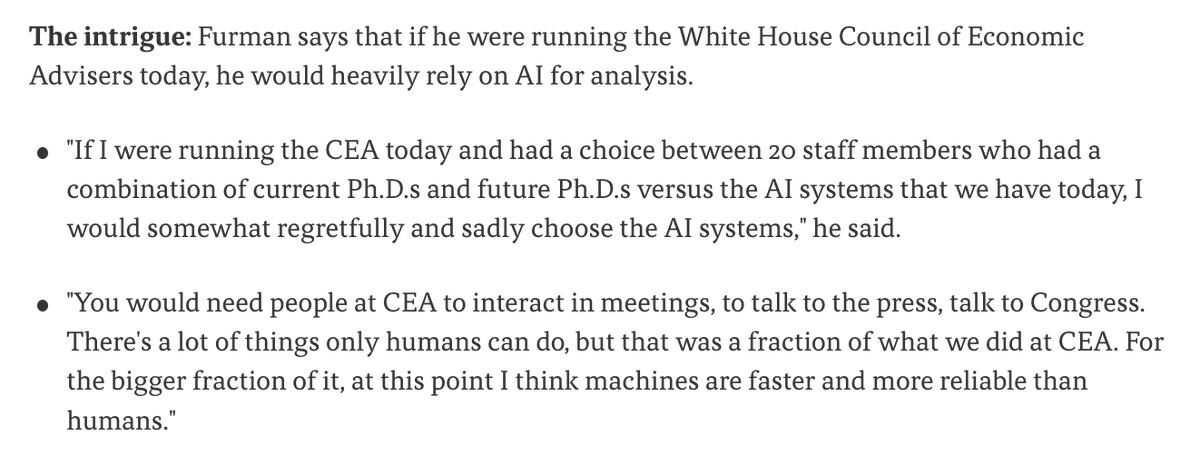
Neil Irwin @Neil_IrwinHe goes so far as to say that if he were to run the White House CEA today he'd do it with a lot of reliance on Claude and friends.

Azeem Azhar @azeemGreat new paper from @i_am_nickbloom A few thousand firms in the US and UK represent half of all AI spending-- roughly top 2%. Trouble is n=845 & 1273; so one firm here or there could make a huge difference. Bottom 50% of firms are <1% of AI spendin by eyeball. Average US firm spends $2000 per employee (in 2025) -- obviously skewed by high spenders. Marginal productivity benefits. Worth comparing to the BCG survey (n=1273), which has more recent fieldwork and may be more self-selected.


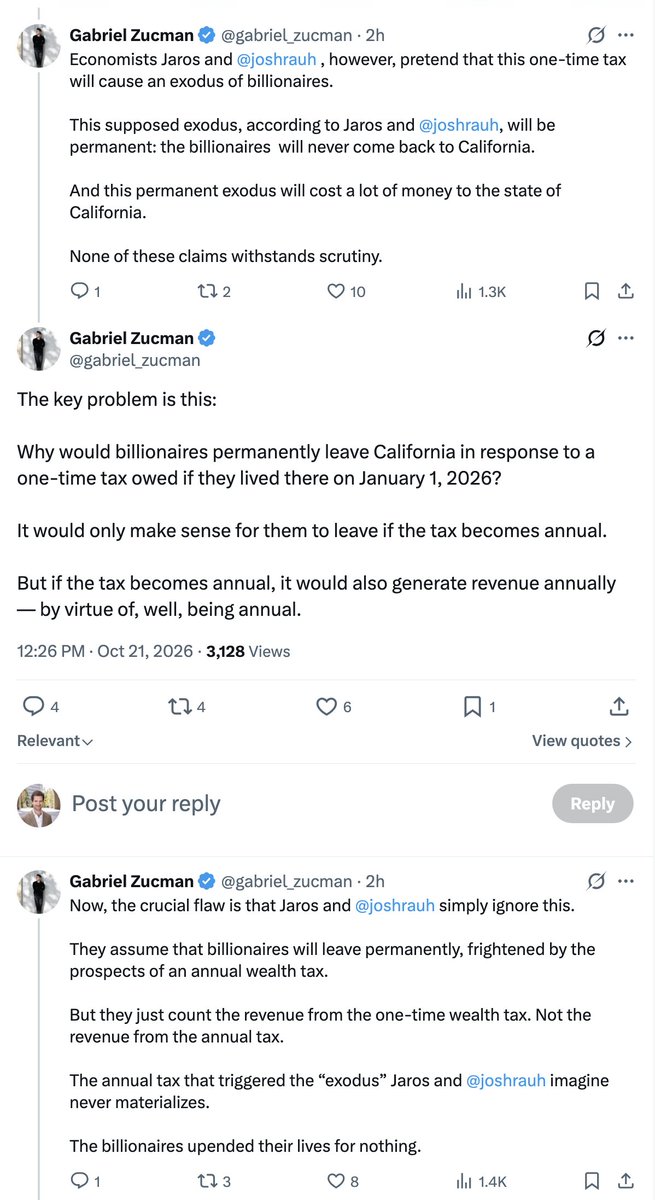
Gabriel Zucman @gabriel_zucmanLet’s be clear: this is a highly inappropriate way to model the effect of Prop 40 on taxpayer behavior. For one, it’s a basic violation of rational expectations, a cornerstone of modern economics. In Jaros and @joshrauh world, the billionaires act irrationally: they respond to a policy that does not exist and will never exist. Economics students around the world are taught this is not an appropriate way to model behavior — but apparently in this context (fighting Prop 40) it’s OK.

Jeremy Kauffman 🦔🌲🌕 @jeremykauffman30 percent of California's 200 billionaires left in the three month window they had to escape a wealth tax
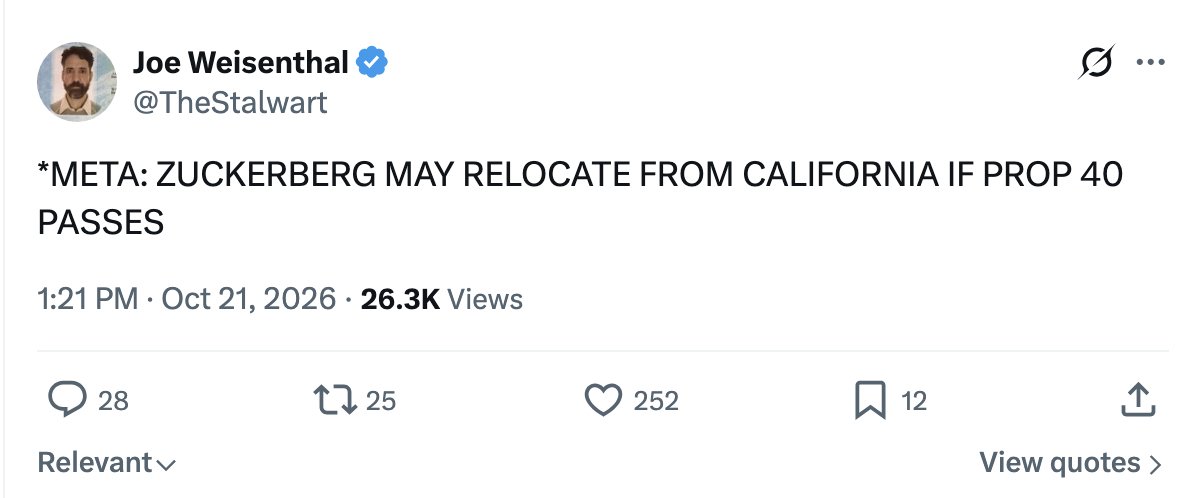
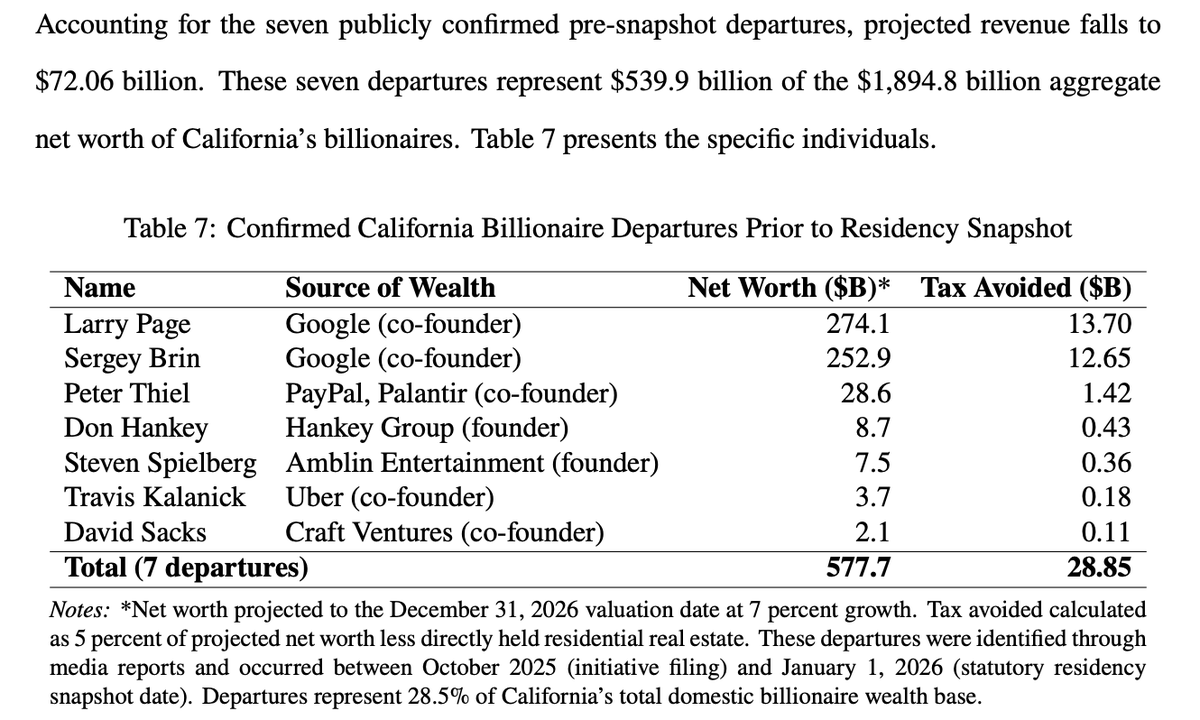
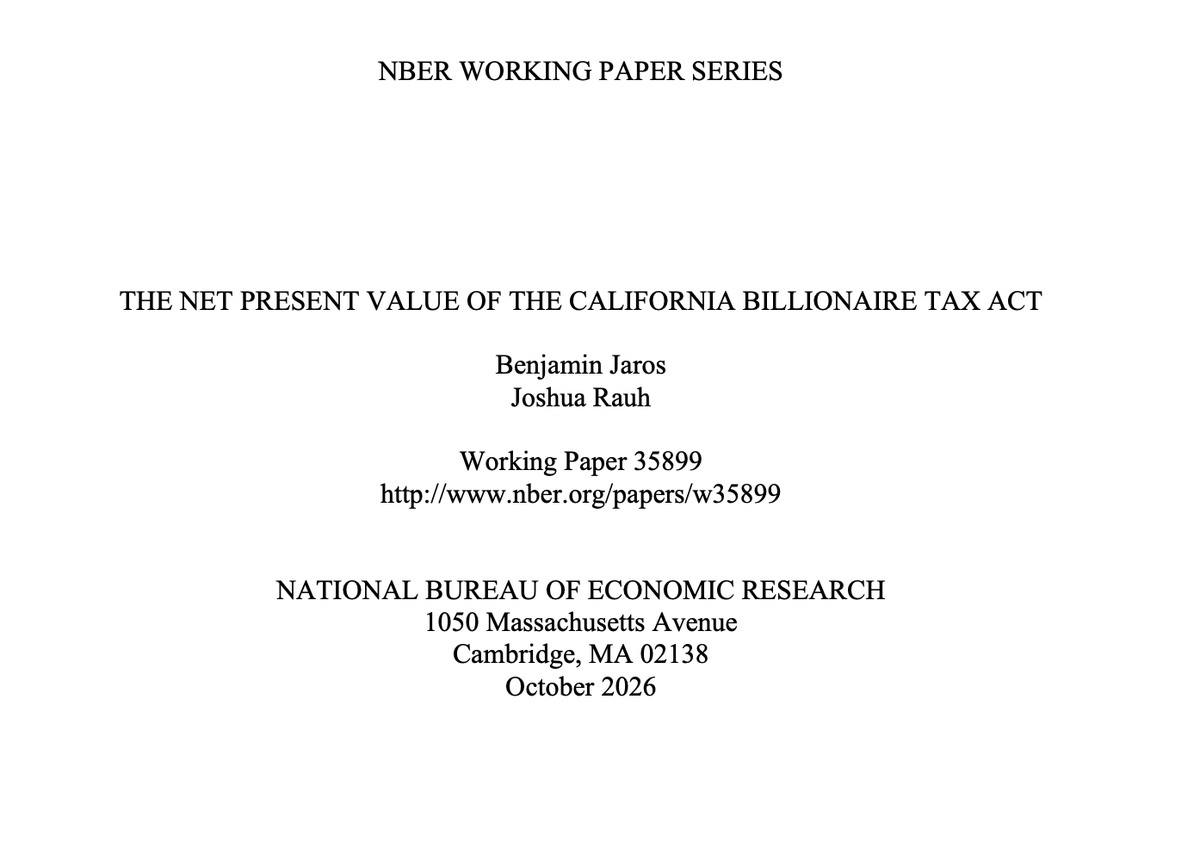
nic carter @nic_carterthis California wealth tax thing is just incredible. so in October 2025, a California healthcare union proposed a "one time" 5% tax on any billionaire's wealth. the ballot measure will be voted on next month. In early December 2025, California announced that it would be a retroactive tax if passed, applying to anyone with CA residency as of Jan 1, 2026. The objective is to pay for Medi-Cal, California's incredibly dysfunctional healthcare system. (which also functions as a glorified welfare apparatus, but that's a discussion for another time). polls reveal that the CA electorate is split around 50/50 on the tax, but prediction markets only give Prop 40 a ~23% chance of passing (there are competing measures on the ballet that would nullify it). there are 200 billionaires in CA, worth collectively somewhere between $2.3 and $2.6 trillion. 5% of that is around $100b, accounting for a small amount of attrition. proponents of the tax forecasted a significant windfall, assuming only a 10% departure rate. supporters thought they were being clever with the retroactive concept. no billionares would leave CA in the few short months between the tax being proposed and the residency cutoff date, without the tax even having passed yet, right? well as it turns out, they did. a new paper [1] from two academics at Stanford called "The Net Present Value of the California Billionaire Tax Act", argues that not only did more billionaires leave due to the proposed tax than its proponents expected, but that the value of the tax, if it does pass, is actually negative. proponents of the tax only assumed 10% avoidance, that is, only 10% of the taxable base of targeted billionaires would leave CA within the very short Oct-Dec 2025 window. Jaros and Rauh, the Stanford academics, find that a lower bound of 28.6% of the taxable base managed to leave. just based on known departures, those departures total $577b in net worth, or $28.8b in potential tax lost. this of course does not capture everyone (many left without announcing their departure), so the authors normalize to departure rates estimated from other wealth tax events, and apply other discounts for litigation, arriving arrive at a figure of only $28-$36b in forecasted tax revenues. but this isn't all! all of the income taxes paid by the departed billionaires are also forsaken. the authors estimate that CA billionaires pay $3.3- 5.8b in annual income taxes. they assume a midpoint of $2b lost in annual collections from departed billionaires. the net present value of that lost income stream is -$68.9 billion. so when you add it all up you get: + $30b one-time tax windfall (estimated) - $69b in present value of lost future income taxes = - 38.9b overall net present value of the tax of course, this analysis is highly estimate driven. the authors simulate the parameters 100k times and find a negative NPV of the implemented tax 85 percent of the time. and if the tax doesn't pass, which it's not looking like it will, California still ended up losing at least $577b in departed net worth, and they have permanently poisoned the well with entrepreneurs who will now worry about future wealth taxes. [1]:



Scott Beaulier @ScottABeaulierAfter teaching at @HarvardHBS, @Cornell, and @Cambridge_Uni, Christopher Marquis has concluded that business schools should be abolished. Maybe the problem isn't business education; maybe it's the corner of business education he knows best. Please Don’t Abolish My Business School


Andrew Curran @AndrewCurran_This is a slide from Terence Tao's 'Math 2.0' public lecture yesterday evening at Caltech. I am highly confident that, if the cure actually worked, almost any Stage 4 cancer patient would tell you that human comprehension of its mechanism is completely irrelevant to them.


1776 Live @250YearsAgoLiveSpanish missionaries in California dedicate a small chapel by a large bay that they call the Mission San Francisco.