Archaeological Survey of India✓

@ASIGoI

ASI under Ministry of Culture, Govt of India is the premier organization for the archaeological research and protection of the cultural heritage of the nation.

174 Following152K Followers8.8K Posts
  1. Archaeological Survey of India✓@ASIGoI
    More than 4,500 years ago, the artisans of Dholavira transformed stone into a remarkable work of art. Today, their legacy lives on in India’s enduring tradition of stone craftsmanship, revealing a remarkable thread of artistic continuity across millennia.
    Ministry of Culture @MinOfCultureGoI
    Dholavira, one of the finest urban centres of the Sindhu-Saraswati Civilization, has yielded what is regarded as the largest known stone sculpture from the entire civilization spread across the northwestern part of the Indian Subcontinent. Found during the excavations near the Eastern Gate of the Castle, this large sculpture is more than just an artefact. It stands as living evidence of a sophisticated artistic tradition of stone sculpting that began over 4,500 years ago and has continued unbroken in India. From such monumental works of the Indus-Saraswati era to the modern craft of stone sculpting, India has preserved and carried forward this civilizational thread. Dholavira does not merely preserve the past, it affirms that the creative genius of the Sindhu-Saraswati Civilization continues to beat throughout India. #LivingContinuity #SindhuSaraswati #IndusValley #Indus #IndusValleyCivilization
    7271368K
  2. Ministry of Culture✓@MinOfCultureGoI
    Dholavira, one of the finest urban centres of the Sindhu-Saraswati Civilization, has yielded what is regarded as the largest known stone sculpture from the entire civilization spread across the northwestern part of the Indian Subcontinent. Found during the excavations near the Eastern Gate of the Castle, this large sculpture is more than just an artefact. It stands as living evidence of a sophisticated artistic tradition of stone sculpting that began over 4,500 years ago and has continued unbroken in India. From such monumental works of the Indus-Saraswati era to the modern craft of stone sculpting, India has preserved and carried forward this civilizational thread. Dholavira does not merely preserve the past, it affirms that the creative genius of the Sindhu-Saraswati Civilization continues to beat throughout India. #LivingContinuity #SindhuSaraswati #IndusValley #Indus #IndusValleyCivilization
    Download
    1626581338.4K
  3. Archaeological Survey of India✓@ASIGoI
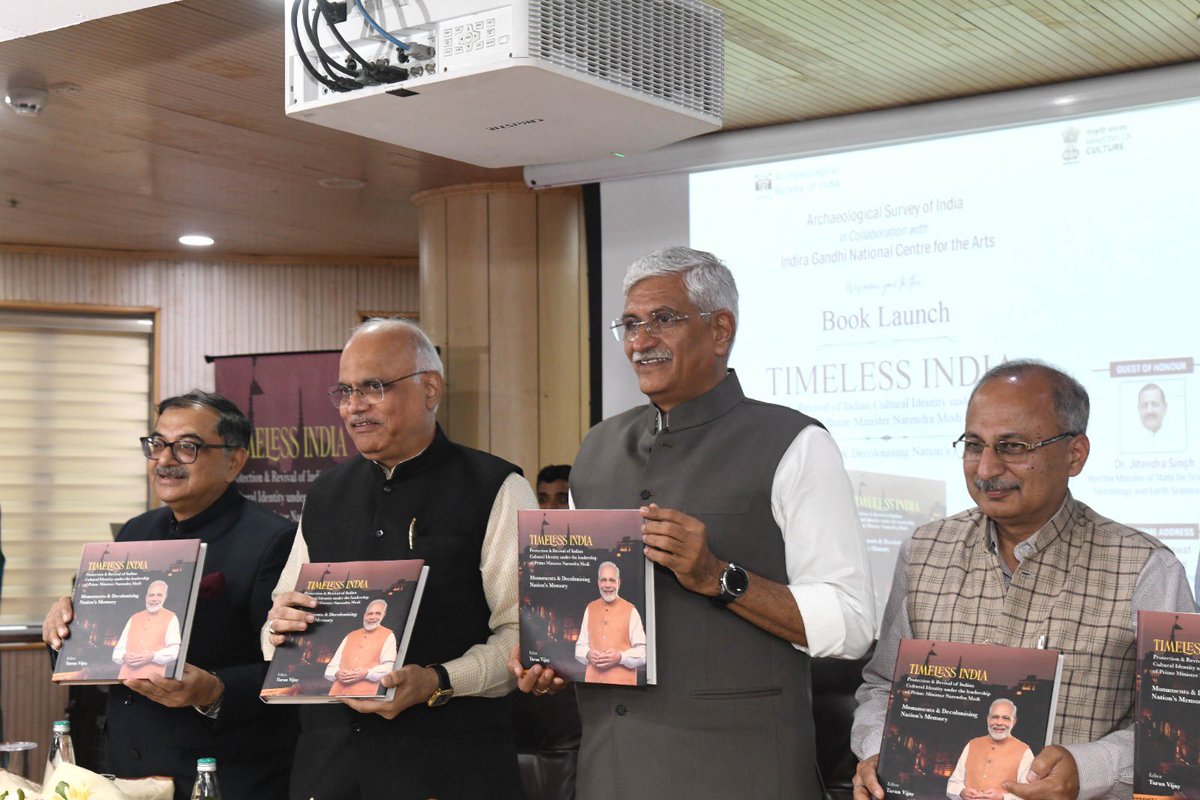
    Shri Gajendra Singh Shekhawat, Union Minister of Culture and Tourism, visited the Archaeological Survey of India (ASI) for the launch of the book Timeless India, authored and edited by Shri Tarun Vijay. Also present at the occasion were Dr Jitendra Singh, Union Minister of State for Science and Technology and Earth Sciences, and Shri Yadubir Singh Rawat, Director General, ASI.
    Download
    01221.3K
  4. Archaeological Survey of India✓@ASIGoI
    Located at Tiruvallam in Thiruvananthapuram, Kerala, the temple complex is one of the earliest in the region and represents a combination of Kerala and Dravida styles of architecture. An inscription on the adhishthana (base) of the temple, attributed to Venad King Vira Keralavarman, is dated to 1224 CE. Based on epigraphical and architectural evidence, the temple complex was constructed between the 13th and 17th centuries CE. (1/2)
    Download
    415582.3K
  5. Archaeological Survey of India✓@ASIGoI
    Posts @ASIGoI
    The inner enclosure, known as the nalambalam, houses the shrines of Parasurama, Brahma and Shiva, along with smaller shrines dedicated to Matsyamurti, Vedavyasa and Subramanya. Outside the enclosure on the eastern side are independent shrines dedicated to Krishna, Ganesha and Sastha. The shrines of Parasurama, Brahma and Matsyamurti follow the Dravida style of architecture. The Parasurama shrine is circular, or more precisely, pot-shaped (ghata-shaped) in plan. It is built of solid granite up to the kapota level, above which rises a detailed brick superstructure. Facing north, the shrine rests on an adhishthana comprising an upana, a short jagati, an octagonal kumuda, a kantha with gala-padas, a pattika and a vedika. Directly in front of the shrine is a namaskara-mandapa with a traditional pyramidal roof adorned with relief sculptures. To the east of the Parasurama shrine is the square Brahma shrine, designed as an ekatala vimana (single-tiered shrine). Next to it is the circular Shiva shrine, facing east and featuring a prominent conical roof. (2/2)
    Download
    034280
  6. Archaeological Survey of India✓@ASIGoI
    Located in Ratanpur, in the Bilaspur district of Chhattisgarh, the Kanthi Dewal Temple is a three-storeyed temple dedicated to Shiva. It was probably built during the fifteenth–sixteenth century CE. Ratanpur was the capital of the Kalachuris of Ratanpura, a branch of the Kalachuris of Tripuri. According to the Ratanpur inscription of the local king Jajjaladeva I, dated 1114 CE, his ancestor Kalingaraja conquered the Dakshina Kosala region and made Tummana (modern Tuman) his capital. Kalingaraja’s grandson Ratnaraja later established Ratanpura (modern Ratanpur). The temple is unusually tall and distinctive in shape, combining features of both Hindu and Islamic architecture. It enshrines a highly polished Shiva-linga made of black basalt. The two lower storeys are square in plan. The ground storey is almost plain, with door openings on all four sides. The storey above it features projecting jharokhas (bay windows) in the middle, flanked by small niches and alcoves on either side. The structure is crowned by a curvilinear shikhara.
    Download
    218652.5K
  7. Archaeological Survey of India✓@ASIGoI
    Archaeological Survey of India
    RT @MinOfCultureGoI: Bridging centuries of knowledge and heritage, India and France join hands to preserve the past and shape the future of cultural preservation. An MoU was signed and exchanged today in Paris between the Ministry of Culture, Government of India, and the Bibliothèque nationale de France (National Library of France), by Shri Vivek Aggarwal, Secretary, Ministry of Culture and Mr. Gilles Pécout (@GillesPecout), President of the BnF (@labnf). The collaboration brings together the expertise of specialised Indian institutions and initiatives, including the National Archives of India (@IN_Archives), the National Library, Kolkata (@NationalLib_GoI), and the Gyan Bharatam Mission (@GyanBharatamMoC). The partnership will focus on five key pillars: Digitisation, Cross-Sharing on the National Digital Repository (NDR), Technology Exchange, Conservation, and Research & Development—strengthening efforts to preserve, share and make cultural and documentary heritage accessible to future generations. #CultureUnitesAll
    0330696
  8. Archaeological Survey of India✓@ASIGoI
    This chlorite sculpture of two-armed Jambhala, dating to the 9th-10th century CE, is a truly unique representation. Jambhala sits in Lalitasana on a double-petalled lotus, his form pot-bellied (lambodara). His right hand is in Varada mudra and holds a matulunga (citron), while his left hand rests on a mongoose that disgorges pearls. He wears an antariya and is richly adorned with anklets, wristlets, armlets, a necklace, a floral garland and large ear ornaments, crowned with a high conical kirita mukuta. The crown depicts the five Dhyani Buddhas in their characteristic mudras, along with a sixth figure seated in vajraparyankasana with Kshepana mudra. His coiled locks fall over his shoulders, an umbrella is shown above his head, and female figures move through clouds on either side. Beneath the seat are five nidhi-kumbhas. One has fallen sideways, and from it the other treasures are shown emerging. Two seated figures also appear below the throne, holding objects described as possible bows or bowls of fire. The reverse of the image holds a particularly important feature: an incised mandala diagram consisting of concentric circles and lotus forms. It contains inscriptions relating to Buddhist creeds, mantras dedicated to Jambhala and his Shakti Vasudhara, the name of his Yaksha, dancing deities, mystic syllables and the musical instruments associated with the mandala.
    Download
    116872.9K
  9. Archaeological Survey of India✓@ASIGoI
    Located on the right bank of the river Brahmani, at the centre of Bajrakot village in Angul district, Odisha, the Bhingesvara Mahadeva Temple dates to the early 8th century CE. It was built by the Sulkis of Kodalaka Mandala, feudatories of the Bhaumakaras. The temple belongs to the Panchayatana class and is triratha in plan and triangabada in elevation. The jagamohana and corner shrines have long since collapsed, although the pillars of the jagamohana and parts of the pabhaga mouldings of the subsidiary shrines still exist. The temple doorframes resemble those of Monastery No. 1 at Ratnagiri Mahavihara and are stylistically similar to the Sisiresvara Temple in Bhubaneswar, both associated with the 8th century CE.
    Download
    5161353.7K
  10. Archaeological Survey of India✓@ASIGoI
    Archaeological Survey of India
    RT @gssjodhpur: On the auspicious occasion of Abhidhamma Day, I am honoured to share this special message from Ven. Borelle Seeladassana of the Sihanada International Meditation Community, Sri Lanka, expressing appreciation for Hon’ble PM Shri @narendramodi Ji’s leadership and the Government of India’s efforts to preserve and promote Buddhism across the world. The message highlights India’s initiatives in strengthening the global Buddhist community through spiritual diplomacy, the sharing of sacred relics, and the preservation and promotion of our rich Buddhist heritage. It also celebrates the deep civilisational and spiritual bonds between India and Sri Lanka, united by the timeless wisdom of Buddha Dhamma. My heartfelt gratitude to PM Shri @narendramodi ji for his visionary leadership and his guiding mantra of “Sabka Saath Sabka Vikas” which inspires India’s commitment to fostering mutual respect, cultural understanding and stronger spiritual ties with the global Buddhist community. #AbhidhammaDay #BuddhaDhamma #IndiaSriLanka
    01010702
  11. Archaeological Survey of India✓@ASIGoI
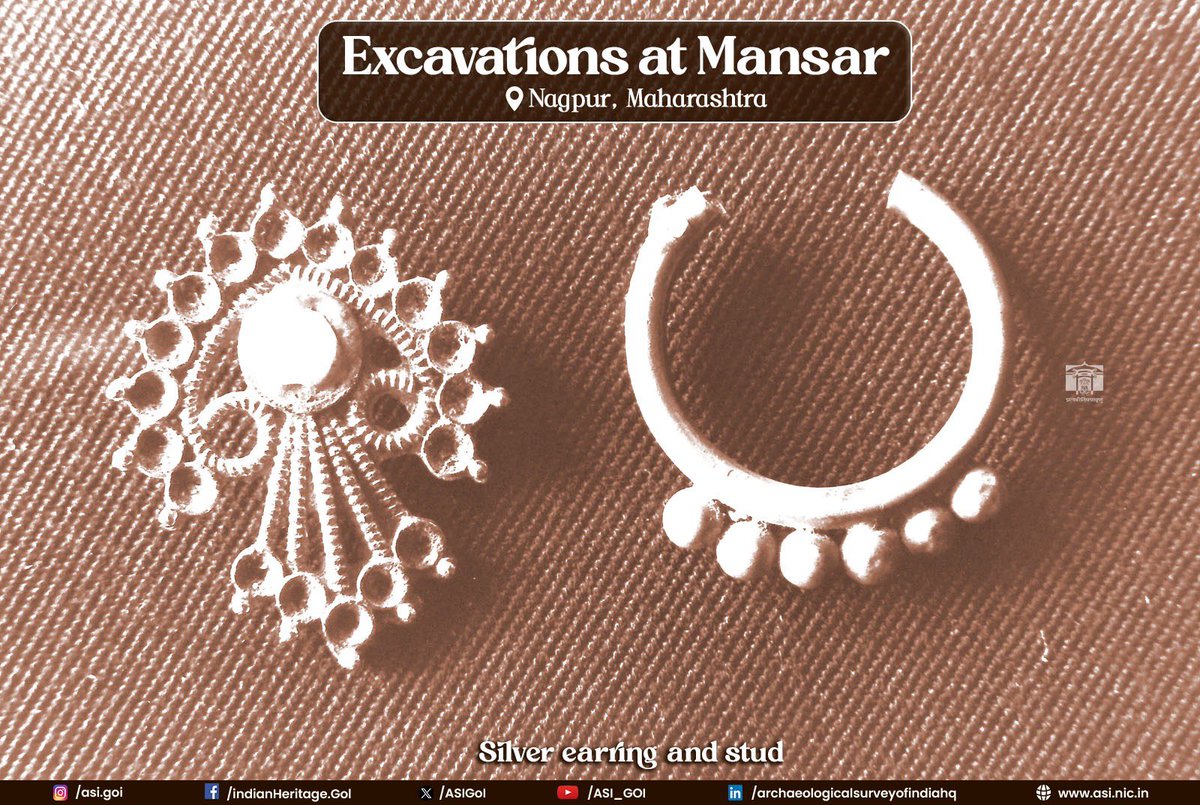
    The first extensive survey at Mansar, Nagpur, Maharashtra, was conducted in 1933, revealing antiquarian, epigraphical and structural remains of the Vakataka period, including a monastery east of the hillock. A Shiva Vamana image was recovered in the 1970s. (1/2)
    Download
    4281084.8K
  12. Archaeological Survey of India✓@ASIGoI
    Posts @ASIGoI
    Excavations in 1994-95 uncovered a massive burnt-brick complex with mud masonry and ratha projections, representing three construction phases. The remains included a moulded adhisthana, two stairways of fourteen steps each, a pradakshina-patha with lime-mixed brick-jelly flooring, and an enclosing prakara. A box-like structure formed by ramp walls protected the complex from natural elements. Pottery finds included various types of Red Ware, featuring incised, stamped and applique decorations, unoxidised Dull Red Ware of the same fabric, coarse-fabric gritty Micaceous Red Ware and fine-fabric Polished Red Ware, along with vases, storage vessels, handis, basins and bowls, Numismatic discoveries included a silver portrait coin and two Kshatrapa coin moulds, as well as copper coins attributed to the Vakatakas and Indo-Sassanians. Based on the coins, the site was dated to 300–650 CE. (2/2)
    Download
    1615612
  13. Archaeological Survey of India✓@ASIGoI
    From magnificent monuments to exquisite sculptures, how well do you know India’s rich cultural legacy? Take the quiz and share your answers in comments section.
    Download
    32262.2K
  14. Archaeological Survey of India✓@ASIGoI
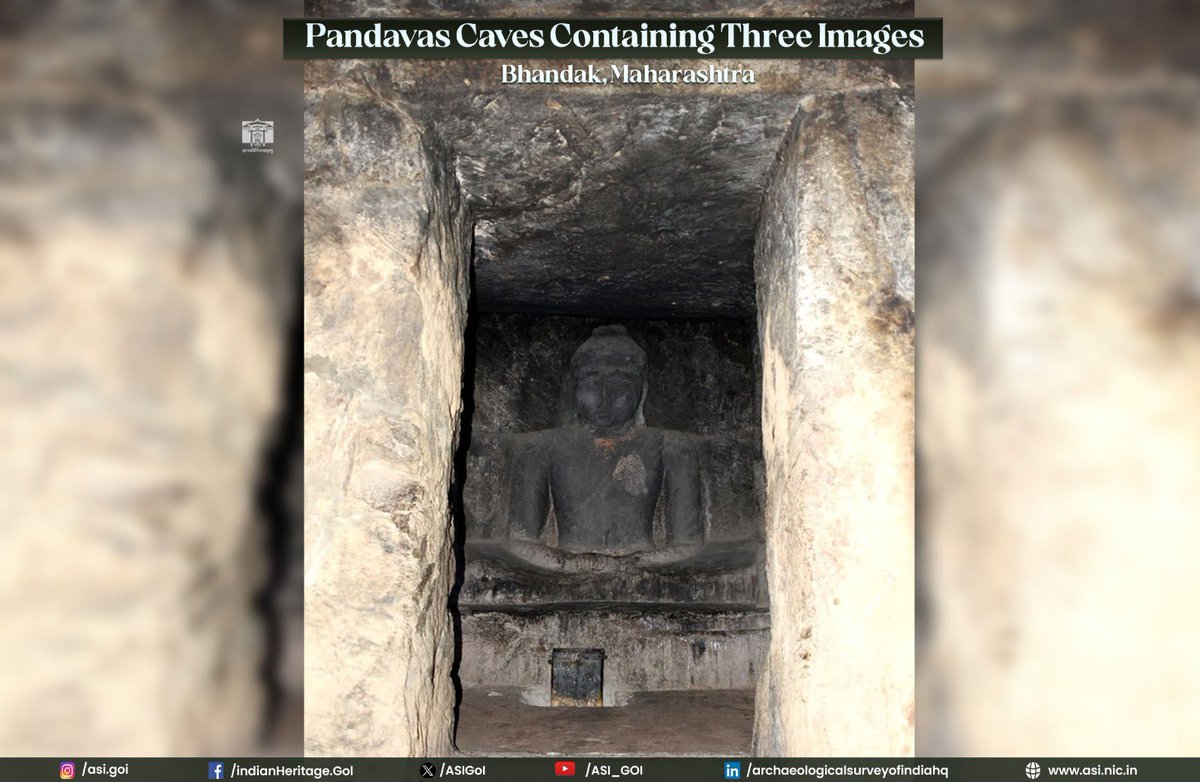
    Located in Maharashtra's Chandrapur district, Bhandak (ancient Bhadrawati) has long been a thriving centre of history, culture, and spirituality. Its archaeological remains, spanning from the Early Historic to the Late Medieval period, bear witness to the flourishing of Buddhism, Jainism, Vaishnavism, Shaivism, and Shaktism. (1/2)
    Download
    416867.3K
  15. Archaeological Survey of India✓@ASIGoI
    Posts @ASIGoI
    Among its most treasured monuments are this group of caves, locally known as Pandavas Caves, and hence notified thus. This was first documented by Alexander Cunningham in 1874. Carved in slopes of Wijasan Hill, Bhandak (Bhadrawati), Maharashtra, these rare Buddhist rock-cut caves feature a central shrine flanked by subsidiary shrines, each housing high-relief seated images of the Buddha. Dating to the Vakataka period (c. 500 CE), they stand as one of the finest examples of Buddhist rock-cut architecture in the Vidarbha region. (2/2)
    Download
    23131K
  16. Archaeological Survey of India✓@ASIGoI
    Scientific preservation of the Char Bangla were carried out during 2023–24 to restore their original appearance. Situated on the bank of the Bhagirathi River, in Murshidabad, West Bengal, the group consists of four temples dedicated to Shiva, built by Rani Bhavani of Natore. Arranged in a square formation, the temples rise on a high platform and feature high-pitched dochala roofs with humped forms and curved cornices. A structural ridge pole covers the junction of the chalas. Each temple has a triple-arched facade adorned with exquisite terracotta sculptures. On special occasions such as Shivratri and Sankranti, devotees visit the temples to offer prayers.
    Download
    11161.7K
  17. Show more posts