Buck Joffrey✓

@BuckJoffrey

Health, Wealth, and the Minnesota Vikings. @_wealthformula @LRMpodcast

383 Following1.5K Followers4K Posts
  1. Buck Joffrey✓@BuckJoffrey
    Robert Kiyosaki once wrote a book called Why "A" Students Work for "C" Students and Why "B" Students Work for the Government. I remember talking to him about this years ago and telling him that I thought the explanation was pretty simple. The C students had nothing to lose, so they took all the chances. The A students, on the other hand, had been programmed to respond to success like Pavlovian dogs. Study hard, get good grades, go to a prestigious school, get a great job. Every step along the way came with positive reinforcement. Why would they stray from that into the unknown? I can relate to this personally. I spent years in medical school and surgical training, getting rewarded for doing exactly what I was supposed to do. And for the most part, that system worked pretty well for me. But when I started getting involved in entrepreneurship, none of that really mattered. I had no business training whatsoever. I made plenty of mistakes, changed directions repeatedly, and somehow managed to build some successful businesses. In retrospect, I think my ignorance was actually an advantage. I didn't know enough to realize how many things could go wrong! I think this psychology also explains some of the irrational things we do as investors. How many times have you held onto a bad investment because you couldn't stomach taking the loss? I've certainly done it. And somehow, the more money we've already lost, the harder it becomes to walk away. This week on Wealth Formula, I talk to Megan McArdle @asymmetricinfo, Washington Post columnist and author of The Up Side of Down, about why smart people make bad decisions and why our fear of failure can sometimes be the biggest obstacle to success. We also get into some interesting discussions about government policies that backfire, wealthy people leaving expensive cities, and what happens to highly educated professionals when AI starts doing work that once required years of training. Megan is a great thinker, and I really enjoyed this conversation. I think you will too. Watch on YouTube: Listen on Apple Podcasts: Listen on Spotify:
    Download
    00051
  2. Buck Joffrey✓@BuckJoffrey
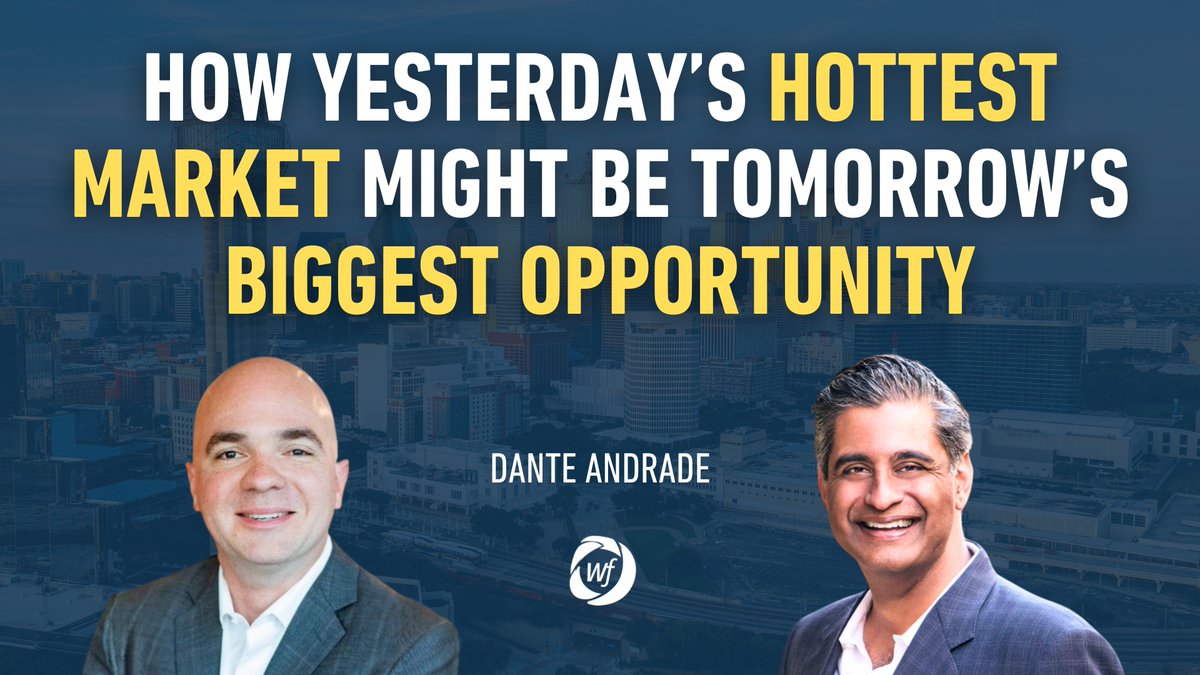
    Could Dallas be approaching its next great real estate buying opportunity? In this week's Wealth Formula Podcast, we sit down with longtime Dallas real estate partner Dante Andrade to discuss the multifamily market's boom, bust, and potential recovery—and why the best opportunities often emerge when investor sentiment is at its lowest. Watch the full episode to find out what’s happening on the ground in Dallas and what it could mean for investors: #DallasRealEstate #MultifamilyInvesting #RealEstateInvesting #CommercialRealEstate #RealEstateMarket
    Download
    10139
  3. Buck Joffrey✓@BuckJoffrey
    In this week's Wealth Formula Podcast, I sit down with my longtime Dallas real estate partner, Dante Andrade, for a conversation about where we are in that cycle today. Dante has spent more than 15 years operating multifamily properties in Dallas. He's been through the boom, the bust, and now he's seeing some interesting changes on the ground that haven't necessarily made their way into the headlines. We also talk candidly about some of the mistakes made during the boom years, what separated the investors who survived from those who didn't, and why the next few years could look very different from the last few. I don't know exactly when the next great buying opportunity will arrive. Nobody does. But I do know that the best investment opportunities rarely feel comfortable when they're staring you in the face. Watch the full episode: #DallasRealEstate #MultifamilyInvesting #RealEstateMarket #CommercialRealEstate #InvestmentOpportunities
    Download
    00063
  4. Buck Joffrey✓@BuckJoffrey
    Buck Joffrey
    RT @solana: Quantumglow. Solana has been early in quantum readiness and remains ahead in its preparation.
    Solana Developers @solana_devs
    What would Solana’s consensus look like in a post-quantum world? Meet Quantumglow: a proposed adaptation of Alpenglow that aims to protect consensus while preserving fast finality. @jacobvcreech and @qkniep explain how it works. Full video below👇
    015304
  5. Solana Developers✓@solana_devs
    What would Solana’s consensus look like in a post-quantum world? Meet Quantumglow: a proposed adaptation of Alpenglow that aims to protect consensus while preserving fast finality. @jacobvcreech and @qkniep explain how it works. Full video below👇
    Download
    688439496.3K
  6. Buck Joffrey✓@BuckJoffrey
    Buck Joffrey
    RT @solana: BREAKING: @JPMorganAM's tokenized money market funds are live on Solana. MONY and JLTXX are both available to qualified U.S. investors through Morgan Money, with subscriptions, redemptions and token balances handled on one platform.
    026004
  7. Buck Joffrey✓@BuckJoffrey
    Buck Joffrey
    RT @mert: Solana is now 95% faster trillions
    Download
    mert @mert
    biggest upgrade in solana history today
    043103
  8. mert✓@mert
    biggest upgrade in solana history today
    1931372.2K180K
  9. Buck Joffrey✓@BuckJoffrey
    There’s something fascinating about real estate cycles. In 2009, Las Vegas was practically synonymous with financial disaster. Home prices had collapsed, foreclosures were everywhere, and plenty of people thought the market might never recover. Phoenix wasn't much better. Florida had entire neighborhoods filled with vacant homes. Investors were running for the exits. Fast forward a decade, and some of those same markets had produced extraordinary returns for investors who bought when nobody else wanted to. The funny thing about markets is that the fundamentals often start improving long before the headlines do. And by the time everyone agrees that a market is hot again, much of the opportunity has already disappeared. I’ve been thinking about this a lot lately because of what we’ve experienced in Dallas. For years, Dallas was one of the hottest real estate markets in America. Population growth was exploding, businesses were relocating, rents were rising, and investors couldn't get enough of it. Then came the perfect storm. Too many apartments were built, interest rates skyrocketed, and property values fell dramatically. Some investors lost everything. Others, including us, have spent the last several years navigating a very difficult environment. But here's what's interesting. The things that made Dallas attractive in the first place haven't gone away. People are still moving there. Major corporations are still expanding. And after years of excessive apartment construction, the pipeline of new supply is finally shrinking. Sound familiar? It reminds me a lot of what happened in the aftermath of 2008. Not because the circumstances are identical—they certainly aren't—but because markets have a way of swinging from excessive optimism to excessive pessimism. And somewhere in that transition, opportunities emerge. In this week's Wealth Formula Podcast, I sit down with my longtime Dallas real estate partner, Dante Andrade, for a conversation about where we are in that cycle today. Dante has spent more than 15 years operating multifamily properties in Dallas. He's been through the boom, the bust, and now he's seeing some interesting changes on the ground that haven't necessarily made their way into the headlines. We also talk candidly about some of the mistakes made during the boom years, what separated the investors who survived from those who didn't, and why the next few years could look very different from the last few. I don't know exactly when the next great buying opportunity will arrive. Nobody does. But I do know that the best investment opportunities rarely feel comfortable when they're staring you in the face. That's what makes investing so difficult. And so interesting. Watch on YouTube: Listen on Apple Podcasts: Listen on Spotify:
    Download
    102113
  10. Buck Joffrey✓@BuckJoffrey
    Buck Joffrey
    RT @sciencegirl: Boston Dynamics' Handle robot is designed for warehouses, using a rear counterweight and suction grippers to efficiently and smoothly move heavy loads.
    036803
  11. Buck Joffrey✓@BuckJoffrey
    On this week’s Wealth Formula Podcast, I talk with Edward Pinto, former chief credit officer at Fannie Mae and co-director of the AEI Housing Center. Ed challenges several assumptions that investors—and policymakers—take for granted. Among them: whether government-funded “affordable housing” actually adds housing, and why your apartment building’s biggest competitor might be a single-family rental down the street. We also discuss something particularly relevant to investors today: properties financed with cheap debt in 2021 facing a very different refinancing environment. For owners, that can create a problem. For buyers, it can create an opening. But a discount alone doesn’t make something a good investment. And waiting until everyone feels comfortable again has its own price. How do you separate a compelling purchase from somebody else’s problem? That’s where this conversation gets interesting. Watch the full episode now: #housingmarket #housingshortage #realestateinvesting #housing #usmarket
    Download
    00065
  12. Buck Joffrey✓@BuckJoffrey
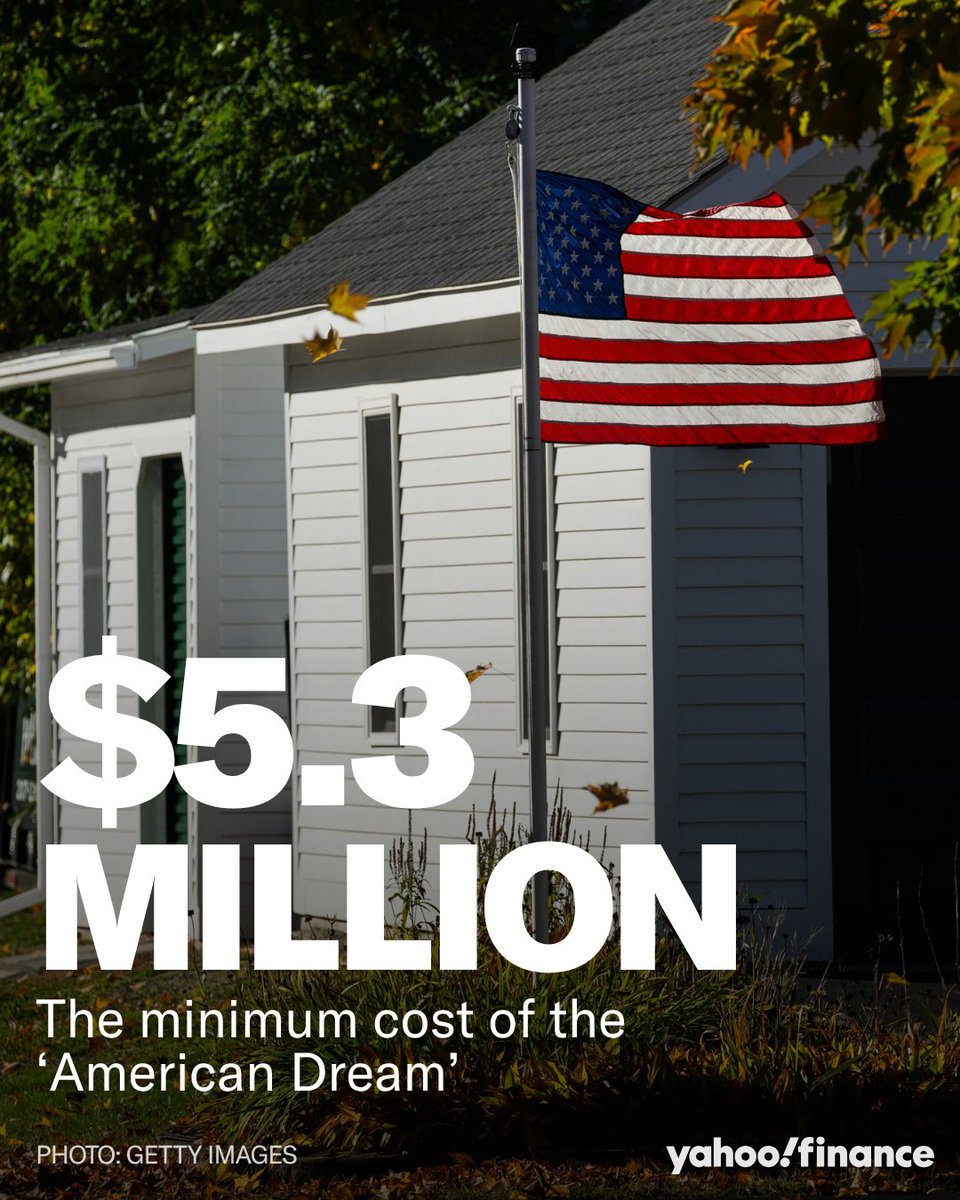
    The American Dream now costs $5.3 million. According to a new Investopedia analysis, that's what it takes to buy a home, raise two children, pay for college, maintain two cars, take vacations, and retire. What's interesting is who can actually afford it. Investopedia estimated lifetime household earnings, including Social Security, based on education levels: One working high school graduate: $2.6 million One working college graduate: $4.1 million Two working high school graduates: $5.3 million Two working college graduates: $8.2 million Two working master's degree holders: $9.4 million A single-income household with a college-educated earner is projected to fall $1.2 million short. Even two working high school graduates are expected to come up slightly short. The three biggest expenses are homeownership at $1.3 million, retirement at $1.2 million, and maintaining two vehicles at another $1.2 million. That's $3.7 million, or roughly 70% of the total cost. Now, there's an important limitation to this analysis. These are gross lifetime earnings, including Social Security, not disposable income. Taxes alone could substantially change the picture. But what I find most interesting is how dependent the traditional American Dream has become on having two incomes. For decades, the conventional advice was straightforward: Get a good education, find a stable job, buy a house, save for retirement, and you'll be fine. That formula is becoming increasingly difficult to make work. And while higher education clearly improves the odds, the numbers also raise a question about how much financial security Americans can realistically achieve through employment income alone. That's why I continue to believe that building income-producing assets is an important part of long-term financial planning. The real goal shouldn't just be earning enough money over 40 years to cover 40 years of expenses. It should be building wealth that eventually reduces your dependence on earned income. Get financially educated: #AmericanDream #CostOfLiving #WealthBuilding #PersonalFinance #FinancialFreedom
    Download
    00059
  13. Buck Joffrey✓@BuckJoffrey
    America has a housing shortage. You’ve heard it in practically every real estate investment pitch. We haven’t built enough homes. People need somewhere to live. Therefore, owning apartments should be a pretty good business. So why have apartment owners in some of the fastest-growing markets offered free rent just to get people through the door the last few years? Because a national housing shortage doesn’t pay your mortgage. Your property needs tenants willing to pay your rent, in your market, right now. That distinction matters—especially when you’re trying to figure out whether today’s discounted real estate is an opportunity or a trap. On this week’s Wealth Formula Podcast, I talk with Edward Pinto, former chief credit officer at Fannie Mae and co-director of the AEI Housing Center. Ed challenges several assumptions that investors—and policymakers—take for granted. Among them: whether government-funded “affordable housing” actually adds housing, and why your apartment building’s biggest competitor might be a single-family rental down the street. We also discuss something particularly relevant to investors today: properties financed with cheap debt in 2021 facing a very different refinancing environment. For owners, that can create a problem. For buyers, it can create an opening. But a discount alone doesn’t make something a good investment. And waiting until everyone feels comfortable again has its own price. How do you separate a compelling purchase from somebody else’s problem? That’s where this conversation gets interesting. Watch on YouTube: Listen on Apple Podcasts: Listen on Spotify:
    Download
    00072
  14. Buck Joffrey✓@BuckJoffrey
    Buck Joffrey
    RT @BMTNSports: "He had extreme confidence and belief. (He) texted me and it's always good to be somewhere where you're wanted." New Vikings receiver Odell Beckham Jr. talks about the impact Kevin O'Connell had on his decision to play for Minnesota.
    0706
  15. Show more posts