Jason Furman✓

@jasonfurman

Professor @Harvard, Director @HarvardBizGov, Senior Fellow @PIIE, teaches Ec10, words @nytopinion, proprietor https://t.co/4eOTjrd0x4, was Chair of Pres Obama's CEA.

2K Following341K Followers22.2K Posts
  1. Jason Furman✓@jasonfurman
    I'm thrilled to be launching Econvitals today. It's been the main way in which I have been tracking and understanding the economy over the last several months. And I decided I might as well share it with all of you--for free. Has a combo of website, email lists & social media.
    Download
    482321.6K269K
  2. Jason Furman✓@jasonfurman
    Jason Furman
    RT @ArnabDatta321: Reminder that 19 leaders in economic policy and national security, including Janet Yellen, @mikepompeo, @jasonfurman, and several others endorsed BAAJA.
    Alec Stapp @AlecStapp
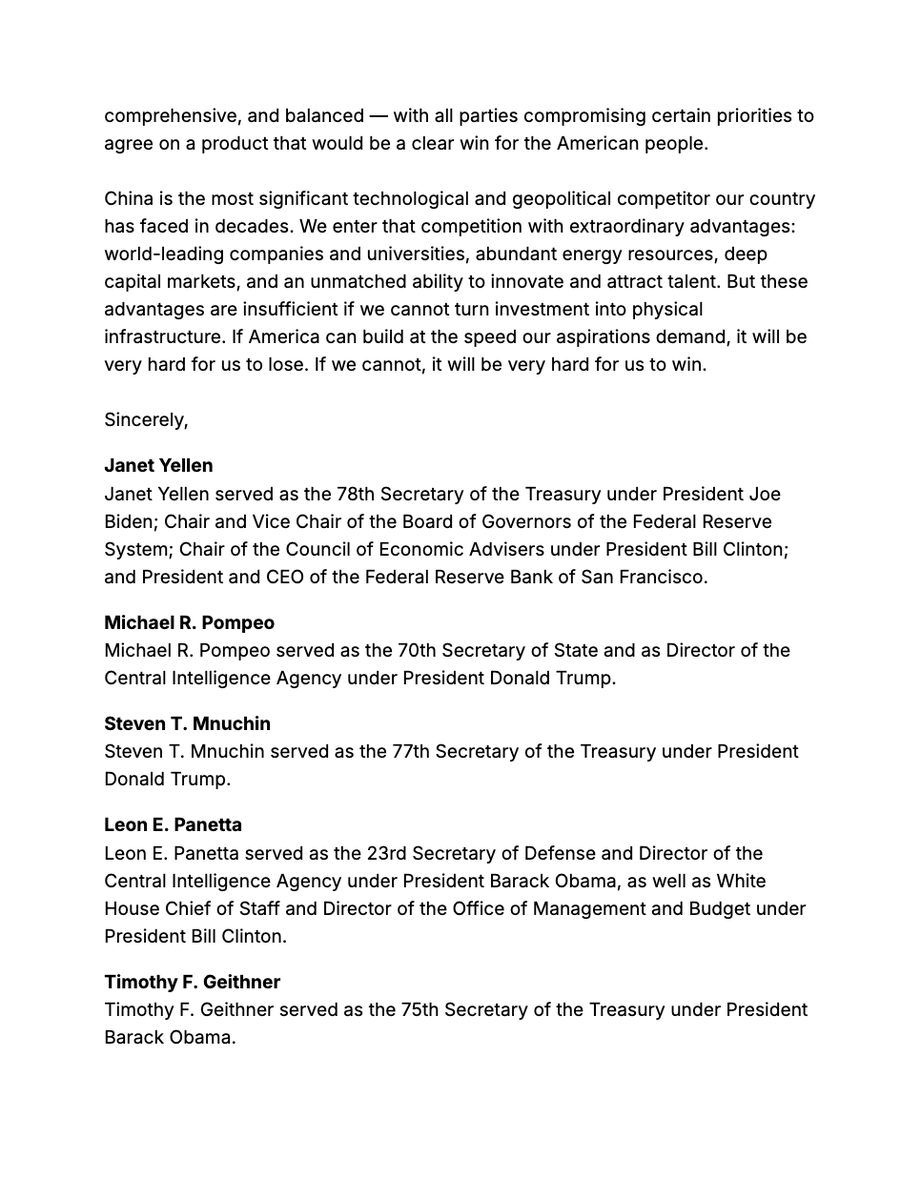
    NEWS: 19 FORMER ECONOMIC AND NATIONAL SECURITY LEADERS ENDORSE THE BIPARTISAN PERMITTING REFORM BILL Today, a group of former Cabinet members and White House principals across seven Democratic and Republican administrations sent a letter calling on Congress to pass BAAJA. Here are the signatories: Janet YELLEN, Michael R. POMPEO, Steven T. MNUCHIN, Leon E. PANETTA, Timothy F. GEITHNER, Henry M. PAULSON, Jr., Robert E. RUBIN, Stephen MIRAN, Jared BERNSTEIN, Tyler GOODSPEED, Jason FURMAN, Glenn HUBBARD, Laura D’Andrea TYSON, Michael J. BOSKIN, Jeffrey ZIENTS, Jake SULLIVAN, Brian DEESE, Larry KUDLOW, Allan B. HUBBARD Key highlights from the letter: 1. “We are not building infrastructure fast enough to remain globally competitive… The median time for a new power plant to move from an interconnection request to commercial operation has more than doubled, from less than two years for projects built between 2000 and 2007 to more than four years for projects built between 2018 and 2024. 2. China has built more high-voltage transmission in the last fifteen years than the U.S. has built in all of its history... In 2024, China accounted for 31.5% of global knowledge- and technology-intensive manufacturing value added, compared with 20.7% for the United States. 3. Federally funded or permitted projects require NEPA review, but private projects often do not, creating a threat of failure precisely where the government is trying to be proactive, strategic, and engaged. 4. A project that spends years awaiting approval must continue carrying development and financing costs while remaining exposed to rising input costs. The IEA reports that prices for utility-scale transformers increased 26% in 2024, while lead times for some transformers have stretched as long as six years. 5. Mining projects also face tremendous uncertainty: a 2026 study by researchers at the Colorado School of Mines found that permitting for modern mining projects takes an average of 5.5 years, rising to 8.9 years for contested projects. The U.S. currently has the second-longest mine development timeline in the world. 6. The Bipartisan American Affordability and Jobs Act is the most significant bipartisan legislative effort that Congress has undertaken in decades to tackle these challenges. 7. BAAJA addresses key constraints stifling American industry by requiring interregional transmission planning, strengthening the federal backstop for nationally significant transmission lines, and creating a faster, more predictable process for connecting new generation to the grid. 8. BAAJA also makes permits more durable by imposing tighter timelines for litigation and limiting frivolous lawsuits that can halt projects indefinitely, while preserving community input and judicial review of substantive agency decisions.” The letter was organized by @arnabdatta321 on behalf of @IFP and covered exclusively by the WSJ this morning.
    0801K
  3. Peterson Institute✓@PIIE
    PIIE mourns the loss of Gary Clyde Hufbauer, a pillar of the Peterson Institute for International Economics & a beloved colleague & friend to many. As one of the Institute's cornerstone senior fellows, he helped C. Fred Bergsten make PIIE what it became from its earliest days & embodied so much of the spirit of the Institute—intellectual engagement, passion to understand & improve the policy world, independence, collegiality, & a deep commitment to bringing economic research to bear on the world's most pressing policy challenges. His passing is an enormous loss to our community & to the field of international economics. Gary leaves behind a monumental legacy, not only in his scholarship & influence on economic policy, but also in our institution which he helped build & the many lives he touched. May his memory be a blessing for his family. He certainly was a blessing to all of us at PIIE.
    4184237.1K
  4. Alec Stapp✓@AlecStapp
    NEWS: 19 FORMER ECONOMIC AND NATIONAL SECURITY LEADERS ENDORSE THE BIPARTISAN PERMITTING REFORM BILL Today, a group of former Cabinet members and White House principals across seven Democratic and Republican administrations sent a letter calling on Congress to pass BAAJA. Here are the signatories: Janet YELLEN, Michael R. POMPEO, Steven T. MNUCHIN, Leon E. PANETTA, Timothy F. GEITHNER, Henry M. PAULSON, Jr., Robert E. RUBIN, Stephen MIRAN, Jared BERNSTEIN, Tyler GOODSPEED, Jason FURMAN, Glenn HUBBARD, Laura D’Andrea TYSON, Michael J. BOSKIN, Jeffrey ZIENTS, Jake SULLIVAN, Brian DEESE, Larry KUDLOW, Allan B. HUBBARD Key highlights from the letter: 1. “We are not building infrastructure fast enough to remain globally competitive… The median time for a new power plant to move from an interconnection request to commercial operation has more than doubled, from less than two years for projects built between 2000 and 2007 to more than four years for projects built between 2018 and 2024. 2. China has built more high-voltage transmission in the last fifteen years than the U.S. has built in all of its history... In 2024, China accounted for 31.5% of global knowledge- and technology-intensive manufacturing value added, compared with 20.7% for the United States. 3. Federally funded or permitted projects require NEPA review, but private projects often do not, creating a threat of failure precisely where the government is trying to be proactive, strategic, and engaged. 4. A project that spends years awaiting approval must continue carrying development and financing costs while remaining exposed to rising input costs. The IEA reports that prices for utility-scale transformers increased 26% in 2024, while lead times for some transformers have stretched as long as six years. 5. Mining projects also face tremendous uncertainty: a 2026 study by researchers at the Colorado School of Mines found that permitting for modern mining projects takes an average of 5.5 years, rising to 8.9 years for contested projects. The U.S. currently has the second-longest mine development timeline in the world. 6. The Bipartisan American Affordability and Jobs Act is the most significant bipartisan legislative effort that Congress has undertaken in decades to tackle these challenges. 7. BAAJA addresses key constraints stifling American industry by requiring interregional transmission planning, strengthening the federal backstop for nationally significant transmission lines, and creating a faster, more predictable process for connecting new generation to the grid. 8. BAAJA also makes permits more durable by imposing tighter timelines for litigation and limiting frivolous lawsuits that can halt projects indefinitely, while preserving community input and judicial review of substantive agency decisions.” The letter was organized by @arnabdatta321 on behalf of @IFP and covered exclusively by the WSJ this morning.
    Download
    19112427158K
  5. econvitals✓@econvitals
    🆕 New on Econvitals: the U.S. trade balance with and without data centers. Through September the deficit is 2.7% of GDP. Without the computers, chips and network gear going into data centers, it is 0.7%, the smallest for those months since 2000.
    Download
    0089.1K
  6. Jason Furman✓@jasonfurman
    In 2000 Bush won the electoral college but lost the popular vote. 2004 could have been the reverse: Kerry came closer to winning the electoral college than the popular vote. If that had happened the perception around electoral college advantages would be very different today.
    Download
    131218730.9K
  7. econvitals✓@econvitals
    Initial jobless claims: 189,000 in the week ending Oct. 31.
    Download
    00611.7K
  8. Jason Furman✓@jasonfurman
    Posts @jasonfurman
    From behind a veil of ignorance, I much prefer a nationwide popular vote. Is more fair, less manipulable, forces campaigning across the country--especially where people are. But I would also only want it to happen through a Constitutional Amendment that commanded broad support.
    50104.5K
  9. econvitals✓@econvitals
    Stocks rose the day after Democrats’ sweeping midterm win, but the mix is more telling: health companies (especially ACA-linked ones like Centene) and solar were up; data-center and Trump- and Musk-related names were down. A Democratic win was priced in.
    Download
    0148.7K
  10. Jason Furman✓@jasonfurman
    Posts @jasonfurman
    The National Popular Vote Interstate Compact seems undemocratic and unsustainable to me. Almost no one I know has even heard of it, no state or national debate. And is not credible: If a Republican wins the popular vote but loses the electoral college would Massachusetts actually appoint Republican electors? It would be even more chaotic and uncertain than our current system. One of the biggest advantages of a democracy is not that it picks the right people (although it can throw people out who are quite bad), but that we have peaceful transitions because most people usually agree on who won. Some of the country changing the rules without checking with their own citizens let alone those in other states would risk that.
    50124.8K
  11. econvitals✓@econvitals
    Posts @econvitals
    Q3 U.S. productivity: +3.6% annualized, the fastest since mid-2025 after three softer quarters. Single quarters swing widely: over two years, from a slight decline to more than 4%. The four-quarter rate, 2.1%, is the lowest in that window.
    Download
    1013.2K
  12. Jason Furman✓@jasonfurman
    At this point anything by a human should contain the disclaimer, “Written by a fallible human, may contain mistakes”
    Ethan Mollick @emollick
    I think there is way too much concern expressed about verification of AI output in everyday work due to a risk of factual errors. It used to be true, but data on more recent models suggest they beat human experts, including PhD specialists, in finding facts and checking claims.
    162021922.3K
  13. Ethan Mollick✓@emollick
    I think there is way too much concern expressed about verification of AI output in everyday work due to a risk of factual errors. It used to be true, but data on more recent models suggest they beat human experts, including PhD specialists, in finding facts and checking claims.
    Download
    3012061.5K112K
  14. Jason Furman✓@jasonfurman
    Jason Furman
    RT @JaneAFlegal: Is there a better gift on a Saturday morning than the BAAJA managers amendment? I THINK NOT. Quick thoughts below after fast read, but I am confident that this bill is now *materially BETTER* if you care about clean energy, affordability, and climate. Time to pass it, folks. 🧵
    04801.2K
  15. Jason Furman✓@jasonfurman
    Jason Furman
    RT @AlecStapp: Important analysis here on how the permitting reform bill has been improved to address concerns. Excited to see a vote on BAAJA soon!
    Will Poff-Webster @willpoffwebster
    Major changes to BAAJA in this amendment responding to Democrats' concerns; two highlight titles: 1. Permit Certainty title has lots of technical fixes: -Requires proof of government bad faith before an energy project can get damages (easy to prove with Trump, hard to use against a future lawful admin) -10-year baseline of past projects rather than 5 years (so Trump anti-wind actions aren't built into the baseline) -Ability for the government to rebut with lawful reasons (helps a future admin could deny polluting projects lawfully) 2. Historic Preservation title has substantive changes: -Feds can no longer take over a noncompliant Tribal Historic Preservation Office (THPO) -Even if a THPO isn't compliant with deadlines, agencies still required to consult with Tribes -Expanded requirements to consult and incorporate feedback from THPOs, Tribes, local govs, State Historic Preservation Offices -Protections for Tribal historic database information to remain confidential to Tribes -No more requirement for THPOs and SHPOs to spend 50% of their time on a project if they miss its deadline -Extra more time to object to a historic preservation report -Federal Highway projects always subject to historic preservation, even if only a formula grant
    01301.2K
  16. Will Poff-Webster✓@willpoffwebster
    Major changes to BAAJA in this amendment responding to Democrats' concerns; two highlight titles: 1. Permit Certainty title has lots of technical fixes: -Requires proof of government bad faith before an energy project can get damages (easy to prove with Trump, hard to use against a future lawful admin) -10-year baseline of past projects rather than 5 years (so Trump anti-wind actions aren't built into the baseline) -Ability for the government to rebut with lawful reasons (helps a future admin could deny polluting projects lawfully) 2. Historic Preservation title has substantive changes: -Feds can no longer take over a noncompliant Tribal Historic Preservation Office (THPO) -Even if a THPO isn't compliant with deadlines, agencies still required to consult with Tribes -Expanded requirements to consult and incorporate feedback from THPOs, Tribes, local govs, State Historic Preservation Offices -Protections for Tribal historic database information to remain confidential to Tribes -No more requirement for THPOs and SHPOs to spend 50% of their time on a project if they miss its deadline -Extra more time to object to a historic preservation report -Federal Highway projects always subject to historic preservation, even if only a formula grant
    112815229.8K
  17. Jason Furman✓@jasonfurman
    Jason Furman
    RT @econvitals: The Econvitals composites, week ending November 6: activity is 0.6 standard deviations below its history since 2013 and 0.2 above forecasts. Inflation is 2.1 above its history and 0.3 above forecasts.
    0401.2K
  18. Jason Furman✓@jasonfurman
    Intriguing.
    Jon Steinsson @JonSteinsson
    The dominant model people use to think about AI's effect on the labor market is automation. But perhaps commoditization is a better model. Automation implies job apocalypse. Commoditization implies plentiful jobs with low wages. 1/
    8915740.8K
  19. Jon Steinsson✓@JonSteinsson
    The dominant model people use to think about AI's effect on the labor market is automation. But perhaps commoditization is a better model. Automation implies job apocalypse. Commoditization implies plentiful jobs with low wages. 1/
    31147877117K
  20. Jason Furman✓@jasonfurman
    Public Service Announcement: If you care about unemployment then the government's official U-3 measure is pretty much all you need. U-6 is a broader measure that includes people not looking for jobs who would take one + involuntary part-time. It is also basically 1.8*(U-3).
    Download
    678210.9K
  21. Jason Furman✓@jasonfurman
    Posts @jasonfurman
    If you want to look at more labor market variables then labor force participation, employment rates and wage rates are all the places I would go next--not U-4, U-5 or U-6. Regardless, as you might imagine, they are all on Econvitals.
    1163.9K
  22. Jason Furman✓@jasonfurman
    Posts @jasonfurman
    P.S. If you really want to use broader measures of underemployment I would rather you look at U-5.5 (which sadly the government doesn't produce) which counts involuntary unemployed as being half unemployed not fully unemployed. I don't like U-6 which treat them the same.
    0083.1K
  23. Jason Furman✓@jasonfurman
    A cool piece of research and a timely piece of history given that Congress currently has the choice to make it easier to build--I very much hope they take it.
    Zachary Liscow @ZLiscow
    NEW PAPER w/ @_josephshapiro & @heidilwilliams_: In 1947, Congress gave feds power to override states blocking gas (not oil) pipelines. Gas pipeline growth sped up 6x. Oil didn’t. The Senate permitting bill does similar for power lines. History strongly suggests it'll work. 🧵
    19497.7K
  24. Zachary Liscow@ZLiscow
    NEW PAPER w/ @_josephshapiro & @heidilwilliams_: In 1947, Congress gave feds power to override states blocking gas (not oil) pipelines. Gas pipeline growth sped up 6x. Oil didn’t. The Senate permitting bill does similar for power lines. History strongly suggests it'll work. 🧵
    Download
    47722238K
  25. Jason Furman✓@jasonfurman
    Jason Furman
    RT @LorenAdler: With Centene and Molina among the big gainers, I’d read this more as a shift in expectations about Medicaid and ACA cuts than about the prospects for hospital payment or Medicare Advantage reforms.
    Jason Furman @jasonfurman
    Stock markets up after election results. But what is most interesting is the composition. Health and solar up, data centers and Musk-related down. Crypto up may be the one I wouldn't have expected. And note, markets presumably had already been pricing in large Democratic gains.
    0301.2K
  26. Jason Furman✓@jasonfurman
    Stock markets up after election results. But what is most interesting is the composition. Health and solar up, data centers and Musk-related down. Crypto up may be the one I wouldn't have expected. And note, markets presumably had already been pricing in large Democratic gains.
    Download
    34160776243K
  27. Jason Furman✓@jasonfurman
    If you pay attention to numbers obsessively day-to-day you can miss the bigger picture. And the bigger picture is that this might be the best--or among the best--job markets we've ever had--as measured by delivering jobs for people that want them.
    Download
    66153945129K
  28. Jason Furman✓@jasonfurman
    Posts @jasonfurman
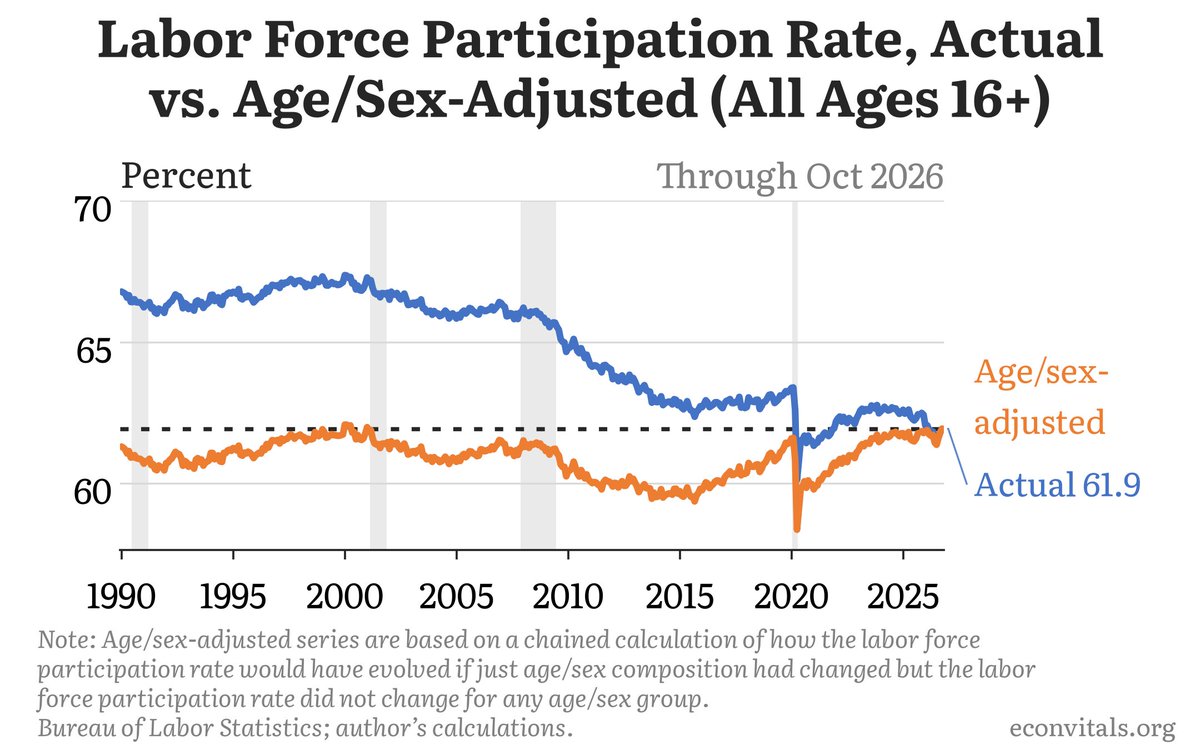
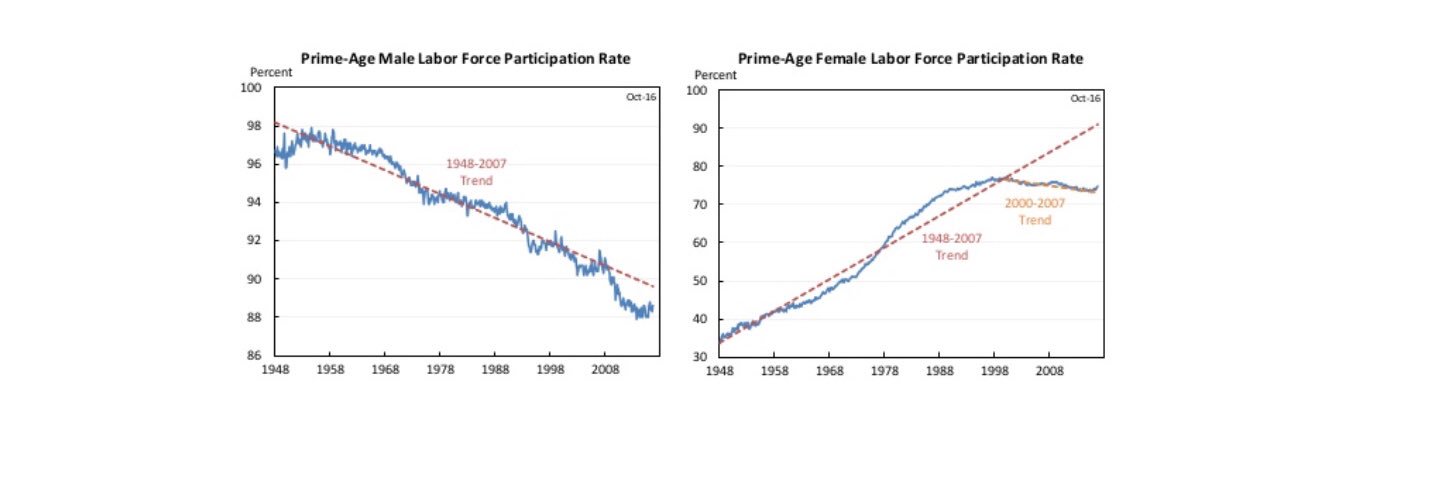
    BTW, labor force participation is down but it's all aging. If you adjust for age it's been basically flat for decades. Lots more on one of my favorite pages.
    Download
    44396.5K
  29. Jason Furman✓@jasonfurman
    Again, I'm not saying every respect labor market the best ever. But getting jobs for people that want them should be the #1 priority for policymakers and it is doing it really, really, really well. Of course #2 is making sure real wages are growing and in that case not so much.
    93485.8K