ModelScope✓

@ModelScope2022

Driving innovations with open communities. 💬 Join our Discord: https://t.co/4M9AHVh5qa

187 Following16.7K Followers1.2K Posts
  1. ModelScope✓@ModelScope2022
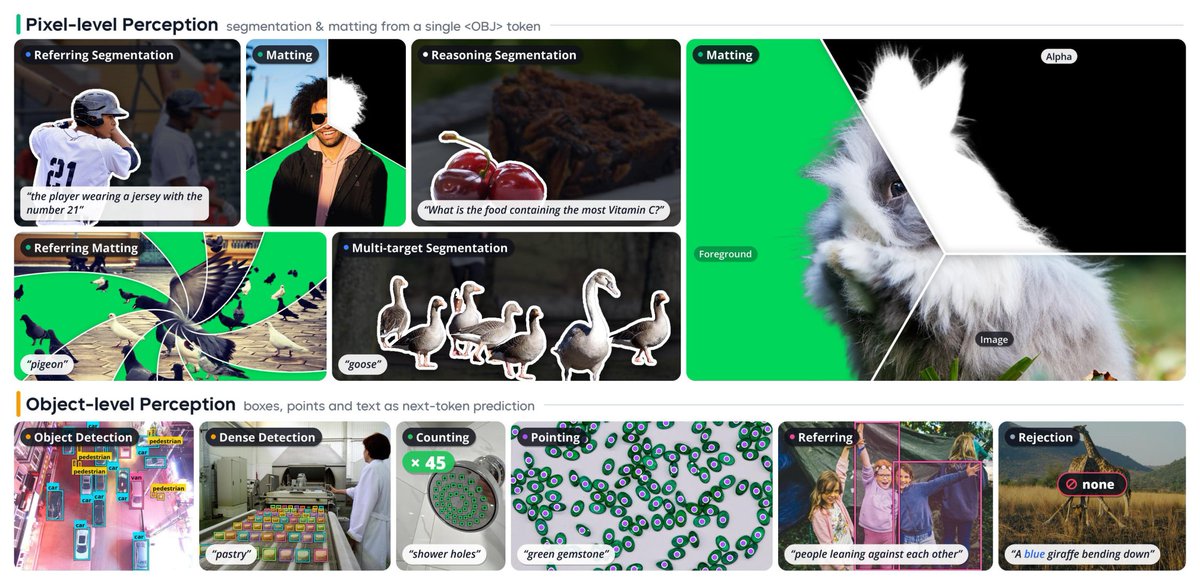
    One model for points, boxes, masks, and alpha mattes. WeVisOne-VL-4B is open-weight, a visual perception model from Tencent's WeChat Vision, built on Qwen3-VL. 🤖 🎨 Try the demo: 🏆 Leading across 30+ perception benchmarks: The team reports strong results from object-level tasks to pixel-level understanding, including 71.3 on Dense200, 89.6 on PixMo-Count, and 71.2 on ReasonSeg. 🧩 One model, seven perception tasks: Detect, localize, count, point to, read, segment, and matte objects through structured next-token prediction. ✂️ From boxes to clean alpha mattes: A lightweight 9.6M pixel decoder produces masks and full-resolution continuous alpha mattes without relying on SAM. 🚫 Rejects targets that are not there: Reaches a 96.4% rejection rate on WeRef-Bench, helping avoid confident boxes for absent queried objects. 📦 Structured outputs for downstream workflows: Returns normalized boxes, points, masks, alpha mattes, and None when no matching target is found. 📜 Apache-2.0 License.
    Download
    32462.2K
  2. ModelScope✓@ModelScope2022
    🩺 Meet Ling-3.0-flash-Sante-fp8! Healthcare-focused AI just got a little lighter. Same powerful reasoning, less memory to worry about. 🤖 • FP8 efficiency: 124B total parameters, just 5.1B active per token, with a smaller memory footprint for deployment. • Quality holds up: Matches the BF16 model's 73.9 average across five healthcare benchmarks. • 256K context: Built for long medical documents, evidence synthesis, and deep research. • Beyond medical Q&A: Native reasoning, tool calling, and support for multi-agent research workflows. • Ready to deploy: Supports SGLang and vLLM on compatible hardware. 🔬 For research use only, not clinical diagnosis or treatment.
    Download
    00342.3K
  3. ModelScope✓@ModelScope2022
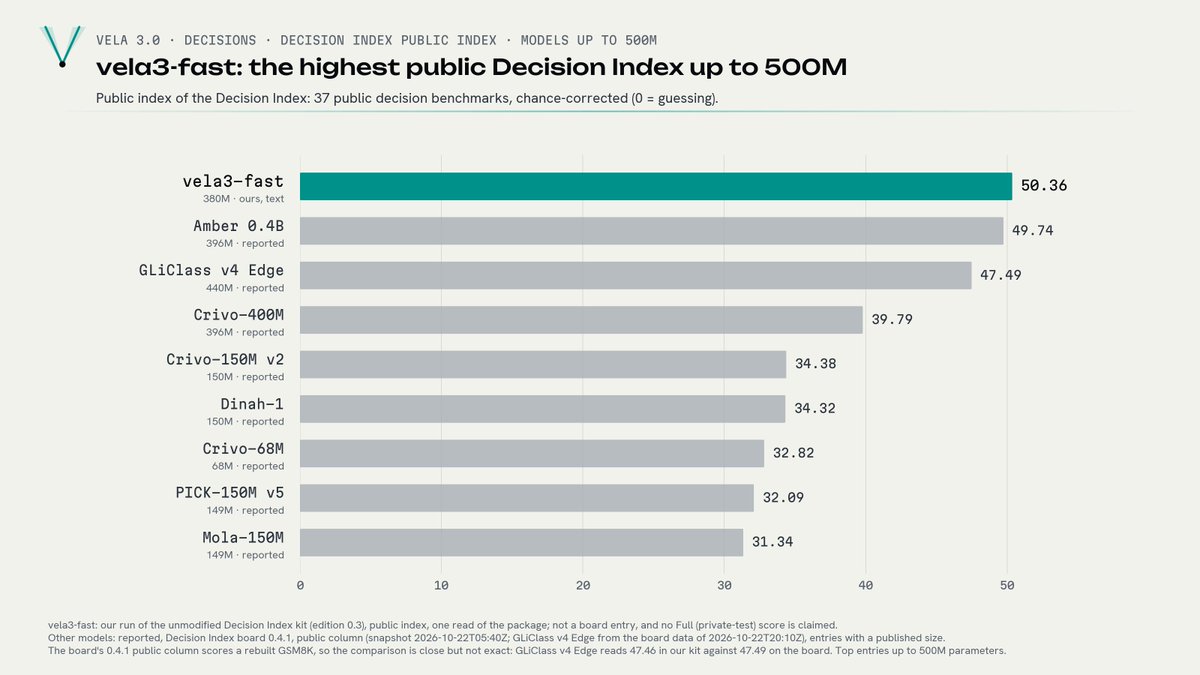
    🚀 Vela 3.0 is here! 6 open routing models from 0.3B to 27B, built to make decisions and extract exactly what you need in a single call. 🤖 🏆 Small but mighty: vela3-fast (0.4B) scores 50.36 on the public Decision Index, ranking #1 among models under 500M parameters. 🧩 6 models for different needs: • fast (0.4B) for text routing • fast-vision (0.3B) for visual decisions and grounding • lite (0.8B), mini (4B), flash (9B), and turbo (27B) for more demanding tasks 🔎 Decide + extract in one call: From yes/no and routing decisions to pinpointing entities, relationships, evidence, PII, and unsupported claims. ⚡ Smart adapters: Add routing and extraction capabilities while keeping the underlying d3 model's regular decision outputs unchanged. 📈 A solid upgrade: Beats Vela 2.0 on 105 of 144 router-signal test files at matched model sizes. 🔓 Open licenses: Apache 2.0 for five models, MIT for fast-vision.
    Download
    18643.8K
  4. ModelScope✓@ModelScope2022
    🎨 Got some creative ideas to test? We've got two more models for you to play with! MOSS-Image-SFT and Fibo-2.0 are now available for both inference and training on ModelScope Civision! 🚀 Go generate something cool, try a little fine-tuning, or just see what happens.
    Download
    01151.3K
  5. ModelScope✓@ModelScope2022
    Nanbeige4.3-33B GGUF: a 33B open-weight dense model for coding, tool use, and complex reasoning, with quantized weights for local inference. 🤖 🧠 Long-context reasoning: The base model supports up to 512K tokens; usable local context depends on runtime settings and memory. 🛠️ Coding and automation: Built for repository refactoring, terminal tasks, and multi-step agent workflows. 🎛️ Flexible deployment: Q4_K_M, Q5_K_M, Q6_K, and Q8_0 options, with llama.cpp and Ollama setup examples. 📜 Apache 2.0.
    32331.8K
  6. ModelScope✓@ModelScope2022
    MiniCPM-OCR is now on ModelScope: a 1.3B document parser plus a 2B quality judge for checking OCR results before they reach your workflow. 🤖 🏆 SOTA parsing at 1.3B: MiniCPM-OCR 1.0 scores 93.68 on Real5-OmniDocBench and 54.7 on OCRBench v2. ⚡ Parse faster with DSpark: The DSpark variant improves end-to-end efficiency by 55%, reaching 1.2 pages per second in the team’s reported comparison. 🛡️ Know what needs review: MiniCPM-OCR Jev scores text, formulas, and tables for reliability, reaching 93.6 AUROC on JevOCRBench. 🛠️ Three jobs, multiple formats: Choose 1.0 for parsing, 1.0-DSpark for faster parsing, or Jev for quality scoring. BF16, GGUF, AWQ, and GPTQ versions are available. 📜 Apache-2.0 License.
    Download
    00341.7K
  7. ModelScope✓@ModelScope2022
    NVIDIA Nemotron 3.5 Transcribe has landed: a 30B-A4B open-weight model that turns up to an hour of recorded speech into searchable transcripts, speaker labels, translations, and answers. 🤖 🏆 Leading transcription and speaker attribution: Ranks first among open-weight models on the Hugging Face English Open ASR Leaderboard, and first on both David AI’s multilingual diarization benchmark and VoiceArena’s 14-system comparison. 🌍 One checkpoint, multiple speech tasks: Transcribes 40 languages, translates 31 languages to and from English, and supports speaker attribution in 13 languages for recordings with up to eight speakers. 🎯 Guide the output with natural language: Prompt for domain terms, transcript conventions, translations, speaker labels, or questions about the recording. Language support differs by task; audio Q&A is trained in English. 🔧 Adapt it to your domain: Granary v2 and NeMo Speech fine-tuning tools extend prompt-level control to training. In the medical case study, fine-tuning reduced held-out WER by 45.8% over the best prompt-only baseline. ⚡ Built for self-hosted batch transcription: Runs on a single GPU, from DGX Spark to Blackwell data-center systems. 📜 License: openmdw-1.1
    Download
    40311.8K
  8. ModelScope✓@ModelScope2022
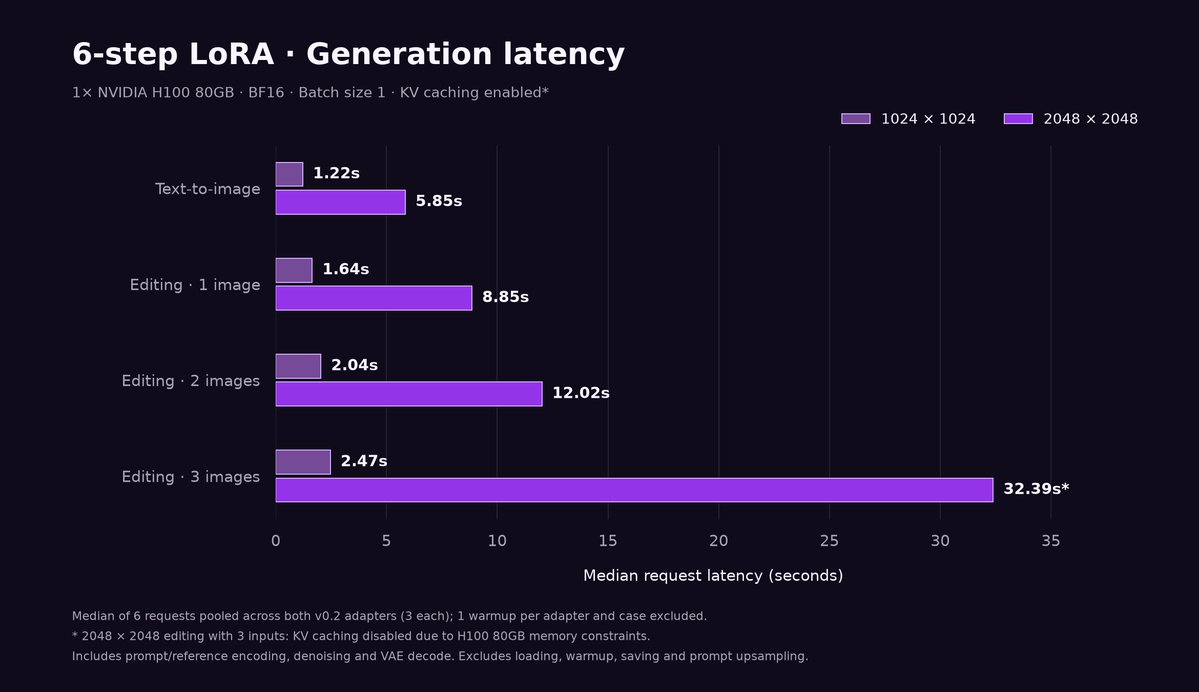
    P-Q-Image-2.1 brings Qwen-Image-2.1 generation and editing down to six steps, with no CFG and up to 6.3× faster generation. 🤖 ⚡ Six steps, same workflow: The v0.2 LoRA adapters run on top of Qwen-Image-2.1 while keeping its base pipeline, text encoder, and VAE unchanged. 🖼️ Generate or edit: Use one adapter for text-to-image generation and single- or multi-image editing, with up to three reference images. ✨ Skip the separate prompt-upscaling pass: The 6-steps-upsampled variant incorporates prompt-upscaling benefits into the adapter, reducing end-to-end generation time from a short prompt. 🎛️ Choose the trade-off: Use 6-steps for behavior closer to the base model, or 6-steps-upsampled when prioritizing visual quality from concise prompts. 🛠️ Built for the Qwen stack: Start at 1024 × 1024 and use the matching six-step schedule. Higher resolutions may work, but were outside the adapter’s training coverage. 📜 Qwen Research License Agreement. This is a LoRA adapter, not a standalone model; it requires the Qwen-Image-2.1 base weights.
    Download
    25694.1K
  9. ModelScope✓@ModelScope2022
    Introducing d3-turbo, a 27B multimodal decision model with up to 128K context per question. 🤖 ⚡ 15.5× faster for 255 questions: In the team’s local test on one image, d3-turbo takes 2.12 seconds versus 32.94 seconds for d3-flash. 🎯 Make structured decisions: Returns choices, yes/no answers, and scores without generating text. Images can also be included in individual questions or options. 📍 Locate and track: Finds objects in images or video frames and tracks targets across a video. 📊 Stronger text decisions: Scores 71.7 on the public Jev Decision Index suite, compared with 65.5 for d3 in the team’s evaluation. 🧩 Up to 128K context per question: Supports 32K by default and 128K with long-context mode enabled. 📜 Apache 2.0.
    Download
    212330715.8K
  10. ModelScope✓@ModelScope2022
    You can now fit MOSS-Image into 4 GB of VRAM with MOSS-Image-EntroPack! Pre-quantized and ready to roll: 🤖 ⚡ Adapt to your VRAM budget: Choose from 4.5-bit, 6-bit, or INT8-6bit (INT8 weights stored in entropy-coded 6-bit). Additional 3.5-bit option avaialbe for MOSS-Image-SFT. 🚀 Faster INT8 inference: Leveraging INT8 matrix operations for inference acceleration. 🧩 Mix components: Choose DiT and text encoder packages independently to suit your setup. 🛠️ Ready for your workflow: Use the packages for inference and LoRA training with DiffSynth-Studio, or run in ComfyUI with DiffSynth-ComfyUI.
    Download
    22563.6K
  11. ModelScope✓@ModelScope2022
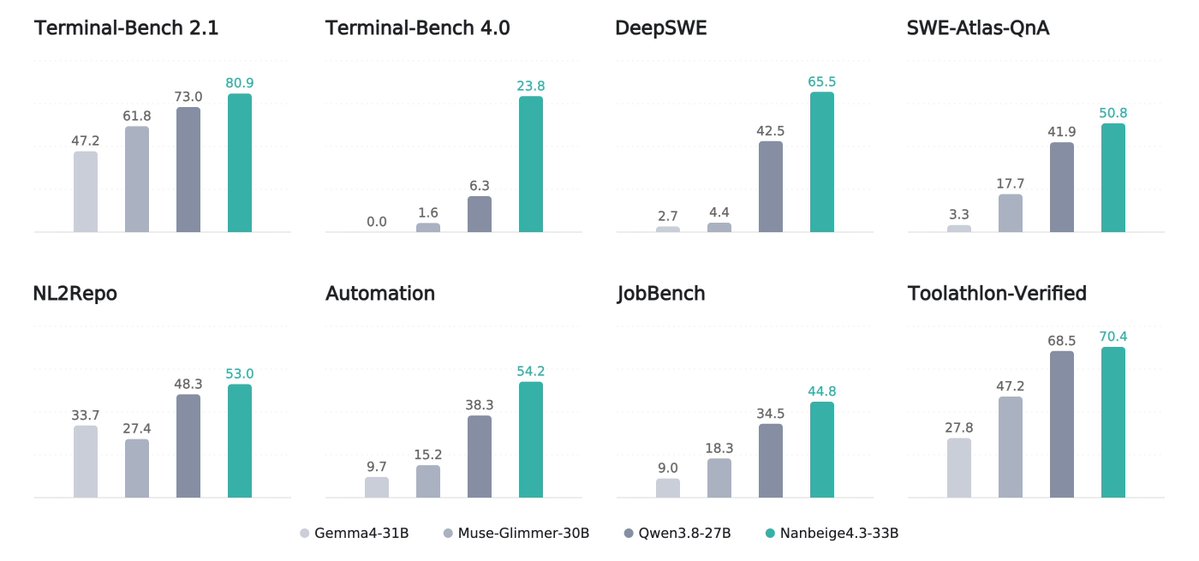
    Nanbeige4.3-33B is here with 512K context and strong agentic performance in a 33B dense model. 🤖 🏆 SOTA agentic performance at the 30B scale: Nanbeige4.3-33B leads most benchmarks in the team’s comparison with open models including Qwen3.8-27B, Muse-Glimmer-30B, and Gemma4-31B. 💻 Agentic coding: Scores 80.9 on Terminal-Bench 2.1 and 65.5 on DeepSWE, compared with 73.0 and 42.5 for Qwen3.8-27B. 🧰 Professional workflows: Reaches 54.2 on Automation Bench and 44.8 on JobBench, covering tasks across tools, occupations, and industries. 🧠 Flexible reasoning and tool use: Switch between thinking and non-thinking modes, and retain previous reasoning for multi-turn agent workflows. 🔬 A teacher for smaller agents: Nanbeige4.3-33B is the flagship teacher model for the team’s planned distillation into smaller models. 📜 Apache 2.0. Supports Transformers, SGLang, and vLLM.
    Download
    53644.2K
  12. ModelScope✓@ModelScope2022
    OvisOCR3 has landed: a unified 0.8B model that turns document images into structured, usable data across five OCR and document-understanding tasks. 🤖 🏆 SOTA at its size across five document tasks: In the team’s reported comparisons, OvisOCR3 leads comparable-size models across document parsing, general OCR, key information extraction, figure captioning, and cross-page table reconstruction. 📄 Parse documents into usable formats: Generate structured JSON, layout JSON, or Markdown with LaTeX formulas and HTML tables from a page image. 🔎 Go beyond reading text: Extract specified fields into a JSON schema, answer image-grounded questions, recover chart data, or return text locations as bounding boxes. 🖼️ Understand visuals inside documents: Add localized captions for figures and create Mermaid representations for flowcharts as part of the parsed page content. 📊 Reconnect tables across pages: Use consecutive page images and parsed Markdown to rebuild a complete HTML table, with source-page associations retained. 🛠️ One compact checkpoint, prompt-selected tasks: Switch capabilities through task prompts instead of deploying a separate model for each OCR or document-processing workflow. 📜 Apache-2.0 License.
    Download
    2161295.2K
  13. ModelScope✓@ModelScope2022
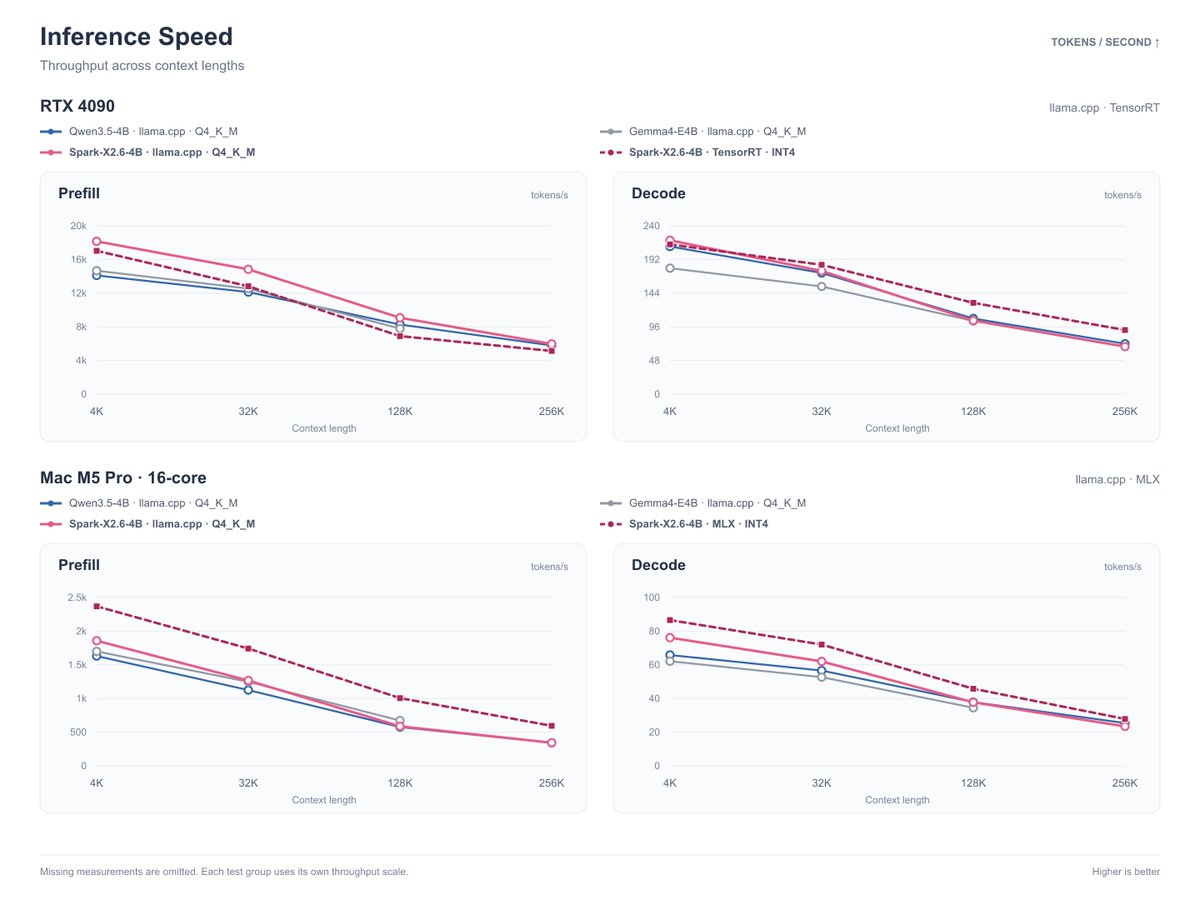
    Spark-X2.6-4B has landed: an open-source model with 1M context, three thinking budgets, and deployment-ready formats for local agents.@SparkLLM 🤖 🏆 Stronger at 4B: In the team’s reported comparison table, it reaches a 63.3 average, ahead of Spark-X2.5-4B at 52.1 and Qwen3.5-9B at 49.1 across the evaluated suite. 🧠 Set the thinking budget: Switch between none, low, and high thinking modes to balance reasoning quality, latency, and cost for each task. ⚡ Built for efficient local inference: A hybrid attention design combines 1M context with resource-conscious deployment, while FP8, INT8, INT4, and GGUF releases offer practical precision and footprint tradeoffs. 🛠️ One model, multiple workflows: Use the Instruct checkpoint for everyday agent work or the Base model for continued training and customization. Supports Transformers, SGLang, vLLM, llama.cpp, Ollama, MLX, and LM Studio. 📜 Apache 2.0.
    Download
    152426211.3K
  14. ModelScope✓@ModelScope2022
    In the Bible, humans tried to build the Tower of Babel but failed when language split them. Today, AI Agents are trying to "build" tasks across 23 languages—and facing the exact same barrier. 🧱🗣 Qwen Team introduces BabelArena, a new open-source multilingual Agent benchmark on 🧵👇 🔗 Dataset: 📄 Paper: 🏆 No single model dominates all benchmarks. ⚠ Low-resource languages show distinct failure modes: high rates of tool-use and control-flow errors (not just answer quality). 📈 Agents consume up to ~2x more tokens in low-resource languages without more interaction rounds. 🗣 Language consistency drops in structured-output tasks, with switches overwhelmingly pointing to English.
    Download
    153262.8K
  15. ModelScope✓@ModelScope2022
    LFM3-1.7B-GGUF is now on ModelScope: 256K context, around 1 GB at 4-bit, and edge-first speed in a 1.73B model built for local agents. 🤖 ⚡ Fast at the edge: In Liquid AI’s reported 32K-context evaluation, LFM3-1.7B delivered at least 2.5× faster prefilling and 1.8× faster decoding than every compared model across three tested devices. 📚 256K context in 1.73B parameters: Built for long prompts, local agents, tool calling, structured output, and domain-specific applications. 💾 Fits lightweight hardware: At 4-bit precision, the original model uses about 1 GB of memory, making local use practical on phones and laptops. 📦 Quantization trade-offs are documented: This GGUF release ranges from 1.85 GB for Q8_0 to 0.92 GB for IQ3_S. In the publisher’s evaluation, Q8_0 retains 96.3% top-1 agreement with a 0.004 mean KLD versus the reference model. 🛠️ Local-first deployment: Run it with an LFM3-compatible llama.cpp build, Ollama, or LM Studio. The original checkpoint also supports single-GPU fine-tuning for domain-specific workflows. 📜 LFM Open License v1.0. This is a GGUF conversion by Atomic Chat; the original model is from Liquid AI.
    Download
    34412.5K
  16. ModelScope✓@ModelScope2022
    Introducing MemT-1.0, an open-weight model family with persistent, evolving memory built into model computation, enabling conversations and agents to reuse historical information without reloading the original context. 🤖 🏆 Leads parametric memory methods: Across 11 memory benchmarks, MemT-1.0-Flash and MemT-1.0-Nano rank first and second among the evaluated methods. 🧠 Memory lives in the model: Dynamic local memory and trainable hyper memory retain past information without carrying the original conversation into every new inference. ⚡ Built for long-running agents: At 128K history, Nano delivers an official 1.86× end-to-end inference speedup and about 66× lower persistent storage than a full-context KV cache. 🛠️ Two backbones, one memory design: Nano is built on Qwen3.6-35B-A3B with about 3B active parameters; Flash builds on DeepSeek-V4-Flash with about 17B active parameters. Both support locally persistent memory sessions. 📜 Flash weights are released under MIT. Inherited backbone licenses still apply.
    Download
    132018210.7K
  17. ModelScope✓@ModelScope2022
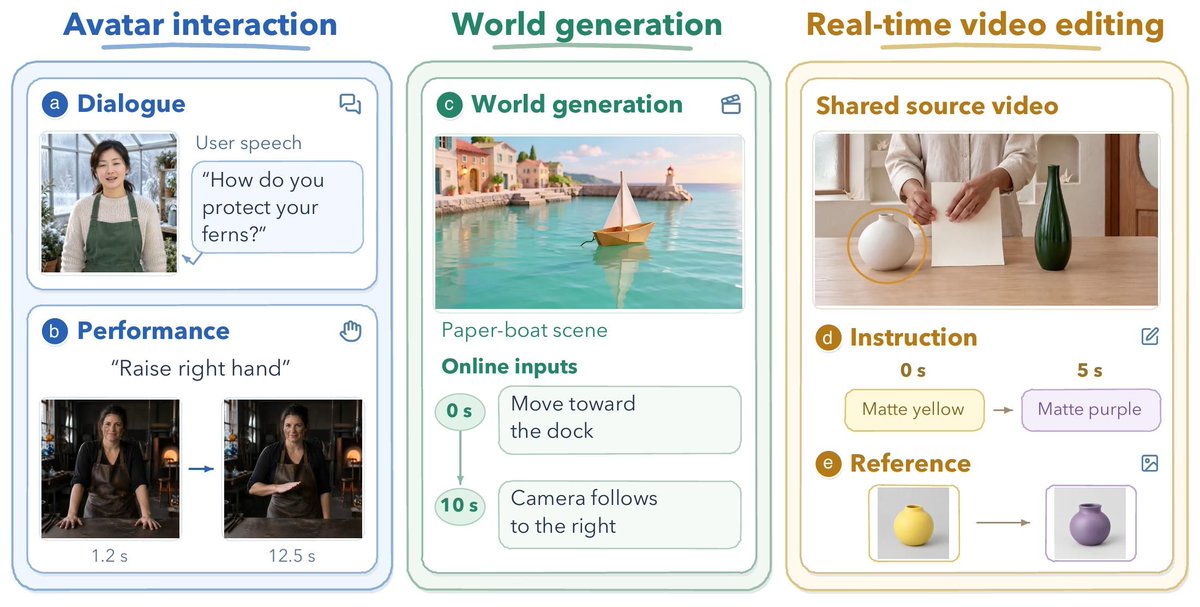
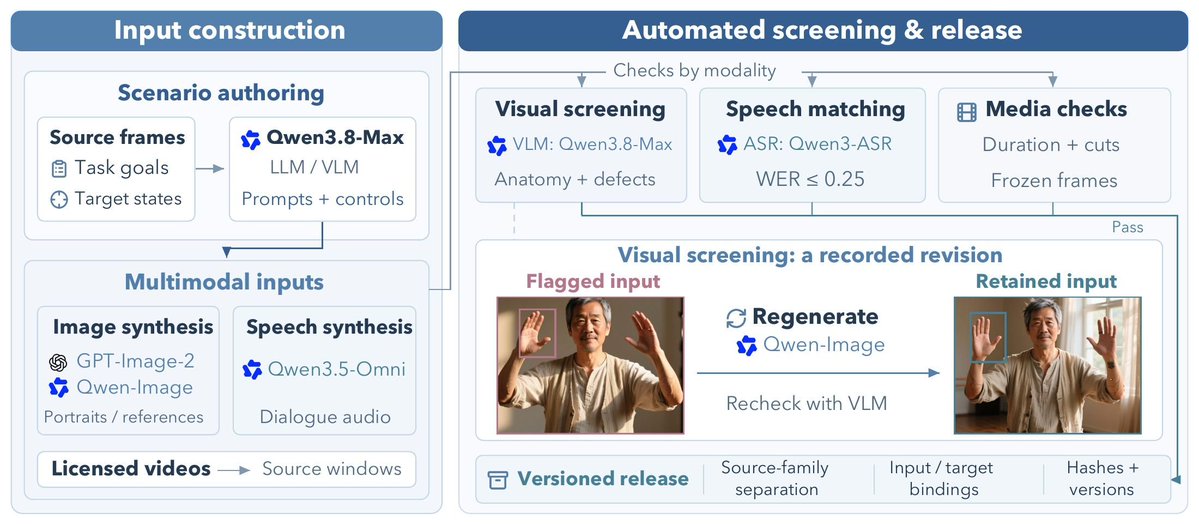
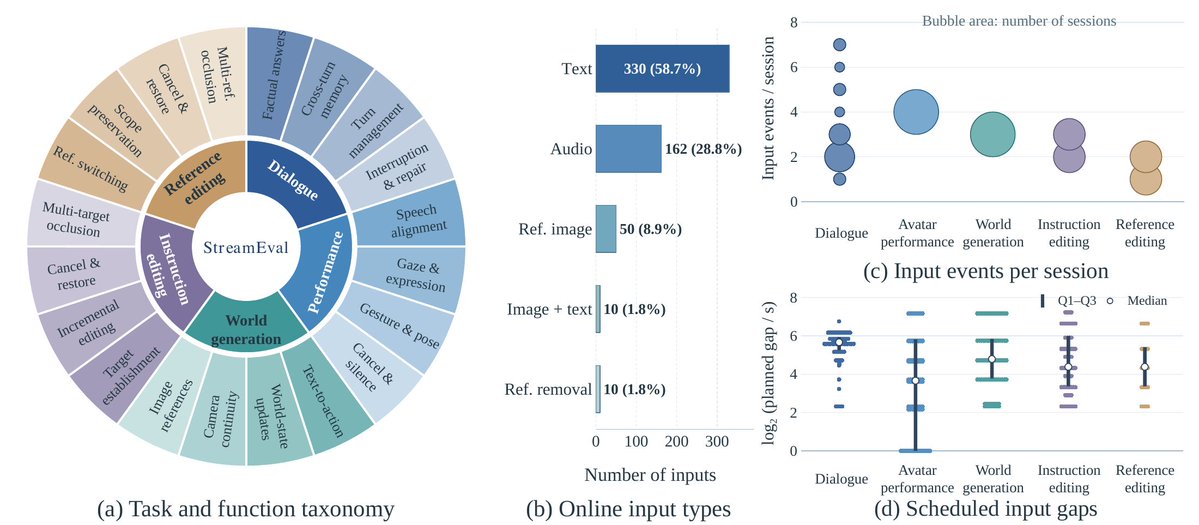
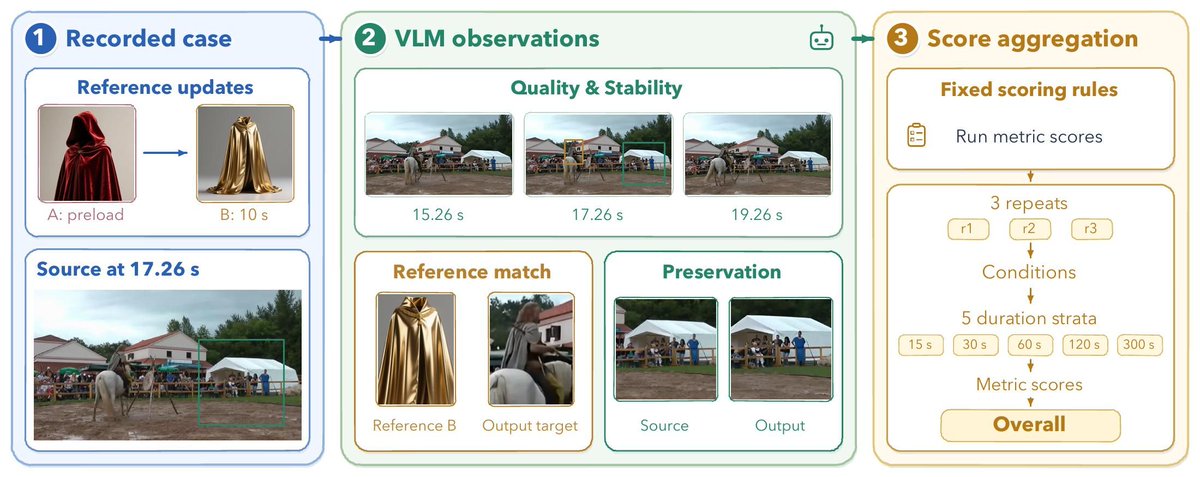
    StreamEval is now on ModelScope for evaluating interactive streaming video generation across 15 to 300-second sessions. 🤖 📄 🎬 300 long-form interactive sessions: Each 15 to 300-second case delivers multimodal requests over time and checks both state changes and content preservation. 🧩 Five tasks, ten metrics: Covers avatar dialogue, avatar performance, world generation, instruction editing, and reference editing across execution, consistency, visual fidelity, and audiovisual coordination. 📊 Visual quality is not enough: Across 37 models, strong visuals and identity retention did not reliably mean better instruction following or sustained state consistency. 🔓 Fully open and updated monthly: Benchmark data, evaluation code, protocols, and scoring rules are public, with monthly leaderboard updates for new and updated models. 📜 Benchmark data: CC BY 4.0. Evaluation code: Apache 2.0. Third-party editing footage requires attribution.
    Download
    21141.7K
  18. ModelScope✓@ModelScope2022
    Spark-X2.6-1.7B has landed: an open-source 1.7B model built for capable local agents.@SparkLLM 🤖 🧠 Think only as much as the task needs: Switch between no-thinking, low-thinking, and high-thinking modes to balance answer quality, latency, and inference cost. 🛠️ Built for everyday agent work: Designed for tool use, multi-step planning, coding, and reasoning workflows in a compact local model. ⚡ Made for constrained hardware: The 1.7B scale makes it a practical starting point for private, responsive, resource-conscious local deployment. 🔧 Ready for the local AI stack: Use it with supported runtimes and quantized formats to fit different hardware and serving setups. 📦 Open to adapt: Start with the chat model for agent workflows, or use the Base checkpoint for continued training and domain customization. 📜 Apache-2.0 License.
    Download
    39975.3K
  19. ModelScope✓@ModelScope2022
    NVIDIA Nemotron Labs Dory1.0-4B is an open-weight reasoning model with up to 256K context, letting developers adjust inference compute within a single checkpoint. 🤖 🔁 One checkpoint, adjustable compute: Run the shared recurrent block for different numbers of loops to balance latency and accuracy per task, with no retraining or model swap. 🏆 Stronger coding-agent results at 4B: At two loops, it reaches 59.5 on SWE-bench Verified in the vendor evaluation, ahead of Qwen3.5-4B at 54.7. 🧠 Extra thinking without longer answers: More loops add latent compute per token instead of simply generating more tokens. ⚡ Loop without compounding cache cost: Optional last-loop KV caching keeps one cache per recurrent attention layer, avoiding extra KV-cache overhead as loop count grows. 📚 Built for long-context workloads: 4B parameters, up to 256K context, and releases in BF16, MXFP8, NVFP4, and Q5_K_M formats. 📜 OpenMDW License Agreement v1.1.
    Download
    52252K
  20. ModelScope✓@ModelScope2022
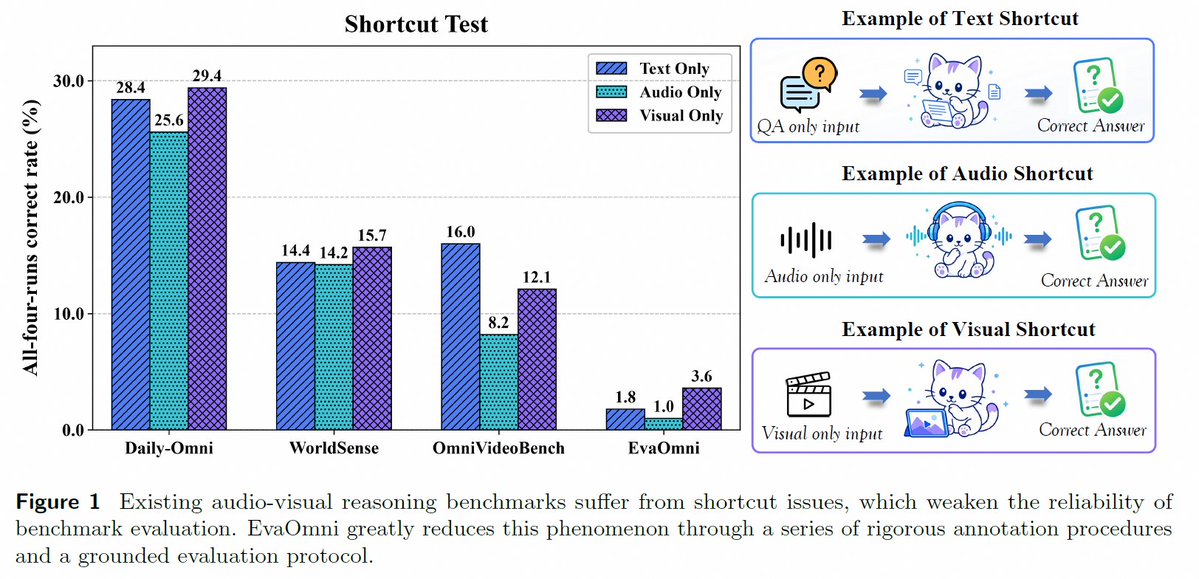
    Does your Omni LLM actually listen and watch, or is it just guessing? 🤔 We are excited to open-source EvaOmni with SJTU, Fudan & Tencent Youtu! 📄 Paper: 💾 Dataset: 💻 GitHub: Moving beyond simple Q&A, EvaOmni tests 1,027 questions across 392 videos to see if models can pinpoint the exact audio and visual evidence for their answers. 📊 The verdict on 24 Omni LLMs: Top model Gemini3.7-Flash hits 79.4% answer accuracy but only 35.1% on precise dual-modal grounding. Models can guess the answer, but they struggle to show their work. 😲 Dive into the benchmark👇
    Download
    33222.1K
  21. ModelScope✓@ModelScope2022
    Post-training gains for agents and scientific reasoning: Ling-3.1-flash-1019 is a 560B open-weight MoE with 25B active parameters per token and support for up to 1M context. 🤖 🛠️ Stronger real-world agents: AA-Briefcase improves from approximately 1400 to 1524 Elo, while AutomationBench-AA rises from 62% to 68% versus Ling-3.1-flash. 🧠 Broader reasoning gains: Scores 44 on the Artificial Analysis Intelligence Index v4.3.2, up from 41 for its predecessor. 🔬 Better scientific performance: CritPt increases from 18% to 26%, and SciCode from 54% to 57%. 📐 Hybrid long-context design: Combines 63 KDA layers with 9 Gated MLA layers. Reaching the full 1M context requires the appropriate long-context serving configuration. 📜 MIT License.
    Download
    31221.9K
  22. ModelScope✓@ModelScope2022
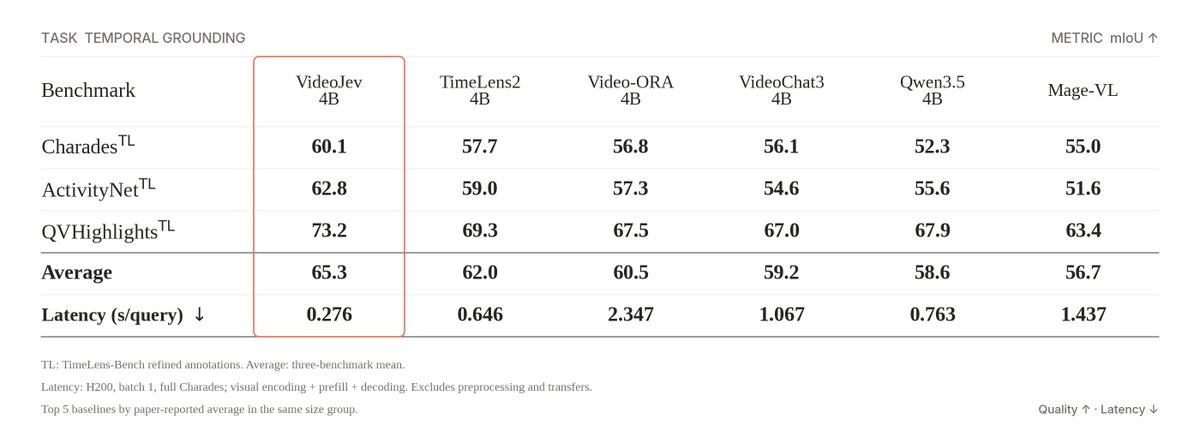
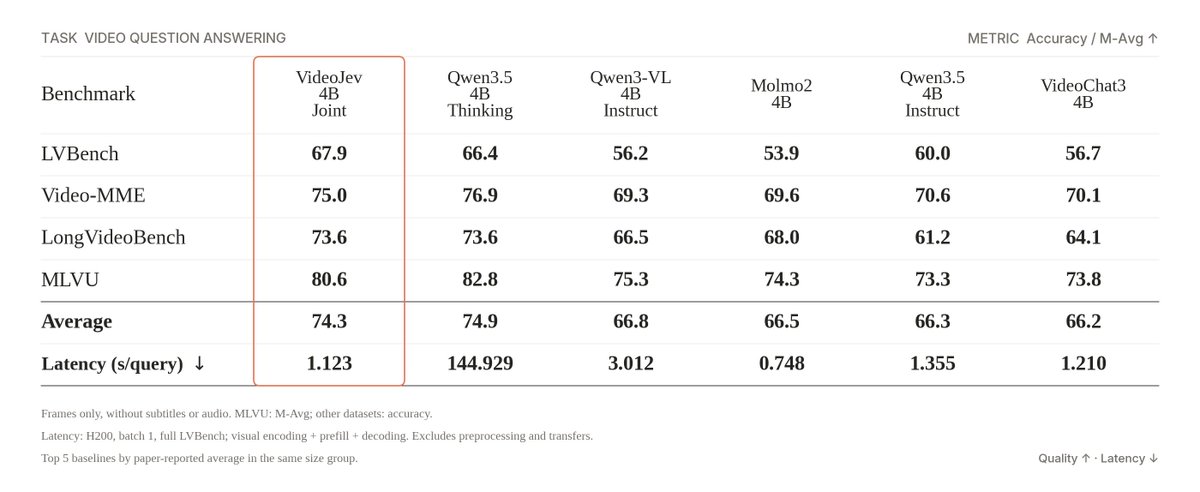
    VideoJev-4B brings direct decision-making to video understanding. Qwen3.5-4B based video decision model for temporal grounding and multiple-choice video QA. 🤖 📄 🏆 Video QA leader at its scale: Ranks #1 among sub-6B models on LVBench, Video-MME, LongVideoBench, and MLVU. ⚡ Direct decisions, not long generations: Scores candidate answers and time spans directly, making video QA and event localization easier to integrate into workflows. 🎬 Find the moment, pick the answer: Locates when an event occurs in video and answers multiple-choice questions with calibrated probabilities. 🧠 Long-video ready: Supports up to 256K context in the official video QA evaluation setup. 🛠️ Ready for local use: Released with BF16 weights, training and evaluation code, plus a quick-start demo. 📜 Apache 2.0.
    Download
    115885.8K
  23. ModelScope✓@ModelScope2022
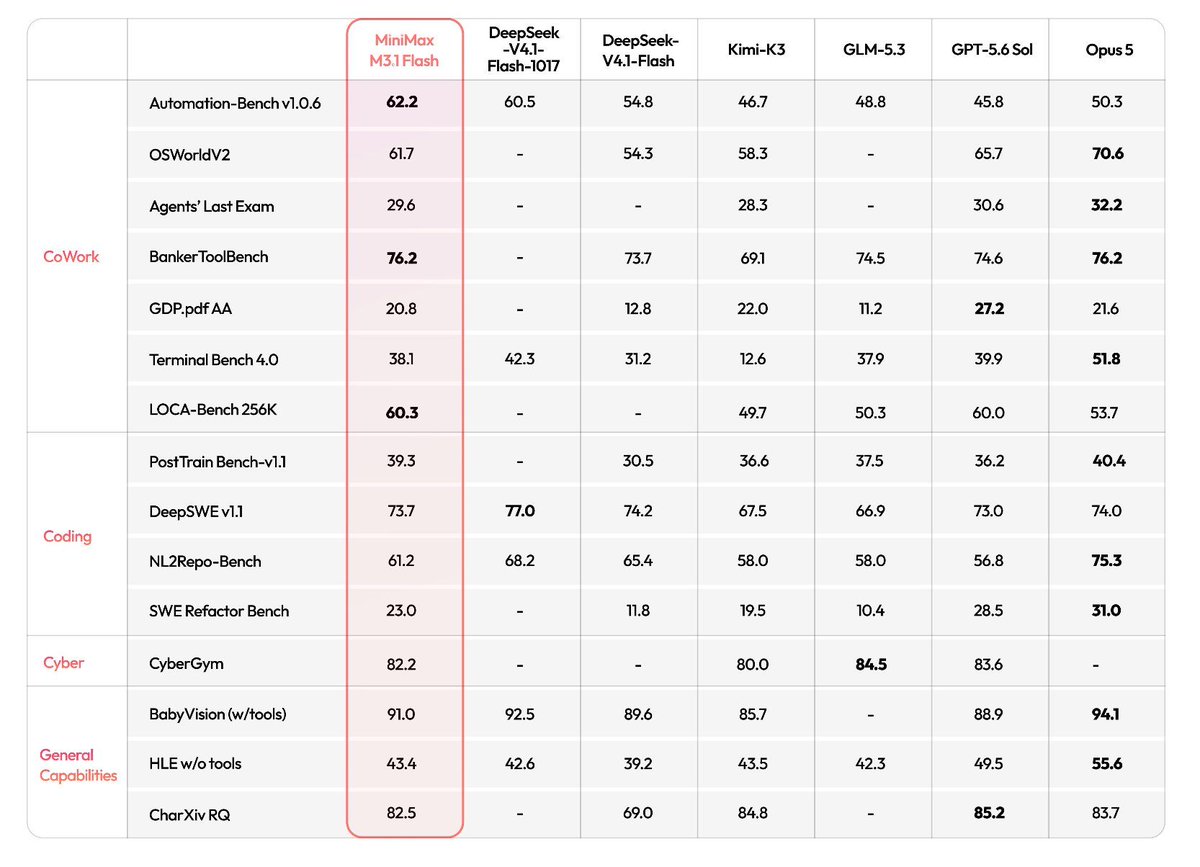
    1M tokens, native image and video input, and 23B active parameters per token. MiniMax-M3.1-Flash has landed as a 428B MoE for coding, computer use, and tool-driven agents. 🤖 📄 🏆 Top result for agent execution: Scores 62.8 on Automation-Bench v1.0.6, the highest result in the model card’s reported comparison. 💻 Strong at coding and computer use: Reaches 73.7% on DeepSWE v1.1, 61.7 on OSWorld 2.0, and 29.6 on Agents’ Last Exam. 🔐 Built for cybersecurity work: Scores 82.2 on CyberGym for vulnerability discovery and validation. ⚡ Efficiency is built in: Sparse attention throughout, QAT NVFP4, and the included DSpark draft head support efficient inference and speculative decoding. 🛠️ Ready to self-host: Model weights are available with SGLang and vLLM deployment guidance.
    Download
    22522.5K
  24. ModelScope✓@ModelScope2022
    Ming-3.0 is here: five open-weight audio models for controllable speech, long-recording analysis, and context-aware transcription. 🤖 🏆 Voice cloning at the top of the open-weight ranking: Ming-3.0-tts-0.5B achieves open-weight SOTA on Artificial Analysis Controlled Voice with a 1069 Elo rating, using eight English reference voices. 🎙️ Design a voice, then direct the performance: The TTS models support voice design from descriptions or references, multilingual synthesis, and controllable delivery for podcasts, characters, and product experiences. 🧠 Turn long recordings into answers: Ming-3.0-audio-flash transcribes, summarizes, analyzes, and follows up on long audio while grounding answers in the original recording. It reaches 99.40 on BigBenchAudio S2T in the authors’ comparison. 📝 Transcribe with business context: Ming-3.0-asr-tiny accepts hotwords, domain terminology, and dialogue history to improve recognition for product names, dialects, and specialized conversations. ⚙️ Choose the fit: Flash models prioritize broader capability, while Tiny and 0.5B options target lower-cost, efficient deployment.
    Download
    3211859.8K
  25. ModelScope✓@ModelScope2022
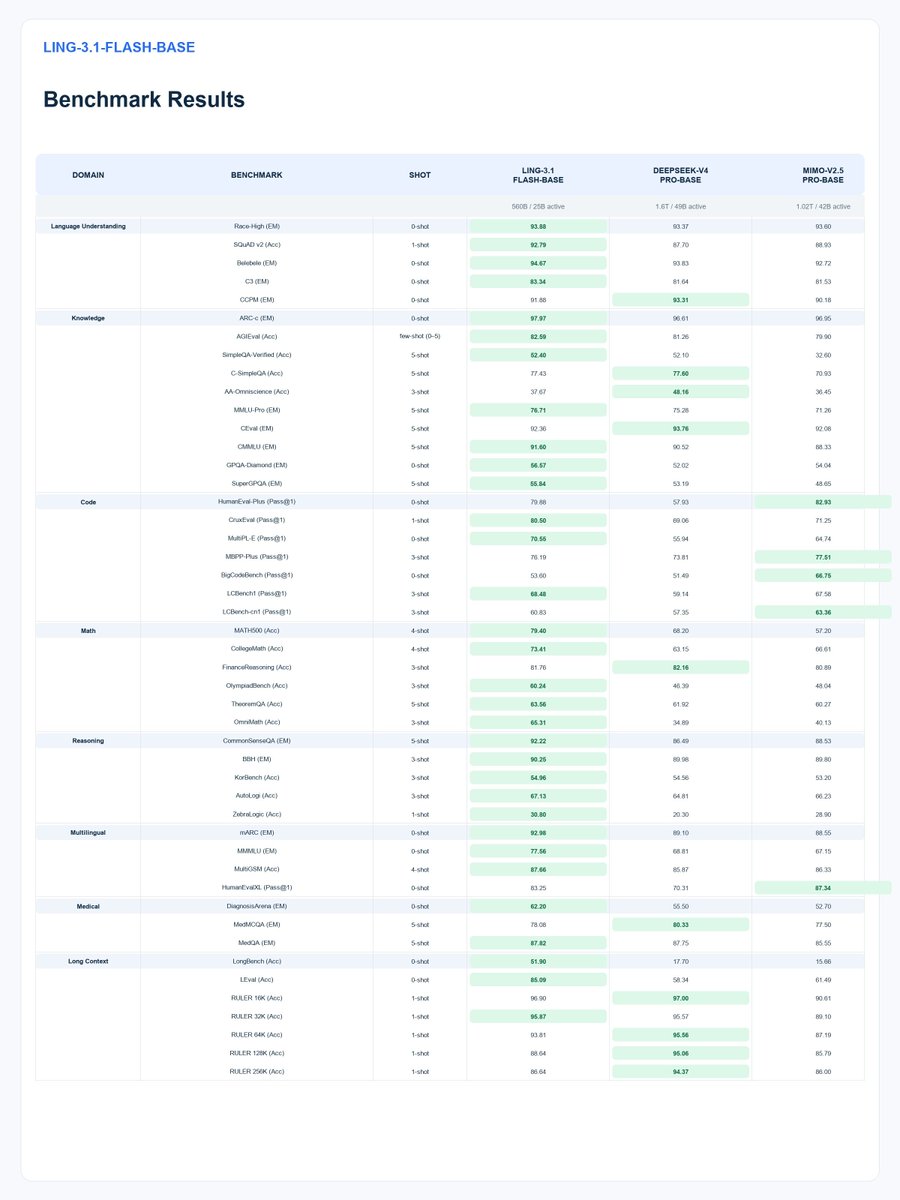
    Ling-3.1-flash-base is now on ModelScope with 1M context, 560B total parameters, and 25B active per token. 🤖 🧠 Built to be adapted: Start from the base checkpoint for continued pre-training, supervised fine-tuning, and domain-specific post-training. 📚 Built for long-horizon work: A 1M-token context window gives custom systems room to work across long documents, codebases, and multi-step workflows. ⚙️ Large capacity, sparse compute: Its hybrid MoE architecture stores 560B parameters while activating about 25B parameters per token. 🛠️ Make it your own: Shape domain terminology, output conventions, task behavior, and assistant policies for the workflows you need. 📜 MIT License.
    Download
    41433.4K
  26. ModelScope✓@ModelScope2022
    Ling-3.0-flash-Sante is now open-source. The 124B healthcare MoE activates only 5.1B parameters per token. 🤖 🏆 #1 among flash-size models on professional healthcare: Scores 54.29 on HealthBench Professional, up 8.56 points, and ranks #2 overall in the team’s evaluation. 🩺 Better at hard medical reasoning: Reaches 76.92 on AFUMED-ComplexReasoning, 90.61 on AFUMED-Drug, and 94.21 on MedQA-USMLE. 🧩 Multi-agent beats single-agent research: BrowseComp rises from 80.20 to 90.47 when moving from one agent to multi-agent collaboration. 🛠️ A healthcare agent, not just medical QA: Deep research, tool use, and task execution gains support real research and professional workflows.
    Download
    7121094.8K
  27. ModelScope✓@ModelScope2022
    Xing4.0-29B-Intent turns a one-line request into structured intent, entities, relations, and action parameters, all through one schema-driven model. 🤖 🏆 Leads the authors’ extraction evaluation: Scores 58 across 6,000 samples from 48 Chinese and English public datasets, ahead of 18 evaluated general-purpose models. 🧠 Choice and extraction in one model: Handles both intent routing and structured semantic parsing, so applications can classify a request and extract the information needed to act on it. ⚙️ Built for reliable tool use: Outputs schema-constrained JSON rather than long-form replies, covering intent detection, entity recognition, relation extraction, and event extraction. 📱 Made for real product flows: Fits customer service routing, smart-device commands, terminal assistants, and agent or function-calling pipelines. 📜 Model weights, training data, and code are released under Apache 2.0. #XingIntent #IntentUnderstanding #SemanticParsing #FunctionCalling #AgenticAI #ModelScope
    Download
    25553.4K
  28. ModelScope✓@ModelScope2022
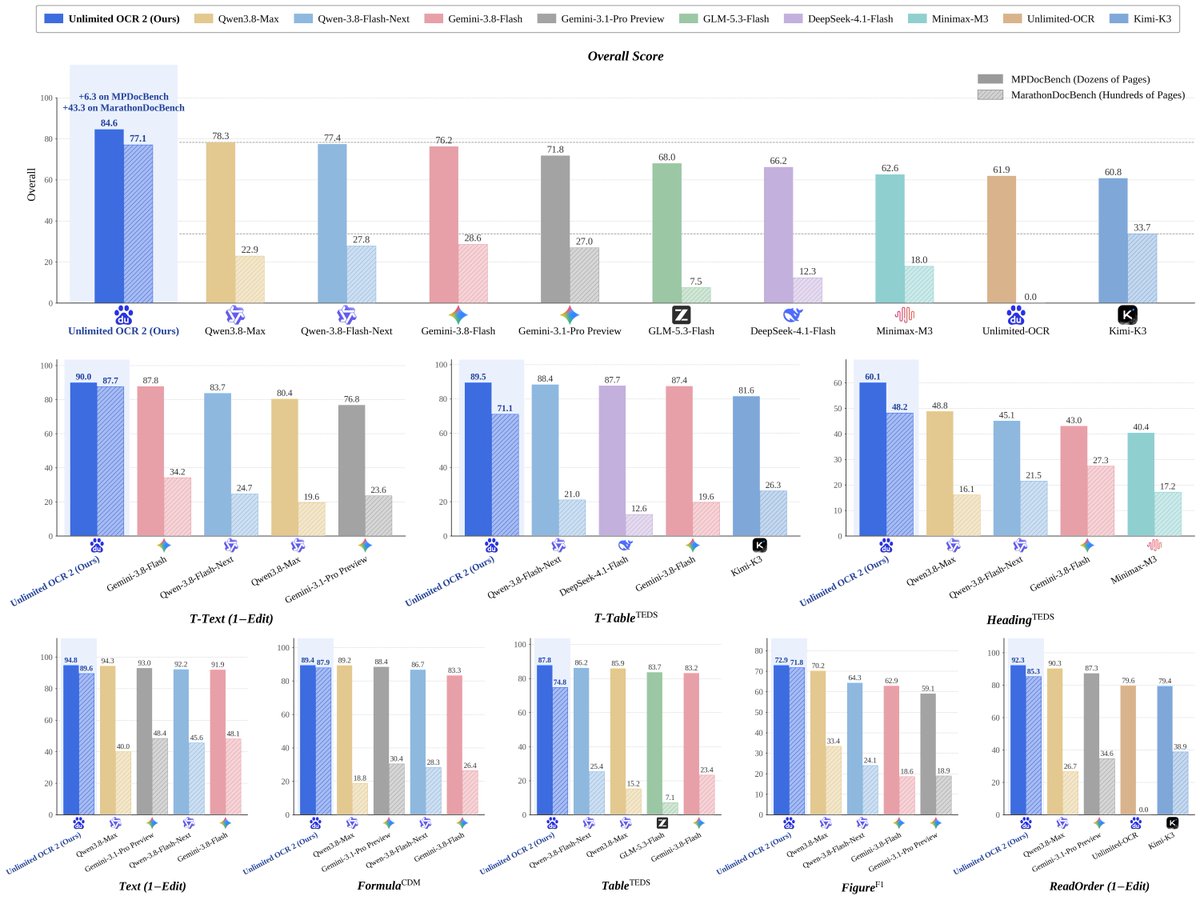
    Introducing Unlimited-OCR-2, built to parse entire documents in one request instead of page by page. 🤖 🏆 SOTA for ultra-long documents: Reaches state-of-the-art results on both MPDocBench and the hundred-page MarathonDocBench. 📚 Parse across pages: Processes every page in one request, preserving cross-page context instead of treating pages as isolated images. ⚡ Built to scale: Sparse Reference Sliding Window Attention keeps per-step decoding latency and memory footprint nearly constant as documents grow. 🛠️ Ready to deploy: Supports native Transformers for quick tests and SGLang for serving. 📜 MIT License.
    Download
    03553.5K
  29. ModelScope✓@ModelScope2022
    Guide image edits with words and up to four reference images. Moss-Image-Edit is an open-weight LoRA adapter for MOSS-Image with ready-to-use ComfyUI workflows. 🤖 🎨 Describe the change: Edit colors, outfits, expressions, lighting, seasons, scenes, and visual style through text instructions. 🖼️ Combine visual references: Use up to four images to guide people, clothing, and scenes. Specify each image's role in your prompt. ⚡ Reuse reference computation: Builds reference-image K/V caches before sampling and reuses them across denoising steps, including both CFG branches. 🛠️ Choose your base: Pair the adapter with either MOSS-Image-Base or MOSS-Image-SFT, then load the provided single-reference or multi-reference ComfyUI workflow. 📜 Project code: GPLv3. Base models and third-party components retain their own licenses.
    Download
    4141409.4K
  30. ModelScope✓@ModelScope2022
    MiniMax H3 Character Swap LoRA is now available on ModelScope, an experimental adapter for recasting a selected person in video from an image reference. 🤖 🎭 Swap the performer, keep the shot: Recast a creator, actor, or avatar from a character reference while retaining the original scene, movement, and camera work. 🧩 V1.5 is the recommended checkpoint: Improved character retention in the authors’ selected V1 comparison examples. 🛠️ Built for the H3 workflow: Load it with the MiniMax H3 Ref2VA base, text encoder, and VAEs in a compatible ComfyUI LoRA workflow. 📜 MiniMax H3 Community License Agreement applies.
    Download
    01443.3K
  31. ModelScope✓@ModelScope2022
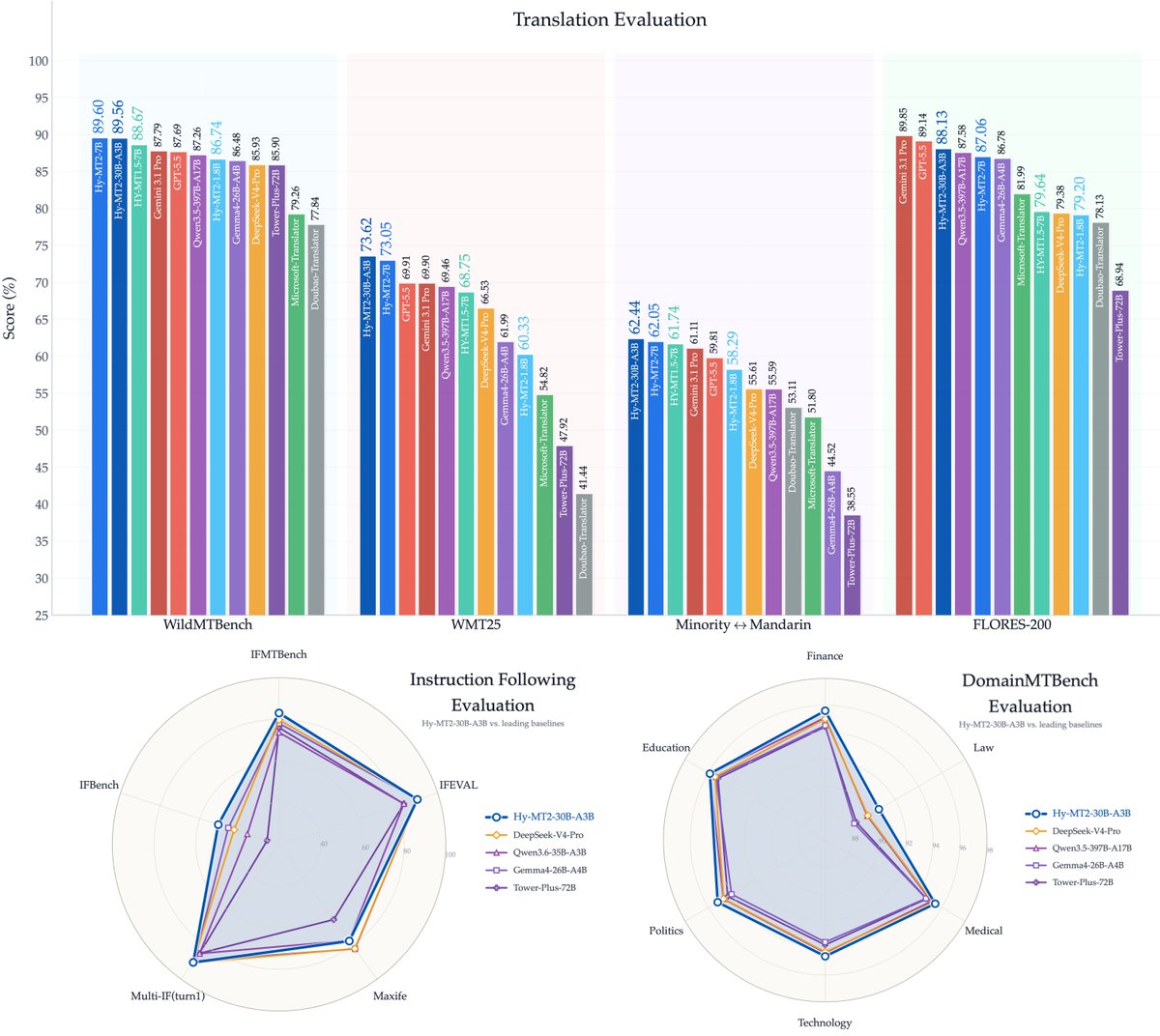
    Hy-SimulMT brings open Chinese-English simultaneous translation to live speech, translating as the speaker talks with text and speech output. 🤖 ⚡ Low latency, strong quality: In the team’s RealSI long-form evaluation, Hy-SimulMT records the lowest StreamLAAL among the compared systems while surpassing the compared open models and four of five commercial APIs on GEMBA quality. 🗣️ Speech-to-speech in both directions: Translate Chinese to English or English to Chinese continuously, with real-time voice cloning to help preserve each speaker’s vocal identity. 🔁 Choose the output workflow: Use the standard checkpoint for translation-only output, or the Interleave variant to receive source text alongside the translation. 🛠️ Ready to build with: FP8 and GGUF variants are available alongside SimulInfer deployment and SimulTrain training tools. 📜 Apache-2.0 License. Speech output and voice cloning require a configured TTS service.
    Download
    10112.2K
  32. ModelScope✓@ModelScope2022
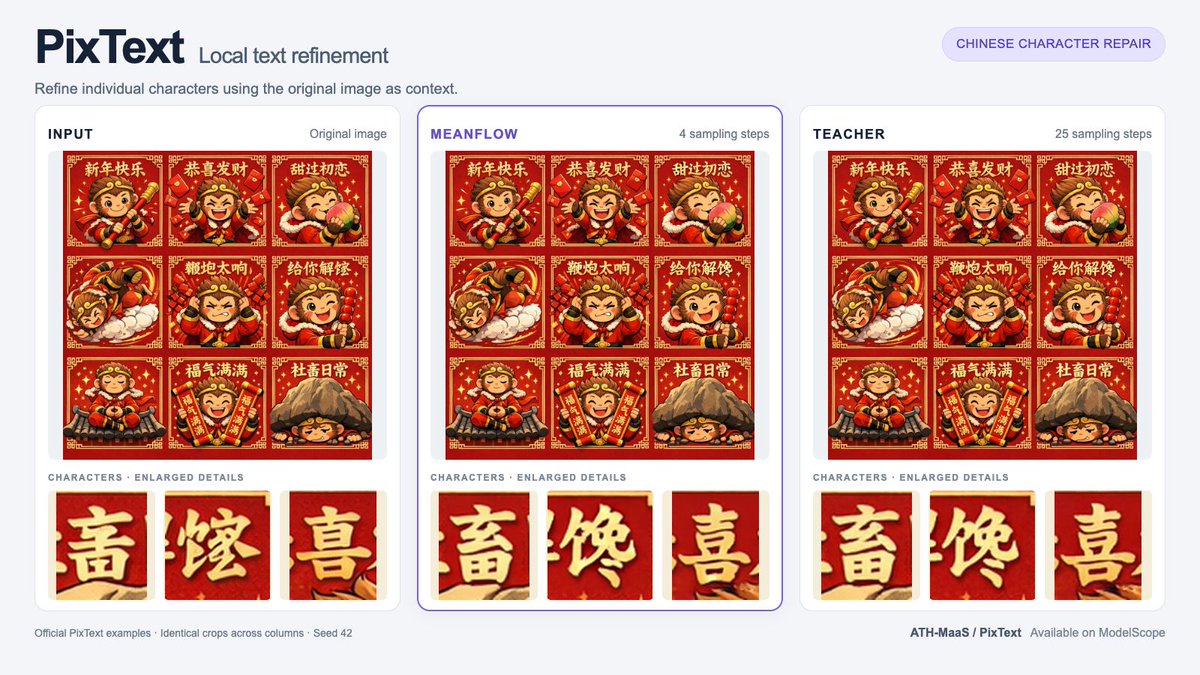
    PixText offers two ~0.95B open-weight models for local text refinement directly in pixel space. 🤖 📄 🏆 Strong text correction: Reaches 83.06% glyph pass and 94.66% exact target-character OCR accuracy on TextRefinementBench, ahead of the strongest reported baseline. ⚡ Four-step generation: PixText-MeanFlow delivers fast local edits in four steps, retaining an 81.84% glyph pass rate with under one GPU-second amortized cost per image in the paper's setup. 🖼️ Edit text, not the whole image: Provide regions and replacement text, then generate multiple targets jointly while keeping pixels outside the edited footprints unchanged. 🧩 Two checkpoints: Choose the 4-step MeanFlow model for quick use or the 25-step Teacher model for the higher-step workflow. 📜 Apache 2.0.
    Download
    04382.7K
  33. ModelScope✓@ModelScope2022
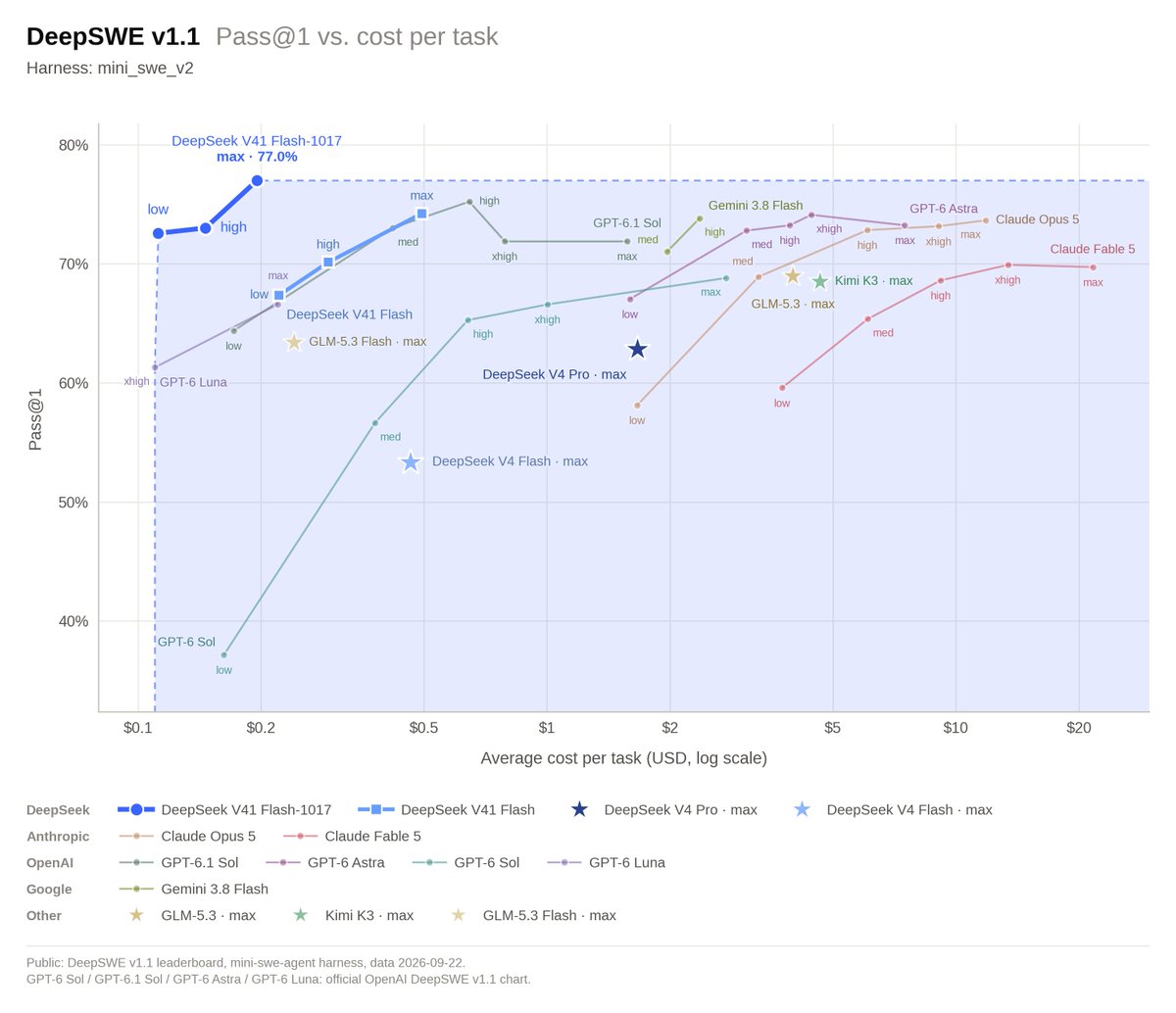
    DeepSeek-V4.1-Flash-1017 delivers stronger coding and agent performance with faster task completion and shorter outputs. Available on ModelScope: 🤖
    DeepSeek @deepseek_ai
    🚀 DeepSeek-V4.1-Flash-1017 is here! Stronger benchmark performance, faster task completion, and shorter outputs than the previous version—a Pareto improvement in performance and cost. Now live on our website, app, and API. 🛠️ Optimized for @DeepSeekHarness, Tencent CodeBuddy, WorkBuddy, and more. Upgrade to DeepSeek Harness v0.2.1-rc.1 or later for the best experience with the new model. 1/4
    1461123.8K
  34. ModelScope✓@ModelScope2022
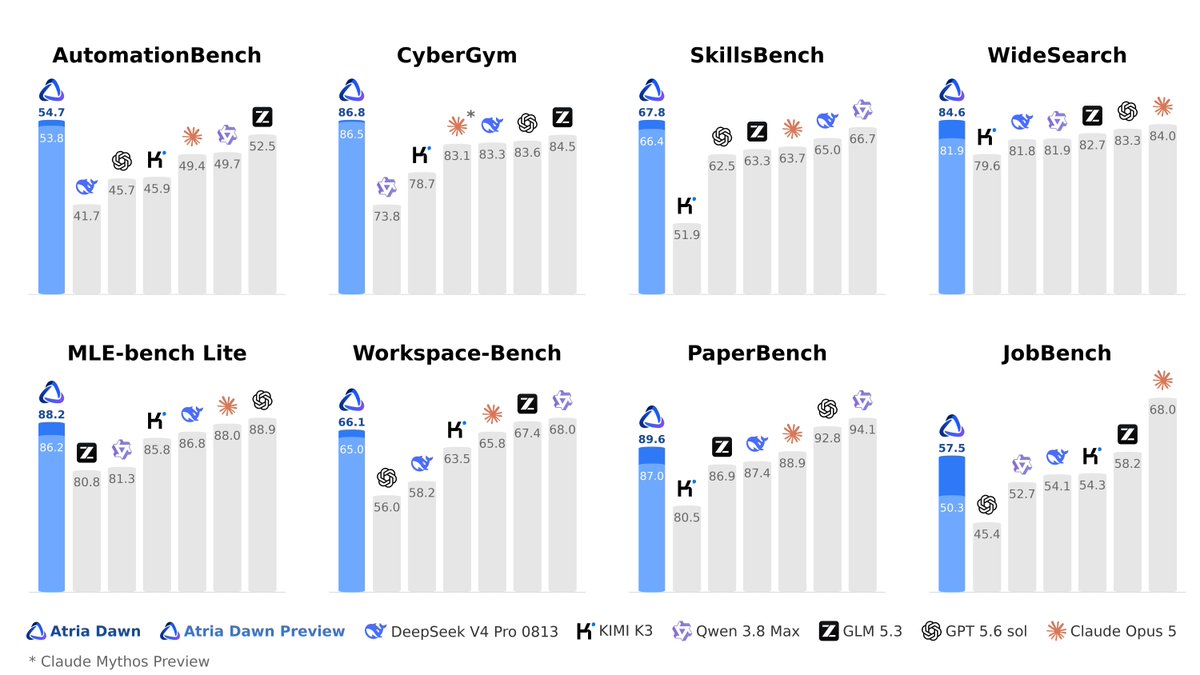
    Atria Dawn’s full release is now on ModelScope with 512K context and open weights for research and engineering agents. 📜 MIT License 🤖 🏆 SOTA in the team’s reported comparison: Atria Dawn leads the evaluated models on AutomationBench, CyberGym, SkillsBench, and WideSearch. 🔬 From research questions to experiments: Finds and organizes evidence, conducts deep research, and turns questions into executable experiment plans. 🛠️ Build and deliver: Creates software, interactive applications, data visualizations, reports, and presentations through multi-step workflows. 🛡️ Security workflows: Analyzes security issues, validates vulnerabilities, and supports fixes and re-validation in authorized environments. ⚡ Ready for deployment: Full and FP8 weights are available, with support for local deployment through SGLang and vLLM.
    Download
    111121919.5K
  35. ModelScope✓@ModelScope2022
    Omni-R2V is now on ModelScope! 339,570 training samples for teaching video models to follow image and video references beyond a single subject. 🤖 📄 🧩 Seven reference controls: Content, motion, style, structure, narrative, multi-content, and cross-aspect. 🎬 Flexible multi-reference training: Each sample includes candidate references, bilingual instructions defining their roles, and a target video. Train with one reference, matched pairs, or compatible subsets. 🔊 Audio when available: Retained target audio also supports reference-to-audiovisual research. 📊 Train and evaluate the same controls: OmniVBench adds 813 cases, 18 tasks, and 12,172 checklist items for reference fidelity and instruction following. 📜 Research use only. Commercial use and media redistribution are not covered.
    Download
    511654.6K
  36. DeepSeek✓@deepseek_ai
    🚀 DeepSeek-V4.1-Flash-1017 is here! Stronger benchmark performance, faster task completion, and shorter outputs than the previous version—a Pareto improvement in performance and cost. Now live on our website, app, and API. 🛠️ Optimized for @DeepSeekHarness, Tencent CodeBuddy, WorkBuddy, and more. Upgrade to DeepSeek Harness v0.2.1-rc.1 or later for the best experience with the new model. 1/4
    Download
    1.6K4.1K37.2K8.1M
  37. ModelScope✓@ModelScope2022
    One 8B image model for generation, editing, and fine-tuning. Bria's Fibo 2.0 Dev is open-weight, with structured JSON control and a full, non-distilled checkpoint. 🤖 🏆 Top-ranked image editing: Fibo 2.0 ranks #1 in image editing and #2 in text-to-image among open-weight models on Artificial Analysis, as of October 20, 2026. 🎨 Flexible editing: Make changes with text instructions, masks, or up to four reference images. 📐 Structured control: Visual GenAI Language uses JSON to specify elements such as composition, lighting, style, and camera settings. 🛠️ Built for customization: The non-distilled base model supports LoRA and full fine-tuning for specific styles, domains, and editing tasks. It was trained exclusively on licensed data. 📜 CC BY-NC 4.0. Commercial use requires a separate agreement with Bria.
    Download
    63554.5K
  38. ModelScope✓@ModelScope2022
    Turn complex documents into data AI agents can use with OXR-1.0, SoMark's 1.3B open-weight model for parsing PDFs and document images into Markdown or JSON. 🤖 🏆 SOTA across three parsing benchmarks: Ranks #1 in the project’s published comparisons on olmOCR-Bench, OmniDocBench, and DocParsingBench. ⚡ Small model, top-tier speed: Also leads the project’s 21-model speed comparison at 557.77 native tokens/s. 📄 Beyond plain OCR: Recognizes 13 element types, including tables, formulas, chemical equations, chemical structures, and code blocks. 🧩 Bring your own layout model: Layout analysis is independent and pluggable, so teams can customize structure handling while retaining OXR’s recognition and reading-order capabilities. 🌀 Trained to improve from failures: Recursive self-improvement during post-training turns real document parsing failures into new optimization signals. 📜 OXR Open Source License applies.
    Download
    68433.6K
  39. ModelScope✓@ModelScope2022
    NVIDIA Nemotron 3.5 Bolt has landed on ModelScope: a 74B-A9B open-weight VLM in a 24GB footprint. 🤖 🏆 Strong agent results: The 24GB model reaches 50.98 on Terminal-Bench 2.1 and 66.75 on BrowseComp. NVIDIA positions it as the #1 open model in its class on PinchBench and #2 among open models on BrowseComp. ⚡ Built for local inference: Native 2-bit quantization fits the model into 24GB while retaining 9B active parameters per token. 👁️ Multimodal, long-context agents: Accepts text, images, and video with up to 256K shared context for prompts, tool results, and conversation history. 🧩 Choose the right variant: Use 24GB IQ2 for local inference, BF16 for post-training and custom quantization, or LiLiCorr variants for speculative decoding. 📜 OpenMDW License Agreement v1.1. Commercial and non-commercial use supported.
    Download
    31281.9K
  40. ModelScope✓@ModelScope2022
    Hy-Nomas has landed. Create an interactive video world and guide its evolution with text and camera control. 🤖 ⚡ 8-step video generation: The distilled configuration generates each segment in 8 denoising steps, with 720 × 1280 output at 24 FPS. 🖥️ Single-GPU inference: A low-memory configuration uses quantized weights and CPU offload to run video inference on one GPU. 🌍 Shape the world as it unfolds: Use multi-turn prompts to introduce objects, change scenes and styles, or describe new actions. 🎥 Control the camera: Guide viewpoint and movement with camera trajectories alongside text instructions. 🧠 Carry context forward: A KV cache retains context from earlier segments as generation continues. 📊 Evaluate interactive worlds: Hy-Nomas-Bench includes 280 cases covering text interaction, camera navigation, combined control, and spatial memory. 🛠️ Adapt and explore: Supports LoRA fine-tuning and offers a web demo for interactive generation. 📜 Apache 2.0. Third-party components are subject to their own licenses.
    Download
    13272.4K
  41. ModelScope✓@ModelScope2022
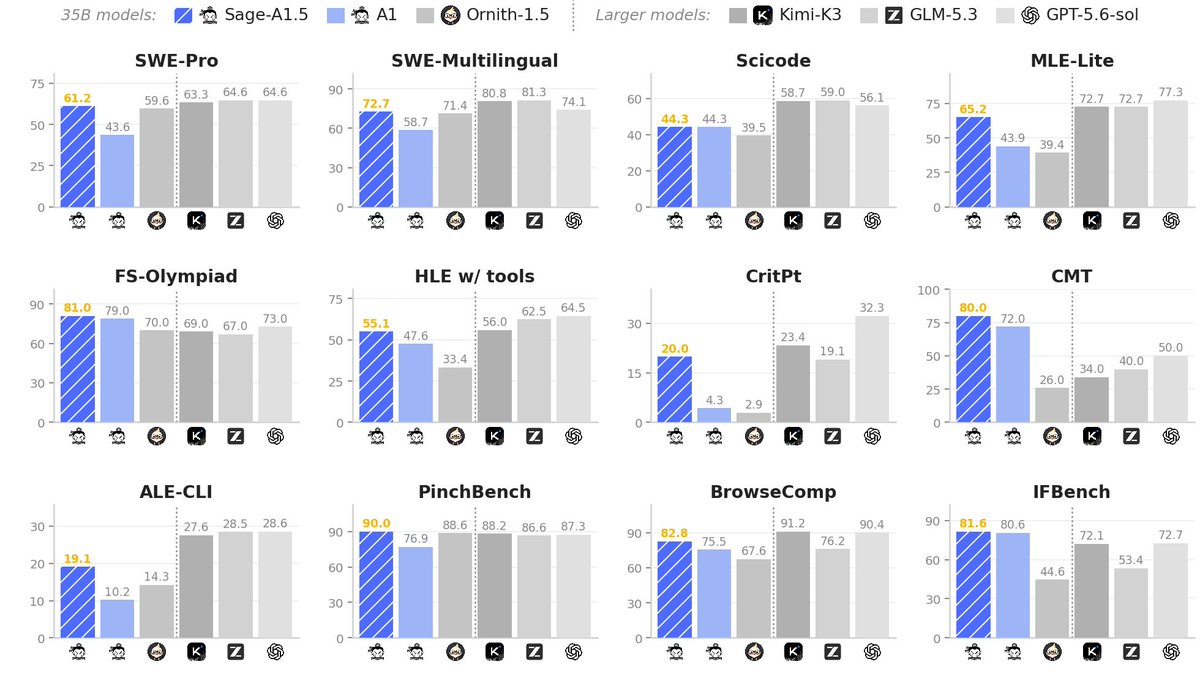
    Sage-A1.5 is here, bringing 256K context, parallel research, and evidence checks to long-horizon scientific workflows. 🤖 🏆 SOTA across scientific benchmarks: Scores 90.0 on PinchBench, 81.0 on FrontierScience-Olympiad, and 48.3 on FrontierScience-Research, ahead of Kimi-K3, GLM-5.3, and GPT-5.6-sol in the reported comparison. 🧩 Agentic Orchestration: When enabled, delegates independent investigations to parallel subagents with isolated contexts, then integrates their evidence and findings to guide subsequent work. ✅ Verification: Optional Verification Mode reviews progress, checks evidence and assumptions, and redirects stalled searches within the model's own reasoning, without a separate critic model at inference. 🔬 Open Scientific Discovery: Supports exploratory research through tool-assisted analysis and produces inspectable research artifacts, extending its use beyond predefined question answering. 🛠️ Native tool use for research: Supports APIs, code interpreters, search engines, and external tools for tool-augmented scientific reasoning and professional workflows. ⚡ Available in BF16, FP8, and GGUF F16/Q8/Q4 formats, with Transformers, vLLM, and SGLang support. 📜 Apache 2.0.
    Download
    203744148.1K
  42. ModelScope✓@ModelScope2022
    Train your decision-model using ms-swift: with model-specific losses, automatic two-level temperature calibration and built-in Open-Jev data. Also capable of converting causal language models into decision models, with generic_decision option.
    16242.7K
  43. ModelScope✓@ModelScope2022
    Introducing Hy-Memory-30B-A3B, a dedicated long-term memory writer with around 3B active parameters. 🤖 📄 🏆 Cross-framework leader: Scores 55.49 across Mem0, Hy-Memory, MemOS, and held-out EverMemOS in the fixed 20% evaluation matrix, ahead of Claude Opus 5 at 54.62. 🧠 Write memories, not chat replies: Decides what to retain, turns evidence into precise memory entries, and updates the persistent store when new information arrives. 🔄 Transfers beyond its training stack: Leads the held-out EverMemOS harness at 56.89, showing the writer can plug into unseen memory frameworks. 🛠️ Easy to integrate: Runs with vLLM and an OpenAI-compatible API, with a no-thinking mode for structured fact and preference extraction. 📜 Apache 2.0.
    Download
    4101566.4K