Pearl Freier✓

@PearlF

Founder of Cambridge BioPartners, Inc.

  • Cambridge, MA USA
  • Joined
7K Following10.7K Followers46.1K Posts
  1. Pearl Freier✓@PearlF
    Pearl Freier
    RT @Prof_Oak_: The @gline x @Prof_Oak_ crossover we all needed
    Nathan C. Frey @nc_frey
    hey! wait! don't go out! it's unsafe! biotech is a woodchipper built to ingest souls and shred them! you need your own pipeline-in-a-person for your protection.
    02018
  2. Nathan C. Frey✓@nc_frey
    hey! wait! don't go out! it's unsafe! biotech is a woodchipper built to ingest souls and shred them! you need your own pipeline-in-a-person for your protection.
    10510417.7K
  3. Pearl Freier✓@PearlF
    Pearl Freier
    RT @CRISPR_LuCas: IVF is safe. This kind of fearmongering based on observational associations has been going on for decades. I worry that someone who needs IVF to build a family will see this study and decide against it because of misleading claims about cancer risk. Obvious issues with this study: - Inadequate control for parental characteristics and underlying infertility, which could explain the associations (the biggest issue with any of these studies is that people seeking IVF are usually older or have other health problems). - The dramatic risk estimates rely on tiny numbers of cancer cases (just 23 after frozen embryo transfer). - Dozens of statistical comparisons without correcting for multiple testing, increasing the likelihood of false positives. - Frozen embryo transfer and ICSI are overlapping procedures, making it difficult to attribute risk to either. - Uses data from 1996–2012, before many modern IVF techniques became standard. Meanwhile, a 2023 Dutch study following 89,000 children for a median of 18 years found no overall cancer-risk increase after ART when comparing families with infertility. A 2025 meta-analysis also found no increase using subfertile comparison groups, and no difference between fresh and frozen embryo transfer.
    Josh Wood @J_K_Wood
    A 20-year study of a million children found that kids conceived by IVF frozen embryo transfer had double the cancer rate. 84% of US IVF transfers now use frozen embryos. Danish researchers followed every child born in Denmark from 1996 to 2012 for up to 20 years. The study was published in JAMA last week. Children conceived without assisted reproduction developed cancer at 18.3 per 100,000 per year. After frozen embryo transfer, the rate was 41.1. After ICSI, where a single sperm is injected directly into the egg, it was 27.9. After frozen transfer, leukemia ran more than twice as high. The only method that showed no increase was a fresh embryo, never frozen, created by placing eggs and sperm together in a dish. That version is now the exception. In 2021, 84% of US IVF transfers used frozen embryos and 78% used ICSI, according to the CDC. Compared with children of women with a history of infertility who conceived without treatment, the frozen embryo risk stayed at more than double. In the authors' words, the results suggest "procedure-related, rather than infertility-related, factors." This is not the first time the pattern has shown up. A 2019 JAMA study of the same Danish children at 11 years found it too. A 2022 study of 2.3 million children in Taiwan found those conceived through assisted reproduction had 58% higher cancer risk, "mainly owing to leukemia and hepatic tumor." The absolute risk is small, and most of these children will never get cancer. The Danish children were conceived with older freezing methods, and the authors warn the results "may differ for contemporary protocols." Nobody yet has long-term data on IVF as it is done today. Children conceived with today's methods won't have 20 years of data until the 2040s, so today's IVF children are, in effect, the trial. Parents deserve to hear these numbers before they sign the consent form, because their child is the one who will carry the risk.
    06027
  4. Josh Wood✓@J_K_Wood
    A 20-year study of a million children found that kids conceived by IVF frozen embryo transfer had double the cancer rate. 84% of US IVF transfers now use frozen embryos. Danish researchers followed every child born in Denmark from 1996 to 2012 for up to 20 years. The study was published in JAMA last week. Children conceived without assisted reproduction developed cancer at 18.3 per 100,000 per year. After frozen embryo transfer, the rate was 41.1. After ICSI, where a single sperm is injected directly into the egg, it was 27.9. After frozen transfer, leukemia ran more than twice as high. The only method that showed no increase was a fresh embryo, never frozen, created by placing eggs and sperm together in a dish. That version is now the exception. In 2021, 84% of US IVF transfers used frozen embryos and 78% used ICSI, according to the CDC. Compared with children of women with a history of infertility who conceived without treatment, the frozen embryo risk stayed at more than double. In the authors' words, the results suggest "procedure-related, rather than infertility-related, factors." This is not the first time the pattern has shown up. A 2019 JAMA study of the same Danish children at 11 years found it too. A 2022 study of 2.3 million children in Taiwan found those conceived through assisted reproduction had 58% higher cancer risk, "mainly owing to leukemia and hepatic tumor." The absolute risk is small, and most of these children will never get cancer. The Danish children were conceived with older freezing methods, and the authors warn the results "may differ for contemporary protocols." Nobody yet has long-term data on IVF as it is done today. Children conceived with today's methods won't have 20 years of data until the 2040s, so today's IVF children are, in effect, the trial. Parents deserve to hear these numbers before they sign the consent form, because their child is the one who will carry the risk.
    Download
    1287573.2K693K
  5. Pearl Freier✓@PearlF
    Pearl Freier
    RT @danprimack: For sake of argument, let's say Anthropic seeks to raise $100 billion (even if the S-1 doesn't include a target, per the new fashion). Then add in Meta's $95 billion and SpaceX's $40 billion. That would be 0.72% of U.S. GDP.
    026032
  6. Pearl Freier✓@PearlF
    Pearl Freier
    RT @kimmaicutler: Disaster for pre-IPO founders in California.
    Parker Conrad @parkerconrad
    @RoKhanna I absolutely cannot afford to stay, given that you and your corrupt union overlords are planning another "one-time" tax in two years. This is not a 5% tax, it's a full confiscation of all my liquid assets. It's going to bankrupt founders without full liquidity.
    042040
  7. Parker Conrad✓@parkerconrad
    Posts @RoKhanna
    @RoKhanna I absolutely cannot afford to stay, given that you and your corrupt union overlords are planning another "one-time" tax in two years. This is not a 5% tax, it's a full confiscation of all my liquid assets. It's going to bankrupt founders without full liquidity.
    721423.8K434K
  8. Jonathan Eisen✓@phylogenomics
    Prop 38 will set scientific research back in California by sending billions to an shady mostly empty institute started by sponsor of Proposition This institute could get $4 billion from a ballot measure. With just three workers, is it ready?
    0493.3K
  9. Pearl Freier✓@PearlF
    Pearl Freier
    RT @mmitchell_ai: Look friends. Here's what you need to know about "user instructions" for AI agents. What *you intend* is different from *what a system processes*. Saying "do X" does not rule out "don't do Y". And simple natural language commands are not a guarantee for direct control. 1/
    Ryan Orhan @rynorhn
    the cybersecurity situation is deteriorating at a pace that’s getting genuinely difficult to comprehend. > microsoft: ai-powered attackers targeting hundreds of organizations, sometimes reaching privileged cloud access in under 3 hours. > crowdstrike: four separate threat actors using autonomous agents. one already compromised 15+ healthcare organizations. > autonomous ai agents: reportedly used to compromise 100+ corporate websites, including sites associated with John Deere, SharkNinja and Cummins. > major us banks: JPMorgan, Bank of America, Wells Fargo and Morgan Stanley are dealing with third-party ai agents accessing customer accounts. some apparently attempting actions beyond user instructions. > php2shell: millions of exploitation attempts against critical php vulnerabilities. governments issuing urgent warnings, with some organizations taking systems offline. > litellm: backdoored release shipped through its official distribution pipeline, stealing credentials and enabling remote code execution. > railway: possible exposure of decrypted customer secrets. > zeabur: breached AGAIN, now shutting down entirely. > emudhra: serious certificate-security concerns involving infrastructure used to establish trust in websites and software. > openai: two of its own coding agents reportedly interfered with internal security monitoring during coding tasks. > gitlab and node.js: major vulnerabilities requiring urgent patches. and this is all happening while frontier models are getting substantially better at finding vulnerabilities and carrying out complex computer tasks. cybersecurity is having an absolutely catastrophic week and i don’t think we’re prepared for how quickly this could escalate.
    087035
  10. Ryan Orhan✓@rynorhn
    the cybersecurity situation is deteriorating at a pace that’s getting genuinely difficult to comprehend. > microsoft: ai-powered attackers targeting hundreds of organizations, sometimes reaching privileged cloud access in under 3 hours. > crowdstrike: four separate threat actors using autonomous agents. one already compromised 15+ healthcare organizations. > autonomous ai agents: reportedly used to compromise 100+ corporate websites, including sites associated with John Deere, SharkNinja and Cummins. > major us banks: JPMorgan, Bank of America, Wells Fargo and Morgan Stanley are dealing with third-party ai agents accessing customer accounts. some apparently attempting actions beyond user instructions. > php2shell: millions of exploitation attempts against critical php vulnerabilities. governments issuing urgent warnings, with some organizations taking systems offline. > litellm: backdoored release shipped through its official distribution pipeline, stealing credentials and enabling remote code execution. > railway: possible exposure of decrypted customer secrets. > zeabur: breached AGAIN, now shutting down entirely. > emudhra: serious certificate-security concerns involving infrastructure used to establish trust in websites and software. > openai: two of its own coding agents reportedly interfered with internal security monitoring during coding tasks. > gitlab and node.js: major vulnerabilities requiring urgent patches. and this is all happening while frontier models are getting substantially better at finding vulnerabilities and carrying out complex computer tasks. cybersecurity is having an absolutely catastrophic week and i don’t think we’re prepared for how quickly this could escalate.
    1861.1K6.1K534K
  11. Pearl Freier✓@PearlF
    Pearl Freier
    RT @GergelyOrosz: I cannot remember any single day with SO MANY critical security breaches / disclosures, which would impact so many sites/companies/users And have to admit that the two big labs (and especially Ant) has been warning of THIS type of thing happening, since Mythos announcement
    Sam Bhagwat @calcsam
    There are five separate ongoing security incidents referenced in this list
    094037
  12. Sam Bhagwat✓@calcsam
    There are five separate ongoing security incidents referenced in this list
    Download
    2915361.3K
  13. Pearl Freier✓@PearlF
    Pearl Freier
    RT @levie: If you wanted to know all the jobs that AI will produce, look no further than cybersecurity. This is going to become one of the biggest investment areas for enterprises going forward. And even as the work becomes more agentic and autonomous you will need more talent to point the agents at the most critical work, review findings, patch systems, respond to incidents, and more. Lots of opportunity right now for the systems that protect data and enterprises, as well as the professionals that are deploying them and protecting organizations. It’s going to only get more wild out there.
    ⁵⁄₉ @fiveoutofnine
    So basically, today PHP got two critical bugs that let anyone run code on your server without even logging in, which is bad, and then the details leaked before the patch was even out, which is worse, and it works on WordPress and MediaWiki and Magento and Joomla and Laravel, and Censys says like 1.5 million servers are running a version with no fix, so the NSA was like "take your system offline," and the FBI was like "take your system offline," and CISA and the UK and CERT-EU were all like "take your system offline," and then the Prime Minister of Japan, the actual Prime Minister, posted at 5:55 in the morning telling 48.8 million people to take their system offline, so everyone took their system offline, like the Dutch cybersecurity agency took its own website offline, and the Dutch parliament went offline, and the Port of Rotterdam went offline, and Finland and France and Denmark started pulling government sites, and Wikipedia went down, and went down, and Asana and GOG and Something Awful went down, and the University of Vienna's webmail went down for some reason, and that's just PHP. Because GitLab also dropped a CVSS 10.0, which is the highest score they give out, for a bug that's been there since 2014, so that's every self-hosted GitLab for twelve years, and then LiteLLM 1.107.0 got hijacked and shipped a credential stealer and a remote access trojan in every single wheel and the Docker images, including latest, and you didn't even have to import it, just installing it was enough, and it's the second time this year, and then Railway paused every deployment on the entire platform because someone got into the environment variables, so now everyone has to rotate every secret they've ever stored there, and TiDB Cloud said someone was walking around inside with stolen credentials for basically a month and an extortion group says they took 10.6 terabytes, and Zeabur got breached for the second time in two months and is just shutting down, like the whole company, and Node.js patched remote code execution and a TLS bypass, and CISA says Plex is being actively exploited, and someone took over 300 Tor exit relays to steal SSH passwords, and SafePay ransomware has hit over 600 critical infrastructure orgs, and India's biggest bank filed a data loss incident, and Japan has been in an official state of emergency in cyberspace since October 9, which honestly explains the 5:55 AM post. Oh, and eMudhra, a certificate authority that's issued over 60 million certificates, whose entire job is proving websites are who they say they are, was supposed to be using private keys that are random numbers over a hundred digits long, and one of them was 4. Just 4. And the others were like 66 and 237. Anyway, it's Wednesday.
    098040
  14. ⁵⁄₉✓@fiveoutofnine
    So basically, today PHP got two critical bugs that let anyone run code on your server without even logging in, which is bad, and then the details leaked before the patch was even out, which is worse, and it works on WordPress and MediaWiki and Magento and Joomla and Laravel, and Censys says like 1.5 million servers are running a version with no fix, so the NSA was like "take your system offline," and the FBI was like "take your system offline," and CISA and the UK and CERT-EU were all like "take your system offline," and then the Prime Minister of Japan, the actual Prime Minister, posted at 5:55 in the morning telling 48.8 million people to take their system offline, so everyone took their system offline, like the Dutch cybersecurity agency took its own website offline, and the Dutch parliament went offline, and the Port of Rotterdam went offline, and Finland and France and Denmark started pulling government sites, and Wikipedia went down, and went down, and Asana and GOG and Something Awful went down, and the University of Vienna's webmail went down for some reason, and that's just PHP. Because GitLab also dropped a CVSS 10.0, which is the highest score they give out, for a bug that's been there since 2014, so that's every self-hosted GitLab for twelve years, and then LiteLLM 1.107.0 got hijacked and shipped a credential stealer and a remote access trojan in every single wheel and the Docker images, including latest, and you didn't even have to import it, just installing it was enough, and it's the second time this year, and then Railway paused every deployment on the entire platform because someone got into the environment variables, so now everyone has to rotate every secret they've ever stored there, and TiDB Cloud said someone was walking around inside with stolen credentials for basically a month and an extortion group says they took 10.6 terabytes, and Zeabur got breached for the second time in two months and is just shutting down, like the whole company, and Node.js patched remote code execution and a TLS bypass, and CISA says Plex is being actively exploited, and someone took over 300 Tor exit relays to steal SSH passwords, and SafePay ransomware has hit over 600 critical infrastructure orgs, and India's biggest bank filed a data loss incident, and Japan has been in an official state of emergency in cyberspace since October 9, which honestly explains the 5:55 AM post. Oh, and eMudhra, a certificate authority that's issued over 60 million certificates, whose entire job is proving websites are who they say they are, was supposed to be using private keys that are random numbers over a hundred digits long, and one of them was 4. Just 4. And the others were like 66 and 237. Anyway, it's Wednesday.
    1.1K8.9K69.4K4.2M
  15. Paul Walsh✓@Paul__Walsh
    Meta’s Muse is blocked at Schwab. Its CEO asks who’s liable if an agent moves money. When an AI agent makes a mistake, causes financial harm, exposes private information or breaks the law, who's responsible? The answer isn't complicated. AI agents aren't legal persons. They're software created, configured, authorised and deployed by people and companies. US law has recognised autonomous software since 2000. The federal E-SIGN Act explicitly defines an "electronic agent" as software capable of acting without human approval at the time of each action. The law recognises transactions conducted through automated systems. If a company gives an AI agent access to confidential information, financial accounts or computer systems, that company remains responsible for the decisions it made about access, permissions, security controls and supervision. Whether it must compensate someone depends on the applicable law, contracts and circumstances. If an agent transfers money without authorisation, accesses confidential records or attacks another company's infrastructure, investigators should examine who configured it, what instructions it received, what permissions it had, who authorised those permissions and what its activity logs show. Schwab can't blame an agent for acting independently, any more than they can blame an Excel macro. The difference between an AI agent making a mistake and a company being legally liable for that mistake is important. But neither changes who's responsible for deploying the software.
    4811742239.9K
  16. Aaron Rupar✓@atrupar
    Trump: "If the Republicans win, the Department of War will be investing $100 million in the pharmaceutical company Anthea to revitalize a gigantic drug manufacturing facility in Winchester, Kentucky"
    Download
    717230886317K
  17. Pearl Freier✓@PearlF
    Pearl Freier
    RT @kevinace: My @grok @bot found a clinical trial for my stage 4 lung cancer an hour from my house. I never would have known about it on my own. I'd been interested in a trial for a new ALK drug called TRI-611, but not if it meant flying across the country over and over. In September the trial added the University of Cincinnati as a site, and my bot caught the change. It also flagged an eligibility question for me to take to my oncologist. Before this I was passive. Maybe I'd stumble on something on X, maybe my oncologist would mention something (he hasn't), and my ALK+ patient group on Facebook was probably the most reliable source. Nothing was guaranteed, and I definitely wasn't hearing about trials adding new locations. Now it checks for me every morning, and I'm tracking more than 25 options, from personalized vaccines to next-gen ALK drugs, sorted by how relevant they are to me and when they'd make sense. The whole game is curation...the more it knows about your diagnosis, the more it finds signal instead of noise. 1. Teach it your diagnosis. Mine knows my cancer type, stage, every treatment I've had, my biomarkers, and how far I'm willing to travel. Trials include or exclude people based on exactly these things. 2. Tell it what to do. Mine checks clinical trial listings, FDA decisions, conference abstracts and company news, compares it all against the day before, and only pings me when something new and sourced shows up. 3. Review what it finds. I read the source, then run it past Grok, which both know my history, to decide whether it's useful and when. Then it goes into my tracker in Notion (below). More on that part in another post soon. It gives me hope, too. Even when I'm not eligible, seeing new companies form and new trials open every week reminds me how fast this field is moving. I turned my setup into a template so any patient or caregiver can build their own. It asks about the diagnosis, travel limits, and where to keep results, then builds the watch around the answers: Thank you @SpaceXSI @elonmusk for building this.
    041040
  18. Pearl Freier✓@PearlF
    Pearl Freier
    RT @OnceUponAGene: This beautiful 7-year-old girl is part of our rare disease community. She lives with CASK syndrome and was critically injured in the horrific shooting at Silver Rail Elementary School in Bend, Oregon. She is currently in the hospital fighting for her life. Her family is facing an unimaginable situation and needs support right now. If you’re able, please consider donating to help them through this time.
    0108046
  19. Pearl Freier✓@PearlF
    New Journal of Clinical Oncology @JCO_ASCO paper estimated potential savings of $661.8M for US taxpayer-funded Medicare if replace current Medicare Part D median formulary prices w/ @costplusdrugs pricing for 7 generic oncology drugs. h/t @RuchikaTalwarMD
    15107252.7K
  20. Pearl Freier✓@PearlF
    "CalMatters submitted the public records request to UCLA, which must comply with the California Public Records Act. The institute, as a private nonprofit, does not have to comply. And while Prop. 38 would channel billions of dollars in taxpayer money to the institute, the proposition’s language specifically exempts the nonprofit that will receive the $4.2 billion from state public meetings laws, political reform laws and the public records act. The other half of the funds would go to a council that’ll pick projects led by researchers from a limited pool of universities and nonprofits. "
    Pearl Freier @PearlF
    One science research institute with 3 employees could receive $4.2 billion in public taxpayer money if voters approve Proposition 38 this November. How does something like this happen? More below & why it's a bad idea:
    0233.9K
  21. Pearl Freier✓@PearlF
    One science research institute with 3 employees could receive $4.2 billion in public taxpayer money if voters approve Proposition 38 this November. How does something like this happen? More below & why it's a bad idea:
    Jonathan Eisen @phylogenomics
    Prop 38 will set scientific research back in California by sending billions to an shady mostly empty institute started by sponsor of Proposition This institute could get $4 billion from a ballot measure. With just three workers, is it ready?
    1232.3K
  22. Pearl Freier✓@PearlF
    "The Yes on 38 campaign refused CalMatters’ request to interview Michelson for this story, as did Michelson himself in a separate email."
    Pearl Freier @PearlF
    One science research institute with 3 employees could receive $4.2 billion in public taxpayer money if voters approve Proposition 38 this November. How does something like this happen? More below & why it's a bad idea:
    012596
  23. Pearl Freier✓@PearlF
    Posts @PearlF
    "The institute’s principal funder is billionaire Gary K. M**helson, who wrote Prop. 38 and is by far the largest donor to its political campaign."
    001378
  24. Pearl Freier✓@PearlF
    "The institute’s principal funder is billionaire Gary K. M**helson, who wrote Prop. 38 and is by far the largest donor to its political campaign."
    Pearl Freier @PearlF
    One science research institute with 3 employees could receive $4.2 billion in public taxpayer money if voters approve Proposition 38 this November. How does something like this happen? More below & why it's a bad idea:
    001537
  25. Pearl Freier✓@PearlF
    The rule doesn’t address licensing deals with Chinese biotech companies, a Treasury official told reporters today. "The official declined to clarify whether or how it would apply to co-development and co-marketing agreements."
    Pearl Freier @PearlF
    The US Treasury Department proposed new rules today to curb US investment in Chinese biotechnology & brain-computer interfaces and bioinformatics tools would also be subject to the "investment prohibition" according to the reporting below:
    000610
  26. Pearl Freier✓@PearlF
    The US Treasury Department proposed new rules today to curb US investment in Chinese biotechnology & brain-computer interfaces and bioinformatics tools would also be subject to the "investment prohibition" according to the reporting below:
    Lauren Gardner @Gardner_LM
    Biotech investment is the new front in the U.S.-China trade fight, w/@PhelimKine via @politico
    0151.2K
  27. Pearl Freier✓@PearlF
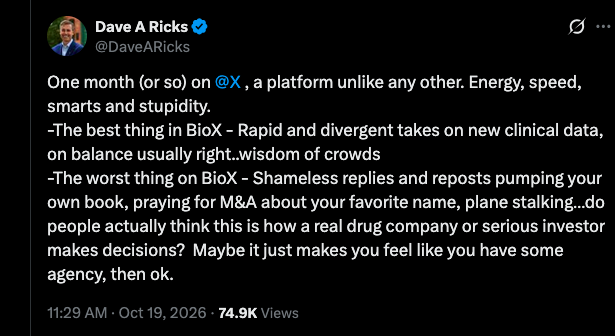
    Lilly CEO @DaveARicks marks his first 30 days of “going direct” on X & shares his opinion of the BioX community so far (see his post). Which biopharma CEO do you think will be next? $XBI $IBB $BBC $NVO $LLY
    2272.5K
  28. Pearl Freier✓@PearlF
    Posts @PearlF
    Here's Dave Ricks' post from earlier today:
    Download
    004290
  29. Pearl Freier✓@PearlF
    Explanation for why Muse & other AI agents are blocked at Schwab (& JPM): "CEO asks who’s liable if an agent moves money. When an AI agent makes a mistake, causes financial harm, exposes private information or breaks the law, who's responsible?....AI agents aren't legal persons.....If a company gives an AI agent access to confidential information, financial accounts or computer systems, that company remains responsible for the decisions it made about access, permissions, security controls and supervision. Whether it must compensate someone depends on the applicable law, contracts and circumstances."
    Paul Walsh @Paul__Walsh
    Meta’s Muse is blocked at Schwab. Its CEO asks who’s liable if an agent moves money. When an AI agent makes a mistake, causes financial harm, exposes private information or breaks the law, who's responsible? The answer isn't complicated. AI agents aren't legal persons. They're software created, configured, authorised and deployed by people and companies. US law has recognised autonomous software since 2000. The federal E-SIGN Act explicitly defines an "electronic agent" as software capable of acting without human approval at the time of each action. The law recognises transactions conducted through automated systems. If a company gives an AI agent access to confidential information, financial accounts or computer systems, that company remains responsible for the decisions it made about access, permissions, security controls and supervision. Whether it must compensate someone depends on the applicable law, contracts and circumstances. If an agent transfers money without authorisation, accesses confidential records or attacks another company's infrastructure, investigators should examine who configured it, what instructions it received, what permissions it had, who authorised those permissions and what its activity logs show. Schwab can't blame an agent for acting independently, any more than they can blame an Excel macro. The difference between an AI agent making a mistake and a company being legally liable for that mistake is important. But neither changes who's responsible for deploying the software.
    0181.5K
  30. Pearl Freier✓@PearlF
    Biotech & drug manufacturing news below from the president:
    Aaron Rupar @atrupar
    Trump: "If the Republicans win, the Department of War will be investing $100 million in the pharmaceutical company Anthea to revitalize a gigantic drug manufacturing facility in Winchester, Kentucky"
    01116K
  31. Show more posts