TechInnovation✓

@TechInnovationz

Tech enthusiast | Diving into quantum, AI, & space $IONQ ….| Insights on future-shaping companies🚀 | Follow me!

  • Etats-Unis
  • Joined
860 Following8K Followers10.4K Posts
  1. TechInnovation✓@TechInnovationz
    I’m 23. I’m from France. I own 400 shares of IonQ . I’m writing that upfront because it matters for what comes next. I’m not a fund manager. I’m not paid to post. Whether the stock goes up or down tomorrow, my life doesn’t change. I’m a master’s student in international business who got pulled into the quantum world a year ago and hasn’t been able to look away since. What started as curiosity turned into something else. A year of reading, asking questions, getting things wrong, being corrected by people who knew more, and trying again. The physics didn’t come naturally. Neither did the financial side. But piece by piece, conversation by conversation, it started to connect. And I’ve been wrong along the way. More than once. The community has corrected me, caught names I misspelled, flagged claims I couldn’t fully source. That’s not a weakness of doing this publicly it’s the point. Working in the open means your mistakes are visible, and that’s exactly what keeps the work honest. The real craft was never about one acquisition. It was about connecting them. Oxford Ionics. SkyWater. Capella Space. Vector Atomic. Lightsynq. Qubitekk. ID Quantique. Skyloom. Seed Innovations. Nine deals in roughly twelve months, and each one reshapes a different layer computing, manufacturing, networking, sensing, space, security, software. That’s before you count the hires behind them, the integration team under Petrina Zaraszczak, the European expansion through Lorenzo Roversi in the Nordics, Marco Pistoia in Rome with the €1B Italian commitment, Darren Strange in Oxford. Before the university partnerships Cambridge and the Cavendish Lab, the OxCam corridor, the AstraZeneca BioVentureHub in Gothenburg, MTSU’s QRISE Center in Tennessee. Before the government layer SHIELD IDIQ, Golden Dome, Katie Arrington as CIO, the GDIT partnership, Robert Cardillo at IonQ Federal. Each piece is a story. Together they tell something bigger. And somewhere along the way, a community formed. The IonQers. Multilingual, scattered across time zones, reading the same filings, catching each other’s mistakes, crediting each other’s findings. Some of my closest conversations this past year have been with people whose real names I don’t know. Content in English, Japanese.. because the quantum ecosystem isn’t a single-language story, and the people trying to follow it deserve to read it in their own language. I want to be transparent about why I do this. It’s not for money. 400 shares wouldn’t change that calculation either way. I do it to help the community understand what’s actually happening to make the information accessible. Quantum is hard. The filings are dense. The physics is intimidating. Most people who could benefit from following this story give up after two paragraphs of jargon. That’s the gap I try to close. That’s why I write the deep dives. That’s why I make short videos breaking down the technology in simple terms. Not for followers. For readers who want to actually understand. Because this ecosystem shouldn’t require a PhD to follow. And when people message me asking why the stock is up or down on a given day I don’t have that answer, and more importantly, that’s not what I’m here for. Price action is noise. The ecosystem is the signal. I’d rather explain why an acquisition matters than guess where the candle closes. I also write this from a European seat, watching a mostly American story with European fingerprints all over it Oxford in the UK, Pistoia in Italy, QuantumBasel in Switzerland, Roversi and the Nordic corridor, Cambridge’s Cavendish Lab. France is not yet a node on this map. Maybe that changes. Either way, writing from here means I see the European side of the ecosystem with a different kind of attention than someone based in Maryland or California would. Two things keep me going. First, the medical side. 1/2 $IONQ
    TechInnovation @TechInnovationz
    In town. See you Tuesday. $IonQ
    432225482.4K
  2. TechInnovation✓@TechInnovationz
    $IONQ Stage C is the prove-it stage of quantum benchmarking Jeff Rothblum asks Dr. Rick Muller, SVP and Chief Scientist of IonQ Federal, in an interview published by IonQ, what Stage C of the Quantum Benchmarking Initiative really means, and what the main takeaway should be for a policymaker. Muller answers that Stage C is the prove-it stage of the initiative. Everyone has great plans, he says, and he recalls a boxing line from Mike Tyson about plans meeting reality. In Stage C, he explains, companies have to show that their technologies, and the architectures and applications built around them, can deliver lasting value to the consumer market. #IonQ #Quantum
    Download
    TechInnovation @TechInnovationz
    $IONQ Rick Muller says quantum is now a security matter Dr. Rick Muller, SVP and Chief Scientist of IonQ Federal, explains in an interview published by IonQ that quantum computers can solve some of the mathematics behind internet security. He describes IonQ Federal's interest as defensive. It wants to understand when the protection people have relied on for decades, for example to secure credit card payments online, could be compromised by a sufficiently powerful quantum computer. Muller says that date was long assumed to sit comfortably in the future, and that the Quantum Benchmarking Initiative, which he says is verifying this for them, shows the picture has changed. The same technology, he adds, brings better drugs and better materials, along with risks to internet and data security systems that the nation and people worldwide have to address. That is where IonQ's security push comes in. It combines post-quantum cryptography (new encryption designed to resist quantum computers) and quantum key distribution (secret keys exchanged with quantum physics). With its pending Elisity acquisition, announced October 12, it plans to add zero trust (every user and device verified before it joins a network), to help governments and companies through their migration. #IonQ #Quantum
    02151.1K
  3. TechInnovation✓@TechInnovationz
    $IONQ Rick Muller says quantum is now a security matter Dr. Rick Muller, SVP and Chief Scientist of IonQ Federal, explains in an interview published by IonQ that quantum computers can solve some of the mathematics behind internet security. He describes IonQ Federal's interest as defensive. It wants to understand when the protection people have relied on for decades, for example to secure credit card payments online, could be compromised by a sufficiently powerful quantum computer. Muller says that date was long assumed to sit comfortably in the future, and that the Quantum Benchmarking Initiative, which he says is verifying this for them, shows the picture has changed. The same technology, he adds, brings better drugs and better materials, along with risks to internet and data security systems that the nation and people worldwide have to address. That is where IonQ's security push comes in. It combines post-quantum cryptography (new encryption designed to resist quantum computers) and quantum key distribution (secret keys exchanged with quantum physics). With its pending Elisity acquisition, announced October 12, it plans to add zero trust (every user and device verified before it joins a network), to help governments and companies through their migration. #IonQ #Quantum
    Download
    TechInnovation @TechInnovationz
    $IONQ "Every quantum company has a roadmap, but what happens when they have to prove it?" The description of IonQ's new video, The Prove It Stage: What DARPA's Stage C Means for IonQ, opens with that question. Dr. Rick Muller, SVP and Chief Scientist of IonQ Federal, sat down with Jeff Rothblum, Director of Global Government Affairs at IonQ, in an 11-minute conversation published today. He tells the story of DARPA's Quantum Benchmarking Initiative. It begins with money. Quantum technologies have attracted large investments for years, and DARPA wants to know whether they are worth more than they cost. To find out, it sized the industries where quantum computers could help, then worked out how long a quantum computer would need to solve each of their problems. Companies move through three stages. In Stage A, each one presents its concept. In Stage B, it writes a roadmap with its risks and the conditions under which it stops. Stage C is reserved for those that qualify: an independent verification team tests their results on real hardware, toward DARPA's goal of a utility-scale quantum computer by 2033. The independent team matters because each approach speaks its own language. Photons, atoms and superconducting circuits produce different metrics, and each company has numbers favoring its own. Stage C puts them on one yardstick, such as the cost to solve an important problem, so the government sees which technologies are most promising and the market can read the same scale. DARPA, Muller recalls, was created to deliver high-risk, high-payoff research to the U.S. military, with the stealth bomber and the internet among its results. Its testing is followed closely in the U.S. and abroad. Muller says IonQ's past year was built with that test in mind. The fidelity record shows how accurate the qubits are, arguably the most accurate the industry has put to the test, he says. The walking cat architecture then shows how to build a machine that corrects its own errors as it runs, flexible enough to be tuned to specific applications. The elliptic curve cryptography work applies it to the signatures that secure the blockchain, including Bitcoin, and estimates in detail the resources needed. Step by step, the path leads to a computer anyone would recognize: you enter data, run an algorithm, run an application. Such a computer could reshape how new things are made. Quantum mechanics underlies the alloys in lightweight electric cars, the motors that turn wind into energy, solar cells and pharmaceuticals, and quantum computers simulate those effects very well. Muller calls it a superpower for anyone developing a new material, treatment, solar cell or computing architecture. The same power reaches internet security. IonQ studies it defensively: when could a powerful enough machine compromise the protection that has secured online card payments for about 30 years? That date once seemed comfortably far away. According to Muller, the benchmarking initiative is verifying that quantum is already here, with benefits and with risks that countries and people worldwide have to address. Beyond the video, IonQ's recent record shows the company assembling the shield against harvest now, decrypt later: encrypted data collected today to be unlocked once a powerful enough machine exists. It published its elliptic curve blueprint in September, a fully compiled, end-to-end estimate for breaking the 256-bit signatures that Bitcoin uses. CEO @NiccoloDeMasi describes defense in depth as post-quantum cryptography in software plus quantum key distribution in hardware, which ID Quantique supplies. The agreed acquisition of Elisity adds zero trust, which verifies every device and user on a network before granting access. He sees a race. Muller says the U.S. is in a major strategic competition with China, quantum included. From the government side, the U.S. and its allies need to develop the technology before the rest of the world. From the industry side, he joined IonQ because it invests in what can win that race. IonQ is based right outside Washington, D.C., with policymakers down the road. His closing line to policymakers: Stage C is the prove-it stage. He cites Mike Tyson on plans, which hold until the first punch lands, and says companies must now back their architectures and applications with proof of lasting value for customers. On October 7, DARPA brought IonQ into Stage C, in an agreement valued at up to $300 million that runs to 2029. Of the six companies there, IonQ alone builds with trapped ions. 🔗 #IonQ #Quantum #DARPA
    02262.1K
  4. TechInnovation✓@TechInnovationz
    $IONQ "Every quantum company has a roadmap, but what happens when they have to prove it?" The description of IonQ's new video, The Prove It Stage: What DARPA's Stage C Means for IonQ, opens with that question. Dr. Rick Muller, SVP and Chief Scientist of IonQ Federal, sat down with Jeff Rothblum, Director of Global Government Affairs at IonQ, in an 11-minute conversation published today. He tells the story of DARPA's Quantum Benchmarking Initiative. It begins with money. Quantum technologies have attracted large investments for years, and DARPA wants to know whether they are worth more than they cost. To find out, it sized the industries where quantum computers could help, then worked out how long a quantum computer would need to solve each of their problems. Companies move through three stages. In Stage A, each one presents its concept. In Stage B, it writes a roadmap with its risks and the conditions under which it stops. Stage C is reserved for those that qualify: an independent verification team tests their results on real hardware, toward DARPA's goal of a utility-scale quantum computer by 2033. The independent team matters because each approach speaks its own language. Photons, atoms and superconducting circuits produce different metrics, and each company has numbers favoring its own. Stage C puts them on one yardstick, such as the cost to solve an important problem, so the government sees which technologies are most promising and the market can read the same scale. DARPA, Muller recalls, was created to deliver high-risk, high-payoff research to the U.S. military, with the stealth bomber and the internet among its results. Its testing is followed closely in the U.S. and abroad. Muller says IonQ's past year was built with that test in mind. The fidelity record shows how accurate the qubits are, arguably the most accurate the industry has put to the test, he says. The walking cat architecture then shows how to build a machine that corrects its own errors as it runs, flexible enough to be tuned to specific applications. The elliptic curve cryptography work applies it to the signatures that secure the blockchain, including Bitcoin, and estimates in detail the resources needed. Step by step, the path leads to a computer anyone would recognize: you enter data, run an algorithm, run an application. Such a computer could reshape how new things are made. Quantum mechanics underlies the alloys in lightweight electric cars, the motors that turn wind into energy, solar cells and pharmaceuticals, and quantum computers simulate those effects very well. Muller calls it a superpower for anyone developing a new material, treatment, solar cell or computing architecture. The same power reaches internet security. IonQ studies it defensively: when could a powerful enough machine compromise the protection that has secured online card payments for about 30 years? That date once seemed comfortably far away. According to Muller, the benchmarking initiative is verifying that quantum is already here, with benefits and with risks that countries and people worldwide have to address. Beyond the video, IonQ's recent record shows the company assembling the shield against harvest now, decrypt later: encrypted data collected today to be unlocked once a powerful enough machine exists. It published its elliptic curve blueprint in September, a fully compiled, end-to-end estimate for breaking the 256-bit signatures that Bitcoin uses. CEO @NiccoloDeMasi describes defense in depth as post-quantum cryptography in software plus quantum key distribution in hardware, which ID Quantique supplies. The agreed acquisition of Elisity adds zero trust, which verifies every device and user on a network before granting access. He sees a race. Muller says the U.S. is in a major strategic competition with China, quantum included. From the government side, the U.S. and its allies need to develop the technology before the rest of the world. From the industry side, he joined IonQ because it invests in what can win that race. IonQ is based right outside Washington, D.C., with policymakers down the road. His closing line to policymakers: Stage C is the prove-it stage. He cites Mike Tyson on plans, which hold until the first punch lands, and says companies must now back their architectures and applications with proof of lasting value for customers. On October 7, DARPA brought IonQ into Stage C, in an agreement valued at up to $300 million that runs to 2029. Of the six companies there, IonQ alone builds with trapped ions. 🔗 #IonQ #Quantum #DARPA
    Download
    13332.8K
  5. TechInnovation✓@TechInnovationz
    Posts @TechInnovationz
    002423
  6. TechInnovation✓@TechInnovationz
    $IONQ | EPB's grid model needs 95.8% fewer parameters On Oct 28, 2026, IonQ published a post on its work with EPB, the municipal power utility of Chattanooga, Tennessee, which serves more than 202,000 homes and businesses according to the post. The topic is distribution grid reconfiguration: choosing which switches to open so the network loses less energy as heat. The post presents a "Utility-in-the-Loop" framework: EPB's engineers define the grid problems, and the research runs on IonQ Forte Enterprise. It links three research papers (arXiv, submitted Sep 30, 2026, not yet peer reviewed) by EPB Quantum, IonQ and Oak Ridge National Laboratory, backed by a $4M NIST grant and eight fellows. What the papers report: - In simulation on a 33-bus network (a bus is a connection point on the grid), a 16-qubit model uses 95.8% fewer parameters than a classical model of width 128. - On a 417-bus network run on quantum hardware, power losses came within about 1.37% of the reference value (589.56 kW against 581.57 kW). - On the remaining cases, the gap to the best known solution ranges from 0.2% to 2.18%. What they state as limits: the networks are public IEEE test networks. In IonQ's video, Robert Long, President of Strategic Initiatives at EPB, says more companies, more people and more industry come to work with EPB on its computer and its network. Source: #IonQ #Quantum #EPB
    Download
    TechInnovation @TechInnovationz
    $IONQ A public utility in Tennessee built a fiber network. Now it sells quantum computing time to the public. IonQ just published a video on EPB, Chattanooga’s municipal utility. IonQ describes it as the first utility in the world to operate both a commercial quantum network and a quantum computer. The network came first, commercial since 2023. The computer is an IonQ Forte Enterprise, live since September 18, from the $22M deal of April 2025. EPB’s CEO Janet Rehberg says its mission has always been the quality of life of the community. The network is also why IonQ’s roadmap fits: the company wants to link several quantum computers, and EPB already had the network. The region sees it as an economic bet. Hamilton County Mayor Weston Wamp calls it the ticket to the knowledge economy. Chattanooga Mayor Tim Kelly points to Vanderbilt and the UT system investing in the city. IonQ’s Ryan Harring adds that the value starts now, so users are ready when the next hardware generations arrive. It is already concrete. UTC is the first customer, eight fellows funded by a $4M NIST grant are running grid algorithms, and IonQ’s $15M, five-year research center will host a commercial quantum memory on live fiber. The fiber precedent: EPB became the first gigabit city in the US in 2010, and a University of Tennessee at Chattanooga study credits EPB’s fiber and smart grid with more than $5.3B in community benefit. Rehberg expects quantum security and optimization to bring value “the way our fiber network did 15 years ago, if not more”. A utility that bet early on fiber is betting early again, with IonQ building the computer, the network link and the memory. #IonQ #Quantum #Chattanooga
    15412.1K
  7. TechInnovation✓@TechInnovationz
    $IONQ A public utility in Tennessee built a fiber network. Now it sells quantum computing time to the public. IonQ just published a video on EPB, Chattanooga’s municipal utility. IonQ describes it as the first utility in the world to operate both a commercial quantum network and a quantum computer. The network came first, commercial since 2023. The computer is an IonQ Forte Enterprise, live since September 18, from the $22M deal of April 2025. EPB’s CEO Janet Rehberg says its mission has always been the quality of life of the community. The network is also why IonQ’s roadmap fits: the company wants to link several quantum computers, and EPB already had the network. The region sees it as an economic bet. Hamilton County Mayor Weston Wamp calls it the ticket to the knowledge economy. Chattanooga Mayor Tim Kelly points to Vanderbilt and the UT system investing in the city. IonQ’s Ryan Harring adds that the value starts now, so users are ready when the next hardware generations arrive. It is already concrete. UTC is the first customer, eight fellows funded by a $4M NIST grant are running grid algorithms, and IonQ’s $15M, five-year research center will host a commercial quantum memory on live fiber. The fiber precedent: EPB became the first gigabit city in the US in 2010, and a University of Tennessee at Chattanooga study credits EPB’s fiber and smart grid with more than $5.3B in community benefit. Rehberg expects quantum security and optimization to bring value “the way our fiber network did 15 years ago, if not more”. A utility that bet early on fiber is betting early again, with IonQ building the computer, the network link and the memory. #IonQ #Quantum #Chattanooga
    Download
    17494.2K
  8. TechInnovation✓@TechInnovationz
    $IONQ Will AI write the quantum algorithms of the future? IonQ's SVP of Field Engineering is not sure. Chad Sakac told a defense and security panel that every parent wonders which skills will matter in the decades to come. He sees a few incredible and interesting jobs in quantum hardware, and a different way of thinking required for new quantum workloads. On AI, he is cautious: "It is very unclear whether AI will be particularly good at building quantum algorithms any time soon." Right after, he points to a skill gap he calls very acute, at least for now. Two IonQ leaders now describe the same gap in quantum skills. And software is where Intel just put a reported $2.3B, agreeing on October 26 to buy Classiq. #IonQ #Quantum #Classiq
    Download
    TechInnovation @TechInnovationz
    $IONQ IonQ's CEO sees a quantum job coming that could be as sought-after as the AI engineer. Asked what Texas should do next, Niccolo de Masi put education and machine access among his priorities, so that college students, and someday soon high school students, learn to build algorithms for quantum computers. He compares that skill set to the proverbial $100 billion AI engineer fought over in California, and is convinced the next equivalent high value job will be in quantum algorithms, with "a huge shortage worldwide". IonQ lives it: about 300 employees two years ago, and 3,000 once its latest acquisition closes. IonQ did not wait to act on software. It invested in Classiq in November 2025, alongside AMD Ventures and Qualcomm Ventures, was among the lead investors in Horizon Quantum, and has partnered with Kipu Quantum since February 2026. On October 26, Intel agreed to buy Classiq, for a reported $2.3B. #IonQ #Quantum #Classiq
    14271.8K
  9. TechInnovation✓@TechInnovationz
    $IONQ IonQ's CEO sees a quantum job coming that could be as sought-after as the AI engineer. Asked what Texas should do next, Niccolo de Masi put education and machine access among his priorities, so that college students, and someday soon high school students, learn to build algorithms for quantum computers. He compares that skill set to the proverbial $100 billion AI engineer fought over in California, and is convinced the next equivalent high value job will be in quantum algorithms, with "a huge shortage worldwide". IonQ lives it: about 300 employees two years ago, and 3,000 once its latest acquisition closes. IonQ did not wait to act on software. It invested in Classiq in November 2025, alongside AMD Ventures and Qualcomm Ventures, was among the lead investors in Horizon Quantum, and has partnered with Kipu Quantum since February 2026. On October 26, Intel agreed to buy Classiq, for a reported $2.3B. #IonQ #Quantum #Classiq
    Download
    37394.5K
  10. TechInnovation✓@TechInnovationz
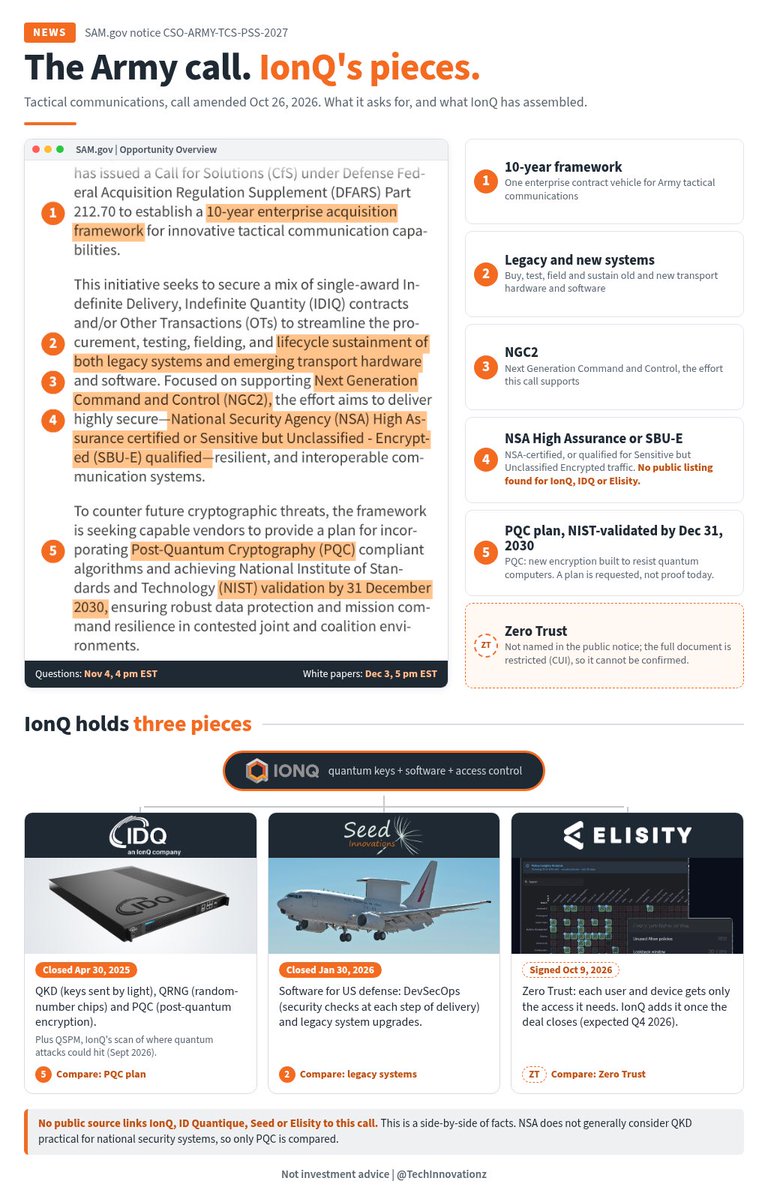
    $IONQ | Three acquisitions, one Army call: how they line up IonQ closed ID Quantique on Apr 30, 2025 and Seed Innovations on Jan 30, 2026. It signed Elisity on Oct 9, 2026 (closing targeted for Q4 2026). On Oct 26, 2026, the Army amended its TCS-PSS Call for Solutions on (CSO-ARMY-TCS-PSS-2027): a 10-year framework for tactical communications supporting NGC2 (Next Generation Command and Control). The public notice asks for NSA High Assurance or SBU-E systems, and a plan for PQC (encryption built to resist quantum computers) validated by NIST by Dec 31, 2030. Set side by side: ID Quantique brings quantum-safe networking already in operation, with QKD (keys carried by light), QRNG (chips that make unpredictable numbers for keys) and PQC, deployed on national networks in South Korea, Poland, Singapore, Switzerland, Slovakia and Romania. This is the piece that lines up with the PQC plan. QSPM, presented at IonQ's Investor Day on Sep 8, 2026, maps where an organization's systems are exposed to attack by quantum computers. It also lines up with the PQC plan. Seed Innovations brings delivery experience: DevSecOps (security checks at every step of software delivery) for US defense customers. USAspending lists $190.2M obligated across its prime awards, including Air Force Platform One orders ($29.7M), ABMS CBC2 ($26.8M) and Advana Edge ($31.4M). Elisity brings access control: Zero Trust software (IdentityGraph) that gives each user, device or AI agent only the connections it needs. Zero Trust is not named in the public TCS-PSS notice, and the full document is restricted, so this is a possible fit. What the Army has said elsewhere: its Unified Network Plan 2.0 (March 2025) makes security based on Zero Trust principles one of its five lines of effort, and an Army official said in 2024 that Zero Trust is not possible without ICAM (identity, credential and access management) on its tactical ICAM program. When PQC protects the data, Elisity limits who can access it. Together, a complete defense. No public record links IonQ to this call, and I found no public NSA High Assurance or SBU-E certification for IonQ products. IonQ is positioned to respond to it. 🔗 #IonQ #Quantum #DefenseTech
    Download
    14503.5K
  11. TechInnovation✓@TechInnovationz
    $IONQ SkyWater SP90 photonics wafers have shipped SkyWater says so on LinkedIn, alongside a closer look at SP90, its 200 mm silicon nitride platform. Photonics means chips that guide light. SkyWater describes SP90 as "customizable to support your application" in quantum, sensing, communications and more. The page lists six modules: routing, fiber connections, on-chip lasers, bonded diamond, single-photon detectors and thin-film lithium niobate. Startups do not need their own fab to use it. Through OnRamp, SkyWater's engineers help scope a foundry-validated roadmap, and selected companies can get early wafers through paid access to SP90 prototype runs. The innovation remains the startup's. On LinkedIn, SkyWater adds that module availability and qualification depend on each program, with the fully qualified platform expected in 2027. SP90 is one of the two platforms of SkyWater Quantum Solutions, launched September 8 under Dr. Mihir Bhaskar, senior vice president and general manager, previously IonQ's senior vice president of R&D. On October 13, SkyWater and D-Wave signed a multi-year agreement extending a collaboration of more than ten years. SkyWater describes itself as an open-access foundry supporting a wide range of quantum hardware modalities. #QuantumComputing #Photonics
    Download
    TechInnovation @TechInnovationz
    $IONQ SkyWater just launched OnRamp: free access to its fab engineers for early-stage quantum startups, to help turn lab prototypes into manufacturable chips. OnRamp is SkyWater's new program for quantum startups. A foundry is a factory that makes chips for other companies, and SkyWater says commercial foundries usually require strict design rules and large volume commitments up front. Selected startups work directly with SkyWater's engineers. They review the design, its materials and its packaging, and check whether it can really be manufactured. Each startup leaves with a written, foundry-validated manufacturing roadmap it can use to support fundraising. It keeps full ownership of its design and process IP. Mihir Bhaskar, who runs SkyWater's quantum unit and co-founded Lightsynq, wrote on LinkedIn: "I've experienced firsthand how challenging it can be for startups and university spin-offs to work with foundries". The roadmap is built around SP90, SkyWater's 200 mm silicon nitride photonics platform. Photonics means chips that guide light, and SkyWater says SP90 supports trapped-ion, neutral-atom and photonic machines, quantum networks and sensors. Selected teams can also get early access to SP90 wafers from SkyWater's own development runs, ahead of the full platform launch, which SkyWater has said it expects in 2027. Those wafers are paid, at low-volume pricing SkyWater calls cost-effective. Who can apply: photonics startups, university spinouts and grant-backed teams in quantum, sensing and communications. NSF X-Labs teams, from a US federal research program, get a special welcome. SkyWater picks projects on technical fit, readiness and engineering capacity. SkyWater has been part of IonQ since July. On IonQ's August 5 earnings call, CEO @NiccoloDeMasi said the plan is "supporting every player in our sector who works with us presently or would like to begin working with us." #IonQ #SkyWater #QuantumComputing
    39683.9K
  12. TechInnovation✓@TechInnovationz
    $IONQ SkyWater just launched OnRamp: free access to its fab engineers for early-stage quantum startups, to help turn lab prototypes into manufacturable chips. OnRamp is SkyWater's new program for quantum startups. A foundry is a factory that makes chips for other companies, and SkyWater says commercial foundries usually require strict design rules and large volume commitments up front. Selected startups work directly with SkyWater's engineers. They review the design, its materials and its packaging, and check whether it can really be manufactured. Each startup leaves with a written, foundry-validated manufacturing roadmap it can use to support fundraising. It keeps full ownership of its design and process IP. Mihir Bhaskar, who runs SkyWater's quantum unit and co-founded Lightsynq, wrote on LinkedIn: "I've experienced firsthand how challenging it can be for startups and university spin-offs to work with foundries". The roadmap is built around SP90, SkyWater's 200 mm silicon nitride photonics platform. Photonics means chips that guide light, and SkyWater says SP90 supports trapped-ion, neutral-atom and photonic machines, quantum networks and sensors. Selected teams can also get early access to SP90 wafers from SkyWater's own development runs, ahead of the full platform launch, which SkyWater has said it expects in 2027. Those wafers are paid, at low-volume pricing SkyWater calls cost-effective. Who can apply: photonics startups, university spinouts and grant-backed teams in quantum, sensing and communications. NSF X-Labs teams, from a US federal research program, get a special welcome. SkyWater picks projects on technical fit, readiness and engineering capacity. SkyWater has been part of IonQ since July. On IonQ's August 5 earnings call, CEO @NiccoloDeMasi said the plan is "supporting every player in our sector who works with us presently or would like to begin working with us." #IonQ #SkyWater #QuantumComputing
    Download
    47588.2K
  13. TechInnovation✓@TechInnovationz
    $IONQ On October 26 in New York, at Inside Quantum Technology's PQC+IQT conference, IonQ's public sector quantum security chief, Charles Robinson, put one idea on a slide: "Crypto-Agility Is a Control-Plane Upgrade". The idea: keep key exchange out of the data path, so keys can be updated centrally as NIST standards evolve, without replacing the encryptors already in place. That is what IonQ's Clarion KX does, delivering PQC and QKD keys to those encryptors. Its case studies include South Korea's national quantum-safe network, linking 48 government departments over 800 km. On October 27, NIST made its post-quantum deadlines official: the need for this kind of agility is now on the calendar. #IonQ #PQC
    Download
    TechInnovation @TechInnovationz
    $IONQ NIST made its post-quantum deadlines official today: RSA and elliptic-curve cryptography will be deprecated after 2030 and disallowed after 2035 under NIST standards. IonQ's own September study estimated that a trapped-ion machine of about 20,000 qubits could break a 256-bit elliptic curve in roughly 26 days. The final NIST IR 8547 widens the 2024 draft: for digital signatures, the 2030 deprecation now covers all quantum-vulnerable algorithms, not just the 112-bit level. Federal high-value systems go first: key establishment by December 31, 2030, digital signatures by December 31, 2031. NIST's answer to the complexity is "building long-term cryptographic agility into organizational infrastructure to allow for seamless updates as post-quantum standards evolve". Today, IonQ is in a position to support government agencies in this transition with real PQC and QKD deployments, as its recent blog on the Geneva-Seoul network shows. #IonQ #PQC #PostQuantum
    12281.8K
  14. TechInnovation✓@TechInnovationz
    $IONQ NIST made its post-quantum deadlines official today: RSA and elliptic-curve cryptography will be deprecated after 2030 and disallowed after 2035 under NIST standards. IonQ's own September study estimated that a trapped-ion machine of about 20,000 qubits could break a 256-bit elliptic curve in roughly 26 days. The final NIST IR 8547 widens the 2024 draft: for digital signatures, the 2030 deprecation now covers all quantum-vulnerable algorithms, not just the 112-bit level. Federal high-value systems go first: key establishment by December 31, 2030, digital signatures by December 31, 2031. NIST's answer to the complexity is "building long-term cryptographic agility into organizational infrastructure to allow for seamless updates as post-quantum standards evolve". Today, IonQ is in a position to support government agencies in this transition with real PQC and QKD deployments, as its recent blog on the Geneva-Seoul network shows. #IonQ #PQC #PostQuantum
    Download
    27393.8K
  15. TechInnovation✓@TechInnovationz
    Posts @TechInnovationz
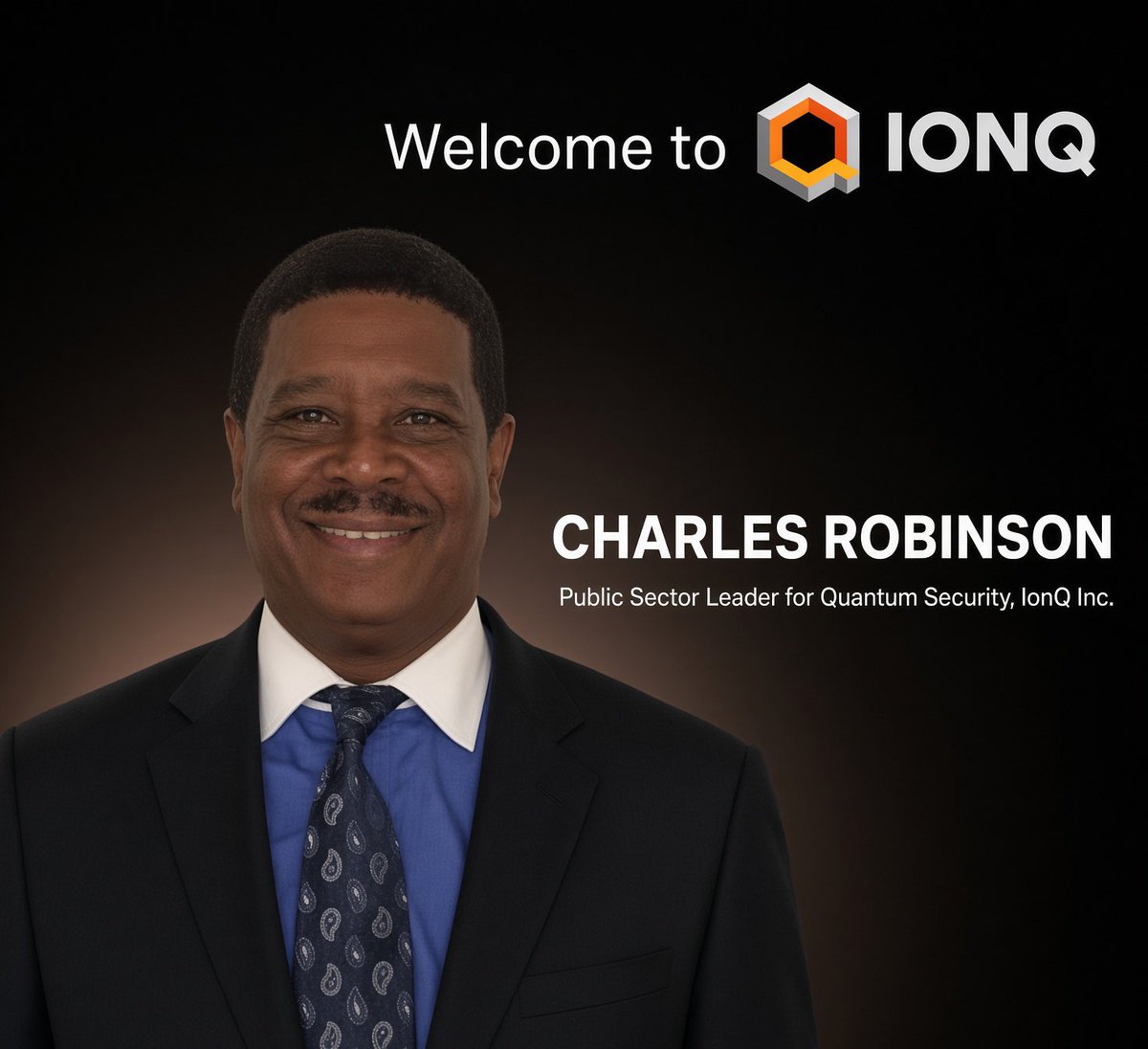
    Charles Robinson ⬇️
    Download
    TechInnovation @TechInnovationz
    $IONQ just hired IBM’s public sector quantum security lead. Charles Robinson spent seven years as Public Sector Leader for IBM Quantum Computing and worldwide head of the Quantum Safe Team. Before that he ran IBM Federal’s DOD Intelligence business as Client Executive. IonQ created the role. Q-Day is moving left, military networking contracts already exceed $100 million, and the company just launched commercial QKD on municipal fiber. $IONQ #IonQ #QuantumSecurity
    002325
  16. TechInnovation✓@TechInnovationz
    $IONQ just hired IBM’s public sector quantum security lead. Charles Robinson spent seven years as Public Sector Leader for IBM Quantum Computing and worldwide head of the Quantum Safe Team. Before that he ran IBM Federal’s DOD Intelligence business as Client Executive. IonQ created the role. Q-Day is moving left, military networking contracts already exceed $100 million, and the company just launched commercial QKD on municipal fiber. $IONQ #IonQ #QuantumSecurity
    Download
    5221268.7K
  17. TechInnovation✓@TechInnovationz
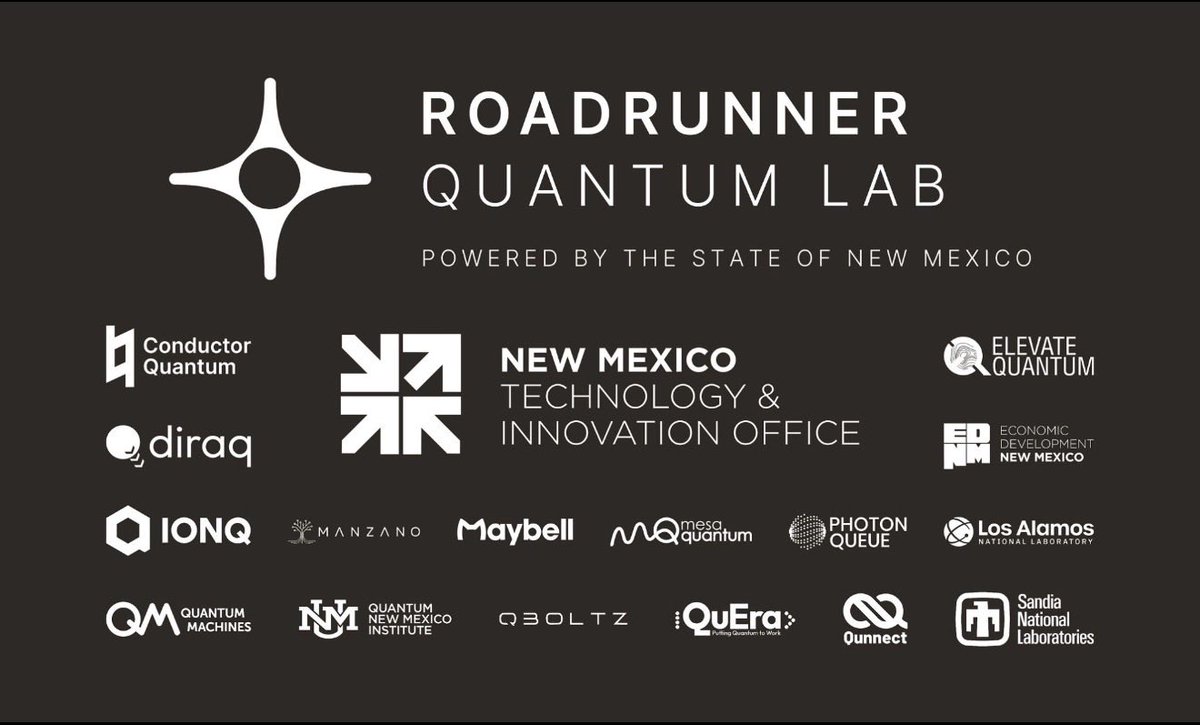
    $IONQ IonQ is hiring for defense in New Mexico. Two Staff Scientists in Quantum Applications (Defense) will be founding members of IonQ's new Customer Solutions team. They will work with national labs, government and industry on quantum algorithms for defense missions, test them against classical methods, and publish the results. Another role is opening soon in Chicago. IonQ is already building its presence in the state: On September 10, Jake Douglass, IonQ's Federal Capture Director, briefed New Mexico lawmakers on the state's quantum economy. IonQ signed an MOU with Sandia National Laboratories to explore quantum co-design at New Mexico's Quantum Demonstration Facility, for national security. On September 29, the Roadrunner Quantum Lab opened in Albuquerque, with IonQ among the companies at the facility. #IonQ #Quantum #NewMexico
    Download
    13291.8K
  18. TechInnovation✓@TechInnovationz
    Posts @TechInnovationz
    ⬇️
    TechInnovation @TechInnovationz
    $IONQ briefed New Mexico lawmakers 19 days before this lab opened. On September 10, Jake Douglass, IonQ's Federal Capture Director after nearly 8 years at Sandia, told the Legislature's Science, Technology and Telecommunications Committee that the risk is research done in New Mexico and value created elsewhere. Asked for 2027 priorities, he named workforce and infrastructure. The lab is one anchor of the state's $450M quantum commitment. IonQ plans to use it and the Quantum Demonstration Facility, which Sandia and Los Alamos will help set up and run on site. Companies will work with the labs' scientists through cooperative research agreements. Scott Millard, IonQ's Chief Business Officer, said today the lab lets industry, national labs, universities and the State "collaborate to move quantum technology from research into real-world capability." 8 weeks before the building opened, IonQ announced an MOU with Sandia to explore quantum co-design at New Mexico's Quantum Demonstration Facility, for national security. $IONQ #IonQ #Quantum #NewMexico
    106434
  19. TechInnovation✓@TechInnovationz
    $IONQ briefed New Mexico lawmakers 19 days before this lab opened. On September 10, Jake Douglass, IonQ's Federal Capture Director after nearly 8 years at Sandia, told the Legislature's Science, Technology and Telecommunications Committee that the risk is research done in New Mexico and value created elsewhere. Asked for 2027 priorities, he named workforce and infrastructure. The lab is one anchor of the state's $450M quantum commitment. IonQ plans to use it and the Quantum Demonstration Facility, which Sandia and Los Alamos will help set up and run on site. Companies will work with the labs' scientists through cooperative research agreements. Scott Millard, IonQ's Chief Business Officer, said today the lab lets industry, national labs, universities and the State "collaborate to move quantum technology from research into real-world capability." 8 weeks before the building opened, IonQ announced an MOU with Sandia to explore quantum co-design at New Mexico's Quantum Demonstration Facility, for national security. $IONQ #IonQ #Quantum #NewMexico
    Download
    14374.4K
  20. TechInnovation✓@TechInnovationz
    Posts @TechInnovationz
    ⬇️
    TechInnovation @TechInnovationz
    $IONQ walked New Mexico lawmakers through the state's quantum economy September 10, Albuquerque. The state's Science, Technology and Telecommunications Committee heard Jake Douglass, Federal Capture Director at IonQ, and Jessi Olsen, CEO of Elevate Quantum, the federal quantum Tech Hub that covers New Mexico. The state has committed about $450M to quantum. Olsen counted 15 quantum companies there, up from 4 in October 2024. Douglass was born and raised in Roswell. Nearly 8 years at Sandia, a workforce role at Elevate, IonQ since May. #IonQ #Quantum #NewMexico
    005322
  21. TechInnovation✓@TechInnovationz
    $IONQ walked New Mexico lawmakers through the state's quantum economy September 10, Albuquerque. The state's Science, Technology and Telecommunications Committee heard Jake Douglass, Federal Capture Director at IonQ, and Jessi Olsen, CEO of Elevate Quantum, the federal quantum Tech Hub that covers New Mexico. The state has committed about $450M to quantum. Olsen counted 15 quantum companies there, up from 4 in October 2024. Douglass was born and raised in Roswell. Nearly 8 years at Sandia, a workforce role at Elevate, IonQ since May. #IonQ #Quantum #NewMexico
    Download
    17588.4K
  22. TechInnovation✓@TechInnovationz
    $IONQ New SEC filing: BlackRock's Schedule 13G/A shows 18,193,010 IonQ shares, or 4.6% of the class, as of September 30, 2026. #IonQ
    Download
    56525.6K
  23. TechInnovation✓@TechInnovationz
    $IONQ 👏👏
    Qollab @qollabxyz
    Congratulations to the local winners of the Qollab x @IonQ_Inc Global Quantum Hackathon 🎉 Teams entered 327 open-source quantum projects, from games and music to finance. Explore and run the winning projects from your browser:
    0120940
  24. Qollab@qollabxyz
    Congratulations to the local winners of the Qollab x @IonQ_Inc Global Quantum Hackathon 🎉 Teams entered 327 open-source quantum projects, from games and music to finance. Explore and run the winning projects from your browser:
    Download
    17364.1K
  25. TechInnovation✓@TechInnovationz
    TechInnovation
    RT @IonQ_Inc: There's a new intercontinental data pathway between Geneva and Seoul—a post-quantum one. The data that traverses it—ours. This pathway is part of a multi-layered post-quantum security connection between our offices in Switzerland and South Korea. It's a model for governments and enterprises the world over. Financial loss. Damage to critical infrastructure. Reputational harm. Toppled stability. Without quantum-level security, many pitfalls lie ahead. But our hybrid solution, which leverages both quantum key distribution (#QKD) and post-quantum cryptography (#PQC), points the way to quantum-level security. Read the full blog → #IonQ #QuantumIsNow #FutureOfQuantum #QuantumSecurity
    0260140
  26. Show more posts