Bytebytego✓

@bytebytego

Weekly system design topics you can read in 10 mins.

2 Following137K Followers2.3K Posts
  1. Bytebytego✓@bytebytego
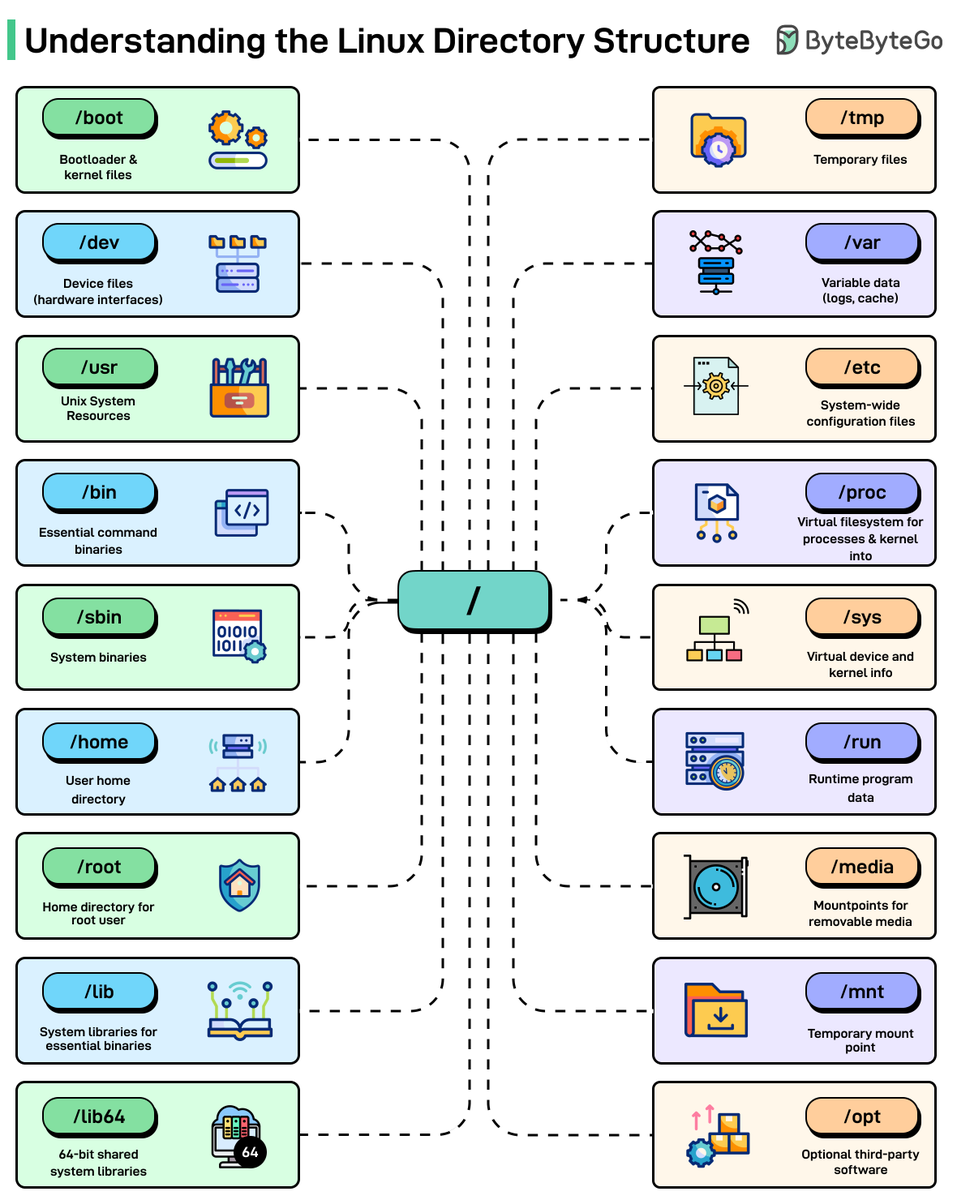
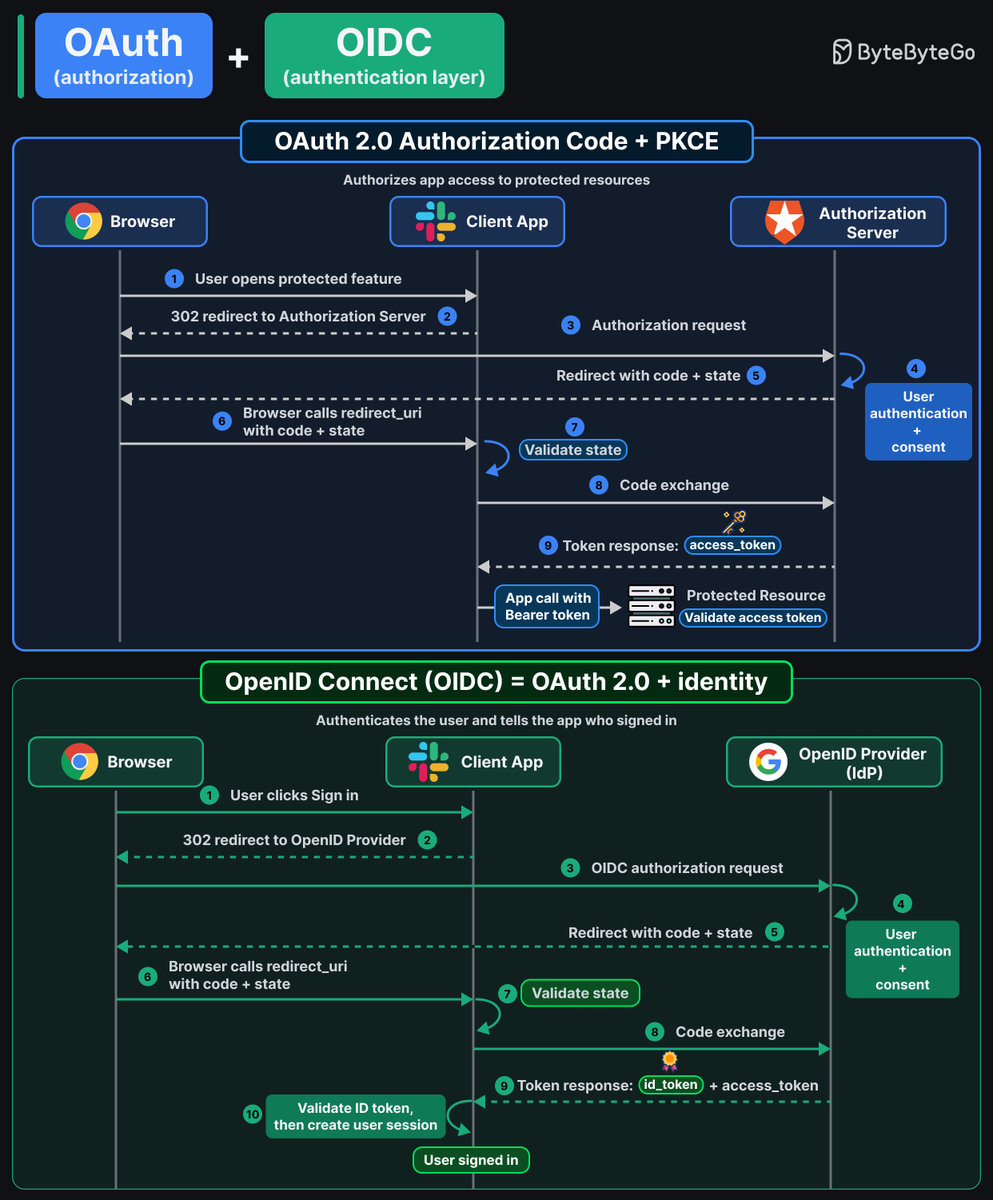
    The Big Archive for System Design - 2023 Edition (PDF) is available now. And it's completely FREE. The PDF contains 𝐚𝐥𝐥 𝐦𝐲 𝐭𝐞𝐜𝐡𝐧𝐢𝐜𝐚𝐥 𝐩𝐨𝐬𝐭𝐬 published in 2023. What’s included in the PDF? 🔹 Netflix's Tech Stack 🔹 Top 5 common ways to improve API performance 🔹 Linux boot Process Explained 🔹 CAP, BASE, SOLID, KISS, What do these acronyms mean? 🔹 Explaining JSON Web Token (JWT) to a 10 year old Kid 🔹 Explaining 8 Popular Network Protocols in 1 Diagram 🔹 Top 5 Software Architectural Patterns 🔹 OAuth 2.0 Flows 🔹 What does API gateway do? 🔹 Linux file system explained 🔹 18 Key Design Patterns Every Developer Should Know 🔹 Best ways to test system functionality 🔹 Top 6 Load Balancing Algorithms 🔹 Top 12 Tips for API Security 🔹 𝐀𝐧𝐝 100+ 𝐦𝐨𝐫𝐞 – Like, follow and subscribe to our newsletter to receive the PDF download link:
    Download
    28143784145K
  2. Bytebytego✓@bytebytego
    Bytebytego
    RT @alexxubyte: It's been 7 years from GPT-2 to GPT-6, and a lot has changed. The diagram below shows each generation and its key highlights, based on the public information we know. GPT-2 (2019): More like a prototype to validate the potential of the decoder-only transformer. This was a 1.5B-parameter model that only went through pre-training with next-token prediction. The trained model was only capable of continuing text, not answering questions. GPT-3 (2020): The same recipe as GPT-2, just much bigger and trained on more data to test how far scale alone could go. GPT-3 had 175B parameters, more than 100 times the size of GPT-2, and still only went through pre-training. The scale allowed it to show in-context learning capabilities. When shown some examples, the model could follow them. GPT-4 (2023): On top of pre-training, OpenAI fine-tuned it with RLHF (reinforcement learning from human feedback), so it was not just a completion model but could actually answer questions. It was also multimodal, meaning that it could process input images as well as text, and it handled up to 32K tokens of context. GPT-5 (2025): The first GPT generation with built-in reasoning. Given a prompt, tools, and an effort level, the trained model could generate reasoning tokens before the answer. Its context window grew to 400K tokens, with a router in ChatGPT to decide when a prompt needed thinking mode. GPT-6 (2026): This new model has a bigger context window (1.05M), supports async tool calling, and is generally safer. An interesting feature, called mid-turn steering, is that it can take a new instruction while it's thinking.
    0170823
  3. Bytebytego✓@bytebytego
    Bytebytego
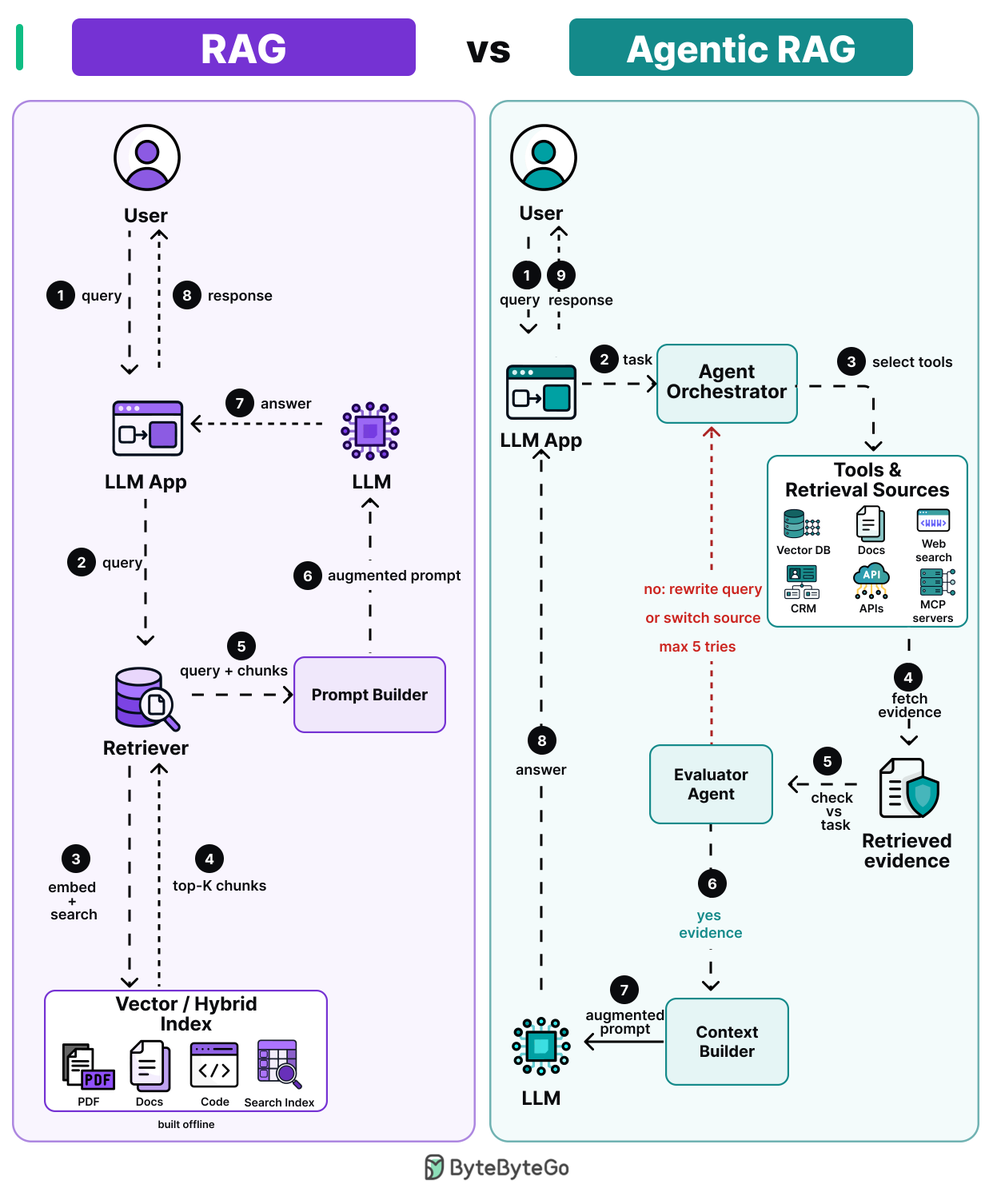
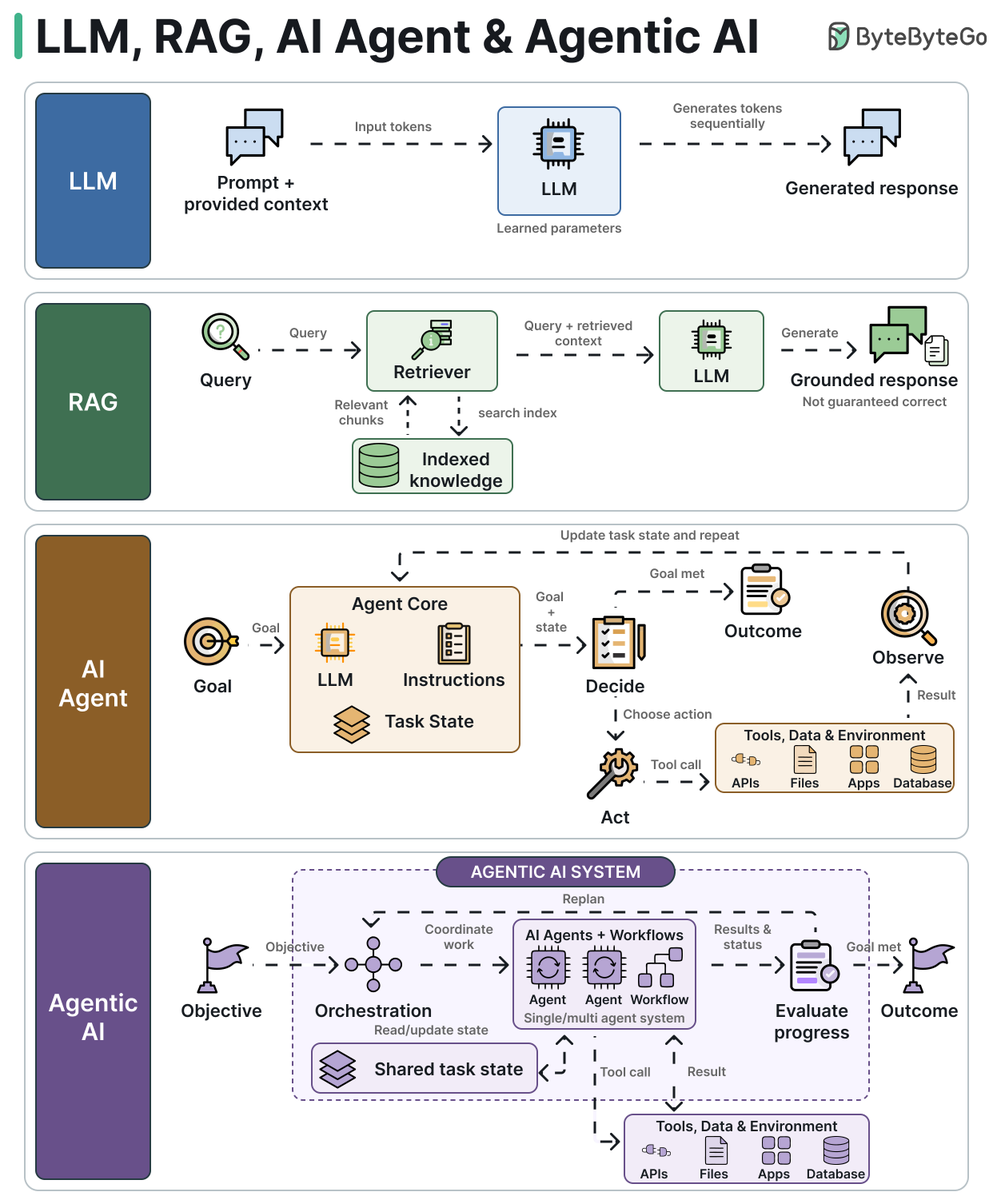
    RT @alexxubyte: 5 AI Building Blocks Every Engineer Should Know - LLMs - Embedding Models - RAG - Agent Harnesses - World Models
    0460963
  4. Bytebytego✓@bytebytego
    Bytebytego
    RT @alexxubyte: Google Translate: The Ideas Behind Neural Translation A simplified illustration of common techniques. Not an exact map of Google Translate’s current system.
    0100964
  5. Bytebytego✓@bytebytego
    Bytebytego
    RT @evelovesolive: EBRMs seem to be good for general combinatorics not just sudoku!
    Alex Xu @alexxubyte
    0701.4K
  6. Bytebytego✓@bytebytego
    How do you actually test your code nowadays?
    Alex Xu @alexxubyte
    How to Test Your Code. Even When AI Writes It.
    01165K
  7. Alex Xu✓@alexxubyte
    How to Test Your Code. Even When AI Writes It.
    Download
    37344835K
  8. Bytebytego✓@bytebytego
    Bytebytego
    RT @alexxubyte: Top 6 Techniques to Make Your AI System Efficient Serving LLMs at scale is expensive. These 6 popular techniques reduce latency and cost, and make your system more efficient.
    0220971
  9. Bytebytego✓@bytebytego
    If you want to redo it yourself, here's the GitHub repo with step-by-step instructions you can follow:
    Bytebytego @bytebytego
    Watch an ex-YouTube engineer rebuild YouTube in 45 minutes. By the end it's running: - Home feed - Video upload to the cloud - Video playback from the cloud - Data in a real database - Search, using multimodal embeddings - Deployed to a real URL All of those explained in under an hour.
    037410.8K
  10. Bytebytego✓@bytebytego
    Watch an ex-YouTube engineer rebuild YouTube in 45 minutes. By the end it's running: - Home feed - Video upload to the cloud - Video playback from the cloud - Data in a real database - Search, using multimodal embeddings - Deployed to a real URL All of those explained in under an hour.
    Download
    895731167K
  11. Bytebytego✓@bytebytego
    Bytebytego
    RT @alexxubyte: Jev is TypeSafe AI's first System One Model. It is 100x faster and cheaper than frontier LLMs. That opens up a lot of use cases people usually skip because the big models are too slow or too expensive for them. Here are 9 use cases where we think Jev could be used instead of an LLM.
    03380942
  12. Bytebytego✓@bytebytego
    Bytebytego
    RT @juberti: @zahanm and I sat down with the ByteByteGo team for a deep dive on the GPT-Live system. It's nicely illustrated and gets into a few details that we weren't able to cover in our previous GPT-Live blog post. Check it out!
    Alex Xu @alexxubyte
    0701.4K
  13. Alex Xu✓@alexxubyte
    145050783.9K
  14. Bytebytego✓@bytebytego
    GPT-Live is the most natural, conversational voice model we've tried. Under the hood, it pairs a new generation of voice model architecture with a serving system built for low latency. To understand how it all works end to end, we sat down with two engineers on the GPT Voice team: Zahan Malkani and Justin Uberti (the creator of WebRTC). In our deep dive, you'll learn: - The three generations of voice systems: cascaded pipelines, turn-based end-to-end models, and full-duplex models - Why separating thinking from talking is the core idea behind GPT-Live - The engineering behind the serving system, including the live and async paths - How evaluation differs for full-duplex voice systems - Lessons for building realtime systems, and what's next for voice
    Alex Xu @alexxubyte
    36226.6K
  15. Bytebytego✓@bytebytego
    Bytebytego
    RT @alexxubyte: 🚀 Announcing ByteByteGo Live: learn AI live from real builders. I’ve spent the past 8 years on education: thousands of hours writing books, deep dive newsletters, YouTube, etc. Two issues I keep seeing are: 1) it’s very different to learn from real builders. 2) most online courses never get finished (~4% completion). Over the past 12 months, we’ve been working on what we can do to change that. Today, I’m excited to announce ByteByteGo Live: live cohort courses taught by real builders. - Taught by real builders. Our instructors include very senior engineers from Google, Meta, etc., as well as @KentBeck , the creator of TDD. They teach what they use in their own work. - Live cohorts. Every course runs live with a group of people, and instructors answer your questions in real time. The current lineup: - AI Engineering Fundamentals - Build with Claude Code - Build Production Grade AI Systems - Rebuild YouTube with AI - AI Evals in Practice - AI Cost Optimization - Trust-optimized AI Development We have big plans for the year ahead: more courses, more instructors, and deeper hands on projects. Check out and let us know what you think.
    0230966
  16. Show more posts