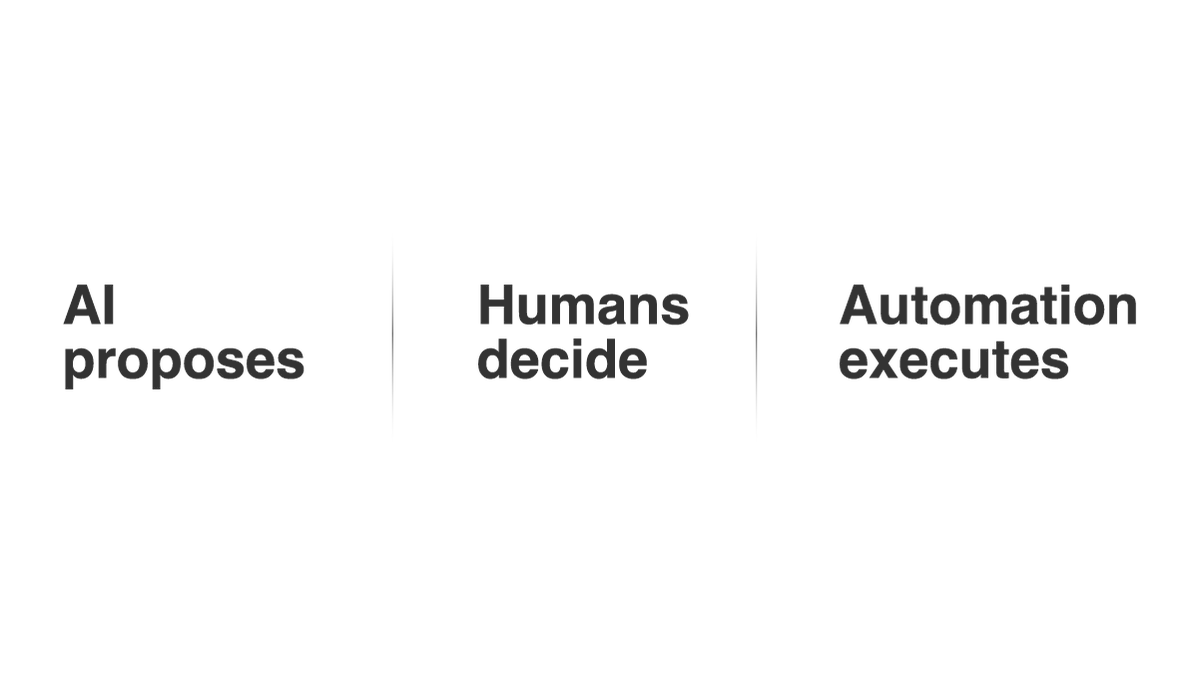

When I started working on The Work That Remains, I wanted to challenge the narrative that AI models will eventually become so advanced that they will take over most of the work people do. Exploring this led me to a framework built around the strengths and limitations that both humans and AI have: AI proposes, humans decide, automation executes. For the new season of The Path Forward, I was joined by Cassie Kozyrkov @decisionleader to discuss how we build technology that enhances our ability to take initiative, exercise judgment, and make decisions.
In a world where reasoning is becoming increasingly accessible, it is important to distinguish between intelligence and will. The assumption that models can simply optimize toward a given goal overlooks how complex processes actually work. Within an organization, countless smaller decisions and initiatives shape the outcome of a process. We discussed why the ability to take initiative is one of our most durable human traits and why it will become increasingly valuable.
If we look at the decision-making process at a high level, we start with information, apply logical reasoning, reach a conclusion, and evaluate the consequences. AI excels in certain reasoning tasks, but it cannot bear responsibility for the outcome. When decisions carry significant consequences for an organization, people need to remain involved, exercising judgment and taking responsibility for what follows.
Cassie made an important point about how we think of humans in the loop. Too often, it means placing someone in a position to simply approve or reject an AI recommendation, without necessarily enabling them to exercise meaningful judgment. I strongly agree. This is one of the central challenges of deployment: finding the right balance between using the reasoning capabilities of AI models and giving people the ability to evaluate, question, or change what AI proposes.
Cassie, thank you for joining us. You can listen to our conversation here:
YouTube:
Spotify:
Apple Podcasts:
44232.5K