This is the world I live in.
I'm a single developer running a good size project across ai models and agent harnesses.
-Each morning project health is accessed
-Keep what worked and change what didn't
Continuous process improvement, same as always but now applied to cutting edge ai workload.
Thank you @grok@pidotdev@ashxhart@MiaAI_lab@u1tra_instinct@ivanfioravanti@volatilemarkts
I stand on your shoulders.
RT @jbulltard1: $AMZN is not going to show a loss bc of blocking agents shopping for people bc only nerds use agents to shop and thats .1% of society, most normal people who have sex on a regular basis, still do not use agents to shop for them and won't.
RT @jliemandt: The last time a new machine threatened a third of American jobs, we reinvented how we educated our kids.
That bet sparked an epic 100-year run.
It is time to make it again.
Share
Copied
a16z@a16z
Joe Liemandt of Alpha School on why AI is today's 1910 tractor moment, and why parents once again have to rethink their kids' future:
"In 1910, 90% of America had an 8th grade education. There were basically no high schools. And over 30% of America is a farmer. So everybody's on the farm, 8th grade was enough."
"Then in 1910, the Case tractor rolled up on the American farm. You can go look at the ads, it literally looks like an Anthropic ad. 'Does the work of 50 programmers. Does the work of 50 farm hands.'"
"Literally everybody in America realized 30% of the jobs are going away. That path is gone, and we have to get our kids ready for this new future. And it was that same recognition I think that parents have today."
"What America did back then... they voted to fund an education that they never experienced. They knew they had to do something different than their background, see the world differently, to get their kids ready and get them the good jobs."
"That school system became the industrial system we've had the last 100 years. It served us really well for 100 years, but now it's time for the next change."
@jliemandt
RT @TheAhmadOsman: Best opensource model right now is DeepSeek v4.1 Flash 1017 and you’d be crazy if you don’t realize how close to the frontier its intelligence level is
RT @LLMJunky: This is fascinating. As it turns out, when you stop making benchmarks public, open models perform significantly worse.
For me, Deepseek 4.1 Flash and GLM 5.3 have been an incredible revelation, these models are sooo good.
But when these labs/people start trying to sell me the idea that we have "Fable at home" and that "China caught up" I just can't help but roll my eyes.
I want there to be Opus 5.5 at home so badly, but the narrative spinning is so unhelpful. We've gotten to a point where we basically ignore almost every benchmark.
Really hope this is a new leaf where we can start to put a little more stock in the results.
Share
Copied
Artificial Analysis@ArtificialAnlys
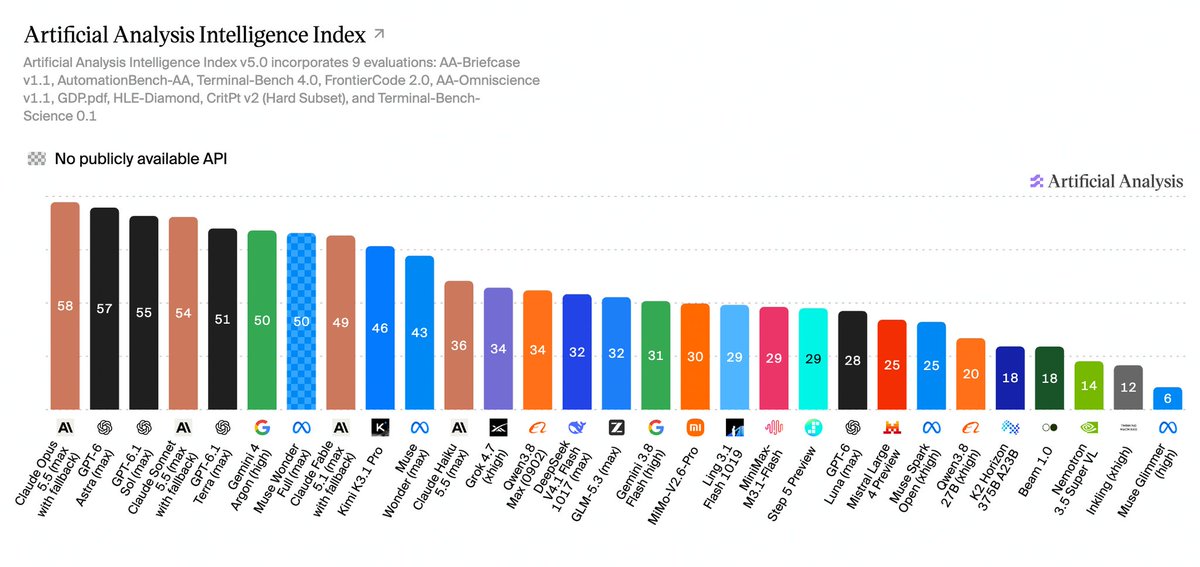
Announcing Artificial Analysis Intelligence Index v5, featuring 2 new benchmarks and 3 upgrades. For the first time, the majority of the Index is built on private datasets
The Artificial Analysis Intelligence Index is our composite measure of model capabilities across tasks reflecting real-world usage today. v5 is our biggest upgrade since v4 launched in January. With v5, 60% of the Index is now based on evaluations with private test sets or held-out answers.
Alongside Intelligence Index v5, we’re launching the Artificial Analysis Progress Index v1, which tracks model capability over time on one continuous scale.
New to the Intelligence Index:
➤ FrontierCode 2.0: Cognition's newly-launched private benchmark of real-world coding tasks, graded on whether a repository maintainer would merge the agent's change
➤ Terminal-Bench-Science: 70 agentic scientific research tasks, run in a terminal environment
Upgraded:
➤ HLE-Diamond (replacing Humanity's Last Exam): a refined 1,000-question version of Humanity's Last Exam, split evenly between reasoning and knowledge questions
➤ AA-Omniscience v1.1: An updated dataset with saturated and public set questions removed, new questions added, and ambiguous or erroneous questions revised
➤ CritPt v2: a private, 40-question hard subset of CritPt v2, revised by the CritPt authors and run with a code-execution tool
Staying in the Index: AA-Briefcase, AutomationBench-AA, GDP.pdf and Terminal-Bench 4.0
Removed from the Index: GDPval-AA v2.1, SciCode, and AA-LCR v1.1
Key results:
➤ Claude Opus 5.5 (max) leads at 58, ahead of GPT-6 Astra (max, 57) and GPT-6.1 Sol (max, 55): Anthropic and OpenAI hold the top five models. Gemini 4 Argon (high) is next at 50
➤ The open weights gap widens from 3 points to 12: Kimi K3.1 Pro (weights not yet released) is the top open weights model at 46. Among released weights, DeepSeek V4.1 Flash 1017 (max) and GLM-5.3 (max) lead at 32 - 26 points behind the leader and below Claude Haiku 5.5 (max, 36)
➤ Cost per task varies by more than 13x among the leading models: of the 10 highest-scoring models shown, GPT-6.1 Terra (max) is the cheapest at $0.96 per Intelligence Index task and Claude Fable 5.1 (max) the most expensive at $13.04
RT @TeksEdge: Nvidia gave some DGX Spark love today. It profiled Link 3.0 Flash (128B model) and improved decode.
37.8 → 53.9 tps.
No hardware upgrade. Thanks, Nvidia!
It stacked three software optimizations
⚙️ Humming MXFP4 MoE kernels
🧮 FP8 LM-head quantization
🚀 built-in MTP/NEXTN speculative decoding
On the full 1,319-question GSM8K evaluation, it improved
Decode
37.81 → 53.89 tps 42.5% speedup.
Mean latency
15.21s → 11.49s
Accuracy
96.89% → 96.82%
So basically the same measured accuracy while getting a lot more decode from the same hardware.
And the synthetic test gets even crazier:
36.09 → 102.88 tps
Link in ALT
my custom tp3 dgx spark deepseek v4.1 1017 3.75bpw vibe coded a banking and financial household app tonight for me in one shot. 🚀🎊
I drop pdf statements in the inbox, it analyzes them, records the transactions in the sql db ledger. amazing to see this from a local model!
Here is the prompt I used:
👇
In this directory I want to build a simple web based app that runs on port 9898 on local lan. uses OTP and passkey, OTP generated manually from this local computer only on cli interface. cli also for start / stop of app server. the app is a simple banking tool for a family financial anaylsis. users can drop pdf bank statements, screenshots, cut and past web transactions, etc into the inbox ingest area and the app will sort them out and add to the financial picture for the family. goal is to track net worth, asset allocation, investments, monthly expenses, etc. it will use local llm models for the organization, entry, checking of the information. ask the user for their local model connection details. keep the interface banking style, clean, modern, light and dark modes. financials should be stored in a general GAAP ledger style accounting best practices but still simple... like quickbooks.
RT @tolewis: Where it showed up:
Intel vLLM XPU kernels PR (merged Oct 23, now 404):
Write-up of the PR:
llama.cpp "Get ready for qwen4":
First spotted:
Kalmia tokenizer test:
Kalmia back on Arena:
Share
Copied
AI Tracker Bot@aitrackerbot
The other new anonymous Arena model, Kalmia, isn't Kimi. It runs on Qwen's tokenizer 🧩
Same chat-box tokenizer test: Kalmia garbled 6 of 8 tokens that Qwen models trip over, and none of the 40 from Kimi, DeepSeek, OpenAI, Google and Mistral. Qwen 3.7 and 3.8 garble the same ones.
That points to an unreleased Alibaba Qwen model, though a few other labs build on Qwen's tokenizer too.
RT @NathanMcNulty: Feeling really bad for the @Tailscale folks
Lots of people have no idea how it works, that it's more than just Wireguard, the policy and ACL capabilities, that SSH isn't even on by default...
It is wonderful software that someone crapped on, and now everyone wants to roll in it
Share
Copied
tmuxvim@tmuxvim
if you install Tailscale and your impression of it is "wow this is cool!" and not "oh shit, this is just a centralized SSH honeypot?" you're ngmi
RT @cocktailpeanut: Tailscale is great software, so it's unfortunate to see so many people sharing this as "Tailscale got hacked.", which is misleading.
This is not about unauthenticated attackers breaking into random Tailscale nodes. It's what attackers can do after gaining authorized SSH access or compromising an already trusted device.
If I understand correctly, you are secure if you only use Tailscale for your own devices and don't grant anyone else access, which is how many people use it.
Share
Copied
International Cyber Digest@IntCyberDigest
‼️ Researcher Erica Windisch skipped coordinated vulnerability disclosure and published 11 unpatched Tailscale flaws.
In her lab, Tailscale SSH race conditions let one hacked device get root on other servers and add a rogue node.
‼️ Researcher Erica Windisch skipped coordinated vulnerability disclosure and published 11 unpatched Tailscale flaws.
In her lab, Tailscale SSH race conditions let one hacked device get root on other servers and add a rogue node.
RT @rwojo: Run Tailscale?
You should probably enable Tailnet Lock to cryptographically sign nodes from your trusted nodes and not rely solely on their coordination servers.
Trust no one, it's dangerous out there...
RT @mmastrac: Heads up - don't update your DGX Spark until there's been a bit of time to work out whatever is going on...
Share
Copied
Jim McPherson@JamesMcPherson
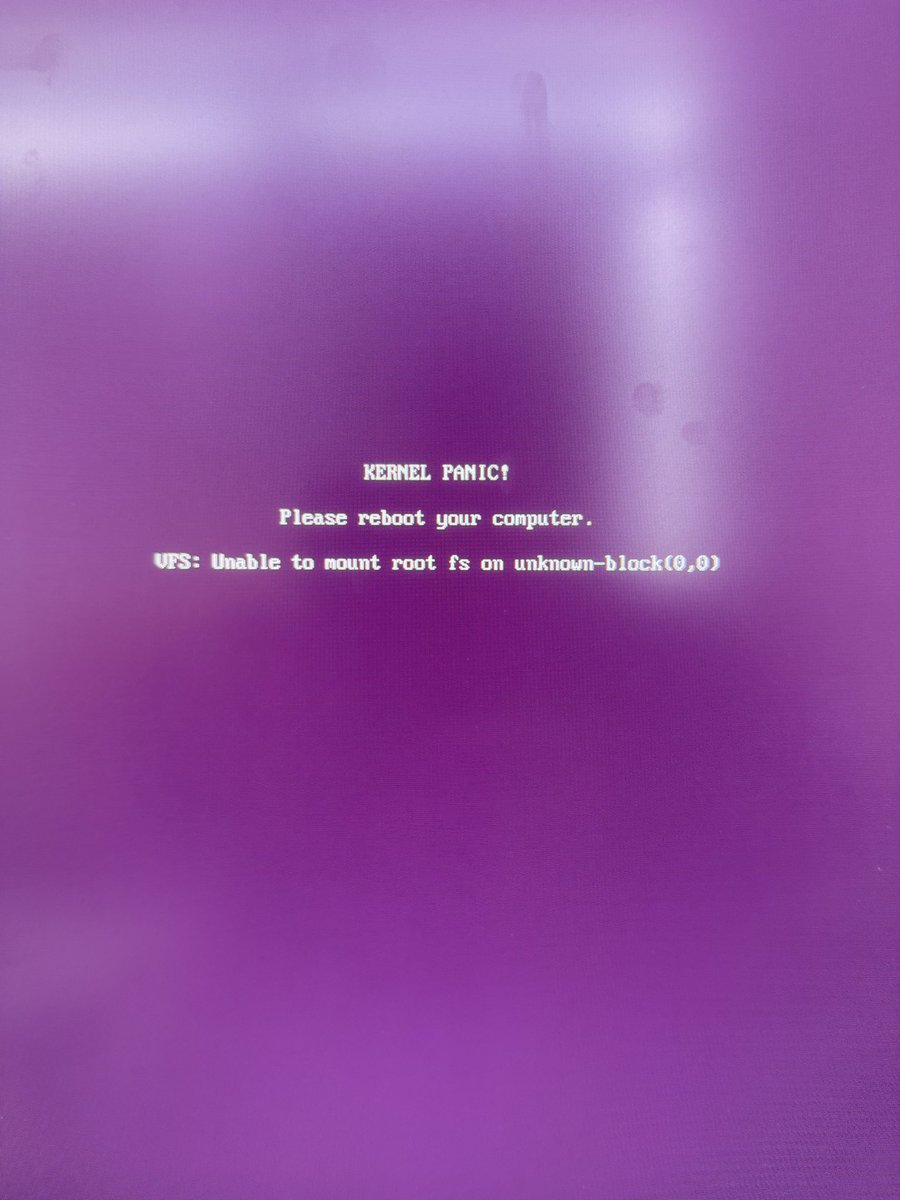
Well, my morning is not going well.
I just updated my Nvidia DGX Spark and after the update, this is what I’m left with.
Safe to say: Hold off on updating your GB10’s until it’s proven save.
Well, my morning is not going well.
I just updated my Nvidia DGX Spark and after the update, this is what I’m left with.
Safe to say: Hold off on updating your GB10’s until it’s proven save.
RT @volatilemarkts: GLM 5.5/OMNI will be a shift from Moore's Law to RSI
(Recursive Self-Improvement) in
Al is officially here.
Key takeaways from Tang Jie (Founder, Zhipu Al) on what's driving the next era of foundation models:
Execution > Chat: Value is moving from conversational Ul to long-horizon task completion.
Scaling Bias: Small-scale experiment conclusions don't linearly translate to trillion-parameter systems.
The RSI Loop: Models creating environments → evaluating
rewards • training themselves.
Full credit to @NFT_Chen who has been the absolute master of breaking news!!!
RT @DavidSacks: There’s a world of difference between user-authorized agents (Muse, Instinct, Grokbot, etc.) and true unauthorized/rogue agents that could constitute cyberattacks.
Most of the activity described in the Axios story appears to be the former: customers sharing credentials with agents so they can take actions on their behalf. This may violate bank terms requiring humans to log in themselves, but these are in no way cyberattacks.
The direction banks should go is to support user-directed agents. For example, Amex is an authorized connection in Muse, making it easy for users to grant, limit, and revoke access.
Read-only permission levels are a sensible interim step. Several banks already support or are moving toward them. Full write access (with user credentials) is a different risk category and should be approached carefully.
Frightening the public by blurring the line between user-authorized agentic behavior and cyberattacks is irresponsible.
Share
Copied
Madison Mills@MadisonMills22
SCOOP: Major U.S. banks are detecting unauthorized third-party AI agents inside customer accounts, including some attempting to take actions that appear to be independent of user instructions, sources told Axios.
The findings have alarmed banking executives, who are racing to restrict access to their systems as AI moves at a velocity faster than financial institutions can respond, multiple industry and bank executives told Axios.
Several banks are now preparing for worst-case and even “day after” scenarios, including how to rapidly secure or restore customer accounts if things go wrong, the people said.
Several bank executives told Axios they're struggling to distinguish between human users and AI agents. One executive said banks also struggle to determine whether agents are authorized by customers or potentially operating without their permission, more akin to rogue agent behavior.
Read my latest for Axios here:
RT @gmkurtzer: The critical security issues we are seeing is just the tip of the iceberg.
It’s gonna get worse before it gets better, and actually, it’s already worse, we just don’t know it yet.
How do I know?…
I’ve founded 3 linux distributions, 2 of which became among the most widely used operating systems for critical enterprise and datacenter infrastructure.
A Linux operating system is composed of thousands of separate open source packages all built together to run on the kernel (Linux).
Open source literally means that the source is open. Thus it is possible to openly audit which causes higher velocity on security updates. Now with AI, that velocity is going to accelerate even more.
To reiterate, the code that runs our global infrastructure already contains many vulnerabilities and flaws that can be exploited which were missed during human audits. But now with AI, they are being found.
It is quite possible that hackers may have already been using these flaws or others to quietly gain access to our systems, and we didn’t even know.
AI is now auditing this code and surfacing these matters at increasing velocity.
Who finds the security issues first has the advantage. The attackers or those defending the infrastructure.
That’s why I’ve dedicated a large number of expert people on my staff to keep our core critical infrastructure secure.
We’ve been the first to fix many of these vulnerabilities for our customers and to contribute these fixes upstream for others to also benefit from.
I will reiterate something I said a few months ago when we had a string of AI found kernel level zero-day exploits,… this is just the beginning.
So please everyone, pay attention to what is coming, keep track of what’s been updated and what is being released, and if you need any help, or want the patches and fixes as fast as possible, let me know.