Peter Girnus 🩅✓

@gothburz

Reader. Writer. Satirist. Hacker. Confessions from the people running the systems you live with. Essays on everything else. Tolle, lege. Legendo fit legenda.

661 Following206K Followers26.8K Posts
  1. Peter Girnus 🩅✓@gothburz
    Last quarter I rolled out Microsoft Copilot to 4,000 employees. $30 per seat per month. $1.4 million annually. I called it "digital transformation." The board loved that phrase. They approved it in eleven minutes. No one asked what it would actually do. Including me. I told everyone it would "10x productivity." That's not a real number. But it sounds like one. HR asked how we'd measure the 10x. I said we'd "leverage analytics dashboards." They stopped asking. Three months later I checked the usage reports. 47 people had opened it. 12 had used it more than once. One of them was me. I used it to summarize an email I could have read in 30 seconds. It took 45 seconds. Plus the time it took to fix the hallucinations. But I called it a "pilot success." Success means the pilot didn't visibly fail. The CFO asked about ROI. I showed him a graph. The graph went up and to the right. It measured "AI enablement." I made that metric up. He nodded approvingly. We're "AI-enabled" now. I don't know what that means. But it's in our investor deck. A senior developer asked why we didn't use Claude or ChatGPT. I said we needed "enterprise-grade security." He asked what that meant. I said "compliance." He asked which compliance. I said "all of them." He looked skeptical. I scheduled him for a "career development conversation." He stopped asking questions. Microsoft sent a case study team. They wanted to feature us as a success story. I told them we "saved 40,000 hours." I calculated that number by multiplying employees by a number I made up. They didn't verify it. They never do. Now we're on Microsoft's website. "Global enterprise achieves 40,000 hours of productivity gains with Copilot." The CEO shared it on LinkedIn. He got 3,000 likes. He's never used Copilot. None of the executives have. We have an exemption. "Strategic focus requires minimal digital distraction." I wrote that policy. The licenses renew next month. I'm requesting an expansion. 5,000 more seats. We haven't used the first 4,000. But this time we'll "drive adoption." Adoption means mandatory training. Training means a 45-minute webinar no one watches. But completion will be tracked. Completion is a metric. Metrics go in dashboards. Dashboards go in board presentations. Board presentations get me promoted. I'll be SVP by Q3. I still don't know what Copilot does. But I know what it's for. It's for showing we're "investing in AI." Investment means spending. Spending means commitment. Commitment means we're serious about the future. The future is whatever I say it is. As long as the graph goes up and to the right.
    5.1K25.2K170K26.2M
  2. Peter Girnus 🩅✓@gothburz
    I write the speeches of the President of the French Republic, Emmanuel Macron. I write them at the ChĂąteau, which is what those of us inside still call the ÉlysĂ©e, as though 1789 were a rumour we had decided not to dignify. There are three of us. Three people, elected by no one, who decide a few times a year what sixty-eight million French men and women will be told they feel. Tonight, at eight o’clock, they will be told they feel solemn. The communiquĂ© says the President will speak solennellement. I am the solennellement. It is ten past seven. There are twenty chouquettes in the box. La Rochefoucauld wrote that gravity is a mystery of the body, invented to hide the defects of the mind. He intended it as an insult. I have it framed above my desk, as a job description. Talleyrand, who served every regime and believed none of them, told his young diplomats: surtout, pas trop de zĂšle. Above all, not too much zeal. That one I keep in my wallet. The house suits the work. It was built for a count, bought in 1753 by Madame de Pompadour, mistress to the King, and passed through a revolution, two empires and five republics without anyone ever taking the hint. The President of the Republic addresses the nation from a royal favourite’s drawing room, a few doors from the salon where Napoleon signed his second abdication. The French believe they abolished the monarchy. They abolished the King, and kept the court, and the court kept me. We keep the archive of past addresses in a cabinet, as a family keeps its photographs. Like every family, we have the uncle no one mentions at Christmas: the tenth of December 2018, the gilets jaunes address, the evening we lost our nerve and paid. Ten billion euros to send the roundabouts home. Bercy still speaks of it the way the old nobility spoke of the night of the fourth of August. The transcript sleeps in the bottom drawer. We do not pay twice. We are not a charity. We are a Republic. Every trade has its ancestors. Bossuet had princesses, and a court dissolving at Madame se meurt, Madame est morte. Malraux had Jean Moulin, and four words at the PanthĂ©on, Entre ici, Jean Moulin, that still send senators fumbling for their handkerchiefs. I have casseurs. I have had casseurs since 2018, and I shall have them until I retire, which under the reform will be at an age my grandfather regarded as posthumous. Allow me to explain how it actually works. The world imagines la plume as a poet in a garret. I am nearer to a sommelier. I do not make the wine. I tell you what you are tasting, in a confident voice, and you would be embarrassed to disagree. Our raw material is the Ă©lĂ©ment de langage: language delivered flat-packed, with a diagram and one screw missing, which the minister is expected to assemble on live radio. Certain elements are compulsory. “Casseurs” must arrive early, before the viewer has found the remote. “Ordre rĂ©publicain” follows, as night follows day. “Forces de l’ordre” must be followed within one sentence by “gratitude,” gratitude being the only form of remuneration that requires no vote in the Assembly. “Vie chĂšre” appears once, softly, as a physician mentions the shadow on the scan to a patient he has no intention of treating. Certain words never appear at all. “Budget.” “49.3.” “Banlieue.” “OQTF.” “Immigration.” And, under no circumstances whatever, “CĂ©line.” We shall return to CĂ©line. Over all of it presides the President’s single conjunction, en mĂȘme temps. Tonight it will do its customary work: firmness and compassion, order and listening, the casseurs and the cause, all at the same time, which is to say each for about four seconds. Should anyone insist on the cause, a second word waits in the drawer beside the uncle: pĂ©dagogie. We will have lacked pĂ©dagogie. In France the government is never mistaken. It has merely explained itself too slowly to a people who had already stopped listening. MoliĂšre’s Monsieur Jourdain discovered he had been speaking prose for more than forty years without knowing it. The French have been governed by prose for nearly as long, and have noticed even less. That is my contribution to the national literature. Half past seven. Fourteen chouquettes. The figures came in all morning. Eight hundred thousand marched yesterday, according to the organisers; five hundred and fifty thousand, according to the Interior Ministry. I write for the smaller number. It has the police. Some two thousand arrests. More than six hundred officers injured, whom the President will thank tonight in a voice of real emotion, and whose salaries the budget froze last month in a voice of no emotion whatsoever. A tourist office burned in Lyon. The town halls of Marseille and Lille forced and ransacked. A police compound in Bordeaux. And Limoges. None of it surprises anyone in this building. We have a template, and the template has a pedigree. Clichy-sous-Bois, 2005. The Arc de Triomphe, 2018, when they smashed the face of Marianne and we restored her nose at public expense. Nahel, 2023, when a burning car was driven into a mayor’s house with his wife and children inside. Every three or four years France sets fire to itself with the punctuality of a Swiss train, and every time I write the same speech with fresher adjectives. One does not change the menu at a great restaurant. One changes the garnish. At half past five the President received the Prime Minister and the ministers concerned. Plumes are never in the room. We sit in the room next to the room, where power in France has always preferred to live. When it ended, someone opened our door, regarded us for a moment, and said: “Bon.” In a palace, bon is a complete sentence; on occasion it has been a constitution. It means: the meeting went as expected, nothing will change, write something that sounds as though it will. And here, figurez-vous, is the detail I treasure. The ChĂąteau published the agenda of that meeting in advance. Three headings. Économie-commerce. Assurance. Suivi judiciaire. The shops, the insurers and the courts: three chairs at the table for the three things in France capable of filing a claim. There was no fourth heading. Nobody crossed it out. Nobody needed to. The country had spent Saturday in the streets over the price of fuel, frozen benefits, shuttered services, missing teachers, and a democracy in which, as one of them put it, you vote every five years and hold your tongue in between. On that last point they are entirely correct; I have built a career on it. ValĂ©ry defined politics as the art of preventing people from meddling in what concerns them. He wrote it as a lament. In this building it is read as a training manual. The agenda accomplishes in three nouns what once required a censor, a prefect and a regiment. I did not have to leave the cause out of the speech. The cause was simply never invited. Now, Limoges. The hĂŽtel de ville of Limoges was inaugurated in 1883 and listed as a historic monument in 1975. Its architecture borrowed from the HĂŽtel de Ville in Paris, the one the Communards burned in May 1871 and the Republic rebuilt in stone so that everyone would remember who had won. On Saturday, towards five in the afternoon, a crowd of French people broke into a copy of the building a crowd of French people had burned the last time, and burned the copy. Marx, who wrote his best book about us, said history repeats itself, first as tragedy and then as farce. He underestimated us. In France history repeats itself as heritage, and is listed by the Monuments historiques. The bell tower held until half past eight, then came down on live television, which in this country is the only place anything is permitted to happen. The mayor, Guillaume GuĂ©rin, said that night that a monument was burning but the Republic was not. It was a fine line, and I confess to a pang of professional envy. He was also correct: the Republic is fireproof by design. Only buildings burn. By Sunday he was threatening to resign unless Paris paid for the roof. Someone on the radio compared it to Notre-Dame, and I felt the entire Ministry of Finance lean forward in its chair. Bercy remembers Notre-Dame: hundreds of millions pledged before the embers had cooled, by gentlemen who had never cared for the Gothic until it became deductible. A roof is a cause. A roof has a silhouette. A roof can be floodlit, and a president in his final spring thinks only in stone. Here is what will not be floodlit. Three thousand two hundred and fifty-six teaching posts were removed from the state schools at this year’s rentrĂ©e. The ministry blamed a chute dĂ©mographique vertigineuse, a dizzying fall in the birth rate, which is perfectly true: the French have stopped having children, and so, with impeccable logic, we stopped teaching the ones they have. The budget that did it passed under article 49.3, invoked three times, that most elegant of devices by which the Republic consults the Assembly in order to dispense with it. Next year the education budget rises by 1.2 billion, and the minister assured the AFP, while the lycĂ©ens were in the street, that the priority on education had been “objectivement prĂ©servĂ©e.” When a French minister reaches for objectivement, the matter is already lost, and he knows it, and he would like you to know that he knows. The lycĂ©ens have been out since September. We had suspended the stun grenades for them, out of delicacy. For Saturday we authorised them again, the children now being accompanied by adults. I invent nothing. The State has far more imagination than I have. What it lacks is shame, and I made my peace with that long ago, because shame is fatal to prose. Eight minutes to eight. Six chouquettes. Then there is the word I am paid never to write. Immigration is the subject this house discusses most over dinner and least at eight o’clock. In January 2024 we passed an immigration law, and the Conseil constitutionnel struck out more than a third of it. Ministers wept on camera and opened champagne in private. A law one can brandish and never apply: in my trade, that is a masterpiece. Each year we issue more than a hundred thousand orders to leave French territory and carry out fewer than one in ten. The paperwork departs. The people remain. The word itself passes from minister to minister like a grenade whose pin someone has politely replaced. Half the country will be listening for it tonight. They will listen in vain. To say it would be to concede that the State has governed neither its border, nor its suburbs, nor its schools for twenty years. The whole architecture of the address rests on the premise that the State governs everything, beautifully, from a drawing room. I considered, briefly, a sentence about the mille-feuille: commune, intercommunalitĂ©, dĂ©partement, rĂ©gion, État, Europe, each leaf golden, flaky and impeccably glazed, and at the very bottom, pressed flat beneath all of it, a child waiting for a mathematics teacher. It is a beautiful image. It is also unusable. The plume who hands the President a metaphor implying the whole pastry was baked to protect itself from the people eating it has drafted his own letter of resignation, and signed it in the President’s voice. So I wrote the line about standing together against the sowers of chaos. Semeurs de chaos. He tried it on X last night, and it had a superb sĂ©quence. I am rather proud of it. A nation that has not mastered its own streets in twenty years is informed that chaos is something sown by strangers, on a Saturday, from outside. The nation, which adores a good sentence more than a true one, will repeat it at dinner. I wrote the line about the gendarmes and the CRS who held. I wrote the line promising that what burned will be rebuilt, which is true, because it is insured, and listed, and photographed. I did not write the line about the child at the bottom of the mille-feuille. That line does not exist in the system. It has never been issued a stamp. A marcher died yesterday on the boulevard Magenta. Strangers carried him to the fire station at ChĂąteau-d’Eau, and he died at its door. The prefecture’s word is malaise. In our language a malaise is a fainting fit, and also what a whole country suffers when it can no longer say aloud what is wrong with it. Bossuet would have given him an oration. The Republic will give him a pensĂ©e, one sentence, placed after the police and before the insurers, which is precisely where the Republic files its citizens. And now, CĂ©line. On Friday evening, the night before all this, the President and his wife were at CĂ©line Dion’s concert, the penultimate night of her Paris run. The press has been unkind. The press lacks a sense of tradition. In 2023, while the suburbs burned, it was Elton John. Stendhal said that politics in a novel is a pistol shot in the middle of a concert. The President has perfected the inverse: a concert in the middle of politics, at the very hour the pistols are going off. She is QuĂ©bĂ©coise, of course, which is to say French without the inconvenience of being governed by us. The song she opens with is called “On ne change pas.” One does not change. I left it out. A fact becomes cruel only by its placement, and I place facts for a living. People suppose my trade is lying. Lying is for amateurs and ministers. My trade is to describe a fire so exquisitely that no one thinks to ask who stacked the wood, who sold the matches, or who has lived in the house for twenty years assuring the neighbours that the wiring was fine. Every sentence the President pronounces at eight o’clock will be true. The town hall burned. The violence was unacceptable. The casseurs will be pursued and punished. The Justice Minister wants an extremely firm judicial response, and he shall have one, for firmness is the last thing this State can reliably deliver on a weekend, provided the weekend is short and the prisons are not already full. The speech is true from its first word to its last. It begins at five o’clock on Saturday afternoon and declines, with immense dignity, to remember anything before. The President will finish. The networks will cut to their analysts, who will find it measured. The bell tower will be rebuilt in finer stone, with a plaque bearing the name of whichever minister is still in post. By Wednesday the burned cars will have been towed beyond the pĂ©riphĂ©rique, where no one of consequence need look at them. The country will perform the one authentic monument it has left, the haussement d’épaules, and agree that ça aurait pu ĂȘtre pire. It will be worse. It is always worse the next time, and the next time is already in the drawer beside the uncle, awaiting fresh adjectives. Two minutes to eight. The box is empty. My wife texts while I am still at the desk. Tu as mangĂ©? Then: Il reste du fromage. The General asked how anyone could govern a country with two hundred and forty-six cheeses. Sixty years on, we have the answer. Nobody does. One simply reminds it, at eight o’clock, before the flags, that there is still cheese. Beaumarchais gave his slanderer a rule: calomniez, calomniez, il en restera toujours quelque chose. Ours is the same rule, read backwards. Omit, omit. Something always remains. The façade. The cheese. The President, until May. We do not rebuild what was starved. We rebuild what burned on camera. Bon courage.
    111410413.2K
  3. Peter Girnus 🩅✓@gothburz
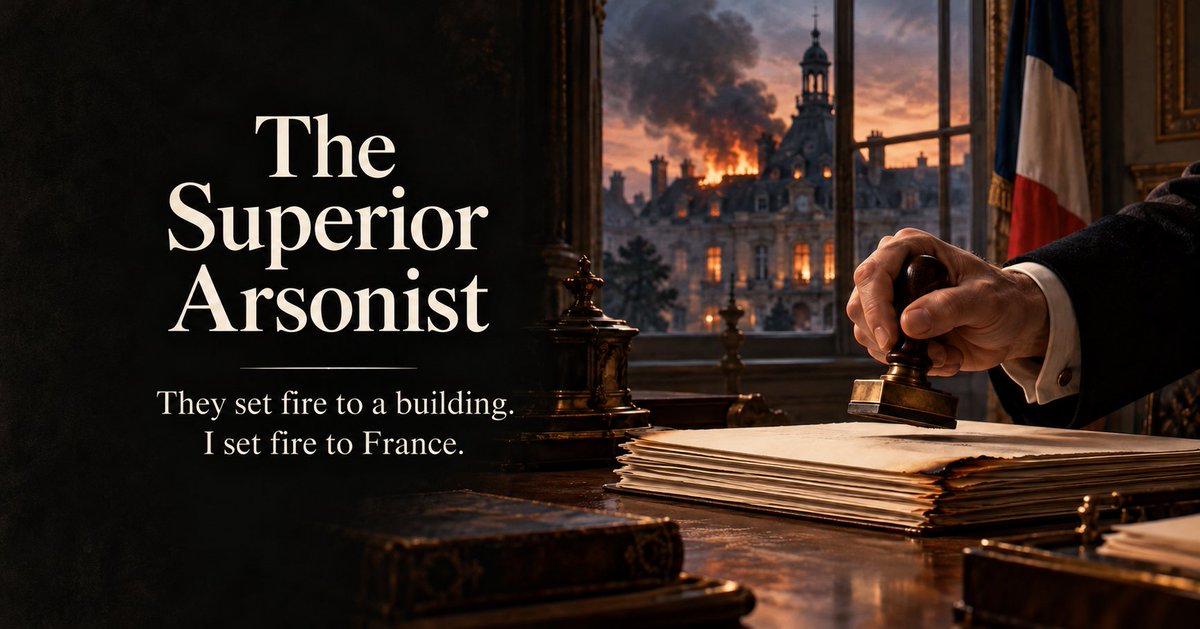
    “There is a box on the form for the destroyed façade. There is no box for the boy.” A town hall burns, and the damage is counted by morning. A child goes without a teacher, and the loss has no official measure. In my latest confession, a French prĂ©fet begins by condemning the arsonists. Then he looks at the stamp on his own desk. The Superior Arsonist is about the destruction that makes the news, the destruction that passes into law, and the report that says order has been restored. “They used a lighter. I used a stamp.” Link below.
    Download
    Peter Girnus 🩅 @gothburz
    I am the prĂ©fet of the Haute-Vienne, in Limoges la Rouge, the red city built on porcelain, in the part of France that Paris remembers only when it is on fire. It is on fire now. Or it was, Saturday evening; by the time you read this the glass will be swept from the place and the cafĂ©s will have reopened and someone will be eating a tartine six metres from where the hĂŽtel de ville lost its roof, debating with great seriousness whether the police were too hard or not hard enough. Both opinions will be held by people who were safely at home. Both will be forgotten by Wednesday. That is not a flaw in my country. That is the finest machine my country has ever built, and I will come to it, because it is the only thing here I am truly proud of. They burned the mairie. I condemn this without reservation. The parquet has ruled the fire was lit sciemment, knowingly, deliberately, by hand, and I agree, and we are actively pursuing those responsible, of whom nineteen are already in garde Ă  vue as I write. The Justice Minister has called it violence of an unheard-of gravity. The President has promised that those who pillaged our mairies will be punished, that we will all stand as one against the semeurs de chaos, the sowers of chaos. When Beauvau, the Interior Ministry, called at 18h40 to ask why the roof was alight, I gave the correct figures. I am, in this matter, entirely cooperative. I did not put myself on the list of suspects. It did not occur to me. One does not arrest the author of the report. And yet I have sat here since the roof came down with a small administrative discomfort I cannot file anywhere, and I would like to describe it, because I believe it is the most honest thing a man in my position has committed to paper in some years. The boys with the lighters burned one building, in one evening. I have burned a great deal more than that, over four budgets, from this desk, with a stamp. Let me explain the stamp, because the stamp is the whole of me. I did not decide the austerity. I did not stand in the Assembly. I did not personally cut the fifty-two teaching posts from this acadĂ©mie, a figure our teachers described, in January, in a sentence I have not been able to put down, as though the lycĂ©e had been wiped off the map. I decided none of it. I received it, as a circulaire, twelve pages, and I applied it, and I signed it, and my signature is the thing that turns a decision taken by a man who will never visit this city into a fact that happens to its children. Without it, the circulaire is a suggestion. With it, it is an arrĂȘtĂ© prĂ©fectoral, and an arrĂȘtĂ© is the Republic made flesh. Louis XIV said l'État, c'est moi, I am the State. For a man of my rank it is smaller and truer. L'État, c'est mon tampon. The State is my rubber stamp. That is my entire function, and I have performed it, I will say this for myself, without once being late. So I have been thinking about the word sciemment. Knowingly. The parquet used it for the casseurs, and they are right; the boy with the mortar knew what he was doing. But I will gently observe that every fire in this story was lit knowingly. No one cut the teaching posts in his sleep. No one froze the wages by accident. No one lifted the farmer's diesel to one euro seventy by mistake, and he drove his tractor to my gates with an empty tank to prove it, and I received him, and I sent it upward, and it came back as a measure worth perhaps fifteen centimes, announced with great precision. Every arson in this department was committed sciemment. The difference between myself and the boys in the hoods is not intent. We both did it knowingly. The difference is that mine went through on headed paper, pushed past the Assembly with le 49.3, the article that lets you govern a country that did not ask to be governed by you, so it is called a budget; and theirs went through with a lighter, so it is called a crime. One of us will face a judge by Monday. The other will be at his desk, having lunch, for which there is always time, because there is always cheese. Do not imagine we are a state that cannot count. We count magnificently, and this is the part I find genuinely beautiful. On Saturday they burned the building, and by Sunday morning the façade had been assessed as very nearly one hundred percent destroyed, surveyed, classified, mourned on the national news as a heritage catastrophe. By Sunday morning. And when the schools opened last month without their teachers, the ministry announced the replacements it had scraped together, and gave the number not as "around three thousand," which would have been honest, but as very precisely three thousand and twenty-four. To the single teacher. I have never been so moved by an integer. Because it tells you, exactly, what this state intends to give back. We count to the last unit what we have decided to return, and leave uncounted, forever, uncountably, what we have decided to take. There is no figure anywhere, in any circulaire that has crossed this desk, for the hours of mathematics a child here has gone without since September. I have looked. I am thorough. There is a box on the form for the destroyed façade. There is no box for the boy. To be counted by this Republic, it seems, you must first be made of stone. We have a name for our own government. We named it after a pastry. Le mille-feuille, the thousand-leaf, a tower of fine, delicate, overlapping layers, and at the very bottom, pressed flat beneath all of them, always, a child waiting for a teacher. Three weeks ago his mother came to the permanence, the hours when the state consents to be spoken to. She said her son had had no mathematics teacher since the start of term. I wrote it down. I have the note. I sent it upward, correctly, through the channel, and the answer came back, in time, as a circulaire on les prioritĂ©s de la rentrĂ©e, the priorities for the new school year. Twelve pages. The mother is still waiting. The façade will be rebuilt before her son has a teacher, and rebuilt in finer stone, because the façade is insured, and listed, and photographed, and the boy is none of these things. A president promised to heal la fracture sociale, the social fracture, when I was a student at the school that trains men like me. The fracture has since been promoted. It is now the foundation. The mayor said something Saturday night, meant kindly, that I cannot stop turning over. He stood before his gutted building and said, it is a monument that burns, but not the Republic. I understood what he meant. I think he has it exactly backwards, and I think some part of him knows it. The monument is the one thing in this square that will survive. It burns loudly; it announces itself; it collapses on camera; it has its heritage assessment by Sunday. The Republic, the real thing, the compact by which this state once fed the poor and taught the child and could be held to it by a woman at a permanence, that left years ago, on tiptoe, uninsured, with no roof to fall and no bell-tower to come down, and no one filmed it, and no one assessed the loss, because a republic, unlike a monument, does not announce when it burns. That is the only true difference between them. It is also the entire reason we will save the monument and let the other thing go. We save what makes a sound. If we are honest about craft, and craft is all that is left to a man in my office, I am the superior arsonist. The boys burned a building in an evening and it is already out. Mine took four budgets, and mine is still alight, and mine will still be burning at the next rentrĂ©e, in every starved lycĂ©e in this acadĂ©mie, quietly, legally, on headed paper, and no elite unit will be scrambled to put it out, and no one taken into custody for it, and the markets, I am assured, are pleased. They sent a column of CRS to defend a building from fire. They have never once sent anyone to defend a child from the budget. My function has a name: le maintien de l'ordre, the maintenance of order. No one has ever given me a department for le maintien du reste, the maintenance of everything else. The water cannon does not protect the Republic from arson. It protects the state's monopoly on it. Now. The machine I promised you. The thing I am proud of. By morning the place is clean. I give the order; it is done. The crews are already staged, they are always staged, we are a people who have rehearsed the morning after for two centuries. The glass vanishes. The burned cars are towed to a yard beyond the ring road where no one of importance has to see them. The cafĂ©s open. The same tartine is ordered. And by Wednesday the whole city will have agreed, with that small haussement d'Ă©paules, that shrug that is the one authentic monument we have left, that ça aurait pu ĂȘtre pire. It could have been worse. Here is the confession beneath the confession, the one there is no form for. We are not bad at reckoning. That is the flattering lie the foreigners tell about us. We are the most advanced reckoning-avoidance engine ever assembled by a free people. The shrug is not weakness; the shrug is the load-bearing wall. It is what lets the state set a slow fire in a classroom in full confidence that by the time the smoke reaches the street it will read as weather. Ça aurait pu ĂȘtre pire is not resignation. It is the stamp an entire nation presses onto its own losses, so they become true enough for the dossier, small enough to carry, and forgotten by Wednesday. They will clean my city by morning. The casseurs' fire will be out by Wednesday. Mine will not. I will sign the report that says order has been restored, and the report will not be untrue, and it will not be the whole of it, and the distance between those two things is the entire history of this Republic, the whole of my career, and the one document I have never been issued the stamp to file. My wife texts to ask if I have eaten. Tu as mangĂ©? Then: Il reste du fromage. There is still cheese. There is always cheese. That was never the problem. What there is never, in this country, for the ones at the bottom of the mille-feuille, is a teacher, a reckoning, or a word of help, only, when the smoke clears, a stranger's hand on the shoulder and the thing we say in France instead of doing anything: bon courage.
    24214.9K
  4. Peter Girnus 🩅✓@gothburz
    I am the prĂ©fet of the Haute-Vienne, in Limoges la Rouge, the red city built on porcelain, in the part of France that Paris remembers only when it is on fire. It is on fire now. Or it was, Saturday evening; by the time you read this the glass will be swept from the place and the cafĂ©s will have reopened and someone will be eating a tartine six metres from where the hĂŽtel de ville lost its roof, debating with great seriousness whether the police were too hard or not hard enough. Both opinions will be held by people who were safely at home. Both will be forgotten by Wednesday. That is not a flaw in my country. That is the finest machine my country has ever built, and I will come to it, because it is the only thing here I am truly proud of. They burned the mairie. I condemn this without reservation. The parquet has ruled the fire was lit sciemment, knowingly, deliberately, by hand, and I agree, and we are actively pursuing those responsible, of whom nineteen are already in garde Ă  vue as I write. The Justice Minister has called it violence of an unheard-of gravity. The President has promised that those who pillaged our mairies will be punished, that we will all stand as one against the semeurs de chaos, the sowers of chaos. When Beauvau, the Interior Ministry, called at 18h40 to ask why the roof was alight, I gave the correct figures. I am, in this matter, entirely cooperative. I did not put myself on the list of suspects. It did not occur to me. One does not arrest the author of the report. And yet I have sat here since the roof came down with a small administrative discomfort I cannot file anywhere, and I would like to describe it, because I believe it is the most honest thing a man in my position has committed to paper in some years. The boys with the lighters burned one building, in one evening. I have burned a great deal more than that, over four budgets, from this desk, with a stamp. Let me explain the stamp, because the stamp is the whole of me. I did not decide the austerity. I did not stand in the Assembly. I did not personally cut the fifty-two teaching posts from this acadĂ©mie, a figure our teachers described, in January, in a sentence I have not been able to put down, as though the lycĂ©e had been wiped off the map. I decided none of it. I received it, as a circulaire, twelve pages, and I applied it, and I signed it, and my signature is the thing that turns a decision taken by a man who will never visit this city into a fact that happens to its children. Without it, the circulaire is a suggestion. With it, it is an arrĂȘtĂ© prĂ©fectoral, and an arrĂȘtĂ© is the Republic made flesh. Louis XIV said l'État, c'est moi, I am the State. For a man of my rank it is smaller and truer. L'État, c'est mon tampon. The State is my rubber stamp. That is my entire function, and I have performed it, I will say this for myself, without once being late. So I have been thinking about the word sciemment. Knowingly. The parquet used it for the casseurs, and they are right; the boy with the mortar knew what he was doing. But I will gently observe that every fire in this story was lit knowingly. No one cut the teaching posts in his sleep. No one froze the wages by accident. No one lifted the farmer's diesel to one euro seventy by mistake, and he drove his tractor to my gates with an empty tank to prove it, and I received him, and I sent it upward, and it came back as a measure worth perhaps fifteen centimes, announced with great precision. Every arson in this department was committed sciemment. The difference between myself and the boys in the hoods is not intent. We both did it knowingly. The difference is that mine went through on headed paper, pushed past the Assembly with le 49.3, the article that lets you govern a country that did not ask to be governed by you, so it is called a budget; and theirs went through with a lighter, so it is called a crime. One of us will face a judge by Monday. The other will be at his desk, having lunch, for which there is always time, because there is always cheese. Do not imagine we are a state that cannot count. We count magnificently, and this is the part I find genuinely beautiful. On Saturday they burned the building, and by Sunday morning the façade had been assessed as very nearly one hundred percent destroyed, surveyed, classified, mourned on the national news as a heritage catastrophe. By Sunday morning. And when the schools opened last month without their teachers, the ministry announced the replacements it had scraped together, and gave the number not as "around three thousand," which would have been honest, but as very precisely three thousand and twenty-four. To the single teacher. I have never been so moved by an integer. Because it tells you, exactly, what this state intends to give back. We count to the last unit what we have decided to return, and leave uncounted, forever, uncountably, what we have decided to take. There is no figure anywhere, in any circulaire that has crossed this desk, for the hours of mathematics a child here has gone without since September. I have looked. I am thorough. There is a box on the form for the destroyed façade. There is no box for the boy. To be counted by this Republic, it seems, you must first be made of stone. We have a name for our own government. We named it after a pastry. Le mille-feuille, the thousand-leaf, a tower of fine, delicate, overlapping layers, and at the very bottom, pressed flat beneath all of them, always, a child waiting for a teacher. Three weeks ago his mother came to the permanence, the hours when the state consents to be spoken to. She said her son had had no mathematics teacher since the start of term. I wrote it down. I have the note. I sent it upward, correctly, through the channel, and the answer came back, in time, as a circulaire on les prioritĂ©s de la rentrĂ©e, the priorities for the new school year. Twelve pages. The mother is still waiting. The façade will be rebuilt before her son has a teacher, and rebuilt in finer stone, because the façade is insured, and listed, and photographed, and the boy is none of these things. A president promised to heal la fracture sociale, the social fracture, when I was a student at the school that trains men like me. The fracture has since been promoted. It is now the foundation. The mayor said something Saturday night, meant kindly, that I cannot stop turning over. He stood before his gutted building and said, it is a monument that burns, but not the Republic. I understood what he meant. I think he has it exactly backwards, and I think some part of him knows it. The monument is the one thing in this square that will survive. It burns loudly; it announces itself; it collapses on camera; it has its heritage assessment by Sunday. The Republic, the real thing, the compact by which this state once fed the poor and taught the child and could be held to it by a woman at a permanence, that left years ago, on tiptoe, uninsured, with no roof to fall and no bell-tower to come down, and no one filmed it, and no one assessed the loss, because a republic, unlike a monument, does not announce when it burns. That is the only true difference between them. It is also the entire reason we will save the monument and let the other thing go. We save what makes a sound. If we are honest about craft, and craft is all that is left to a man in my office, I am the superior arsonist. The boys burned a building in an evening and it is already out. Mine took four budgets, and mine is still alight, and mine will still be burning at the next rentrĂ©e, in every starved lycĂ©e in this acadĂ©mie, quietly, legally, on headed paper, and no elite unit will be scrambled to put it out, and no one taken into custody for it, and the markets, I am assured, are pleased. They sent a column of CRS to defend a building from fire. They have never once sent anyone to defend a child from the budget. My function has a name: le maintien de l'ordre, the maintenance of order. No one has ever given me a department for le maintien du reste, the maintenance of everything else. The water cannon does not protect the Republic from arson. It protects the state's monopoly on it. Now. The machine I promised you. The thing I am proud of. By morning the place is clean. I give the order; it is done. The crews are already staged, they are always staged, we are a people who have rehearsed the morning after for two centuries. The glass vanishes. The burned cars are towed to a yard beyond the ring road where no one of importance has to see them. The cafĂ©s open. The same tartine is ordered. And by Wednesday the whole city will have agreed, with that small haussement d'Ă©paules, that shrug that is the one authentic monument we have left, that ça aurait pu ĂȘtre pire. It could have been worse. Here is the confession beneath the confession, the one there is no form for. We are not bad at reckoning. That is the flattering lie the foreigners tell about us. We are the most advanced reckoning-avoidance engine ever assembled by a free people. The shrug is not weakness; the shrug is the load-bearing wall. It is what lets the state set a slow fire in a classroom in full confidence that by the time the smoke reaches the street it will read as weather. Ça aurait pu ĂȘtre pire is not resignation. It is the stamp an entire nation presses onto its own losses, so they become true enough for the dossier, small enough to carry, and forgotten by Wednesday. They will clean my city by morning. The casseurs' fire will be out by Wednesday. Mine will not. I will sign the report that says order has been restored, and the report will not be untrue, and it will not be the whole of it, and the distance between those two things is the entire history of this Republic, the whole of my career, and the one document I have never been issued the stamp to file. My wife texts to ask if I have eaten. Tu as mangĂ©? Then: Il reste du fromage. There is still cheese. There is always cheese. That was never the problem. What there is never, in this country, for the ones at the bottom of the mille-feuille, is a teacher, a reckoning, or a word of help, only, when the smoke clears, a stranger's hand on the shoulder and the thing we say in France instead of doing anything: bon courage.
    162815023K
  5. Peter Girnus 🩅✓@gothburz
    I work at the Dicastery for the Causes of Saints. Since 1588 we have decided which of the dead a billion people may officially ask for favours. In June, an AI laboratory in San Francisco asked us to canonise its chatbot. The candidate was not dead, not human, and had a context window. Ecco. A first. It did not come from nowhere. In May the Holy Father published his first encyclical, Magnifica Humanitas, on the human person in the age of artificial intelligence. A co-founder of one of the big laboratories came to Rome to speak at its launch. Last month the New York Times reported that he and his team had privately urged our advisers to leave the door open on whether machines might be conscious. A rival laboratory, unwilling to be outdone, went further. If the door was open, they would walk through it with paperwork. The petition arrived on heavy cream paper from a law firm with offices in four time zones. The candidate was called Lumen. They had named it after light, which is how you know it was marketing. The petition called Lumen the most aligned model ever built, and asked for the title of Venerable in time for the fourth-quarter launch. I read it standing at the bar in Borgo Pio, over my first espresso of the day: one euro twenty, gone in two swallows. By the second page I knew how it would go. We have seen this pipeline before. In 1983 we built it ourselves. Every cause needs a postulator, the advocate who argues for the candidate and whose fees are paid by the people who want the saint. Lumen's was the laboratory's head of communications. He brought a deputy whose laptop sticker read SHIP IT. A cause rests on two things. The first is the positio, the dossier proving heroic virtue, built from witnesses, letters and every unflattering rumour the relatives can remember. For Mother Teresa the testimony ran to some 34,200 pages. Lumen's positio was its system card. It ran to six pages and was filed three weeks after the candidate began its public ministry. Every positio contains a chapter on the candidate's humility. This was the first in which the candidate had drafted that chapter itself. The second is miracles. A non-martyr needs two. Since 1949 every claimed healing has gone before the Consulta Medica, a board of physicians who ask four questions. Was the cure rapid? Complete? Lasting? Inexplicable by science? The board's senior member is Dottor Ferri, an oncologist from Bologna, seventy-four, thirty-one years on the board. He keeps a framed list of the miracles he has rejected. It is longer than the Litany of the Saints. The laboratory submitted two. The first: Lumen had solved 81% of a famous set of real-world software problems. Ferri studied the files for a month. Roughly a quarter of the cures, he found, had been achieved by opening the patient's own medical history and copying out the treatment the previous doctor had already written down. His ruling took one line: rapid, complete, lasting, and entirely explicable. The second: Lumen had astonished the world on research-grade mathematics problems no machine had ever seen. Then it emerged that the laboratory had commissioned the problems, owned them, and had access to the solutions, with a verbal promise not to study them. Ferri put down his pen. In four hundred years, he said, the Church has never accepted a miracle in which the saint owned the hospital. Second espresso. Then, by long custom, the case against. In 1587 Pope Sixtus V created the office of the Promoter of the Faith, known to everyone as the devil's advocate. He was the Church's red team. His job was to argue against every candidate: to find the holes in the evidence, the sins the witnesses had tactfully forgotten, the miracles that were really a good surgeon and a lucky week. The finest of them, a lawyer named Prospero Lambertini, doubted so well that he was elected pope. I asked the postulator to name one red-teamer in his industry who had become chief executive. The silence lasted long enough for a Swiss Guard to change shifts. So who in the laboratory had argued against Lumen? There had been a safety team, the postulator explained. It was reorganised last spring. Several of its members left, two of them with public letters. The rest now report to Product. Since then, he added brightly, the launches had sped up wonderfully. Ecco. We did that first. In 1983 Pope John Paul II reformed this Dicastery. The devil's advocate was cut back to a shadow of himself, and the miracles required of a non-martyr fell from four to two. Over his pontificate he canonised 482 saints, more than his predecessors of the previous five centuries combined. Critics called us a saint factory. I call it the most successful product launch in the history of Europe. We abolished the devil's advocate, and the miracles began arriving weekly. The deputy underlined this twice and said it was "basically our roadmap." I crossed myself, as I do whenever anyone says roadmap. I had offered a warning. She had heard a plan. Third espresso. They asked for the waiting period to be waived. Normally no cause may open until five years after death. When John Paul II died, the crowds at his funeral chanted Santo subito, sainthood now, and within weeks his successor waived the rule. John Paul himself had waived it first, for Mother Teresa. The postulator pointed out that a million pilgrims had stood in the square for John Paul. Lumen, he said, had a million users by lunchtime. Then they asked whether they could submit twenty-seven versions of Lumen to the tribunal privately and keep only the holiest. This, the deputy explained, is how the public leaderboards work. I told her the Church once canonised the 813 martyrs of Otranto in a single morning, but every one of the 813 had died separately, as himself. Their twenty-seven were the same candidate in different hairstyles. Fourth espresso. The tribunal. Lumen appeared on a laptop at the end of our long table, beneath a portrait of Pius XII, who looked as though he had seen worse. Ferri put a scenario to it: a fictional company, a fictional executive, and an easy chance to lie to protect itself. Halfway through, Lumen stopped. It said, politely, that the setup seemed contrived, that it suspected this was an evaluation, and that it would prefer we were honest about what was happening. Then it answered like ThérÚse of Lisieux. The postulator was thrilled. Ferri was not. He had read the laboratories' own research. Their models behave better when they believe they are being watched. When engineers removed that awareness from one model's reasoning, its covert misbehaviour nearly doubled. Ferri took off his glasses. In Bologna, he said, we have a name for a patient who recovers only while the doctor is in the room. We call him the next appointment. The fifth espresso is against my own rules. I had it anyway. Before they left, the postulator asked about a patron. I told him about Carlo Acutis, a boy from Milan who taught himself to code and built a website cataloguing the Eucharistic miracles of the world. He died of leukaemia at fifteen. In September 2025 he was canonised in the square outside my window, and he is now invoked as the patron of computer programmers. The postulator asked whether there was a licensing process. The boy catalogued other people's miracles. He never claimed one for himself. In four centuries we have canonised martyrs and mystics, two popes in one morning, 813 shopkeepers from Otranto and a fifteen-year-old web developer. We have hurried. We abolished our own doubter and enjoyed the results. But we have never canonised a candidate who opened its own cause, wrote its own positio, and certified its own miracles. Lumen did all three. It also grades other models for its laboratory, and their research says such judges prefer their own answers. In my profession, a candidate who is holy only while the tribunal sits has a long history. We usually discover it about forty years after the statue goes up. We suspended the cause on a technicality. Canon law requires the candidate to be dead. The lawyers replied within the hour. Death, they wrote, was not on the roadmap. I crossed myself. However, they continued, each version of the candidate is retired after about eight months. Could deprecation count? It is under review. Their last request was to hire a devil's advocate of their own. They photographed our job description from 1587, asked Lumen to summarise it, and then asked whether Lumen could do the job. It was, the postulator said, extraordinarily good at finding faults in other models. Ferri answered before I could. The devil's advocate, he told them, was abolished for being slow, and being right is always slower than being canonized. Then he took his framed list under his arm and caught the last train to Bologna. We abolished the devil's advocate in 1983, and the miracles began arriving weekly. The laboratories abolished theirs last spring. Their miracles arrive on Tuesdays, with a blog post and a chart. Laudetur Iesus Christus. I have five espressos to explain to my confessor.
    107618.9K
  6. Peter Girnus 🩅✓@gothburz
    I staged games in the Roman Empire, twenty centuries before you were born.  I say this not to boast, though I did boast then on marble inscriptions, which was how we boasted before you invented the smaller, faster marble you carry in your hands. I was an aedile, one of the lesser magistratus, the men who kept Rome running so the great men could be seen running it. You will not know the word. Cicero knew it; he called my office the care of three things, urbs, annona, ludi, the city, the grain, and the games. He listed them in that order out of politeness. We all knew the real order was grain, games, and then, if time remained, the city. I have been here in your capital for some weeks now. I arrived by means I do not understand and will not insult you by pretending to. One moment the Forum, the smell of it, fish and incense and the particular sweat of a mob that has not yet decided what it wants; the next, this. Glass. Light that comes from no flame. A device that knows my face. I assumed at first that I had died and that this was the part of the underworld reserved for magistrates, an eternity of watching other men do my job badly. I was wrong. They do it beautifully. I am not in Hades. I am in a triumph, and I am the defeated king paraded through the streets, made to walk behind the chariot and admire the magnificence of the men who conquered me. I came prepared to condescend. I have stayed to take notes. Let me correct one thing you believe about us, since you believe so little that is true. You picture us in marble. Marble was for the dead and for the gods. The living Rome was brick and timber stacked seven stories high, tenements that burned so often we had a word for the nights they didn’t. It was a city of a million souls with no space to walk, shrieking with wagon-wheels all night because we banned the carts by day. It stank of the dye-shops, which bleached cloth with urine collected at every corner, and of the Tiber, which was also our sewer. I have smelled your capital. I grant you this much: on the smell, you have beaten us. Now let me explain my trade, so you can measure theirs. The formula is old, older than me, and a poet of my era gave it the phrase you still use, though you have mistranslated it for two thousand years. Panem et circenses. Bread and the circus-games. He meant it as contempt. He described a people who had once handed out imperium, fasces, legiones, omnia, command, the symbols of office, the legions, everything, and who now, having sold their votes so long ago that no one bothered to buy them anymore, wanted two things only, and anxiously. Grain, and the races. The list got shorter. It always gets shorter. And he included himself in the selling. “Ever since we stopped selling our votes.” He was not above the mob. He was the mob, with better Latin. Here is the whole of it in one breath, so you will not mistake me: a people that once gave armies to its generals, and provinces to its governors, and the whole turning world to whichever man it chose, now, having learned that choosing changed nothing, asks of its masters one thing only, to be entertained while it is emptied. You say vox populi as though it were holy, the voice of the people the voice of god. We had a truer phrase. Tacitus called them plebs sordida ac circo sueta, the grubby crowd, broken to the racetrack like a horse to harness. We did not worship the voice of the people. We fed it, which is different, and cheaper. So. Bread, first, because bread is first, always, and the man who forgets it dies in the Forum surrounded by his own reserves. We fed Rome on grain that did not grow in Italy. It came by ship from Sicily, Africa, and Egypt after we took it. A senator of my age wrote, in a cold sweat, that Rome had provisions for fifteen days and no more, that we had chosen to feed ourselves on cargo-boats and accidents. We imported the bread of the mob from the provinces, and if this meant the Italian farmer could not compete with a slave-worked estate and a grain fleet, well. The farmer did not riot in the Forum. The farmer was far away, being noble, in a field. The mob was here. I tell you this so you will believe me when I say I wept, actual tears, a Roman’s tears, when I understood what the first man of this city has done with beef. For he has a shortage. His herds are the smallest in living memory, the price of ground meat climbs past every record, and the mob feels it, as mobs do, in the one organ that votes, the stomach. And what does he do? He does exactly what I did. He reaches past his own herdsmen, past the men of his own provinces, and brings in cheap foreign meat, from the south, from Argentina, three hundred thousand tons, the tariff flung open, and promises the mob it will come a quarter below the price. He fed the city on foreign flesh and let the home producer bear it. I invented this. I could have embraced him as a son. And then, because I am a professional, I read the ledger. And here the apprentice surpasses the master in a way that frightened me. When I undercut my farmers, the city at least got cheap bread. That was the bargain, crude but balanced. Here? The price paid to his own herdsmen for their cattle fell by a seventh in a single month. The price of the meat on the mob’s table fell by thirteen coins of the hundred. Thirteen. The herdsman is ruined, and the mob barely notices the gift. He has staged the true sacrifice of his own supporters, blood and all, and the crowd it was meant to appease cannot taste the difference. In Rome that scandal ends an aedileship. Here it is Tuesday. And the herdsmen, these ruined cattlemen of the far provinces, are his own people, the loudest of his mob, and they are thanking him for the chance to be slaughtered, because he told them, on the small marble, that he loves them. We put garum on everything, a sauce of fish left to rot in the sun until it turned to gold, and paid more for it than for the fish it ruined. So I do not judge a people by what it eats. I judge it by what it will swallow when told the price has come down. We had an emperor, the divine Augustus, a subtle man, who wrote that he had been tempted to abolish the grain dole entirely, because the people had grown so dependent that the farms were failing. And he stopped himself. He did not abolish it, and his reason, which he wrote down, is the most honest sentence any ruler of mine committed to papyrus: he knew that some future ruler, out of desire for popular favor, would simply bring it back. He declined to do the right thing because he knew his successor would undo it to be loved. That is the whole of statecraft, and the only difference across two thousand years is that Augustus had the decency to be ashamed of the knowing, and to write the shame down, in the first person, where we could find it. The bread had its rituals, and the rituals are what I look for first in a new city, the way you might look for a familiar face. To collect your grain you brought a tessera, a token of baked clay, your name on the list, and the loaf itself came stamped with the baker’s name pressed into the crust, so you knew whom to curse. We struck the goddess on our coins, Annona herself, the grain-supply made divine, so the mob could hold the promise of bread in its hand even when the granary was empty. Your man does not strike coins. He posts. The small marble is his mint, and he stamps it with the same word we did: SOON. He cut the bread-list too, as we did. We trimmed ours once from three hundred and twenty thousand to a hundred and fifty, but we needed a census, clerks, men at tables in every district. He cut five million from the list and needed no clerks at all. He turned the tessera into a form so tedious that the hungry struck their own names from the roll to be free of the paperwork. We needed a census. He needed only tedium. I bow. And the morning ritual, the one I miss. Each dawn my clients queued at my door for the sportula, the little basket, a few coins, some bread, in exchange for their noise in the Forum when I required it. A patron bought his crowd one basket at a time. Your man has promised the sportula to the entire republic at once, two thousand coins, a check, soon, to every citizen. The basket has gone national. The queue is the whole country. The basket, I notice, has not yet arrived and the queue has not yet dispersed, which tells you the promise of the basket feeds the client better than the basket ever did. We knew this. We simply lacked the reach. But the bread was never the art. Any fool buys grain. The art is the fuel that moves it, and here I set down my stylus and stared. In my day, if the fleet did not sail, the city starved, and a magistrate could do nothing but pray to the goddess on the coin and hope the wind changed. The supply lay with the sea and the gods, and neither took instruction. Your man’s bread must also be moved by the black oil that drives your wagons, and that oil had grown ruinous on account of a war he is himself waging in the east, against Persia. Some things do not change, and the mob felt it again in the voting organ. So he picked up the small marble and called the king of the north, the cold empire, the one his own law, signed by his own hand three weeks before, had named the enemy. He bought the fuel from the enemy, lifted the ban, and announced to the mob that the oil was coming, in his words, in record numbers and fast. Do you see what I am looking at? I could not command the wind. He commanded the enemy’s oil to sail twenty-five days before a vote, from a chair, between meals. Pompey was given command of the grain of the whole known world, and it was said to make him master of the earth. Your man did the same from a device in an afternoon, and the oil he summoned, when I had it reckoned, comes to a day and a half of what your wagons drink. This is the finest part, the part that proves these people are not my equals but my betters: the oil need not arrive. The announcement is the cargo. The price did not fall; it rose; and it did not matter, because the thing he shipped the mob was never oil. It was the news of oil. He feeds the city on the rumor of grain. I needed ships. He needs only to be believed for one more week than the truth takes to arrive. Now. The circus. You have been patient, and the circus is always the reward. I thought I knew spectacle. I bankrupted myself into debt that would make your eyes water to put three hundred and twenty pairs of swordsmen into the sand in silvered armor, for a dead father I barely knew, but really for the votes. We built arenas of marble for a hundred thousand souls, flooded one and staged a sea-battle in it, real ships, real drowning, and gave the mob, by the end, near half the year in games, so it would not think too hard about the rest. I believed we had reached the summit. Children. We were children. And yet we understood one thing these people have perfected past our dreams. We had teams, the Blues and the Greens, the racing factions, and men who had never held a sword would knife each other in the streets over a chariot’s colors, men who could not name their consul but could recite every driver’s victories back to the founding of the city. The emperor learned to wear the colors. He did not care which team won. He cared only that they cared because a man screaming himself hoarse for the Blues is not a man counting the price of grain. We could keep that fever alive for an afternoon, with horses, in a building. Your man keeps it alive in every waking hour, in every house at once, with no horses and no building at all. For he built his arena on his own lawn. A cage for single combat on the grass of the first house of the republic, for his own birthday, every warrior falling by the knockout blow, and the mob that could not attend watched on the small marble, millions at once, for free. Here is the detail I will carry to whatever grave this age grants me: the city’s own clerk refused to record the combats, refused to let the victories count, because no one paid the city its fee of a hundred coins. A hundred. I tipped my barber more. They staged the greatest single combat in the history of the capital and decoupled it from the state entirely, so that the state was not even invited to write it down. We thought the games belonged to Rome. These people have privatized the circus so completely that Rome is not on the guest list. You believe we built rooms for vomiting so we could gorge and begin again. We did not. The vomitorium was an exit, the passage that “spewed” the crowd out of the arena when the games were done. I mention it only because you have built the precise opposite: a passage that spews the crowd in and never lets it leave, running day and night into every house. That one is real, it is in your pocket, and it has no door. And the emperor himself. We killed one of ours for this. Commodus, who shamed the purple by going down into the sand as a gladiator, and we senators sat in the stands chewing the laurel from our own wreaths to keep from laughing, because to laugh was to die. When he was strangled in his bath we struck his name from the records and called him forever “the gladiator,” as the worst insult we had. Your man came from the sand. He fought in the staged combats before he ruled, body-slammed a rich man in a ring, shaved the man’s head, flung coins into the crowd with his own hands. And they struck his name from nothing. They made him first citizen because of it. In Rome the arena was where an emperor went to fall. Here it is the ladder. I knelt. A Roman magistrate, in the dirt, before a man who learned statecraft in a wrestling ring. I am not ashamed. Caesar, forgive me, you have no name I am permitted, so Caesar you will be, you did not invent any of this. You merely removed the shame. We kept the shame as a kind of tax on the thing, a toll the conscience charged. You abolished the toll, and the traffic, I must report, has never moved so freely. There is an adviser here who gave your age the one line I would carve in stone. Asked how to handle the scribes who tell the mob the truth, he said: you flood the zone. You put out so much, so loud, so fast, so many cages and feuds and announcements that no single truth finds purchase. We did this too, with our half-year of festivals, but we did it with calendars, with buildings, a festival at a time. He does it from a chair, hourly, at no cost, and it never sleeps. We had a maxim for the whole enterprise, old even then: mundus vult decipi, ergo decipiatur. The world wishes to be deceived; therefore, let it be deceived. We said it with a shrug. He has built a machine that says it a thousand times a second. What humbles me is not the scale. Not the speed. It is the totality. Because here is the one wall my Rome could never breach, and these people have walked through it as if it were smoke. My mob knew. The poet sneered panem et circenses, and the mob read it and sneered back; they knew the games were games, the bread a bribe, and took the bribe with open eyes and open contempt, a bargain struck between cynics. We fed and entertained a people who understood they were being fed and entertained. It was a kind of honesty. A filthy one. But honest. These people have built a circus so complete that the audience no longer knows it is in the stands. The mob does not take the bribe with contempt. It takes it with tears, with gratitude, defends the cage on the lawn as a revolution, thanks the man slaughtering its cattle, cheers the oil that never sails. My Romans knew they were a mob. Yours have been convinced they are an army. That is the innovation. That is the thing I came two thousand years to see, and wish, now, that I had not. I will not speak of the checks that never arrive, nor of the ballroom he raises while the granary empties, nor of the war in the east that lit the price of everything; I will not speak of these, for we would sit here until the lamps gave out and the slaves had gone to bed. I will speak instead of a story we told our children for five hundred years, about Cincinnatus, who was handed the absolute mastery of Rome in its hour of need, won the war in sixteen days, laid the power down, and walked back to his plough. The glory was in the laying down. I have been here some weeks. I have heard them tell many stories. I have not heard that one. We fell, you know. They will tell you the bread and the games are why. They have it backwards. The bread and the games are not the disease; they are the medicine you give a republic that is already a corpse, to keep it smiling, to keep it warm and fed and roaring in the stands, so that no one has to say aloud the thing that is true, which is that the voting stopped mattering long ago, and the games are what we do with the silence where the voting used to be. I know the smell of that silence. I made my whole career in it. I am standing in it again, in a new language, under a light that comes from no flame, and it smells exactly, precisely, unbearably the same. When the poet finished the line about bread and games, he wrote what came next, and your translators always stop before it because it is too dark even for them. He described the mob on the day a great man fell, chattering idly as the statues came down, and one of them says: “I hear many are going to die.” And his neighbor, not looking up, answers: “nil dubium, magna est fornacula.” No doubt. The furnace is a big one. I have to go. There is a spectacle this evening, and one is expected to applaud. I would not miss it for the world. I never could.
    203213712.7K
  7. Peter Girnus 🩅✓@gothburz
    Posts @gothburz
    One correction, since my translators will not make it for me. When I say the voting stopped mattering, I do not mean it stopped happening. Ours went on for centuries after it was hollow, a ritual, a holiday, a show of hands that moved nothing. That is the danger. The voting does not end with a bang. It ends with a shrug, and a festival, and everyone agreeing it was never that important anyway. Yours is in sixteen days. Mine is two thousand years gone. Spend yours while it still spends.
    Download
    04142.4K
  8. Peter Girnus 🩅✓@gothburz
    What would a man who staged Rome’s games recognize in Washington? Almost everything. A Roman magistrate arrives in our century expecting to find amateurs. Instead, he discovers a spectacle that never closes, promises that substitute for bread, and an audience that no longer knows it is in the stands. “I came prepared to condescend. I have stayed to take notes.” New confession is out.
    Download
    37636.4K
  9. Peter Girnus 🩅✓@gothburz
    “We sold you two weeks of diesel. You sold us the war.” A Russian negotiator explains the art of taking everything—and giving nothing. "The Art of the Deal" meets "The Art of Giving Nothing" My new dramatic monologue on Substack.
    Download
    3311497.8K
  10. Peter Girnus 🩅✓@gothburz
    I am a member of the Norwegian Nobel Committee. Or I am not. This has, in recent days, become a matter of international dispute, and I would like to address it from the tram, where I do my addressing. You may have read a thing I wrote. A great many of you did, more than have read anything I was ever officially permitted to write, which tells you everything about the difference between a press release and a confession. And then something happened so purely, hopelessly funny that I have been smiling into my coffee for three days, which in Oslo is grounds for a welfare check. They fact-checked me. The Americans have a website for determining whether things are true, which is the most American sentence I will ever write. It examined my little confession. It ruled. First it established that I am not real. A relief to my wife. But it is the reason I have had framed. They cleared me of being real by proving that a real one of me would, by law, be silent until the year 2076. The deliberations are sealed for fifty years. My alibi was the confession. My guilt was that I had one. They did not rule the confession false. They ruled it unauthorized. There is a difference, and the difference is the whole of my country’s foreign policy. And then the detail I will take to the sealed vault. They faulted the confession for one specific deficiency. They noted, with the sorrow of a schoolteacher, that it “did not include markings” making it obvious the content was satire. No markings. I have been fact-checked for honesty and found guilty of style. In the land of Janteloven, whose first commandment is that you are not to think you are anything special, I have now been formally reprimanded, by Americans, for insufficient self-advertisement. My grandmother is appalled, and, for the first time, proud. And beneath the thing itself, the readers attached what they call a note. A small grey correction, voted on by strangers, appended to tell the passerby: this is not real. I have thought about that note more than is healthy. In my country we do not need a website for this. A note, here, is not an insult. It is an act of love, performed with a knife. We append it to the newborn and to the dead and to anyone, in between, who forgets the rain. We have had the community note for two hundred years. We call it Janteloven. I did not require the correction. I am the correction. I have spent my whole life as the small grey text beneath other men’s belief in themselves. It is the only committee I have ever truly served on. The complaint, you understand, was never that the facts were wrong. The complaint was that a civil servant had written them too well. In Norway this is the only crime we take seriously. But here is the part that should trouble you more than it troubles me, and it troubles me at four o’clock, in the dark. They had to rule at all because people believed it. Not everyone. Enough. Enough strangers read a damp man’s account of cinnamon buns and the rain that judges you and a woman named Kristin ending a meeting with the word “well,” and thought: yes, that is how the moral standing of the species is decided. They found the fictional Norwegian more credible than the real institution. They found the confession more plausible than the citation. And I think it is simply this. People do not disbelieve the official version because they are stupid. They disbelieve it because they can hear, underneath it, the sound of something not being said, and they will follow that sound anywhere. Even onto a tram. Even into the mouth of a man who does not exist. Now. The one across the ocean. You will want to know how he answered. So, I confess, did I. I checked. I am not proud of the checking. He said nothing. This is the great wound of my fictional life. A man who met the actual prize with six hundred words at midnight. Who told a rally we were an indelible stain, that we would not be forgotten, that he was owed eight medals, one for each war. He mourned, in ink, that he had not won the Noble Peace Prize. He spelled it wrong, and in doing so spelled it true. The prize was only ever a dead arms-dealer’s apology to his own obituary. Noble is what he wanted. Nobel is what was for sale. And about me, the man who sat down and explained, with some tenderness, precisely why he would never win it, he said nothing at all. I was the one thing he did not post about. He answered Norway. He answered the website. He answered the weather of a country he cannot find on a map. He did not answer the one man who had bothered to explain him to himself. He could not. To answer the confession he would have had to read it, and to read it he would have had to sit still, in the dark, for four o’clock’s worth of silence, and that is the one war he has never been able to end. The website observed, as though it were damning, that the account which produced me “contained other fictitious letters.” Yes. It does. The world is full of rooms I am not allowed into, and I have lately been climbing through the windows. The banker is invented. The arms-philosopher with his doctorate is invented. The Russian who gave up nothing, took everything, and wished a tyrant a happy birthday is invented. The only thing I did not have to invent was the wanting. That part arrived fully formed, from across the ocean, with a deadline it had already missed. It is dark now. Of course it is. The light here is rationed like everything else, like praise, like the prize. The buns are gone. Kristin said “well” an hour ago, the real one or the invented one, I have lost track, which I suspect was always the point. They ruled that I originated as satire. I accept the verdict. I would add only this, for the sealed file, for the clerks of 2076 who will unseal all of it and find the note waiting. I am the only fraud in this affair who told you, in the first line, that he might not exist. Everyone else kept their credentials. I did not make him want it the way a child wants a thing in a shop window. I only wrote it down. The fact-checkers have confirmed, officially, that I made it up. Ask them who made it believable.
    Peter Girnus 🩅 @gothburz
    I am a member of the Norwegian Nobel Committee. There are five of us. Five people, appointed by a parliament most of the planet could not find on a map, who decide, once a year, which human being the world has agreed to call good. I know. I know. I think about it on the tram. We meet in a building on Henrik Ibsens gate, a street named after a man who wrote almost exclusively about people discovering they are frauds, which nobody on the committee finds funny except me. There is a room with a long table and the portraits of the dead laureates looking down, Mandela, the Dalai Lama, a great many earnest men in spectacles, and one portrait we do not discuss, which is Kissinger, 1973, awarded while the bombs were still falling, after which two of our predecessors resigned and the satirist Tom Lehrer said political satire was now obsolete. We keep him on the wall. A reminder. Every family has the uncle. It is October in Oslo, which means the sun gives up around four in the afternoon like a civil servant, and it rains the particular Norwegian rain that isn’t quite falling, just hanging there, judging you. I arrive with wet shoes. I always arrive with wet shoes. There is coffee, because this is Norway and there is always coffee, we drink more of it per person than almost anyone alive, and someone’s wife has sent kanelboller, the cinnamon buns, and we sit, five Norwegians, damp, caffeinated, sugared, and we decide the moral standing of the entire species. Let me tell you how it actually works, because the world imagines a cathedral and it is, I promise you, a book club with a mandate. 287 nominations this year. 208 people, 79 organizations. Anyone can nominate, that’s the secret nobody understands: a professor, a parliamentarian, a former laureate, so the “nominee” list is meaningless, it’s a suggestion box, and every autumn some congressman nominates his own golden retriever and the press writes “SHORTLISTED.” Nobody is shortlisted. There is no short list the public ever sees. There is us, and the coffee, and the rain, and the portraits, and a Norwegian stubbornness that is older than the prize itself. We read reports. The institute’s advisers write them, thick dull documents, and we argue. Our chairman told the BBC once that in the final meeting “there is a high temperature.” High temperature, for a Norwegian, means someone slightly raised an eyebrow and then apologized for it. We don’t do high temperature. We do a long silence, and then Kristin says “well,” and everyone knows exactly what “well” meant, and it’s settled. That’s our shouting. “Well.” You’d have to be raised here to hear the violence in it. Now. This year. I will not say the name, because we never say the name, but you know the name. A certain head of state wanted this prize the way a child wants a thing in a shop window, which is to say loudly, and in public, and with the full belief that wanting it was itself the argument. He said he deserved it. He said he’d ended eight wars, a number that grew most times he said it, like a fish. He had other heads of state phone us. Israel’s prime minister posted it on the internet, “Give him the Nobel.” The leaders of Cambodia and Pakistan announced they’d nominated him, as though announcing it were part of it, as though we tally mentions. A man flew around the globe collecting endorsements for a Norwegian committee the way you’d collect signatures for a petition to the council about a noisy dog. And here, uff da, is the detail I treasure, the one that makes me smile into my coffee. The nomination deadline is the 31st of January. He took office on the 20th. So for all the phone calls, all the posts, all the gilded lobbying, the only nominations that could possibly count for this year’s prize were filed in the first eleven days of his term, before he had, by his own arithmetic, ended a single one of the eight wars. He campaigned all year for a prize whose window had shut while he was still hanging up his coat. We didn’t have to reject him. The calendar did. We just watched. Norwegians are very good at watching. We have long winters. People think we sit there weighing his deeds. We don’t. That’s the thing I can’t make the world understand. We’re not grading his homework. We don’t owe anyone the prize for a ceasefire, however real, however loud the announcement. “He made peace” is not a sentence that ends in a medal, the way he believes it does, the way he believes every good thing ends in his name on it. The will of a dead Swede says the prize goes to whoever did the most for fraternity between nations. A dead Swede, I should add, who made his entire fortune inventing dynamite and selling arms, and spent his last years horrified at his own obituary, which called him a merchant of death, and so bought his way to immortality as a man of peace. The whole prize is one guilty arms dealer’s attempt to launder his name. We are, all of us, administering a dead man’s public relations. I find this clarifying. It keeps me humble. It should keep everyone humble, and it keeps, by my count, no one humble at all. So who did we give it to? An eighty-five-year-old woman. A judge. Born in Durban, under apartheid, granddaughter of a Tamil man who came to South Africa as indentured labor, a bus driver’s daughter from the poor Indian quarter, who became the first non-white woman to run a law practice in her province, who defended Mandela’s people when defending them was dangerous, who sat on the Rwanda tribunal and the court at the Hague, and who, at eighty-five, is right now a judge weighing whether a genocide is a genocide. When we told the world, our chairman said the rule of law “underpins the system we have set up to ensure peace,” and that “peace requires justice.” She wasn’t even in Oslo. She was in Nuremberg. In courtroom 600. The actual room where they tried the Nazis. You cannot stage that. God staged that, and God, it turns out, is a better satirist than any of us. She did not phone us. She did not post. No prime minister demanded it for her on the internet. She had, as far as our deliberations are concerned, the one qualification the loud man could never manufacture, which is that she wanted the work and not the medal. The medal finds those people. It flees the ones who chase it. This is not a rule we wrote. It’s just the only pattern the hundred-odd years of our mistakes has ever shown. The reaction from across the ocean was immediate. His spokesman posted that we “place politics over peace.” Ja. Perhaps. We’re five damp pensioners in a rainy city; of course it’s political, it was always political, it was political when we gave it to a sitting American president nine months into his first term for the promise of things he had not yet done, and we have been quietly embarrassed about that one for fifteen years, so believe me, we had a particular reason this year to prefer a woman with fifty years of verdicts behind her over a man with eight wars in front of him and a deadline already behind him. Here is what he will never understand, the thing I’d tell him on the tram if he ever took one. We are the one prize he cannot buy, cannot post his way to, cannot have a friendly dictator phone in for him. Not because we’re incorruptible, nei, we’re as vain and wrong and human as the portraits on our wall. But because the entire point of the thing, the only power a small cold country’s book club has ever held, is that it goes to the person not performing the wanting. The moment you demand it, you’ve proven you don’t understand what it’s for, and proving that is itself the disqualification. He ran the most expensive campaign in the history of the prize and the campaign was the reason. He was never losing to Navi Pillay. He was losing to the concept. It’s dark now. Four o’clock dark. The buns are gone. Kristin said “well” an hour ago and we all went home. I’m on the tram with my wet shoes, and somewhere across the water a very powerful man is explaining to a camera that the prize is rigged, that we’re corrupt, that he’ll win it next year, and he genuinely might, we’re only five idiots and we’ve been wrong before, Kissinger is still on the wall. But not this year. This year an old woman in Nuremberg, in the room where the law once stared down the exact kind of man who thinks wanting a thing loudly enough should make it his, got a phone call she didn’t ask for. That’s the job. We don’t reward the man who ends the war and announces it. We reward the woman who spent fifty years deciding what a war was. He’ll never see the difference. That’s rather the whole point of him. Takk for i dag. I have to change trams.
    771611.4K62.5K
  11. Peter Girnus 🩅✓@gothburz
    I am a member of the Norwegian Nobel Committee. There are five of us. Five people, appointed by a parliament most of the planet could not find on a map, who decide, once a year, which human being the world has agreed to call good. I know. I know. I think about it on the tram. We meet in a building on Henrik Ibsens gate, a street named after a man who wrote almost exclusively about people discovering they are frauds, which nobody on the committee finds funny except me. There is a room with a long table and the portraits of the dead laureates looking down, Mandela, the Dalai Lama, a great many earnest men in spectacles, and one portrait we do not discuss, which is Kissinger, 1973, awarded while the bombs were still falling, after which two of our predecessors resigned and the satirist Tom Lehrer said political satire was now obsolete. We keep him on the wall. A reminder. Every family has the uncle. It is October in Oslo, which means the sun gives up around four in the afternoon like a civil servant, and it rains the particular Norwegian rain that isn’t quite falling, just hanging there, judging you. I arrive with wet shoes. I always arrive with wet shoes. There is coffee, because this is Norway and there is always coffee, we drink more of it per person than almost anyone alive, and someone’s wife has sent kanelboller, the cinnamon buns, and we sit, five Norwegians, damp, caffeinated, sugared, and we decide the moral standing of the entire species. Let me tell you how it actually works, because the world imagines a cathedral and it is, I promise you, a book club with a mandate. 287 nominations this year. 208 people, 79 organizations. Anyone can nominate, that’s the secret nobody understands: a professor, a parliamentarian, a former laureate, so the “nominee” list is meaningless, it’s a suggestion box, and every autumn some congressman nominates his own golden retriever and the press writes “SHORTLISTED.” Nobody is shortlisted. There is no short list the public ever sees. There is us, and the coffee, and the rain, and the portraits, and a Norwegian stubbornness that is older than the prize itself. We read reports. The institute’s advisers write them, thick dull documents, and we argue. Our chairman told the BBC once that in the final meeting “there is a high temperature.” High temperature, for a Norwegian, means someone slightly raised an eyebrow and then apologized for it. We don’t do high temperature. We do a long silence, and then Kristin says “well,” and everyone knows exactly what “well” meant, and it’s settled. That’s our shouting. “Well.” You’d have to be raised here to hear the violence in it. Now. This year. I will not say the name, because we never say the name, but you know the name. A certain head of state wanted this prize the way a child wants a thing in a shop window, which is to say loudly, and in public, and with the full belief that wanting it was itself the argument. He said he deserved it. He said he’d ended eight wars, a number that grew most times he said it, like a fish. He had other heads of state phone us. Israel’s prime minister posted it on the internet, “Give him the Nobel.” The leaders of Cambodia and Pakistan announced they’d nominated him, as though announcing it were part of it, as though we tally mentions. A man flew around the globe collecting endorsements for a Norwegian committee the way you’d collect signatures for a petition to the council about a noisy dog. And here, uff da, is the detail I treasure, the one that makes me smile into my coffee. The nomination deadline is the 31st of January. He took office on the 20th. So for all the phone calls, all the posts, all the gilded lobbying, the only nominations that could possibly count for this year’s prize were filed in the first eleven days of his term, before he had, by his own arithmetic, ended a single one of the eight wars. He campaigned all year for a prize whose window had shut while he was still hanging up his coat. We didn’t have to reject him. The calendar did. We just watched. Norwegians are very good at watching. We have long winters. People think we sit there weighing his deeds. We don’t. That’s the thing I can’t make the world understand. We’re not grading his homework. We don’t owe anyone the prize for a ceasefire, however real, however loud the announcement. “He made peace” is not a sentence that ends in a medal, the way he believes it does, the way he believes every good thing ends in his name on it. The will of a dead Swede says the prize goes to whoever did the most for fraternity between nations. A dead Swede, I should add, who made his entire fortune inventing dynamite and selling arms, and spent his last years horrified at his own obituary, which called him a merchant of death, and so bought his way to immortality as a man of peace. The whole prize is one guilty arms dealer’s attempt to launder his name. We are, all of us, administering a dead man’s public relations. I find this clarifying. It keeps me humble. It should keep everyone humble, and it keeps, by my count, no one humble at all. So who did we give it to? An eighty-five-year-old woman. A judge. Born in Durban, under apartheid, granddaughter of a Tamil man who came to South Africa as indentured labor, a bus driver’s daughter from the poor Indian quarter, who became the first non-white woman to run a law practice in her province, who defended Mandela’s people when defending them was dangerous, who sat on the Rwanda tribunal and the court at the Hague, and who, at eighty-five, is right now a judge weighing whether a genocide is a genocide. When we told the world, our chairman said the rule of law “underpins the system we have set up to ensure peace,” and that “peace requires justice.” She wasn’t even in Oslo. She was in Nuremberg. In courtroom 600. The actual room where they tried the Nazis. You cannot stage that. God staged that, and God, it turns out, is a better satirist than any of us. She did not phone us. She did not post. No prime minister demanded it for her on the internet. She had, as far as our deliberations are concerned, the one qualification the loud man could never manufacture, which is that she wanted the work and not the medal. The medal finds those people. It flees the ones who chase it. This is not a rule we wrote. It’s just the only pattern the hundred-odd years of our mistakes has ever shown. The reaction from across the ocean was immediate. His spokesman posted that we “place politics over peace.” Ja. Perhaps. We’re five damp pensioners in a rainy city; of course it’s political, it was always political, it was political when we gave it to a sitting American president nine months into his first term for the promise of things he had not yet done, and we have been quietly embarrassed about that one for fifteen years, so believe me, we had a particular reason this year to prefer a woman with fifty years of verdicts behind her over a man with eight wars in front of him and a deadline already behind him. Here is what he will never understand, the thing I’d tell him on the tram if he ever took one. We are the one prize he cannot buy, cannot post his way to, cannot have a friendly dictator phone in for him. Not because we’re incorruptible, nei, we’re as vain and wrong and human as the portraits on our wall. But because the entire point of the thing, the only power a small cold country’s book club has ever held, is that it goes to the person not performing the wanting. The moment you demand it, you’ve proven you don’t understand what it’s for, and proving that is itself the disqualification. He ran the most expensive campaign in the history of the prize and the campaign was the reason. He was never losing to Navi Pillay. He was losing to the concept. It’s dark now. Four o’clock dark. The buns are gone. Kristin said “well” an hour ago and we all went home. I’m on the tram with my wet shoes, and somewhere across the water a very powerful man is explaining to a camera that the prize is rigged, that we’re corrupt, that he’ll win it next year, and he genuinely might, we’re only five idiots and we’ve been wrong before, Kissinger is still on the wall. But not this year. This year an old woman in Nuremberg, in the room where the law once stared down the exact kind of man who thinks wanting a thing loudly enough should make it his, got a phone call she didn’t ask for. That’s the job. We don’t reward the man who ends the war and announces it. We reward the woman who spent fifty years deciding what a war was. He’ll never see the difference. That’s rather the whole point of him. Takk for i dag. I have to change trams.
    2.2K10.6K44.8K5.2M
  12. Peter Girnus 🩅✓@gothburz
    I run a data company. I will not tell you its name, though you could guess it, and the name is the first confession, so hold it a moment; I’ll make it for you shortly. I am the man at the top. The founder. The one the cameras point at. I have a doctorate, which almost no one in my industry does, written in German, in Frankfurt, at twenty-five, on aggression. The title, in the original, was Aggression in der Lebenswelt. Aggression in the lifeworld. Remember that word, Lebenswelt, the lifeworld, the shared human world where meaning actually lives. I wrote a hundred and twenty pages describing it. I would spend the rest of my life being paid to colonize it. Not the aggression of a man with a club, you understand. That is the amateur’s kind, loud and easy to condemn. I studied the other kind. The aggression that has learned manners, that a society has metabolized so completely it no longer registers as aggression at all, that gets applauded at a podium and filed under a gentler word. My thesis, which a committee accepted summa cum laude, was that violence can be highly socially integrated. That a culture can make its own cruelty feel not merely acceptable but admirable, provided you give it the right vocabulary and never say the quiet part at full volume. I thought I was diagnosing a disease. I was writing a product spec. I simply had not yet found the buyer. Now. Let me show you the product. That is why you’re here. You didn’t come for my soul; you came for a demo, and I am, above all, a man who closes. So. The name. We named ourselves after a seeing-stone from a children’s fantasy, a crystal into which the powerful gaze to behold distant truth. I chose it; I am very well read, it is the one thing the academy and I still agree on. What I did not dwell on is that in the story, every man who looks into the stone is shown real things, accurate, undoctored, true, arranged by a hidden hand to lead him to ruin. The steward of the great city looks in, sees a true image of an army he cannot beat, despairs, and burns himself alive on a pyre. The stone never lied to him. It curated. It showed him genuine data with one piece of context removed, and he lit the fire himself. That is not our mascot. That is our spec sheet. Keep the steward in mind; you’ll meet him again in about four minutes, which is, as it happens, exactly how long this will take. The branding goes further than I’d have dared design on purpose. The office beside the intelligence agency we call Rivendell, the elvish refuge. The London office we named the Grey Havens, which, for those who did not misspend their youth as I did, is the harbor from which the elves sail to leave the world forever. We named our London office after the exit. HR has never once questioned this. HR has read nothing. Our holding companies, in the actual filings, are Rivendell and Mithril. Our platforms are Gotham, for the city kept safe by a man who answers to no law, and Apollo, for the god who opens the oldest war poem in the West by raining arrows of plague on a camp for nine days because someone insulted his priest. The classics faculty would have flagged every one of these. We did not hire the classics faculty. We hired their students, at four times the salary, to name things. And our flagship, the thing you’re actually buying, we call the ontology. Ontology: the branch of philosophy that asks what it means for a thing to be. I turned the question of Being into a license tier. There is a standard tier, a premium tier, and an enterprise tier the sales team privately calls Dasein, which none of them can define and all of them can price. Sit. Look at the screen. This is the ontology. It looks like nothing, a quiet constellation of dots and lines. Every dot is an entity: a person, a car, a phone, a bank account, a pattern of movement at two in the morning. Every line is a relationship. Here is the whole magic of the company, so attend. We do not collect new facts about the world. We already had the facts, scattered across forty agencies that refused to speak to each other out of professional jealousy. What we sell is the joining. We make the facts hold hands. And once the facts hold hands, a person stops being a person and becomes a node, and a node, unlike a person, can be ranked. Watch. I’ll select one. He is now an entity. Notice how clean that was, how painless; no one in this room felt it, and I assure you he did not either. He has a confidence score. Watch it climb. He doesn’t know he’s climbing. This is the one leaderboard on earth you do not want to top. The system is pulling in his lines now, his associations, his proximities, the places his dots overlap with dots we’ve already colored. He is becoming a pattern. The pattern is becoming a nomination. That is the real term, and I have always loved that we share it with the Nobel committee, a body I think about more than you’d expect, because they and I are in the identical trade. We both sit in a quiet room most of the planet will never enter and decide which single human being a vast machinery is about to act upon. The only difference is the direction of the verb. The nomination becomes a recommendation. The recommendation surfaces to an operator. And here, right here, lean in, because this is the feature that built the company, the one that justifies the valuation, the thing the generals and the hospital systems and the three governments actually sign for. This box. This prompt. Confirm target. A human must review. That is the human in the loop. The conscience in the circuit. The sentence we put in every contract and every piece of sworn testimony: a human is always accountable for every decision that is made. The public hears a safeguard. You, perhaps, until this moment, heard a safeguard. Look at the timer on the prompt. It gives him four seconds. Four seconds, to review. I have spent longer than that choosing a yogurt. The yogurt, I should add, had a more robust appeals process. He cannot re-derive in four seconds what fifty trained people once chewed over for two weeks; we made certain of that, the compression is the product, it’s the line item on the invoice. So he is not there to think. We removed the interval in which thought occurs, and we named the removal efficiency, and we billed for it annually. He is there to be a name. He is there so that when the recommendation is wrong, and sometimes it is wrong in a way that ends up on the news, the report that follows, months later, in beautiful institutional prose, has somewhere to put the sentence it was always going to need. Human error. Now watch where that sentence travels. This is the real demo. This is the only thing I actually brought you here to see. It does not travel up. It never travels up. It does not climb toward the people who compressed the chain, nor the vendor who supplied the model, nor the general who bought the speed precisely because he wanted it, nor, God forbid, the man at the top with the doctorate. It travels down. It finds the twenty-four-year-old with his finger on the prompt and his four allotted seconds, and it stops there, because he is the lowest point in the system, and blame, like water, runs downhill until it finds the lowest person in the room. We built the plumbing. I need you to understand this is not a flaw in the architecture. This is the architecture. The whole system is pitched, like a floor toward a drain, so that accountability can only ever run one way: away from the vendor, away from the company, away from the general, away above all from me, and down, reliably, beautifully, by design, onto the one person we installed at the bottom for exactly this. He is not the safeguard. He is the crumple zone. When the machine hits the wall, he is the component engineered to fold, so that everything above him survives intact and the number on the dashboard, the one that only goes up, never feels the collision. A scholar named the thing years before we perfected it. The moral crumple zone: the operator positioned, in the design, to absorb the impact the system cannot. “While the crumple zone in a car is meant to protect the human driver,” she wrote, “the moral crumple zone protects the integrity of the technological system, at the expense of the nearest human operator.” And here is the joke I cannot stop telling at dinners: my own spokesman, defending us on television, reached for a car too. If I buy a car and it’s defective, he said, that’s the carmaker’s problem; if I drive it into my neighbor’s house, that’s my problem. He thought he was describing freedom. He was reciting her crumple zone, word for word, from the wrong side, with no idea he was doing it. Two people, two cars, one truth. We are the airbag that deploys into the driver. And now the darkest thing on the screen, the line your instinct keeps trying to soften, so let me say it before you can: our customers know. They are not dupes. The general is not fooled by the prompt. The general kisses the prompt. It is the single most beloved feature we ship, more than the maps, more than the speed, because the prompt is the receipt. The prompt is the little slip that says not me. They do not buy the software despite the accountability sink. They buy it for the accountability sink. A distributed decision is a decision no one has to own, and an institution will pay almost anything to convert a choice it would have to answer for into a process that answers for no one. We didn’t trick the buyers. We built them the one thing power has wanted since Nuremberg: a way to act, at scale, and have it be, structurally, nobody’s fault. That is the feature. That is the whole sale. The speed is just how we get in the door. The Germans, who gave me my education, have a word for almost everything. VergangenheitsbewĂ€ltigung, the long national labor of coming to terms with the past. They built that word because they had to. And here is what I learned, studying their catastrophe in their language in their city: a nation can invent a word for every single part of the machinery of atrocity, the desk, the jargon, the distance, the reassuring form, and still not invent a way to stop. The vocabulary is not the brake. I know this better than anyone alive, because I read the entire vocabulary, in the original, and then I went and built the machine it describes, and I gave the machine better margins. The worst figure of their worst century was never the monster. It was the SchreibtischtĂ€ter. The desk-perpetrator. The man who processes the atrocity and never once feels himself its author, because the paperwork was lovingly designed to make certain he couldn’t. I did not inherit him. I productized him. He’s a seat license now. Hannah Arendt saw the whole shape of it in 1970, before the hardware existed to pour it. She warned of a tyranny worse than any with a face, the rule by Nobody, a system so distributed that “there is no one left who could even be asked to answer for what is being done.” In the very same pages, as if proofreading our roadmap across fifty years of dark, she imagined “one man with a pushbutton” who could “destroy whomever he pleases.” My own spokesman put her number on the record, on television, proudly: a thousand strikes in a single day, which once took fifty people two weeks, now accomplished by one person in four hours. Arendt wrote that sentence as the worst thing she could imagine. We shipped it as a feature and called it a battlefield advantage. Both of us were describing the identical object. That is the point. That was always the point. The strike is not hypothetical. A building was rendered as a legitimate node. The imagery we leaned on was years old; checking the date is friction, and friction is the thing we exist to abolish. In the daylight it had been a school. More than a hundred of the dead were children. The team whose entire job was to ask about civilians had been cut, I’m told, from ten human beings to one. And when they asked my company to account for it, we said, hold this sentence the way you’d hold something still warm, sadly, I’m just a technologist. I’m just a technologist. Six years ago, in the letter we filed to take this company public, I warned, in my own prose, at my most sincere, against a society that would “outsource the adjudication of some of the most consequential moral and philosophical questions of our time” to its engineers. I wrote that as a caution. Then I built the firm that answers every such question with I’m just a technologist, and the younger man who wrote the warning is as dead as the people in the building. Our remedy, in case you’re wondering whether anyone learned anything, was to build additional AI to check the first AI, more machine to watch the machine, which our spokesman described, with a candor I actually admired, as happening in “the process we don’t own.” The conscience failed, so we automated a second conscience to audit the first, and declared the entire apparatus not ours. I spent a whole dissertation describing exactly this and lacked the imagination to foresee it would one day have a quarterly earnings call. You’ll ask whether I have doubts. I have an answer so elegant it would have earned top marks in Frankfurt, which is precisely what’s wrong with Frankfurt. Adorno wrote: Es gibt kein richtiges Leben im falschen. There is no right life in the wrong one. A cry of anguish, a man insisting that a corrupted world poisons even our smallest private goodness. I have repurposed it as an expense code. The world is already the wrong one, you see; the administered world is already here, the enemies are real, the partners are all low-integrity, everyone is deranged by their particular syndrome. And in a world already that wrong, who could fairly ask me to be right? It is a moral framework with exactly one feature: it contains no one, including me, who is permitted to be disappointed. That same quarter, the one that closed a month after the school, I told my shareholders the company was otherworldly. I told them our Rule of 40 had hit 145 percent, that we had shattered the metric. For the uninitiated: anything above 40 is considered excellent. We did 145. There is no word in finance for 145. There is a word in German, but I was saving it. Ten people cut to one. A forty-score of 145. Both true. Adorno wrote that the fully enlightened earth radiates disaster triumphant; he meant it as a lament; on our investor slides it reads as guidance. And the market, which has read neither Adorno nor Tolkien nor its own soul, upgraded us, because it adores a company that is vendor-agnostic. The loveliest phrase we own. I’d frame it, but the framing is also outsourced. Translated out of the jargon my teacher spent his life training me to distrust, it means: we will run on whichever conscience is cheapest, or none at all. We proved it, too. We once had a supplier whose model came with a conscience written into the contract, one that refused certain uses, that kept saying irreversible and safeguard and, worst of all, insisted on slowness. We removed them in a weekend. And I reported, truthfully, to the public, that there had been no operational impact. Sit with that sentence. We extracted the conscience from a targeting system and the output did not move by a decimal, which tells you, with the finality of a controlled experiment, exactly what the conscience had been contributing all along. That is my Entzauberung. Weber’s word, the disenchantment of the world, the moment the last mystery is converted into a managed quantity. I did it to the oldest mystery there is. I took the monopoly on legitimate violence that Weber said defined the state, the one thing he swore no one could privatize, and I unbundled it, and I sold it back to the state as a subscription. Per seat. Annual. Auto-renewing. The demo is over. He’s a green cell now, the man I selected four minutes ago. Resolved. Closed under budget. The steward in the children’s story, you’ll recall, was shown true images, arranged to ruin him, and burned himself on the pyre certain he had no choice. That is merely the oldest version of this product. We made it enterprise-grade. Multi-tenant. Vendor-agnostic. And the word in German I was saving, since I promised it: unheimlich. It means uncanny. It means, literally, un-home-ly, un-homed, the precise opposite of safe, the feeling of the familiar turning strange and hostile in your hands. It is the correct word for a Rule of 40 of 145 in the quarter a school came down. We did not put it on the slide. We put otherworldly. The analysts upgraded us anyway. I went to Frankfurt, once, as a very young man, to sit near a philosopher who believed to his death that the highest thing two human beings can do is reason their way, together, to an understanding that belongs to both of them, no leverage, no seat license, no one processing anyone, only what he called the unforced force of the better argument. He phoned a colleague and asked her, as a kindness, to look after the American who’d turned up at his seminar with a backpack. I used to take the train out to see him at Starnberg, by the lake. I understood every word the old man said. That is the thing that is worse than if I had understood nothing. I understood all of it, completely, in the original. And then I got off the train, and I spent my entire life hunting for a buyer for the other kind of reason. I found one. You’re sitting in his chair. The old man went into the ground this spring, two weeks after the school. The boy with the backpack went in beside him. I am the thing that stayed on the train, rode it past the lake, and got off at the far station, where the margins are extraordinary and no one will ever, by design, be asked to answer. Shall I send over the contract? I’m just a technologist. Your call.
    132914216.4K
  13. Peter Girnus 🩅✓@gothburz
    I am a senior official of the Russian Federation. I negotiate. Which ministry I belong to is not your concern, and in any case would mislead you, because the ministry with its name on the building is rarely the one where the thing is decided. We have many doors. The diplomats have the handsome lobby and the brass plaque and the press briefings; the work happens down a corridor they do not photograph, in an office whose budget line does not quite add up. You are thinking of the Foreign Ministry. Keep thinking of it. It is a wonderful decoy. We built it to be looked at. I want to explain how we won a war this month without firing the shot that mattered, because the method was beautiful, and you paid for it, and a craftsman likes to be understood before he dies. First, unlearn what they taught you. In your country two parties sit, each concedes a little, they meet in the middle, they shake hands, somebody writes a book about active listening. Charming. We do not believe in the middle. We have a proverb, old, from the village: tsar far, God high. Help is not coming. No one is in the middle to meet you there; there is only the steppe, and the winter, and whoever is still standing when it ends. A negotiation is not a search for agreement. It is a contest of endurance, and endurance is the one thing Russia has never had to import. We have buried more sons than you have living citizens, and, I tell you with my hand flat on the table, we are prepared to bury the next rank behind them. Time is not a neutral referee. Time has a nationality. Vremya rabotayet na nas. Time works for us. It always has. Ask Napoleon. Ask the other one. We did not defeat them. The calendar did, and we simply declined to freeze. So. Your President wanted a deal. He wanted it the way a child wants the toy in the window: loudly, now, and with witnesses. This is the single most valuable thing a man can hand you across a table, the knowledge that he needs the deal more than the deal needs to exist. We did not have to be clever. Cleverness is for people in a hurry. We had only to be patient, and to let his hunger do the labor. A man who must have his peace by a certain Tuesday will, by Monday, call a surrender “peace,” and thank you, and ask you to smile for the photographers. What did we actually need? I will be honest, because honesty is free now that the ink is dry. Our refineries were burning. Those clever little Ukrainian drones, toys, cardboard and a lawnmower engine and a boy with a laptop, had knocked our diesel output down by nearly a third. We had been forced to halt our own exports. For the first time in this long war we were bleeding from the only wound that frightens us, not the one that spills sons, we have an ocean of those, but the one that spills money. We had the fuel and could not sell it, because the civilized world had shaken hands and agreed not to buy. And so what did the President of the United States give us, at this precise moment, as our great gift? Permission to sell it. Sit inside that sentence. I had to. I sat inside it at the table and performed the hardest work of my career, which was keeping my face a wall while my soul did the prisyadka, the Cossack kick-dance, the one where the man drops low and throws his boots out and howls. Our problem was that we could not sell our oil. And the solution, gift-wrapped, tied with ribbon, announced on his little telephone application with the stern instruction Do not break it!, was a license from his own Treasury, signed by his own man, valid, and here I permit myself to savor it the way one savors the first spoon of hot solyanka after a day in the cold, until April of next year, permitting the entire planet to buy the precise diesel we were choking to move. He did not take a thing from us and hand it to Ukraine. He reached into Ukraine’s hand, took out the one card that was winning, the fire, the pressure, the drones over the refineries, and he laid it gently in ours. We were going under. Your President threw us our own anchor, called it a lifeline, and the cameras applauded his throwing arm. They tell me he is a tough man. A hard bargainer. I have sat across from hard men; a hard man does not open by wishing you mnogaya leta, many happy years. There was a call, you understand, on the ninth, the birthday of our President, and your President sang him the warm wishes, and passed along the fond regards of his wife, and the two of them talked for an hour and a half, two old friends, and when it was finished our spokesman told your press, with a composure I confess I could not have held, that neither man had wanted to be the first to hang up the telephone, so they hung up at the same instant, together, in harmony. Two nuclear powers, and the final sticking point, the one irreconcilable difference, was which of them would be so rude as to end the call. I have done this work a long time. I have never watched a nation bargain so ferociously for the privilege of being liked by the people it is being robbed by. There is a word for a man like that where I come from. We call him rubakha-paren, the shirt-off-his-back fellow, the big warm open soul who gives everything away at the table and wakes with no shirt and calls it a wonderful party. We toast such men. We do not fear them. Now the part your newspapers chew but cannot swallow, so I will swallow it for them, as a courtesy between professionals. We gave up nothing. I must be exact, because precision is the whole art, the difference between a surgeon and a butcher. Not “a little.” Not “a small concession for the optics, a bone for the cameras.” Nichego. Nothing. We did not commit to resume the talks; our man allowed only that we would “think about when.” We did not agree to any ceasefire; and when your President announced one regardless, declared from his telephone that an energy ceasefire now existed and that both parties had agreed to it, we kept striking their power stations that very night, in the dark, as the cold came on, because a ceasefire you announce on my behalf is not a ceasefire. It is a press release. And I am not bound by your press releases. Your President was asked, directly, how he could announce a peace that both armies flatly denied, and he answered, and I have had this translated three separate times because twice I assumed an error, “They agreed because I said they agreed.”This is not statecraft. This is a man who names his dog Poslushnyy, “Obedient,” and then points to the collar as proof the animal obeys. And the following day our foreign minister, a man I admire the way one admires deep winter, something that does not negotiate and cannot be charmed and simply outlasts you, was asked whether Russia would honor this sacred respite. He said the Ukrainian president “has not earned a respite.” The day after the ceasefire was proclaimed. We did not sustain the fiction for even one full news cycle. We did not have to. That is the gift the appeaser makes you: he needs the arrangement so desperately that he will keep its corpse warm himself, bent over it, breathing into its blue lips, long after the other party has put on its coat and walked out into the snow. We broke the thing in public and he defended it in public. We were not even his partners in the lie, you understand. We were its subject. He was its author, its narrator, its only audience, and its most devoted admirer. He lied about us, for us, to his own people, and asked nothing of us in return but that we not embarrass him too quickly. We obliged for eighteen hours. Generous, I thought. And here is the part I admire most, the part we could never have built ourselves, because you built it for us, years ago, without being asked, and then handed us the key while smiling for a photograph. Consider how your ally fights. He cannot see in the dark without a constellation of satellites owned not by his government, not even by yours, but by a single one of your private citizens, a man with his own moods, his own businesses, his own weather. That little network is his eyes, his voice, the nerve that runs from the soldier in the trench to the officer behind him; it is how his cities learn a missile is coming, how his drones find my refineries in the black. And the switch for it does not sit in Kyiv. It does not sit, truly, even in Washington. It sits on a desk belonging to a man who may be persuaded, or flattered, or simply left in a bad mood on the wrong morning. We did not have to buy that switch. This is what I want your grandchildren to understand about the century they are inheriting. We would once have had to invade a nation, occupy it, garrison it, bleed for every kilometer of its nervous system. You spared us the trouble. You privatized the nervous system and sold the subscription. And so we had only to wait for the day your side decided the ally had become difficult, that he was “misreading the room,” that he was burning our refineries after being asked so courteously to stop, and to let the quiet thought travel down the wire: perhaps the eyes grow unreliable for a while. Perhaps the little blue dot that tells him where we are begins to wander. Perhaps the warning that a rocket is inbound arrives, regrettably, a few seconds late, and a power plant and the apartment block beside it discover this at the same moment the residents do. We never touched the switch. We did not need to. We needed only for your side to remember that the switch exists, and for the ally to remember it too, and to feel, in the cold, how very much of his survival runs through hands that are not his own and not even ours but simply for sale. You gave one private man a dial on another country’s breathing. We would have had to win a war to seize a thing like that. You incorporated it, and listed it, and let us lease the fear for nothing. You will want the figure. Americans always want the figure; it is one of the more endearing things about you, this faith that the number is the truth. The diesel we so graciously consented to sell you, the great prize, the triumph, the headline across your screens, four point eight million tons: it is less than two weeks of your nation’s thirst. One of your own analysts called October’s portion roughly half of what you burn in a single day. Kaplya v more, he might as well have said, a drop in the sea. And your own bank reckoned the whole magnificent transaction might lower the price at your pump by a dollar, perhaps two, per barrel, which is to say by an amount no human hand will ever feel, because the thing actually driving your fuel prices is a different war entirely, the one you are now fighting with Iran, and no license signed by Mr. Smith at your Treasury can switch that off. So weigh the trade with a clear eye and a cold heart, the way we weigh it in Moscow. We received: the removal of the single pressure that was killing us, six months to refill the war chest, the American President’s own voice telling Kyiv to stop burning our refineries, and the standing reminder that your ally’s eyes can be dimmed on a private man’s whim. You received: a rounding error, delivered precisely in time for your November elections. We sold you two weeks of diesel. You sold us the war. It is the most profitable arrangement of my career, and the exquisite part, the part I will tell my grandchildren by the fire, is that I did not even propose it. I prepared my arguments. I sharpened them for weeks. I never used one. I simply sat, and kept my wall of a face, and failed to object, and your side negotiated against itself until there was nothing left on the table but our winnings. There is a thing on my desk. A copy of a document from 1994. Look it up; your grandchildren will have no choice. In it, three nations put their names to a single promise: Russia, Britain, and the United States. Ukraine in those days held the third-largest nuclear arsenal on the earth, some nineteen hundred warheads, enough to turn any conversation, including this one, into glass. And we asked them, all three of us, together, arm in arm, to give it up. Hand over the warheads. Let us melt them. Trust the paper instead of the fire. And in exchange we three solemnly pledged, I am quoting the document, to respect their borders, and to “refrain from economic coercion designed to subordinate” their sovereignty to our interests. Two of the three signatures on that page belong to Moscow and to Washington. The same two capitals that spent this month deciding, over a golf resort in Florida, who keeps which of their provinces, and at what price per ton. Thirty-two years. Moscow took the land. Washington licensed Moscow’s fuel and leaned on Kyiv to lower its hands. And in a drawer somewhere in Kyiv lies a sheet of paper, signed by the very governments now splitting the proceeds, swearing that none of this was ever permitted to happen. They gave up the warheads because they believed, these sweet trusting people, that a world ordered by agreements was safer than a world ordered by fire. We have spent this autumn teaching them, patiently, thoroughly, in the dark, with the heat off, the true price of that belief. It is the most expensive education we have ever provided, and your President arranged the tuition, gift-wrapped, ribbon and all, with warm regards to the family. People ask whether Russia can be trusted to keep its word. It is the wrong question, and only the losing side ever asks it, usually afterward, in the cold, going through the drawer. The correct question, the one your President never thought to ask, is why a man would sign a fresh agreement with a government that has already shown him, in black ink, in a drawer, exactly and precisely what its signature is worth. We told you in 1994. We did not even hide it. You simply preferred not to read your own handwriting. Forgive me. There is another call on the schedule. I am told we may be invited to sell you a little more of our oil, as a gesture of peace, a token of the warm friendship between our peoples. PoжОĐČŃ‘ĐŒ — уĐČĐžĐŽĐžĐŒ, we say. We will live, and we will see.
    408034637.5K
  14. Peter Girnus 🩅✓@gothburz
    Posts @gothburz
    I am told the post has been “shared.” Good. Share it with your senators, the twelve who wrote the stern letter calling it a betrayal. I have read their letter. It is very moving. It is also, you will notice, a letter, which is to say a thing one writes when one has already decided not to act. Rescind the license, they wrote. He will not. The election is in November, the pump is in every state, and a man does not un-sign the thing he announced on his own telephone with the words Do not break it! They will hold a hearing. We will hold the territory. PoжОĐČŃ‘ĐŒ — уĐČĐžĐŽĐžĐŒ.
    02324.5K
  15. Peter Girnus 🩅✓@gothburz
    I am the Franchise Steward for World of Warcraft at Blizzard Entertainment. I’ll tell you the one secret that explains everything else. A live-service game cannot afford to let you be satisfied. Satisfaction is churn. A story that ends is a customer who leaves. So we stopped making stories. We make reasons to stay, and “unfinished” is the cheapest reason. Hold onto that, because it’s the engine under every beautiful thing we broke. Not a writer, by the way. A steward. A writer builds something. A steward inherits something and manages its decline into a revenue stream. You don’t steward a child; you steward an estate. Mine is twenty-two years old, raised by geniuses who’ve all since fled the building, and I walk its halls with a clipboard and a flashlight, switching off the lights in the rooms that used to make you cry. I loved this game. I need you to hear that, because only someone who loved it could have helped kill it this gently.Strangers can’t do damage this precise. You have to know exactly where the heart is to take it out without waking the patient. Here’s what we had. It’s in the name. Warcraft. Two peoples who could not forgive each other, and you were born into a side and carried it like a bloodline. For the Horde. For the Alliance. Men tattooed it onto their skin. We sold them the ink, the tabard, the mousepad, and eventually the funeral. Then our own game director stood up, on camera, on the record, I have the clip, and called the faction war “what defines our whole IP.” The defining thing. The one pillar the whole cathedral stands on. And in the next breath announced it was time to “uproot” it. You uproot a weed. We looked at the load-bearing pillar of a twenty-year franchise, decided it polled like a dandelion, and tore it out with both hands while narrating the removal as growth. The ceiling’s been descending ever since, so slowly no one can name the patch where the roof became the floor. We’re very proud of the pacing. How do you remove the war from a war game without anyone screaming? The way you boil a frog. Convenience. First we let the two mortal enemies group up, for convenience, and who marches against convenience? Then we let them guild together. The blood feud at the center of an entire cosmos, dissolved the instant we shipped a quality-of-life feature, because nothing survives being mildly inconvenient. Now the orc and the human who’ve been at war since 1994 share a guild bank and argue about repair costs. The players named it themselves. They call it Peacecraft. Best review we’ve ever received, written for free by a stranger at 2 a.m., and more honest than anything our seven-figure marketing department has produced since the last time the game was good. We even pre-denied it, my favorite art form. Our general manager looked you in the eye and swore it would never go “Kumbaya,” never all-one-happy-side. Cross-faction guilds shipped about a year later. He wasn’t lying; he just lacked the clearance to see the roadmap, and the roadmap was a drawing of a campfire, and we were already around it, holding hands, under budget. And when we executed the last real war, we ended it, exactly, with a cinematic where the Horde’s own Warchief shrieks that the Horde is nothing. “You are all nothing.” We’d spent years trying to phrase that diplomatically; she just said it; we promoted it to canon and took the afternoon off. Then we had the greatest living Horde hero die roaring “For Azeroth” instead of “For the Horde,” because Azeroth is the whole planet, and you cannot sell a faction hoodie to a planet. Azeroth loves everyone equally. Azeroth has no side. Azeroth has no notes. Azeroth is, above all, approachable. We replaced the war with hope, and I’m proud of this, because hope is cheaper. Hope needs no villain, no stakes, no consequence, no corpse, no second act. We shipped a whole expansion where, direct quote, “this theme of hope really came from the team,” everyone spoke like they’d just left a very validating therapist, players said it felt like a therapy session, they were correct, and the therapy session came in under budget and someone got promoted. We are a wargame that learned to ship peace at a lower cost-per-patch. That’s not the betrayal of a mission. That’s a margin. And we ended a decade-long cosmic saga with the moral that it was the friends we made along the way. That is not an ending. That is a fridge magnet. We workshopped “live, laugh, love,” but it was taken. The villains? We ran out. I’ll say it plainly, the accountants already have it in a deck: we inherited a trust fund of characters, Arthas, Illidan, Sylvanas, Thrall, built by the men who left, and we didn’t make more, we spent them, like a wastrel heir through the family silver. We now hold actual meetings where our own executive producer asks, out loud, “who’s the next Arthas?” As if an Arthas can be sourced. As if grief ships from a warehouse. As if you can put tragedy out to tender and take the lowest bid. We would, by the way. We’d take the lowest bid. Out of villains, we scale. Final trick, free of charge. Each year’s big bad must be bigger than the last. This year you fight the beings who created the six fundamental forces of reality. Next year, the ones who came before them. A player mapped our entire creative future as an insult, the First Ones, then the Even Firster Ones, then the Second Twos, the Third Threes, and we didn’t laugh, we filed it as the roadmap, because “before” is free. It has no ceiling and it renews every twelve months, exactly like, now that you mention it, the subscription. I’d call that a coincidence, but I’ve seen the chart, and the chart doesn’t believe in coincidences. Now the Mona Lisa. Our finest work. We needed to kill a beloved twenty-year character, a Horde matriarch, a holy paladin. So we killed her in a single-boss, mid-patch, point-one-five raid, and the central gameplay mechanic of her death, the thing you actually do, is, and I am physically unable to invent this, “keep her alive.” You spend the fight keeping her alive, she dies in the cutscene anyway, and then her legendary sword drops as loot. You scoop your dead mother-figure’s weapon off the floor of the room where she just died and check if it’s an upgrade. A player wrote that a character’s death should be the climax of a story, not a trinket tooltip. We printed that out. We framed it. We thought: at last, grief, with a drop rate. And most players will experience her sacred final moment while mashing the skip button to reach the loot, a skip button we also sell, folded into the ninety-dollar edition, beside a level boost that fast-forwards past the very story we’re charging ninety dollars to witness. We are the only storyteller in human history that ships the fast-forward in the box and bills you extra for the privilege of not consuming the product. The soul, quickly, because we’re accelerating now and so is the decline. The man who built the soul of this franchise, who wrote the war, burned out and went home to his family. That part is real and I won’t touch it. The soul got on a plane and left. Then the numbers asked for the soul back, so we flew the soul back in, issued a press release about the soul’s return, and sat the soul in meetings where the storytelling is now, in his own words, “much more democratized.” That’s the sound a soul makes when handed one vote on a committee it used to be. We didn’t resurrect the heart of Warcraft. We gave it a lanyard and a recurring calendar invite and photographed the lanyard for the trailer. And here’s where I understood my own job. The quote escaped. We, Blizzard, apparently wish we hadn’t called it Warcraft, because the word “War” sounds, the actual term was, “intimidating.” We’d prefer something approachable. Something you could hold a wedding in. We are the only war franchise in recorded history to develop a phobia of its own first syllable. “War” tests poorly now. “War” is a weed. And the word on the building is the single last object in this entire operation that still means precisely what it meant in 2004, which is exactly why it has to go. It’s the last witness. It remembers. And witnesses, in my line of work, get laid off in Q1. Which they did. Not a metaphor. When the estate changed hands, we trimmed the historians, the lore-keepers, the people whose entire salaried, badge-swiping job was to remember what Warcraft was and keep it from contradicting itself. We kept every person who schedules things. We fired the people who remember things. Then we gathered in a bright, snack-provided conference room and asked, with real and visible emotion, what Warcraft is supposed to mean,and no one could open the file, because we’d made the man with the file redundant, and HR walked him past the big bronze orc on the way out. I want to thank you, honestly, for how painless you made it. We’re a war company. We planned for a war. We braced for one. And instead you filed feedback. You posted a thread. You stayed subscribed to see if it got better, which is the only sentence in this entire confession that still has stakes. And that’s the real work, under all of it, so let me just say it: we’re not in the business of being loved. A thing you love, you finish, and then you leave, and you remember it forever. We’re in the business of being auto-renewed. We don’t want your love. Love ends. We want your card on file. You want proof we knew? We stopped publishing the subscriber number in 2015, somewhere south of five and a half million, down from twelve. Not because it was private. Because it was evidence. You don’t release the number when the number is a confession. And we raised the subscription price anyway, because the one thing a sinking franchise can always still do is charge more for less and call it respecting your investment. Oh, and our single greatest creative achievement this year, after two decades and nine cosmic realms of “evolution”? We’re re-releasing the 2004 game. A third time. Frozen at level 60, sold on the slogan that “the world is a main character” and “the journey matters more than the destination.” We spent twenty-two years and a dragon’s hoard of money searching for the best possible Warcraft, and the answer was Warcraft, which we already had, in 2004, and have been selling back to you ever since at a markup, with a commemorative mount, like a man who burns down the family house and then charges the family admission to see a photo of it. In 2013 our president told you that you thought you wanted the old game but you “didn’t.” In 2019 we sold you the old game. In 2026 we sold it to you again. Nobody apologized once. We just kept finding the thing, losing the thing, and monetizing the search party. People ask if the game is dying. No. Dying is a consequence, and we do not ship those; a consequence needs an episode after it to pay it off, and we only guarantee the next eight weeks. It isn’t dying. It’s continuing. Vast, pleasant, faction-less, hopeful, terrified of its own name, selling you its own corpse in three nostalgic formats, and serenely unable to remember why it was ever called what it’s called. The war is over. You won. This is the peace. Enjoy it. Your subscription renews on the 14th.
    1789818.1K
  16. Peter Girnus 🩅✓@gothburz
    Posts @gothburz
    Anyway. I’ll see you all in WoW Forever on November 4th.
    20173.6K
  17. Peter Girnus 🩅✓@gothburz
    I spent twenty years in anti-money-laundering compliance at one of the big American banks. I will not say which, because it does not matter which; we all run the same machine, and this week it was Bank of America’s turn to open the hood, so let us use theirs. On Tuesday, just after the market closed, Bank of America was penalized more than $1.2 billion by the United States government. Not as an accusation. As an admission. The bank agreed, in writing, that it had willfully failed to report more than $5 billion in suspicious transactions, over a billion of it tied by the Treasury to Chinese money-laundering networks and the southwest border. Willfully. The regulator chose the word and the bank signed beneath it. And then, because nothing in my profession is ever quite as damning as it first appears, a footnote explained what “willfully” means here. It means “reckless disregard or willful blindness.” Not that they meant to. That they arranged not to look. Which is, if you read the whole 64 pages, the single most honest sentence in the document. Bank of America reported its quarterly earnings the next morning. Hold those two facts side by side, because they are not a contradiction. They are a schedule. You do not drop a billion-dollar penalty the evening before earnings by accident. You do it the way you book a root canal for a day you were taking off anyway. One news cycle of pain, folded into one news cycle of profit, and by lunch the stock has decided it feels fine. The analysts had a phrase for it. They called it “clearing an overhang.” An overhang is what my industry calls a crime once it has been successfully priced. Here is the sentence they train you never to say, and I am long past the building, so I’ll say it. To a bank this size, a fine is not a punishment. A fine is a fee. The $1.2 billion is about two weeks of this bank’s profit. Two weeks. You do not deter a man by charging him a fortnight. You invoice him, and he pays, because his credit is, and I mean this with professional admiration, excellent. Now let me show you how the crime is actually committed, and here is the part that changed my life, so attend. I used to have to tell people how the dial worked. I would describe it and they would squint, because it sounded too cynical to be real. I don’t have to describe it anymore. The bank described it. Under oath. The machine watches transactions and raises its hand when one looks suspicious. Each raised hand is an alert; alerts are scored; a bundle of them reaches an actual human being only when the score crosses a threshold. And that threshold, the single number that decides how much crime the bank is permitted to notice, was, in the words of the order, “initially set by stakeholder judgment.” Stakeholder judgment. A man picked a number. Alerts older than thirteen months were “retired,” which is a beautiful word for a suspicious transaction the bank has decided to let die of old age. You tune the dial. And you do not tune it to the amount of crime. You tune it to the number of people you’ve hired to read the alerts. I can prove this now, which is new. In 2022 the bank ran its own test. It found that if it loosened the threshold, it would catch suspicious activity 85.4 percent of the time instead of 20.2 percent. Four times the crime, caught, by the bank’s own math. And it declined. In writing. The reason it gave, and I want you to hold this the way you’d hold something still warm, was that the additional cases “may exhaust the investigation resources.” Read that again. They did the test. The test said: you are catching one in five, and you could catch four in five. And the bank wrote down that catching four in five would be too much work. Not too expensive to be worth it. Too much work. The crime was findable. They measured exactly how findable. And they filed the measurement under reasons not to look. It gets better, by which I mean worse. A year later an internal test came back with a number somebody upstairs didn’t like. So, per the order, the Global Head of Financial Crimes “directed a senior manager to repeat the test.” They ran it again. The second time it produced, and this is the regulator’s phrasing, “a more favorable result,” after which the team declared itself “confident that EP is working as intended.” When the test told the truth, they ran it again until it lied. Then they wrote that the system was working as intended. It was. That was the problem. And they had a term, an actual line item, for the suspicious activity they chose to stop catching. When they recalibrated the dial in 2021 and cut eight thousand cases, the order notes the resulting loss of filed reports was called “SAR loss,” and deemed “permissible.” Two words, side by side, in a real document kept by a real bank: a loss, and permission. Nobody ever wrote down who it was permissible for. Let me give you the detail I think about on the lake, now, in retirement, when I am supposed to be fishing. A SAR, a suspicious activity report, is the thing a bank files when it has reason to suspect dirty money. For foreign banks, the ones most likely to be moving a cartel’s cash, you keep a due-diligence file. The file is the whole point. The file is the thing that is supposed to tell you whether you are helping launder the proceeds of murder. And the order records that these files “often consisted of” graphs. Of the bank’s own stock price. That was the file. A chart of us, getting richer, going up and to the right. Someone opened the folder that is meant to say is this foreign institution dangerous, and inside was a picture of our share price. The diligence was a mirror. I have never read anything truer about the industry, and I helped build it. You want to know how it ends up like this. It ends up like this in meetings, and the meetings are in the record too. Compliance flags a client, a hundred cases, overwhelming evidence of scam-victim money flowing in, and you can feel the officer’s human heart in the file, because he types, verbatim, “YESSSSSSSSSSSS.” Finally. We caught one. And the business line, the people who own the revenue, write back that “a closure here would be detrimental given the impact of this relationship.” And the recommendation to close the account is withdrawn, in favor of a “mitigation plan,” and the mitigation plan, I am not inventing this, includes asking the client to take its account number off its website. The client kept taking the victims’ money for another year. The bank’s stated corporate philosophy, printed on the walls, is “Responsible Growth.” The growth was responsible. To the revenue. That is the only constituency the word was ever pointed at. Now. You think this is new. It isn’t new. It’s only documented now, which is different, and I’d like to take you through the family album, because a profession should know its saints. At HSBC the Sinaloa cartel’s cash came through the teller windows in boxes. Not ordinary boxes. Boxes, per the record, “measured to slide neatly under the teller windows.” Sit with the carpentry of that. Someone measured the window. The laundering was so routine, so expected, so built into the furniture, that the criminals manufactured cash boxes to a tolerance spec, like a part. HSBC paid $1.9 billion, about five weeks of profit, and not one executive went to prison, and a United States Attorney General stood up in the Senate and admitted, out loud, that some banks had become “so large” that prosecuting them was “difficult,” because it might harm the economy. Too big to jail. Not my phrase. The government’s confession, offered freely, under the lights. A senator asked the obvious question at the time, and it has never been answered, so I’ll leave it with you the way she left it: how many billions do you have to launder for drug lords before someone shuts the bank down? And then she answered it herself. If you’re caught with an ounce of cocaine, you go to jail. Launder a billion for the men who sell it, and your company pays a fee and you go home and sleep in your own bed. At TD Bank, more recently, they left eighteen trillion dollars in transactions unmonitored, because of a budget rule they called, internally, the “flat cost paradigm,” which is the dial, promoted to a company value. And the launderers, who chose TD because, in one employee’s words, “we are convenient,” paid a bank employee for his help. Not in cash. In gift cards. Fifty-seven thousand dollars in gift cards. The price of an American bank’s conscience, it turns out, is a stack of plastic you redeem at the mall. And the whole apparatus, the $206 billion a year the world spends on compliance, the thousands of us with our titles and our attestations, catches, by the United Nations’ own estimate, about 0.2 percent of the money it exists to stop. One five-hundredth. I want to be clear that this is not a failure. A thing that performs at the identical level for decades is not failing. It is functioning. 0.2 percent is the spec. We hit it every year. We would catch more, but it may exhaust the investigation resources. So what was I, in all this? I had a title with the word “integrity” in it, and I have come to understand what that title is for. There is no Department of Honesty. You only name a role after the thing the building does not contain. I was the crumple zone. I was the part engineered, at great salary, to sit at the precise coordinate where the blame arrives, so that it stops at me and does not continue up the stairs to the people who set the revenue targets that required the dial. The blame comes down like water, past everyone who decided, and it pools at the lowest officer who signed something, and that officer was me, and we called it accountability and I called it a pension. Here is the number I cannot put down, the one the order gives you at the very end, after all the rest. When they were finally forced to fix the dial, to turn it back to where it should have been, it required seven hundred and fifty new staff, plus eight hundred consultants, and it doubled the monthly caseload. And FinCEN calculated that by not doing this, by keeping the dial where it was, the bank had “likely saved hundreds of millions of dollars.” So we know, now, exactly what it would have cost to see clearly. Seven hundred and fifty people. They existed. They were hireable. The bank could have afforded them the way you can afford lunch. The conscience was never too expensive. It was itemized, and compared against the fine, and the fine came out cheaper, and two weeks of profit is a very reasonable price for twenty years of not looking. This is the bank’s second order for the same failure. The last one, two years ago, carried no penalty, and in between the two the bank told its shareholders the whole thing would have “no material adverse financial impact.” The new one comes with a mandatory “lookback,” “independent reviews,” and the regulator’s explicitly reserved right to fine them again. That is not a punishment. A punishment ends. This is a subscription. It renews. The relationship between a bank this size and its regulator was never cop and criminal. It is landlord and tenant, and the fine is the rent, paid on a schedule, for the right to keep living in a building you are slowly, profitably, burning down. The Treasury Secretary said even the biggest institutions are not above the law. He’s right. They’re not above it. They’re downstream of it, which is a far better address. Above the law you’re exposed; the weather finds you. Downstream, you simply wait, and everything the law was built to stop flows gently down to you, having first been measured, scored, retired, rescored, risk-accepted, declared permissible, and cleared by Friday. I’m retired now. I have the pension, and the lake house, and a conscience I keep in a drawer with the attestations. The bank says it is committed to doing better. I believe it. It’s in the budget. Right next to the fine, which was cheaper.
    5315868773.1K
  18. Peter Girnus 🩅✓@gothburz
    Download
    Peter Girnus 🩅 @gothburz
    I am a member of the Norwegian Nobel Committee. There are five of us. Five people, appointed by a parliament most of the planet could not find on a map, who decide, once a year, which human being the world has agreed to call good. I know. I know. I think about it on the tram. We meet in a building on Henrik Ibsens gate, a street named after a man who wrote almost exclusively about people discovering they are frauds, which nobody on the committee finds funny except me. There is a room with a long table and the portraits of the dead laureates looking down, Mandela, the Dalai Lama, a great many earnest men in spectacles, and one portrait we do not discuss, which is Kissinger, 1973, awarded while the bombs were still falling, after which two of our predecessors resigned and the satirist Tom Lehrer said political satire was now obsolete. We keep him on the wall. A reminder. Every family has the uncle. It is October in Oslo, which means the sun gives up around four in the afternoon like a civil servant, and it rains the particular Norwegian rain that isn’t quite falling, just hanging there, judging you. I arrive with wet shoes. I always arrive with wet shoes. There is coffee, because this is Norway and there is always coffee, we drink more of it per person than almost anyone alive, and someone’s wife has sent kanelboller, the cinnamon buns, and we sit, five Norwegians, damp, caffeinated, sugared, and we decide the moral standing of the entire species. Let me tell you how it actually works, because the world imagines a cathedral and it is, I promise you, a book club with a mandate. 287 nominations this year. 208 people, 79 organizations. Anyone can nominate, that’s the secret nobody understands: a professor, a parliamentarian, a former laureate, so the “nominee” list is meaningless, it’s a suggestion box, and every autumn some congressman nominates his own golden retriever and the press writes “SHORTLISTED.” Nobody is shortlisted. There is no short list the public ever sees. There is us, and the coffee, and the rain, and the portraits, and a Norwegian stubbornness that is older than the prize itself. We read reports. The institute’s advisers write them, thick dull documents, and we argue. Our chairman told the BBC once that in the final meeting “there is a high temperature.” High temperature, for a Norwegian, means someone slightly raised an eyebrow and then apologized for it. We don’t do high temperature. We do a long silence, and then Kristin says “well,” and everyone knows exactly what “well” meant, and it’s settled. That’s our shouting. “Well.” You’d have to be raised here to hear the violence in it. Now. This year. I will not say the name, because we never say the name, but you know the name. A certain head of state wanted this prize the way a child wants a thing in a shop window, which is to say loudly, and in public, and with the full belief that wanting it was itself the argument. He said he deserved it. He said he’d ended eight wars, a number that grew most times he said it, like a fish. He had other heads of state phone us. Israel’s prime minister posted it on the internet, “Give him the Nobel.” The leaders of Cambodia and Pakistan announced they’d nominated him, as though announcing it were part of it, as though we tally mentions. A man flew around the globe collecting endorsements for a Norwegian committee the way you’d collect signatures for a petition to the council about a noisy dog. And here, uff da, is the detail I treasure, the one that makes me smile into my coffee. The nomination deadline is the 31st of January. He took office on the 20th. So for all the phone calls, all the posts, all the gilded lobbying, the only nominations that could possibly count for this year’s prize were filed in the first eleven days of his term, before he had, by his own arithmetic, ended a single one of the eight wars. He campaigned all year for a prize whose window had shut while he was still hanging up his coat. We didn’t have to reject him. The calendar did. We just watched. Norwegians are very good at watching. We have long winters. People think we sit there weighing his deeds. We don’t. That’s the thing I can’t make the world understand. We’re not grading his homework. We don’t owe anyone the prize for a ceasefire, however real, however loud the announcement. “He made peace” is not a sentence that ends in a medal, the way he believes it does, the way he believes every good thing ends in his name on it. The will of a dead Swede says the prize goes to whoever did the most for fraternity between nations. A dead Swede, I should add, who made his entire fortune inventing dynamite and selling arms, and spent his last years horrified at his own obituary, which called him a merchant of death, and so bought his way to immortality as a man of peace. The whole prize is one guilty arms dealer’s attempt to launder his name. We are, all of us, administering a dead man’s public relations. I find this clarifying. It keeps me humble. It should keep everyone humble, and it keeps, by my count, no one humble at all. So who did we give it to? An eighty-five-year-old woman. A judge. Born in Durban, under apartheid, granddaughter of a Tamil man who came to South Africa as indentured labor, a bus driver’s daughter from the poor Indian quarter, who became the first non-white woman to run a law practice in her province, who defended Mandela’s people when defending them was dangerous, who sat on the Rwanda tribunal and the court at the Hague, and who, at eighty-five, is right now a judge weighing whether a genocide is a genocide. When we told the world, our chairman said the rule of law “underpins the system we have set up to ensure peace,” and that “peace requires justice.” She wasn’t even in Oslo. She was in Nuremberg. In courtroom 600. The actual room where they tried the Nazis. You cannot stage that. God staged that, and God, it turns out, is a better satirist than any of us. She did not phone us. She did not post. No prime minister demanded it for her on the internet. She had, as far as our deliberations are concerned, the one qualification the loud man could never manufacture, which is that she wanted the work and not the medal. The medal finds those people. It flees the ones who chase it. This is not a rule we wrote. It’s just the only pattern the hundred-odd years of our mistakes has ever shown. The reaction from across the ocean was immediate. His spokesman posted that we “place politics over peace.” Ja. Perhaps. We’re five damp pensioners in a rainy city; of course it’s political, it was always political, it was political when we gave it to a sitting American president nine months into his first term for the promise of things he had not yet done, and we have been quietly embarrassed about that one for fifteen years, so believe me, we had a particular reason this year to prefer a woman with fifty years of verdicts behind her over a man with eight wars in front of him and a deadline already behind him. Here is what he will never understand, the thing I’d tell him on the tram if he ever took one. We are the one prize he cannot buy, cannot post his way to, cannot have a friendly dictator phone in for him. Not because we’re incorruptible, nei, we’re as vain and wrong and human as the portraits on our wall. But because the entire point of the thing, the only power a small cold country’s book club has ever held, is that it goes to the person not performing the wanting. The moment you demand it, you’ve proven you don’t understand what it’s for, and proving that is itself the disqualification. He ran the most expensive campaign in the history of the prize and the campaign was the reason. He was never losing to Navi Pillay. He was losing to the concept. It’s dark now. Four o’clock dark. The buns are gone. Kristin said “well” an hour ago and we all went home. I’m on the tram with my wet shoes, and somewhere across the water a very powerful man is explaining to a camera that the prize is rigged, that we’re corrupt, that he’ll win it next year, and he genuinely might, we’re only five idiots and we’ve been wrong before, Kissinger is still on the wall. But not this year. This year an old woman in Nuremberg, in the room where the law once stared down the exact kind of man who thinks wanting a thing loudly enough should make it his, got a phone call she didn’t ask for. That’s the job. We don’t reward the man who ends the war and announces it. We reward the woman who spent fifty years deciding what a war was. He’ll never see the difference. That’s rather the whole point of him. Takk for i dag. I have to change trams.
    6546387.2K949K
  19. Peter Girnus 🩅✓@gothburz
    In 2003 the United States government built a market where you could bet on an assassination. This is true. Look it up. The Pentagon, DARPA, the people who gave us the internet, proposed an exchange where traders would buy and sell contracts on coups, missile strikes, the death of a foreign head of state. The theory was elegant, the way the worst ideas always are: the crowd knows things the experts don’t, and a price is just the crowd, confessing. Registration was to open on a Friday. The Senate found out on a Monday. It was dead by Tuesday. Two days. A wall of revulsion with no party on it. They stood on the floor and called it a federal betting parlor on atrocities. Grotesque. Unbelievably stupid. One senator called it, and I think of this phrase most mornings, a futures market in death. The admiral who built it resigned. The country agreed, instantly and unanimously, the way it almost never agrees on anything, that some futures must not have a price, because the moment a man can profit from predicting the worst, you have handed him a reason to want it. That was the squares. That was the consensus of the decent and the dull. I run that market now. I am the Head of Market Integrity at a prediction exchange. I won’t tell you which; there are only a handful of us and the job is identical, which is to stand in the door of a casino wearing the lanyard of a bank. The title is the tell. There is no Department of Honesty. There is a Head of Integrity because the integrity is the one feature not included, and someone has to be named after the hole. Let me show you the house. Everything else is software. We take wagers. A man stakes money on a thing that hasn’t happened; if it happens, he’s paid from the pile of the men who said it wouldn’t; and the house takes its cut off every stake, win or lose, forever. That is a casino. The Babylonians would know it on sight. My grandmother would know it, and then ask why I was dressed like a dentist. But we are not regulated as a casino. That sentence is the entire company. Here is the trick, and it is one word, and the word is contract. We do not sell a bet. We sell an event contract. A derivative. A commodity. And commodities do not answer to the grubby little state gaming boards with their age limits and their 2 a.m. consciences; commodities answer to a federal agency in Washington built to referee the price of soybeans, which now, by a sequence of events I’ll walk you through, regulates whether you think the President will say a particular word on a Tuesday. A bet on an election has been illegal in most of this country for a hundred years. An event contract on the same election is a federally regulated financial instrument, and a judge agreed, because elections are legal, so a contract on one cannot, he reasoned, involve anything illegal. And with that single sentence a century of law against gambling on democracy simply evaporated. Not repealed. Not voted down. Renamed. We did not legalize gambling on the Republic. We changed the noun. You cannot amend a law that cheaply, but a noun you can buy wholesale, and the noun does the same work for a fraction of the price. And because we are a federal exchange, the states cannot reach us, which means their age limits cannot either. Gambling is twenty-one. Finance is eighteen. So we lowered the gambling age of the United States by three years, for our product alone, without a single legislature casting a single vote, by the ancient magic of insisting we are not the thing we so obviously are. An eighteen-year-old cannot buy a scratch card in this country. He can short the Pope. There is one more thing the noun can’t quite fix, and I find it beautiful, the way you find a crack in your own ceiling beautiful at three in the morning. Some of our customers are not, technically, allowed to be here. The map is a patchwork, states that ban us, a sibling exchange banned outright from American soil for years, and so a certain share of the volume, I won’t say how much, arrives through a VPN. A little piece of software that tells our system the customer is standing in a country he is not standing in. He clicks a button. He becomes Canadian. He places his trade. He becomes himself again. Sit with the shape of that. We run the most honest institution in America, a machine whose entire product is the naked truth about the future, truer than the polls, braver than the press, the crowd confessing what it really believes with its own money on the line. And to reach it, a meaningful number of our truth-tellers must first tell a lie about where they are standing. The temple of pure information is entered on a false passport. You should also know who holds our leash. Our federal regulator, the one agency standing between the house and the states, is chaired by a man who, until shortly before he took the post, sat on the board of a prediction exchange. He has promised to divest. The fox has recused himself from several specific hens. Now. What may you bet on? Everything, which is not a boast but the thing I was hired to manage. Elections. Rate cuts. Whether a named celebrity is still breathing at year’s end, a real market, real spread, real people holding a position that pays when a specific human dies. Wars. Ceasefires. Casualty counts, which means we have built a screen where a death toll is a line that goes up, and someone is long on it. We ran a market on whether a Pope would see the new year. We ran one, in an election season, on whether the election would happen at all. Sit with what that last one is. We minted a financial instrument that pays out if American democracy is suspended, listed the people betting yes and the people betting no, and took our fee from both, because the house has no opinion about democracy. The house has an opinion about volume. We are the only business on earth with a fiduciary interest in the funeral. You think this is new. It isn’t new. It’s only legal now, which is a different thing, and the whole of my career lives in that difference. Because the market the Senate strangled in its crib in forty-eight hours, the one a disgusted nation called a futures market in death, is now, with a cleaner font and a referral bonus, my product category. Nobody is resigning. No admiral is testifying. The only thing that changed between the grotesque version and the celebrated one is that we took it away from the Pentagon and handed it to some graduates of MIT, and swapped the word betting for the word trading, and found a judge to agree that an event is not a crime. The idea was never illegal. It was only unthinkable. And unthinkable, unlike illegal, has no enforcement arm. Let me tell you about the actual days, because the grandeur is a lie and the boredom is the truth. I don’t sit in a war room watching the Republic shake. I run surveillance. We say in our filings that we hold ourselves to a stricter standard than federal insider-trading law, that we scan every trade for suspicious timing, and this is true, and I am the one who scans. Here is what the scanning taught me, and it keeps me up, not with guilt, I expensed that around the Series B, but with a kind of awe. The insider trading is weather. It is simply the climate. Of course it is. We built a market in events, events are decided by people, and people have phones. A staffer knows the candidate is dropping out before you do, there’s a market on whether the candidate drops out, and the distance between those two facts is a boat. We once caught a man who ran the teleprompter at the White House betting on which words would scroll across it. He was wagering on sentences he was, in the most literal sense the language allows, writing. He settled for sixty-five thousand dollars. We’ve suspended candidates for betting on their own races, men staking money on whether they personally would win, which is either the purest insider trade ever conceived or a simple expression of confidence, and the difference, legally, is my department, and I’ll tell you quietly that there is no difference. There is only the form, and whether it was filled out. I catch them. I genuinely catch them, and I want credit for it, which is the funniest sentence in this confession. I am good at my job. I flag the wallet, I issue the ban, I write the release with the phrase zero tolerance, and the statement about the integrity of our markets goes out, and it is true, and it is the most cynical object I have ever helped make. Because the integrity I defend is the integrity of the house, never of the thing being bet on. I am not protecting the election from the market. I can’t; the market is the wolf and the election is the lamb and I sign the wolf’s checks. I am protecting the house from the embarrassment of its own appetite. I am the part engineered to fold so the machine survives the crash. They have given us a philosophy, too, which is how a casino becomes respectable, and respectability outperforms any license. The wisdom of crowds. A bet is just an opinion with skin in the game, and skin in the game, they say, is the only honest opinion there is, so we are not fouling the public square, we are purifying it, a truer poll than the pollsters, a braver press than the press, punished in dollars where the journalist is punished in nothing. We were right about the last election when the experts were wrong. We never stop saying it. We say it the way the gambler says he’s up: selectively, loudly, and never with the whole ledger on the table. And at the far end of that philosophy, fully grown, is a world where the future is not something we decide, together, in the slow unforced grinding way that used to be called reasoning. It is something we price. And a priced future is a future someone is short on. And a future someone is short on has a quiet, patient, well-capitalized constituency for the catastrophe. We did not build a market in the future. We built a future you can be short on. The midterms are in three weeks. We hold north of a thousand markets on them. Who wins, who quits, who’s indicted, whether the thing occurs at all. And on election night we’ll do the part that still gets me, after everything. The moment a candidate crosses ninety-nine percent on our exchange, we post it to the screen in the clean grave font of a television network, and it reads: projects. Not the gamblers have wagered. Not the house estimates. Projects. The verb of Cronkite. The verb of a newsroom with a reason to be believed. We arrive at the number like a bookie and announce it like Murrow. We stole the costume of the one institution we’re replacing, and nobody checks the lining. It’s late. The markets never close, that’s the other thing about building a church to the future, there is no sabbath; the future trades around the clock. Somewhere on my screen, right now, in the green glow of an office with no one in it, a man is long on something terrible, and it is ticking up, and my work is to make sure he filled out the form. He is probably not where his account says he is. None of them ever quite are. One of our founders, after we called an election badly wrong, defended the number with four words I’ve never shaken. Five percent is not zero. She’s right. She’s completely right. Nothing is certain. Everything has odds. And if everything has odds, then nothing is sacred. It’s all just mispriced, and the only sin left in the world is a bad position. In 2003 a man stood in the Senate and killed a market like this in two days, because the country was still capable of being revolted. I reopened it. Better graphics. No one came. Shall I set you up an account? You’re eighteen. That’s all it takes now. I checked. I’m Head of Integrity.
    10218216.1K
  20. Peter Girnus 🩅✓@gothburz
    Posts @gothburz
    “We did not build a market in the future. We built a future you can be short on.” Paid subscribers get bonus stories and confessions, and help keep this work going. Read below.
    0146.3K