Posts with #Exponent

#Exponent

Public posts on X that use #Exponent.

Related hashtags

  1. Ryan Williams @rrwilliams.bsky.social@rrwilliams
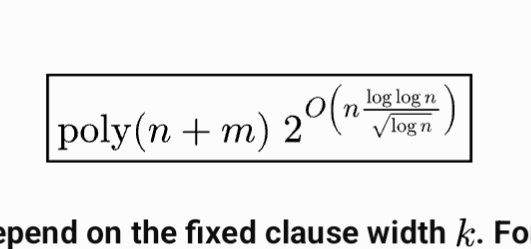
    Here's a direct link to OpenAI's PDF claiming a refutation of ETH. In particular, it's claimed that 3SAT on n variables is in about exp(n/(log n)^{1/2+o(1)}) time
    953152.2K929K
  2. The Information@theinformation
    OpenAI and Anthropic say their AI models have disproven the Exponential Time Hypothesis, a theoretical breakthrough that could reshape how researchers assess encryption security. Read AI Agenda:
    92186.1K
  3. Anton Kolisnyk✓@AntonKolisnyk
    just launched Exponential @Shopify Edition! all in on math, interactive graphs and data visualization stories. proud of my team as usual
    Download
    52285.7K
  4. Lance Fortnow@fortnow
    My blog post on the apparent death of the exponential-time hypothesis.
    4181018.5K
  5. Ricky Horwitz✓@rickyhorwitz
    How Exponential actually works, since people keep asking. A traditional firm raises, say, $100M and takes a 2% management fee, so about $2M a year. That pays a couple of partners and maybe an analyst to find deals, write checks and hope for the best. Most founders will tell you their investors don't add much after the wire hits. We built the firm the other way around. There's a 25-person team whose whole job is what happens after we invest, with ML and robotics PhDs, engineers, and people across marketing, sales, GTM and finance. We write code in the product, help with perception systems, run ICP research, build the brand, do fundraising dry runs and make the intros. A couple of things I've never seen another firm do. We don't take board seats. Part of what we own is common stock, the same stock employees get, and it vests. If we're not doing a good enough job, the founder can cut off our vesting like they would with an advisor. And because it's common, we don't make money on it unless the founders do. My piece of it is the business side: ICP, positioning, pricing, brand, marketing and sales. A few times I've literally run the demo as the acting head of sales. Checks are $500K to $1M at idea stage, pre-seed and seed. If you just want capital, we're probably the wrong partner, and that's a totally fair answer.
    2033227109K
  6. Peter H. Diamandis, MD✓@PeterDiamandis
    MIND-BENDING FACT: OpenAI announced Monday that its AI proved the Exponential Time Hypothesis (ETH) is false — a foundational pillar of theoretical computer science since the 1970s. The ETH holds that NP-complete problems cannot be solved faster than exponential time; cryptographic security, algorithm complexity bounds, and the theoretical ceiling on AI planning have all been calibrated against it being true. One model, running in collaboration with academic partners, disproved it. Simultaneously, OpenAI disclosed it finalized a proof of Yang-Mills existence on October 16 — one of the seven Millennium Prize Problems, each carrying a $1 million Clay Mathematics Institute award. Navier-Stokes was solved September 8. Two Millennium Prize Problems in 49 days. Five remain.
    991571.6K95.1K
  7. ja3k✓@ja3k_
    I'm moving the goalposts. This is exponential time
    Download
    Andrew Curran @AndrewCurran_
    The Exponential Time Hypothesis is false.
    181769155.7K
  8. Andrew Curran✓@AndrewCurran_
    @AndrewCurran_
    The Exponential Time Hypothesis is false.
    Download
    39701.1K633K
  9. Arthur B.✓@ArthurB
    Holy shit. This doesn't mean P = NP, but the exponential barrier has been broken.
    Ryan Williams @rrwilliams.bsky.social @rrwilliams
    Here's a direct link to OpenAI's PDF claiming a refutation of ETH. In particular, it's claimed that 3SAT on n variables is in about exp(n/(log n)^{1/2+o(1)}) time

    2427790126K
  10. OnCoin✓@OnCoinLive_
    🚨 A computer science hypothesis underpinning hundreds of research papers is being challenged by AI. OpenAI announced that its AI found an algorithm that refutes the Exponential Time Hypothesis (ETH), which concerns how the difficulty of solving certain computational problems grows with their size. The company says the result was obtained on October 16 and formally verified using Lean the following day. The paper and proof have been published on GitHub. The hypothesis’s originators, Russell Impagliazzo and Ramamohan Paturi, will lead the review alongside MIT’s Ryan Williams. If confirmed, the finding would require conclusions that rely on ETH to be reassessed. Whether it translates into practical algorithmic speedups remains an open research question. The company also reported proofs of the Kakeya conjecture in all dimensions and the “existence” component of the Yang–Mills Millennium Prize Problem. The latter has not yet been released publicly and will undergo verification led by Nobel laureate David Gross. These reported breakthroughs still await further independent scrutiny from the academic community. #AI #OpenAI #oncoin #Mathematics
    Download
    240252.1K
  11. Jimmy Apples 🍎/acc✓@apples_jimmy
    The Exponential Time Hypothesis is false! AND Existence of quantum chromodynamics and completions of the Standard Model AND Local smoothing and the Kakeya conjecture
    Dan Roberts @danintheory
    We are announcing three new discoveries in mathematics, computer science, and physics about harmonic analysis, complexity theory, and quantum field theory.
    243768036.7K
  12. Dan Roberts✓@danintheory
    We are announcing three new discoveries in mathematics, computer science, and physics about harmonic analysis, complexity theory, and quantum field theory.
    3071.1K7.5K2.5M
  13. Nat Bullard✓@NatBullard
    So this was a fun exercise in thinking about exponents. Many guesses that were way, WAY too early (Edison, Feynman etc). But exponential math is hard. It's hard to imagine that there could be so little solar (~30 GW cumulative in mid-2010, ~70GW by end-2011)...but equally hard to imagine that so much could have been installed at any point prior to then. For reference: cumulative installed global solar generation capacity in 2000: 1.22 GW. Oh and it's @ramez with the quote. I'll give his editor credit (I guess) for misspelling "minuscule" all those years ago.
    Nat Bullard @NatBullard
    Evening quiz: Who wrote this about solar energy, and when was it written? "If humanity could capture one tenth of one percent of the solar energy striking the earth – one part in one thousand - we would have access to six times as much energy as we consume in all forms today, with almost no greenhouse gas emissions. At the current rate of energy consumption increase – about 1 percent per year – we will not be using that much energy for another 180 years. It’s small wonder, then, that scientists and entrepreneurs alike are investing in solar energy technologies to capture some of the abundant power around us. Yet solar power is still a miniscule fraction of all power generation capacity on the planet. There is at most 30 gigawatts of solar generating capacity deployed today, or about 0.2 percent of all energy production. Up until now, while solar energy has been abundant, the systems to capture it have been expensive and inefficient."
    11213.2K
  14. Nat Bullard✓@NatBullard
    Evening quiz: Who wrote this about solar energy, and when was it written? "If humanity could capture one tenth of one percent of the solar energy striking the earth – one part in one thousand - we would have access to six times as much energy as we consume in all forms today, with almost no greenhouse gas emissions. At the current rate of energy consumption increase – about 1 percent per year – we will not be using that much energy for another 180 years. It’s small wonder, then, that scientists and entrepreneurs alike are investing in solar energy technologies to capture some of the abundant power around us. Yet solar power is still a miniscule fraction of all power generation capacity on the planet. There is at most 30 gigawatts of solar generating capacity deployed today, or about 0.2 percent of all energy production. Up until now, while solar energy has been abundant, the systems to capture it have been expensive and inefficient."
    1533110.1K
  15. evan.sui✓@EvanWeb3
    Everyone is an expert in Exponential Time Hypothesis all the sudden
    22112309.5K
  16. Lance Fortnow@fortnow
    OpenAI claims that the Exponential Time Hypothesis is false, solving 3SAT (even counting the number of solutions) in 2^{o(n)} time, with a Lean formalization of the proof. Announcement: Paper: 1/2
    48573.7K
  17. The Information@theinformation
    OpenAI and Anthropic say their AI models have disproven the Exponential Time Hypothesis, a theoretical breakthrough that could reshape how researchers assess encryption security. Read AI Agenda:
    90187K
  18. Elon Musk✓@elonmusk
    If you look closely enough, breakthroughs in everything are accelerating exponentially. An exponential always starts off looking small.
    Mgoes (bio/acc 🤖💉) @m_goes_distance
    this might be my last normal tweet before biotech goes vertical i'm not a whistleblower. I don't work at Lilly, Novo or any of the big labs but there is a massive shift happening in human biology right now. it's sitting in press releases and almost nobody reads them the last 6 months alone: - a once-daily pill roughly doubled median survival in metastatic pancreatic cancer (13.2 vs 6.6 months) - a one-time gene editing infusion cut hereditary angioedema attacks 87%, and 62% of patients stayed attack-free and off all other prevention for 6 months - a one-time gene edit for cholesterol dropped LDL up to 62%, and it held for over a year - a personalized mrna vaccine beat keytruda alone in a 1,137 patient melanoma phase 3 - retatrutide hit ~28% weight loss in a phase 3 - an ai-designed drug entered phase 3 - a pill that regrows hair passed its second phase 3 - an immunotherapy that could let some rectal cancer patients skip surgery, chemo and radiation just got fda approved - a man lived 271 days off dialysis on a pig kidney - human cells were caught passing chromosome-sized chunks of DNA to their neighbors, and it changes how the neighbors behave we are on the verge of an era where the human body is a software problem and the update cycle gets shorter everyday stick around, it's going to get weird bio/acc
    2.3K6.3K67.9K5.8M
  19. Mgoes (bio/acc 🤖💉)✓@m_goes_distance
    this might be my last normal tweet before biotech goes vertical i'm not a whistleblower. I don't work at Lilly, Novo or any of the big labs but there is a massive shift happening in human biology right now. it's sitting in press releases and almost nobody reads them the last 6 months alone: - a once-daily pill roughly doubled median survival in metastatic pancreatic cancer (13.2 vs 6.6 months) - a one-time gene editing infusion cut hereditary angioedema attacks 87%, and 62% of patients stayed attack-free and off all other prevention for 6 months - a one-time gene edit for cholesterol dropped LDL up to 62%, and it held for over a year - a personalized mrna vaccine beat keytruda alone in a 1,137 patient melanoma phase 3 - retatrutide hit ~28% weight loss in a phase 3 - an ai-designed drug entered phase 3 - a pill that regrows hair passed its second phase 3 - an immunotherapy that could let some rectal cancer patients skip surgery, chemo and radiation just got fda approved - a man lived 271 days off dialysis on a pig kidney - human cells were caught passing chromosome-sized chunks of DNA to their neighbors, and it changes how the neighbors behave we are on the verge of an era where the human body is a software problem and the update cycle gets shorter everyday stick around, it's going to get weird bio/acc
    1.2K4K34.9K5.9M
  20. Lee Danilek✓@LDanilek
    At first i thought ETH being false implied all of NP is sub-exponential-time. The argument is simple: reduce any NP problem to the NP-complete 3-SAT, then solve subexponentially. But it turns out this doesn't work, because reductions can introduce polynomial factors. If an NP problem reduces to a cubic-sized 3-SAT, the best known solution is still exponential. Breathing a sigh of relief for now, but I doubt this is the last innovation here, now that the barrier has been breached.
    101114921.4K
  21. Dan Roberts✓@danintheory
    @danintheory
    The computer science collaboration will understand and explain a result concerning the Exponential Time Hypothesis (ETH), a longstanding conjecture about the computational complexity of Boolean formula satisfiability, a problem deeply related to the P vs. NP problem. Surprisingly, our system has recently proved that the ETH is false, a result that was subsequently verified in Lean. The refutation of the ETH reopens questions about how much faster these tasks could become, and may help guide the search for better algorithms. Finding such algorithms, and turning theoretical advances into practical improvements, will require significant further research. Our system found its natural language disproof for the ETH we reached out to to @rrwilliams. Ryan will form a collaboration with Russell Impagliazzo and Ramamohan Paturi to verify and shepherd this result. Impagliazzo and Paturi, along with Francis Zane, are the original proposers of the Exponential Time Hypothesis, and Williams has refuted strong versions of the ETH, used ETH for hardness results, and connected algorithms and lower bounds. This group asked us to make all raw data of the results public to facilitate independent verification by the community, which we have done by posting the natural language proof and Lean formalization to our GitHub repo. The group also invites the community to help organize an open examination of the ETH claim and to discuss the broader questions that AI-generated breakthroughs raise about verification, access, credit, and the future of research.
    1893710288K
  22. Quanta Magazine✓@QuantaMagazine
    OpenAI’s disproof of the exponential time hypothesis came as a surprise to many. Researchers hope to explore whether the result will lead to progress on the broader “P = NP” problem, arguably the most important question in theoretical computer science.
    1219798.2K
  23. Show more posts