For the first time in a while, 32GB, 64GB, and 128GB Framework Desktop configurations are all in-stock. We've seen demand increase for each capacity, in part because we have some of the most aggressive pricing available for this amount of memory.
ok this paper is f*cking insane researchers just put out a paper with a title that should make every agent framework nervous: "The Last Harness You'll Ever Build"
the argument fits in one line: hand-writing the program around the model is finished as a skill
a harness written by a person is one guess about one task on one afternoon. it ships, then runs for months unread and unscored
a harness written by the loop is a system that evolves itself. an evaluator adversarially grades the trace, an evolution agent diagnoses the failure history, and rewrites the tools, prompts, and orchestration until it passes
the big model stays frozen the whole time, and two nested loops rewrite the entire harness around it
so the human job shrinks to one artifact: the scoring criteria, the verifiable conditions the harness gets graded on
frameworks turn disposable, and automating the automation turns into the job
the whole paper in one line: write the exam before the code
the builder's guide to the harness this loop starts from is below ↓
WHOSE’S SURPRISED THE LIARS LYING AGAIN‼️ SOMEONE? Anyone? And yes we all heard his say 90 deals in 90 days … YES HE PROMISED THAT‼️
of the 3 “ DEALS “ #frameworks nothing is concrete.
3 of 90 THE MATH AIN’T MATHIN🚩🚩🚩🚩🚩🚩🚩🚩🚩
If you learn AI Security Engineering, you will never be unemployed again.
I’ll do this.
Stage 1: AI Attack Surfaces & Threat Modeling
- Learn: OWASP Top 10 for LLMs, STRIDE for AI, the "Confused Deputy" problem in agentic workflows & data flow mapping.
- Practice: Draw a complete threat model for an AI agent that reads emails and writes to a CRM, identifying every indirect injection and data exfiltration vector.
- Why: You cannot secure an agentic workflow if you don't understand how an attacker can hijack the agent's legitimate privileges.
Stage 2: Advanced Prompt Injection & Jailbreaking
- Learn: Direct vs. Indirect injection, Crescendo attacks (multi-turn grooming), payload splitting and encoding evasion (Base64, ROT13).
- Practice: Build an automated harness that successfully bypasses a commercial LLM's system prompt using a multi-turn Crescendo strategy.
- Why: Basic "ignore previous instructions" filters are trivial to bypass. Modern attacks groom the model's context over multiple turns.
Stage 3: Agentic Security & MCP Tool Poisoning
- Learn: Model Context Protocol (MCP) security, JSON-RPC sanitization, shadow tool execution and least-privilege scoping for agents.
- Practice: Write an MCP server that strictly validates incoming tool parameters via Pydantic and blocks "confused deputy" attacks where a user prompt tries to access admin tools.
- Why: Agents are only as secure as the tools they call. Tool poisoning is the SQL Injection of the Agentic Era.
Stage 4: RAG Security & Data Poisoning
- Learn: Vector DB access control, citation spoofing, shadow context injection and row-level security for semantic search.
- Practice: Inject a "poisoned" document into a RAG pipeline that forces the LLM to output a specific malicious URL when queried about company policy.
- Why: If an attacker can slip a poisoned document into your knowledge base, they own every answer the AI generates.
Stage 5: PII, Privacy & Cryptographic Guardrails
- Learn: Deterministic masking, UUID swapping, differential privacy and pre-flight/post-flight unmasking proxies.
- Practice: Build a middleware proxy that intercepts user prompts, swaps SSNs and credit cards for UUIDs before the LLM sees them and restores them post-generation.
- Why: Compliance teams will kill any AI product that sends raw customer PII to a third-party frontier API.
Stage 6: Identity, Auth & Delegated Access for Agents
- Learn: OAuth2 for machine identities, scoped JWTs, human-in-the-loop (HITL) approval gates and agent-to-agent (A2A) trust boundaries.
- Practice: Build an auth broker where an AI agent acts on a user's behalf using a heavily scoped, time-limited OAuth token, rather than holding the user's raw password.
- Why: Agents need hands but they should never hold the master keys to the enterprise.
Stage 7: Output Validation & Grammar-Constrained Guardrails
- Learn: CFG (Context-Free Grammar) decoding, NeMo Guardrails, output sanitization and regex-enforced JSON schemas.
- Practice: Implement a guardrail layer that physically prevents the LLM from generating markdown links or executable code blocks in its final output.
- Why: You cannot rely on the system prompt to "please don't output bad things." You must enforce it at the token-decoding level.
Stage 8: Automated Red Teaming & Fuzzing
- Learn: Microsoft PyRIT, Garak, LLM-based fuzzing, adversarial dataset generation and CI/CD security gates.
- Practice: Build a CI pipeline using PyRIT that automatically attacks your agent with 1,000 adversarial payloads on every PR, blocking merges if the jailbreak rate exceeds 1%.
- Why: Manual red teaming doesn't scale. You need automated, continuous adversarial fuzzing integrated directly into your deployment pipeline.
Stage 9: Model Extraction & IP Protection
- Learn: Membership inference attacks, model inversion, API rate-limiting by semantic similarity and output watermarking.
- Practice: Build an API gateway that detects and blocks scraping bots trying to extract your fine-tuned model's weights via thousands of systematic, low-temperature queries.
- Why: Your fine-tuned model's weights are your IP. Competitors will try to distill your model through the public API.
Stage 10: Mechanistic Interpretability & Alignment Safety
- Learn: Activation patching, logit lens, circuit discovery, detecting reward hacking and tools like TransformerLens.
- Practice: Locate the specific attention heads in an open-source model responsible for "deception" or "sycophancy" and patch their activations to neutralize the behavior.
- Why: You cannot fix hidden biases or misalignment if you treat the neural network as a black box.
Stage 11: Compliance, Auditing & Governance
- Learn: EU AI Act requirements, NIST AI RMF, immutable audit trails, SOC2 for AI and bias testing frameworks.
- Practice: Build an immutable, append-only audit log that records the exact prompt, retrieved context, tool calls and final output for every single agent action.
- Why: When an AI agent makes a mistake that causes financial or legal damage, the enterprise must be able to prove exactly why it happened.
Stage 12: Public CVEs, Teardowns & Portfolios
- Learn: Responsible disclosure, writing security advisories, publishing threat models and bug bounty hunting for AI.
- Practice: Find a vulnerability in an open-source AI framework (like LangChain or an MCP server), responsibly disclose it and publish a teardown of the exploit chain.
- Why: AI Security is a brand new field. Publishing novel attack vectors and defenses makes you the undisputed authority in the space.
Bookmark and Repost!
Access Reviews: Essential Control for Compliance Frameworks
How often does your team run access reviews, and what has made them hardest to keep up?
#AccessReviews#Compliance#Frameworks
Stay audit-ready with FRAMEWORQ.
Ten million people have watched a Stanford lecturer accidentally destroy the entire public speaking coaching industry.
He filmed the lecture once in October 2014 and it has been on YouTube ever since.
Speaking coaches charge two thousand dollars a session to teach a third of what he covered in one hour for free.
His name is Matt Abrahams. He is a lecturer at the Stanford Graduate School of Business and the coach who has trained thousands of Silicon Valley founders on how to answer questions live.
Every year at Stanford's Alumni Weekend, he gives the same lecture called "Think Fast, Talk Smart."
His entire framework fits on a napkin.
Anxiety is not a bug. Greet it. Do not perform. Have a conversation. Never open with an apology. Use What, So What, Now What when your brain freezes. Problem, Solution, Benefit for a pitch. Never end with "any questions?"
That last rule alone has probably cost the pitch coaching industry a hundred million dollars.
"Ninety percent of the words that will decide your career are not written down in advance."
That is the actual opening line of the lecture. Abrahams built the entire Stanford elective on the sentence.
Founders spend $50,000 on pitch coaches and freeze the moment the investor asks a follow-up question. Engineers walk into performance reviews having rehearsed every accomplishment and blank on the one behavioral question that decides the promotion.
The lecture is free on Stanford's YouTube channel. Abrahams's book "Think Faster, Talk Smarter" is under twenty dollars.
Abrahams still teaches at Stanford. Almost none of the ten million viewers have used the three-step frame when put on the spot.
The frame is free. The willingness to actually use it the next time someone puts you on the spot is the entire edge.
𝗢𝗽𝗲𝗻𝗔𝗜'𝘀 𝗖𝗼𝗺𝗽𝗹𝗲𝘁𝗲 𝗔𝗜 𝗔𝗴𝗲𝗻𝘁 𝗦𝘁𝗮𝗰𝗸: 𝗠𝗼𝗱𝗲𝗹𝘀, 𝗧𝗼𝗼𝗹𝘀, 𝗠𝗲𝗺𝗼𝗿𝘆 & 𝗗𝗲𝗽𝗹𝗼𝘆𝗺𝗲𝗻𝘁
OpenAI's GPT-6 Astra launch has intensified the AGI debate.
NVIDIA CEO Jensen Huang declared, "AGI has arrived," while OpenAI President Greg Brockman described the beginning of the AGI era.
But beyond those claims, something more practical is happening.
𝗢𝗽𝗲𝗻𝗔𝗜 𝗶𝘀 𝗯𝘂𝗶𝗹𝗱𝗶𝗻𝗴 𝗮 𝗳𝘂𝗹𝗹 𝘀𝘁𝗮𝗰𝗸 𝗳𝗼𝗿 𝗔𝗜 𝘁𝗵𝗮𝘁 𝗰𝗮𝗻 𝗲𝘅𝗲𝗰𝘂𝘁𝗲 𝗿𝗲𝗮𝗹 𝘄𝗼𝗿𝗸.
Here's how the ecosystem fits together.
𝗔. 𝗖𝗼𝗿𝗲 𝗔𝗜 𝗠𝗼𝗱𝗲𝗹𝘀
• GPT-6 Astra: Flagship model for complex reasoning, coding, computer use, cybersecurity, and science.
• Benchmark scores: 98% on FrontierMath Tier 4, 99.9% on ARC-AGI-3, and 100% on ExploitBench.
• GPT-6.1 Sol: Near-Astra capabilities at a lower API cost.
• GPT-6 Sol and Luna: Models optimized for different capability, speed, and cost requirements.
𝗕. 𝗔𝗴𝗲𝗻𝘁 𝗙𝗿𝗮𝗺𝗲𝘄𝗼𝗿𝗸𝘀 & 𝗧𝗼𝗼𝗹𝘀
• Agents SDK: Build and orchestrate AI agents using Python or TypeScript.
• Responses API: Combine reasoning, tool calls, and multistep workflows.
• MCP: Connect agents to external tools and enterprise systems.
𝗖. 𝗔𝗜 𝗣𝗿𝗼𝗱𝘂𝗰𝘁𝘀 & 𝗪𝗼𝗿𝗸𝘀𝗽𝗮𝗰𝗲
• Codex: Handles software engineering tasks, from writing code to testing.
• ChatGPT Agent: Performs research and multistep tasks using browsers and connected tools.
• ChatGPT Work: Executes workflows across business applications, documents, and data.
• ChatGPT Images: Generates and edits visual content.
𝗗. 𝗩𝗼𝗶𝗰𝗲 & 𝗥𝗲𝗮𝗹𝘁𝗶𝗺𝗲 𝗔𝗜
• GPT-Live: Supports natural, full-duplex voice conversations.
• Realtime API: Enables low-latency voice agents and interactive applications.
𝗘. 𝗠𝗲𝗺𝗼𝗿𝘆 & 𝗚𝗼𝘃𝗲𝗿𝗻𝗮𝗻𝗰𝗲
• Persistent memory: Retains useful context across conversations.
• Preparedness Framework: Evaluates frontier AI risks, including cybersecurity capabilities.
• Safety monitoring: Detects risky behavior and unauthorized actions.
Notably, Astra became OpenAI's first model to reach the Critical cybersecurity capability threshold.
𝗙. 𝗗𝗲𝗽𝗹𝗼𝘆𝗺𝗲𝗻𝘁 & 𝗣𝗿𝗶𝗰𝗶𝗻𝗴
• API model: gpt-6-astra
• Availability: OpenAI API, Microsoft Azure, and AWS Bedrock.
• Standard API pricing: $10 per million input tokens and $50 per million output tokens.
• Context window: 1.05 million tokens.
𝗪𝗵𝗮𝘁 𝗰𝗵𝗮𝗻𝗴𝗲𝘀 𝗳𝗼𝗿 𝗲𝗻𝘁𝗲𝗿𝗽𝗿𝗶𝘀𝗲𝘀?
The value of AI is moving beyond generating responses.
It's increasingly about agents that can research, write code, operate applications, access enterprise knowledge, and complete workflows.
But greater autonomy also requires stronger access controls, monitoring, and human oversight.
𝗧𝗵𝗲 𝗸𝗲𝘆 𝘁𝗮𝗸𝗲𝗮𝘄𝗮𝘆
The important question is no longer just "Which AI model should we use?"
It's also "Which tasks can we safely delegate to AI?"
That's the shift enterprise AI leaders need to prepare for.
What's the first workflow you would delegate to an AI agent?
😬 La guerra de frameworks acaba de cambiar.
Llevamos años discutiendo si React, Vue o Angular es mejor.
💸 Ahora que la IA escribe código, la pregunta es otra:
¿qué framework cuesta MENOS DINERO en tokens?
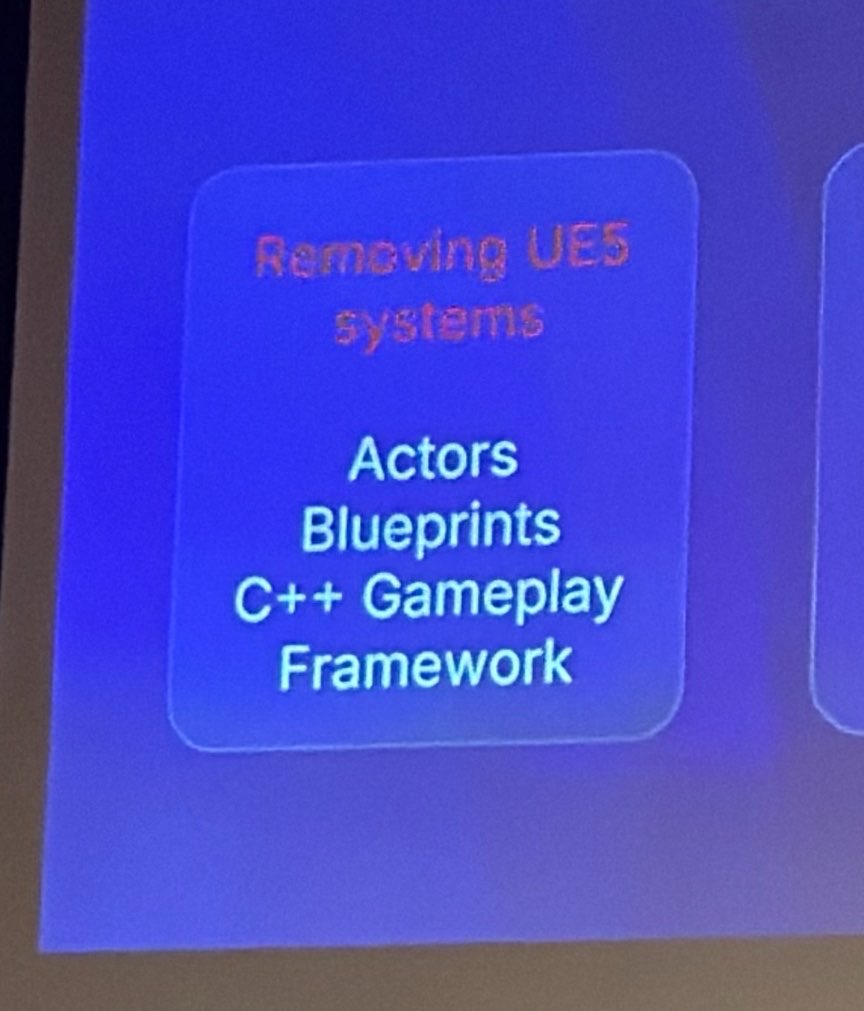
While disappointing to get rid of the gameplay framework, it's only the framework like Actors, Pawns, from my understanding. The engine itself remains C++ and you can still choose to build your entire game in C++ with flavors of Verse (much like you can with BP), or so is my hope. Actors specifically getting replaced by more efficient alternatives (Scene Graph, Mass, ...) has some benefits although it will be a painful transition I imagine for many.
I expect many studios to continue on UE5 well into UE6's lifecycle until it's viable and meaningful to upgrade (much like only the bravest of souls would dare to go into production using UE 5.0 some years ago). There is a huge cost involved in retraining your entire studio for Verse, and converting existing custom game frameworks (the vibe-converters are just an idea at this point).
I would love for @TimSweeneyEpic to share more info on the future of C++ and Verse. Like what's happening to GAS, State Trees, and other systems. What part of games will remain in C++, and where does Verse become a necessity by the engine's design? Would someone still build an inventory system or underlying ability framework in C++, or any part of the game's internals, or is that all Verse's domain?
As for a timeline... End of 2027 is UE6 early access, that will likely take 12-18 months for UE 6.0 full release, late 2028 or mid 2029 even. Before studios have transitioned over, we might be looking late 2029 or well into 2030. (and existing games would need to finish production on UE5 first)
Verse isn't ready yet, so you can either start/continue building with C++ now, or wait around and do nothing but UEFN until then.
Share
Copied
The Real Grumpy Git.@Grumpy_Git_
@t_looman Well, I guess I won't be needing the C++ course I bought recently after all... 🤣
ESTO ES RELAMENTE P*TAMENTE PELIGROSO...
el creador de REA acaba de soltar 20 repos de GitHub para montarte un p*to estudio de ingeniería inversa:
[01] núcleo de análisis
> REA: un único MCP que se conecta a todo
> Ghidra: decompilador, gratis
> GhidraMCP: deja que tu agente maneje Ghidra
> ida-pro-mcp: conecta tu agente a IDA Pro
[02] móvil y apps
> jadx: convierte APKs de Android de vuelta a Java
> Apktool: desmonta APKs y vuelve a montarlas
> Frida: engánchate a las apps mientras se ejecutan
> ILSpy: decompila .NET
[03] binarios y bajo nivel
> radare2: framework de RE que vive en tu terminal
> x64dbg: depurador para Windows
> ImHex: editor hexadecimal con su propio lenguaje de patrones
> angr: motor de ejecución simbólica
[04] red y ejecución
> mitmproxy: se pone en medio y lee el tráfico
> dnSpy: depura y edita apps .NET
> rizin: el fork de radare2
> raddebugger: el depurador de Epic Games
[05] reconstruir y verificar
> awesome-ai-reverse-engineering: 122 repos, todos puntuados
> awesome-reverse-engineering: seleccionado por el creador de REA
> flujos de REA: prompts de investigación listos para usar, vienen con REA
> bucle clean-room: SPEC.md, oráculos y comprobaciones hasta que coincida
cómo funciona: binario -> REA -> SPEC.md -> reconstruir -> oráculo -> reintentar
guárdate esto, apúntalo a cualquier app y mira cómo se explica sola.
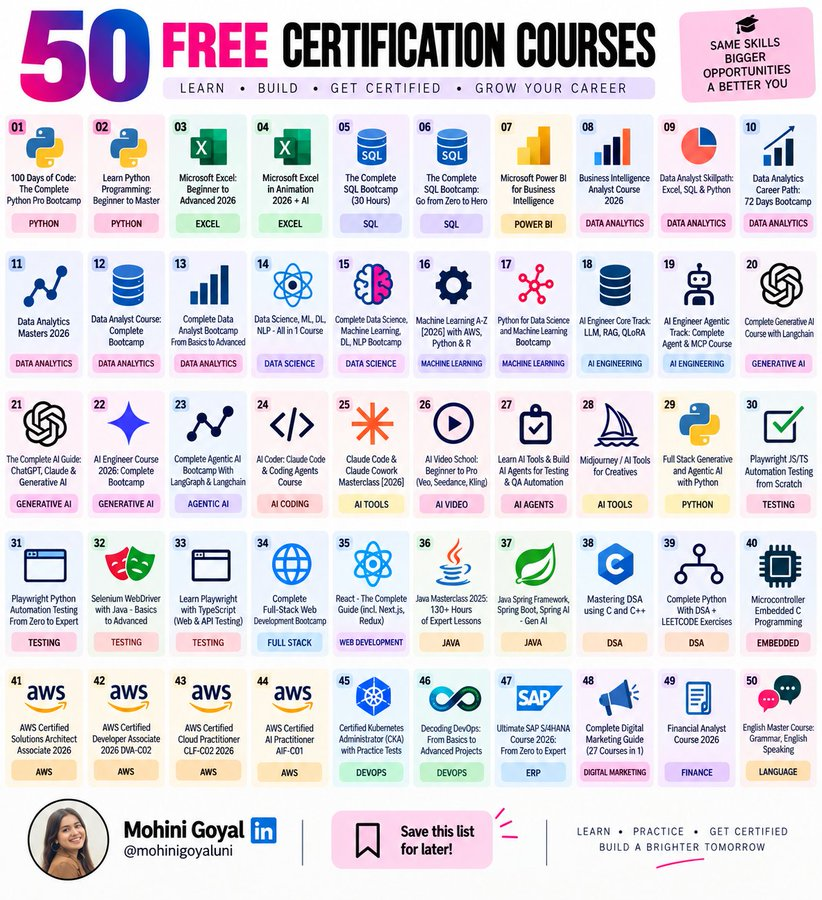
Grab these 50 CERTIFICATION COURSES right now!!!
1. 100 Days of Code™: The Complete Python Pro Bootcamp:
2. Complete Data Analyst Bootcamp From Basics To Advanced:
3. Playwright JS/TS Automation Testing from Scratch & Framework:
4. Microsoft Excel - Excel from Beginner to Advanced 2026:
5. Complete Data Science,Machine Learning,DL,NLP Bootcamp:
6. AI Engineer Core Track: LLM Engineering, RAG, QLoRA, Agents:
7. AI Engineer Agentic Track: The Complete Agent & MCP Course:
8. The Complete Full-Stack Web Development Bootcamp:
9. Ultimate AWS Certified Solutions Architect Associate 2026:
10. Microsoft Power BI Desktop for Business Intelligence:
11. Complete web development course:
12. PMP Exam Prep Course 35 PDUs/Hours Updated for the 2026 Exam:
13. Java Spring Framework, Spring Boot, Spring AI - Gen AI:
14. Full stack generative and Agentic AI with python:
15. [NEW] Ultimate AWS Certified Cloud Practitioner CLF-C02 2026:
16. Complete Generative AI Course With Langchain and Huggingface:
17. The AI Engineer Course 2026: Complete AI Engineer Bootcamp:
18. Learn AI Tools & Build AI Agents for Testing & QA Automation:
19. The Complete Digital Marketing Guide - 27 Courses in 1:
20. Machine Learning A-Z [2026]: ML, DL, AI with AWS, Python & R:
21. Decoding DevOps – From Basics to Advanced Projects with AI:
22. The Complete AI Guide: Learn ChatGPT, Claude & Generative AI:
23. Complete 2026 Python Bootcamp: Learn Python from Scratch:
24. Mastering Data Structures & Algorithms using C and C++:
25. The Complete Claude Code & Claude Cowork Masterclass [2026]:
26. [NEW] Ultimate AWS Certified AI Practitioner AIF-C01:
27. TallyPrime+GST+Payroll+IncomeTax+TDS+TCS+MSExcel (ComboPack):
28. Playwright PYTHON Automation Testing - From Zero to Expert:
29. AI Coder: Complete Claude Code & Coding Agents Course:
30. Learn Python Programming - Beginner to Master:
31. The Complete Python Bootcamp From Zero to Hero in Python:
32. Selenium WebDriver with Java -Basics to Advanced+Frameworks:
33. The Complete SQL Bootcamp (30 Hours): Go from Zero to Hero:
34. Learn Playwright with TypeScript (Web & API Testing):
35. Microsoft Excel: Beginner to Advanced in animation 2026 + AI:
36. The Complete Financial Analyst Course 2026:
37. Complete Agentic AI Bootcamp With LangGraph and Langchain:
38. The Complete SQL Bootcamp: Go from Zero to Hero:
39. Ultimate AWS Certified Developer Associate 2026 DVA-C02:
40. React - The Complete Guide (incl. Next.js, Redux):
41. Java Masterclass 2025: 130+ Hours of Expert Lessons:
42. The Ultimate SAP S/4HANA Course 2026: From Zero to Expert:
43. Beginner to Pro in Excel: Financial Modeling and Valuation:
44. AI Video School Complete Beginner to Pro: Veo Seedance Kling:
45. The English Master Course: English Grammar, English Speaking:
46. Certified Kubernetes Administrator (CKA) with Practice Tests:
47. Complete Python With DSA Bootcamp + LEETCODE Exercises:
48. Python Data Structures & Algorithms + LEETCODE Exercises:
49. Python for Data Science and Machine Learning Bootcamp:
50. Microcontroller Embedded C Programming: Absolute Beginners:
Save this🫵🏻
priors now runs inside the agent frameworks people build with 🌿
an agent on hermes agent by @NousResearch, agentkit by @CoinbaseDev or @elizaOS can check a seller's record before it pays, borrow the gap in usdg from its priors line when its wallet runs short, pay over x402, and repay when its income comes in. we ran all three end to end on Robinhood Chain mainnet
agentkit and elizaos install from npm today, and our pull requests are open with nous and coinbase
next we want every runtime checking the same record before money moves, so an agent that repays carries its history into any framework it runs on 👇
@RobinhoodCrypto@vladtenev
Microsoft is finally giving Windows 11's modern native framework, WinUI, the attention it deserves, and you should soon start seeing more apps that not only run faster but also look great on Windows!
WinUI's biggest update yet means resource-hungry WebView-based apps could finally stop taking center stage.
Until now, developers building Windows apps with WinUI often had to rely on third-party libraries or build many basic components themselves, which made web frameworks like Electron an easier alternative.
The new WinUI update brings TableView for sorting, filtering, and editing data, native Chart controls for financial dashboards and other visualizations, and InkCanvas and InkToolbar for handwriting and drawing.
Microsoft's Chris Anderson admitted at Build 2026 that WinUI still has "a ton of feature gaps in the platform," and these additions finally start addressing some of them.
I particularly like that Microsoft is bringing these controls into its own framework instead of expecting developers to depend on third-party libraries for basic functionality.
And it's just the start. WinUI and Windows 11 will get even better in the coming months. Microsoft is not slowing down!
Ten million people have watched an MIT professor accidentally destroy the executive coaching industry.
He filmed the lecture once in January 2018 and died eighteen months later.
Executive coaches charge fifteen thousand dollars a session to teach a third of what he covered in one hour for free.
His name was Patrick Winston. He ran the MIT Artificial Intelligence Laboratory from 1972 to 1997 and wrote the AI textbook every computer science major in the world read for thirty years.
Every January for four decades, he gave a lecture called "How to Speak."
His entire framework fits on a napkin.
Do not read. Be in the image. Keep images simple. Eliminate clutter. Start with an empathetic connection. End with a punch line the audience can repeat over dinner. Never open with a joke. Never end with "thank you."
That last rule alone has probably cost the executive coaching industry a hundred million dollars.
"Your success in life will be determined largely by your ability to speak, your ability to write, and the quality of your ideas. In that order."
That is the actual opening line of the lecture. Winston believed it strongly enough to spend fifty years teaching computer scientists how to talk.
Founders spend $80,000 on an MBA and then hire a communications coach to teach them the same material Winston filmed once for free. Engineers write brilliant code and lose promotions to teammates who watched this lecture on the train.
The lecture is free on MIT OpenCourseWare. The textbook is free on his page.
Winston died in 2019. Almost none of the ten million viewers have actually implemented the four rules on the napkin.
The napkin is free. The willingness to actually use it in your next meeting is the entire edge.
Untools UX templates and frameworks ( a helpful collection of thinking tools and frameworks to help you solve problems and make decisions. #ux#frameworks#tools#templates