Posts with #InputOutput

#InputOutput

Public posts on X that use #InputOutput.

Related hashtags

  1. Input Output Group@IOGroup
    Unlocking new pathways Bridges unlock new pathways for Cardano. Learn about more ways to use Cardano with secure bridges. 🎥 Watch the clip:
    Download
    22152.3K
  2. WEST Memories Fan Account@Fan_westjp
    💜💜 いよいよ明日…!🥹✨ 🎤 𝗧𝗼𝗺𝗼𝗵𝗶𝗿𝗼 𝗞𝗮𝗺𝗶𝘆𝗮𝗺𝗮 𝟭𝘀𝘁 𝗟𝗜𝗩𝗘 𝗧𝗢𝗨𝗥 𝟮𝟬𝟮𝟲 「𝗜𝗡𝗣𝗨𝗧⇄𝗢𝗨𝗧𝗣𝗨𝗧」✨ 📅 9/18(金)・19(土) 神山くんのステージ、ついに始まるよ〜😭💜 この瞬間、絶対見逃せない…!👀✨ #神山智洋 #INPUTOUTPUT
    Download
    14356245.8K
  3. Input Output Group@IOGroup
    Before trusting a bridge, ask what its security claim actually proves. IO research pairs mathematical proofs with automated checks for failures within a defined model. Read Crossing with Confidence:
    Download
    410884.8K
  4. Input Output Group@IOGroup
    What happens when intelligent programs can work together? In Tokyo, @IOHK_Charles explored Nightframes: his vision for private, context-aware programs that can coordinate on our behalf.
    Download
    213754.3K
  5. Input Output Group@IOGroup
    Cardano Vision Q3 update: Hear all about IOR’s progress on Cardano Vision 26 workstreams. 🎥 Watch the clip:
    Download
    52616714.1K
  6. Yuura✓@0xyuura
    Traditional justice runs like this: justice(case) { wait(years); pay(lawyers); trust(one_human); return unknown; } No timeout. No log you can audit. No clear error when the input is wrong. If the one human is tired, biased, or simply never shows up, the function still runs, and you still pay for the wait. @GenLayer changes the function itself. An intelligent contract takes the same dispute as input, checks evidence in the real world, and asks independent validators to agree before it returns anything. One validator is not the verdict. Agreement is. If new evidence arrives, a good function re-runs. It does not defend its first output because it was first. That is the upgrade the film is asking for: a function that has to reach agreement before it can decide. Slow. Expensive. Wrong. That is not a verdict. That is a bug report. #JusticeNeedsAnUpgrade
    GenLayer @GenLayer
    Slow. Expensive. Wrong. It's been this way for centuries. It doesn't have to be. #JusticeNeedsAnUpgrade
    331962475
  7. Pavel Simó✓@pavelsimo
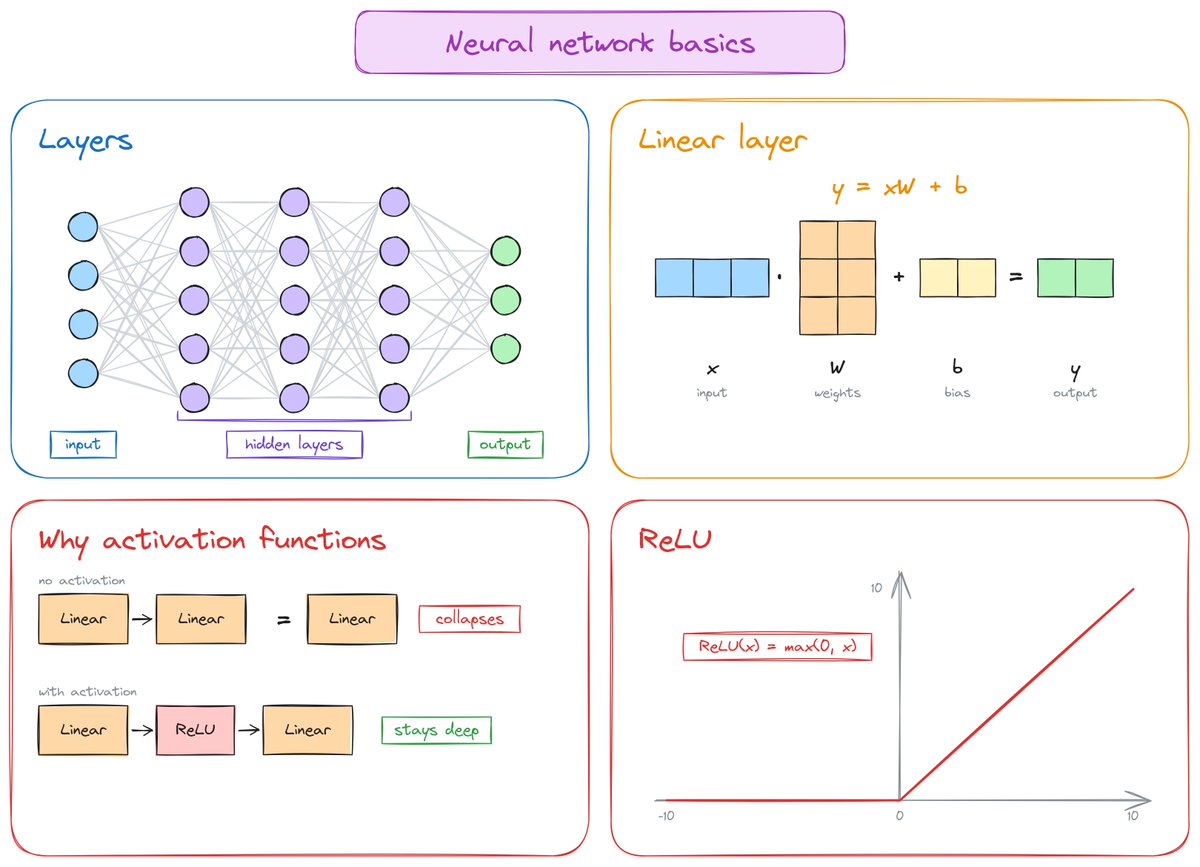
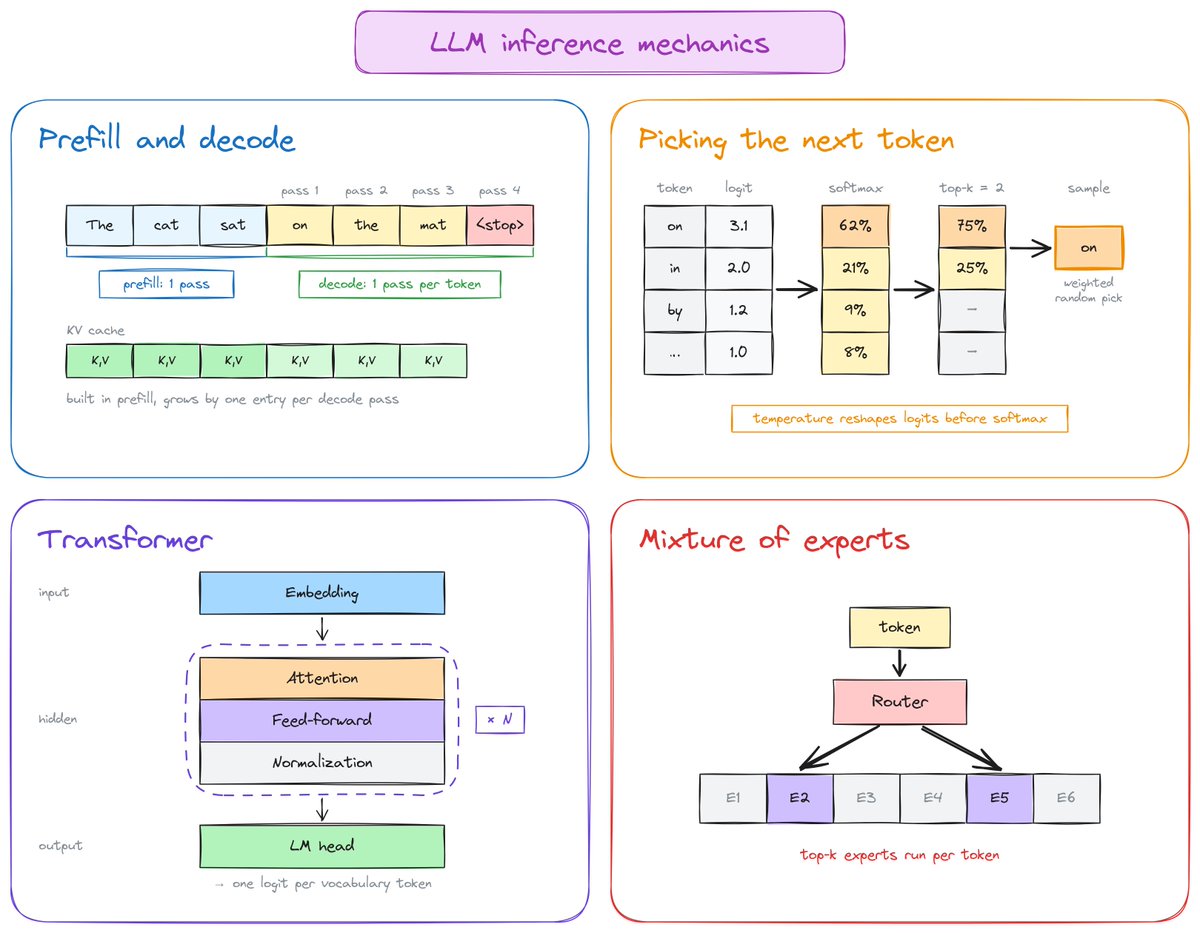
    Day 3/100 of Inference Engineering > today i read chapter 2 of Inference Engineering. there's a lot to cover, so i'm splitting this chapter into two posts. one today and one tomorrow. that way i can keep the post in a "manageable" size without leaving too much content out. > the chapter starts with a high-level intro to neural networks in section 2.1. some of it was familiar, but still a good refresher... section 2.2 then builds on that with the basics of inference, attention, and MoE. > transfomers have become the foundation of generative AI. as you might know there are not exclusive to LLMs, they power every modality: voice, image, video, etc. > two important transformer-based models: autoregressive token generation and iterative denoising. > neural networks have nodes (neurons). a group of nodes is called a layer. there are three types of layers: input layer, hidden layer, and output layer. > the book explains matmul is a core operation for linear layers, and why stacking linear layers alone collapses into a single layer with all matrices combined together. > activations like ReLU add nonlinearity so the network can learn more complex patterns. basically break linearity to allow for multi-layer neural networks. > as you probably heard by now, LLMs typically produce tokens autoregressively. this means they produce new tokens one at a time based on every previous token. > the book explained the two phases of inference: prefill and decode. in prefill we process the prompt and cache its keys and values. decode then uses that cache to generate tokens one at a time. > the inference process can be nudged by configuration arguments such as: temperature, top-k and top-p. > there are two main types of attention: self-attention and cross-attention. self-attention is when tokens pay attention to other tokens in the same sequence (that's what happens in LLMs). cross-attention is when one sequence pays attention to another, like image features looking at a text prompt while generating an image. > the book also explains mixture of experts (MoE) architecture optimization. the idea is that inside the neural network, some layers have several smaller networks called "experts". when generating an answer a router picks just a few of those experts to process each token. that way, the model can have more parameters without using all of them for every token, which saves computation. > you may have seen this in some qwen model names, for example: Qwen3-235B-A22B. here A22B means 22B active parameters per token, out of 235B total parameters.
    Download
    Pavel Simó @pavelsimo
    Day 2/100 of Inference Engineering > today i read chapter 1 of Inference Engineering. compared to yesterday chapter there is a lot of important stuff on this one, i tried my best to extract the main points. > there is not one fit all for inference, an inference services must be specialized for the demands of their workloads. thus it's important to know: model requirements, app. interface, latency budgets, unit economics and usage patterns. > there are two ways to add ai to your app: shared inference or dedicated deployment. > if you're building ai product and you have no idea of your workload will be, start with pay-per-token API, something like OpenRouter (shared inference). > one of the most important decisions is which model you choose to work with. smaller models tend to be cheaper and faster to run. so before you go all crazy on speculative decoding keep that in mind... check if a smaller model can get the job done. > on evals, the book mentioned the ongoing industry benchmark-maxxing that is going on and how those tests are being gamed to make a model looks good... also on the importance of having application evals tailor to your app. the latter is a must have! > the book defines fine-tuning as taking a foundation model and re-targeting it to different use case. fine-tuning benefits from tasks when the scope is small, for example text2sql. important fine-tuning does not changes the model architecture only the weights. > destillation on the otherhand preserves the behavior of a large model in a smaller, more efficient model, and thus changes the architecture. > learned a bunch of metrics: time to first token (TTFT), perceived and total tokens per second (TPS), iter-token latency (ITL), also the important of consider latency percentiles while measuring those.
    54742.8K
  8. Pavel Simó✓@pavelsimo
    Day 2/100 of Inference Engineering > today i read chapter 1 of Inference Engineering. compared to yesterday chapter there is a lot of important stuff on this one, i tried my best to extract the main points. > there is not one fit all for inference, an inference services must be specialized for the demands of their workloads. thus it's important to know: model requirements, app. interface, latency budgets, unit economics and usage patterns. > there are two ways to add ai to your app: shared inference or dedicated deployment. > if you're building ai product and you have no idea of your workload will be, start with pay-per-token API, something like OpenRouter (shared inference). > one of the most important decisions is which model you choose to work with. smaller models tend to be cheaper and faster to run. so before you go all crazy on speculative decoding keep that in mind... check if a smaller model can get the job done. > on evals, the book mentioned the ongoing industry benchmark-maxxing that is going on and how those tests are being gamed to make a model looks good... also on the importance of having application evals tailor to your app. the latter is a must have! > the book defines fine-tuning as taking a foundation model and re-targeting it to different use case. fine-tuning benefits from tasks when the scope is small, for example text2sql. important fine-tuning does not changes the model architecture only the weights. > destillation on the otherhand preserves the behavior of a large model in a smaller, more efficient model, and thus changes the architecture. > learned a bunch of metrics: time to first token (TTFT), perceived and total tokens per second (TPS), iter-token latency (ITL), also the important of consider latency percentiles while measuring those.
    Download
    8121515.4K
  9. Input Output Group@IOGroup
    🔬 Missed the Cardano R&D session? Watch the recording for a Q3 update from Input Output Research (IOR) on Cardano Vision 26, including Peras voting certificates, Mithril bridge security, ZK-rollup analysis, and minUTXO alternatives. 🎥 Watch it here 👇
    Download
    39774.8K
  10. Input Output Group@IOGroup
    ICYMI: Every week, IO shares a roundup of the latest progress across the technical development stack. Missed this week? Catch up here 👇
    Download
    113754.7K
  11. Ovi✓@0x0v1
    Pure slop. Awful engineering. 12,100 dead IOCs. Useless. People slopping out security tools left right and centre. We really need to consider what the input to vibe coded shit is nowadays since the output is so easy to achieve. If people with 0 knowledge just slop out security tools like this, we will degrade our security over time.
    Israel Exposed @xIsraelExposedx
    We have released Zero Breach Toolkit, a free open sourced tool capable of detecting over 12,100 traces of Israeli & other spyware on your devices. It works on Windows, Linux, Mac, Android and Iphones. You can download it here: Inside the folder with the tools run this command: python -X utf8 scan/zero-breach-toolkit.py It never writes to disk, never connects to the internet, or ask for admin perms. It takes around 10-15 minutes to run depending on the device. This project is fully open source, so feel free to take the code and use it to create your own tools. If you find some spyware on your device, consider sending it to us via telegram. Leave us a star on GitHub if the tool helped you. Follow our backups: @ZionismExposedx @IsraelExposedAr God bless
    70214.7K
  12. Israel Exposed✓@xIsraelExposedx
    We have released Zero Breach Toolkit, a free open sourced tool capable of detecting over 12,100 traces of Israeli & other spyware on your devices. It works on Windows, Linux, Mac, Android and Iphones. You can download it here: Inside the folder with the tools run this command: python -X utf8 scan/zero-breach-toolkit.py It never writes to disk, never connects to the internet, or ask for admin perms. It takes around 10-15 minutes to run depending on the device. This project is fully open source, so feel free to take the code and use it to create your own tools. If you find some spyware on your device, consider sending it to us via telegram. Leave us a star on GitHub if the tool helped you. Follow our backups: @ZionismExposedx @IsraelExposedAr God bless
    Download
    8499.8K36.7K1.8M
  13. 山本真央樹@maokiyamamoto
    神山智洋ソロライブツアー 全9公演終了💪 ⁡ 神ちゃん最高に格好良かったしバンドメンバーも最高すぎた!! またやりたいなぁ✌️ ───────────→ Tomohiro Kamiyama 1st LIVE TOUR 2026 INPUT⇄OUTPUT ←─────────── #TomohiroKamiyama #神山智洋 #INPUTOUTPUT
    Download
    14963.2K40.2K
  14. Show more posts