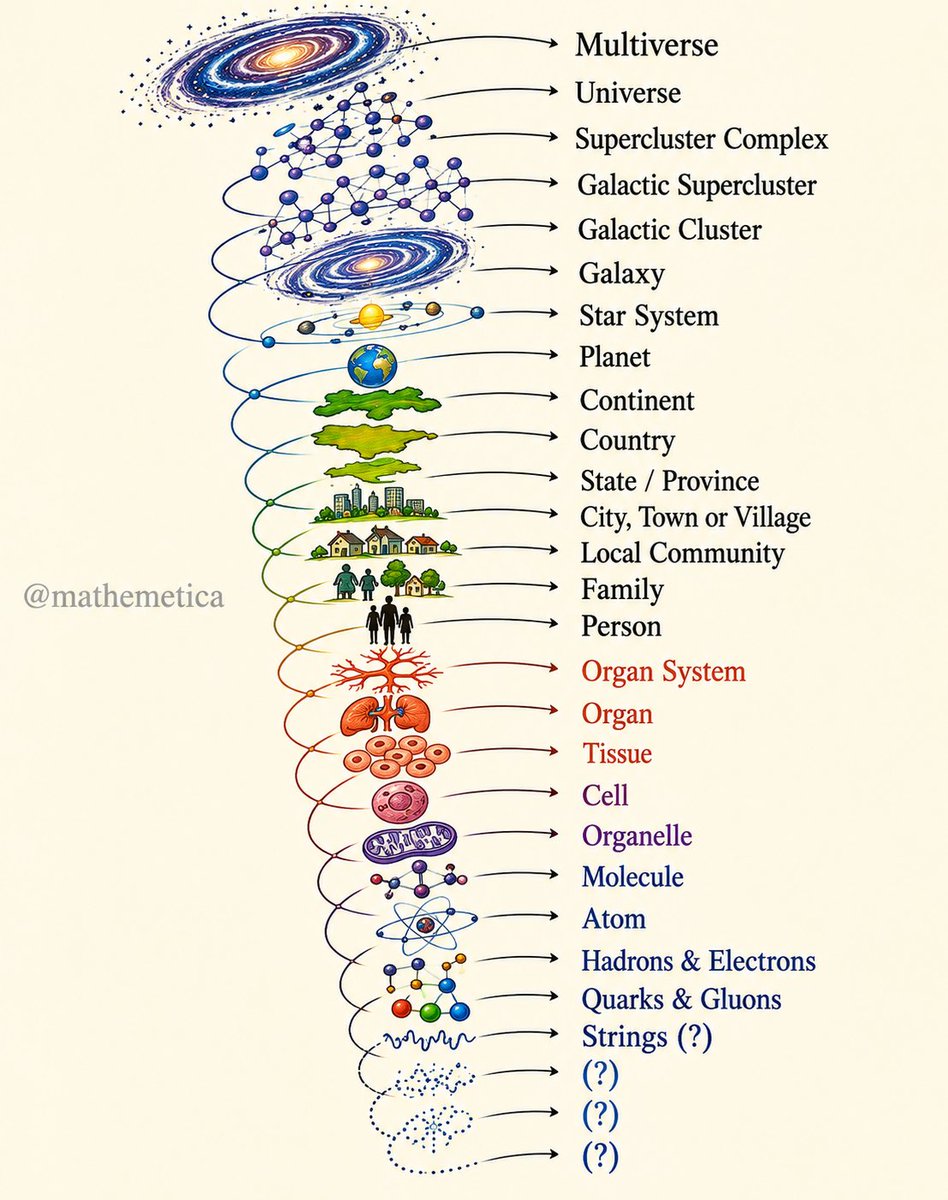
Why can one set of equations govern both the web of galaxies and the quarks inside an atom?
This spiral maps reality’s nested hierarchy: from multiverse and supercluster complexes through galaxies, planets, cells, atoms, and down to speculative strings. Each level is a new mathematical structure built from the one below it.
Multiscale modeling that exploits these hierarchies drives climate simulations, drug discovery, and hierarchical neural nets that learn features at every resolution.
Mathematics is the single language that remains coherent across every power of ten.
At which transition do the rules of nature feel most discontinuous to you?
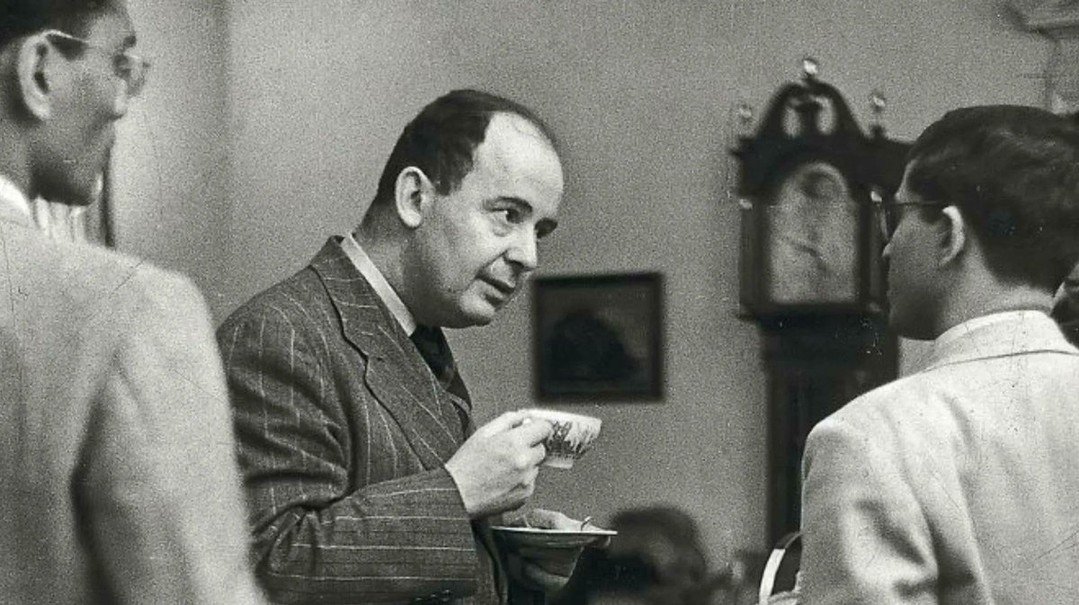
By age six, John von Neumann was already fluent in eight languages, including Ancient Greek and Latin, and could divide eight-digit numbers in his head.
At eight he was studying differential and integral calculus. He entered the University of Budapest at fifteen, earned a degree in chemical engineering by nineteen, and completed his PhD in mathematics in Berlin at twenty-two.
He went on to help build the mathematical foundations of quantum mechanics, invent game theory, and lay the theoretical groundwork for modern computers.
Sometimes the coordinates are the problem.
Imagine training a linear classifier to separate a cluster of points from a ring surrounding it. No matter how you position a straight line, you cannot perfectly separate the two classes.
But mathematics offers a rather clever solution.
Introduce one additional feature:
z = x₁² + x₂²
This represents the squared distance of each point from the origin. In the new three-dimensional space, a flat plane can separate the two classes. What required a circular boundary in the original space becomes a linear separation in the new representation.
This is where the kernel trick enters the picture.
Support Vector Machines (SVMs) can be formulated so that training depends on inner products between feature vectors. A kernel function allows us to calculate these inner products in a transformed space without explicitly constructing the transformed vectors.
K(a,b) = φ(a)ᵀφ(b)
And the mathematics goes much further than three dimensions.
The Gaussian RBF kernel corresponds to an infinite-dimensional feature space. Yet its kernel values can be calculated directly from the original input vectors using a simple exponential function of their squared distance.
This means an SVM can learn nonlinear decision boundaries while operating implicitly in a feature space that would be impossible to construct explicitly.
There are trade-offs, of course. Kernel methods can become expensive for large datasets because of the number of pairwise evaluations required. And choosing a kernel does not guarantee that a classification problem becomes easy.
But the underlying mathematical insight is beautiful.
A problem that cannot be separated by a straight line in its original coordinates may become linearly separable in another representation.
And the kernel trick lets us exploit that geometry without ever explicitly building the higher-dimensional feature vectors.
A square wave can emerge from the sum of smooth circular motions. By projecting odd Fourier harmonics (n = 1, 3, 5, …) onto the real axis, their combined oscillations gradually approximate the sharp transitions of a square wave.
Each added harmonic brings the waveform closer to its ideal shape. The sound you hear is generated directly from the same mathematical sum, S_N(t), turning Fourier's mathematics into an audible signal.
The 2026 Breakthrough Prize in Mathematics goes to Frank Merle for his breakthroughs in nonlinear evolution equations.
Merle transformed our understanding of wave phenomena, fluid dynamics, and singularity formation by proving that certain equations long believed to be globally stable can in fact blow up in finite time.
With the channels of energy method and concentration-compactness techniques, developed often in collaboration with Carlos Kenig and Thomas Duyckaerts, he made decisive progress on the soliton resolution conjecture.
His results also include a full classification of blow-up scenarios for the nonlinear Schrödinger equation and the surprising discovery that its defocusing version can become singular in finite time.
The Gaussian integral hides π in plain sight.
Start with ∫₀^∞ e^{-x²} dx. Square it, switch to polar coordinates, and the infinite plane becomes a simple radial integral. The angular part contributes 2π while the radial part collapses to 1, leaving exactly π/4.
Take the square root and the half-line integral equals √π / 2. One substitution turns an intractable product of exponentials into the most famous constant in mathematics.
Even the simplest bell curve knows the circle.
Why can countless photons occupy the exact same quantum state while electrons cannot?
Bosons carry integer spin and obey Bose-Einstein statistics, so they can share one state. This enables lasers, superconductors, and force exchange via photons, gluons, W/Z bosons, and the Higgs.
These integer-spin carriers power fiber optics and quantum computing.
The mathematics of integer spin gives particles mass and coherent light.
Music of Mathematics Episode 3
In this animation, five moving points trace a beautiful 3D shape called the Halvorsen attractor:
dx/dt = -a*x - 4*y - 4*z - y²
dy/dt = -a*y - 4*z - 4*x - z²
dz/dt = -a*z - 4*x - 4*y - x²
The math is actually playing the music. Every time a point crosses a boundary, it triggers a note. Its position determines the pitch, while its side-to-side movement pans the sound between your left and right ears (headphone on)
You don’t need a robotics degree to learn the math behind robots.
University of Michigan has a 26-lecture course sitting on YouTube. Free. 🤖
It is the recorded lecture series from ROB 501, a graduate-level course covering much of the mathematical foundation used in robotics.
Some of what it covers:
→ Abstract linear algebra
→ Linear operators & eigenvalues
→ Projection and least squares
→ Recursive least squares & Kalman filtering
→ Probability & Gaussian random vectors
→ QR factorization
→ Newton-Raphson
→ Real analysis & convergence
→ Linear programming
These are not short overview videos either. Many of the lectures are around an hour long and work through the mathematics properly.
The accompanying GitHub repository also includes the textbook, lecture notes, homework, exams, recitations, and MATLAB material.
If you work in robotics, controls, estimation, perception, or ML and want stronger mathematical foundations, this is a very good resource to save.
All 26 lectures are free.
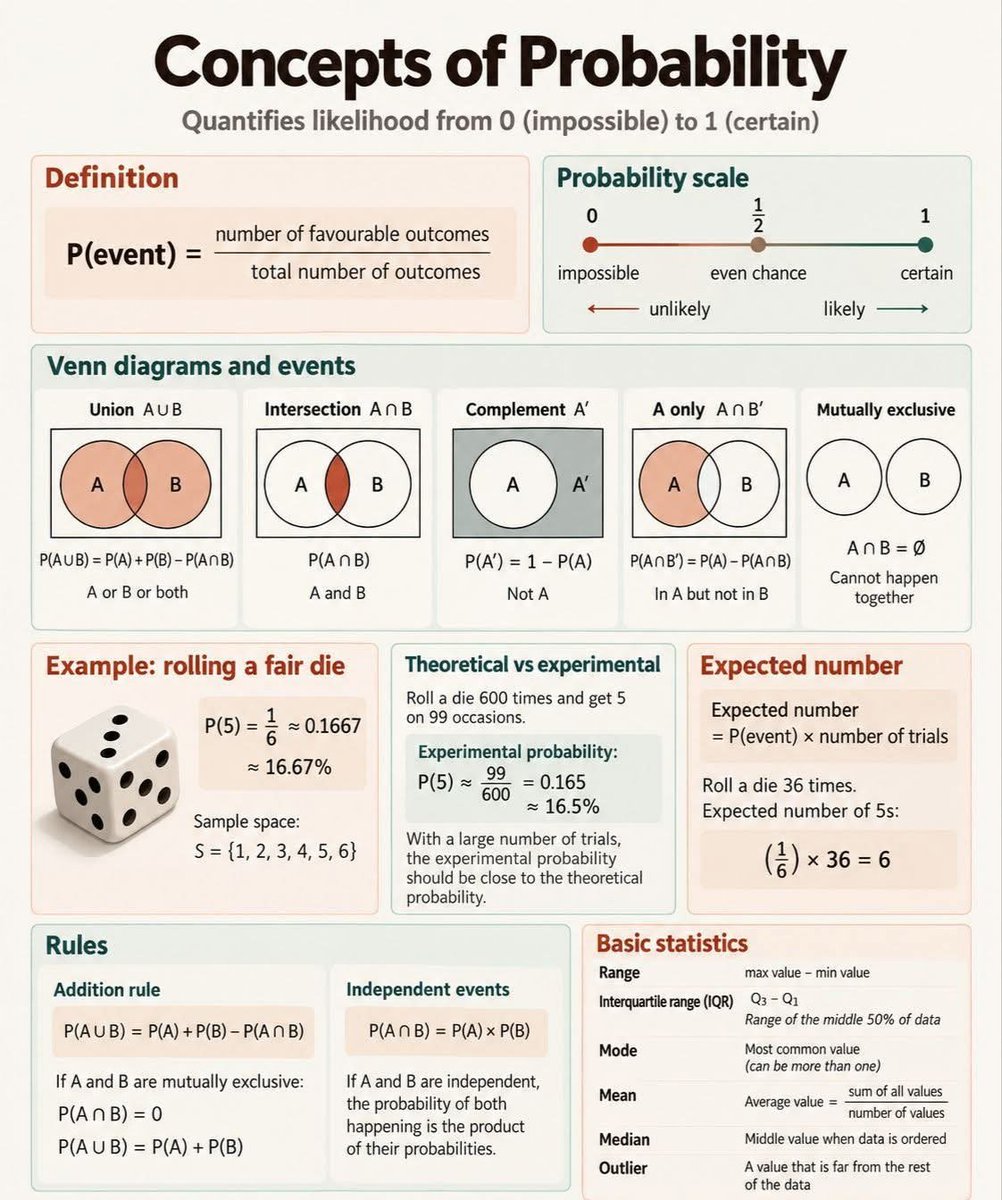
🎲 Probability is more than just predicting outcomes, it is the mathematical language of uncertainty. From rolling a die to powering AI, risk analysis, and scientific discovery, probability helps us make sense of a world full of unknowns.
#Mathematics#Probability#Statistics
Mathematics of Deep Learning: An Introduction (Free PDF)
Want to understand the mathematics behind Deep Learning?
This textbook from De Gruyter provides an introduction to the mathematical foundations of deep learning.
333 Pages
Topics worth exploring:
Mathematical foundations of Deep Learning
Linear Algebra
Calculus and Optimization
Neural Networks
Mathematical concepts behind Deep Learning algorithms
A useful resource for students, researchers, and AI/ML enthusiasts who want to strengthen their mathematical understanding.
Read and access the PDF:
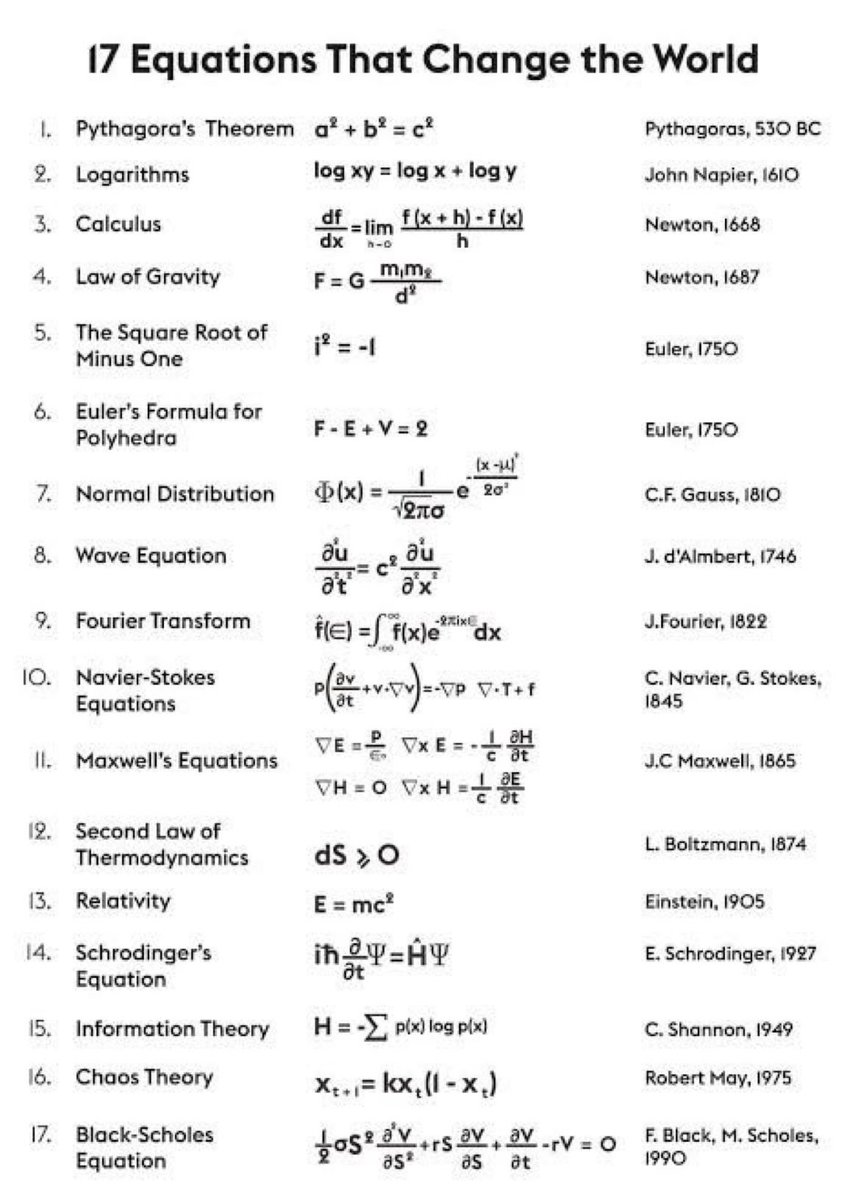
These 17 equations didn't just describe the world, they rebuilt it.
From a² + b² = c² to E = mc², each line is a lever that moved science, technology, and how we see reality. Pythagoras gave us geometry. Newton gave us change and gravity. Euler gave us the imaginary and the topology of space. Gauss, Fourier, Maxwell, Schrödinger, Shannon: each formula compressed centuries of observation into something that could be used, predicted with, and built upon.
They are not decorations. They are the shortest, sharpest instructions reality has given us so far.
Mathematics is how the universe writes its own source code.
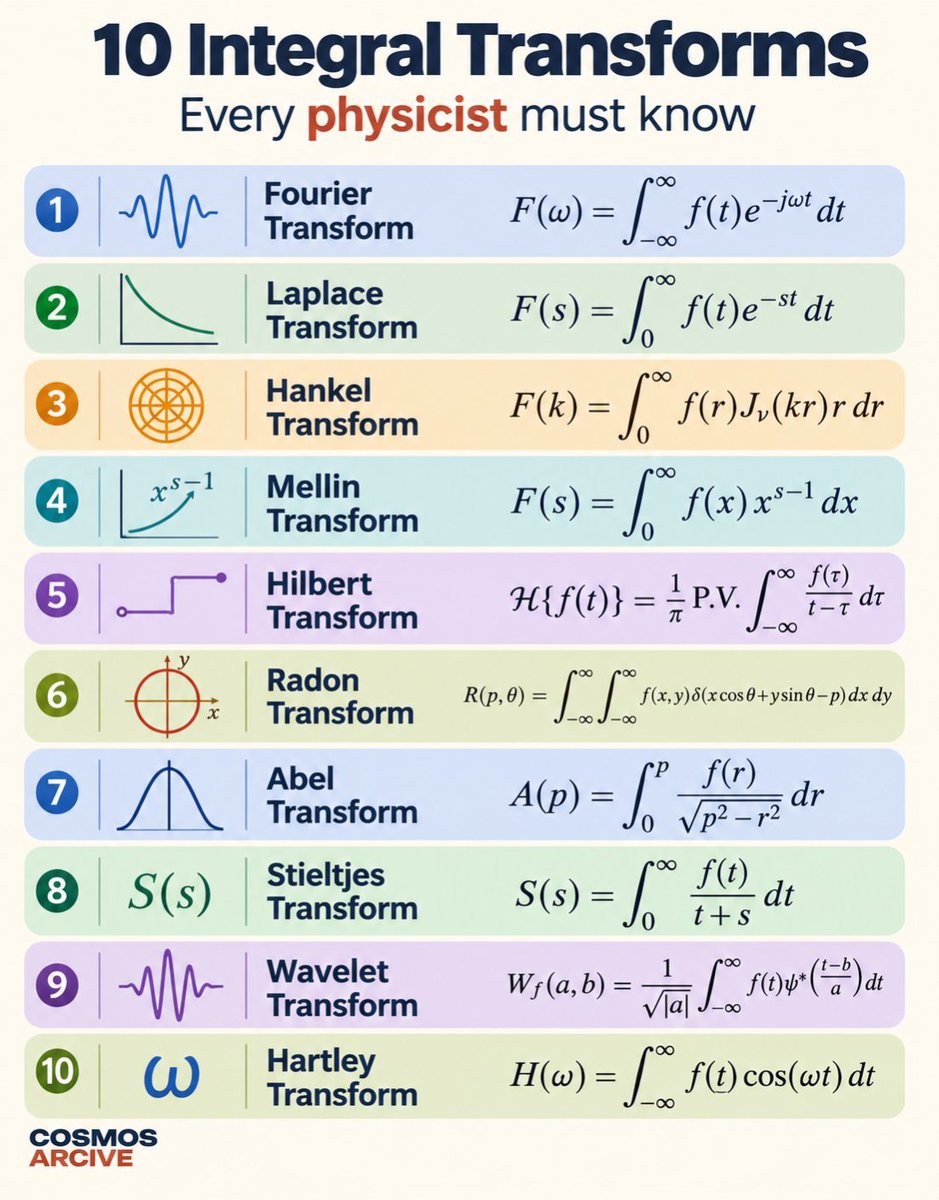
A powerful equation can sometimes become much easier when viewed from a different angle. That's exactly what integral transforms do.
From Fourier's frequency analysis to Laplace's differential equations, each transform offers a different way to tackle mathematical problems.
The Fourier transform, for example, converts a function from time to frequency:
F(ω) = ∫₋∞⁺∞ f(t)e⁻ⁱωᵗ dt
Different perspectives, same underlying mathematics.
Simple trigonometric functions can birth a butterfly.
A single parameter t, fed into nested sines and exponentials, traces the outline of a living wing:
x = sin(t)(e^cos(t) − 2 cos(4t))
y = cos(t)(e^cos(t) − 2 cos(4t))
The same principle scales hearts from cubic sines and double-angle cosines, then lifts into three dimensions where Lorenz parameters and spherical harmonics weave closed loops on an ellipsoid.
Mathematics does not invent beauty; it reveals the shapes already latent in its simplest rules.
Modest intelligence is arriving faster than most people realize.
Today, we're open-sourcing TwIL-8B.
Just 8.8 billion parameters, yet approaching frontier-model scores on several difficult benchmarks:
• 93% of frontier performance on coding
• 92% on instruction following
• 90% on contest mathematics
All from a model small enough to run on your own hardware.
But the benchmarks aren't the most important part of this announcement.
For years, the AI industry has focused on building the most capable model, regardless of the cost required to run it.
I believe that equation is changing.
The next era of AI will be defined by the cost of completing work. Not simply the intelligence of the model, but how efficiently that intelligence can accomplish the task.
If a model with 8 billion parameters can reliably complete the same work as one with hundreds of billions, why pay for the larger model?
As smaller models become more capable, intelligence becomes something we can distribute, specialize, and run across the hardware we already own.
That's the future we're building at @thewebAI
TwIL-8B is available today. Open weights.
And this is just the first of several announcements we're making today.
HF Link:
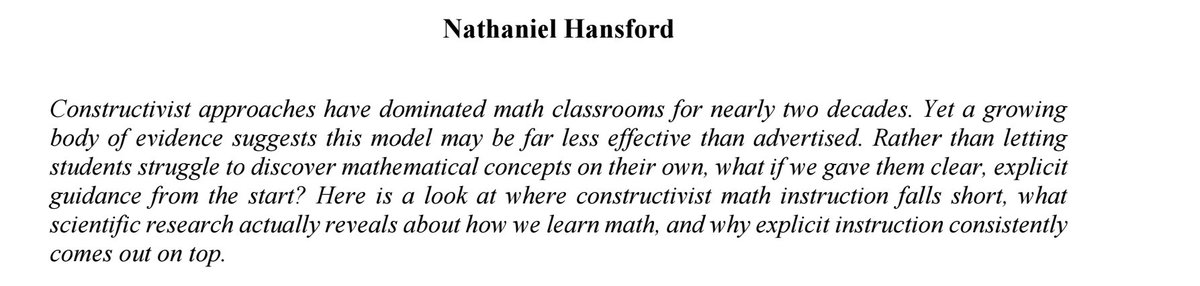
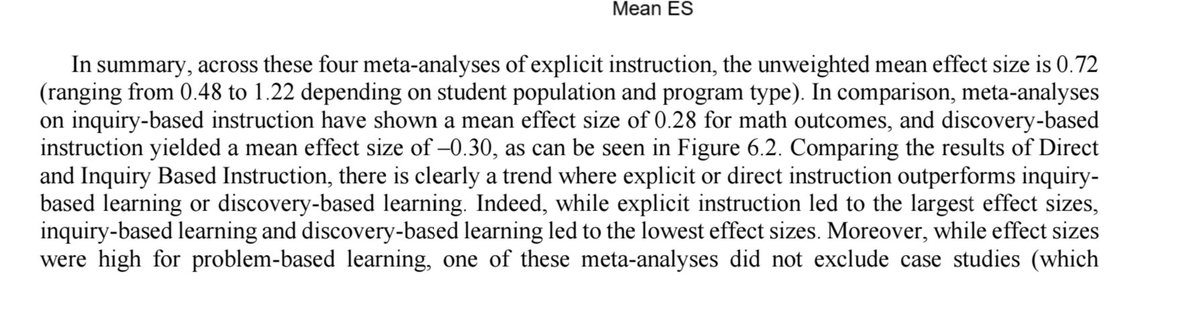
Empirical evidence surrounding mathematics pedagogy concludes that explicit and direct instruction consistently outperforms constructivist, inquiry-based, and discovery-based approaches in fostering mathematical achievement.
Discovery-based learning yields a negative effect on student achievement (d = -0.30), while explicit and Direct Instruction consistently deliver large, reliable gains averaging 0.72 rising to 1.22 for struggling learners. Complex problem-solving does not bypass foundational procedural fluency; it depends on it. If we want authentic mathematical reasoning, we must teach the concepts and procedures explicitly from the start.
In practice, inquiry functions effectively only as a later-stage consolidation tool for advanced learners who have already mastered foundational skills through explicit instruction never as a primary vehicle for novices to learn them from scratch.
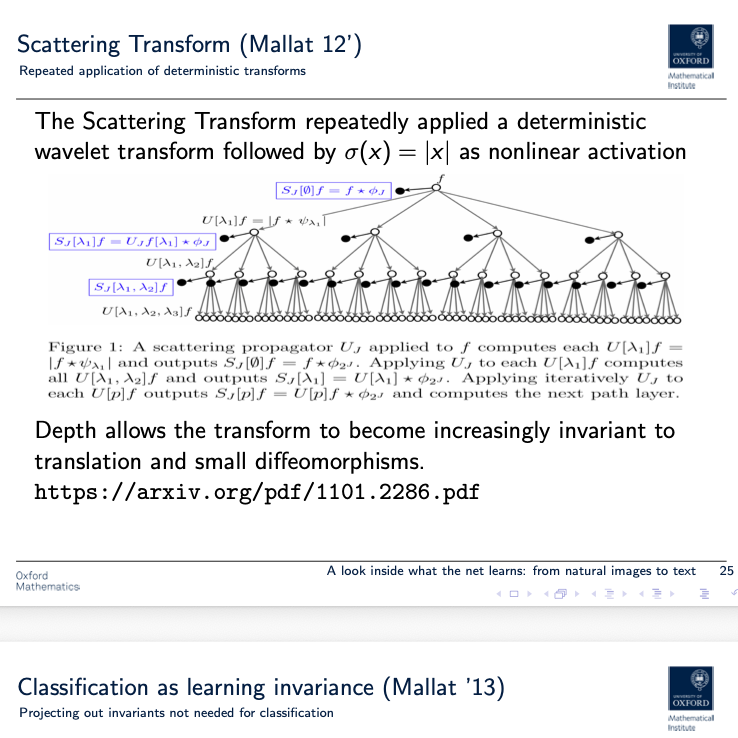
"Theories of Deep Learning" is a 2026–27 mathematics course offered by the University of Oxford that examines the mathematical foundations of deep neural networks.
The course consists of 16 freely available lectures covering neural network architectures, nonlinear transformations, convolutional structures, pooling, optimization, dictionary learning, transferability of learned features, adversarial examples, random matrix theory, learning invariances, and more.
The lectures explore mathematical theories that help explain how deep neural networks learn and why they perform as they do. I consider this a particularly valuable resource for anyone interested in the mathematics underlying modern AI systems.
I think we have reached a form of weak AGI in the domain of mathematics. The models can help formalize major projects, they deliver technical expertise in basically any area of mathematics, and more and more mathematicians use models for exploration, exploitation, and even ideation.
I am preparing a longer post about this. From my own projects in algebra, I can see that the speedup and jump in quality are unprecedented. To be honest, most mathematical questions are intractable for AI systems, but they are hopeless for humans, too. A surprising number of problems described in the literature can be cracked with the right auto-research skills and clever harnesses (and a ton of tokens) within days.
Things are changing way too fast to comprehend every change. But I do see very young researchers, including PhD students, starting completely new, crazy projects exploring the interactions between models and mathematics. So there is hope that these people will lead the frontier in a few years and we won't end up with a frontier devoid of human mathematicians.
A severe misalignment in mathematics?
In September 2026, 25 Fields Medallists signed a statement raising concerns about the growing influence of AI on mathematical research.
Their central argument was that AI companies are increasingly focused on solving mathematical problems, while mathematicians are interested in something much deeper: understanding *why* things work.
The response from this has been incredibly interesting to watch unfold.
And some mathematicians have explained why they haven’t signed it.
Fields Medallist Timothy Gowers publicly explained why he chose not to sign the declaration, arguing that solving problems is itself a legitimate goal of mathematics, and questioning whether an abundance of AI-generated results would necessarily be harmful.
Gowers wrote a piece on Terence Tao’s blog which I would highly recommend reading.
He writes “Under the circumstances, I think the best we can do is recognise the changes that are coming and try to work out the least unsatisfactory way of dealing with them.”
Since then, OpenAI has established an independent advisory group of mathematicians, including Gowers, to address questions around AI-generated research, verification and academic credit.
So, while the original concerns haven’t disappeared, the conversation is definitely evolving.
As AI becomes increasingly capable of solving difficult mathematical problems, perhaps the bigger question isn’t whether AI can do mathematics, but what we actually want mathematics to become.
What do you think?