Posts with #float
#float
Public posts on X that use #float.
Related hashtags

Reminder: Float's first trader airdrop is tomorrow 🪂 💰 $122K+ USDC in the vault, and still growing ⏱️ Wed Nov 4, 11:00 AM CST At 11:00 AM sharp the snapshot is taken and the leaderboard locks. Volume after that counts toward the next round. The list is then reviewed, bots and wash trading are removed, and the USDC is sent straight to the top 100 wallets, sized by volume. You still have time to climb. Check your spot:2018782.8K
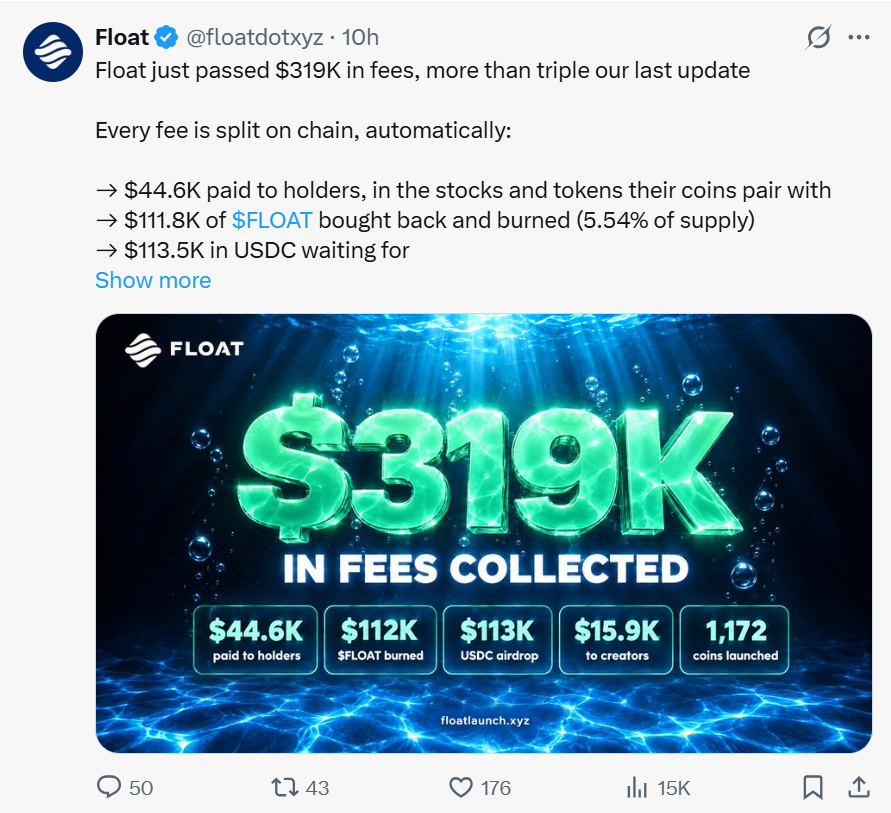
Float just passed $319K in fees, more than triple our last update Every fee is split on chain, automatically: → $44.6K paid to holders, in the stocks and tokens their coins pair with → $111.8K of $FLOAT bought back and burned (5.54% of supply) → $113.5K in USDC waiting for the top traders, airdropped tomorrow, Nov 4 → $15.9K earned by creators → 1,172 coins launched on 126 stocks and tokens And we're just getting started. We're working on new updates that will make a real impact for the trenches.504017915.9K
Float update 🌊 Every coin launched on now gets a contract address ending in "fLoat" → Works on every pair: stocks, SOL and tokens → Dev buy still lands in the same transaction as the launch → Coins already launched keep their current CA and aren't affected Heads up: the "fLoat" ending comes from launching on our site. Coins launched through third-party tools or scripts that call the program directly still get a regular CA Also shipped behind the scenes: → Moved to a bigger dedicated server built to handle our growth → Security hardening across the launch flow and our servers → Upgraded launch transactions so every pair fits in one transaction → Extra safety checks on holder rewards payouts → Price protection on $FLOAT buys from our buyback wallet Launch yours today.532822219.2K
⚡Fourtis Express Listing - FLOAT⚡ @floatdotxyz FLOAT ( #FLOAT ) CA: Bv1a7cEj5aRnJQhMw4kRQqAFesMSd5LwcDnUzq52BMmr PRICE: $0.002536 | MC: $2,386,439 #Fourtis #Newlisting #Altcoin #Memecoin #FourtisListing #Dyor666740
FwukinWeeb@MADbluederHoly shit dudeD @BoDizzer@Hideo_Fufujima No fuckin kidding holy shit 😭2531321.5K241K
Misterprickly@Misterprickly@MADblueder@MADblueder This animator did their research. Real ones FLOAT!0012318K
hun con nhện@nacconnhen61671.7K17.9K
Cherry🍒🗒️☆@CherryberryaiskI plan on having Charizard slowly float down as the flame on its tail gets smaller then faint (DIE) mid song teeheeCherry🍒🗒️☆ @Cherryberryaisk1) Frostbite Shiny Mix - @justdemianagain Assets - Me Noteskin - Numya Chart - Camilo Annoying fnf fans DNI I made this for fun and out of passion so I don't wanna hear any negativity anyone who ignores that will be permanently BLOCKED😒😒4192182.5K
Cherry🍒🗒️☆@Cherryberryaisk1) Frostbite Shiny Mix - @justdemianagain Assets - Me Noteskin - Numya Chart - Camilo Annoying fnf fans DNI I made this for fun and out of passion so I don't wanna hear any negativity anyone who ignores that will be permanently BLOCKED😒😒704612K41.7K
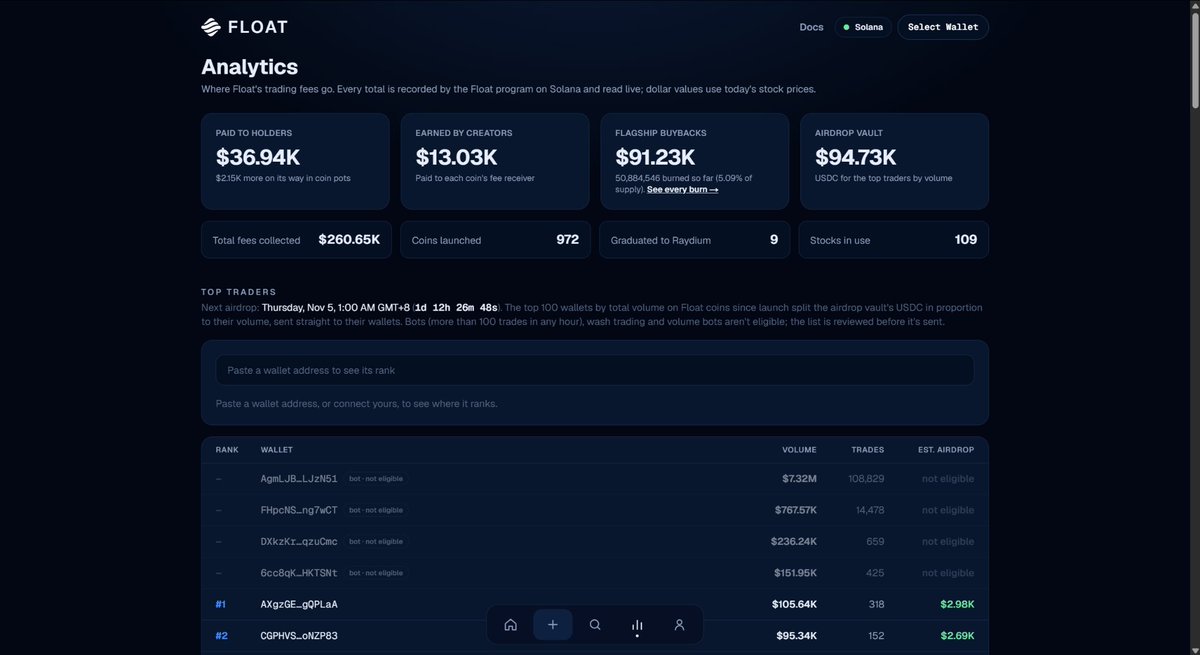
This time, $FLOAT presents an interesting situation. Bv1a7cEj5aRnJQhMw4kRQqAFesMSd5LwcDnUzq52BMmr Platform metrics are still growing rapidly, while the token price has fallen from its $5 million peak to around $2.2m. The two are no longer moving in sync. I remain positive about its fundamentals. Over the past few days, Float has expanded its tokenized gold pairs, while continuing to improve its trader airdrop, buyback mechanism, launch infrastructure, and security. The platform is clearly becoming more mature. However, I don't want to ignore what the price is telling us: trading turnover remains high, but liquidity is declining. FLOAT's fundamentals are stronger than before, while its short-term market structure has become weaker. But this raises a question: If FLOAT's fundamentals are still growing, why is its price falling? Previously, I was more focused on whether Float could make the stock-paired memecoin model work. Now, I'm more interested in whether it can turn its trading activity into sustainable user demand, especially after generating hundreds of thousands of dollars in platform fees and continuously buying back and burning FLOAT. Let's start with the data. The numbers have improved considerably. In the previous official website snapshot, cumulative fees were approximately $260.65K, with $36.94K paid to holders, $13.03K earned by creators, approximately $91.23K used for FLOAT buybacks, and $94.73K accumulated in the trader airdrop vault. The latest Analytics page now shows cumulative fees of $343.34K, holder distributions of $48.43K, creator earnings of $17.16K, buybacks of $120.18K, and an airdrop vault balance of $123.44K. Several major metrics have increased by roughly 30% during this period. The buyback and burn figures are particularly worth watching: the total number of FLOAT burned has reached 59,724,253, representing approximately 5.97% of the total supply, compared with 5.09% previously. This shows that Float's fee mechanism is actually operating. Every trade on the platform generates fees, which are distributed among traders and project participants, while a portion is continuously used to buy and burn FLOAT. One thing I particularly like is that the buyback records have become more transparent. The team has established a dedicated Burn page, where every buyback has a corresponding Solscan transaction. Users can check the actual amount spent, tokens burned, and historical records. Recently, the team also changed its buyback execution method. Instead of making small purchases every 10 minutes, funds accumulate until reaching 5 SOL before a buyback is executed. If the amount still hasn't reached 5 SOL after four hours, the accumulated funds are used to execute the buyback rather than waiting indefinitely. Product-wise, there are two recent developments worth watching. The first is the official launch of GOLD. Users can now launch memecoins paired not only with stock tokens, SOL, and other tokens, but also with tokenized gold. I think this is a reasonable expansion. Stock assets offer exposure to companies and the technology sector, while gold represents an entirely different market narrative. Float is no longer focused exclusively on U.S. equities. It is beginning to bring more real-world assets into the memecoin launch market. For creators, a wider selection of paired assets means more narratives to build around. For the platform, expanding the range of assets creates more potential trading scenarios. Of course, the underlying backing, liquidity, and redemption conditions of tokenized gold still need to be verified. Trading a token paired with tokenized gold should not be confused with owning physical gold. Another update is the branding of its launch contracts. Tokens launched directly through Float's website now receive contract addresses ending in "Float". This applies to stock, SOL, and other token pairs, and developers' initial purchases can be included in the same transaction as the launch. Previously launched tokens will not be affected, and tokens created through third-party tools that directly call the program may not have this suffix. This might seem like a minor detail, but standardizing the launch experience and adding a recognizable identity can help improve the platform's brand recognition. More importantly, the team has also migrated to a larger dedicated server and strengthened security across its launch process and infrastructure. It has consolidated launch transactions across different pairs into a single transaction, added additional safety checks for holder reward payouts, and introduced price protection for FLOAT purchases made by the buyback wallet. These improvements may not immediately generate more trading volume, but they show that the team is beginning to address the practical challenges that come with scaling a platform. Especially after several Solana websites experienced frontend attacks, I think Float taking the initiative to review and strengthen its own infrastructure is a positive development. The next clear catalyst is the first USDC trader airdrop. The vault has now accumulated approximately $123.44K in USDC. According to the official rules, the platform will select the top 100 wallets based on cumulative trading volume and distribute rewards proportionally according to each wallet's share of the total volume. USDC will be sent directly to users' wallets, with no manual claiming required. The leaderboard will be locked at the designated snapshot time, and trading activity after that point will count toward the next round. The anti-bot rules have also become more specific. Wallets executing more than 300 trades in a single hour, or more than 100 trades per hour across five different hours, will be disqualified. Wash trading and bot activity will also be excluded, and the final leaderboard will undergo an on-chain history review. This mechanism can encourage short-term trading activity on the platform. Traders have an incentive to keep trading on Float to compete for USDC rewards, while greater trading activity could theoretically generate more platform fees and FLOAT buybacks. But there is one question I particularly care about: What happens after the airdrop ends? If users are only increasing their trading volume to compete for a place in the top 100, some of that activity could disappear rapidly once the snapshot is completed. What really matters is whether those traders continue using the platform after receiving their rewards. Another easily overlooked detail is that rewards are distributed proportionally to trading volume, rather than equally among the 100 wallets. This means the final rewards could be heavily concentrated among a small number of high-volume accounts. This is a trader incentive program, not a universal airdrop for all token holders. Now let's return to FLOAT's chart. At the time I am preparing this post, the market cap is approximately $2.2 million, liquidity is around $319.3K, and 24-hour trading volume is approximately $3.4 million. Compared with the previous market cap of around $3.29 million, it has declined by roughly one-third. Measured against the historical high of approximately $5 million shown on the latest chart, the drawdown exceeds 50%. Interestingly, trading volume has not declined alongside the price. It has actually increased from approximately $3 million to $3.4 million, while pool liquidity has fallen from around $408.6K to $319.3K. In other words, trading activity remains high, but it has not translated into sufficiently stable price support. High turnover can produce impressive trading statistics, but it can also mean that large amounts of capital are constantly moving in and out rather than accumulating as long-term holdings. Based on these developments, I see three main areas worth watching for future upside. First, whether the initial USDC airdrop can bring in users who stay. The distribution itself is only one milestone. Trading activity after the airdrop will determine whether the incentive program has actually succeeded. Second, whether stock and gold pairs can generate new launch and trading demand. Float now offers a wider range of asset options. If it continues adding pairs with genuine liquidity and more projects successfully graduate, the platform still has room to expand its market. Third, whether buybacks can continue accelerating alongside business growth. Approximately $120K in cumulative buybacks and nearly 6% of the total supply burned already represent a measurable value-capture mechanism. If platform fees continue growing and buybacks expand accordingly, FLOAT's supply-demand dynamics could improve further. The previously mentioned application for a dedicated FLOAT/SOL liquidity pool is also worth monitoring. If Raydium approves it, this could become another catalyst. However, it should not be treated as an implemented feature yet. Of course, the biggest risk remains the gap between the number of tokens launched and the number of projects with genuine staying power. An earlier official website snapshot showed approximately 972 tokens launched, with 9 graduating. The project's latest update has reported 1,172 launched tokens, while the latest graduation page now shows 11 projects. At least we can see that more projects are successfully graduating. However, compared with the total number of launches, the proportion that actually reaches graduation remains relatively small. If the number of launches continues increasing but graduations and post-graduation trading activity fail to keep pace, platform revenue may become increasingly dependent on new launches rather than sustained trading activity from existing projects. Therefore, my current view of FLOAT is that its fundamentals are continuing to strengthen, but market sentiment and price momentum have clearly cooled down. The recent updates are not simply about adding a few more features. They are gradually improving trader incentives, asset availability, launch infrastructure, server capacity, and buyback transparency. Float is becoming much more like a trading platform with actual fee revenue and a functioning token buyback mechanism than it was when it first launched. However, I wouldn't conclude that FLOAT should return to a $5 million market cap simply because cumulative fees have increased from $260K to $343K. Ultimately, the market prices future expectations, not historical cumulative fees. What I want to see is that users don't disappear after the first airdrop, gold and other newly added pairs begin generating sustained trading activity, more projects graduate, and buybacks continue growing alongside platform activity. If these developments materialize, the current price correction could give the market a reason to reassess FLOAT's growth potential. But if trading volume drops sharply after the airdrop, launches continue increasing while graduations remain stagnant, then the impressive revenue figures we see today may simply reflect the temporary prosperity created by early-stage incentives. Float has already demonstrated that it can generate trading activity and platform fees at scale. What it needs to prove next is that users are still willing to come back when there are no airdrop incentives driving them. In other words, user retention is the next metric that really matters. Chart:Jeff @cfm_solMy view on $FLOAT is that this rally is no longer driven solely by the idea of a stock-paired memecoin launchpad. Bv1a7cEj5aRnJQhMw4kRQqAFesMSd5LwcDnUzq52BMmr The market is beginning to price in a more developed business model built around platform fee revenue, USDC incentives, and token buybacks and burns. This is also why I remain positive about FLOAT's recent fundamental progress. However, one figure is still worth keeping an eye on: 972 tokens launched, but only 9 have graduated. The platform is clearly expanding, but project quality and post-graduation retention have not fully caught up yet. Over the past few days, Float's product development, supported asset range, and revenue metrics have all expanded rapidly. Cumulative fees have now exceeded $260K, while more than 50 million FLOAT have been bought back and burned, representing approximately 5.09% of total supply. When a relatively new Launchpad starts generating meaningful platform revenue and can consistently convert part of that revenue into token buybacks, it is natural for the market to reassess its valuation. Let's go back to Float's original product design. Built on Raydium LaunchLab, Float's core model allows every newly launched memecoin to be paired with a real tokenized stock, such as NVDA, TSLA, MCD, and others. Users trade with SOL, and the platform automatically converts SOL into the corresponding stock token before executing the memecoin trade. Users do not need to hold the underlying stock tokens themselves. According to the project, each token starts with approximately $20K in initial liquidity, rather than the more common $4K, and launching a token using an existing ticker requires a 1 SOL fee. What makes this model interesting is that it connects memecoin issuance and trading with the liquidity, pricing, and narratives of stock-related assets. Trading fees are not simply retained by the platform. They are distributed according to a predefined structure: 35% goes toward USDC rewards for traders, 15% is paid to holders of the corresponding tokens in the paired asset, and another 35% is used to buy back and burn FLOAT. Creators also receive a share of the fees, with approximately $13K currently recorded on the website. One distinction is important: the 15% holder allocation goes to holders of individual project tokens, not directly to FLOAT holders. The primary value-capture mechanism for FLOAT is the buyback and burn funded by platform fees. The early data already showed that this model was gaining traction relatively quickly. Less than an hour after launch, Float reported 145 tokens launched across 41 stock assets, generating approximately $21.5K in fees. Around $8.18K had already been used to buy back and burn FLOAT, while another $8.18K had entered the trader reward vault. In its first-day recap, the number of launches increased to 361 across 69 assets. Cumulative fees reached approximately $75K, buybacks and burns totaled around $26.3K, and approximately 17 million FLOAT had been burned, representing about 1.7% of total supply. Three tokens had also graduated to Raydium. A subsequent snapshot showed approximately 485 tokens launched across 79 assets, with cumulative platform fees exceeding $100K. The latest website data has moved to another level: cumulative fees have reached $260.65K, with 972 tokens launched and 9 graduated to Raydium. The platform currently has 109 stock assets actively in use. The fee distribution dashboard shows approximately $36.94K paid to holders, $13.03K earned by creators, $91.23K allocated to flagship token buybacks, and $94.73K accumulated in the USDC trader reward vault. At the earlier $100K fee milestone, approximately $35.2K had been used for buybacks, with around 3% of total supply burned. Now, cumulative buybacks have reached $91.23K, with 50,884,546 FLOAT burned, representing approximately 5.09% of total supply. This is the main reason I remain bullish on FLOAT. The platform is not simply increasing the number of newly launched tokens. Trading fees are accumulating, and the buyback-and-burn mechanism has already reached a meaningful scale. Its revenue model is beginning to show the potential for a self-reinforcing cycle: new projects attract trading activity, trading generates fees, fees fund trader incentives and FLOAT buybacks, incentives attract more traders, and buybacks connect platform activity directly to the token's circulating supply. One of the most important recent developments is the expansion of Float's supported pairing assets. The project previously announced milestones of 179, 234, and 400 pairs. The latest website shows approximately 298 available tokenized stocks, of which 109 are actively being used. These figures come from different update times and dashboard definitions, so they should not be treated as one perfectly continuous data series. But the overall direction is clear: Float is expanding from a relatively small selection of curated stock pairs toward a much broader range of asset options. One particularly interesting addition is SPY. SPY represents the S&P 500 ETF. Float now allows users to launch memecoins paired with SPY. Users still trade with SOL, while the platform handles the conversion into SPY tokens. Holders receive their share of trading fees in SPY, and the project has also stated that liquidity will be permanently locked upon graduation. This expands the pairing model beyond individual company stocks and into index-based assets, giving creators a wider range of narratives to build around. Custom Pairs takes asset expansion a step further. Users can search for a pairing asset by ticker or contract address, provided that Raydium has already created the corresponding LaunchLab configuration. According to Float's updates, candidate assets must have a genuine market and live pricing, at least $10K in liquidity, no Mint or Freeze Authority, and must pass checks against fake or copycat tickers. There is an important limitation here: not every token can immediately become a supported pairing asset. Raydium's LaunchLab configuration and administrator permissions remain prerequisites. Custom pairs may also have thinner liquidity than curated pairs, resulting in higher trading costs. So while expanding the asset range is positive, the real value will come from pairing assets that can consistently attract trading activity. Another potential catalyst I am watching is Float's application to Raydium for a dedicated global config for FLOAT. The team has explained that other pairing assets can already be integrated through their respective configurations, but FLOAT itself does not yet have one. Only Raydium administrators can create it. If the application is approved, the team plans to establish a FLOAT/SOL CLMM pool, allowing the fee vault to route holder rewards and buybacks through that pool. This feature has not gone live yet, but if completed, it would create a more direct connection between the platform's flagship token and its trading infrastructure. The clearest near-term catalyst is the first USDC trader airdrop, which is scheduled for November 4 at 17:00 UTC. Its significance goes beyond simply distributing rewards to traders. Until now, users have been watching platform fees accumulate in the vault without having experienced the first full distribution. The first actual payout will test whether Float's incentive model can deliver as promised and could bring another wave of attention and trading activity. The buyback mechanism has also been adjusted. Float no longer primarily relies on small purchases every 10 minutes. Instead, it accumulates funds until reaching 5 SOL before executing a buyback. If the amount does not reach 5 SOL within four hours, whatever has accumulated will be used to make a purchase. At the same time, the project launched a dedicated Burn page. Every buyback can now be matched with a corresponding Solscan transaction. The page displays cumulative tokens burned, the percentage of total supply, SOL spent, and hourly and daily burn charts. The website now shows more than 50 million FLOAT burned. Compared with the earlier milestones of 1.26 million, 17 million, and 35 million tokens, the growth has been substantial. This also makes the buyback data easier for external users to verify, rather than relying solely on announcements from the team. Looking at the price, as of the time I am preparing this post, FLOAT has a market cap of approximately $3.29M, liquidity of around $408.6K, and 24-hour trading volume of approximately $3M. Trading volume is roughly 7.3 times the pool liquidity, indicating substantial market turnover. But it also means that short-term capital inflows and outflows can have a relatively significant impact on price. The short-term bullish structure has not yet been broken, but this is no longer the early accumulation phase. The $3.4M market cap area is the immediate resistance to watch. A sustained move above it could open the way for another attempt at the previous high of approximately $4.32M. On the downside, if the market loses the $3.26M area, the next levels worth watching are around $2.67M, followed by approximately $2.33M. This is also why I think it makes more sense to wait for confirmation of a breakout rather than ignore short-term volatility simply because the price has been rising. As for what the market is betting on, I don't think it is simply betting that FLOAT will launch more memecoins. Instead, the market is pricing in the possibility of three mechanisms working together: First, the expansion of stock and ETF pairing assets gives creators more launch options and broadens the platform's reach. Second, trader incentives and holder fee distributions may help retain trading activity instead of concentrating it entirely around the initial launch phase. Third, 35% of platform fees are continuously used to buy back and burn FLOAT, creating a direct connection between platform trading volume and the flagship token's supply. There is real potential in this model, but one issue cannot be ignored: as mentioned at the beginning, only 9 out of 972 launched tokens have graduated to Raydium, representing less than 1%. That is a relatively low graduation rate. Many newly launched projects are still in their early stages, so this figure alone does not prove that project quality is poor. However, it does reveal Float's current challenge: the supply of new launches is already growing, but the number of projects successfully passing through the Bonding Curve and retaining meaningful post-graduation trading activity remains limited. If the number of graduations increases but trading activity quickly disappears afterward, it will be difficult for platform revenue to maintain its current growth trajectory. Float therefore needs to differentiate itself through better liquidity, transparent fee distribution, and a consistent product experience, rather than simply replicating the stock-paired memecoin concept. The three outcomes I will be watching most closely are: First, whether the initial airdrop on November 5 can be completed successfully and whether trading activity remains strong after the rewards are distributed. Second, whether the FLOAT/SOL configuration receives approval from Raydium, allowing the platform to further improve buyback and reward routing for its flagship token. Third, whether the number of graduated projects and their post-graduation trading volumes can grow together. If these three developments are gradually validated, the market will have a stronger reason to revalue FLOAT from an emerging Launchpad token into a platform asset with recurring fee revenue and a functioning buyback mechanism. But what I don't want to see is the number of launches continually setting new records while the number of graduated projects remains stuck in single digits. Float's next stage is not about proving how many tokens it can launch. It is about proving that people are still willing to trade those tokens after they graduate. So my overall view is that FLOAT's fundamentals are strengthening, although the short-term price has already priced in part of that progress. Chart:2062.1K
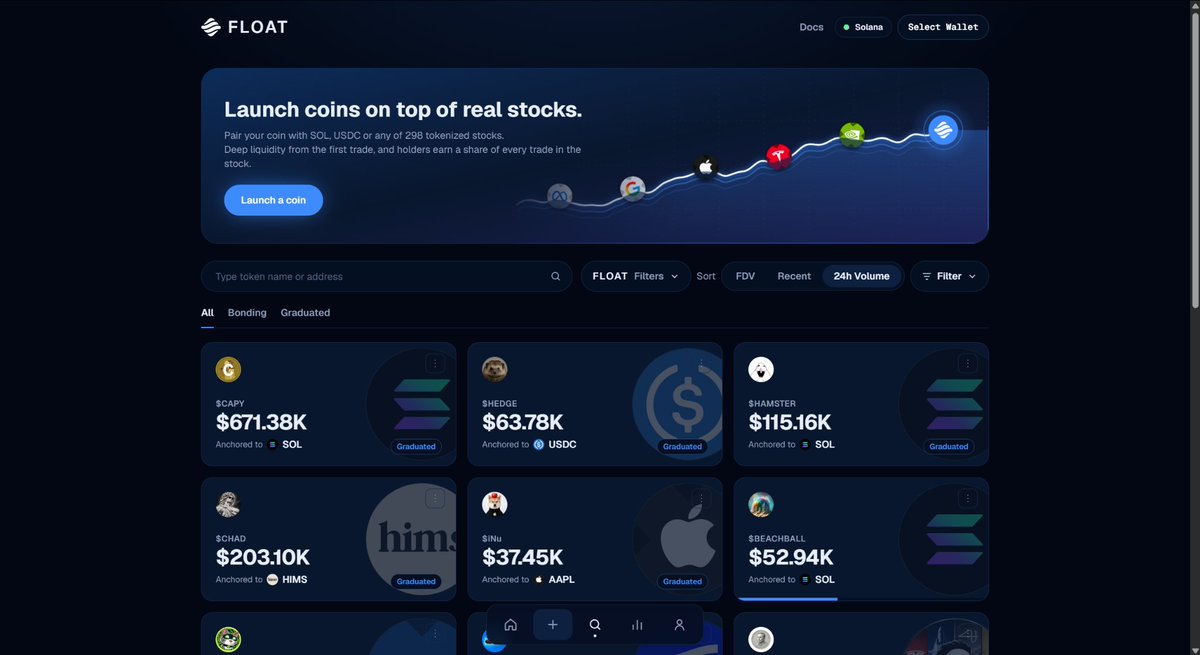
My view on $FLOAT is that this rally is no longer driven solely by the idea of a stock-paired memecoin launchpad. Bv1a7cEj5aRnJQhMw4kRQqAFesMSd5LwcDnUzq52BMmr The market is beginning to price in a more developed business model built around platform fee revenue, USDC incentives, and token buybacks and burns. This is also why I remain positive about FLOAT's recent fundamental progress. However, one figure is still worth keeping an eye on: 972 tokens launched, but only 9 have graduated. The platform is clearly expanding, but project quality and post-graduation retention have not fully caught up yet. Over the past few days, Float's product development, supported asset range, and revenue metrics have all expanded rapidly. Cumulative fees have now exceeded $260K, while more than 50 million FLOAT have been bought back and burned, representing approximately 5.09% of total supply. When a relatively new Launchpad starts generating meaningful platform revenue and can consistently convert part of that revenue into token buybacks, it is natural for the market to reassess its valuation. Let's go back to Float's original product design. Built on Raydium LaunchLab, Float's core model allows every newly launched memecoin to be paired with a real tokenized stock, such as NVDA, TSLA, MCD, and others. Users trade with SOL, and the platform automatically converts SOL into the corresponding stock token before executing the memecoin trade. Users do not need to hold the underlying stock tokens themselves. According to the project, each token starts with approximately $20K in initial liquidity, rather than the more common $4K, and launching a token using an existing ticker requires a 1 SOL fee. What makes this model interesting is that it connects memecoin issuance and trading with the liquidity, pricing, and narratives of stock-related assets. Trading fees are not simply retained by the platform. They are distributed according to a predefined structure: 35% goes toward USDC rewards for traders, 15% is paid to holders of the corresponding tokens in the paired asset, and another 35% is used to buy back and burn FLOAT. Creators also receive a share of the fees, with approximately $13K currently recorded on the website. One distinction is important: the 15% holder allocation goes to holders of individual project tokens, not directly to FLOAT holders. The primary value-capture mechanism for FLOAT is the buyback and burn funded by platform fees. The early data already showed that this model was gaining traction relatively quickly. Less than an hour after launch, Float reported 145 tokens launched across 41 stock assets, generating approximately $21.5K in fees. Around $8.18K had already been used to buy back and burn FLOAT, while another $8.18K had entered the trader reward vault. In its first-day recap, the number of launches increased to 361 across 69 assets. Cumulative fees reached approximately $75K, buybacks and burns totaled around $26.3K, and approximately 17 million FLOAT had been burned, representing about 1.7% of total supply. Three tokens had also graduated to Raydium. A subsequent snapshot showed approximately 485 tokens launched across 79 assets, with cumulative platform fees exceeding $100K. The latest website data has moved to another level: cumulative fees have reached $260.65K, with 972 tokens launched and 9 graduated to Raydium. The platform currently has 109 stock assets actively in use. The fee distribution dashboard shows approximately $36.94K paid to holders, $13.03K earned by creators, $91.23K allocated to flagship token buybacks, and $94.73K accumulated in the USDC trader reward vault. At the earlier $100K fee milestone, approximately $35.2K had been used for buybacks, with around 3% of total supply burned. Now, cumulative buybacks have reached $91.23K, with 50,884,546 FLOAT burned, representing approximately 5.09% of total supply. This is the main reason I remain bullish on FLOAT. The platform is not simply increasing the number of newly launched tokens. Trading fees are accumulating, and the buyback-and-burn mechanism has already reached a meaningful scale. Its revenue model is beginning to show the potential for a self-reinforcing cycle: new projects attract trading activity, trading generates fees, fees fund trader incentives and FLOAT buybacks, incentives attract more traders, and buybacks connect platform activity directly to the token's circulating supply. One of the most important recent developments is the expansion of Float's supported pairing assets. The project previously announced milestones of 179, 234, and 400 pairs. The latest website shows approximately 298 available tokenized stocks, of which 109 are actively being used. These figures come from different update times and dashboard definitions, so they should not be treated as one perfectly continuous data series. But the overall direction is clear: Float is expanding from a relatively small selection of curated stock pairs toward a much broader range of asset options. One particularly interesting addition is SPY. SPY represents the S&P 500 ETF. Float now allows users to launch memecoins paired with SPY. Users still trade with SOL, while the platform handles the conversion into SPY tokens. Holders receive their share of trading fees in SPY, and the project has also stated that liquidity will be permanently locked upon graduation. This expands the pairing model beyond individual company stocks and into index-based assets, giving creators a wider range of narratives to build around. Custom Pairs takes asset expansion a step further. Users can search for a pairing asset by ticker or contract address, provided that Raydium has already created the corresponding LaunchLab configuration. According to Float's updates, candidate assets must have a genuine market and live pricing, at least $10K in liquidity, no Mint or Freeze Authority, and must pass checks against fake or copycat tickers. There is an important limitation here: not every token can immediately become a supported pairing asset. Raydium's LaunchLab configuration and administrator permissions remain prerequisites. Custom pairs may also have thinner liquidity than curated pairs, resulting in higher trading costs. So while expanding the asset range is positive, the real value will come from pairing assets that can consistently attract trading activity. Another potential catalyst I am watching is Float's application to Raydium for a dedicated global config for FLOAT. The team has explained that other pairing assets can already be integrated through their respective configurations, but FLOAT itself does not yet have one. Only Raydium administrators can create it. If the application is approved, the team plans to establish a FLOAT/SOL CLMM pool, allowing the fee vault to route holder rewards and buybacks through that pool. This feature has not gone live yet, but if completed, it would create a more direct connection between the platform's flagship token and its trading infrastructure. The clearest near-term catalyst is the first USDC trader airdrop, which is scheduled for November 4 at 17:00 UTC. Its significance goes beyond simply distributing rewards to traders. Until now, users have been watching platform fees accumulate in the vault without having experienced the first full distribution. The first actual payout will test whether Float's incentive model can deliver as promised and could bring another wave of attention and trading activity. The buyback mechanism has also been adjusted. Float no longer primarily relies on small purchases every 10 minutes. Instead, it accumulates funds until reaching 5 SOL before executing a buyback. If the amount does not reach 5 SOL within four hours, whatever has accumulated will be used to make a purchase. At the same time, the project launched a dedicated Burn page. Every buyback can now be matched with a corresponding Solscan transaction. The page displays cumulative tokens burned, the percentage of total supply, SOL spent, and hourly and daily burn charts. The website now shows more than 50 million FLOAT burned. Compared with the earlier milestones of 1.26 million, 17 million, and 35 million tokens, the growth has been substantial. This also makes the buyback data easier for external users to verify, rather than relying solely on announcements from the team. Looking at the price, as of the time I am preparing this post, FLOAT has a market cap of approximately $3.29M, liquidity of around $408.6K, and 24-hour trading volume of approximately $3M. Trading volume is roughly 7.3 times the pool liquidity, indicating substantial market turnover. But it also means that short-term capital inflows and outflows can have a relatively significant impact on price. The short-term bullish structure has not yet been broken, but this is no longer the early accumulation phase. The $3.4M market cap area is the immediate resistance to watch. A sustained move above it could open the way for another attempt at the previous high of approximately $4.32M. On the downside, if the market loses the $3.26M area, the next levels worth watching are around $2.67M, followed by approximately $2.33M. This is also why I think it makes more sense to wait for confirmation of a breakout rather than ignore short-term volatility simply because the price has been rising. As for what the market is betting on, I don't think it is simply betting that FLOAT will launch more memecoins. Instead, the market is pricing in the possibility of three mechanisms working together: First, the expansion of stock and ETF pairing assets gives creators more launch options and broadens the platform's reach. Second, trader incentives and holder fee distributions may help retain trading activity instead of concentrating it entirely around the initial launch phase. Third, 35% of platform fees are continuously used to buy back and burn FLOAT, creating a direct connection between platform trading volume and the flagship token's supply. There is real potential in this model, but one issue cannot be ignored: as mentioned at the beginning, only 9 out of 972 launched tokens have graduated to Raydium, representing less than 1%. That is a relatively low graduation rate. Many newly launched projects are still in their early stages, so this figure alone does not prove that project quality is poor. However, it does reveal Float's current challenge: the supply of new launches is already growing, but the number of projects successfully passing through the Bonding Curve and retaining meaningful post-graduation trading activity remains limited. If the number of graduations increases but trading activity quickly disappears afterward, it will be difficult for platform revenue to maintain its current growth trajectory. Float therefore needs to differentiate itself through better liquidity, transparent fee distribution, and a consistent product experience, rather than simply replicating the stock-paired memecoin concept. The three outcomes I will be watching most closely are: First, whether the initial airdrop on November 5 can be completed successfully and whether trading activity remains strong after the rewards are distributed. Second, whether the FLOAT/SOL configuration receives approval from Raydium, allowing the platform to further improve buyback and reward routing for its flagship token. Third, whether the number of graduated projects and their post-graduation trading volumes can grow together. If these three developments are gradually validated, the market will have a stronger reason to revalue FLOAT from an emerging Launchpad token into a platform asset with recurring fee revenue and a functioning buyback mechanism. But what I don't want to see is the number of launches continually setting new records while the number of graduated projects remains stuck in single digits. Float's next stage is not about proving how many tokens it can launch. It is about proving that people are still willing to trade those tokens after they graduate. So my overall view is that FLOAT's fundamentals are strengthening, although the short-term price has already priced in part of that progress. Chart:55338.1K

$FLOAT is live. Here's what it powers Float is a memecoin launchpad where every coin is paired with a real tokenized stock (NVDA, TSLA, MCD + 130 more), built on Raydium. → Deep liquidity: coins start at ~$20K, not $4K. Way more expensive to bundle → No free vamps: copying a ticker costs 1 SOL, every time → Traders get paid: 35% of fees airdropped in USDC to the top 100 by volume, every Monday → Holders get paid: 15% of fees paid out in the paired stock → 35% of fees buy back & burn $FLOAT, automatically, on chain Every trade on Float pays traders, holders, and $FLOAT. Not just the platform. CA: Bv1a7cEj5aRnJQhMw4kRQqAFesMSd5LwcDnUzq52BMmr401817437.8K
What in the random million dollar runner spawner in silence out of thin air is this $FLOAT381116125.1K
Floatie Float game preview Play now at iOS and Playstore coming soon !31136762
NEWS: Another launchpad has arrived on Solana, featuring tokenized stock and privacy coin pairs, $FLOAT. Do you think the platform is here to stay or will it dump by Monday?231710911.5K
🍫 Welcome to Marshmallow Land! 🍭 Hop in, grab a donut, and float into Mally's world! 🍩 Chocolate rivers, candy adventures, and a lots of STICKY fun awaits! ☁️ The sweetest adventure is just getting started! 🚀 🍬 Join the Sticky Squad! #Mally #Solana #Web3Gaming14515288
New pair on Float: SPY You can now launch a coin paired with SPY, the S&P 500 ETF, one of the most traded funds in the world. → Launch with SOL, Float swaps into SPY for you → Holders get paid their share of trading fees in SPY → Liquidity locked forever on graduation432717326.1K
- Show more posts