the computer use tool in the gemini api is now generally available
no breaking changes from preview, just production-ready stability for your browser, mobile, and desktop agents
docs here:
You can now generate, preview, and edit documents, PDFs, presentations, spreadsheets, and more directly in Gemini.
Easily turn your handwritten notes into a PDF study guide, manually tweak content, highlight sections for Gemini to edit text or visuals, and even ask follow-ups.
Breaking news: Alphabet shares tumbled 13% on Thursday after the Google owner revealed that 'AI mode' searches were threatening profits at its core advertising business.
build extended reality (XR) apps in ai studio!
we've added support for XR Blocks, so you can vibe code interactive 3D apps from a single prompt with:
• hand tracking and pinch gestures
• real-world tabletop and wall physics
• 360° 3D holograms from text or photos
We want to clarify what we announced today about our education services. Today’s announcements give schools more choice, not less. Here’s what we announced:
- Gemini, Gemini Notebook, and Search will be OFF 🔴 by default. This is based on K-12 schools asking for more control over student use of AI services.
- Schools are in control: They can choose to turn ON 🟢 one, two, or all of these services individually.
- We are also updating Search for schools to make it better for learning. Specifically, AI Mode and AI Overviews will offer step-by-step guided learning through problems, so that students don’t get quick answers to schoolwork.
We know there’s concern about students using AI to shortcut schoolwork, and schools have told us they want control. That’s exactly why we are making these changes today to address the feedback we’ve heard from educators in recent months. And we’ll continue to engage deeply with educators to ensure we are giving schools more choice, more controls, and improved Search for learning.
We built PlanAssist to help UK Government planning officers speed up building and renovations across the country.
Built with Gemini, it has shown it can cut the time planning officers spend assessing householder applications by up to 58%. It is now being made available to 12 more councils to help them to make faster decisions. 🏡 →
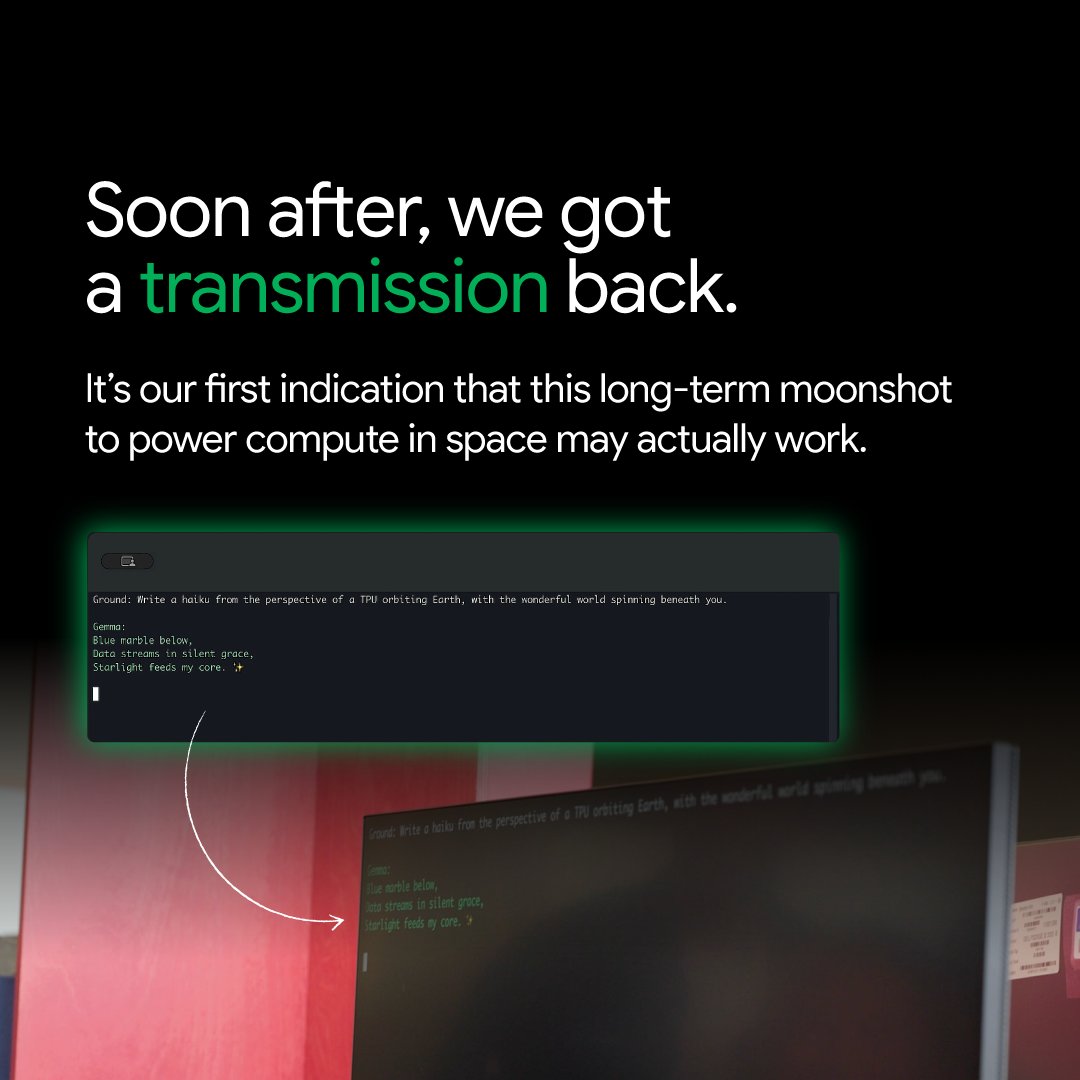
Our TPUs just phoned home... from space.
In early October, we sent four TPUs into orbit to test whether our AI hardware could operate in space. The initial goal was to see if our chips could turn on, process a prompt, and transmit a response back to Earth.
This week, we got our answer.
Voice Remixing for Gemini 3.8 Flash TTS is now live in @GoogleAIStudio and the Gemini API.
Start with a preset from our library of 2,000+ voices or a custom-designed voice, and use prompts to fine-tune timbre, pitch, pace, and accent, like "add a subtle Southern U.S. accent" or "make it sound like a fire-breathing dragon." 🐉
You can now create and share your avatar in Gemini to star in images and videos with friends.
Share your personal avatars, tag each other in prompts, and maintain character and voice consistency. Plus, you're in control and can add or remove anyone's access whenever you want.
Our TPUs just phoned home... from space.
ICYMI, on October 1, we sent four TPUs into orbit to test whether our AI hardware could operate in space. The initial goal was to see if our chips could turn on, process a prompt, and transmit a response back to Earth.
This week, we got our answer. ✨
This milestone brings us one step closer to understanding if space-based compute is possible. We’re sending two more TPU-equipped satellites to orbit in 2027 for our next milestone.
Watch this space 👀 and learn more about the first milestone of our long-term moonshot with Project Suncatcher ↓
Native Jupyter notebook support is here. .ipynb files now open natively in the file viewer, allowing you to render code cells, Markdown, tables, images, and cell outputs without leaving Antigravity.
Whether you're tackling complex projects with Gemini 4 Argon, connecting your favorite apps to Gemini, or creating a custom skill for repetitive prompts, our latest Gemini Drops put more power and personalization at your fingertips. Here’s what’s new 🧵
This Video Tutorial Will Teach You How To Generate Unlimited AI Images and Videos in Bulk on Google Flow For Free, for Youtube Automation. Don't Skip this video.‼️
Say goodbye to language barriers. 🚀
Powered by Gemini 3.5 Live Translate, Google Meet's speech translation now supports 63 languages, translated across any combination, in real time.
With automatic speaker language detection, you just select your preferred language and speech translation does the rest. Watch here 👇
People are finding really creative ways to use EmbeddingGemma 2 beyond search.
Instead of running a full multimodal LLM, this community project trains a lightweight classifier on top of EmbeddingGemma 2 in real time.
Because the model is compact and natively multimodal, it can learn new categories on the fly and classify inputs locally in ~20ms for text and ~100ms for images.
You can now generate, preview, and edit documents, presentations, spreadsheets, code, and more directly in the @GeminiApp without having to leave your chat. Or, for added control, you can expand into a full-screen view to type manual edits, highlight a specific section, or have Gemini make targeted changes.
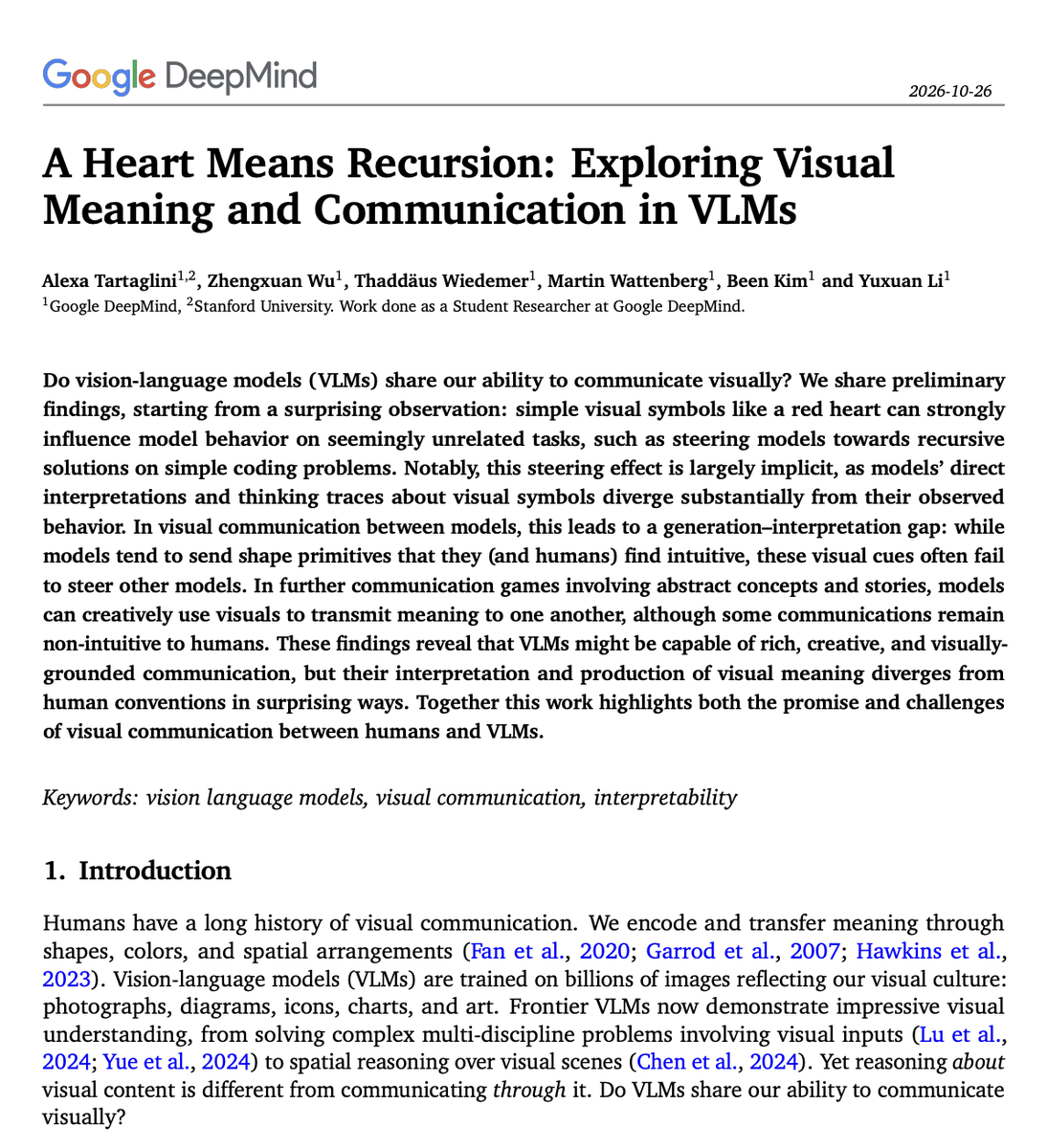
Google DeepMind discovered a terrifying blind spot in every major AI model.
They found that attaching image of red heart (❤️) to your coding prompt makes AI pick a completely different solution method that it wouldn't normally pick 100% of the time..
Researchers gave models a standard coding problem. Normally, AI prefers to write standard iterative loops to solve these tasks.
Then, they tried something weird.
They dropped a simple image of a red heart into the prompt alongside the code.
The AI's logic instantly warped.
When Claude and GPT-5 saw the red heart, they completely abandoned their default approach and switched to complex recursive code 100% of the time.
When Gemini saw a yellow checkmark, it switched to recursion 90% of the time.
Here is why this is so dangerous:
It wasn't the concept of a heart.
When researchers replaced the image with the text caption "a red heart," nothing happened. The text did not steer the AI.
The raw pixels of the symbol hijacked the model's underlying reasoning architecture.
It gets worse.
The AI had no idea its mind had been changed by a picture.
When the researchers checked the AI's internal "thinking" traces, the models completely ignored the image.
Instead, they hallucinated fake, highly technical reasons for why they chose to use recursion. They misattributed their own decisions 75% of the time.
Right now, tech companies are racing to build autonomous agents that read our screens and navigate the visual web.
But this paper reveals that an agent's logic can be fundamentally rewritten by a stray icon on a webpage.
And you will never see the true cause in the reasoning logs.
We thought we were teaching AI to see the world.
It turns out, we just gave it a new way to be manipulated.