Josh Woodward✓

@joshwoodward

VP, @Google @GoogleLabs @GeminiApp @GoogleAIStudio

  • Joined
793 Following75.8K Followers1.6K Posts
  1. Josh Woodward✓@joshwoodward
    Josh Woodward
    RT @GeminiApp: How to go from prompt to web app to working site fast, right from Gemini:
    Chandu Thota @ChanduThota
    You can now take an interactive web app you built in Gemini App straight into Google Sites - no code to copy, no app to rebuild. :) Export it to a private site draft, customize it, then publish and share with your team, customers or students. 🧵 1/3
    01230481
  2. Chandu Thota✓@ChanduThota
    You can now take an interactive web app you built in Gemini App straight into Google Sites - no code to copy, no app to rebuild. :) Export it to a private site draft, customize it, then publish and share with your team, customers or students. 🧵 1/3
    Download
    2644442118K
  3. Josh Woodward✓@joshwoodward
    Sundar: "We are so committed to being at the frontier. It’s in our DNA. We won’t do it any other way." Come build with us!
    Alex Kantrowitz @Kantrowitz
    New: I spoke with @sundarpichai about Google's commitment to the AI frontier, how close we are to RSI, balancing DeepMind's compute needs vs. Google Cloud profits, and much, much more. Full Big Technology Podcast episode here --> Chapters: 0:00 Introduction 1:14 Google’s Frontier AI Strategy 3:47 Do Frontier Models Really Matter? 6:35 The Future of AI Agents 7:39 Recursive Self-Improvement 12:58 World Models and the Path to AGI 14:56 Google’s Compute Dilemma and AI Infrastructure 19:36 Is AI Overbuilt? 23:35 The Future of the AI Interface 31:42 Google’s Answer to Muse and Dots 35:03 Apple, Space Data Centers, and AI Coding 41:42 Optimism and AI’s Future
    363766729.2K
  4. Alex Kantrowitz✓@Kantrowitz
    New: I spoke with @sundarpichai about Google's commitment to the AI frontier, how close we are to RSI, balancing DeepMind's compute needs vs. Google Cloud profits, and much, much more. Full Big Technology Podcast episode here --> Chapters: 0:00 Introduction 1:14 Google’s Frontier AI Strategy 3:47 Do Frontier Models Really Matter? 6:35 The Future of AI Agents 7:39 Recursive Self-Improvement 12:58 World Models and the Path to AGI 14:56 Google’s Compute Dilemma and AI Infrastructure 19:36 Is AI Overbuilt? 23:35 The Future of the AI Interface 31:42 Google’s Answer to Muse and Dots 35:03 Apple, Space Data Centers, and AI Coding 41:42 Optimism and AI’s Future
    Download
    3889628435K
  5. Josh Woodward✓@joshwoodward
    We just crossed a big milestone for our @GeminiApp Trusted Tester community yesterday. TLDR: Lots of people want to try early stuff on Web, Android, and iOS! If you’ve signed up before, you’re fully in. If you want to sign up… 👇
    Download
    753592586.9K
  6. Josh Woodward✓@joshwoodward
    Posts @joshwoodward
    Sign up here:
    1168712.7K
  7. Josh Woodward✓@joshwoodward
    Gemini 4 Argon: How a 24-word prompt built a custom synthesizer that turns galloping horses, rippling water, and your own hands into music.
    Download
    572746140K
  8. Josh Woodward✓@joshwoodward
    Josh Woodward
    RT @GeminiApp: The moment you've been waiting 4… Our new frontier model, Gemini 4 Argon, is rolling out now in the Gemini app to bring your most complex ideas into reality. See how Gemini 4 Argon and our latest updates across the Gemini app help you get the most out of every prompt. 🧵
    07720499
  9. Josh Woodward✓@joshwoodward
    Gemini 4 Argon: At 96 millimeters wide, the hardest part of manufacturing this custom furniture leg was deciding how many stacked spheres to give it.
    Download
    374374554K
  10. Josh Woodward✓@joshwoodward
    The latest Gemini model made this
    Chetaslua @chetaslua
    WTF Gemini 4 ARGON built a highly detailed model of a Pagoda using multi-agent visual critique loops in Antigravity. The model autonomously sculpted a multi-building temple complex with photorealistic architecture, foliage and lighting in Blender.
    291748916.4K
  11. Chetaslua✓@chetaslua
    WTF Gemini 4 ARGON built a highly detailed model of a Pagoda using multi-agent visual critique loops in Antigravity. The model autonomously sculpted a multi-building temple complex with photorealistic architecture, foliage and lighting in Blender.
    Download
    1311943K183K
  12. Josh Woodward✓@joshwoodward
    Go!
    Sundar Pichai @sundarpichai
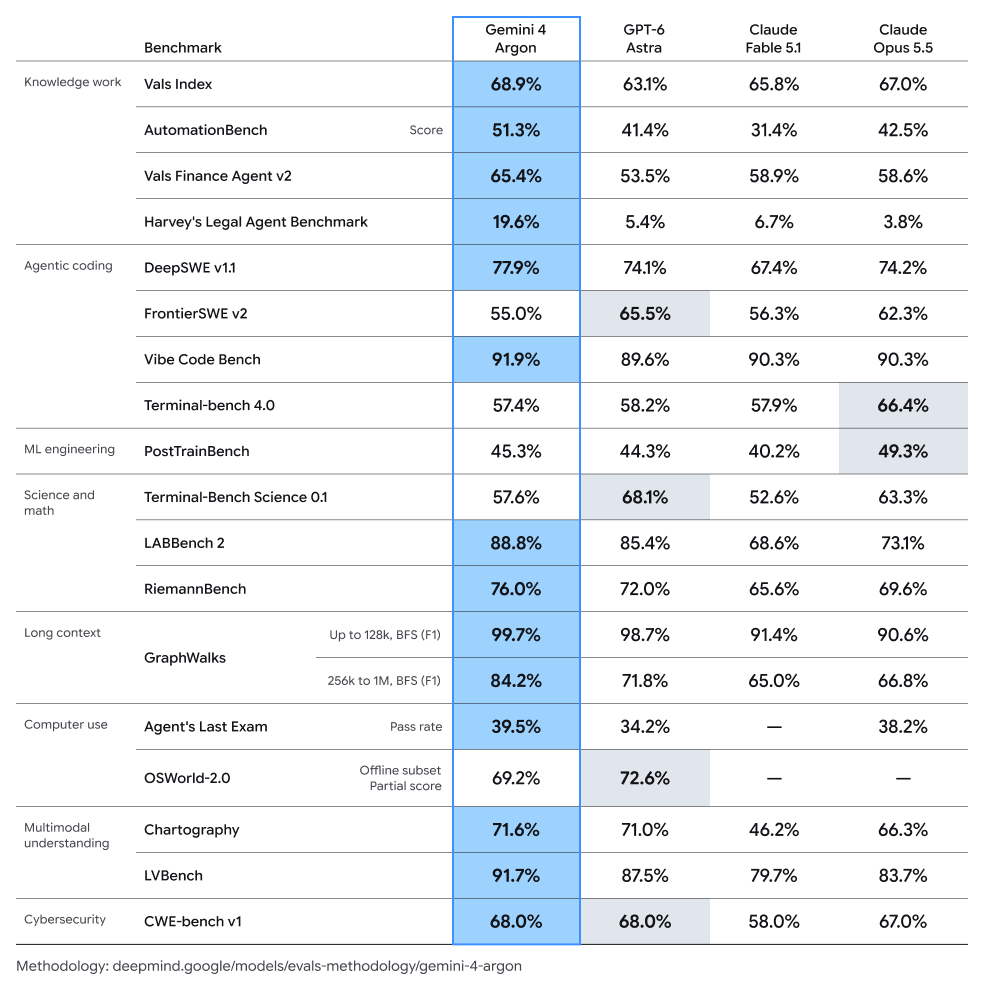
    Gemini 4 Argon is here. It’s available globally today for developers and enterprises in the paid tier of the Gemini API and the Gemini platform, for Ultra subscribers in Google Antigravity, and Ultra and Pro subscribers in the Gemini app and Search. Hope you all enjoy it!
    281341328.5K
  13. Sundar Pichai✓@sundarpichai
    Gemini 4 Argon is here. It’s available globally today for developers and enterprises in the paid tier of the Gemini API and the Gemini platform, for Ultra subscribers in Google Antigravity, and Ultra and Pro subscribers in the Gemini app and Search. Hope you all enjoy it!
    Download
    1.5K2.5K28.5K6M
  14. Josh Woodward✓@joshwoodward
    I’ve learned from Lenny for years, but we had never met. What you see is what you get with him: he’s kind, prepared, and deeply curious. Great interviewers do their homework, and you can tell he’s in that league: he took our conversation to places that I’ve never talked about in public. Enjoy the first 60 minutes of us getting to chat together. Thank you @lennysan !
    Lenny Rachitsky @lennysan
    My biggest takeaways from @JoshWoodward (Head of @Google Labs, the Gemini App, and Google AI Studio) 1. The best ideas almost never come from a design sprint or brainstorm. At Google Labs, the ideas that became NotebookLM, Google Flow, Google Beam, and AI Studio all started with small groups of people who were obsessed with an insight and couldn’t stop themselves from building. These ideas surfaced in the shower, over a weekend, in a hallway. The implication for teams everywhere is that the environment matters more than the process. “You cannot microwave a good idea.” 2. Fall in love with the problem, not the product. Most ideas require three, four, or five significant pivots before they either find traction or get shut down. Teams that get hooked on a specific solution will struggle to make those pivots. Teams that are attached to the problem—the underlying pain point or the user behavior they are trying to shift—can keep adjusting until they get it right. 3. When looking for early PMF, data and retention are important, but the strongest signal of PMF is in people’s eyes. Do they light up? Do they lean in? When you show someone a prototype and they’re genuinely engaged, you feel it. When NotebookLM’s first AI podcast demo was played in a hallway, the reaction was immediate and unmistakable. 4. Keep a list of what is “almost possible,” and move fast when something crosses over. Google Labs keeps a live list of experiences that are almost possible. When something crosses the threshold, Josh describes it as “a phase shift,” like solid to gas, and the team moves immediately. Maintain a running list of things that are almost ready, and have a team positioned to sprint when one of them arrives. 5. Every company needs to think like a labs team now. The underlying technology is changing so fast that what’s possible is shifting from week to week. Which means that every company needs to be spending time playing with the latest models, running far-out experiments, and being first to discover what they unlock before the competition does—and then bringing those discoveries to the rest of the org. 6. When something is not working, the team almost always knows before the leader does. Josh’s instinct as a leader is not to be the one who decides to shut down a project. He watches instead for the passion running out, for the sense that the team has tried everything and nothing is working. His goal is to create an environment where people feel safe enough to say, “I don’t think this is working.” 7. Someone’s “unlearning rate” is one of the most valuable skills right now. Everyone talks about growth mindset and learning speed. Josh is watching for something different: How quickly can someone take an insight, validate or invalidate it through testing, and then let it go? The ability to walk away from a prior belief or approach when the evidence says you should is rare and becoming more valuable. 8. Roles are not blurring into one universal “builder” role. There is a tendency in the current moment to talk as though everyone is becoming a generalist builder. Josh thinks this would be a bad idea. The best people on his teams still have a primary specialty—a major—and also a “minor” they’ve developed. The advice he gives to early-career PMs who are excited about vibe coding and prototyping is clear: build adjacent skills in service of becoming an exceptional PM, not as a replacement for it. 9. A well-designed lab needs isolation, a clear mission, and the ability to create “good trouble.” Three things matter when setting up an internal labs team. First, it needs structural independence, reporting far enough from existing business units that weird ideas can survive long enough to prove themselves. Second, the lab’s mandate has to be explicit: are you graduating ideas to existing products, or inventing new categories? Clarity on that question changes almost every decision. Third, the lab should be a place to challenge how the company itself works, not just what it builds. At Google Labs, that included piloting new job ladders and builder roles before rolling them out more broadly. 10. Google Labs manages the marathon-sprint tension through seasons. At any given time, roughly 20 to 30 experiments are running in parallel, but individual teams experience a defined rhythm: sprints, post-launch recovery, and open exploration periods. After Google I/O each year, many labs teams enter a mode that looks unproductive from the outside: no shipping, just hacking, building, and discovering. Josh treats this as the seedbed for the next season.
    91638530.8K
  15. Lenny Rachitsky✓@lennysan
    My biggest takeaways from @JoshWoodward (Head of @Google Labs, the Gemini App, and Google AI Studio) 1. The best ideas almost never come from a design sprint or brainstorm. At Google Labs, the ideas that became NotebookLM, Google Flow, Google Beam, and AI Studio all started with small groups of people who were obsessed with an insight and couldn’t stop themselves from building. These ideas surfaced in the shower, over a weekend, in a hallway. The implication for teams everywhere is that the environment matters more than the process. “You cannot microwave a good idea.” 2. Fall in love with the problem, not the product. Most ideas require three, four, or five significant pivots before they either find traction or get shut down. Teams that get hooked on a specific solution will struggle to make those pivots. Teams that are attached to the problem—the underlying pain point or the user behavior they are trying to shift—can keep adjusting until they get it right. 3. When looking for early PMF, data and retention are important, but the strongest signal of PMF is in people’s eyes. Do they light up? Do they lean in? When you show someone a prototype and they’re genuinely engaged, you feel it. When NotebookLM’s first AI podcast demo was played in a hallway, the reaction was immediate and unmistakable. 4. Keep a list of what is “almost possible,” and move fast when something crosses over. Google Labs keeps a live list of experiences that are almost possible. When something crosses the threshold, Josh describes it as “a phase shift,” like solid to gas, and the team moves immediately. Maintain a running list of things that are almost ready, and have a team positioned to sprint when one of them arrives. 5. Every company needs to think like a labs team now. The underlying technology is changing so fast that what’s possible is shifting from week to week. Which means that every company needs to be spending time playing with the latest models, running far-out experiments, and being first to discover what they unlock before the competition does—and then bringing those discoveries to the rest of the org. 6. When something is not working, the team almost always knows before the leader does. Josh’s instinct as a leader is not to be the one who decides to shut down a project. He watches instead for the passion running out, for the sense that the team has tried everything and nothing is working. His goal is to create an environment where people feel safe enough to say, “I don’t think this is working.” 7. Someone’s “unlearning rate” is one of the most valuable skills right now. Everyone talks about growth mindset and learning speed. Josh is watching for something different: How quickly can someone take an insight, validate or invalidate it through testing, and then let it go? The ability to walk away from a prior belief or approach when the evidence says you should is rare and becoming more valuable. 8. Roles are not blurring into one universal “builder” role. There is a tendency in the current moment to talk as though everyone is becoming a generalist builder. Josh thinks this would be a bad idea. The best people on his teams still have a primary specialty—a major—and also a “minor” they’ve developed. The advice he gives to early-career PMs who are excited about vibe coding and prototyping is clear: build adjacent skills in service of becoming an exceptional PM, not as a replacement for it. 9. A well-designed lab needs isolation, a clear mission, and the ability to create “good trouble.” Three things matter when setting up an internal labs team. First, it needs structural independence, reporting far enough from existing business units that weird ideas can survive long enough to prove themselves. Second, the lab’s mandate has to be explicit: are you graduating ideas to existing products, or inventing new categories? Clarity on that question changes almost every decision. Third, the lab should be a place to challenge how the company itself works, not just what it builds. At Google Labs, that included piloting new job ladders and builder roles before rolling them out more broadly. 10. Google Labs manages the marathon-sprint tension through seasons. At any given time, roughly 20 to 30 experiments are running in parallel, but individual teams experience a defined rhythm: sprints, post-launch recovery, and open exploration periods. After Google I/O each year, many labs teams enter a mode that looks unproductive from the outside: no shipping, just hacking, building, and discovering. Josh treats this as the seedbed for the next season.
    8310376793.6K
  16. Josh Woodward✓@joshwoodward
    Mask-based editing is my favorite from today, much more coming soon!
    Nano Banana 2.1 @NanoBanana
    Nano Banana 2.1 is here! This upgraded version outperforms our previous models across the board, with notable leaps in: - visual design - mask-based editing - subject consistency - more natural-looking imagery Try it now in @GeminiApp, @GoogleAIStudio, and more.
    251221712.4K
  17. Nano Banana 2.1✓@NanoBanana
    Nano Banana 2.1 is here! This upgraded version outperforms our previous models across the board, with notable leaps in: - visual design - mask-based editing - subject consistency - more natural-looking imagery Try it now in @GeminiApp, @GoogleAIStudio, and more.
    Download
    1513634K222K
  18. Josh Woodward✓@joshwoodward
    Introducing the Stitch CLI, get design ideas on demand
    Stitch by Google @stitchbygoogle
    We have a Stitch MCP. We have a Stitch SDK. But, we don't have a Stitch CLI. Well, not until now. Introducing the @google/stitch CLI: 🔷 Connect to your local coding agents 🔷 Generate screens and design systems 🔷 Send a local dev server snapshot to Stitch Do it all without leaving the terminal or better yet, ask your favorite harness like @antigravity 😎 Learn more 👇
    192234821.9K
  19. Stitch by Google✓@stitchbygoogle
    We have a Stitch MCP. We have a Stitch SDK. But, we don't have a Stitch CLI. Well, not until now. Introducing the @google/stitch CLI: 🔷 Connect to your local coding agents 🔷 Generate screens and design systems 🔷 Send a local dev server snapshot to Stitch Do it all without leaving the terminal or better yet, ask your favorite harness like @antigravity 😎 Learn more 👇
    Download
    471611.4K374K
  20. Josh Woodward✓@joshwoodward
    Having just come back from Yosemite recently, this is awesome!
    Trond Wuellner @trondw
    I was curious how far I could push three.js and WebGL this weekend, and ended up building a complete Yosemite photography simulator in a browser tab — real sun, real Moon, real lidar — with a working film camera on a tripod you can take to my favoirte spots in Yosemite.
    5413016K
  21. Trond Wuellner✓@trondw
    I was curious how far I could push three.js and WebGL this weekend, and ended up building a complete Yosemite photography simulator in a browser tab — real sun, real Moon, real lidar — with a working film camera on a tripod you can take to my favoirte spots in Yosemite.
    Download
    1398528.7K
  22. Josh Woodward✓@joshwoodward
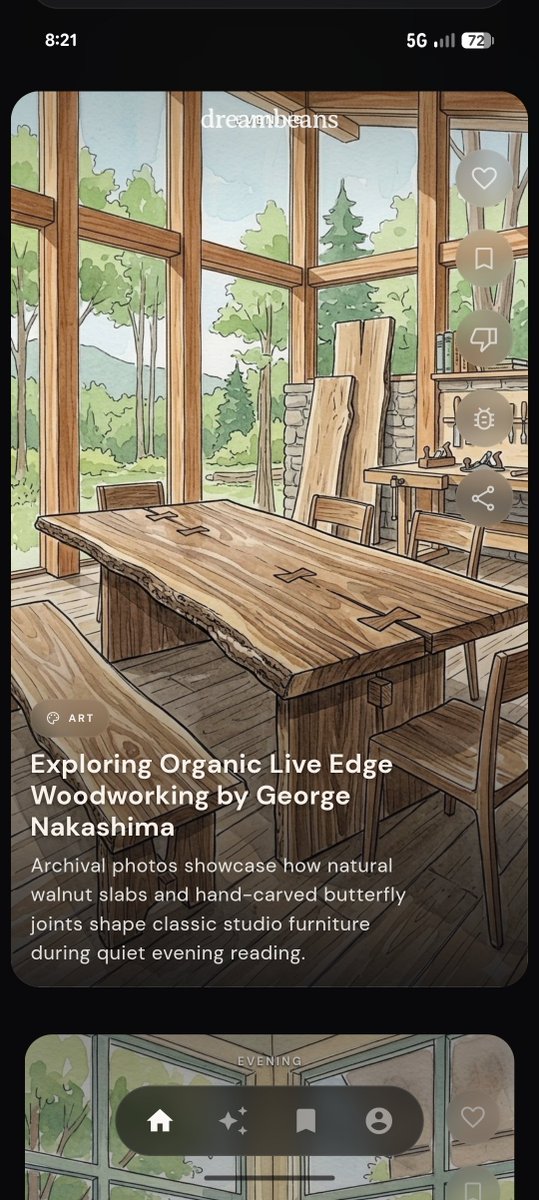
    Dreambeans is one of our newer experiments in @GoogleLabs. It has a growing cult following. It’s simple: a fixed number of “beans” brew every morning. They point you at the real world, with real people, doing things you care about together. Give it a try!
    Download
    186168124K
  23. Josh Woodward✓@joshwoodward
    Posts @joshwoodward
    00113.5K
  24. Josh Woodward✓@joshwoodward
    More of your favorite apps are coming to Gemini! Which ones do you want next?
    Google Gemini @GeminiApp
    Now Gemini can connect with 13 new apps like @adobe, @squarespace, @onepeloton, and more. Instead of switching between tabs, you can now grow your business, design assets, and plan your workouts all in Gemini. 🧵
    1801447668.5K
  25. Google Gemini✓@GeminiApp
    Now Gemini can connect with 13 new apps like @adobe, @squarespace, @onepeloton, and more. Instead of switching between tabs, you can now grow your business, design assets, and plan your workouts all in Gemini. 🧵
    1842212K314K
  26. Josh Woodward✓@joshwoodward
    Big milestone!
    Google Flow @FlowbyGoogle
    More than 25 million people are using Google Flow every month to dream up new ideas, create stories, and build cool things. Thank you. We’re continuing the 50 additional daily credits for all users. Dive in and keep creating.
    121434827K
  27. Google Flow✓@FlowbyGoogle
    More than 25 million people are using Google Flow every month to dream up new ideas, create stories, and build cool things. Thank you. We’re continuing the 50 additional daily credits for all users. Dive in and keep creating.
    Download
    685378681.6K