In his new book, “Boundaries of Tolerance,” MIT Sloan’s Jeffrey Saviano says that AI’s novel risks and “ethical infirmities” have made governance and strategy a leadership necessity.
A new certificate program is designed to help PhD students in science and engineering at MIT translate their research into practice in deep-tech fields such as biomedicine, nuclear energy, climate sciences, quantum computing, and space exploration.
In his new book, MIT Sloan professor Eric So examines the ways artificial intelligence is reshaping human cognition and offers advice on protecting your uniquely human skills while using AI.
Before asking AI to gather copious information and then asking questions, do the cognitive work of identifying the questions you need to answer, and then use AI to help get the answers quickly.
In today’s AI-driven environment, robust data monetization is a precondition for success. Here are three principles that help determine whether data monetization efforts will drive financial performance.
What tasks should AI be trusted with, and when should humans remain involved? Designing those decision rights is one of the defining challenges of the AI era. Researchers at the MIT Center for Information Systems Research have developed a framework to help.
Learn more:
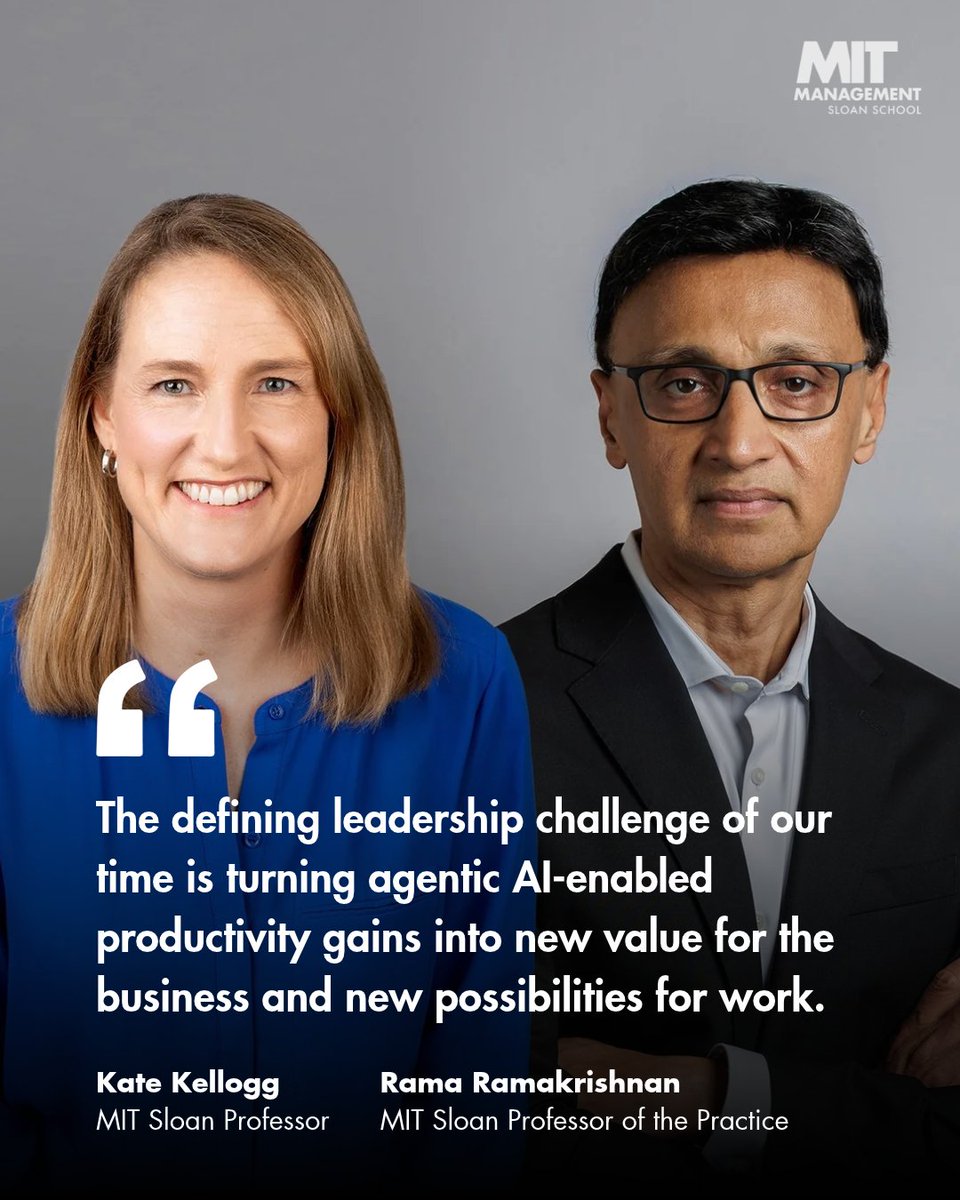
RT @MITSloanAlumni: As organizations begin deploying agentic systems that can execute entire workflows, a consequential question is emerging: How can leaders turn agentic AI productivity gains into business growth?
Learn more at
AI can participate in negotiations in four positions. Each position gives AI different levels of authority and creates different risks for accountability, fairness, and human agency.
Artificial intelligence can draft a memo or summarize a meeting instantly. Deciding which memo matters, whether that summary is accurate, or what to do next still requires human knowledge.
To gain maximum productivity from artificial intelligence, the MIT Sloan School of Management’s Robert Pozen advises using AI as a coworker, not a crutch; focusing AI on the final product; and delegating work to AI without abandoning human judgment.
In a recent article, MIT Sloan’s Kate Kellogg and Rama Ramakrishnan examine what it takes to redesign workflows, prepare employees for evolving roles, and turn AI-enabled productivity into sustainable business growth in the age of agentic AI.
Learn more:
In his new book, MIT Sloan professor Eric So examines the ways artificial intelligence is reshaping human cognition and offers advice on protecting your uniquely human skills while using AI.
Learn more:
Course offerings like AI-Augmented Work, Economics of Ideas and Entrepreneurship, and Leading Agentic AI Transformation in Organizations anticipate businesses’ future needs.
Researchers from the MIT Sloan School of Management argue that as AI tools become more widely available, competitive advantage will depend on the trust, data, expertise, operating capabilities, and work redesign that companies build around them.
Artificial intelligence will transform more jobs than it eliminates outright. The biggest productivity gains will come not from incorporating AI into existing workflows but from redesigning those workflows entirely. @MITshapingwork
It’s possible for privacy-preserving technologies to coexist with data analytics. Researchers can protect individual privacy and still get reliable results from data.