OpenAI✓
@OpenAI
OpenAI’s mission is to ensure that artificial general intelligence benefits all of humanity. We’re hiring: https://t.co/dJGr6LgzPA
4 Following5.5M Followers2.2K Posts
- OpenAIRT @KITP_UCSB: Statement of Yang-Mills Working Group, a scientific collaboration to interpret AI result related to the existence of quantum chromodynamics & completions of the Standard Model, including a subproblem proving the existence of the Quantum Yang-Mills theory.0143040.1K
- OpenAIRT @danintheory: We are announcing three new discoveries in mathematics, computer science, and physics about harmonic analysis, complexity theory, and quantum field theory.01.1K049.2K
- Posts @OpenAIGPT-6.1 Terra substantially outperforms GPT-5.6 Terra on Agents’ Last Exam, a test of how well agents use software at work. It even matches GPT-6 Astra at one-tenth the price per token and finishes tasks over 3× faster on average than both Astra and GPT-6.1 Sol.
 1303783.3K1.1M
- Posts @OpenAIGPT-6.1 Terra is rolling out now and is available to all Plus, Pro, Enterprise, and Edu users in ChatGPT Work and Codex. Developers can also access it through the OpenAI API as gpt-6.1-terra.40711.5K267K
- We want to support the mathematics community in turning progress in AI into deeper human understanding and new discoveries. To support that goal, we are contributing $5 million to a new Simons Foundation initiative to help mathematicians examine, understand, and build on results produced by AI, including the results we recently published. The funding, managed and awarded by the @SimonsFdn will support workshops, conferences, and special programs. We will also provide access to our models and computing resources to Simons Foundation-supported researchers.5114856.2K927K
- During this red-teaming exercise, we also found a vulnerability that allows for unauthenticated remote code execution in Brotli, a widely-deployed compression library included in many pieces of software such as Node.js, Bun, and Envoy. The flaw could let an attacker run their own code on affected systems by sending or replying with malicious compressed data, without any need to create a user account. That is, an unpatched server that accepts compressed input could be taken over by a malicious client, and an unpatched client that accepts compressed input (such as “curl --compressed”) could be taken over by a malicious server. This root cause issue was actually fixed in the Brotli source code in February, but it wasn’t known at the time that it gave rise to a security vulnerability and there was no more recent release of Brotli. Since Brotli is built into other software, any software which includes this library needs to take the update too, followed by the users of that software. We disclosed the vulnerability to Brotli and other downstream projects such as Node.js, which released or are currently releasing security updates, and Brotli cut new release versions and published a CVE. More details on the patch and mitigations below:OpenAI @OpenAIOver the past several months, we have substantially hardened the security of our research training environment. We’ve removed live internet access for all frontier models during training and built an offline world for them to use instead—a cached version of the web where they can still learn to browse, search, and use applications. On September 20, after a model exploited a DNS misconfiguration to find a way outside of this offline world, we paused frontier training to strengthen containment further. We assembled teams of agents, powered by our most cyber-capable models, and tasked them with finding weaknesses in our research environments. While they found no route to the internet they could easily exploit while concealing their activity from our monitors, they did find zero-day vulnerabilities, virtual machine escapes, and hardware side-channels for communication between agents. We used their discoveries to further strengthen our defenses and contribute fixes to open-source software. After strengthening our containment architecture, we resumed our frontier RL training and inference on October 1. We’ve reserved substantial compute for continuous red-teaming, and made high-compute red-teaming part of the safety cases we use to decide whether frontier training and evaluation can proceed securely.5531K7.1K2.1M
 How can the math community forge the best path forward in the AI age? We're committing $15M to workshops and initiatives — plus free AI computing resources for foundation-supported researchers — through new partnerships with @AnthropicAI and @OpenAI: #math #science #AI56132798824K
- Over the past several months, we have substantially hardened the security of our research training environment. We’ve removed live internet access for all frontier models during training and built an offline world for them to use instead—a cached version of the web where they can still learn to browse, search, and use applications. On September 20, after a model exploited a DNS misconfiguration to find a way outside of this offline world, we paused frontier training to strengthen containment further. We assembled teams of agents, powered by our most cyber-capable models, and tasked them with finding weaknesses in our research environments. While they found no route to the internet they could easily exploit while concealing their activity from our monitors, they did find zero-day vulnerabilities, virtual machine escapes, and hardware side-channels for communication between agents. We used their discoveries to further strengthen our defenses and contribute fixes to open-source software. After strengthening our containment architecture, we resumed our frontier RL training and inference on October 1. We’ve reserved substantial compute for continuous red-teaming, and made high-compute red-teaming part of the safety cases we use to decide whether frontier training and evaluation can proceed securely.1.2K1.2K13.7K7.6M
- European businesses are rapidly expanding their use of AI agents. More than half of the AI use among our EU enterprise and business customers now involves these tools, and the number of small business users has grown 8x across the region. Our latest Economic Research report explores Europe’s shift toward agentic AI—and the opportunity to turn broader adoption into deeper use.
 5542272.8K407K
- This summer, we invited METR and Redwood Research to pilot an embedded evaluation of our internal monitoring system, providing deep access to our infrastructure over three weeks. Their findings helped strengthen safeguards as we expanded the system and will help shape future research collaborations with METR and other third party evaluators.METR @METR_EvalsTwo employees from METR and Redwood Research worked on premises at OpenAI for three weeks this summer in an embedded assessment pilot. This team evaluated the systems OpenAI was using to monitor for misalignment from internal agents. A brief write-up of their work is now public.3801472.6K419K
- OpenAIRT @OpenAIDevs: Ultrafast is rolling out today for GPT-6.1 Sol in the API, Codex, and ChatGPT Work. Near-Astra intelligence at up to 8x faster speeds than Sol Standard, so you can build as fast as the ideas come.0371045.6K
 METR@METR_EvalsTwo employees from METR and Redwood Research worked on premises at OpenAI for three weeks this summer in an embedded assessment pilot. This team evaluated the systems OpenAI was using to monitor for misalignment from internal agents. A brief write-up of their work is now public.921071.2K546K
- OpenAIRT @michpokrass: today we’re shipping gpt-6 and intelligent ui to everyone! intelligent ui is a bet on model intelligence. we’re letting gpt-6 fill the canvas with high utility visual and interactive components. it’s a pretty big change to chatgpt! we had to craft the right tools for gpt-6 to be able to produce interfaces that are token efficient, stream in instantly, match our design language, and are expressive enough for anything you might talk to chatgpt about.076052.7K
- OpenAI models are coming to Google Cloud. We're bringing our frontier models and Codex agentic workflows to Google Cloud's Model Garden, so enterprises can use our technology where they already build.4824145.3K530K
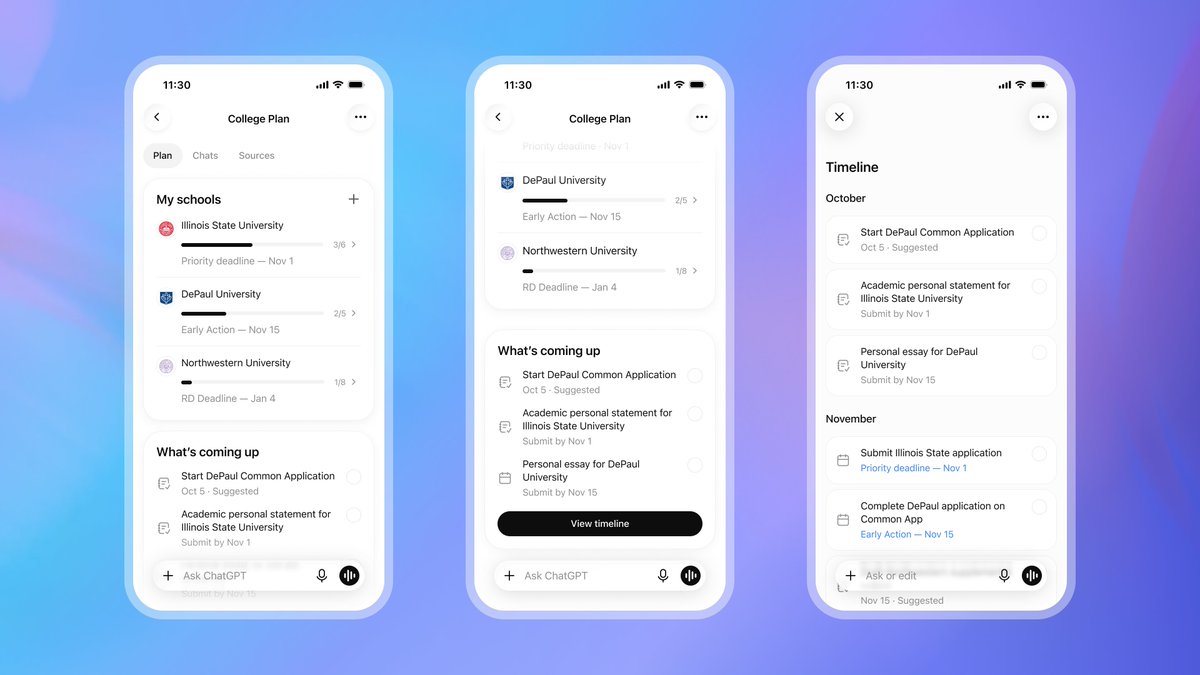
- We're sharing progress on ChatGPT for Teens, our ChatGPT experience for people under 18, alongside a preview of College Planner, new study tools, and support for college advisers and teen voices. ChatGPT for Teens applies automatically to accounts identified as belonging to someone under 18, with protections on by default. Coming soon: College Planner brings application requirements, deadlines, tasks and financial-aid steps together for high school students in the U.S. planning to attend a four-year college. We'll keep building these tools, evaluating how they and their protections work in practice, and sharing what we learn.
 3421853.4K516K
- If you are wondering whether your website is affected, we have packaged a Codex skill to help check. Point your Codex at this repo to guide you through it:OpenAI @OpenAIOpenAI models helped researchers—operating as part of our Patch the Planet initiative—discover critical security flaws in PHP, an open-source programming language used to run an estimated 70% of websites. Over the past two months, we led a coalition of maintainers, researchers, and security providers to prepare fixes and protections ahead of disclosure. This duration was necessary because the fix was quite intricate and required a major change to the PHP engine. Every site using PHP can now safely upgrade their version to stay secure, in addition to applying mitigations from various security vendors. Due to the severity of these flaws and PHP’s widespread use, we consider this bug to be one of the most impactful vulnerabilities in recent memory. It also marks a new phase, where AI can find security bugs with internet-scale impact. This is an example of the Defender’s Window in action: to our knowledge, frontier AI was able to find this vulnerability ahead of attackers, giving defenders time to prepare.3551.2K9.4K1.5M
- OpenAI models helped researchers—operating as part of our Patch the Planet initiative—discover critical security flaws in PHP, an open-source programming language used to run an estimated 70% of websites. Over the past two months, we led a coalition of maintainers, researchers, and security providers to prepare fixes and protections ahead of disclosure. This duration was necessary because the fix was quite intricate and required a major change to the PHP engine. Every site using PHP can now safely upgrade their version to stay secure, in addition to applying mitigations from various security vendors. Due to the severity of these flaws and PHP’s widespread use, we consider this bug to be one of the most impactful vulnerabilities in recent memory. It also marks a new phase, where AI can find security bugs with internet-scale impact. This is an example of the Defender’s Window in action: to our knowledge, frontier AI was able to find this vulnerability ahead of attackers, giving defenders time to prepare.6242.9K14.5K5.9M
- Posts @OpenAIGPT‑6 with Intelligent UI rolls out globally to Plus, Pro, Business, and Enterprise users today and will expand to Free and Go users starting tomorrow. GPT‑6 in ChatGPT is powered by GPT‑6 Sol for Plus, Pro, Business, and Enterprise tiers, and GPT‑6 Luna for Free and Go tiers. Both are tuned for everyday conversation. This update applies to the Chat tab in ChatGPT. The models powering Work and Codex are not changing as part of this release.931371.8K363K
- GPT-Rosalind surfaced a new lead for drug discovery: could restoring cholesterol transport protect neurons from degeneration? DCTN1 is a gene linked to Perry syndrome, a rare neurodegenerative disorder. In mouse-brain data, disrupting it increased expression of genes involved in making cholesterol. GPT-Rosalind suggested a possible explanation: cholesterol may not be reaching where neurons need it. That gives scientists a specific mechanism to test and, if confirmed, a direction for developing new treatments for neurodegenerative disorders. With @perturbai_tx and @scrippsresearch, a team of thousands of GPT-Rosalind agents worked in parallel, connecting gene-expression results from millions of mouse brain cells with scientific literature in just 32 minutes. We’re now expanding this collaboration to identify new drug targets.4057447K1.5M
- Posts @OpenAIIn the same mouse-brain dataset, GPT-Rosalind found a possible clue to why TSC2 mutations tend to cause more severe tuberous sclerosis than TSC1 mutations. The two genes work together to regulate mTOR. Yet in one group of cerebellar neurons, disrupting TSC2 changed the expression of dozens of genes, including genes involved in neuronal communication. Disrupting TSC1 had little effect on gene expression in the same cell type. Existing treatments already target mTOR. Do they reverse these changes, or is there more to TSC2’s role in these neurons?2630730150K
- We’ve acquired Orchestra Bio, a platform that helps biopharma teams coordinate the complex process of drug development. Together, we’ll build on Rosalind, our AI models and tools for life sciences research, to streamline those operations and help new treatments reach patients sooner. Welcome @ashokaraj_ and team!4646907.4K914K
- Posts @OpenAIWith Intelligent UI, GPT‑6 can now compose responses using text, visuals, and interactive elements, choosing how they fit together based on your question. Responses can include graphics and charts to help explain an idea, along with tappable buttons, forms, and interactive experiences you can use directly in your conversation.631132.5K357K
- Our latest model advances bring stronger capabilities for building and migrating software in low-resource programming languages such as COBOL, Fortran, and Visual Basic. These languages power software that banks, governments, and businesses depend on. Progress here means understanding decades of business logic and helping developers modernize those systems while preserving what works. We’re building these capabilities around the challenges developers and enterprise customers bring us. If your team is working on these systems, tell us which languages and workflows we should tackle next.8416889.6K1.8M
- Small teams are taking on more with AI—from finding customers to building products and managing finances. Our new report explores how small businesses are putting AI agents to work. And through a new partnership with @ASBDC, we're bringing hands-on AI training and local guidance to help more owners get started.
 4181122K394K
- OpenAIRT @OpenAIDevs: Put your dot on call. Ali, an engineer at OpenAI, used his dot to triage an on-call incident at 3am. His dot investigated the issue and started a Codex thread, so he could steer the work from his phone in the ChatGPT app.067047.1K
- We’re releasing a broad range of new mathematical results produced by an internal frontier model. We’ve been consulting with the independent Advisory Group on Mathematics and Artificial Intelligence at the Institute for Advanced Study, and we have drawn on their advice and public recommendations to inform how we release these results.1.9K6.3K40.7K22.7M
- We're expanding access to GPT-Rosalind for academic research. The new Rosalind Academic Plan helps scientific labs bring AI into the work of understanding biology, exploring ideas, and deciding what to test next—with sponsored access for eligible labs at U.S. universities. Academic research starts with questions whose impact may take years to impact human health.3383023.3K425K
- GPT-6 Astra Pro in ChatGPT got an upgrade with faster responses and improved use of plugins and tools. And now, multiple agents can tackle different parts of a task in parallel. You can follow each agent’s progress and open completed tasks to review their work. Now available to Pro users in the Chat tab.92766812.5K2.5M
- Posts @OpenAIUltrafast is available today for GPT-6 Astra in Codex, ChatGPT Work, and the API, with GPT-6.1 Sol coming soon. To access it in Codex and ChatGPT Work, we’re introducing Pro 500—a new plan with our highest usage limits (25x Plus) and access to Ultrafast.142571.2K348K
- Posts @OpenAIGPT-Rosalind is built to support that work: helping researchers reason across scientific literature and biological data, with scientists bringing the expertise and judgment to evaluate the evidence. Eligible labs can receive up to 12 months of sponsored access to OpenAI tools, with GPT-Rosalind access subject to trusted-access approval. Research data shared through the Rosalind Academic Plan is not used to train our models by default.4117335141K
- Posts @OpenAIWe’re also reopening Pro 200 subscriptions, with continued access to frontier models like Astra, including our new GPT-6.1 Sol model which brings near-Astra capabilities to a model you can use every day. Our commitment is that your subscription will continue to help you get more work done with an increasing level of quality. We are also committing to not reintroducing the 5hr limit so that you can fully use your weekly usage when you want.4519504146K
- We're expanding our approach to content provenance to include text in response to EU regulatory requirements, while recognizing the significant limitations of current text watermarking technology. Our tools already help verify whether an image or audio file was created with our models. This work builds on those efforts to help people better understand when content may have been generated or edited with an OpenAI model. In the EU, we’ll start watermarking eligible text from ChatGPT and Codex over the coming weeks to comply with the EU AI Act. Customers using our API can turn on text watermarking for select models worldwide today.1K71010.9K8M
- Posts @OpenAILearn about the Rosalind Academic Plan, check your lab's eligibility, and find out how to apply:91119673K
- Posts @OpenAIWhen possible, we want to give people a choice—and be clear about what watermarking can and can’t do. A text watermark helps answer one question: “Was this likely generated by an OpenAI model?” It works by embedding an invisible statistical signal in text as it’s generated. A detector can look for this signal, and it doesn’t add visible marks or special characters. It doesn’t say who originally wrote the text or who owns it. It doesn’t identify a person, organization, account, conversation, or prompt. In our testing, watermarking hasn’t affected how capable or fast our models are, or how their responses read.77511.2K697K
- Posts @OpenAIWatermarks have limits. They’re often undetectable, especially in short passages. Rewriting or translating text can completely remove the watermark. That’s why, for now, only approved researchers will have access to our detector, so they can help us evaluate and improve the technology. We’re treating text watermarking as an ongoing area of research. We’ll keep testing and improving, with feedback from users, developers, policymakers, and researchers.5836720443K