Panzer✓
@panzer
Now: building agentic systems at https://t.co/NtsqKjJHVt Then: EIC, TechCrunch, VP Marketing, Tiptop @[email protected]
4.9K Following40.4K Followers3.1K Posts

- index all the things!sara beykpour @pandemonaImportant conversations are happening on podcasts, and now your agents using Exa can hear them 🎧 @ParticleAPI is Exa's provider of podcast data and intelligence, delivering on our mission to bring spoken conversation to agents everywhere.0171K
 Important conversations are happening on podcasts, and now your agents using Exa can hear them 🎧 @ParticleAPI is Exa's provider of podcast data and intelligence, delivering on our mission to bring spoken conversation to agents everywhere.913648.7K
- I'm historically terrible at fantasy football, but I love it. So I built a @bot to manage my @YahooFantasy team this year and it's doing a banger job, just took first place in my league! Install it for yourself and see how it does for you. Let me know what updates to make!

 2031.2K
- When Disney created their sadly ill-fated Star Wars hotel, they made a few incredibly cool, incredibly delicate 'real' lightsabers for the performers in the shows. I'm probably one of few outsiders to get to try one. They travel with their own sound system and engineers for the fx - and yes, it feels like a real one.21371K146K
- the open source community going full r/photography on ai coding is patently insanePolymarket @PolymarketJUST IN: Reddit's r/opensource begins banning any project that uses AI, was created with AI, or is designed for AI tools.2192.3K
 JUST IN: Reddit's r/opensource begins banning any project that uses AI, was created with AI, or is designed for AI tools.2301813K251K
- I remember getting the call to test out portrait mode before its release. The marriage of history, art and computational science that came together to make this possible is still incredible to me to this day. These are probably some of the first portrait mode photos ever taken by someone outside Apple.


 Johnnie Manzari @johnniePortrait mode launched 10 years ago today. I think it resonated with people because it didn’t feel digital. It felt analog. And this was likely because the inspiration behind its technique went all the way back to oil painting. Sometimes pure math isn’t enough; you need to combine it with insights from the liberal arts. If you recall Portrait mode shipped a month after the iPhone did. This was because this insight about oil painting took a while to figure out. Initially, Portrait mode was seen as a giant math problem. You’d do disparity calculations on the two sensors and output a depth map. The problem was this approach feels and looks digital; it feels fake. In areas without texture, it’s impossible to do this calculation. In areas with ultra fine detail, a lower resolution depth map leads to terrible transitions and a full resolution depth map takes forever to compute. One solution would be to reduce the amount of bokeh so the issues are not as obvious. But then you lose the whole point of the feature, which was to make it look like you had a large, wide-open lens. The solution to this conundrum—the tradeoff between artifacts and the amount of blur— was quite elegant, but it took a while to stumble across. There’s a saying in painting that if you get the eyes right, nothing else matters. Inspired by this principle from oil painting, the idea was to make sure we never got the eyes wrong. We brought in a machine learning block to find the eyes, and draw a mask layer that protected them, then paired that with the disparity depth map. Counterintuitively, the solution was not to decrease the amount of blur, it was to increase it. The additional blur that we could add once the eyes were protected allowed us to hide the artifacts that were create by bad depth calculation. We let the ears go soft, let the nose go a bit soft. This is that wide open look that people loved, even if people didn’t realize that the ears going soft was why. I was thinking about this recently with regard to AI. We’ll be able to do more amazing things… we just need to study the masters who came before us.215610.2K
 Portrait mode launched 10 years ago today. I think it resonated with people because it didn’t feel digital. It felt analog. And this was likely because the inspiration behind its technique went all the way back to oil painting. Sometimes pure math isn’t enough; you need to combine it with insights from the liberal arts. If you recall Portrait mode shipped a month after the iPhone did. This was because this insight about oil painting took a while to figure out. Initially, Portrait mode was seen as a giant math problem. You’d do disparity calculations on the two sensors and output a depth map. The problem was this approach feels and looks digital; it feels fake. In areas without texture, it’s impossible to do this calculation. In areas with ultra fine detail, a lower resolution depth map leads to terrible transitions and a full resolution depth map takes forever to compute. One solution would be to reduce the amount of bokeh so the issues are not as obvious. But then you lose the whole point of the feature, which was to make it look like you had a large, wide-open lens. The solution to this conundrum—the tradeoff between artifacts and the amount of blur— was quite elegant, but it took a while to stumble across. There’s a saying in painting that if you get the eyes right, nothing else matters. Inspired by this principle from oil painting, the idea was to make sure we never got the eyes wrong. We brought in a machine learning block to find the eyes, and draw a mask layer that protected them, then paired that with the disparity depth map. Counterintuitively, the solution was not to decrease the amount of blur, it was to increase it. The additional blur that we could add once the eyes were protected allowed us to hide the artifacts that were create by bad depth calculation. We let the ears go soft, let the nose go a bit soft. This is that wide open look that people loved, even if people didn’t realize that the ears going soft was why. I was thinking about this recently with regard to AI. We’ll be able to do more amazing things… we just need to study the masters who came before us.71727846.2K
- beautifully bentBrian Moore @lanewinfieldmade this project that randomly texts one of your contacts “thinking of u”0011.9K
 Brian Moore@lanewinfieldmade this project that randomly texts one of your contacts “thinking of u”141131644.7K
- reason to live securedGabe Follower @gabefollowerMike Morasky, a developer from Valve, directly mentioned HLX (rumored to be Half-Life 3) during his Q&A session.0021.1K
 Mike Morasky, a developer from Valve, directly mentioned HLX (rumored to be Half-Life 3) during his Q&A session.2731.7K20.7K2.4M
- no one has ever seen the world the same way btw, something you get obsessed with as a photographer. incredible.gray ❄️🫧 @graycrawfordit appears my squinting simulator is working 👀 we all love wave optics, naked-eye interference, eyelash diffraction right0031.6K

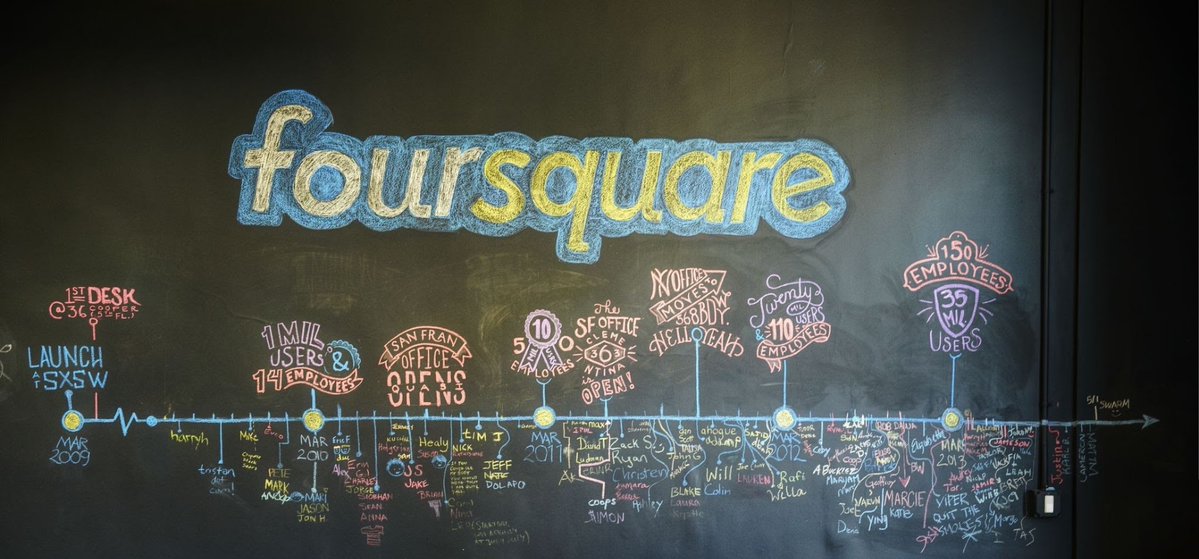
- Put this on LI but dropping it here too. Thank you for everything fsq - really one of the rare early second boom services that I felt a true, genuine attachment to and that wove itself into my life. It brought the world to me - being from a small town and suddenly a traveler it made me feel less lost and alone on the globe.Dennis Crowley 🇺🇸 (mostly on Threads, @dens) @densFoursquare was acquired last month. The outcome was disappointing. It's taken me a while to write this, but I think I'm finally done grieving it. Here are some thoughts on our final years, an effort to honor the team who helped build & maintain FSQ's legacy, and my attempt to finally get some closure.00252.6K
 Foursquare was acquired last month. The outcome was disappointing. It's taken me a while to write this, but I think I'm finally done grieving it. Here are some thoughts on our final years, an effort to honor the team who helped build & maintain FSQ's legacy, and my attempt to finally get some closure.
 4442683K729K


- This is super funBrian Corrieri @Brian_CorrieriMeet PianoDuo, my second game for iPhone Duo. 🎹 Launching October 23. The top screen becomes a window into your room. Piano tiles flow toward you. Play melodies from famous classical pieces. Press & creators: DM me for TestFlight access. Gameplay captured from the app. When you play, the room view uses your live camera.00173.6K
 Meet PianoDuo, my second game for iPhone Duo. 🎹 Launching October 23. The top screen becomes a window into your room. Piano tiles flow toward you. Play melodies from famous classical pieces. Press & creators: DM me for TestFlight access. Gameplay captured from the app. When you play, the room view uses your live camera.801001.7K128K