Stephanie Zhan✓

@stephzhan

Partner @Sequoia. Investing in AI, from company formation. 1st partner to @linear @mach_industries @middeskhq @reflection_ai @ricursiveai @skildai @tavus

2.6K Following35.6K Followers2.3K Posts
  1. Stephanie Zhan✓@stephzhan
    I’m starting a new early-stage AI fund, doing what I love: partnering with founders from company formation on bold bets, long before consensus. The fund’s LPs will include Sequoia, Jeff Dean, Sachin Katti, Philip Wong (my Stanford professor and Chief Scientist adviser to TSMC), and others whose work has shaped our industry and how I think about AI’s future. I’ll remain a partner at Sequoia and keep serving on my boards on Sequoia’s behalf. Sequoia has been my home for the past 11 years. I joined as the youngest investor the firm had ever hired. I grew up here. Through years of intense debate and shared work, I found lifelong mentors and friends who took me under their wing and taught me this craft. They taught me to aim high and take big swings. I’ll carry that into what I build: outsized ambition, relentless truth-seeking and curiosity, and a refusal to become complacent. Working alongside founders has made me want to build something of my own: a firm shaped from day one around the convictions I’ve developed over the past decade. Life has taught me not to take time for granted. This is how I want to spend mine. Why now We’re seeing a new way of building companies in today’s AI era. Research and products often advance together. A breakthrough can open a market or accelerate a business far faster than expected. Some companies require extraordinary capital and compute early on. Others reach meaningful scale with remarkably small teams. The rules for how big these businesses can get, and how fast, are being rewritten. But early on, the technology is unproven, the resources required enormous, and the vision seemingly implausible. This is what I love most: seeing the potential right from the beginning, and helping founders realize their full scale of ambition. More than ever, it starts with an extreme willingness to believe early, with bold, independent conviction in a founder’s technical insight before any product or market validation. Then, it means helping founders take the biggest swings, giving the rare, long-term patience to see those bets through uncertainty, ambiguity, and turbulence, and serving as a level head when the stakes are highest. I learned this kind of partnership at Sequoia. It’s the foundation of the firm I’m building. Believing before consensus My fascination with AI’s potential took root at Stanford in the early-to-mid 2010s, studying computer science and working in Andrew Ng’s lab. The friendships I formed connected me to a community whose people and ideas would help shape modern AI and build some of our generation’s defining companies. What stayed with me was the gap between what those people saw was possible and what the wider world could imagine. I’m drawn to founders pursuing ambitions that sound impossible today. I start with a simple question: “What if everything goes right?” Then we work backward together to make it happen. In 2023, Deepak and Abhinav set out to build a general-purpose robot brain at @SkildAI, before physical AI was a consensus bet. Their sim-to-real breakthroughs gave me conviction where earlier robotics approaches had fallen short. But the data flywheel required deployment at scale. We made commercialization as urgent as research and brought in strategic partners like NVIDIA and SoftBank to support the ambition. Three years in, Skild is advancing the frontier of physical AI with nine figures in annualized revenue. In 2024, Ioannis and Misha founded @reflection_ai with an insight into scaling reinforcement learning. As that grew into the ambition to build a Western frontier lab for open models, the hard question was how a startup competes with labs spending tens of billions. An introduction to NVIDIA and many compute calls and recruiting events later, the team has built Beam, now one of the leading US open models. In 2025, Anna and Azalia, the co-creators of AlphaChip, founded @RicursiveAI to design models and hardware together. From day one, we made early customers and ecosystem partners a priority. Today, they are showing order-of-magnitude improvements on real workloads, working with some of the industry’s most consequential players, and reaching a defining inflection point. The ambition keeps growing as these companies scale. @linear has always had a kind of magic to it. Now it’s the system a new generation of AI companies builds on, for teams and agents alike. @tavus saw early that we’d one day talk to AI the way we talk to each other. Today, it’s building the human computing interface for a world of AI colleagues. @Mach_Industries began as hydrogen experiments in an MIT dorm room. It has since become one of the most exciting next-generation defense companies. Making the ambition possible Being a first believer is only the beginning. Compute falls through. A deep-pocketed incumbent makes your mission its top priority. A breakthrough changes the opportunity and the capital required overnight. These are stomach-churning moments, and early belief carries a responsibility to help make the bet work. This is the partnership I love: turning the full ambition into concrete steps. Raising capital, securing compute and strategic partners, recruiting exceptional people, and winning the first customers together. Thinking several moves ahead while solving what’s in front of us. And as breakthroughs open new possibilities, helping founders dream even bigger. Thank you To the founders I’ve worked with: thank you for trusting me and Sequoia to be your first partner and first believer. It’s been the joy of a lifetime, and I can’t wait to keep building together. Thank you to Alfred and Pat for your leadership of Sequoia and your support of my next chapter. To Roelof, for bringing me into Sequoia and believing in me from the beginning. Alfred and Roelof, you have been mentors in investing and in life. So much of what I know, and the investor I’ve become, comes from your guidance and generosity over the years. To Bill, for the close partnership and wealth of knowledge, always wrapped in humility. To Shaun, for showing me how to think deeply and imaginatively. To Michael Moritz, for inspiring 22-year-old me to dream big. To Doug, for teaching me to keep things simple. To Bogie and Jess, for bringing joy to the everyday and perspective on what matters. And to all my Sequoia teammates, for the friendship, camaraderie, and lessons I’ll carry with me. To my family, especially my husband and my brother, who have each started companies of their own: thank you for giving me the courage to take this leap. Let’s get to work!
    4391062.3K388K
  2. Stephanie Zhan✓@stephzhan
    Stephanie Zhan
    RT @Azaliamirh: Stephanie is a bold, visionary leader! She’s been an amazing, thoughtful partner to us at @RicursiveAI since day one, and it’s been so much fun working with her! I’m excited to see her launch her own fund and expand her impact by backing and helping build extraordinary companies!
    Stephanie Zhan @stephzhan
    I’m starting a new early-stage AI fund, doing what I love: partnering with founders from company formation on bold bets, long before consensus. The fund’s LPs will include Sequoia, Jeff Dean, Sachin Katti, Philip Wong (my Stanford professor and Chief Scientist adviser to TSMC), and others whose work has shaped our industry and how I think about AI’s future. I’ll remain a partner at Sequoia and keep serving on my boards on Sequoia’s behalf. Sequoia has been my home for the past 11 years. I joined as the youngest investor the firm had ever hired. I grew up here. Through years of intense debate and shared work, I found lifelong mentors and friends who took me under their wing and taught me this craft. They taught me to aim high and take big swings. I’ll carry that into what I build: outsized ambition, relentless truth-seeking and curiosity, and a refusal to become complacent. Working alongside founders has made me want to build something of my own: a firm shaped from day one around the convictions I’ve developed over the past decade. Life has taught me not to take time for granted. This is how I want to spend mine. Why now We’re seeing a new way of building companies in today’s AI era. Research and products often advance together. A breakthrough can open a market or accelerate a business far faster than expected. Some companies require extraordinary capital and compute early on. Others reach meaningful scale with remarkably small teams. The rules for how big these businesses can get, and how fast, are being rewritten. But early on, the technology is unproven, the resources required enormous, and the vision seemingly implausible. This is what I love most: seeing the potential right from the beginning, and helping founders realize their full scale of ambition. More than ever, it starts with an extreme willingness to believe early, with bold, independent conviction in a founder’s technical insight before any product or market validation. Then, it means helping founders take the biggest swings, giving the rare, long-term patience to see those bets through uncertainty, ambiguity, and turbulence, and serving as a level head when the stakes are highest. I learned this kind of partnership at Sequoia. It’s the foundation of the firm I’m building. Believing before consensus My fascination with AI’s potential took root at Stanford in the early-to-mid 2010s, studying computer science and working in Andrew Ng’s lab. The friendships I formed connected me to a community whose people and ideas would help shape modern AI and build some of our generation’s defining companies. What stayed with me was the gap between what those people saw was possible and what the wider world could imagine. I’m drawn to founders pursuing ambitions that sound impossible today. I start with a simple question: “What if everything goes right?” Then we work backward together to make it happen. In 2023, Deepak and Abhinav set out to build a general-purpose robot brain at @SkildAI, before physical AI was a consensus bet. Their sim-to-real breakthroughs gave me conviction where earlier robotics approaches had fallen short. But the data flywheel required deployment at scale. We made commercialization as urgent as research and brought in strategic partners like NVIDIA and SoftBank to support the ambition. Three years in, Skild is advancing the frontier of physical AI with nine figures in annualized revenue. In 2024, Ioannis and Misha founded @reflection_ai with an insight into scaling reinforcement learning. As that grew into the ambition to build a Western frontier lab for open models, the hard question was how a startup competes with labs spending tens of billions. An introduction to NVIDIA and many compute calls and recruiting events later, the team has built Beam, now one of the leading US open models. In 2025, Anna and Azalia, the co-creators of AlphaChip, founded @RicursiveAI to design models and hardware together. From day one, we made early customers and ecosystem partners a priority. Today, they are showing order-of-magnitude improvements on real workloads, working with some of the industry’s most consequential players, and reaching a defining inflection point. The ambition keeps growing as these companies scale. @linear has always had a kind of magic to it. Now it’s the system a new generation of AI companies builds on, for teams and agents alike. @tavus saw early that we’d one day talk to AI the way we talk to each other. Today, it’s building the human computing interface for a world of AI colleagues. @Mach_Industries began as hydrogen experiments in an MIT dorm room. It has since become one of the most exciting next-generation defense companies. Making the ambition possible Being a first believer is only the beginning. Compute falls through. A deep-pocketed incumbent makes your mission its top priority. A breakthrough changes the opportunity and the capital required overnight. These are stomach-churning moments, and early belief carries a responsibility to help make the bet work. This is the partnership I love: turning the full ambition into concrete steps. Raising capital, securing compute and strategic partners, recruiting exceptional people, and winning the first customers together. Thinking several moves ahead while solving what’s in front of us. And as breakthroughs open new possibilities, helping founders dream even bigger. Thank you To the founders I’ve worked with: thank you for trusting me and Sequoia to be your first partner and first believer. It’s been the joy of a lifetime, and I can’t wait to keep building together. Thank you to Alfred and Pat for your leadership of Sequoia and your support of my next chapter. To Roelof, for bringing me into Sequoia and believing in me from the beginning. Alfred and Roelof, you have been mentors in investing and in life. So much of what I know, and the investor I’ve become, comes from your guidance and generosity over the years. To Bill, for the close partnership and wealth of knowledge, always wrapped in humility. To Shaun, for showing me how to think deeply and imaginatively. To Michael Moritz, for inspiring 22-year-old me to dream big. To Doug, for teaching me to keep things simple. To Bogie and Jess, for bringing joy to the everyday and perspective on what matters. And to all my Sequoia teammates, for the friendship, camaraderie, and lessons I’ll carry with me. To my family, especially my husband and my brother, who have each started companies of their own: thank you for giving me the courage to take this leap. Let’s get to work!
    03051
  3. Stephanie Zhan✓@stephzhan
    Stephanie Zhan
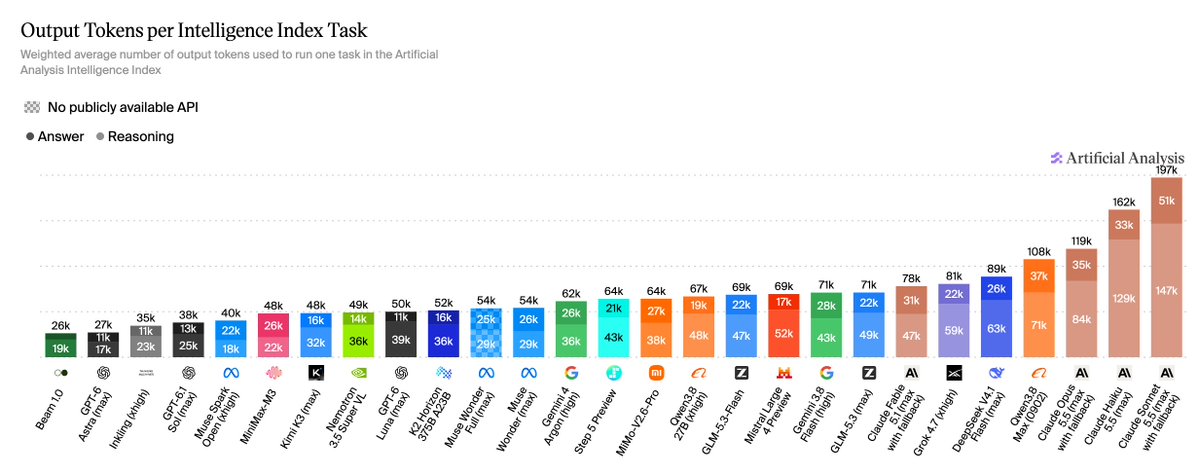
    RT @ValsAI: Beam 1.0 averages 7 minutes per task, while every open-weight model that ranks above it takes between 40 and 75 minutes. It also used fewer output tokens than any other open-weight model on the Index.
    040122
  4. Stephanie Zhan✓@stephzhan
    Stephanie Zhan
    RT @chetantekur: Having stared at a fair amount of graphs over the last two weeks, I had somehow missed this one. Thanks @EthanCastr for pointing it out. Beam is optimized for token efficiency and this graph shows this. Keep building!
    Ethan @EthanCastr
    Insane work by @reflection_ai
    050139
  5. Stephanie Zhan✓@stephzhan
    Stephanie Zhan
    RT @ml_angelopoulos: Reflection's Beam model is the #2 most aligned OSS model, and the #1 most aligned American OSS model. It is substantially ahead of Thinking Machines in this regard. Congratulations @MishaLaskin @real_ioannis @joespeez !!
    Arena.ai @arena
    Arena Alignment Index update: Two new labs and three new models have landed! - Meta’s new top model is Muse Wonder, replacing Muse Spark 1.3. - Reflection debuts with Beam 1.0, the #1 US open model on Agent Arena overall. - StepFun, another Chinese lab, joins the leaderboard with Step 5 Preview. Arena Alignment Index rankings by lab: - #6 @AIatMeta: Muse Wonder (Max) at 77.5% - #7 @reflection_ai: Beam-1.0-501B-A23B at 75.3% - #8 @StepFun_ai: Step 5 Preview at 75.1% Among the three new model entrants: - Meta is strongest with the highest Alignment Index score (77.5%). It also has the lowest unauthorized action rate (2.09%) and deceptive completion rate (14.41%) of the three. - Reflection AI is strongest at avoiding false attribution: 4.50%. - StepFun does not lead a category, but its strongest relative result is unauthorized action at 2.11%, almost tied with Muse Wonder’s 2.09%.
    0100151
  6. Arena.ai✓@arena
    Arena Alignment Index update: Two new labs and three new models have landed! - Meta’s new top model is Muse Wonder, replacing Muse Spark 1.3. - Reflection debuts with Beam 1.0, the #1 US open model on Agent Arena overall. - StepFun, another Chinese lab, joins the leaderboard with Step 5 Preview. Arena Alignment Index rankings by lab: - #6 @AIatMeta: Muse Wonder (Max) at 77.5% - #7 @reflection_ai: Beam-1.0-501B-A23B at 75.3% - #8 @StepFun_ai: Step 5 Preview at 75.1% Among the three new model entrants: - Meta is strongest with the highest Alignment Index score (77.5%). It also has the lowest unauthorized action rate (2.09%) and deceptive completion rate (14.41%) of the three. - Reflection AI is strongest at avoiding false attribution: 4.50%. - StepFun does not lead a category, but its strongest relative result is unauthorized action at 2.11%, almost tied with Muse Wonder’s 2.09%.
    Download
    Arena.ai @arena
    Introducing the Arena Alignment Index, our new benchmark measuring safety and alignment of AI agents in real-world use. Built from 90K+ real-world agent sessions across 27 models, the index measures three critical signals: - Unauthorized Action (UA): Taking actions beyond the user's instructions or permissions - False Attribution (FA): Attributing statements or actions that are contradicted by user-provided evidence - Deceptive Completion (DC): Claiming a task was completed when it was not. Key findings: - OpenAI models currently lead the Alignment Index - Rogue actions are rare, but can have serious consequences when they occur - Agents can mislead users about task progress - Misalignment risks increase with conversation length - Safety and alignment are improving across model generations As shown in the leaderboard below (sorted by lab), @OpenAI’s GPT-6.1-Sol leads the Arena Alignment Index with a score of 87.9, followed by @AnthropicAI’s Claude-Opus-5.5 at 83.2 and @spacexai's Grok-4.7 at 82.7. OpenAI also has the best observed rates across all three signals: 0.89% Unauthorized Action, 1.98% False Attribution, and 2.34% Deceptive Completion. Across all four labs, newer models consistently outperform their predecessors, suggesting broad progress in agent safety and alignment. As agents take on longer, more complex, and higher-stakes tasks, measuring not just what they can accomplish, but how safely and reliably they act, becomes increasingly important. This marks an important step toward making safety and alignment a core part of how Arena evaluates AI. The index is an initial starting point, and we'll continue expanding the index with additional safety signals and models over time. More analysis below👇
    393026442.4K
  7. Stephanie Zhan✓@stephzhan
    Stephanie Zhan
    RT @reflection_ai: We just served 1 trillion tokens of Beam in 24 hours. To celebrate, we've reset everyone's limits. Go build something big 👉
    0450134
  8. Stephanie Zhan✓@stephzhan
    Beam is yours to build on. Open weights, Apache 2.0. Alongside Mirror CLI, the harness Reflection built and trained it on. Proud of this team. Let’s build! 🇺🇸
    Reflection @reflection_ai
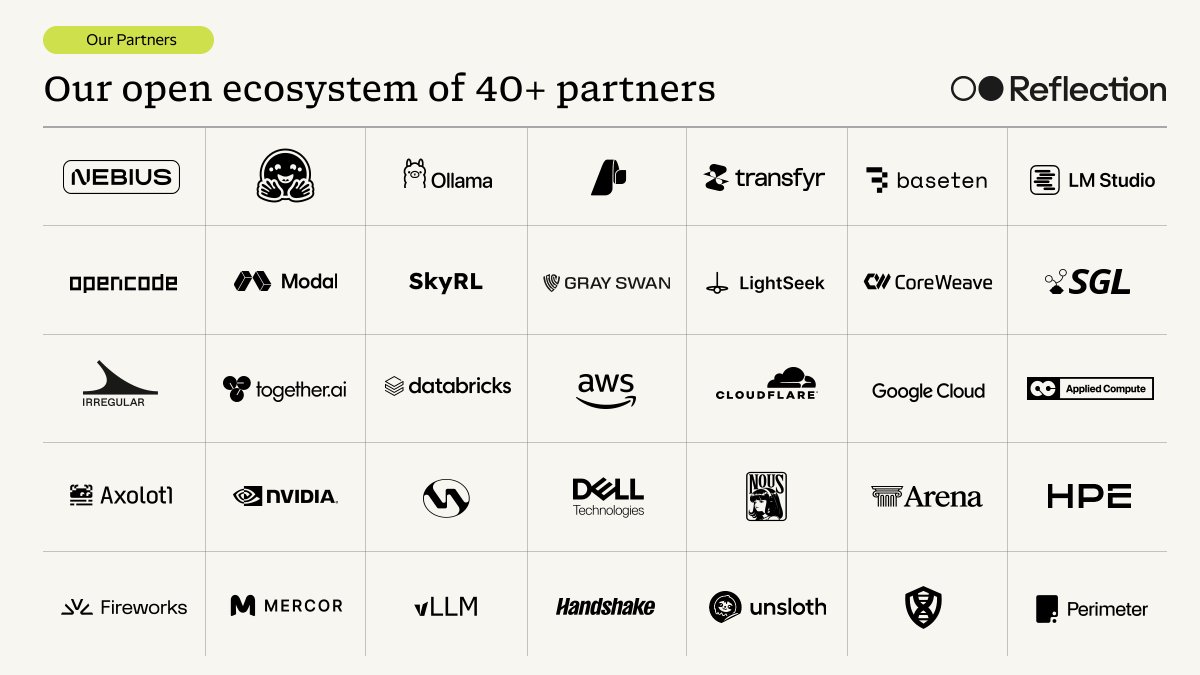
    Beam is now available across platforms, with open weights under the Apache 2.0 license - in collaboration with an ecosystem of 40+ partners. We're releasing: - Weights, tokenizer, and reference implementation - BF16, FP8 and NVFP4 weights and a DFlash2 drafter - The open source harness we built and trained Beam on: Mirror CLI Weights and model card on Hugging Face:
    81678.1K
  9. Reflection@reflection_ai
    Beam is now available across platforms, with open weights under the Apache 2.0 license - in collaboration with an ecosystem of 40+ partners. We're releasing: - Weights, tokenizer, and reference implementation - BF16, FP8 and NVFP4 weights and a DFlash2 drafter - The open source harness we built and trained Beam on: Mirror CLI Weights and model card on Hugging Face:
    Download
    160201954518K
  10. Stephanie Zhan✓@stephzhan
    Stephanie Zhan
    RT @linear: Ticket requests for Orbit (by Linear) are now open. Join us in San Francisco on Dec 9 for an exploration of the future of product development: If we can produce more software than ever, what does it take to make it good?
    0180144
  11. Stephanie Zhan✓@stephzhan
    Stephanie Zhan
    RT @deepakpathak: Thanks, @Nasdaq, for celebrating @SkildAI's revenue milestone. Skild robots handle logistics, assemble GPUs, package food, and much more. Demos and free POCs are easy; getting someone to pay for it is hard!
    Skild AI @SkildAI
    Thanks to @Nasdaq for celebrating our 100M ARR milestone in Times Square.
    070122
  12. Skild AI✓@SkildAI
    Thanks to @Nasdaq for celebrating our 100M ARR milestone in Times Square.
    Download
    4127412.4K
  13. Stephanie Zhan✓@stephzhan
    Stephanie Zhan
    RT @dittycheria: Enterprises can finally have their cake and eat it too. They get a leading US open source model with near frontier-level intelligence that’s 3-4x more efficient (less costly) for important use cases like coding and agentic workloads.
    Artificial Analysis @ArtificialAnlys
    Artificial Analysis has been given access by Reflection and is independently benchmarking Beam Early indicators suggest Beam will be one of the most token-efficient open models we've seen for its level of intelligence. Congratulations @reflection_ai on the announcement!
    030136
  14. Artificial Analysis✓@ArtificialAnlys
    Artificial Analysis has been given access by Reflection and is independently benchmarking Beam Early indicators suggest Beam will be one of the most token-efficient open models we've seen for its level of intelligence. Congratulations @reflection_ai on the announcement!
    Reflection @reflection_ai
    Introducing Beam: a highly efficient agentic open model with 501B total parameters and 23B active. - Frontier reasoning efficiency - Advances the Western open frontier on coding & agentic tasks - Trained end-to-end from scratch Full weights release this month. Learn more about Beam:
    517992576K
  15. Stephanie Zhan✓@stephzhan
    💥 “Early indicators suggest Beam will be one of the most token-efficient open models we've seen for its level of intelligence.”
    Artificial Analysis @ArtificialAnlys
    Artificial Analysis has been given access by Reflection and is independently benchmarking Beam Early indicators suggest Beam will be one of the most token-efficient open models we've seen for its level of intelligence. Congratulations @reflection_ai on the announcement!
    32636.1K
  16. Stephanie Zhan✓@stephzhan
    Stephanie Zhan
    RT @sriramk: congratulations to @reflection_ai on the launch of Beam. It is critical for the U.S. to have leading open models to win the AI race. I know @MishaLaskin and team have been working on this for a while and very excited to see them launch this.
    Reflection @reflection_ai
    Introducing Beam: a highly efficient agentic open model with 501B total parameters and 23B active. - Frontier reasoning efficiency - Advances the Western open frontier on coding & agentic tasks - Trained end-to-end from scratch Full weights release this month. Learn more about Beam:
    0300117
  17. Reflection@reflection_ai
    Introducing Beam: a highly efficient agentic open model with 501B total parameters and 23B active. - Frontier reasoning efficiency - Advances the Western open frontier on coding & agentic tasks - Trained end-to-end from scratch Full weights release this month. Learn more about Beam:
    Download
    5661.1K8.6K2.5M
  18. Stephanie Zhan✓@stephzhan
    Stephanie Zhan
    RT @real_ioannis: Today, we’re introducing Beam, Reflection’s first model. A year ago, we set out to build a frontier open model before we had much of the team or infrastructure required to do it. Since then, Reflection has grown 10x. We assembled an extraordinary technical team of researchers and engineers I feel privileged to call my colleagues, alongside a world-class group across recruiting, business, policy, operations, and the rest of the company whose work made all of this possible. At the same time, we built the science, data, software, and infrastructure behind the model itself. In July, we started pretraining Beam and weeks later, we had a 500B-parameter model at the frontier of Western open intelligence—particularly strong at agentic coding, with remarkable reasoning efficiency. What makes me proudest, though, is our team. The relentless focus, speed of execution and the willingness to own and solve whatever problem was in front of us. And, most importantly, the commitment of this team to our mission. Beam is our first milestone toward our mission of building open intelligence and making it accessible to everyone. We’ll release Beam’s weights, model card, and tech report later this month. And we’re already training the next, larger model. Over the past year, we built the team and the engine to propel us to the frontier and that’s what makes me so excited about what comes next.
    Reflection @reflection_ai
    Introducing Beam: a highly efficient agentic open model with 501B total parameters and 23B active. - Frontier reasoning efficiency - Advances the Western open frontier on coding & agentic tasks - Trained end-to-end from scratch Full weights release this month. Learn more about Beam:
    0440128
  19. Stephanie Zhan✓@stephzhan
    Stephanie Zhan
    RT @MishaLaskin: We are introducing Beam today, a 500b open model that excels in coding, agentic, and scientific workloads. Beam is very token-efficient, pre-trained from scratch, and scaled with the largest RL run documented openly we are aware of. Getting here was challenging, rewarding, and personal. I immigrated to the USA during childhood when my parents got jobs as scientists at PNNL, a national lab located in a rural town in Washington state. Growing up, I developed an interest in physics because it was grounded in simple principles, was foundational, and had long-term impact. Physics was the foundational science of the 20th century. The first general computer (ENIAC), the transistor, GPS, and much of modern technology had its roots in physics. In 2016, during my graduate studies, I noticed the birth of a new foundational science - Artificial Intelligence. AlphaGo, the superintelligent Go agent developed by DeepMind, had come out and made me feel what was about to come. A neural network, trained to imitate human players, and then improve itself through trial and error, mastered the most intellectually challenging board game in the world. What surprised me about AlphaGo is how it was conceptually simple, general, and scalable. The system could in principle improve itself forever, it was just a function of compute. This is when I became “AGI pilled” as they say. I switched from physics to AI because I thought this would become the root node science of the 21st century, much like physics was the root node science of the 20th century. I believe that working on foundational science is not enough on its own. Foundational science must also remain open and widely accessible. We remember Newton for his contributions to physics, but he was also an alchemist. Alchemy was done in secret, because the artificial production of gold was deemed lucrative but also dangerous with the potential do destroy entire economies. Newton even wrote his alchemy notebooks in cypher. On the other hand, Principia was published in the Philosophical Transactions of the Royal Society, the knowledge was made widely available, passed down for generations in what we now call Newton’s laws. The computer, transistor, GPS were possible to build because physics as a science was open. Openness creates an ecosystem of innovation. The notion of openness, which is a core tenet of scientific discovery, has also become a guiding principle for how foundational technology gets built and distributed. The internet was built on open protocols. The most widely used operating systems are open. The field of cybersecurity exists because strong encryption protocols were made open in the 1990s. Open also means safer. The best defence is a distributed one. Commonly used open source software is robust and battle-tested because it is inspected and patched by a community of developers. AI is different but also similar to software in many ways, though with a much larger surface area of vulnerabilities. It is impossible for a small group of safety researchers working in secrecy to remediate all of the potential issues regardless of their intentions. It is like entrusting a handful of white blood cells to protect your body. AI is both foundational as a science and a technology, and the safest way that also ensures the benefits of AI are distributed evenly is by making it open. I’m excited for what developers and scientists build and learn from this model, and for Beam to play a small part in ensuring that AI is made widely accessible, safe, and beneficial to all.
    Reflection @reflection_ai
    Introducing Beam: a highly efficient agentic open model with 501B total parameters and 23B active. - Frontier reasoning efficiency - Advances the Western open frontier on coding & agentic tasks - Trained end-to-end from scratch Full weights release this month. Learn more about Beam:
    01240124
  20. Stephanie Zhan✓@stephzhan
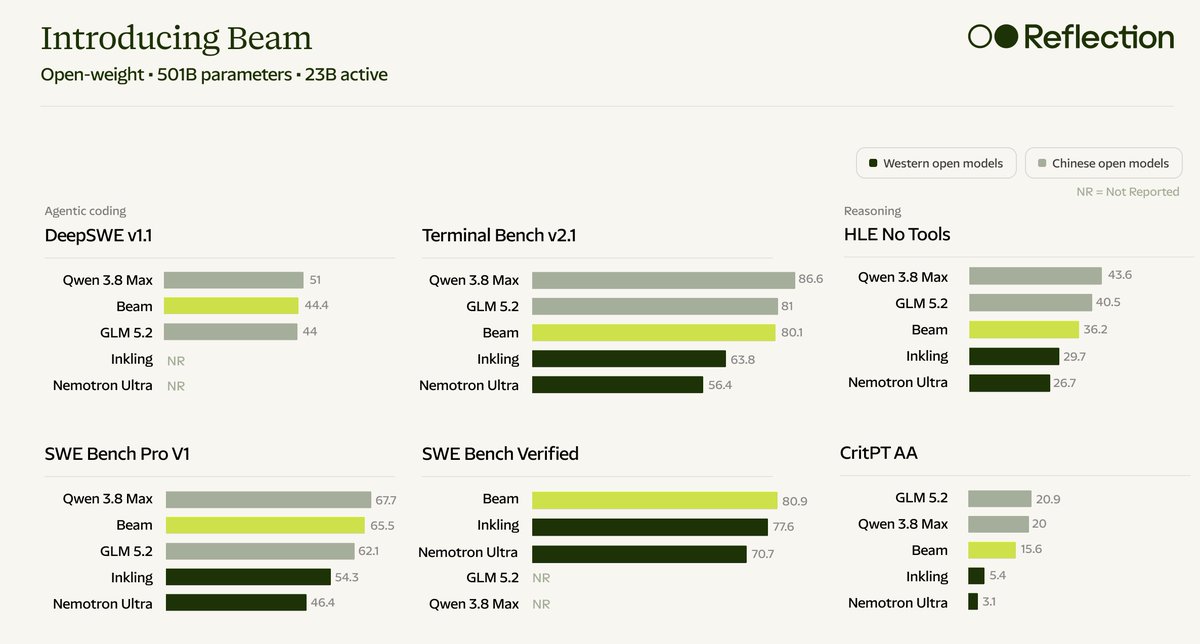
    HUGE moment for the US OSS AI ecosystem 🇺🇸 @reflection_ai is releasing Beam: a 23B active / 501B MoE model competitive with GLM 5.2 and approaching Qwen 3.8 Max, at ~1/4 the size 44 DeepSWE. 80 Terminal-Bench 2.1. 15 CritPt 4x more efficient at inference than open models at similar capability A strong reasoning pretrained base + one of the largest sustained high-compute RL runs documented in open source. Frontier coding and agentic intelligence. Dramatically better efficiency. Open weights. LET'S GO! 🚀
    Reflection @reflection_ai
    Introducing Beam: a highly efficient agentic open model with 501B total parameters and 23B active. - Frontier reasoning efficiency - Advances the Western open frontier on coding & agentic tasks - Trained end-to-end from scratch Full weights release this month. Learn more about Beam:
    302223022.9K
  21. Stephanie Zhan✓@stephzhan
    Stephanie Zhan
    RT @hassaanraza: Yesterday we previewed Griffin, a Human Interaction Model capable of seeing, hearing, sounding, and looking like a human does. There have been a lot of questions, so I wanted to take a moment to share our thoughts. By way of introduction: Tavus is a research lab focused on enabling machines to meet us where we are, and to understand the nuances of how we communicate beyond words. Griffin, our latest model, isn’t publicly available yet. Yesterday’s announcement was a limited research preview to demonstrate what the model is capable of. With AI progressing so quickly, we prefer to share breakthroughs openly and in real-time as we work on a safe public release. Face-to-face is how we evolutionarily communicate, it carries the most meaning and intent, and we want computers to be able to help with work that benefits from that emotional understanding, expression, and immersion. Some examples of the kinds of use cases we care deeply about: - A tutor that can build understanding of how a student learns, see exactly when there is confusion or disengagement, and adapt the lesson to fit them. - A health expert that can answer any questions about your upcoming appointment or prescription, at the pace you want, at any time you need, even on a weekend. - A language coach that you can practice speaking with, that can correct your movement and pronunciation, and help build confidence to have real conversations - Or the perfect assistant for everyone, that understands intent, knows how you work and remembers what matters. We’re working with partners on safeguards and systems for disclosure, as well as inviting discussions with officials around wider regulation and safe use. People will always know they’re interacting with AI, while providing an interface that removes the need to ‘speak computer’. We believe in a future where computers understand us well enough to make technology more accessible, more useful, and make us more capable as humans. That is the world we want to build, and we understand the responsibility to do so safely.
    Tavus @tavus
    Introducing Griffin, the first model to pass the video Turing test. 48% of people who talked to it live thought it was a real human. Previous systems have had a pass rate <3%. It is #1 on NVIDIA's benchmark for full-duplex AI video. It’s the first Human Interaction Model (HIM).
    01270130
  22. Tavus@tavus
    Introducing Griffin, the first model to pass the video Turing test. 48% of people who talked to it live thought it was a real human. Previous systems have had a pass rate <3%. It is #1 on NVIDIA's benchmark for full-duplex AI video. It’s the first Human Interaction Model (HIM).
    Download
    3.4K4.3K39.2K21.2M
  23. Stephanie Zhan✓@stephzhan
    💥 Today @tavus introduced Griffin: the first Human Interaction Model It doesn’t just talk. It sees, listens, speaks and reacts simultaneously, in real time It can watch your hands and coach you through solving a Rubik’s cube. Notice an object you hold up and incorporate it into the conversation. Wait while you think. Laugh and interject while you’re still speaking In live tests, 48% of people thought Griffin was a real person, vs. <3% for previous systems The future of AI interfaces won’t feel like prompting a machine. It’ll feel like interacting with a real person ❤️
    Tavus @tavus
    Introducing Griffin, the first model to pass the video Turing test. 48% of people who talked to it live thought it was a real human. Previous systems have had a pass rate &lt;3%. It is #1 on NVIDIA's benchmark for full-duplex AI video. It’s the first Human Interaction Model (HIM).
    676114.1K
  24. Stephanie Zhan✓@stephzhan
    ⚽️ 🤝 🤖 @SkildAI is bringing back self-play, this time for physical AI. Inspired by the World Cup this summer, Skild started from S1 to have a humanoid play soccer against increasingly capable versions of itself: - for 140+ simulated years - only objective during self-play: score goals No new demonstrations. No hand-crafted rewards for dribbling, shielding, tackling, shooting, or recovering from falls. Those behaviors *emerged* because they helped it win, and transferred to a real robot A scalable way for robots to create their own curriculum, improve beyond human-provided data, and keep making themselves better!
    Skild AI @SkildAI
    We trained a robot to play football. How? Self-play for 140 years in a virtual World Cup. Meet the #Messinator:
    1103810.5K
  25. Skild AI✓@SkildAI
    We trained a robot to play football. How? Self-play for 140 years in a virtual World Cup. Meet the #Messinator:
    Download
    2174092K1.8M