My tweets are not a news outlet (i.e. "All the News That's Fit to Print").
I tweet what I find interesting.
I don't tweet things that are stated frequently or better by others.
My goal is not to please all readers but simply to amuse myself.
RT @RonKarlsbergMD: The use of AI and healthcare extenders should be a platform for considering an entire revamping of medical education and how our healthcare is delivered. The critical issue is to learn how to learn, not just the facts, which has been a major emphasis of the pre-medical pathway as well as medical education. This ancient approach will need to change very rapidly.
Unexpected consequences are common and often problematic
Share
Copied
Tony LaRocco@TonyLaRocco
@JoelDeTeves Anthropic/OpenAI (and all other Frontier AI companies for that matter) are causing a paradox.
They're trying so desperately hard to avoid agents doing "bad things" but in the act of being so cautious and restrictive, are causing the rise in abliterated/uncensored models.
@JoelDeTeves Anthropic/OpenAI (and all other Frontier AI companies for that matter) are causing a paradox.
They're trying so desperately hard to avoid agents doing "bad things" but in the act of being so cautious and restrictive, are causing the rise in abliterated/uncensored models.
Some medical societies bring in retired politicians to talk about the past for their keynotes, others bring in Nobel scientists to talk about the future!
Share
Copied
Katalin Susztak@KSusztak
Craig Mello kicking off the nephrology meeting ! @ASNKidney RNA medicines and oligo therapies will be the next generation cures for the kidney patients
Craig Mello kicking off the nephrology meeting ! @ASNKidney RNA medicines and oligo therapies will be the next generation cures for the kidney patients
RT @PatrickHeizer: We can't brute force compute all possible moves in Go, a static game with a simple 19 x 19 grid, yet somehow people think we're going to simulate a dynamic system of trillions of cells each containing trillions of molecules.
Share
Copied
Mira@_Mira___Mira_
If you had an exponential amount of compute you could solve simulate biology exactly and wouldn't need to run any experiments.
Some of you will think "of course, but that's an unrealistic assumption" and others will think "no, you need experiments even with that much compute. That's just How It's Done".
You would of course need evaluations once you have a solution, but you don't in principle need experiments to find it: Experiments are a way to save compute, dating from a time when it was much more expensive.
And I think the presentation is exponential but real systems aren't irreducibly exponential. AlphaFold worked, after all.
RT @David_Ouyang: Updated with sections on structural heart echo.
Walks through the steps for TAVR, mTEER, and tTEER. This includes 3D models as well as simulated 2D ultrasound images.
Would appreciate feedback and suggestions for improvement!
This cycle is broken.
Important results should be released when they are ready, not because of hype cycles around major meetings!
Share
Copied
Harold J. Burstein, MD, PhD, FASCO@DrHBurstein
The leaked Merck vaccine data @myESMO underscore the challenges of the orchestrated theater of Act 1, company press release -> Act 2 hold data -> Act 3 public report at major meetings. Act 2, the hold phase, builds excitement for the company & discussion but inevitably there are data shared with KOLs and other stakeholders.
$MRNA rose 276% (🔼mkt cap $40+B) on press release and fell 18% (🔽$12B) on leak.
Seems unclear how this orchestration helps patients or actual research. To the extent there is peer review, it is done by the journals and not the meeting organizers themselves.
@adamfeuerstein@matthewherper
RT @AnilMakam: So the media and KOLs failed miserably in carrying their water based on press release without any data. What.A.Shocker
What do you call failing over and over?
Share
Copied
Harold J. Burstein, MD, PhD, FASCO@DrHBurstein
The leaked Merck vaccine data @myESMO underscore the challenges of the orchestrated theater of Act 1, company press release -> Act 2 hold data -> Act 3 public report at major meetings. Act 2, the hold phase, builds excitement for the company & discussion but inevitably there are data shared with KOLs and other stakeholders.
$MRNA rose 276% (🔼mkt cap $40+B) on press release and fell 18% (🔽$12B) on leak.
Seems unclear how this orchestration helps patients or actual research. To the extent there is peer review, it is done by the journals and not the meeting organizers themselves.
@adamfeuerstein@matthewherper
Medicine will be the only field in which AI increases cost. Why are doctors allowing AI companies to feed off of the Physician Fee Schedule?
Share
Copied
Wil@WillyRontgen
Medicare paying hospitals an extra $137.53 for a chest CT they run thru AIDoc Multi-Triage CT Body software, meanwhile rad actually reading the study only makes about $49. Makes sense.
Same thing is happening for ECGs and about to happen for echocardiograms
Share
Copied
Wil@WillyRontgen
Medicare paying hospitals an extra $137.53 for a chest CT they run thru AIDoc Multi-Triage CT Body software, meanwhile rad actually reading the study only makes about $49. Makes sense.
RT @WillyRontgen: Medicare paying hospitals an extra $137.53 for a chest CT they run thru AIDoc Multi-Triage CT Body software, meanwhile rad actually reading the study only makes about $49. Makes sense.
RT @nlindenberg: Agree, and that monopoly is already eroding. Editors still decide what gets printed. They no longer get the last word on what it means.
Share
Copied
Venk Murthy MD PhD@venkmurthy
I have said it for years: editors are the single weakest link in the academic system IMO
This is a power that should not reside in central planners (see Hayek) but in the wisdom of the community
* Disclosure: I am currently and have been an editor
I have said it for years: editors are the single weakest link in the academic system IMO
This is a power that should not reside in central planners (see Hayek) but in the wisdom of the community
* Disclosure: I am currently and have been an editor
Share
Copied
Jason Locasale@LocasaleLab
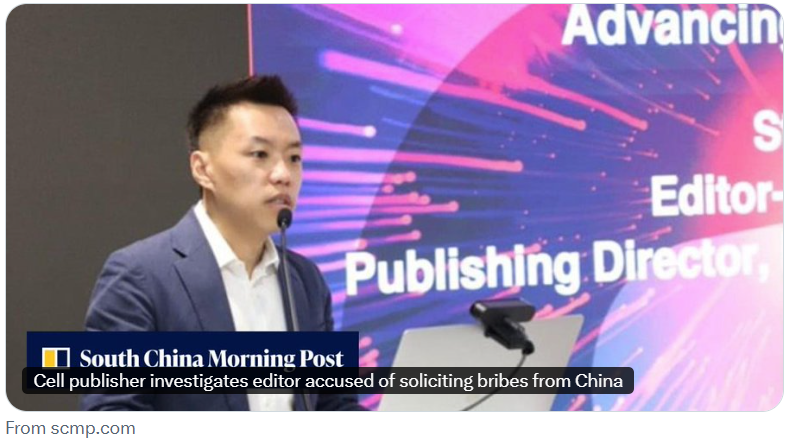
Quid pro quo is rampant in academic peer review and publishing.
But I would be shocked if it were as explicit as “pay me $300K and I’ll publish your paper.” Editors are generally not stupid enough to spell out an arrangement like that. Those working for publicly traded publishing companies like this guy know they would risk their jobs and criminal prosecution.
Where it gets murky is paid conference travel that looks like a luxury vacation, cozying up to editors, buying them meals and drinks, and socializing with them. Networks form, and getting into those networks can be key to getting grants and papers published. Editors have friends in those circles too. They notice who you know and who you are associated with.
At some journals, you build good relationships with the editors. At others, you never manage to crack the system. Over time, you learn what particular editors like, which subjects excite them, and how they want a story presented. You start shaping your work and its presentation around those preferences.
There is a game to play, and you learn how to play it. The influence rarely if ever needs to take the form of an explicit transaction. It becomes embedded in relationships, access, and reciprocal favors, until anticipating what pleases the gatekeepers starts shaping the science itself.
RT @emollick: By every measure, Opus 4.8 beats human experts as peer reviewers in a study of 124 Harvard social science papers covering a range from statistical analyses to formal models to qualitative work.
As academics, we need to figure out how to adapt the practice of science to AI, fast.
RT @cheprofessor: If offered odds, I'd bet that within 5 (max 10) years, publishing as we know now would have disappeared. Papers (preprints) will be available quickly for all to see with reviews coming from everywhere - and AI will help with the process. The lack of gate keepers will be very disruptive and the noise will almost certainly increase for a while - but slowly but surely the end result will be the "internet" where we will find the latest and greatest work with "confidence limits" on what to believe and what to reject.
Quid pro quo is rampant in academic peer review and publishing.
But I would be shocked if it were as explicit as “pay me $300K and I’ll publish your paper.” Editors are generally not stupid enough to spell out an arrangement like that. Those working for publicly traded publishing companies like this guy know they would risk their jobs and criminal prosecution.
Where it gets murky is paid conference travel that looks like a luxury vacation, cozying up to editors, buying them meals and drinks, and socializing with them. Networks form, and getting into those networks can be key to getting grants and papers published. Editors have friends in those circles too. They notice who you know and who you are associated with.
At some journals, you build good relationships with the editors. At others, you never manage to crack the system. Over time, you learn what particular editors like, which subjects excite them, and how they want a story presented. You start shaping your work and its presentation around those preferences.
There is a game to play, and you learn how to play it. The influence rarely if ever needs to take the form of an explicit transaction. It becomes embedded in relationships, access, and reciprocal favors, until anticipating what pleases the gatekeepers starts shaping the science itself.
RT @R_H_Ebright: "As to why authors would be willing to spend massive sums to bribe journals, the industry insider said...'It is essentially an investment,' he said, noting that once a paper was published in a top journal, 'all sorts of academic titles, resources and research grants follow'"
Share
Copied
Richard H. Ebright@R_H_Ebright
Allegation: "the journal editor in question gave the clinician submitting the manuscript a quote: 'An initial payment of 2 million yuan (US$299,000), with more potentially required later.'"
Allegation: "the journal editor in question gave the clinician submitting the manuscript a quote: 'An initial payment of 2 million yuan (US$299,000), with more potentially required later.'"
RT @LocasaleLab: Bryan is spot on about the gap between sequencing a genome and knowing what to do with it.
The Human Genome Project was hyped as the be-all and end-all of understanding human disease. Meanwhile, areas concerned with how our bodies interact with the environment, including diet, physical activity, environmental exposures, pharmacology, and toxicology, were neglected for decades.
We’re left with Bryan leading the way because scientists don’t have good answers to the questions most people are interested in.
Leading institutions such as NIH and FDA helped entrench those priorities. We became extraordinarily good at reading genetic sequences while leaving fundamental questions about human physiology and metabolism unanswered.
It’s time to change those priorities and give these neglected areas the scientific attention they deserve.
Share
Copied
Bryan Johnson@bryan_johnson
I can't find a way to use my genome.
I’m the most intense longevity athlete in the world and haven’t used my genome for a single thing.
Fully sequenced in 2012. Again this year, paying $7,902 for matched 30x long read + 100x short read.
Still, nothing.
What am I missing?
I can't find a way to use my genome.
I’m the most intense longevity athlete in the world and haven’t used my genome for a single thing.
Fully sequenced in 2012. Again this year, paying $7,902 for matched 30x long read + 100x short read.
Still, nothing.
What am I missing?
For most people, genetic sequencing adds little to health management
Share
Copied
Bryan Johnson@bryan_johnson
I can't find a way to use my genome.
I’m the most intense longevity athlete in the world and haven’t used my genome for a single thing.
Fully sequenced in 2012. Again this year, paying $7,902 for matched 30x long read + 100x short read.
Still, nothing.
What am I missing?