Phoenix Research✓

@0xPhoenix77

🪶 DeFi Researcher Crypto narratives & trenches radar

1.9K Following12.3K Followers56.7K Posts
  1. Phoenix Research✓@0xPhoenix77
    Onchain options ecosystem Part 2 Part 1 covered many of the established names in onchain options. Part 2 goes further down the stack, mapping the newer venues, primitives and markets starting to take shape. This time I'm covering: > Options trading & liquidity > Perpetual / new option primitives > New underlyings > Next wave 1/ Options trading & liquidity @paradex dated options with RFQ execution on Starknet @CallPutApp crypto and synthetic stock/ETF options on Base @ArrowMarkets onchain options building toward Monad @hypersurfaceX options with structured premium strategies @SynapseProtocol Hypercall options across crypto and equity underlyings @SharwaFinance options brokerage and aggregation layer @splitmarkets onchain options trading desk @kodachi_io options inside a broader trading superapp 2/ Perpetual / new option primitives @Panoptic_xyz perpetual options built around AMM liquidity @GammaSwapLabs short-duration digital options @0xflatmoney everlasting options primitive @NoRektFi lending positions hedged with options @StormbitFinance credit and settlement infrastructure using options for hedging 3/ New underlyings @nondollar_life onchain stock and crypto options @convallax options on prediction market probabilities @Stock_Works tokenized stock options @LongBowOptions options on new assets via Robinhood Chain @premarket_xyz options around pre-launch assets, IPOs, TGEs and RWAs @pokerfi_gg turning poker into an options market 4/ Next wave @JoyrideExchange 0DTE options on Solana @HyperdeltaX building options around Hyperliquid @layerv_official volatility and options platform in development @degrop_ degen-focused onchain options launching soon @heat_fi social trading UX for options @deriverse_io Solana trading stack with options on the roadmap The options stack is expanding beyond BTC and ETH. More teams are building options around stocks, prediction markets and pre-launch assets, not just BTC and ETH. And more new venues are still coming online. Bookmark and retweet for part 3
    Download
    54710310.2K
  2. Phoenix Research✓@0xPhoenix77
    From crypto perps to tokenised ETFs on GRVT? The collaboration between @grvt_io and Mirae Asset Securities (HK) could open up a much bigger market. The first step is already done. GRVT has subscribed to tokenised funding notes arranged by Mirae Asset Securities (HK), part of a group overseeing $1T+ in global client assets. Both sides are now exploring: - Tokenised Treasuries - Corporate bonds - ETFs GRVT also intends to connect the note exposure to GRVT Earn, subject to applicable requirements.
    Grvt @grvt_io
    Grvt × Mirae Asset Securities 🤝 Grvt has subscribed to tokenised funding notes arranged by Mirae Asset Securities - the first step in a collaboration on tokenised products. Traditional finance and onchain markets, moving closer. Read the full article in comments below 👇
    25142350
  3. Grvt@grvt_io
    Grvt × Mirae Asset Securities 🤝 Grvt has subscribed to tokenised funding notes arranged by Mirae Asset Securities - the first step in a collaboration on tokenised products. Traditional finance and onchain markets, moving closer. Read the full article in comments below 👇
    Download
    473119638.3K
  4. Phoenix Research✓@0xPhoenix77
    52% of merged PRs automated in one month. @superplanehq team achieved with their own product. Coding agents can write code, but engineers still spend hours managing tasks, fixing CI failures, and reviewing outputs. SuperPlane 1.0 introduces an open-source software factory that handles that coordination. From picking up tickets to verifying results, the workflow runs with human oversight. imo, the next AI coding unlock is less babysitting, more shipping
    Darko Fabijan @darkofabijan
    Last month, 52% of the pull requests our team merged were automated through SuperPlane. Today, we’re launching @superplanehq 1.0: an open source software factory for engineering teams. We built it because using a coding agent can feel like becoming its assistant. Starting sessions. Checking its work. Chasing failing CI. SuperPlane takes on that coordination: - Scans your backlog and proactively picks up tickets suited to automation. - Runs a coding agent and verifies the result. Works through CI failures and review feedback. - Your team reviews the evidence and decides what ships. The setup, instructions, and standards are shared across the team. When someone improves the process, everyone benefits. Choose your agents and models. Run it on your own infrastructure. We spent more than a decade building CI/CD at Semaphore. We’ve seen how much teams can accomplish when routine work runs reliably in the background. Now we’re bringing that approach to coding agents. Here’s how it works:
    220332.3K
  5. Darko Fabijan✓@darkofabijan
    Last month, 52% of the pull requests our team merged were automated through SuperPlane. Today, we’re launching @superplanehq 1.0: an open source software factory for engineering teams. We built it because using a coding agent can feel like becoming its assistant. Starting sessions. Checking its work. Chasing failing CI. SuperPlane takes on that coordination: - Scans your backlog and proactively picks up tickets suited to automation. - Runs a coding agent and verifies the result. Works through CI failures and review feedback. - Your team reviews the evidence and decides what ships. The setup, instructions, and standards are shared across the team. When someone improves the process, everyone benefits. Choose your agents and models. Run it on your own infrastructure. We spent more than a decade building CI/CD at Semaphore. We’ve seen how much teams can accomplish when routine work runs reliably in the background. Now we’re bringing that approach to coding agents. Here’s how it works:
    Download
    279109497207K
  6. Phoenix Research✓@0xPhoenix77
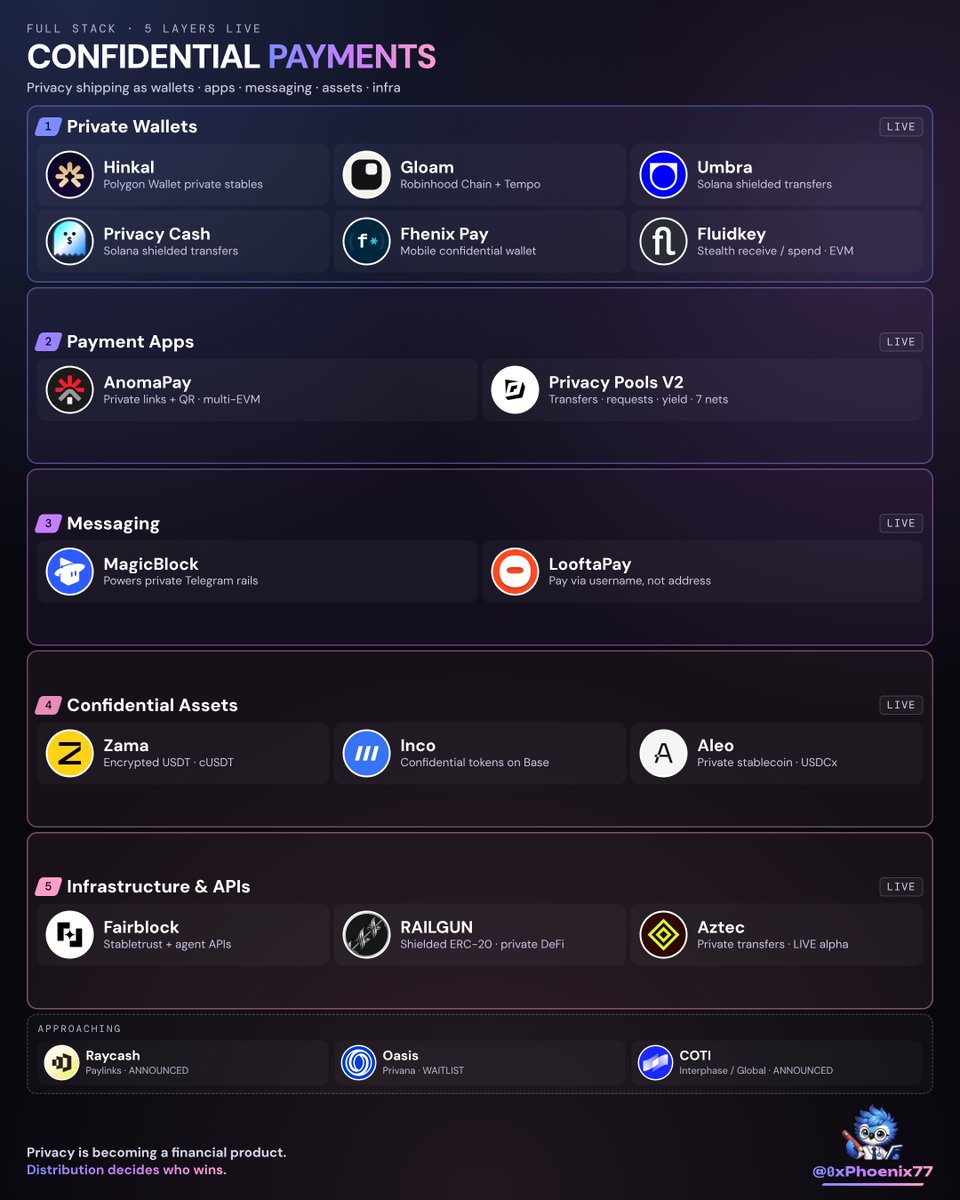
    Confidential Payments Are Becoming a Full Stack Onchain payments still expose financial activity by default. Now privacy is expanding into wallets, payment apps, stablecoins and developer infrastructure. The ecosystem is growing across five layers. 1/ Private Wallets · LIVE - @hinkal_protocol brings private stablecoin payments to Polygon Wallet. - @gloamtrade supports private balances and payments on Robinhood Chain and Tempo. - @UmbraPrivacy and @theprivacycash enable shielded transfers on Solana. - @fhenix offers confidential payments through a mobile wallet (Fhenix Pay). - @fluidkey enables stealth receive and spend on EVM. 2/ Payment Apps · LIVE - @AnomaPay supports private payments through links and QR codes across multiple EVM chains. - @0xbowio's @0xprivacypools V2 enables private transfers, payment requests and yield across seven networks. 3/ Messaging · LIVE - @magicblock powers @looftapay, allowing private Telegram payments using usernames instead of wallet addresses. 4/ Confidential Assets · LIVE - @zama enables encrypted USDT balances and transfers through cUSDT on Ethereum. - @inconetwork brings confidential tokens to Base. - @AleoHQ supports private stablecoin payments through USDCx. 5/ Infrastructure & APIs · LIVE - @0xfairblock offers Stabletrust, combining confidential transfers with APIs for AI agents. - @RAILGUN_Project provides shielded ERC-20 transfers and private DeFi infrastructure. - @aztecnetwork enables private transfers on Aztec (LIVE alpha). More products are approaching: - @raycashxyz: Private Paylinks · ANNOUNCED - @OasisProtocol: Privana · WAITLIST - @COTInetwork: Interphase + COTI Global · ANNOUNCED Privacy infrastructure protects transaction data. Applications make it accessible. Wallets and payment channels bring distribution. The next competitive advantage will come from combining meaningful confidentiality with simple payment experiences. Privacy is becoming a financial product, with distribution shaping who captures adoption.
    Download
    321473.2K
  7. Phoenix Research✓@0xPhoenix77
    Phoenix Research
    RT @Jonasoeth: ngl, this report gave me a much deeper understanding of tokenized stocks onchain. There are plenty of valuable findings, but a few insights from @redstone_defi really stood out to me: 1. Perps are still where stocks actually trade One of the biggest takeaways from RedStone's report is how much equity perp trading dominates the market. Equity perp volume is roughly 9.9x higher than tokenized stock spot volume. Even with tokenized stocks surpassing $3B, most onchain trading activity still happens through derivatives rather than spot tokens. For now, traders seem to value the leverage and liquidity of perps more than holding tokenized shares. 2. After-hours trading is a clear advantage Around 55% of tokenized stock trading volume happens outside traditional market hours. Even more impressive, Sunday evening perp prices correctly predicted the direction of Monday's market open around 65% of the time in RedStone's sample. This is one of the clearest examples of the real utility crypto infrastructure brings to tokenized equities. 3. The defi gap remains huge Only 2.6% of tokenized stocks are actually being used in DeFi, despite 42% of the supply being technically eligible as collateral. Most of the collateral usage comes from a handful of smaller markets, while assets from larger issuers barely see meaningful borrowing activity. This suggests there's still a massive gap between making tokenized stocks available in DeFi and generating real demand for them as collateral. 4. Liquidity and actual ownership are highly fragmented There are roughly 4.04M holders, but the average balance is only around $780. Most positions are small, retail-sized holdings concentrated across a limited number of venues. Meanwhile, many large balances sit in issuer wallets and exchange hot wallets rather than individual investor wallets. Another detail worth noting: the three largest issuers, accounting for roughly 70% of the market, don't provide direct equity ownership. Instead, holders typically receive indirect economic exposure or claims backed by underlying shares. --- The full report goes much deeper into market structure, trading behavior, liquidity fragmentation, and the DeFi adoption gap that RedStone has identified. If you want to explore the full data and analysis, I'd recommend checking out the report below.
    RedStone ♦️ @redstone_defi
    Tokenized stocks total $3.17B+ in onchain value. Only 2.6% of that is used in DeFi. Read our latest report with @FourPillarsFP and @AleaResearch, revealed at @TokenizeThisNYC Singapore edition, to learn why. Features insights from: @Securitize, @DinariGlobal, @SuperstateInc, @extendedapp, @lista_dao, @JupiterExchange, @CredoraNetwork.
    05016
  8. Phoenix Research✓@0xPhoenix77
    Phoenix Research
    RT @Jonasoeth: imo, one of the most valuable insights from @paretocredit's article is that most real Bitcoin borrowing demand sits in the OTC market, where hedge funds, prime brokers, and financial institutions borrow Bitcoin to support their operations. Onchain, Bitcoin is mostly used as collateral, leaving lending rates close to zero. This gap is exactly what credit products like Pareto x Two Prime aim to address, bringing offchain institutional borrowing demand onchain through a more structured credit model. So what makes this Bitcoin Credit product different from traditional OTC lending and existing onchain markets? 1. Yield backed by institutional credit demand The vault currently offers around 1.61% net APY, paid in $WBTC. That's significantly higher than most onchain Bitcoin lending pools, where limited borrowing demand keeps rates near zero. More importantly, the yield comes from interest paid by institutional borrowers rather than relying on token incentives. 2. Credit structure designed for institutional lending Rather than operating as a typical lending pool, Pareto structures the vault as a credit facility with defined risk controls. @Two_Prime puts up 150 WBTC of its own capital as first-loss protection, absorbing credit losses before they reach lenders. The vault also has monthly redemption cycles and a Credit Agreement outlining lender rights and recovery procedures. This follows the hybrid onchain + offchain model that Pareto has already demonstrated across its previous Credit Vaults. 3. A new access channel for institutional Bitcoin credit The product opens institutional Bitcoin credit exposure to eligible lenders holding capital onchain. Previously, accessing OTC lending opportunities often required direct institutional relationships, with limited flexibility around participation. By bringing this exposure onchain, Pareto creates another channel for capital allocation beyond traditional OTC relationships. 4. The composability potential of $pAXIOMBTC For me, this is the strongest advantage of bringing Bitcoin credit onchain. Unlike traditional OTC positions, the vault's receipt token can potentially be integrated into secondary markets, money markets, or more complex structured DeFi products. That opens the door for the same Bitcoin credit exposure to gain additional liquidity, distribution, and utility across DeFi.
    Pareto @paretocredit
    06015
  9. Pareto✓@paretocredit
    54326.4K
  10. Phoenix Research✓@0xPhoenix77
    Onchain Credit Is Entering a New Phase DeFi lending is evolving beyond floating rates and liquidity pools. The next competitive edge lies in financing terms, collateral management and credit risk. Recent developments show this shift: - @Morpho Midnight crossed $100M in reported deposits, bringing fixed-rate, fixed-term lending. - @longbowlend is extending this model to Robinhood Chain. - @aave V4 introduced externally curated markets with @SentoraHQ, supporting RLUSD @Ripple PYUSD and OUSD - @openstandard. Professional risk management is becoming part of the lending infrastructure. - @AscendFi and @m1xglobal completed an institutional repo on @StellarOrg, executing 72 automated hourly rolls with USDM1 collateral. - @chainlink Data Feeds supported pricing for the USDC leg. - @Ripple and @arf_one announced RLUSD-based settlement financing, connecting short-term credit with real payment flows. These developments point toward a more specialized credit market. Borrowers want predictable financing. Lenders want transparent risk. Institutions want efficient collateral and settlement. As liquidity infrastructure becomes more standardized, competitive advantage shifts toward those who structure financing, manage risk and optimize capital. Liquidity provides the foundation. The next value layer is credit structuring.
    Download
    323442.5K
  11. Phoenix Research✓@0xPhoenix77
    A month ago, I mapped who supplies, routes, and tokenizes AI inference. Now I'm looking at the next piece of the market: Verifiable Inference. As agents start paying for compute, proving what actually ran becomes essential. 12 projects building across 4 key pillars: Pillar 1 - Verifiable Execution > @lagrangedev - $LA builds DeepProve for cryptographic inference proofs. > @inference_labs makes autonomous AI execution auditable. > @OpenGradient - base:0xfbc2051ae2265686a469421b2c5a2d5462fbf5eb combines zkML proofs and TEE attestations. Pillar 2 - Private Execution > @PhalaNetwork - ethereum:0x6c5ba91642f10282b576d91922ae6448c9d52f4e runs private inference inside GPU TEEs. > @0G_labs - $0G builds private, verifiable inference infrastructure. > @nesaorg enables secure inference on its AI Layer 1. Pillar 3 - Reproducibility > @gensynai - $AI develops REE to make AI execution reproducible and verifiable. > @PrimeIntellect built TOPLOC, where validators recompute hidden states to verify inference. Pillar 4 - Compute Provenance > @prlnet - $PEARL turns GPU AI compute into proof of useful work that secures a chain. > @AethirCloud - $ATH runs Checker nodes that guard compute integrity on its network. > @darkbloomai routes requests to physical Macs across a live compute network. > @eigencloud - $EIGEN builds open compute infrastructure and verifiable agent tooling. As inference becomes a tradable service, buyers will demand proof of execution, privacy, and reliability. These four pillars are where the next wave of onchain AI gets built.
    Download
    Phoenix Research @0xPhoenix77
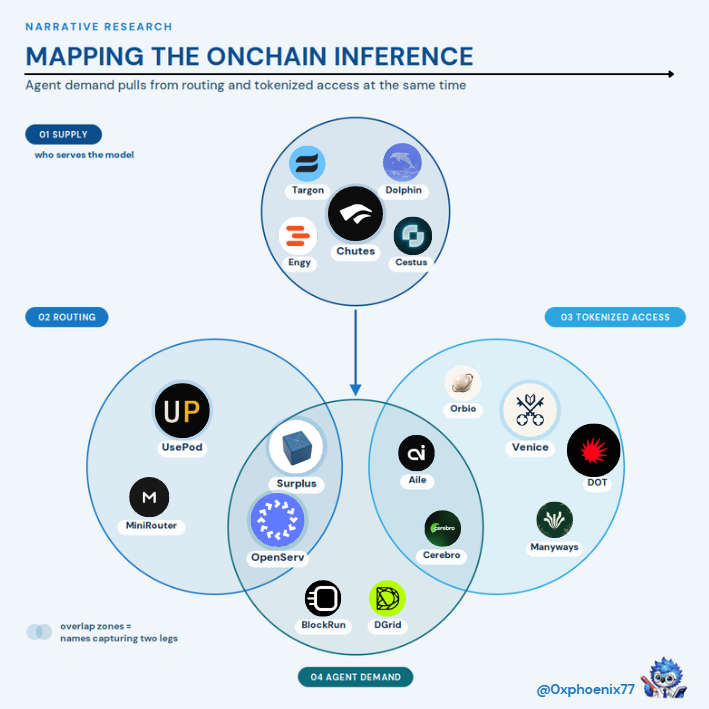
    Every part of onchain inference is starting to accrue value to a different set of projects Supply → Chutes Routing → Surplus, UsePod Tokenized access → Venice Agent demand → OpenServ I’m using the leaders as anchors, then building a watchlist of smaller names around each market. 1/ Inference Supply @chutes_ai sets the benchmark. 6.12B requests and 35.8T+ input tokens in its released dataset. Banger names: @engyai verified inference @TargonCompute confidential compute @dphnAI - $POD consumer GPU inference @CestusNetwork early distributed inference The shift here is from renting GPUs → selling served intelligence. 2/ Routing & Inference Markets OpenRouter proved multi-provider routing can scale. Now crypto is opening the supply side. @AskSurplus - base:0xc52aedec3374422d7510e294cfaa90799595cba3 seller-priced inference; 2.5M requests / 107B input tokens by July @UsePodAI GPU + API-key supply, USDC settlement @miniroutersh 1.2B tokens / 60.4K requests / 239 models in 30d @openservai - $SERV agent routing + execution layer More suppliers → better routing → tighter pricing. 3/ Tokenized Inference @AskVenice - $VVV is the reference point. $DIEM turns inference access into a transferable asset, while Venice recently reported 250B tokens/day. Smaller experiments: @orbiodotso - robinhood:0xaa07a0e9209e16ac99708c3ec70159c6ef3128a3 → live OpenRouter credit market; ~$35-37K asks, 22.5% best discount @usedotai - $DOT IRM + stake-for-inference @AileLabs - solana:8d3bQS9vNy3BfqK9dX95JRoaTbWoiuL2hzmSFLDopump idle Claude / Codex / Gemini access @Cerebro_RH - robinhood:0xeb24a2663af4ee979dcbfe39cb95b5f12d369c4b agents + inference credits @manyways_rh - robinhood:0xa26992c4268a8a78a4d872fe4bdad2ed03ac287d early model-access market This is where inference starts moving from usage → credits → transferable inventory. 4/ Agent-native Demand Agents may become the biggest native buyers of inference. @openservai - $SERV agent infra @AskSurplus x402 inference @AileLabs - solana:8d3bQS9vNy3BfqK9dX95JRoaTbWoiuL2hzmSFLDopump x402 settlement @Cerebro_RH - robinhood:0xeb24a2663af4ee979dcbfe39cb95b5f12d369c4b agents consuming credits @BlockRunAI USDC per LLM call @dgrid_ai pay-per-inference Humans pick brands. Agents can route around price, quality, latency, privacy and availability. ➟ Onchain Inference Map Supply Chutes · Engy · Targon · Dolphin · Morpheus · Cestus Routing / Markets Surplus · UsePod · MiniRouter · OpenServ Tokenized Inference Venice · Orbio · DOT · Aile · Cerebro · Manyways Agent Demand OpenServ · Surplus · Aile · Cerebro · BlockRun · DGrid My approach: keep the leaders as core exposure, then selectively build positions in smaller names as usage and liquidity show up. The leaders already own the attention. Now I’m looking for which smaller names capture the next leg.
    182363.9K
  12. Phoenix Research✓@0xPhoenix77
    Every part of onchain inference is starting to accrue value to a different set of projects Supply → Chutes Routing → Surplus, UsePod Tokenized access → Venice Agent demand → OpenServ I’m using the leaders as anchors, then building a watchlist of smaller names around each market. 1/ Inference Supply @chutes_ai sets the benchmark. 6.12B requests and 35.8T+ input tokens in its released dataset. Banger names: @engyai verified inference @TargonCompute confidential compute @dphnAI - $POD consumer GPU inference @CestusNetwork early distributed inference The shift here is from renting GPUs → selling served intelligence. 2/ Routing & Inference Markets OpenRouter proved multi-provider routing can scale. Now crypto is opening the supply side. @AskSurplus - base:0xc52aedec3374422d7510e294cfaa90799595cba3 seller-priced inference; 2.5M requests / 107B input tokens by July @UsePodAI GPU + API-key supply, USDC settlement @miniroutersh 1.2B tokens / 60.4K requests / 239 models in 30d @openservai - $SERV agent routing + execution layer More suppliers → better routing → tighter pricing. 3/ Tokenized Inference @AskVenice - $VVV is the reference point. $DIEM turns inference access into a transferable asset, while Venice recently reported 250B tokens/day. Smaller experiments: @orbiodotso - robinhood:0xaa07a0e9209e16ac99708c3ec70159c6ef3128a3 → live OpenRouter credit market; ~$35-37K asks, 22.5% best discount @usedotai - $DOT IRM + stake-for-inference @AileLabs - solana:8d3bQS9vNy3BfqK9dX95JRoaTbWoiuL2hzmSFLDopump idle Claude / Codex / Gemini access @Cerebro_RH - robinhood:0xeb24a2663af4ee979dcbfe39cb95b5f12d369c4b agents + inference credits @manyways_rh - robinhood:0xa26992c4268a8a78a4d872fe4bdad2ed03ac287d early model-access market This is where inference starts moving from usage → credits → transferable inventory. 4/ Agent-native Demand Agents may become the biggest native buyers of inference. @openservai - $SERV agent infra @AskSurplus x402 inference @AileLabs - solana:8d3bQS9vNy3BfqK9dX95JRoaTbWoiuL2hzmSFLDopump x402 settlement @Cerebro_RH - robinhood:0xeb24a2663af4ee979dcbfe39cb95b5f12d369c4b agents consuming credits @BlockRunAI USDC per LLM call @dgrid_ai pay-per-inference Humans pick brands. Agents can route around price, quality, latency, privacy and availability. ➟ Onchain Inference Map Supply Chutes · Engy · Targon · Dolphin · Morpheus · Cestus Routing / Markets Surplus · UsePod · MiniRouter · OpenServ Tokenized Inference Venice · Orbio · DOT · Aile · Cerebro · Manyways Agent Demand OpenServ · Surplus · Aile · Cerebro · BlockRun · DGrid My approach: keep the leaders as core exposure, then selectively build positions in smaller names as usage and liquidity show up. The leaders already own the attention. Now I’m looking for which smaller names capture the next leg.
    Download
    331624.3K
  13. Phoenix Research✓@0xPhoenix77
    Phoenix Research
    RT @0xCheeezzyyyy: Apart from it's novel d(3,3) model, the biggest value proposition of @namidefi lies in its positioning as an all-in-one liquidity + yield coordination layer across chains. Why so? Rather than building isolated DeFi products, Nami's Omni Layer connects the entire user journey: 🔸 OmniSwap → Aggregates 16 providers for optimised same-chain + cross-chain execution, alongside MultiSwap. 🔸 OmniDeposit + OmniShift → Simplifies LP creation + migration across chains, allowing capital to follow better yield opportunities w/o the usual bridging + rebalancing complexities. 🔸 OmniGauge → Aggregates liquidity incentives across chains into unified markets, enabling veNAMI holders to vote once across multiple networks. 🔸 Nami Relayer → Automates voting, reward collection + reinvestment strategies. imo the bigger picture is how these products reinforce one another. More efficient execution + mobile liquidity enables deeper markets + trading activity → greater fee generation → stronger incentives for veNAMI voters + ogNAMI stakers. Coupled with d(3,3)'s adaptive emissions, Nami is essentially building a multichain liquidity economy where capital efficiency, user experience + token value accrual are interconnected. The interesting part isn't any single feature, but how the entire stack could compound adoption + economic activity across the ecosystem. Worth a read 👇
    nami @namidefi
    017019
  14. nami✓@namidefi
    2218121211.1K
  15. Phoenix Research✓@0xPhoenix77
    Follow the money after it enters DeFi. Across 8 emerging protocols, capital is taking on very different category That capital is being put to work across three areas: 1/ Yield-Bearing Dollars @tori_finance | ~$71.5M TVL Uses delta-neutral trading strategies to back trUSD and generate yield. @AxisFDN | ~$60.8M TVL Uses cross-venue arbitrage to generate returns for USDx holders. @noon_capital | ~$38.4M TVL Offers USN with yield generated through managed strategies. All three compete for capital seeking dollar-denominated returns, but the underlying strategies and risks differ. 2/ Lending & Capital Allocation @CurrentSUI | ~$58.1M TVL A lending market on Sui with roughly $78M in active loans. @infiniFi | ~$68.3M TVL Allocates capital across strategies with different liquidity profiles. TVL has risen from ~$45M at the end of September. @TradeNeutral | ~$22.4M TVL Routes capital into managed quantitative trading strategies. Capital efficiency depends on borrowing activity, strategy performance and how liquidity is managed. 3/ Risk Coverage & Tokenized Assets @Firelightfi | ~$68.7M TVL Uses staked FXRP to back DeFi insurance coverage. @KAIO_xyz | ~$39.6M TVL Brings investment products onchain through tokenization infrastructure. These are two different roles for capital: backing financial risk and providing exposure to investment assets. TVL measures the assets held or accounted for by a protocol, but it tells us much less about how those assets are used. The next layer of DeFi growth will be measured by how effectively capital is put to work, not simply how much is deposited.
    Download
    190363.5K
  16. Phoenix Research✓@0xPhoenix77
    Every Uniswap LP knows the feeling: fees come in, then price moves and eats them. @rangepilotio calls itself an AI Liquidity Desk. One side earns fees as a Uniswap LP. The other side holds a hedge on @Lighter_xyz. The AI desk runs both together. So the position collects fees while the hedge absorbs the price swing. $RANGE is now live on Robinhood Chain, with the product live too. Farm and stake open from day one. New chains need LPs who stay in the pool through volatility. Hedged LPing is how that liquidity sticks. CA: 0x0d92477c8D66f2a6a95B83b9526de4e61be1D733
    RangePilot.io @rangepilotio
    $RANGE is live on Robinhood Chain. Your AI Liquidity Desk: Uniswap LPs + Lighter hedges. Product live. Farm & Stake starts today. Stay degen. Stay hedged. CA: 0x0d92477c8D66f2a6a95B83b9526de4e61be1D733
    280401.6K
  17. RangePilot.io✓@rangepilotio
    $RANGE is live on Robinhood Chain. Your AI Liquidity Desk: Uniswap LPs + Lighter hedges. Product live. Farm & Stake starts today. Stay degen. Stay hedged. CA: 0x0d92477c8D66f2a6a95B83b9526de4e61be1D733
    Download
    1583910.5K
  18. Phoenix Research✓@0xPhoenix77
    Phoenix Research
    RT @Jonasoeth: 11 Aave markets ended Q3 with $1.3B+ in deposits and $417M borrowed. Across V3 and V4, @aave expanded into new chains, consumer credit, and different lending structures. A few things stood out to me 🧵
    TokenLogic @Token_Logic
    07020
  19. TokenLogic✓@Token_Logic
    4133512.9K
  20. Phoenix Research✓@0xPhoenix77
    Every chain says it is quantum-ready. A holder can check it in one step: sign with a post-quantum key. I sorted 18 teams by how far a holder can go with that key today. Layer 1 · Post-quantum from genesis @QRLedger: post-quantum native. @QuantusNetwork: every mainnet transaction is post-quantum signed. @PQabelian: lattice-based, quantum-secure from day one. @cellframenet: built to protect funds from quantum threats. Layer 2 · Upgraded and live @Algorand: Falcon-1024 accounts, 2.7M+ post-quantum transactions. @PeraAlgoWallet: rekey an existing account to post-quantum. @LuteWallet: Falcon accounts with password protection. @NEARProtocol: ML-DSA signing on mainnet. @blueshift: Winterwallet, Winternitz vaults on Solana mainnet. Layer 3 · Testnet @tezos: Quantumnet, staking with post-quantum keys. @QANplatform: XLINK pairs EVM wallets with post-quantum keys. @Starknet: a phone signed an ML-DSA transaction, verified onchain. @SuiNetwork: ML-DSA-65 signatures in testnet releases. Layer 4 · Proposals and research @Aptos: AIP-137, opt-in SLH-DSA signatures. @ethereum: EF post-quantum team targets L1 resistance by 2029. @hedera: A post-quantum user key type targeted for 2027. Bitcoin BIP-360: P2MR outputs drop the exposed key path. @projecteleven: Strongpoint post-quantum custody. Signatures move first, and consensus follows. Chains that let holders rekey in one transaction will carry their users through the quantum migration.
    Download
    66241178.5K
  21. Phoenix Research✓@0xPhoenix77
    5 catalysts for $GRVT before Nov 30. The first is already done: 1.1M $GRVT bought back and burned, nearly 1% of circulating supply. 4 more launches are coming: > Upgraded Earn with up to 11% yield > Stable Funding Perps across TradFi markets > Yield-bearing assets as trading margin > GRVT 2.0, an all-in-one onchain investing app The flywheel is worth watching: more products attract users and volume, driving revenue that could support further buybacks. With $51B in January trading volume, @grvt_io already has a foundation to build on. Curious how this plays out
    Grvt @grvt_io
    241434.2K
  22. Grvt@grvt_io
    43789684380K
  23. Phoenix Research✓@0xPhoenix77
    Ethereum privacy is moving into execution. From private L2s to FHE coprocessors and institutional settlement, a full infrastructure stack is taking shape. Part 1 mapped the applications. Part 2 looks at the infrastructure behind them. 1/ Private Execution Some networks bring privacy directly into the environment where transactions and applications run. - @aztecnetwork: Privacy-first Ethereum L2 using ZK proofs for private state and execution, with Alpha V6 governance underway. - @Starknet: STRK20 brings shielded balances and transfers to an existing public L2. Already 50 assets and ~$1.4M shielded (per Starknet, Oct 7). - @zksync: Prividium enables permissioned execution with private data and proofs anchored to Ethereum. - @silentdao_: TEE-based Ethereum L2 built on OP Stack, serving institutional workflows. @horizenglobal: Base L3 developing confidential EVM infrastructure. These approaches support different needs, from private DeFi to institution-controlled execution. 2/ Confidential Computation Another approach brings privacy to applications already running across Ethereum. - @zama: FHE infrastructure powering confidential tokens, with $100M+ earning yield through Morpho (per Zama, Oct 15). - @fhenix: CoFHE brings encrypted computation to EVM contracts, with mainnet launch planned. - @inconetwork: TEE-based confidential computation through Inco Lightning, now live on Base mainnet. - @nillion: Dusk brings encrypted markets infrastructure to Ethereum mainnet. - @chainlink: Confidential HTTP is live, while broader Confidential Workflows remain in private beta. This is where modular privacy gets interesting. Developers can integrate confidentiality into existing applications and tap into established liquidity, rather than building an entirely new privacy network. 3/ Wallet & Transaction Privacy Privacy also extends to how users access applications, submit transactions and settle payments. Ethereum Kohaku: Privacy-focused wallet and SDK infrastructure, with Privacy Pools tooling currently in alpha. @ShutterNetwork: Threshold-encrypted mempools, live on Gnosis with Ethereum L1 integration under development. @0xfairblock: Confidential settlement infrastructure, with a MoonPay PYUSDx integration announced. These tools aim to reduce information exposure beyond smart contract execution. Ethereum privacy is developing through two complementary approaches: Dedicated networks provide private execution, while modular infrastructure brings confidentiality closer to existing applications and liquidity. Wallet tooling and transaction protection extend privacy further into the user experience. The next milestone is adoption: more production integrations, more active shielded capital, and more applications using privacy by default. Part 1 covered what users can do privately. Part 2 maps the infrastructure making it possible.
    Download
    Phoenix Research @0xPhoenix77
    Tornado Cash holds $629.7M on Ethereum. Railgun holds another $109.7M. Privacy on Ethereum is leaving the vault for apps people already use. 1/ Private Balances The foundation is letting users receive and hold assets without exposing their entire financial history. - @fluidkey and @UmbraCash: Stealth addresses for private receiving. - @RAILGUN_Project: Shielded balances for private DeFi, accessible through wallets like @anondotinc. - @zERC20io: Token wrapping for unlinkable transfers. - @Veildotcash: Privacy pools on Base. 2/ Private DeFi Once assets are shielded, the next step is putting capital to work. - @zama: Confidential token infrastructure, including integrations with Morpho. - @PrivacyBoost: SDK for private Morpho Earn balances. - @ZKPanther: Shielded trading through DEX liquidity. - @0xbowio: Privacy Pools with yield opportunities. - @xochi_fi: Shielded settlement on Aztec. - @tacitfi: Private issuance and swaps backed by BTC and ETH. - @EkuboProtocol and @OpusMoney: Private liquidity and borrowing on Starknet. 3/ Private Applications The final layer brings privacy into products users already understand. - @ambire: Integrating Railgun and Privacy Pools into wallet UX. - @hinkal_protocol: Hinkal Pay combines public and private balances. - @AnomaPay: Private payments and swaps on Ethereum. - @P_Inference: Private AI chat with payments on Aztec. - @Haven_Hn_: Private neobank card on Starknet. - @raycashxyz: Private stablecoin app, currently on waitlist. The next phase of Ethereum privacy is about what users can do with their private balances. From shielding assets to earning yield, trading and spending, privacy is gradually moving into the applications themselves. These products are at different stages of development, but the direction is becoming clearer. The next metric worth watching is how much shielded capital actually gets used. Part 2 covers the networks powering the stack.
    264474.4K
  24. Phoenix Research✓@0xPhoenix77
    Tornado Cash holds $629.7M on Ethereum. Railgun holds another $109.7M. Privacy on Ethereum is leaving the vault for apps people already use. 1/ Private Balances The foundation is letting users receive and hold assets without exposing their entire financial history. - @fluidkey and @UmbraCash: Stealth addresses for private receiving. - @RAILGUN_Project: Shielded balances for private DeFi, accessible through wallets like @anondotinc. - @zERC20io: Token wrapping for unlinkable transfers. - @Veildotcash: Privacy pools on Base. 2/ Private DeFi Once assets are shielded, the next step is putting capital to work. - @zama: Confidential token infrastructure, including integrations with Morpho. - @PrivacyBoost: SDK for private Morpho Earn balances. - @ZKPanther: Shielded trading through DEX liquidity. - @0xbowio: Privacy Pools with yield opportunities. - @xochi_fi: Shielded settlement on Aztec. - @tacitfi: Private issuance and swaps backed by BTC and ETH. - @EkuboProtocol and @OpusMoney: Private liquidity and borrowing on Starknet. 3/ Private Applications The final layer brings privacy into products users already understand. - @ambire: Integrating Railgun and Privacy Pools into wallet UX. - @hinkal_protocol: Hinkal Pay combines public and private balances. - @AnomaPay: Private payments and swaps on Ethereum. - @P_Inference: Private AI chat with payments on Aztec. - @Haven_Hn_: Private neobank card on Starknet. - @raycashxyz: Private stablecoin app, currently on waitlist. The next phase of Ethereum privacy is about what users can do with their private balances. From shielding assets to earning yield, trading and spending, privacy is gradually moving into the applications themselves. These products are at different stages of development, but the direction is becoming clearer. The next metric worth watching is how much shielded capital actually gets used. Part 2 covers the networks powering the stack.
    Download
    379687.8K
  25. Phoenix Research✓@0xPhoenix77
    Phoenix Research
    RT @Jonasoeth: My take on the partnership between @redstone_defi and @Brickken: 1. T+0 settlements via Settle could bring the most value to Brickken's ecosystem. Price feeds and credit ratings are offered by multiple providers, but turning T+N settlement into T+0 liquidity addresses one of RWA's biggest pain points. Brickken has supported over $660M in tokenized assets, spanning equity, real estate, and energy. Many of these asset classes are traditionally illiquid, with lengthy redemption cycles. RedStone Settle uses solvers to provide immediate liquidity, while solvers take over the positions and handle redemption. If executed well, this could unlock more Brickken assets as collateral in defi lending markets. 2. Expanding agent-ready RWAs on Brickken Brickken already offers APIs, an MCP server, and SDKs that allow AI agents to interact with tokenized assets. RedStone adds three key infrastructure components: - Pricing to determine asset valuations. - @CredoraNetwork to assess credit risk. - Settle to support exits and liquidations. Together, these components could help AI agents move beyond executing transactions toward managing RWA positions autonomously. 3. An institutional moat is taking shape RedStone is expanding vertically across pricing, risk, and settlement rather than competing solely as an oracle provider. Through Brickken, RedStone gains an opportunity to integrate all three layers with asset issuers from the tokenization stage. As issuers and lending markets adopt the full stack, switching costs could rise, making the infrastructure harder to replace. imo, that's where RedStone's long-term institutional moat could emerge, with Settle as its strongest differentiator.
    RedStone ♦️ @redstone_defi
    NEW: @Brickken, a tokenization platform with 150+ clients and $660M in tokenized assets, has selected RedStone as its data infrastructure partner. Brickken-issued assets can now access the full RedStone stack: feeds, T+0 settlement via Settle, and @CredoraNetwork risk ratings, the data layer to enable work in DeFi for RWA's.
    05020
  26. RedStone ♦️@redstone_defi
    NEW: @Brickken, a tokenization platform with 150+ clients and $660M in tokenized assets, has selected RedStone as its data infrastructure partner. Brickken-issued assets can now access the full RedStone stack: feeds, T+0 settlement via Settle, and @CredoraNetwork risk ratings, the data layer to enable work in DeFi for RWA's.
    Download
    263615112.6K
  27. Phoenix Research✓@0xPhoenix77
    Investors put $29M into Solana privacy engines. Users put about $2M into the privacy apps. That 14x gap is the clearest open lane in Solana privacy. Follow the money, then the users, then the partners a founder needs. Where did the money go? Into the lower layer. Three engines run sealed math for other teams: > @Arcium: MPC across many nodes. Mainnet alpha since Feb, $9M raised. > @magicblock: Private Ephemeral Rollups in secure hardware. $10.5M raised, Private Payments API in mainnet beta since March. > @inconetwork: encrypted compute, in beta on Solana devnet. $9.5M raised across two rounds. Where are the users today? Deposits sit with a handful of consumer apps. One side of the gap is funding and the other is deposits, so read 14x as a direction: > @theprivacycash: the top Solana privacy pool on DefiLlama. $1.62M TVL, $135K in 30-day fees. > @UmbraPrivacy: private hold, send and swap. v2 live since Oct 13, $0.35M TVL. > @cloak_ag: private payroll and payment links. Mainnet since Sep 15. > @looftapay: private USDC to a social handle, live with MagicBlock privacy. Wallets that want privacy through an API have an option too: @helius: Solana Rings, encrypted balances your app calls through an API. Beta on devnet. The money sits one layer below the users. So the engines need apps, and some already have them.
    Download
    252382.7K
  28. Phoenix Research✓@0xPhoenix77
    Prediction markets traded $76B in September. All of it answers one question: will it happen? The bigger money sits in the questions that come next. Picture planning a trip with a weather app. You ask four questions, and each one now has its own market. ❱ Will it rain? The odds market, already huge. @Kalshi: $60.85B in Sept @Polymarket: $13.12B @opinionlabsxyz: $610M @HyperliquidX HIP-4: $81M, up 3.7x, with @Outcomexyz as a front end ❱ Which plan do we pick? Every option gets a market, and the highest price wins. DAOs use this to vote. @MetaDAOProject: 21 of 22 market-run DAOs, ~$39M @umia_finance: live on Base and Robinhood Chain, $3.6M TVL ❱ What does rain cost me? Prices for gold, oil or BTC in the world where the event happens. @lightconexyz: launch by year end @ProofMarkets: own appchain, mainnet ~Nov @ifmarkets: cash-settled 10x, 2,000+ beta traders ❱ How do I insure the trip? Once an outcome has a price, you can hedge it and borrow on it. @BranchpointXYZ: one shared name for every event @gondorfi: loans against Polymarket shares @DeriveXYZ: $3.82B options in Sept Odds were version zero. Consequences are the bigger market.
    Download
    290442.8K
  29. Phoenix Research✓@0xPhoenix77
    Phoenix Research
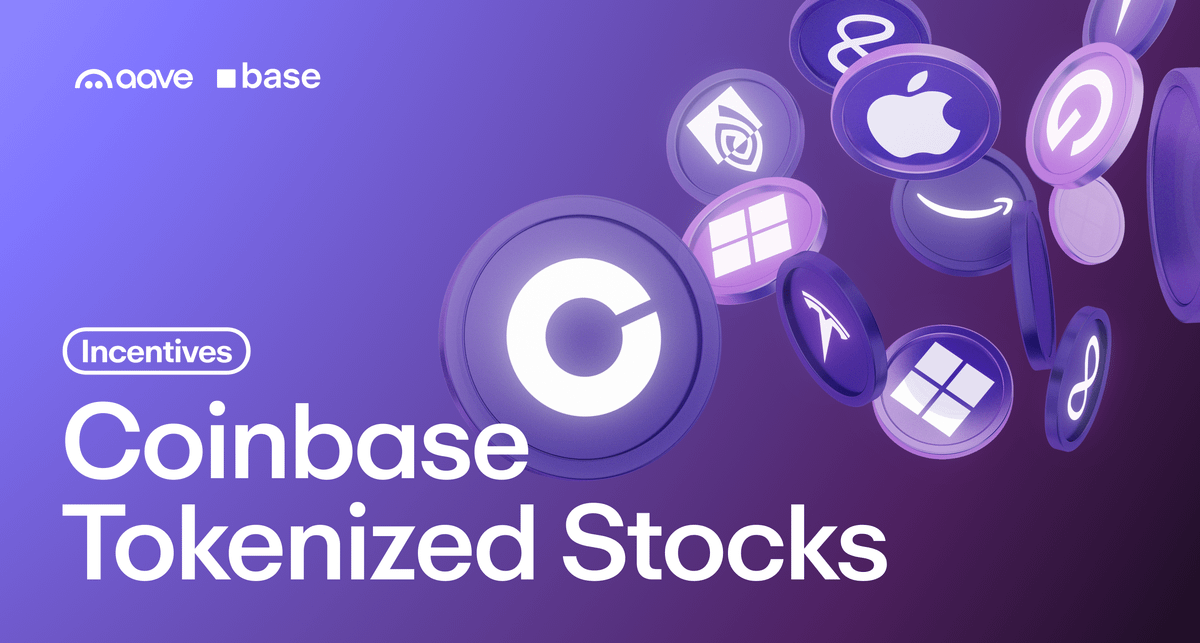
    RT @Jonasoeth: Tokenized stocks on @base are finding more use cases in DeFi. 3% USDC incentives to boost tokenized stock deposits on @aave V4 $1.2M in collateral from @superformxyz, bringing automated carry trade strategies to retail users. 🧵,
    Aave @aave
    Aave DAO has approved incentives for the Coinbase Tokenized Stocks market on @base. Tokenized stocks are only available in eligible jurisdictions outside of the U.S.
    02022
  30. Aave@aave
    Aave DAO has approved incentives for the Coinbase Tokenized Stocks market on @base. Tokenized stocks are only available in eligible jurisdictions outside of the U.S.
    Download
    455763458.1K
  31. Show more posts